Christian women, Complementarianism, Mailbag

The Mailbag: Is it biblical for women to carry out The Great Commission?

Originally published June 18, 2018

Last week, I received some questions from a Facebook follower regarding my article Basic Training: The Great Commission. I thought they were very insightful and that other readers might have the same questions, so I’m sharing and expanding on my answers to her here. (I’ve edited/condensed the reader’s questions and comments {in bold type} for the sake of brevity.)

Given my understanding of what Jesus is commanding, and comparing it with other examples in the New Testament, it’s not for women to do the Great Commission. Our role is not to make disciples, teach, or baptize, but to keep the home, edify other women believers, etc. The Great Commission is for men, not women, to do because…

1. The Great Commission requires teaching and baptizing.

2. Jesus was speaking the Great Commission to His disciples, who were all male.

3. We don’t see any specific New Testament examples of women sharing the gospel with the lost through their own witness or example.

4. Because we don’t see any specific New Testament examples of women sharing the gospel or any explicit commands for women to share the gospel, it violates the regulative principle for women to share the gospel with the lost.

This reader’s questions really got me thinking and digging. I love questions that make me think hard and dig into Scripture and theology for answers!

First, let me briefly address the points of this issue that are not in dispute. As I understand her, the reader is in full agreement with Titus 2:3-5 and the example of Lois and Eunice. She agrees with the biblical principles of women training their own children in the gospel and discipling Christian women (already saved) inside the church. Her questions have mainly to do with sharing the gospel with the lost outside the church – evangelism.

Next, before we dive into the reader’s questions themselves, it is very important to distinguish between two types of Scripture:

Broadly speaking, there are two main types of Scripture: descriptive and prescriptive. Descriptive passages describe something that happened: Noah built an ark. Esther became queen. Paul got shipwrecked. These passages simply tell us what happened to somebody. Prescriptive passages are commands or statements to obey. Donโ€™t lie. Share the gospel. Forgive others.

If we wanted to know how to have a godly marriage, for example, we would look at passages like Ephesians 5:22-33, 1 Corinthians 7, and Exodus 20:14,17. These are all passages that clearly tell us what to do and what not to do in order to have a godly marriage.

What we would not do is look at Davidโ€™s and Solomonโ€™s lives and conclude that polygamy is Godโ€™s design for marriage. We would not read about Hosea and assume that God wants Christian men to marry prostitutes. We would not read the story of the woman at the well and think that being married five times and then shacking up with number six is OK with Jesus.

Descriptive passages may support, but never trump, the clear instruction of prescriptive passages.ยน

Now, let’s see if we can come to some biblical conclusions on her questions:

1. The Great Commission requires teaching and baptizing.

Teaching:
Often, when we’re looking at women’s roles in the church and being obedient to 1 Timothy 2:12, people conflate evangelism with teaching. Teaching Scripture to saved people inside the church gathering is not the same thing as sharing the gospel with lost people outside the church gathering. They are two separate, distinct things. First Timothy 2:12 (and other prohibitive passages) only prohibits the former, not the latter. The Great Commission, and the New Testament overall, commands the latter.

Teaching Scripture to saved people inside the church gathering is not the same thing as sharing the gospel with lost people outside the church gathering. They are two separate, distinct things.

As Christian women we want to be sure we keep these two things straight and carry out The Great Commission in the way God has prescribed for women to carry it out. May we share the gospel with a lost man or woman “as we are going”? Yes. If that person is a man, once he is saved is it biblically appropriate for a woman to teach and disciple him? No. If he is saved, he is supposed to be joined to a local church. Once inside the church body, he is to be taught Scripture and discipled by men.

As Christian women we want to be sure we keep teaching and evangelism straight and carry out The Great Commission in the way God has prescribed for *women* to carry it out.

Here are some resources which may be of further help:

Rock Your Role: Jill in the Pulpit

Rock Your Role FAQs (see #11 for using wisdom on sharing the gospel with men)

Basic Training: 7 Reasons Church is Not Optional and Non-Negotiable for Christians

Women Preaching the Gospel? at A Word Fitly Spoken (This is sort of the opposite {and unbiblical} argument: “Because the Bible says ‘preach the gospel’ -meaning, we’re to evangelize- that means women can preach in church, too!”. I thought you might find it interesting.)

Baptism:
When it comes to teaching inside the church, we have clear, prescriptive passages that specifically tell us what women are not to do. With evangelism, we also have clear commands in The Great Commission, and elsewhere, that disciples of Christ are to share the gospel.

But when it comes to baptism, we don’t have a clear “this or that person should or should not perform baptisms” passage, so we need to look at the principles and precedents surrounding baptism.

The people specifically named as personally performing baptisms in the New Testament were John the Baptist (who baptized Jesus), the twelve apostles, Philip the Evangelist, Paul and/or Silas, and Paul. All of these were men, and all held pastoral or pastoral/elder-type formal leadership positions in the embryonic or infancy stages of the church. All of them were commissioned, ordained, or set apart to their positions by God, Jesus, or the church. We do not see any New Testament instances of random church members – male or female – performing baptisms, only those in positions of church leadership.

Additionally, baptism is a formal, official, consecrated ordinance of the church, not a casual, personal, relational activity between individuals, friends, or loved ones. It should no more be administered by any church member who wants to do it than the Lord’s Supper should be. Both ordinances should be administered by an ordained pastor or elder of the church. That leaves out women as well as most men. Does the responsibility of pastors to baptize mean that men who aren’t pastors shouldn’t carry out the Great Commission? Of course not. We – men and women – share the gospel with someone, and if that person gets saved, part of our responsibility is to do what we can to get him plugged in to a local church where a pastor can baptize him. We don’t have to baptize him ourselves in order to be fulfilling The Great Commission.

Basic Training: Baptism

2. Jesus was speaking the Great Commission to His disciples, who were all male.
Yes, they were all male. They were all apostles, too. But first and foremost, they were all disciples – followers of Christ – just as Christians are today. Our identity in Christ – who we are, spiritually – trumps what we are, physically (male or female), and what we do (different roles and behaviors) as a result of who and what we are. Galatians 3:28 tells us:

There is neither Jew nor Greek, there is neither slave nor free, there is no male and female, for you are all one in Christ Jesus.

In Christ, there is only one type of being: Christian. There is only one kind of spiritual DNA. There’s no XX and XY. There’s just X. Ontologically, Christians are all the same kind of spiritual being.

The Great Commission is based on who the disciples, and we, are – followers of Christ – just as many of the other things that Jesus taught His disciples were. For example, when the disciples said, “Lord, teach us to pray,” and Jesus responded with the Lord’s Prayer, did Jesus mean that only the Twelve, or only men should use it as their model in prayer? When Jesus washed the disciples’ feet, did He mean that only the disciples or only men should serve one another in humility? When Peter asked Jesus how many times he had to forgive, did “seventy times seven” apply only to Peter, only to the disciples, or only to men? Of course not. Christ’s instructions to His followers apply to all who follow Him. It is in the way in which we carry these instructions out that Christ differentiates and delegates divergent and discrete responsibilities to men, women, and church leadership.

As disciples, we are to carry out The Great Commission. As Christian women, we carry it out in a different way from men and pastors.

As disciples, we are to carry out The Great Commission. As Christian women, we carry it out in a *different way* from men and pastors.

3. We don’t see any specific New Testament examples of women sharing the gospel with the lost through their own witness or example.
We don’t see any specific verses that say something along the lines of “Miriam shared the gospel with Simon, and he got saved,” that’s true. But how about these…

โœขThe woman at the well in John 4: “So the woman left her water jar and went away into town and said to the people, ‘Come, see a man who told me all that I ever did. Can this be the Christ?’ They went out of the town and were coming to him.” (28-30)

โœขThe widow (and townswomen) of Nain in Luke 7: “Fear seized them all, and they glorified God, saying, ‘A great prophet has arisen among us!’ and ‘God has visited his people!’ And this report about him spread through the whole of Judea and all the surrounding country.” (16-17)

โœขThe friends of Tabitha in Acts 9: ” And he gave her his hand and raised her up. Then, calling the saints and widows, he presented her alive. And it became known throughout all Joppa, and many believed in the Lord.” (41-42)

โœขLydia in Acts 16: “The Lord opened her heart to pay attention to what was said by Paul. And after she was baptized, and her household as well…” (14-15)

โœข1 Corinthians 7:12-16: “If any woman has a husband who is an unbeliever, and he consents to live with her, she should not divorce him. For the unbelieving husband is made holy because of his wife…For how do you know, wife, whether you will save your husband?”

โœข1 Peter 3:1-6: “Likewise, wives, be subject to your own husbands, so that even if some do not obey the word, they may be won without a word by the conduct of their wives.”

The first four examples imply that various women, to one degree or another, were pointing people to Jesus. But, again, these are descriptive passages. They lend a bit of support to the idea of women sharing the gospel with others, but we build doctrine on prescriptive passages like The Great Commission. The last two examples are prescriptive passages instructing women in sharing the gospel with their lost husbands. These passages are supportive of women sharing the gospel.

4. Because we don’t see any specific New Testament examples of women sharing the gospel or any explicit commands for women to share the gospel, it violates the regulative principle for women to share the gospel with the lost.
Well, as I mentioned above, we do see descriptive passages that at least hint at women sharing the gospel, and we also see prescriptive passages that explicitly instruct women in sharing the gospel with their lost husbands. But The Great Commission and other passages that are general commands to all followers of Christ to share the gospel are the strong and emphatic passages we draw doctrine from, not the more tangential passages. So even if the regulative principle did apply to evangelism, it would be supported by Scripture.

But the regulative principle doesn’t apply to evangelism as the full terminology – the regulative principle of worship – helps us to understand. The regulative principle applies to the corporate worship service, not evangelism, not marriage, not finances, not employment, not parenting, nor any other biblical issue. Just corporate worship.

Are women to carry out The Great Commission? Yes. We are to carry it out in the way Christ has prescribed for godly Christian women.

Are women to carry out The Great Commission? Yes. We are to carry it out in the way Christ has prescribed for godly Christian women.


ยนRock Your Role: Oh No She Di-int! Priscilla Didnโ€™t Preach, Deborah Didnโ€™t Dominate, and Esther Wasnโ€™t an Egalitarian

If you have a question about: a Bible passage, an aspect of theology, a current issue in Christianity, or how to biblically handle a family, life, or church situation, comment below (Iโ€™ll hold all questions in queue {unpublished} for a future edition of The Mailbag) or send me an e-mail or private message. If your question is chosen for publication, your anonymity will be protected.

Complementarianism

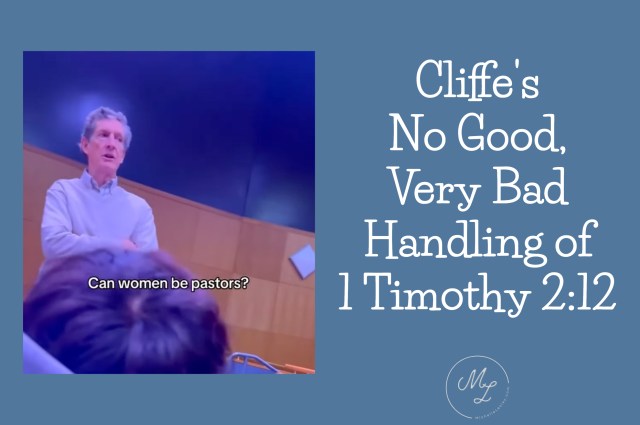
Cliffe’s No Good, Very Bad Handling of 1 Timothy 2:12

I had no idea who “Cliffe” in this video is, until I reposted it on X (thanks to Jon Root for the original) with my comments, and followers informed me that this is Cliffe Knechtle, who (along with his son, Stuart) seems to be an open air apologist with a large following on YouTube.

I’m hoping Cliffe just had a no good, very bad day on the day this was recorded and that he goes back, examines the pertinent texts more carefully (and in context), repents, and publicly corrects his errors.

Because, for someone who – I’ve been told – is a respected apologist, this is embarrassingly bad, not to mention, deceptive, even if he didn’t mean it to be.

Let this be an example of how to critically evaluate teaching according to Scripture. And, in case any of your friends and loved ones hold some of these same errant beliefs, here’s how you can help them see the truth of Scripture.

So, ladies, let this be an example to you of how to critically evaluate teaching according to Scripture. And, in case any of your friends and loved ones follow Cliffe or hold some of these same errant beliefs, let me offer a biblical corrective you can use to help them see the truth of Scripture. Open your Bible and follow along with the video. Cliffe’s words below are in bold. (I’ve also interspersed some additional helpful resources.)

“Paul writes that women are not to be pastors.”

No, “God writes…”. Paul penned it, but 1 Timothy 2:11-3:7 is God’s Word. God’s idea, not Paul’s. Paul wrote down what the Holy Spirit breathed out.

Now I’m guessing Cliffe would probably agree with me about that, and I, myself, use that kind of phraseology sometimes, too, but it’s important to remind ourselves – especially with passages of Scripture that broken, sinful human beings have made controversial, like this one – that this is God speaking, not Paul, the sinful human being dreaming this up and imposing it on the church.

“I don’t think that’s a fair translation.”

Then how come every single trustworthy translation of the Bible (and even a lot of the untrustworthy ones) translate it that way? Is Cliffe an expert in the biblical languages and knows better than all the expert Bible translation teams who translated it the way he disagrees with?

Furthermore, although it’s a true summary of what he did write, Paul didn’t write, “Women are not to be pastors.” It’s important to rightly handle and accurately quote the actual text when you’re teaching a biblical concept.

It’s important to rightly handle and accurately quote the actual text when you’re teaching a biblical concept.

“He does write, ‘I do not permit a woman to have authority over a man.'”

No, He (God) writes, “I do not allow a woman to TEACH OR exercise authority over a man…”. Again, it’s important to rightly handle and accurately quote the actual text when you’re teaching a biblical concept.

It’s also important to incorporate the entire body of text that applies to the issue you’re dealing with. In this case, that would be not just 1 Timothy 2:12, but 1 Timothy 2:11-3:7 and Titus 1:5-9. The pastoral qualifications in 1 Timothy 3 and Titus 1 are also crystal clear (“Husband of one wife,” and male pronouns throughout, anyone?) that pastors must be men.

“And yet Paul had a partner in ministry named Priscilla…”

Not in the sense that she was a pastor or taught or exercised authority over men in the gathering of the body, or he would have been the biggest hypocrite in the Bible, because that would have violated God’s breathed out Word – which Paul wrote – in 1 Timothy and Titus. Scripture nowhere characterizes Priscilla as a pastor or any sort of egalitarian “partner in ministry” to Paul that in any way violated clear, New Testament, didactic passages on the role of women in the church.

“…who taught the great preacher Apollos.”

Read the actual passage in Acts 18:24-28. It’s not like she was his seminary professor and she trained him for the pastorate. She and Aquila heard him preach an incomplete gospel and pulled him aside privately and corrected him. Once. Briefly. We have no idea how much of the correcting Priscilla herself did, but even if she did all of it, this does not violate 1 Timothy 2:11-3:7 because that passage prohibits women from pastoring, teaching, and exercising authority over men in the gathering of the Body.

In the Acts 18 passage, Priscilla was not a pastor, nor was she teaching or exercising authority in the gathering of the Body. This was a private meeting, possibly even led by her husband.

There isn’t a woman in Scripture whose actions prove that it’s biblically OK for women to pastor, preach to, or exercise authority over men in the church. Not a single one. Check out:
Oh No, She Di-int! Priscilla Didn’t Preach, Deborah Didn’t Dominate,
and Esthers Wasn’t an Egalitarian.

“So what on earth is he saying when he says, ‘I don’t allow a woman to have authority over a man’? I would argue…that he’s pointing out that in Ephesus… there was a goddess, Diana of the Ephesians, so there was massive confusion about sexual roles…”

Why would you argue that, brother? God plainly tells us His reason for prohibiting women from pastoring, teaching, or exercising authority over men in verse 12. It’s right there in verses 13-14…

For it was Adam who was first formed, and then Eve. And it was not Adam who was deceived, but the woman being deceived, fell into trespass.

1 Timothy 2:13-14

…and it has nothing to do with Ephesus, Diana, confusion about sexual roles, women abusing their freedom in Christ, or education (which he mentions later in the video). God clearly and unequivocally tells us His reasons for this command: the Creative order and the woman’s deception.

And when you replace God’s reasons in verses 13-14 with any other reason or explanation, you’re calling God a liar. You’re saying His reasons are wrong and yours are right. That you know better than God. That is a very dangerous and blasphemous statement to make.

What then? If some did not believe, does their unbelief abolish the faithfulness of God? May it never be! Rather, let God be true and every man a liar, as it is written,
โ€œThat You may be justified in Your words,
And overcome when You are judged.โ€

Romans 3:3-4

What does 1 Timothy 2:12 actually teach? Check out: Jill in the Pulpit?

“That’s [massive confusion about sexual roles due to the goddess, Diana of the Ephesians,]…” why he says in 1 Corinthians 11 and 14, he says, ‘I don’t allow a woman to teach a man’.”

That’s not what 1 Corinthians 11 and 14 say, that’s what 1 Timothy 2:12 says. First Corinthians 11:1-16 is about male headship and authority. It makes no mention of women teaching men. First Corinthians 14:26-40 is about keeping order in the worship service. It makes no mention of women teaching men.

Furthermore, while God may have, indirectly, been addressing some sort of “confusion about sexual roles” in 1 Corinthians 11 and 14, this sexual confusion had nothing to do with the “goddess, Diana of the Ephesians” because this is in Corinth, not Ephesus.

And again, 1 Timothy 2:12 is the verse that prohibits women from teaching men, and the reason for this prohibition is not “massive confusion about sexual roles due to the goddess, Diana of the Ephesians,” the reason is the Creative order and the woman’s deception, as verses 13-14 clearly tell us.

This kind of confusion and conflation is what happens when you depend on your memory instead of opening the Bible and reading the text, especially if it’s a passage you haven’t dealt with recently. (Trust me. I know. I’ve done it myself.)

“Some very strong Christians, whom I respect highly, disagree with me.”

That’s because what you’re saying is a completely unbiblical mangling of the text. Anyone with third grade reading comprehension skills should disagree with you.

“Paul had partners, who were women, in ministry.”

No he didn’t. Not in the egalitarian sense he’s trying to make these kids believe. (See above about Priscilla.) And if he’s referring to women besides Priscilla, there’s even less information about them in Scripture, so any pronouncement that these other women were pastors or egalitarian “partners” is not only pure conjecture, but also eisegesis of the highest order.

“If God gives a woman gifts, we’re to give women the opportunity to use those gifts.”

Certainly, within the parameters of Scripture. God, the giver of all gifts, has every right to place restrictions on how we may use those gifts. God has never gifted a woman to teach with the intent that she should use that gift to teach men in the church because that contradicts His written Word. If He did that, He would be a liar and a hypocrite and He would cease to be God. There are plenty of ways women can use the gifts of teaching and exhortation without violating God’s commands about the role of women in the church. Ask me how I know.๐Ÿ™‚

My favorite apologetic responses to egalitarians?
The Mailbag: Counter Arguments to Egalitarianism

In fairness, we can’t see most of the audience, but notice that, of the audience members we can see, no one seems to have a Bible in his or her hands in order to be a good Berean and check out what Cliffe is saying against Scripture. And it doesn’t look like anyone is raising a hand to ask him any questions, either. (Hopefully, those things happened after the end of the video.)

Don’t just believe what you’re told. Go to God’s Word, be a good Berean, and check it out. And help your friends and loved ones to do likewise.

Don’t just believe what you’re told. Go to God’s Word, be a good Berean, and check it out. And help your friends and loved ones to do likewise.

Christian women, False Doctrine

Throwback Thursday ~ 8 Unbiblical Notions Christian Women Need to Be Set Free From

Originally published June 2, 2017

Your recent article on prayer really helped me. I was always taught that prayer was a two-way conversation. For years, I would talk to God and wait for Him to talk back to me, but He never did. I thought it was because there was unknown sin in my life, or that I didn’t have enough faith, or that God just wasn’t interested in me. It’s so freeing to know the truth.

Comments like this from readers are always bittersweet for me. It makes me practically giddy to hear from Christian women who have been set free from false doctrines they’ve been taught, but it also grieves me deeply to reflect on the years they spent thinking they were somehow deficient as Christians or doubting God’s love for them simply because they were taught, and believed, unbiblical notions and ideas.

Let’s see if we can dispel a few of those today:

1. Prayer is this big, complicated, mystical thing.
Nope. Prayer is simply talking to God about whatever is on your heart. What’s made prayer complicated is the unbiblical teachings that have grown up around it such as praying in “tongues,” listening prayer, contemplative prayer, sozo prayer, soaking prayer, etc.

8 Things You Need to Know about Prayer

2. “Women’s Ministry” equals fluff and silliness.
There’s nothing wrong with having a little fun from time to time. Hey, we all need to blow off steam, right? But if cookie exchanges and teas and painting parties and dress up parties and sleepovers and makeup parties and fashion shows and movie nights are all your women’s ministry does, it’s unhealthy. And it’s not really a ministry, either. If something is a “ministry” it should exist to point people to Christ and disciple them once they get to Him. Your women’s ministry should include ministry of the Word, discipleship, evangelism, comfort ministry (to the ill, shut-ins, new moms, new members, etc.), serving the church, encouragement, supporting your pastor and elders, and so on.

Mary and Martha and Jesus and Women’s Ministry
Biblical Womenโ€™s Ministry โ€“ Part 1
Practical Womenโ€™s Ministry โ€“ Part 2

3. Women’s Bible study- great balls of fire, don’t get me started.
โ™ฆ A Bible verse (or half a Bible verse) plus an inspiring story from the author’s or someone else’s life is not Bible study. Bible study is picking up your Bible and studying it.

Bible Study
Bible Studies

Bible study is picking up your Bible and studying it.

โ™ฆ If you’re hosting a women’s Bible study, you do not have to use books and DVDs written by someone else. In fact, I would recommend against doing so. Get someone who is able to teach – yes, it could even be a man – and study a book of the Bible from beginning to end.

You’re Not as Dumb as You Think You Are: Five Reasons to Put Down that Devotional and Pick Up the Actual Bible

McBible Study and the Famine of God’s Word
Can you recommend a good Bible study for women/teens/kids?

โ™ฆ One reason I recommend against using “canned” women’s Bible studies is that the vast majority of them (95% in my estimation- not an exaggeration) teach false doctrine. When you walk into most Christian bookstores the first thing you’ll see is the best sellers shelf, and the majority of those books are written by false teachers such as Beth Moore, Priscilla Shirer, Christine Caine, Lysa TerKeurst, Sarah Young, and others.

Popular False Teachers
The Mailbag: โ€œWe need to stop relying on canned studies,โ€ doesnโ€™t mean, โ€œWe need to rely on doctrinally sound canned studies.โ€.

โ™ฆ If you do decide to occasionally do a book study, you do not have to use one written by a woman. In fact, if you want a book that’s doctrinally sound, you have a much better chance of finding one written by a man than by a woman, sad to say. Check out some godly men who are pastors, authors, and teachers at…

Recommended Bible Teachers

4. Faithful church attendance isn’t that important.
If you think you don’t need church or that you can skip it whenever something more fun comes along, your thinking isn’t biblical. God thinks it’s important enough for His people to gather regularly for worship that He emphasizes it throughout the entirety of Scripture- Old and New Testament. Get your heiney in the pew every week, honey, and find a place to serve.

7 Reasons Church is Not Optional and Non-Negotiable for Christians
Searching for a new church?

5. I am woman, hear me roar.
โ™ฆ Beth Moore and many other female teachers who rebel against Scripture by preaching to and teaching men in the church say that they are doing so “under their husband’s and/or pastor’s authority”. Neither your husband nor your pastor has the OK from God to allow you, or any other woman, to teach men in the church. God says women aren’t to teach or hold authority over men in the church, and when God says no, no one has the authority to say yes. Furthermore, there isn’t a single passage of Scripture that allows any man to give any woman this type of “under my authority” dispensation to teach men. To say that it’s permissible for a woman to teach men “under her husband’s/pastor’s authority” is just as biblically absurd as saying it’s OK for a woman to lie, commit adultery, gossip, or steal “under her husband’s/pastor’s authority.” Sapphira sinned under her husband’s authority and look what happened to her.

Fencing Off the Forbidden Fruit Tree
Jill in the Pulpit

Ten Things You Should Know About 1 Timothy 2:11-15 and the Relationship Between Men and Women in the Local Church at CBMW

Neither your husband nor your pastor has the OK from God to allow you, or any other woman, to teach men in the church.

โ™ฆ Egalitarians are often so vehement in their insistence that women should teach men and hold authority over men in the church, that they are essentially saying that the only way a woman’s service or leadership in the church can have any value is if it’s exercised over men. I’ve heard many of them turn up their noses at the idea of teaching women and children and other forms of service (that don’t involve teaching or authority over men), in a haughty “we’re better than that” kind of way.

No way.

Have you seen the garbage women and children are being taught in the church under the guise of “Sunday School” or “Bible study”? Women’s and children’s classes at your church are in desperate need of women who are doctrinally sound and able to teach. What about the need to visit church members who are in the hospital or shut-ins? How about record-keeping, working in the sound booth, welcoming visitors, serving on committees, mowing the church’s lawn, participating in outreach activities, fixing a meal, chaperoning youth activities, hosting a visiting pastor or missionary? There’s a ton of important and valuable work for women to do in the church. We don’t have time to worry about teaching and holding authority over men. Let the men worry about that.

Servanthood
Let Me Count the Ways: 75 Ways Women Can Biblically Minister to Others

6. My feelings and opinions reign supreme.
Uh uh. Not if you’re a Christian, they don’t. That’s how lost people operate. If you’re a Christian, you’re not entitled run your life or make decisions by any opinion other than that of your Master. What He says – in His written word – goes. Period. Regardless of how you feel about it or whether or not you agree with it. That means if a “Bible” teacher you really like is teaching things that conflict with Scripture, you dump her. You love Mr. Wonderful and want to marry him, but he’s not saved? Nope. You’re a woman who’s certain God has called her to preach? No way. Your husband has said no about something, but you want to do it anyway? Forget it.

The Bible is our Authority
Bad Fruit, Diseased Trees, and the Authority of God’s Word

7. If something or someone claims to be a Christian, it is.
I suppose at some point in Christian history, there might have been a time when, if someone handed you a “Christian book,” it was a pretty safe bet it was doctrinally sound. Or if someone said she was a Christian, you could be fairly certain she was truly born again.

Not so much these days.

You cannot take at face value that someone who says she’s a Christian is using the Bible’s definition of Christianity and has been genuinely regenerated. You cannot trust that just because something is sold at LifeWay or another Christian retailer that it’s doctrinally sound. You can’t assume that just because someone is a “Christian” celebrity, writes “Bible” studies, speaks at “Christian” conferences, and has a large following, that she’s handling God’s word correctly (or at all) and teaching you biblical truth. There’s just too much false doctrine running rampant in evangelicalism and too many people who believe and teach it.

Don’t be a weak and naรฏve Christian woman. Jesus Himself said, “Not everyone who says to me, ‘Lord, Lord’ will enter the kingdom of Heaven…” There are many people who draw near to God with their lips, but their hearts are far from Him. It is God’s will for you to be a good Berean and to test everything according to Scripture. We will know the truly Christian from the false by their fruits, not their platitudes.

8. Sugar and spice and everything nice- that’s what Christian girls are made of.
That’s not a Bible verse, but rather and unspoken rule among most Christian women. Somewhere we’ve gotten the idea that Christian unity or love means “being nice” to people. Weโ€™re always smilingly sweet and never say anything that might hurt someoneโ€™s feelings or could rock the boat at church.

Are we to be kind? Yes. Are we to do our best not to hurt others? Of course. Should we be making waves over every little thing that rubs us the wrong way? Absolutely not.

But neither is it loving to see a Mack truck bearing down on an oblivious sister in Christ and refrain from yanking her out of harm’s way because it might dislocate her shoulder. It is not unity to see Satan deceiving a friend through sin or false doctrine and not plead with her to turn to Christ and His word because she might think we’re rude. And that’s the situation we often find ourselves in at church or with Christian friends.

Was Jesus – our perfect example of love – being unloving, unkind, hateful, or divisive when He rebuked the Pharisees, cleared the temple, or said, “Get behind Me, Satan!” to Peter?

Love for the brethren isn’t “being nice.” It’s caring so much about a fellow saint that we want what’s best for her in Christ. Sometimes that requires being firm, confrontational, or demonstrating “tough love.” People’s eternities and spiritual health are at stake. How loving is it to stand aside and let a sister waltz into Hell or struggle for years on end in her walk with the Lord because she’s living in sin or believing false doctrine? “Being nice” isn’t a fruit of the Spirit. It’s time we stop being nice and start being biblical.

I Can’t Sit Down, Shut Up, and Play Nice
Discernment: What’s Love Got to Do with It?

“Being nice” isn’t a fruit of the Spirit. It’s time we stop being nice and start being biblical.

Do you believe any of these unbiblical notions? If so, set them aside, repent, and believe and practice what Scripture says. Any time we believe something that’s in conflict with God’s word, it’s a hindrance to the abundant life and growth in Christ that He wants to bless us with.

False doctrine enslaves. It places a yoke of confusion, anxiety, and “try harder” on the shoulders of those who embrace it. Christ did not set us free from sin so that we might turn right around and become captives to a new, pseudo-Christian type of sin: false teaching. It is for freedom and a healthy spiritual life that Christ has set us free.

Christ did not set us free from sin so that we might turn right around and become captives to a new, pseudo-Christian type of sin: false teaching.

Podcast Appearances

Podcast Guest Appearance – Conversations with a Calvinist

Although you may be more familiar with him from his hilarious “churches/denominations” videos (check out a couple of my favorites here and here), my friend, Keith Foskey, also has a regular video podcast called Conversations with a Calvinist in which he tackles serious topics and interviews (mostly not about Calvinism, my non-Calvinist friends).

Listen in as Keith and I chat about an important topic that’s been making the rounds of late, Should Women Be Teaching the Bible? We know it’s unbiblical for women to teach men the Bible, but some Christians believe women shouldn’t even be teaching the Bible to other women. Is that biblical? What role do women play in the home, in the church, and in teaching other women?

You can watch and listen above or listen on Apple, Spotify, and other podcast platforms. And, be sure to join Keith’s Facebook group and follow him on Twitter and Instagram.


Articles / resources mentioned or touched on in the episode:

Do You MIND? : Five Reasons for Pastors to Mind What Their Brides Areย Reading

A Word Fitly Spoken

Biblical Women’s Ministry (part 1) at A Word Fitly Spoken

Practical Women’s Ministry (part 2) at A Word Fitly Spoken

The Pew (May 2023) at A Word Fitly Spoken


Got a podcast of your own or have a podcasting friend who needs a guest? Need a speaker for a womenโ€™s conference or church event? Click the โ€œSpeaking Engagementsโ€ tab in the blue menu bar at the top of this page, drop me an e-mail, and letโ€™s chat!

Complementarianism, Rock Your Role

The Mailbag: Questions about the role of women in the church

A reader recently left a comment containing numerous questions on my article Rock Your Role: Jill in the Pulpit (1 Timothy 2:11-12). Her individual questions are in bold type below with my answers in regular type.

If you have questions about the role of women in the church, I recommend not only that article, but all of the articles in my Rock Your Role series. Jill, Rock Your Role FAQs, and The Mailbag: Counter Arguments to Egalitarianism seem to answer the questions I’m asked the most, so you may want to start with those.


some honest questions here

Thanks for asking. I hope my answers will help. I’d like to preface my answers with some biblical information I hope will be helpful to all of my readers when addressing questions and issues like this:

You did not say whether or not you are a genuinely regenerated Christian, nor was I able to infer from your questions whether or not you are. This is going to be crucial to your understanding and accepting the biblical answers I’m about to give you, because Scripture makes clear to us that people who aren’t saved do not embrace the things of God. They aren’t even able to understand them in any meaningful way.

The natural person does not accept the things of the Spirit of God, for they are folly to him, and he is not able to understand them because they are spiritually discerned.

1 Corinthians 2:14

Scripture is also clear that those who belong to Christ will obey His written Word, while those who do not belong to Christ -even if they claim to be Christians- don’t obey His written Word.

And by this we know that we have come to know him, if we keep his commandments. Whoever says โ€œI know himโ€ but does not keep his commandments is a liar, and the truth is not in him, but whoever keeps his word, in him truly the love of God is perfected. By this we may know that we are in him: whoever says he abides in him ought to walk in the same way in which he walked.

1 John 2:3-6

Sometimes when we read hard truths in the Bible, we initially struggle to accept them, but genuinely born again Christians are on a general trajectory of increasing in their love for, understanding of, and submission to God’s written Word. False converts (unsaved people who think they’re saved) and unsaved people are on the opposite trajectory and increasingly disdain, harden their hearts against, and rebel against God’s written Word.

If, in examining your own heart, you (or someone else reading this) find yourself on that second trajectory regarding this or any other biblical issue, let me offer you some resources that will help and that are much more urgent for you than the issue of the role of women in the church:

What must I do to be saved? (in the blue menu bar at the top of this page) You must repent and believe the biblical gospel.

Am I Really Saved? A First John Check-Up If you’re not really sure whether or not you’re saved, you may find it helpful to work through my Bible study on 1 John.

Searching for a new church? (in the blue menu bar at the top of this page) If you’re saved, you need to be a faithful, invested member of a doctrinally sound local church. Among many other things, that’s where you’ll learn the biblical answers to questions like the ones you’ve asked below.

As I said in the Jill article:

Godly women donโ€™t look for ways to get around Scripture.
Godly women look for ways to obey Scripture.

If you already know Christ as Savior, awesome! It’s wonderful that you’re asking questions and learning more about Scripture so you can grow in Him.

Now, let’s tackle your specific questions…


โ€”if the letter to Timothy was a letter to him and we are reading his mail, then what about the other NT letters written to the various churches? Are we also not reading their mail and what God was meaning for them to do?

I would encourage you to read that paragraph again carefully. I’ve bold-typed some of the more salient points:

First Timothy (along with 2 Timothy and Titus) is one of the pastoral epistles. It was written by Paul to young pastor Timothy as sort of a job description and operations manual for pastors, elders, and the church. So right off the bat, an important point we often miss about 1 Timothy is that it was written to a man, Timothy, a pastor, who would use this letter to train his elders (also men) and, subsequently, his congregation. That doesnโ€™t mean that 1 Timothy doesnโ€™t apply to women, or shouldnโ€™t be studied by women, or that women arenโ€™t required to obey 1 Timothy. It just means that when we open the letter of 1 Timothy, we need to understand that we, as women, are reading somebody elseโ€™s mail. Mail that pertains to us, yes, but mail thatโ€™s addressed to Timothy, and by extension, to pastors and elders today. That will help us better understand the tone and perspective of the passage.

So, you could think of it like this: the pastoral epistles (1&2 Timothy and Titus) have three “levels,” if you will, of who they’re addressed to: a) immediate: Timothy and Titus, b) by extension: all other / subsequent pastors and elders, c) with application to every church, Christian group, and individual Christian.

The other epistles, generally speaking, have two “levels” of who they’re addressed to: a) immediate: a specific church or people group of Christians (the church at Colossae, the church at Ephesus, etc.) b) by extension: all other / subsequent churches, groups of Christians, and Christian individuals.

There’s a sense in which, from Genesis through Revelation, we’re “reading somebody else’s mail,” because we were not alive when any of the books of the Bible were written, so we were not the original audience of any of Scripture. That being said, the Bible is still God’s word to us, through those original audiences. All of it, when correctly handled, applies to us in one or more ways, and we are required to obey God’s commands, instructions, laws, and teachings to New Testament Christians, no matter where in the Bible they are located.


โ€”What about women who are called to preach? Like slave Sojourner Truth and 2 quaker women called to preach against slavery in the south USA civil war times. Were they wrong? sinning? going against scripture?

I don’t know who the Quaker women are that you’ve referred to, and I’m not overly familiar Sojourner Truth or any of her “sermons,” but I think you may be conflating and confusing a few things here. Let’s see if we can untangle them.

  1. As I mentioned in my preface remarks, just because someone claims to be a Christian (or history has led us to believe they were Christians) does not mean they have actually been born again. I don’t know whether or not any of these women were truly Believers, and neither do you. Sojourner said and did some things that might cause one to wonder, and, while there could be individuals who get saved while still in Quakerism, the Quaker belief system, generally speaking, is not biblical, and therefore, not Christian.
  2. Making civil speeches against slavery (or on any other topic) is not “preaching” even if the speech maker or others called it preaching. “Preaching” is defined by Scripture alone, not by culture or common parlance. Preaching is the proclamation of God’s rightly handled, written Word for the edification of the church.
  3. If any of these women were actually preaching – proclaiming God’s Word or exhorting people from God’s Word – in a co-ed gathering, then yes, they were “wrong, sinning, and going against Scripture” because God’s written Word prohibits women from doing that as I explained at length in the Jill article. And when God’s written Word says not to do something and we do it anyway, that’s called sin.
  4. God doesn’t call women to preach or pastor. God has never called a single, solitary woman to preach. Ever. First, because God doesn’t give extra-biblical revelation like that. He tells us exactly who He has called to preach (and who He hasn’t) in 1 Timothy 2:11-3:7 and Titus 1:5-9. Second, because, even if He did give extra-biblical revelation, God is not a man that He should lie or change His mind, and He already told us in His Word that women aren’t to pastor, preach to, or teach men, or exercise authority over men in the gathering of the church body.

โ€”Paul gives โ€œcommandsโ€ about operating under patriarchy and slavery, both part of Roman society. He does not talk against either yet today we Christians abhor slavery but still support patriarchy. Why?

Because patriarchy was God’s design and command and antebellum American slavery wasn’t. I’m not totally sure exactly what you mean by Roman “patriarchy” and the “commands” Paul gave about it, which passages you’re referring to, or what all you many have in mind about patriarchy and slavery as you asked this question, so I can only give you a very general answer.

  • Instructing Christians on how to behave in a godly way when they’re in the middle of ungodly circumstances is not the same thing as God condoning or approving of those ungodly circumstances. There were many Christians who obeyed Scripture’s instructions while in concentration camps during World War II. That doesn’t mean God was in favor of concentration camps.
  • Antebellum American slavery was “man stealing” (which was a different type of slavery than that practiced during New Testament times), and is prohibited by Scripture.
  • Male headship was established by God at Creation and is continually buttressed and re-established throughout the Bible:

Look at the overall general pattern of male headship and leadership in Scripture. First human created? A man. The Patriarchs? As the word implies โ€“ all men. Priests, Levites, Scribes? Men. Heads of the twelve tribes of Israel? Men. Major and minor prophets? Men. All kings of Israel and Judah? Men. Noahic, Abrahamic, Mosaic, and Davidic Covenants? All established between God and men. Authors of Scripture? Men. The forerunner of Christ? John the Baptist โ€“ a man. Messiah? A man. All of the apostles? Men. All of the pastors, elders, and deacons of churches in the New Testament? Men. Founder and head of the church? Christ โ€“ a man. Leader and head of the family? Men. – from: The Mailbag: Counter Arguments to Egalitarianism

Anyone – including the Romans of Paul’s time – who stepped outside of God’s commands regarding patriarchy and slavery was in sin.


โ€”-in Ephesians 5:21 and following verses Paul tells 4 different groups to submit. He uses 2 different forms. For people and spouses he uses the form that means to submit as to one another. For children/slaves he uses the form that means to submit to an authority. Why werenโ€™t women included under the same one as children/slaves?

I’m sorry, but this question is impossible to answer because neither slaves nor children are mentioned in Ephesians 5:21-33 (or even in 5:1-20). If by “following verses” you meant elsewhere in Ephesians or in other places in the New Testament, you should have specified those passages so I could look at them, understand what you’re talking about, and explain them to you in context.

I also don’t know where you’re getting your information about “two different forms” (of the word “submit,” I’m assuming), so I have no way of knowing whether or not that’s accurate, and since I don’t read Greek, and I suspect you don’t either, I prefer to stick to reliable English translations rendered by experts in the biblical languages.

All I can say is, since I don’t know which passages you’re referring to, I don’t know why, allegedly, two different forms of the word submit were used. All I can tell you is – you know whether or not you’re a wife, and you know what the English word “submit” means, and if you’re married, Scripture’s instruction to you in Ephesians 5:22-33 (and elsewhere in Scripture) is to submit to your husband.

There is nowhere in Scripture where husbands are commanded to submit to their wives or that husbands and wives are to “mutually submit” to one another. Many egalitarians try to make Ephesians 5:21 say that, but that is a twisting of Scripture. Notice that verse 21 isn’t even a complete sentence. If you read verse 21 in context (i.e. – read verses 1-21) it should be obvious that Paul is addressing the church, not married couples, and that verse 21 is referring to being unselfish and putting others in the church first. (Check your cross-references on that verse. One of them is probably Philippians 2:3.) See why I keep harping on “rightly handled Scripture”?


โ€”-why do churches send women who say they are called to preach to the mission field?

Because they’re in sin. Those churches are either ignorant of Scripture’s commands about women preaching, or they’re in rebellion against those commands. Both are shameful, and both are sin.

If it is wrong here in the US for a woman to preach/pastor why is it ok in a foreign land?

It isn’t. If it’s a sin in the United States, it’s a sin in Kenya, Croatia, Uruguay, Sri Lanka, Australia, Antarctica, and everywhere else on the planet (and off the planet if God ever allows humans to live on the moon or something like that).

โ€”-why did Jesus break the rules about women? He talked with them, obeyed his mom at the party, let them learn of spiritual things, defended them, the woman at the well was the first evangelist and women were the first to see the empty tomb (all these things broke rules/laws about women and their testimonies were outlawed in that time and place) What was the point of doing this if women were going to be told they could not preach/teach and their only purpose to be wife/mom/homebodies? It does not make sense to me.

Where does the Bible say any of those things, though? Most of the things you’ve listed aren’t God’s law, they were secular law, Pharisaical law, or cultural custom, not commands of God. Jesus never broke any of God’s laws that are spelled out in the Bible. That would be sin, and we know Jesus never sinned. He wasn’t bound by man’s laws, and certainly not if they contradicted God’s Word. That’s why He and the Pharisees butted heads so often. They were trying to bind Him to their man-made laws (which often contradicted Scripture), which they sinfully equated to Scripture. By ignoring man-made laws and customs about women (while obeying God’s law about them) Jesus re-elevated the women He came into contact with to their rightful biblical place.

Let’s look:

  • “He talked with them…defended them” – There’s nothing in Scripture telling men they can’t talk to or defend women. Men talk to women all over the Bible and there are many places in Scripture where men are called upon to take up arms to defend women and children.
  • “Obeyed His mom at the party” – I assume you’re talking about the wedding at Cana. I just want to make sure we’re all understanding this correctly. From an earthly perspective, Jesus was obeying or acquiescing to His mother. However, Jesus, while fully man, was also fully God. He knew exactly what He was going to do next. Mary’s request was in line with His pre-ordained plan to turn the water into wine, and thus, in addition to the miracle, also gave Him an opportunity to set us an example of honoring His mother. Had she requested something that was not in line with His plan to turn the water into wine, He would have honored her in another way, but he would not have “obeyed” her request.
  • “Let them learn of spiritual things” – Not only does Scripture not prohibit women from learning spiritual things, women are commanded to “learn of spiritual things” from Genesis to Revelation. When Adam told Eve, “Hey, God said we can’t eat from this one tree right here,” that was a spiritual thing a woman learned. Deuteronomy 6:7 commanded the Israelites to teach God’s Word to their children, not just their sons. Ezra taught God’s law to “both men and women and all who could understand what they heard”. I also addressed this concept in the Jill article: First Timothy 2:11 (immediately before 2:12, which prohibits women from pastoring, preaching ,etc.) says “Let a woman learn quietly with all submissiveness.” God (remember, Jesus is God) commanded pastors to make sure women had the opportunity to “learn of spiritual things”.
  • “the woman at the well was the first evangelist” – Welllll, technically, no. We don’t even know for sure if she was a Believer when she went back to town and told everyone to come see Jesus. But OK, let’s go with that for a minute. Again, Scripture doesn’t prohibit women from relaying the gospel to lost people they encounter, it commands it of all Christians. (If you’re not clear on the difference between evangelism and preaching/pastoring, listen here.)
  • “women were the first to see the empty tomb…their testimonies were outlawed in that time and place” – I know a woman’s testimony in court was considered unreliable, but I’m not positive it was actually “outlawed”. But even if it was, that would have been a secular law. God’s Word doesn’t outlaw it. Yes, perhaps Jesus allowed women to be the first eyewitnesses to His resurrection in part to honor these women who had followed Him so faithfully, and to demonstrate that the testimony of women isn’t unreliable just because they’re women.

What was the point of doing this if women were going to be told they could not preach/teach and their only purpose to be wife/mom/homebodies? It does not make sense to me.

Because, as I said, Jesus elevated women to their rightful biblical place. He didn’t lower them to the wrongful, unbiblical place of modern day feminism and its rebellion against Scripture.

But really listen to what you’re saying here. I hope you didn’t mean to do this, but you just dismissively swept aside God’s high, holy, good, and biblical calling on the lives of most Christian women to be godly wives and mothers and manage their households well for the glory of God.

“Their only purpose…” Seriously? I don’t mind telling you I’m personally offended that you just insulted what I’ve dedicated my heart, soul, and life to for the past 30 years. You’re saying it doesn’t matter because I wasn’t pastoring or preaching to men. Never mind that I continually poured God’s Word into the six beautiful children He blessed us with. Never mind that I’ve gotten up every day for three decades – with no pay or vacation time, mind you, 24/7/365 – and striven to be a godly example, encouragement, and helpmeet to my husband. Never mind that I’ve taught and discipled more women and children at my church than I can count. No, all of that is worthless because I wasn’t preaching to or teaching men. That women’s teaching is only valuable if they’re teaching men. You may not have meant that, but that’s the effect of what you said. I’m not trying to be unnecessarily harsh with you, I’m trying to give you just enough of a healthy, biblical sting that you’ll realize that you’ve been influenced more by what the world values for women than what God values for women.

Godly women honor and respect the high calling and unique gifting women have to disciple other women and to raise up the next generation of godly men and women by discipling our own, and other, children. Because this is such a weighty and arduous responsibility, we consider it a blessing that God has not also burdened us with the responsibility to preach, teach the Scriptures to men, or exercise authority over men in the context of the gathering of the church. Rather, we encourage the men who have been given this responsibility, leaving godly women free and unfettered to carry out the ministry God has given us. – from: The Mailbag: Counter Arguments to Egalitarianism


I have so many more questions and seeking lots of help to find the answers. The scripture says to study to show yourself approved. I hope this applies to women too!

It absolutely does! I’m glad you’re asking questions and seeking to learn! And you’re right, as I’ve referred to throughout this article, 2 Timothy 2:15 says:

Do your best to present yourself to God as one approved, a worker who has no need to be ashamed, rightly handling the word of truth.

2 Timothy 2:15

As I said at the beginning, the best place to get your questions answered and to learn how to rightly handle Scripture is in a doctrinally sound local church. Ask a godly older woman in your church to disciple you. (Not sure what that’s all about? Listen here and here.) “Pester” your pastor (he’ll love it!). And study, study, study, directly from the text of Scripture (listen here, and check out the Bible studies tab in the blue menu bar at the top of this page).

Thanks for any insight you can give me.

You are most welcome. It is my pleasure to serve you in Christ.


If you have a question about: a Bible passage, an aspect of theology, a current issue in Christianity, or how to biblically handle a family, life, or church situation, comment below (Iโ€™ll hold all questions in queue {unpublished} for a future edition of The Mailbag) or send me an e-mail or private message. If your question is chosen for publication, your anonymity will be protected.