What better way to celebrate Reformation Day and biblical womanhood than to combine the two? Today, we’re going to take a look at some women in Reformation history and in biblical history who exemplified biblical womanhood by influencing others toward godliness.
Choose any of the women below and read their stories (click on their names). Then consider the following questions:
1. In what ways did this woman exemplify biblical womanhood in her culture, context, circumstances, family situation, or church?
2. Which godly character traits or Fruit of the Spirit were especially obvious in her life, words, and actions?
3. Which Scripture passages come to mind as you read this woman’s story? In what ways did she live these Scriptures out (or fail to live them out)?
4. Are there any instances of sin in this woman’s story? If so, how can you learn from what she did wrong and avoid this sin in your own life?
5. How does this woman set a godly example that you can apply to your own life?
6. In what ways did this woman point someone to Jesus, serve the Kingdom, or help God’s people?
October 31, 2017, marked the 500th anniversary of the beginning of the Protestant Reformation, and because I’m all theme-y and whatnot, I’m in the midst of a fantastic book called Reformation Women by Rebecca VanDoodewaard who I dearly wish were on social media so I could shamelessly fangirl her and make a general nuisance of myself by asking too many questions.
Get this book. Now. You’re welcome.
Normally, when we read about the Reformation, we’re reading about great preachers and leaders like Luther, Calvin, Zwingli, and Hus, but preaching was not the only work of the Reformation. And that’s one of the things that captivated me about Rebecca’s book. All of the women included therein were strikingly courageous, tireless laborers, who contributed greatly to the success of the Reformation, and they did it all while coloring inside the lines of biblical womanhood – doing vital work godly women are uniquely equipped by Christ to do. They opened their homes as a refuge to scores of Protestants (often including those aforementioned notable preachers and other integral leaders) fleeing for their lives from Catholic marauders. They set up prison ministries and fed and clothed the poor. They nursed their communities through the Plague. Those who were queens and princesses used their power to protect Reformers and change persecutory laws. Those who were married to pastors and leaders helped in their ministries and edited their books and papers. And they wrote. Poetry. Position papers. Booklets. Letters. What a happy discovery (for me, anyway) to find sisters of the quill from so long ago.
All of these women were strikingly courageous, tireless laborers, who contributed greatly to the success of the Reformation, and they did it all while coloring inside the lines of biblical womanhood.
But these great ladies were not our only foremothers in the faith. For as long as God’s people have been God’s people, God’s people have rebelled and needed to be reformed. In fact, that’s the entire, overarching theme of the Old Testament- the need for Israel to reform from its idolatry. And all along the way we see faithful women like Deborah, Jael, Esther, Jehosheba, Jedidah, Huldah, Samson’s mother, and others willing to buck the trend of sin and rebellion and point the way back to God and holy living by their deeds and the example of their lives.
The New Testament gives us extraordinary examples such as the women who ministered to Jesus during His earthly ministry, stood by Him at the cross, and were the first ones at His tomb. Priscilla, Lydia, Dorcas, Eunice, Lois, Phoebe and other believing women soon followed, all lending their aid in their own unique ways to reforming dead, legalistic Judaism into biblical Christianity.
All of these great women of God, serving Him through thousands of years as only godly women can, laying the foundation with their blood, sweat, and tears, for the church we know today.
But have we “arrived”? Is the need for women to work for reform in the church a fast fading dot in the rear-view mirror of modern day evangelicalism? Judging from the articles I read and the e-mails I receive about the problems in the church, the answer to that question would be a big, fat “no.”
Perhaps armies of the Catholic “church” no longer hunt down fleeing Protestants. And, maybe Nero isn’t using Christians as torches for his garden parties any more (although there are certainly areas of the world where our brothers and sisters in Christ face similar threats every day). But the stealth, guerrilla warfare Satan has been waging against the Western church in recent decades might be even more damaging. Certainly, it’s more diffuse and wider spread. Instead of raping the bride of Christ, Satan has chosen instead to seduce her. Why forge an enemy when you can woo a lover?
Instead of raping the bride of Christ, Satan has chosen instead to seduce her. Why forge an enemy when you can woo a lover?
False teachers. Word of Faith heresy. The New Apostolic Reformation. Abuse in the church. Biblical illiteracy. “Lone Ranger” Christians. Idolatry. Irreverence in the sanctuary.
It is easy to see why the heart of the Protestant Reformation was Semper Reformanda– “always reforming.” The work of fighting for sound doctrine, biblical worship, and pure hearts and hands never, never, never ends.
So what does it look like to be a woman of the modern day Reformation? What can we church ladies do to help turn the tide of apostasy in Christendom? Permit me to nail eight theses to the door of your church.
What does it look like to be a woman of the modern day Reformation? What can we church ladies do to help turn the tide of apostasy in Christendom? Permit me to nail eight theses to the door of your church…
None of the women named earlier in this article changed the world or the entire church. Not a single one of them. In fact some of them brought about great changes in their locales that were overturned in the years after their deaths.
The problems facing the church today are overwhelming. You’re one person. You can’t fix everything (and God doesn’t expect you to). Maybe you can’t even fix everything in your own church. But what you can do is determine to be faithful to Christ and His Word in your sphere of influence. Bloom where you’re planted. “Brighten the corner where you are“, as the old gospel song says. You can’t do everything, but what’s something you cando?
2. Color Inside the Lines
One of the major problems plaguing the church today is Christian women who rebel against God’s Word by stepping outside the boundaries God has drawn for women in the family and the church. Don’t shoot yourself in the foot by following suit in your zeal to reform. There’s plenty of work to be done by godly women – work that we’re better equipped for than men – without violating Scripture.
3. Mind Your Demeanor
No, we shouldn’t be wishy washy milksops or mealy-mouthed shrinking violets. But we also shouldn’t be loud-mouthed harpies, brashly marching into hell with a water pistol (just trust my own failures on this one). We need to be velvet-covered bricks: soft on the outside, firm on the inside. We should attain to all the Christlike virtues of demeanor: patience, kindness, compassion, mercy, and grace mingled with an unyielding stand on Scripture and an uncompromising commitment to Christ. For some of us, the former comes easier. For some of us, the latter. But we must seek that godly balance as we go about the work of the Kingdom.
4. Serve the Local Church
If you have rejected the mere idea of local church membership and think you’re going to bring about change from the outside as an unchurched (or functionally unchurched) writer, speaker, or Christian celebrity, you’re part of the problem, not part of the solution. The church is God’s plan for Christianity, not evangelical gurus. Do whatever you have to do to find a doctrinally sound one, join it, and get to work serving.
The church is God’s plan for Christianity, not evangelical gurus.
When it comes to the church, fixing what’s broken doesn’t rest on your shoulders. Spiritual problems require spiritual solutions, and only God can bring those about. You can defend Scripture til you’re blue in the face or explain all day long why someone is a false teacher, but only God can lift the veil and enlighten the eyes of the heart. Be faithful in your efforts, but be more faithful in prayer. Like the persistent widow, grab hold of the Lord on behalf of the church and don’t let go.
6. Teach Other Women
In my experience, the number one way false doctrine enters the church is through women’s ministry and women’s “Bible” study. You want to work for reform in the church? Work on reforming your church’s women’s ministry. Explain to your sisters why that divangelista is a false teacher. Request Bible study classes that study the actual Bible. Volunteer to organize the next women’s conference or retreat and schedule doctrinally sound speakers. Teach a women’s or girls’ Sunday School class. Transform the church by transforming the hearts and minds of women.
Transform the church by transforming the hearts and minds of women.
The book of Exodus tells the story of Israel’s battle with Amalek. When Moses held up his arms, Israel prevailed. When he let down his arms, Amalek prevailed. Eventually, Aaron and Hur came alongside Moses and held up his arms for him so that Israel could win the battle. Who was more important to Israel’s victory in this story- Moses or Aaron and Hur? If you answered “both,” you’re correct. Israel couldn’t have won without Moses holding up his hands, but Moses couldn’t have held up his hands without Aaron and Hur. Most of the women of the Old Testament, New Testament, and Protestant Reformation who effected godly change among God’s people were not Moseses. They were Aarons and Hurs. What can you do to hold up the arms of your pastor, your elders, your husband, your church?
8. Stand
Make sure you know your Bible backwards, forwards, and upside down in context. Know right from wrong, the biblical from the unbiblical. Learn what God’s Word says, and stand. Don’t back down. Do it with a godly demeanor, but do it. Refusing to budge from the truth of Scripture might cost youyour “church”. It might cost you your family and friends. It might cost you your job, your reputation, and your finances (as we’ve seen in recent years with Christians in the business world who have refused to cave to the homosexual agenda). But as our brothers and sisters who went to the fiery stake, the dank prison cell, and the gallows would tell you, fidelity to God’s Word is worth it. Loyalty to Christ is worth anything it might cost you. Stand.
As our brothers and sisters who went to the fiery stake, the dank prison cell, and the gallows would tell you, fidelity to God’s Word is worth it. Loyalty to Christ is worth anything it might cost you. Stand.
Whether your women’s ministry is using a book by a false teacher, there’s a faction of backbiters in the church that needs to be quelled, or your pastor is overwhelmed and needs some help, there’s something in your church that you can pray about, help with, or work on to help it move toward spiritual health. The church needs discerning, biblically knowledgeable, mature Christian women to step up and fight ungodliness whenever and wherever we’re able. Will you be a courageous laborer in the modern day Reformation?
The church needs discerning, biblically knowledgeable, mature Christian women to step up and fight ungodliness whenever and wherever we’re able. Will you be a courageous laborer in the modern day Reformation?
The Protestant Reformation. Outside of biblically recorded events and the closing of the canon of Scripture, it is arguably the most important event in church history, and one of the most important events in world history as well, yet many Christians today are unaware of this landmark incident in their heritage which birthed the Protestant church.
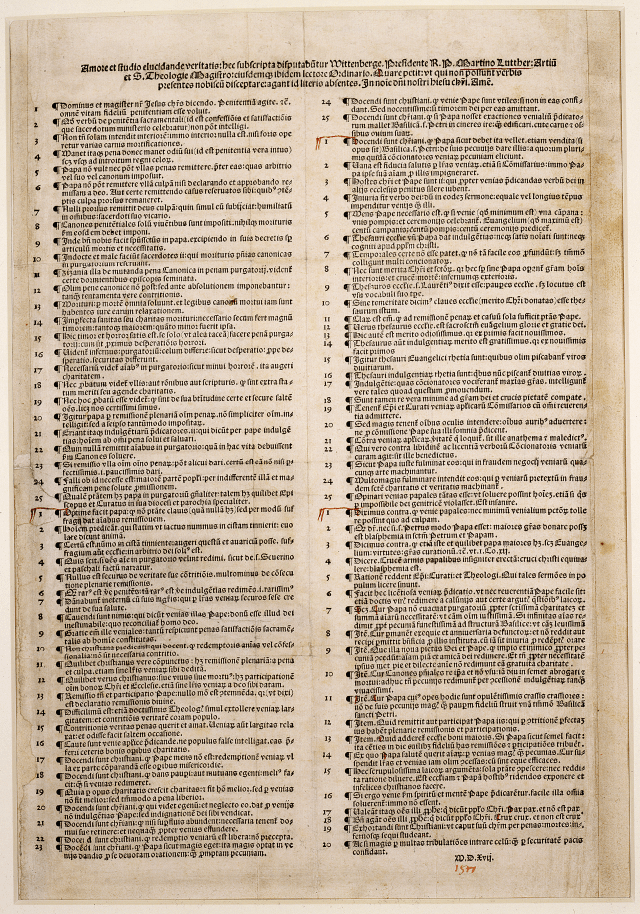
The year was 1517. A monk named Martin Luther gripped his hammer and nailed a list of biblical grievances against the Roman Catholic Church to the door of Castle Church in Wittenberg, Germany, much like we might post a notice to a community bulletin board today. These 95 Theses protested the Catholic Church’s unbiblical policy of selling indulgences, part of an effort to raise funds for the building of St. Peter’s Basilica in Rome. The Catholic Church had created the idea of the Treasury of Merit, sort of a “bank account” of merit deposited by Christ, Mary, the saints, and others as a result of their good works. When church members sinned, they could purchase an indulgence, which was akin to asking the Church to “transfer funds” from the Treasury of Merit to the sinner’s account. The indulgence basically excused the sinner from a certain amount of time in purgatory and/or temporal punishment for that sin.
In addition to protesting the sale of indulgences, Luther’s 95 Theses called the Catholic Church to conform to Scripture by abandoning its unbiblical practices and teachings regarding the doctrines of salvation, religious authority, the nature of the church, and the essence of Christian living.
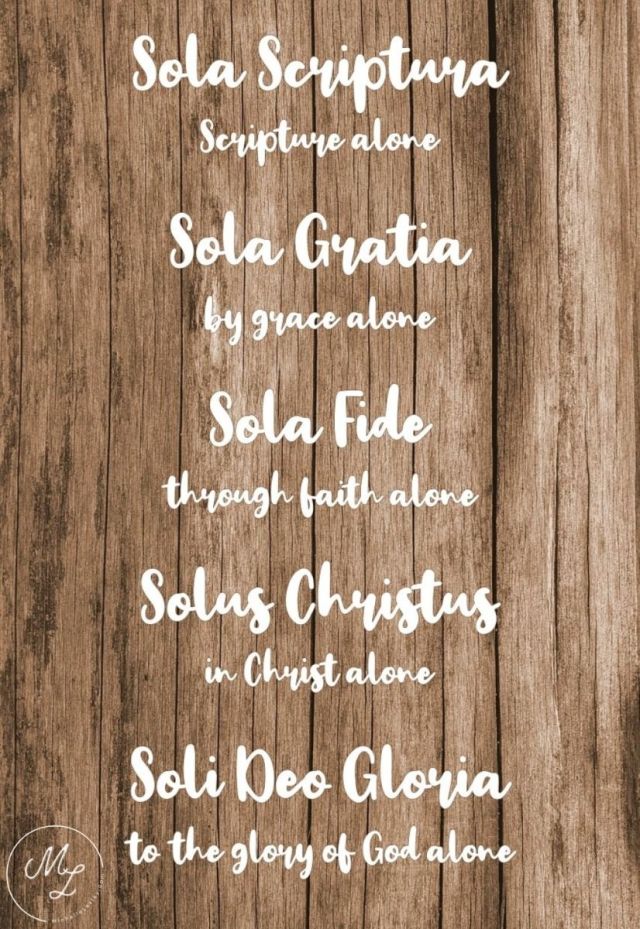
Luther’s calls for reform spread quickly throughout Europe, inspiring the likes of church fathers Ulrich Zwingli (Zurich), John Calvin (Geneva), and John Knox (Scotland) to join the effort in their own locales. As they worked to address the issues raised in Luther’s document, these men codified what we know today as the “Five Solas of the Reformation,” the basis of Protestant church doctrine. The five solas are:
1. Sola Scriptura– Scripture alone is the basis for all church doctrine, belief, and practice. (2 Timothy 3:16-17)
2. Sola Gratia– Salvation is by grace alone. It is an unmerited gift of God based solely on His goodness, not our own (because we don’t have any). (Ephesians 2:8-9)
3. Sola Fide– Salvation is through faith alone. Faith is a gift bestowed by God. We are saved only by placing that faith in Christ’s finished work on the cross, not by doing good works or by any other attempts to earn salvation. (Ephesians 2:8-9)
4. Solus Christus– Salvation is found in Christ alone. As Acts 4:12 says, “And there is salvation in no one else, for there is no other name under heaven given among men by which we must be saved.”
5. Soli Deo Gloria– God saves man for God’s glory alone, and Believers are to live our lives to glorify Him alone. (Romans 11:36)
One of Luther’s most cherished ideals, from which we still benefit today, was that common people should have access to both the Scriptures and worship services in their own language. Prior to the Reformation, the Bible was only available in Latin. Likewise, all masses and other church services were conducted in Latin. Luther translated the Bible into German, and was later followed by William Tyndale, Myles Coverdale, David Brainerd, and others who translated the Bible into various languages.
On Reformation Day, we commemorate the work, zeal, and sacrifices of Luther and the other reformers. Reformation Day is observed on October 31.
Or maybe I answered your question already? Check out my article The Mailbag: Top 10 FAQs to see if your question has been answered and to get some helpful resources.
Could I get your home address? I have some questions that I don’t want on the internet.
Where do you live? What church do you go to?
Have you ever gotten an email or DM/PM from someone you don’t know asking for personal information out of the blue like that? I have.
I love all of my followers and I love that by following me, reading my blog, listening to my podcast, etc., you feel a kinship, maybe even a friendship, with me. I dearly wish we could all be friends in person – and if you’re a genuinely regenerated Believer, one day we will be – for eternity! I can’t wait!
But while we’re on this broken, sinful earth, I’ve heard all the same “stranger on the internet” horror stories you have, along with the warnings not to give out personal information to said strangers.
That’s why my Contact and Social Media page – the only place I’m aware of where my email address is available – clearly says in the very first sentence (right under “Important information. Please read before e-mailing“):
I handle all correspondence with readers via email or social media private message (i.e. no phone calls or snail mail).
The next paragraph begins:
I regret I am unable to answer most emails/PMs unrelated to speaking engagements, and I cannot engage in discipleship or counseling relationships with individual readers via email/PM.
In addition to the fact that I don’t have the time that’s required to engage in email relationships (I’m sorry, I wish I did.), if you need one-on-one counsel or discipleship God’s plan is the local church, not the internet. It’s not right for me to get between you and your pastor or you and a Titus 2 older woman at your church, and it wouldn’t be the best for your spiritual growth, either. This is just one of the dozens of reasons it’s imperative that you be a faithful member of a doctrinally sound local church.
I’m honored (I mean that!) that any of y’all would want me to answer your questions individually or give you personal counsel, but even if I could, it wouldn’t be God’s design or what’s best for you. And for safety reasons, although I’m sure none of you have sinister motives, I have no way of knowing whether you’re you or some whacko is impersonating you, so if you ask for personal information from me, it’s not that I don’t love you, it’s just that I don’t know you, so you’re unlikely to receive a reply.
What are your thoughts on female apologists? Do we treat them the same as “female pastors”? These women frequently speak at mixed gender conferences on Biblical topics. I question, though, what’s the difference between letting a woman get behind the pulpit at a Saturday conference for both genders versus a Sunday morning?
That’s a very good question – one many more Christians should be asking – and the answer is, “There isn’t a difference.”. If something is a sin on Sunday morning, it’s just as much of a sin on Saturday afternoon, Tuesday at midnight, or Thursday at brunch.
It doesn’t matter what a woman’s title is Wait, that’s not quite accurate. It does matter if a woman bears the title of pastor, overseer, elder, bishop, or the title of any other biblical office or position that Scripture restricts to men. There is never a time when it’s biblical for a woman to bear such a title. Why? Because if she bears the title of, say, “pastor,” and she’s doing the job of a pastor, she’s sinning by violating Scripture’s prohibition against women pastors. If she bears the title of “pastor” and she’s not doing the job of a pastor, then her title is a lie, which is also a sin.
But beyond those biblical titles and offices (for example: there’s no biblical office or position of apologist, conference speaker, etc.), it doesn’t matter what a woman’s title is. What matters is whether or not she’s violating Scripture by teaching men in the gathering of the Body. When the Body is gathered for teaching and/or preaching, whether that’s on a Sunday morning for church, on a Saturday at a Christian conference, or whatever the day, situation, event, or venue, women are not to instruct men in the Scriptures. Period. I don’t care what she calls herself, what she says she’s trying to do, or who gave her permission to do it. God’s Word doesn’t give her permission, and she’s violating Scripture.
When the Body is gathered for teaching and/or preaching, whatever the day, situation, event, or venue, women are not to instruct men in the Scriptures. Period.
How can we minister to unbelievers who believe cardinals are loved ones visiting*, or other signs they believe are their lost loved ones communicating with them?
*In case it’s not obvious, this is not a Christian site and I’m not recommending it for anything other than the explanation of this superstition.
To those of us who have been saved a long time and have never run into this idea culturally, it seems silly and laughable. But try to remember how scary death and the afterlife seemed before you got saved. Lost people have no way of making sense of death. No hope and peace of an eternity with Christ. Of course they make up ridiculosities like “There’s just nothingness after you die,” or “Everybody goes to Heaven” … or cardinals. They’re trying to comfort themselves, and this is the best that fallen mankind has been able to come up with. Only Jesus makes sense of death and eternity.
Most people who remark on the appearance of a cardinal this way probably “believe” it about as much as they “believe” there’s a pot of gold at the end of the rainbow, or “step on a crack, break your mother’s back,” or that they’ll really have seven years’ bad luck if they break a mirror. It’s just something people once heard somewhere and they say it so they’ll have something to say at the moment.
So the first thing I’d probably do is say something like, “Oh really? I’ve never heard that before. Where does that belief come from?” or “Very interesting. Why do you believe that?”. And listen. Being interested in someone’s beliefs not only demonstrates that you care about her, but it’ll give you a better grasp of where she’s coming from, spiritually (maybe she really does believe cardinals embody the spirits of the dead), and hopefully it will give you an opportunity to share the gospel with her. And that’s what she desperately needs if she believes this cardinal ma-lark-ey. (Sorry, I couldn’t resist!)
You may also want to want to give a listen to our 3-part A Word Fitly Spoken podcast series, Death, Dying, and Funerals, where we discussed this issue (and other ways to respond to lost loved ones about death) in greater detail:
I listen to John MacArthur’s podcast daily. I love his study Bible and have learned so much from him. A friend recently sent me [a link from a so-called discernment site]. Are you aware of Pastor MacArthur having any ties to the Free Masons? Praying for discernment. Thank you for your help and guidance.
I’m so glad you’re seeking to be discerning rather than just believing whatever random thing you’ve heard on the internet. Good on ya!
This is just one of the many silly false accusations about John MacArthur that are floating around out there. (Frankly, by now, I’m kind of surprised nobody has accused him of being a robot from Mars.) But why believe me? Listen to Dr. MacArthur in his own words:
But I’m really glad you asked, because this is a great opportunity for me to share a couple of quick discernment tips with everyone:
Consider the source. Ever heard that before? It’s certainly true of blogs and news sites and discernment ministries. Some are reliable and trustworthy. Some are not. If you’re not sure, don’t just blindly trust the information from that site, especially if it’s largely speculation, conjecture, opinion, or just plain sounds nutty (or is backed up only by other sites fitting that description). Do your homework. Use sources you know to be trustworthy that are backed up by Scripture and other trustworthy sites.
(Personally – and this is the kind of thing you learn from experience, so it never hurts to reach out to somebody like me and ask if you’re new to this discernment stuff – I would never trust a website named GodIsTerrible dot whatever – the website shared with the reader who sent in the question. I know it’s based on part of a KJV Bible verse, but I don’t really care what the blogger’s motive was for choosing that domain name. Without context, it’s blasphemous and deliberately deceptive, and that’s not someone I’d consider trustworthy on anything biblical.)
Straight from the horse’s mouth. If you want to know what someone believes, it’s always best to go straight to the source, particularly if it’s someone you know or have reasonable access to. If it’s someone you don’t have easy direct access to, like Dr. MacArthur, go to his website, find the search bar, and start searching. You can even use an internet search engine. I found the video above by typing “John MacArthur masons” into Google. It was the second hit.
Keep up the great work of being a good Berean!
If you have a question about: a Bible passage, an aspect of theology, a current issue in Christianity, or how to biblically handle a family, life, or church situation, comment below (I’ll hold all questions in queue {unpublished} for a future edition of The Mailbag) or send me an e-mail or private message. If your question is chosen for publication, your anonymity will be protected.
Numerous articles have been written about how you, as a church member, can be an encouragement to your pastor- how you can constructively praise his sermon, pray for him, get him a great gift for Pastor Appreciation Month, etc. These are good things. Please be sure to support your pastor. Being a pastor is one of the toughest and most thankless jobs out there, and if you’ve read the statistics you know pastors need and deserve all the encouragement they can get.
Your preaching pastor isn’t the only person on your church’s staff who needs your support. So does your minister of music.
But your preaching pastor isn’t the only person on your church’s staff who needs your support. So does your minister of music. And, having been married to one for over twenty years, I can tell you there aren’t manyarticles out there letting you know how church members can encourage their ministers of music. Ready to show some love? Here are seven ways you can be an encouragement to your minister of music.
1. Make practice a priority.
Before you join the choir or praise team or volunteer to play an instrument, find out how much of a time commitment it will be, and consider whether or not you can diligently keep that commitment. Once you’ve joined or volunteered, attend rehearsals, worship services, and performances faithfully, and be sure to arrive on time. You have no idea how much it means to your minister of music that he can count on you.
2. Get to church on time.
Think about how you would feel if you planned a dinner party, worked hard all week cooking and cleaning, and then one of the couples you invited carelessly showed up halfway through the meal. You’d probably think that was kind of rude and feel somewhat discouraged. That’s sort of the way a minister of music can feel when people (especially the same people every week) habitually arrive late to church for non-emergency reasons. Not only that, but it’s a distraction to others when you come in late, plus you’re missing out on praising God and getting your heart prepared to receive His Word during the sermon. Being on time and ready for worship benefits everybody!
3. Sing!
If you were in a meeting at work or in a college class, would you pick up your knitting, clip your nails, walk around the room chatting with friends, or bury your nose in your phone the whole time? Probably not, yet, over the years I have seen church members do all these and more during the music portion of the worship service. It’s disrespectful to the God we’re supposed to be worshiping and to the minister of music who is trying to do the work God has called him to. On the other hand, I love it when we get in the car after church and my husband says, with a smile on his face, “Wow, they were really singing today!” We have an incredible Savior who has given us the privilege of praising Him, so let’s take Him up on it. Sing out! You can worship and be an encourager all at the same time.
4. Smile!
It’s pretty disheartening for a minister of music to stand up front, giving it all he’s got, and then look out over the congregation and see a bunch of people looking like they’d rather be at the dentist. Think about Who you’re singing to and all the reasons why you’re singing to Him, and I challenge you to keep a frown on your face! Just the simple act of smiling while you’re singing will do wonders for your minister of music (and for you!).
5. Think before you complain.
Has your minister of music said or done something that’s clearly a sin or false doctrine? If so, you have a biblical obligation to go to him -kindly and in love- and talk to him about it directly.
Is your complaint a matter of personal preference- style of music, whether or not he wears a tie, etc.? Give it 24 hours. Does it still seem just as important? Could you possibly be a servant to him (and others in the congregation whose opinion is the opposite of yours) by overlooking an offense and not complaining?
If you do feel the need to voice your concern (and there are valid concerns that aren’t sin-related), approach your minister of music the way you would want to be approached. Instead of, “Turn that dadgum volume DOWN!” how about, “I was wondering if it would be possible to ask the sound tech to lower the volume in the house speakers a little? My baby’s ears are very sensitive and she gets fussy when it’s that loud. I hate missing worship when I have to take her out to the lobby.” Instead of, “Hymns are so boring. I don’t see why we have to sing them half the time,” how about, “I really loved those two worship songs we sang this morning! Do you think we might be able to sing more songs like that soon?” Christ wants us to be kind to one another, so show your minister of music a little “Golden Rule” love.
6. Speak encouraging words often.
It’s been our experience, and seems to be the general consensus among ministers of music, that the most common kind of feedback they get is negative feedback. People are much quicker to complain than affirm. Buck the trend. Did he choose one of your favorite songs for the service? Did a certain song help you to understand one of God’s attributes better? Did the choir do a nice job on their anthem? Are you praying for him? Tell him. He appreciates it more than you know.
7. Show tangible appreciation.
It is amazing what even the smallest gift can do to lift my husband’s spirits. A card of appreciation (I have come across cards that he has saved for years), something related to one of his hobbies, a church member buying him lunch at a fast food place. They might be small items monetarily speaking, but their message is, “I care about you, and I appreciate your hard work.” And that’s priceless.
We have been blessed over the last two decades to serve at several churches that had members who were very good at encouraging their minister of music. Their love and support made my husband’s ministry a joy. What are some ways you can think of to encourage the minister of music at your church and spread that same kind of joy?