There’s a lot more to Jen Wilkin than meets the eye. Over the last 15 years, she’s become a popular Christian author and speaker whose books and Bible studies are used by hundreds of Southern Baptist churches (and churches in other denominations) across the U.S.
Yet, at the same time, Jen’s positions on a variety of biblical and social issues have stirred up a tempest of controversy, which discerning churches and individuals should be aware of…
In case you missed it yesterday on social media, you can read the remainder of my debut article, The Troubling Trajectory of Jen Wilkin at Center for Baptist Leadership.
Additional Resources:
Jen Wilkin (The “Troubling Trajectory” article {above} and the podcast episode {below} are both linked in the “Additional Resources” section of this article.)
But understand this, that in the last days there will come times of difficulty. For people will be lovers of self, lovers of money, proud, arrogant, abusive, disobedient to their parents, ungrateful, unholy, heartless, unappeasable, slanderous, without self-control, brutal, not loving good, treacherous, reckless, swollen with conceit, lovers of pleasure rather than lovers of God, having the appearance of godliness, but denying its power. Avoid such people. For among them are those who creep into households and capture weak women, burdened with sins and led astray by various passions, always learning and never able to arrive at a knowledge of the truth.
2 Timothy 3:1-7
If someone were to ask you, “What kind of person do you want to raise your daughter to be?” how would you answer? Caring? Independent? Loyal? Kind?
I’m betting none of us would answer “weak,” “burdened with sins,” “easily led astray by her passions,” or “unable to arrive at a knowledge of the truth.” Yet in these last days in which we find ourselves, that’s exactly what many good-hearted Christian mothers with nothing but the best of intentions are raising their daughters to be. It’s not that they want their daughters to grow up to be spiritually weak or led astray by sin or unbiblical teaching, it’s just that they lack the skills and tools necessary for properly training their daughters in the Scriptures and godliness.
Maybe you’re one of those moms. You want to train your daughter to be a wise, godly, discerning woman, but you’re not quite sure how. Hey, we all have those areas of our lives that we need a little help with. As an older mom myself, maybe I can lend a hand.
My daughter is almost twenty, and while she’s nowhere near perfect, by the grace of God, she is a godly young lady. Looking back, there are many things my husband and I did wrong as parents. But God, in His mercy, covered our failures and saw all of us through as He taught us through His Word how to raise a biblically strong woman.
6 Ways to Raise a Biblically Strong Woman
1. Set an example.
Our daughters learn by watching us. Faithfully study your Bible, pray, attend church, obey God’s Word, submit to your husband, repent and ask forgiveness when you sin, and serve others and your church together.
2. Learn, and teach your daughter, good hermeneutics.
Hermeneutics is just a fancy word for rightly handling God’s word. Use a reliable Bible translation. Understand Scripture in its immediate and overall context. What was the author’s intended meaning, his audience, genre, and culture? Point your daughter to Christ as you study God’s Word together.
3. Find a doctrinally sound church, join it, and attend faithfully as a family.
Study God’s Word and compare everything that’s preached and taught to Scripture (in context). Does your church’s teaching line up? Then be committed to attending every single week, not just when you feel like it or when there’s nothing better to do. Instill in your daughter a love for, and a commitment to, the church.
4. Fight the fluff.
Unfortunately, many of the most popular preachers, teachers, and Christian authors (including women’s Bible study authors) teach and write things that may sound good and make us feel good, but are in direct conflict with Scripture. These are the very people Paul was speaking of in 2 Timothy 3. Teach your daughter to follow only trustworthy teachers whose theology is in line with Scripture.
5. Bring prayer and Scripture into every situation.
She can’t find her favorite doll? Kids picking on her at school? She wants to wear clothes that barely cover her? Discuss what the Bible say about these things. Pray together about them. Lead your daughter into prayer and Scripture as part of daily life, and it will teach her that God is to have authority over every aspect of our lives and that we are to obey Him in all things.
6. Teach her how to share the gospel.
If you’re not sure how to properly present the gospel to someone, learn. You can’t lead your daughter to Christ if you can’t share the gospel with her. If your daughter is already saved, make sure she knows how to correctly share the gospel with friends and loved ones. The Great Commission was the last instruction Christ gave us before leaving earth, and we are all to be about the business of carrying it out until He returns.
The 2 Timothy passage at the beginning of this article is our commission to guard our households against ungodly ways and people – even those who may falsely call themselves Christians – who might creep in and steal our daughters’ hearts and minds away from Christ. He has charged us to train them in godliness, and we must faithfully answer His call to raise wise, discerning, and biblically strong women of God.
What advice would you offer moms who want to raise
biblically strong women?
I’ve recently met a woman who is a “pastor” of a church. When asked why she is preaching to men, her response was this:
“Men will not teach. None will stand up. We started as a congregation of women and slowly some husbands came, as well as their sons. But none will take responsibility. So if I do not speak truth and stand up, who will?”
This was in another country I recently visited where men do not take authority, nor do they desire it. Women are primary in every area.
This is a difficult situation to be in, and I do sympathize. I’ve been in church and family situations in which men were not being the godly leaders they were supposed to be. It’s very frustrating. Even more so in the case of your friend, because Scripture prohibits women from stepping in and taking over when a man will not lead the church.
(And all of this, and the following, goes for women in any church who have “stepped in” to a pastoral role or a role Scripture reserves for men such as, but not limited to: worship leader/minister of music, any other pastoral or elder position – with or without the title of “pastor/elder,” teaching co-ed adult Sunday School, Bible study, or small groups, etc.)
But in addition to the fact that the Bible is very clear that your friend is not to preach to men, she’s doing a terrible job as “pastor” on several other counts:
✢ She doesn’t believe in the necessity of prayer, or in God’s provision, enough to ask Him to provide a pastor.
✢ She’s not teaching her “congregation” to cry out to the Lord and trust Him to provide. Instead, she’s teaching them to take matters into their own hands when they need something, even if it means disobeying God’s Word. (Kind of like Sarah did.)
✢ She’s teaching her “congregation” that they it’s OK to disobey God if it’s difficult or inconvenient to obey Him.
✢ She’s teaching the women that they don’t have to submit to God’s design for biblical womanhood.
✢ She’s teaching the men to continue to be lazy and shirk their God-given duty to lead. Why should they when a woman is all too willing to step in and do the work for them?
She asks, “If I do not speak truth and stand up, who will?”. My answer to that question is, “That’s God’s business to take care of, not yours.” Her business is to obey Him and trust Him to work out everything else. And besides, she’s not “standing up and speaking truth”, she’s standing up and speaking or demonstrating all the untruths I enumerated above.
My counsel to this woman would be to immediately step down as “pastor,” stop preaching to and instructing the men, and publicly repent to God and to everyone in the church for her sins of disobeying God’s Word and setting a bad example for the church. She should inform them that she will no longer be preaching but that she will be praying for God to raise up a pastor, either from among the men of the church or from outside the church.
The men and women can, and should, meet to pray and sing together every Sunday. One of the other women (the former “pastor” needs to sit out of leadership for a while) can certainly teach a women’s Bible study class. But if the men want a Bible teacher or pastor, one of them is going to have to step up and do it, or God will have to send a man from somewhere else. And the women need to be sure they’re holding their ground and refusing to step into that role. What a godly testimony of obedience they will be to the men! Hopefully, it will shame the men over their own disobedience.
God doesn’t give anyone permission to disobey Him just because it’s hard or inconvenient. It was the hardest thing in the world for Jesus to go to the cross, but He did it anyway because He was obedient to His Father. He was willing to die rather than disobey. That is the example she needs to follow.
No temptation has overtaken you that is not common to man. God is faithful, and he will not let you be tempted beyond your ability, but with the temptation he will also provide the way of escape, that you may be able to endure it.
1 Corinthians 10:13
In your struggle against sin you have not yet resisted to the point of shedding your blood.
Hebrews 12:4
In all your ways acknowledge him, and he will make straight your paths.
Proverbs 3:6
Commit your way to the Lord; trust in him, and he will act.
Psalm 37:5
When we face tests of our faith, it is not time to take the easy way out and sin, it is God stretching us and giving us an opportunity to trust and obey Him so He can use that situation as a vehicle for growing us to greater maturity and Christlikeness.
This lady, and the rest of the church, has the opportunity here to cry out fervently to God to provide them with a pastor and then trust Him to act on their behalf. That’s exactly what Lydia and the other women at Philippi did, and God sent them Paul!
Ask, and it will be given to you; seek, and you will find; knock, and it will be opened to you. For everyone who asks receives, and the one who seeks finds, and to the one who knocks it will be opened. Or which one of you, if his son asks him for bread, will give him a stone? Or if he asks for a fish, will give him a serpent? If you then, who are evil, know how to give good gifts to your children, how much more will your Father who is in heaven give good things to those who ask him!
Matthew 7:7-11
Which would bring more glory to God and be more of a testimony to His greatness: for this lady to have taken matters into her own hands and sinned, or for her and the rest of the women to obey God, for everyone to pray and trust God for a pastor, and then to have the awesome experience of God answering that prayer?
There’s nothing amazing, especially in that culture, about men being lazy and women stepping in and picking up the slack. Why have a Christian church that is supposed to be following the all powerful God of the universe be just one more example of that? Instead, they could have an incredible testimony of God providing a pastor and changing the hearts of the men of the church to take responsibility and lead. What kind of an impact would that have on the surrounding culture? How many doors might that open for that church to share the gospel?
If you have a question about: a Bible passage, an aspect of theology, a current issue in Christianity, or how to biblically handle a family, life, or church situation, comment below (I’ll hold all questions in queue {unpublished} for a future edition of The Mailbag) or send me an e-mail or private message. If your question is chosen for publication, your anonymity will be protected.
…they all walked sedately into the church. The first clang of the bell rang out when they were on the steps. After that, there was nothing to do but sit still till the sermon was over. It was two hours long. Almanzo’s legs ached and his jaw wanted to yawn, but he dared not yawn or fidget. He must sit perfectly still and never take his eyes from the preacher’s solemn face and wagging beard. Almanzo couldn’t understand how Father knew that he wasn’t looking at the preacher, if Father was looking at the preacher himself. But Father always did know.
From Farmer Boy by Laura Ingalls Wilder¹
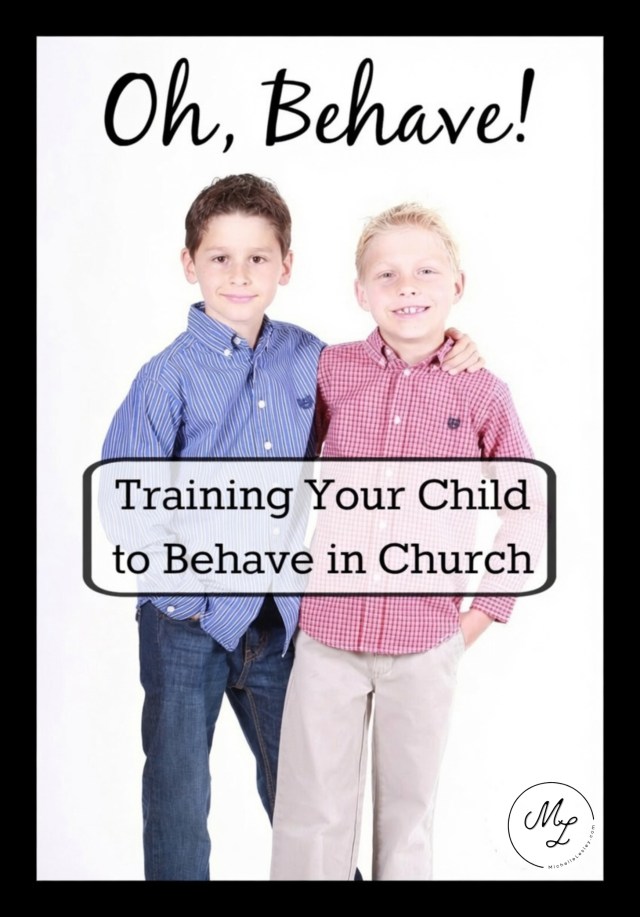
A hundred and fifty-ish years ago, this is how children were expected to behave in church. I love a good sermon, but I’m not sure even I could meet those behavioral expectations, and, these days, I certainly wouldn’t expect my children to. But fast forward from the 1800’s to 2000’s, and think about how you may have seen some children behave in church. It’s quite a bit different from Almanzo’s experience, wouldn’t you say?
I don’t think we need to dial things back a hundred and fifty years, though. A little fidgeting, a Bible dropped loudly on the floor, a few seconds of wailing while you frantically search for the lost pacifier, a bit of jabbering, none of these things are a big deal. But neither should a toddler be allowed to run up and down the aisles of the sanctuary for the bulk of the sermon. Eight year olds do not need to be crawling around on the floor between the pews playing with toys. Twelve year olds can reasonably be expected to stay awake, sit still, and pay attention during the service.
We expect our children to obey us (and other adults) and behave properly in a variety of places: school, the grocery store, restaurants, on their sports teams, at scout meetings. Why, when the worship service is far more important than any of these, would we not require them to act appropriately in church? And when we require them to behave themselves in all these other venues but not in church, what are we teaching them about the importance of church, reverence, God?
When we require our children to behave themselves in all these other venues but not in church, what are we teaching them about the importance of church, reverence, God?
For the past several years, the message coming from many pastors and churches has been, “Your child is welcome in church! Don’t worry if he makes noise!”. Some pastors are known to say things like, “Never mind if your baby cries! I’ll just preach louder!”. It is absolutely true that children of all ages should be made to feel welcome and loved in church, and that the entire congregation should be patient, loving, and understanding with the occasional cry, babble, or fidget. But a few parents seem to hear this welcoming attitude toward children as, “It’s fine for your child to run wild during the sermon or scream his head off for the duration of the worship service.”. That’s not the case. Allowing your child to make noise or misbehave with no attempt to address the situation is unloving and unkind to your church family who, though patient and loving, are being distracted from worship by your child. A loving church is not license for you to shirk your responsibility to them, to God, and to your child to teach him to behave appropriately in church.
A welcoming pastor and a loving church is not license for you to shirk your responsibility to them, to God, and to your child to teach him to behave appropriately in church.
But, if you’ll determine in your heart to train your child, you might be surprised at all the blessings and benefits you encounter along the way.
What is appropriate church behavior?
That’s going to vary by age. Obviously, a three year old isn’t going to sit perfectly still for thirty minutes and take sermon notes. But, believe it or not, you can start (and I would strongly recommend) training your child from infancy that church is a place where we sit still, sit quietly, listen when it’s time to listen, and participate when it’s time to participate.
You can start training your child from infancy that church is a place where we sit still, sit quietly, listen, and participate appropriately.
The first and best way to train your child is by modeling proper church behavior yourself. Does he see you singing enthusiastically during the worship time? Are you checking your makeup or Facebook during prayer? Are you visibly paying attention during the sermon? Constantly talking to your husband or a friend during the service? Your child will imitate what he sees and take his cues from you as to what is acceptable behavior.
Otherwise, you train your child in church the same way you would train him in any other situation. If you were at a restaurant, and your baby was crying incessantly, you would tend to his needs at the table, or, if you couldn’t, you would take him out to the lobby or outside until he calmed down. The simple act of doing so begins to plant the idea in his mind that a certain level of behavior is expected in that venue.
If your school aged child won’t sit quietly in his seat at school, the teacher administers the appropriate discipline, and, possibly, you do too, at home.
It’s the same way at church. You let your child know what is expected of him behavior-wise at church, praise him when he does well, and administer discipline when he disobeys.
A few helpful hints:
Infants and toddlers:
If your church offers a nursery, there’s no shame in making use of it. As a stay at home mom, I well remember the days when church was the only opportunity I had for a small breather from my children, for adult fellowship, and for hearing God’s word without interruption.
But if you want to have your infant or toddler in church with you, that’s great! Be sure your diaper bag is well stocked with anything you might need to keep a little one relatively still and quiet. Bottles, pacifiers, small snacks that won’t make too much of a mess, some small, soft toys (such as stuffed animals or board books- maybe even a special one that’s only for Sundays) that he can quietly play with in his lap.
Some parents are under the mistaken impression that sitting in the balcony with their child will minimize the amount of noise the congregation hears from him. This is not true in most churches. Sitting in the balcony, in many churches, is like sitting your child in front of a megaphone. And the more cavernous your church is, the more your child’s voice is amplified to the entire room. Then there’s the added noise of toddlers stomping around and dropping things, which is much louder than if your child were doing these things on the main floor of the sanctuary.
Try to choose an aisle seat on the main floor near a door in case you need to make a hasty exit. Also, try to sit somewhere where any noise your child might make won’t be picked up by the pastor’s (or other) microphone.
Older children:
Sometimes well meaning Sunday school teachers serve sugary snacks or other foods/drinks that might make your child jittery. If so, it may be more difficult for him to sit quietly during church. Check out the snack situation in your child’s class, and serve him a breakfast that won’t give him the fidgets.
Make a bathroom/water fountain pit stop before the service a weekly habit. If your child would benefit from running a lap or two outside before the service to work off some energy, make that part of the weekly routine as well.
Dress your child appropriately, yet comfortably for church. I still remember scratchy lace on some of my childhood Sunday dresses. And sitting up against the back of a pew or chair wearing a dress that ties in the back? Absolute torture when that knot dug into my spine. It’s kind of hard to sit still when your entire outfit is conspiring against you.
Get them started on taking notes during the sermon. Give your preschooler some crayons and paper and help him listen for something in the sermon he can draw a picture of (a sheep, Jesus, an angel, a garden…).
Lower elementary aged children might enjoy taking “tally mark” notes. Make a brief list of words your child is likely to hear during the sermon (God, Jesus, Bible, Love…) and instruct him to make a tally mark next to the word any time he hears it during the sermon. Some pre-readers can even attempt this if you draw a couple of small pictures instead of words (a heart for “love,” a cross for “Jesus,” etc.) Before church starts, try to guess with your child which word will get the most marks. After church, count up the marks and see if you were right. You may even want to do your own tally mark sheet during the sermon to model for your child what you want him to do.
Some churches offer a fill in the blank sermon outline in the bulletin. This is a perfect note taking activity for older children and tweens. They can also be encouraged to turn in their Bibles to all the Scriptures the pastor mentions, copy down a verse from the text of the sermon, or write down any questions that occur to them as they listen.
And, speaking of questions, another fun activity is for each family member to write down a couple of questions, and their answers, from the sermon. Then, in the car on the way home, each person gets to ask his questions. Whoever gets the most correct answers gets to pick what’s for lunch (or bragging rights, or something else fun). It’ll keep EVERYONE paying attention, and it’s a great way to reinforce and discuss the sermon.
Attend church every Sunday. Not only is it biblical to attend faithfully, but children thrive on routine, and it will be easier for them to remember how to behave if they’re learning and practicing those behavior skills weekly instead of in a “hit and miss” fashion.
Children with Disabilities
Believe it or not, I actually do have some experience in this area. For several years, I taught at two different state schools for the deaf, working with deaf students and students with multiple disabilities. After that, I worked for a couple of years as an advisor, advocate, and service provider for disabled students at a large state university. I’m not unsympathetic to parents of children with disabilities and to the issues disabilities cause.
Since there is such a wide range of disabilities that may cause noise or behavior issues in church, I can’t offer specific suggestions that would apply to every child with a disability. So let me just offer a few general thoughts:
Like every other parent, you have to address your child’s noise and behavior in a way that’s appropriate to his age and abilities, whatever those may be. Your child’s disability does not relieve you of the responsibility to train him and address his issues as best you can. Ask and trust God to help and equip you to know and do what’s right for your child.
When it comes right down to it, in church, noise is noise, and distraction is distraction, whether it’s coming from an adult who can’t stop coughing, a baby who won’t stop crying, or your child’s particular issue. When it’s in our power to address a distraction – our own or our child’s – we should make every effort to do so.
Get some wise counsel. Ask your child’s doctor, teacher, therapist, social worker, etc. for some help. Do you have a clear picture of what your child is and isn’t capable of? Are you expecting too much or too little of him? Are there any helpful suggestions they can offer for managing his issues in church? Ask other parents of children with the same disability as your child for any tips or tricks they’ve learned. What has worked? What hasn’t worked? Ask your pastor if there’s any reasonable accommodation that could be made for your child that hasn’t been, such as adjustments to the light or sound, accessibility adjustments, piping the sermon audio into an adjacent room, etc.
Training your child to behave well in church isn’t easy at times. I know. I have six children and we have raised all of them in church. But if you and your husband will invest the time and effort, everyone benefits. Your pastor will be able to preach uninterrupted. Your fellow church members will be able to worship undistracted. Once your child begins to behave himself better, you will be able to focus more on the service and be less frazzled. But most importantly, your child will develop the skills necessary for hearing and paying attention to God’s Word being proclaimed, and what a blessing that will be to him now, and for the rest of his life.
What are some things that have worked well to help your child behave in church?
¹Laura Ingalls Wilder, Farmer Boy (New York: Harper Collins, 1933), 90-91
If you’re searching for a new church (rather than wanting to recommend one) click here.
If you’ve followed me for a while, you know I’m passionate about helping people find doctrinally sound churches to join. I’ve recently been updating my list of…
…but we can always use more recommendations for doctrinally sound churches, church search engines, andchurch planting organizations,especially in the states that don’t have very many recommendations and in countries outside the United States. So I’d love it if you’d help out by making a recommendation!
Please read this part carefully and in its entirety before recommending a church. 👇👇👇
I really need your help with preliminary vetting here, readers. Please carefully read and follow the guidelines and instructions below so your recommendation won’t be deleted or rejected.
You must have a personal connection (ex: you’re a member or recent former member, you know the pastor personally, etc.) to the church you’re recommending
Please check this list to see if the church you’re recommending is already listed. (It takes time for me to weed out recommendations of churches that are already listed.)
Please check this link to see if the church search engine or church planting organization you’re recommending is already listed. (Read carefully. The Master’s Seminary, Founders, G3, Grace Advance, and several others are already listed.)
The following types of churches, church search engines, and church planting organizations will not be added to the list (due to doctrinal or other issues)1:
United Methodist Churches
Calvary Chapel churches (continuationist)
Christian and Missionary Alliance (CMA) churches (continuationist, egalitarian, social justice)
Any church that believes/teaches entire sanctification/sinless perfection
Any church that believes/teaches a genuinely regenerated Christian can lose or forfeit his salvation
Churches that consider Calvinism/Reformed theology to be false teaching
KJV Only churches (Churches which consider the King James Version to be the only acceptable and/or inspired translation of the Bible. Churches which merely prefer using the KJV are fine.)
Any church that uses music from Bethel, Jesus Culture, Hillsong, Elevation, Maverick City, anyone connected with these groups (such as Phil Wickham), Catholics, non-Christians, or any other contemporary musician who isn’t doctrinally sound.
Any church that uses or recommends books and materials from false teachers. This includes churches recommending, affiliated with, or financially supporting The Gospel Coalition, CRU, or any other parachurch organization which platforms false teachers, and/or is egalitarian, woke, compromises on the Bible’s teaching on gender/sexuality, etc.
Any church that violates Scripture’s teaching on the role of women in the church (1 Timothy 2:11-3:7). This includes, but is not necessarily limited to: churches with a female bearing the title of “pastor” (of anything) or “elder,” churches which allow women to function in pastoral roles without the title of pastor / elder (for example: female ministers of music or worship leaders; discipleship “facilitators” or “directors” who essentially function as elders / associate pastors, and so on), churches which allow women to preach to, hold unbiblical authority over, or instruct men or co-ed groups in the Scriptures (for example: teaching / co-teaching co-ed adult Sunday School / Bible study classes or home / small groups).
Any church that does not have a detailed statement of faith (“What we believe,” “Doctrinal statement,” etc.) or link to such.
Any church that does not have the pastor’s name (and pastoral staff / elders, if any) listed on its website. (I don’t list churches which are currently without a pastor. You’re welcome to submit your church once you get a new pastor.)
Any church that does not have a website (a social media page alone is not enough).
If the church, church search engine, or church planting organization you’re considering recommending meets the criteria above, I’d love to consider it! Please commentbelow with:
The full, correctly spelled name of the church, church search engine, or church planting organization
The city and state, or city and country the church is located in
The church’s, church search engine’s, or church planting organization’s website. Submissions without websites will not be considered and will be automatically deleted.
I apologize if this is inconvenient, but I’m really going to need you to make your recommendation in a comment on this article, rather than a social media comment or private message, email, or comment on another article. That way, I’ll have all the recommendations in one place and I won’t miss yours.
Just a reminder, I handle all comments manually, so your comment will not appear immediately. When I add (or decline to add) your church to the list, I’ll post your comment and let you know whether or not I’ve added your church. Please do not submit your recommendation multiple times because you think I haven’t responded quickly enough. It takes time to sort through and delete multiple submissions for the same church/organization.
I vet every church that’s submitted, so it may take me a while (possibly several weeks to several months) to get to your recommendation depending on how many submissions I receive (last time it was well over 100). Your patience is appreciated.
Thanks so much for helping your brothers and sisters in Christ find a good, solid church!
1I am not saying any church or person who falls into one of these categories is automatically a heretic, unsaved, or a horrible person/church. These are merely the requirements for a church to be on this particular list because these are the requirements most of the people who use this list are looking for.