Holidays (Other)

The Blessing of Freedom

Originally published April 10, 2008

Have you ever thought about what it’s like to be a Christian in other parts of the world?

Have you ever thought about what it’s like to be a Christian in other parts of the world1?

Indonesia, Nigeria- Christians are slaughtered for not conforming to Islamic law. In Nigeria, since the year 2000, thousands have been put to death.

Saudi Arabia and other Gulf states, North Africa, Mauritania, Iran, the Comorros Islands, Sudan- Direct persecution by the state is written into the legal code. Any non-Islamic or dissident Islamic religious expression is forbidden. Any Saudi who seeks to leave Islam faces the strong possibility of execution.

Egypt- The Coptic Church (which is somewhat similar to Catholicism in its roots and practices) has been the target of church burnings and local massacres.

Pakistan- In 1997, the Christian town of Shantinagar, was effectively leveled.

China, Vietnam, Laos, Belarus, Turkmenistan and Uzbekistan- Generally, there is freedom to worship in state-controlled religious bodies, but any religious expression outside of these bodies is strenuously controlled or suppressed.

Roman Catholicism is outlawed because it accepts the authority of the Pope, who is from outside the country. Priests and bishops have been imprisoned. Hundreds of Protestant leaders of the underground church have been arrested and sentenced to jail and labor camps.

North Korea- Nearly every free exercise of religion is viciously repressed, and thousands of people have been sent labor camps for practicing their faith.

Burma- An organization called the State Law and Order Restoration Council brutally oppresses tribal minorities, which, in large part, are comprised of Christians. Their tactics include: massacre, rape, forced labor, and the use of children to clear minefields.

United States-
Christianity is protected under the Constitution and is the majority religion in this country. We even have the right to legal redress if our religious liberties are infringed upon.

We can worship publicly with no fear of government, military, or other attacks.

We do not have civil rights (such as the right to vote, work, or own property) taken away from us simply because we embrace Christianity.

We have the right to proselytize (as long as weโ€™re not harassing anyone), advertise and spread our religion.

Persecution is usually limited to people hurting our feelings when we witness to them, and social issues that offend our sensibilities.

We have beautiful, comfortable churches (as well as Christian schools, organizations and stores), complete with heat and air conditioning; comfortable pews; nurseries; indoor plumbing; Bibles, music, and materials in our own language; musical instruments; technology; and paid, and frequently seminary-trained, pastors and staff.

So what are we doing with all these blessings? Have we gotten so used to freedom and opportunity that we consider them a birthright rather than a precious gift from God that He has the prerogative to revoke if He chooses? He did it with the Israelites time and time again in the Old Testament: They obeyed God. He blessed them. After a while, they got comfortable with all the blessings and became lazy. They strayed away from God. He gave them over to oppressive rulers. They cried out in repentance. He delivered them and blessed them, and the cycle started all over again.

What will it take to shake Christians out of our complacency?

What will it take to shake Christians out of our complacency, humble us in gratitude for the opportunities God has given us, and motivate us to use the freedom with which He has blessed us to build His kingdom?

From everyone who has been given much, much will be required; and to whom they entrusted much, of him they will ask all the more.

Luke 12:48b

1Insights on Law and Society: A Magazine for Teachers of Civics, Government, History & Law, Vol. 7.3 (Spring 2007); Published by the American Bar Association

Christian women, Parenting

Avoiding the Creepers: Six Ways to Raise a Biblically Strong Woman

Originally published May 15, 2015

If someone were to ask you, โ€œWhat kind of person do you want to raise your daughter to be?โ€ how would you answer? Caring? Independent? Loyal? Kind?

Iโ€™m betting none of us would answer โ€œweak,โ€ โ€œburdened with sins,โ€ โ€œeasily led astray by her passions,โ€ or โ€œunable to arrive at a knowledge of the truth.โ€ Yet in these last days in which we find ourselves, thatโ€™s exactly what many good-hearted Christian mothers with nothing but the best of intentions are raising their daughters to be. Itโ€™s not that they want their daughters to grow up to be spiritually weak or led astray by sin or unbiblical teaching, itโ€™s just that they lack the skills and tools necessary for properly training their daughters in the Scriptures and godliness.

Maybe youโ€™re one of those moms. You want to train your daughter to be a wise, godly, discerning woman, but youโ€™re not quite sure how. Hey, we all have those areas of our lives that we need a little help with. As an older mom myself, maybe I can lend a hand.

My daughter is almost twenty, and while sheโ€™s nowhere near perfect, by the grace of God, she is a godly young lady. Looking back, there are many things my husband and I did wrong as parents. But God, in His mercy, covered our failures and saw all of us through as He taught us through His Word how to raise a biblically strong woman.

6 Ways to Raise a Biblically Strong Woman

1. Set an example.

Our daughters learn by watching us. Faithfully study your Bible, pray, attend church, obey Godโ€™s Word, submit to your husband, repent and ask forgiveness when you sin, and serve others and your church together.

2. Learn, and teach your daughter, good hermeneutics.

Hermeneutics is just a fancy word for rightly handling Godโ€™s word. Use a reliable Bible translation. Understand Scripture in its immediate and overall context. What was the authorโ€™s intended meaning, his audience, genre, and culture? Point your daughter to Christ as you study Godโ€™s Word together.

3. Find a doctrinally sound church, join it, and attend faithfully as a family.

Study Godโ€™s Word and compare everything thatโ€™s preached and taught to Scripture (in context). Does your churchโ€™s teaching line up? Then be committed to attending every single week, not just when you feel like it or when thereโ€™s nothing better to do. Instill in your daughter a love for, and a commitment to, the church.

4. Fight the fluff.

Unfortunately, many of the most popular preachers, teachers, and Christian authors (including womenโ€™s Bible study authors) teach and write things that may sound good and make us feel good, but are in direct conflict with Scripture. These are the very people Paul was speaking of in 2 Timothy 3. Teach your daughter to follow only trustworthy teachers whose theology is in line with Scripture.

5. Bring prayer and Scripture into every situation.

She canโ€™t find her favorite doll? Kids picking on her at school? She wants to wear clothes that barely cover her? Discuss what the Bible say about these things. Pray together about them. Lead your daughter into prayer and Scripture as part of daily life, and it will teach her that God is to have authority over every aspect of our lives and that we are to obey Him in all things.

6. Teach her how to share the gospel.

If youโ€™re not sure how to properly present the gospel to someone, learn. You canโ€™t lead your daughter to Christ if you canโ€™t share the gospel with her. If your daughter is already saved, make sure she knows how to correctly share the gospel with friends and loved ones. The Great Commission was the last instruction Christ gave us before leaving earth, and we are all to be about the business of carrying it out until He returns.

The 2 Timothy passage at the beginning of this article is our commission to guard our households against ungodly ways and people โ€“ even those who may falsely call themselves Christians โ€“ who might creep in and steal our daughtersโ€™ hearts and minds away from Christ. He has charged us to train them in godliness, and we must faithfully answer His call to raise wise, discerning, and biblically strong women of God.

What advice would you offer moms who want to raise
biblically strong women?


And for all you boy moms, be sure to check out…

Six Ways to Raise a Godly Man

Obedience

Faultfinders Contending With the Almighty

Originally published September 25, 2015

1 tim 2 12

Nobody could ever accuse Christianity of being easy. A religion that tells you to die to self and take up your cross daily is no walk in the park. And there’s no magical moment in this life when you’ve suddenly “arrived” at the top level of spiritual maturity where everything in the Bible makes perfect sense, your prayer life is phenomenal every day, obeying Christ’s commands is a breeze, and you’re floating around on a little cloud of holiness.

We are all messed up, muddling through, and constantly battling the flesh, from the person who got saved five minutes ago to the theologian who’s been walking with the Lord for decades.

We are all messed up, muddling through, and constantly battling the flesh, from the person who got saved five minutes ago to the theologian who’s been walking with the Lord for decades

matt 6 15

It’s hard enough to obey the Scriptures we embrace – love one another, be kind, be truthful – but then we encounter Scriptures that, for whatever reason, we butt heads with. Scriptures to which our initial, fleshly reaction is, “No way. I’m not doing that.” We argue with them. We look for loopholes and ways we can get around them. We reason out all sorts of caveats as to why that Scripture doesn’t apply to us or why we don’t have to obey it.

My parents hurt me deeply. There’s no way I’m going to honor the people who did that to me.

God gave me a special gifting and called me to preach. It doesn’t matter that I’m a woman.

Why should I forgive him? He ruined my whole life!

You have no idea how badly she hurt me. I’ll never be able to love her or pray for her.

ex 20 12

There’s no denying it, sometimes obeying a certain Scripture will be the hardest thing we ever do. But slaves of Christ are not given the option of saying “no” to their Master. If you’ll look in your Bible at the verse you’re struggling against, you’ll notice there’s no asterisk next to it that says, “except you.”

Slaves of Christ are not given the option of saying “no” to their Master. If you’ll look in your Bible at the verse you’re struggling against, you’ll notice there’s no asterisk next to it that says, “except you.”

1 pet 3 1 2

When we approach one of God’s commands to Christians and decide we’re not going to obey it because we don’t want to or shouldn’t have to or it’s too hard, what we’re really doing is setting ourselves above the Bible in judgment of it and coming to the conclusion that we know better than God.

Yeah, that’s not a good idea. Especially for Christians.

Ever read the book of Job? Job went through some pretty awful stuff. Stuff that I certainly would have argued against and questioned God about just like he did. And yet, despite all of Job’s suffering, God didn’t give him a pass.

And the Lord said to Job:
โ€œShall a faultfinder contend with the Almighty?
He who argues with God, let him answer it.โ€
Then Job answered the Lord and said:
โ€œBehold, I am of small account; what shall I answer you?
I lay my hand on my mouth.
I have spoken once, and I will not answer;
twice, but I will proceed no further.โ€

Job 40:1-5


 And how does this grab you?

But who are you, O man, to answer back to God? Will what is molded say to its molder, โ€œWhy have you made me like this?โ€ Has the potter no right over the clay, to make out of the same lump one vessel for honorable use and another for dishonorable use?

Romans 9:20-21

Do you get the sense from these verses, which address very different situations, that God isn’t crazy about people questioning His sovereignty, His decisions, or His Word, regardless of their circumstances?

God is God. We are not.

God isn’t crazy about people questioning His sovereignty, His decisions, or His Word, regardless of their circumstances. God is God. We are not.

God sets the rules for Christianity, not “everyone doing whatever is right in his own eyes.”

matt 5 44

Lots of times we think we have to “feel comfortable” with a certain Scripture if we’re to obey it, but the truth is just the opposite. When we say, “Lord, I don’t want to do this, but I’m going to do it anyway because I love You, and Your Word says so,” guess what happens? God begins to change our hearts. In time, He helps us grow to embrace the Scriptures we once rejected. He helps us to love others and see them through His eyes.

When we say, “Lord, I don’t want to do this, but I’m going to do it anyway because I love You, and Your Word says so,” guess what happens? God begins to change our hearts.

Yes, it is going to be hard. There are going to be times when we have to grit our teeth, hold our noses, and obey Christ even when everything inside us screams, “NO!

But we have a precious Savior who has promised to help us be content in any circumstance and will give us the strength to do anything He puts in front of us.

I can do all things through him who strengthens me.

Philippians 4:13

I’ve fought. I’ve cried. I’ve whined, “I can’t!” And every time God has brought me back to this verse that says, “Yes, you can, and I’ll help you.” And you know what? He did.

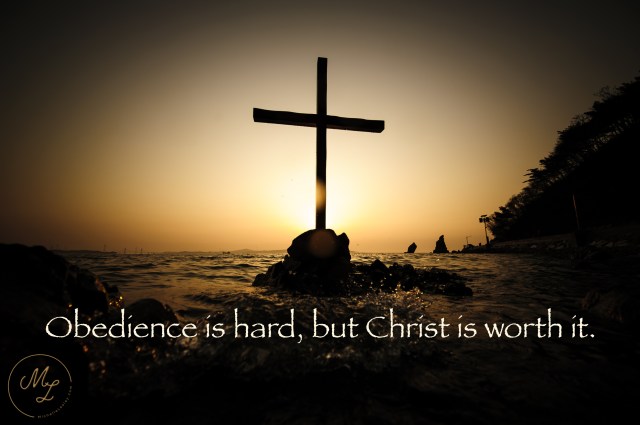
Obedience is hard, but Christ is worth it.

Obedience is hard, but Christ is worth it.

Church, Discernment

Persecution in the Pew

Originally published August 7, 2015

Beheadings of Christians by ISIS. Crosses forcibly torn off churches by the Chinese government. Pastors imprisoned. Believers tortured for leaving Islam or sharing the gospel.

The treatment our brothers and sisters across the globe receive at the hands of pagans is nearly unfathomable. They are made to suffer – simply for claiming the name of Christ – by those who openly hate God and want nothing more than to stamp out Christianity.

This is how we, as the American church, have come to define persecution. Outsiders, non-Christians, and the government, all on the attack against the Bible, our faith, our practices, and other beliefs we have long held dear. It’s a correct definition, but it’s not a complete definition.

While we already see a “light” form of this type of persecution in the U.S. – mainly over the issue of homosexuality – there’s another kind of Christian persecution that is mushrooming right under our noses, which most church members either seem oblivious to, or are actually participating in. It’s the persecution in the pew.

If you’re a Christian who has ever dared to vocally take a stand on the truth of God’s Word against the false teaching so prevalent in today’s pop Christianity, you’ve almost certainly experienced this type of persecution at the hands of people who call themselves “Christians.”

Don’t believe me?

Try posting a Facebook status that says the Bible prohibits women from being pastors or teaching men.

Demonstrate from Scripture to a Beth Moore, Joyce Meyer, or Joel Osteen groupie that she’s following a false teacher.

Talk to a church member who supports Planned Parenthood “because they provide health care”.

Explain why Christians ought not attend same sex weddings.

Discuss the Bible’s account of Creation with someone from your church who has embraced Darwinian evolution.

Certainly, there are new and immature Christians who simply don’t know these things are unbiblical and are still struggling to embrace God’s Word in these areas. And there are those who know what God’s Word says, but rebel against it in these areas, who silently ignore Christians who espouse biblical truth, or can politely discuss why their “Christian” views differ from Scripture. However, the willfully biblically ignorant, “screaming banshee” contingent is growing, both in volume and in number.

Surprised? Me too. I’ve been on the receiving end of verbal abuse (and I do mean abuse – name calling, swearing, mocking, the questioning of my salvation, and any number of other nasty and condescending remarks) from “Christians” defending these and other unbiblical views numerous times and I still can’t get over my shock every time it happens.

Call me crazy, I guess I just expect people who call themselves “Christians” to love, obey, and uphold Scripture, not attack those who actually do.

But this kind of thing really shouldn’t be cause for wonder and amazement. We should expect it. Persecution of God’s people by those who claim to be God’s people has been happening since the Old Testament.

Jeremiah:
Now Pashhur the priest, the son of Immer, who was chief officer in the house of the Lord, heard Jeremiah prophesying these things. Then Pashhur beat Jeremiah the prophet, and put him in the stocks that were in the upper Benjamin Gate of the house of the Lord. Jeremiah 20:1-2

Amos:
Then Amaziah the priest of Bethel sent to Jeroboam king of Israel, saying, โ€œAmos has conspired against you in the midst of the house of Israel. The land is not able to bear all his words… And Amaziah said to Amos, โ€œO seer, go, flee away to the land of Judah, and eat bread there, and prophesy there, but never again prophesy at Bethel, for it is the king’s sanctuary, and it is a temple of the kingdom.โ€ Amos 7:10, 12-13

Isaiah:
For they are a rebellious people, lying children, children unwilling to hear the instruction of the Lord; who say to the seers, โ€œDo not see,โ€ and to the prophets, โ€œDo not prophesy to us what is right; speak to us smooth things, prophesy illusions, leave the way, turn aside from the path, let us hear no more about the Holy One of Israel.โ€ Isaiah 30:9-11

Perhaps Jesus had in mind some of these instances of Israel’s persecution of the prophets when He said in the Sermon on the Mount:

Blessed are those who are persecuted for righteousness’ sake, for theirs is the kingdom of heaven. โ€œBlessed are you when others revile you and persecute you and utter all kinds of evil against you falsely on my account. Rejoice and be glad, for your reward is great in heaven, for so they persecuted the prophets who were before you. Matthew 5:10-12

The balance of the New Testament is rife with examples of Christians, and even Jesus Himself, being persecuted by those who claim to be God’s people:

Stephen was martyred by “the people and the elders and the scribes,” while Paul, “circumcised on the eighth day, of the people of Israel, of the tribe of Benjamin, a Hebrew of Hebrews; as to the law, a Pharisee;” who went on to be a zealous “persecutor of the church” held their coats.

It was the “high priest, the senate of the people of Israel, and the Pharisees” who imprisoned and flogged the apostles and “charged them not to speak in the name of Jesus” in Acts 5:17-42.

Peter and John were arrested by “the priests and the captain of the temple and the Sadducees” and threatened by “Annas the high priest and Caiaphas and John and Alexander, and all who were of the high-priestly family.”

Even Jesus “came to his own, and his own people did not receive him.” He was nearly stoned twice by Jewish leaders. And, even though it was the Romans who actually carried out the crucifixion, it was only because it was illegal, under current Roman law, for the temple authorities to execute their own criminals.

It was one of Jesus’ own followers who betrayed him to the chief priests. It was the “chief priests and the elders” who arrested Jesus. It was “the high priest…scribes and the elders” who presided over the kangaroo court that condemned Jesus to death. And it was “all the chief priests and the elders of the people” who finally handed Jesus over to Rome.

We may think of these people as Jews, scribes, and Pharisees, but they were the “church people” of their day. It was these “church people” – as much, if not, at times, more so than pagans – who were the ones shouting down, threatening, persecuting, and murdering Jesus and Christians who upheld the truth of His Word.

Jesus knew this would happen. In John 16:2-4 He warned the disciples:

They will put you out of the synagogues. Indeed, the hour is coming when whoever kills you will think he is offering service to God. And they will do these things because they have not known the Father, nor me. But I have said these things to you, that when their hour comes you may remember that I told them to you.

And so it goes today. Deceived, self-proclaimed “Christians”, those inside the church who are often just as unsaved as the pagans outside the church, those who prove that they don’t belong to Christ by fighting against His Word instead of loving and obeying it, these “church people” are the ones viciously attacking Christians who dare to stand on and for the truth of Scripture. And they think they’re doing God a favor by acting this way.

Continue to cling to Christ and His Word and you’ll be one of their victims. It’s inevitable. Jesus said, “If they persecuted me, they will also persecute you.” But keep your eyes on Jesus, not on your circumstances, and remember He also said, “Blessed are those who are persecuted…theirs is the kingdom of heaven.” When you’re persecuted, even by “Christians” you can “rejoice and be glad, for your reward is great in heaven!”

Thanks/Thanksgiving

25 Things I Forgot to Thank God For

Originally published March 13, 2015

I’ve just been in a funk, lately. Nothing out of the ordinary is wrong, but it’s been raining for eleventy two days in a row, and the constant darkness and dreariness seems to have wormed its way into my psyche and, I noticed recently, even into my prayer life.

A couple of days ago, I started out my prayer time with a huge sigh followed by a bunch of wimpering and whining about nothing of consequence. I was just moody. And I didn’t feel like praying.

And then God graciously brought a lovely little snippet of Scripture to my mind:

give thanks in all circumstances;
for this is the will of God in Christ Jesus for you.

1 Thessalonians 5:18

Want to know God’s will for your life? There it is: give thanks in all circumstances. When you get a new car. When you catch your spouse cheating on you. When you’re on a glorious vacation. When you get laid off from work. When you’re happy. When you’re sad. When you’re in the mood, and when you’re not in the mood.

Give thanks in – not necessarily for, but in – all circumstances.

Well, this was certainly a circumstance. Why not give gratitude a try? I was in the car headed to pick up my boys from school, and I decided to spend the entire twenty minute drive just thanking God for things.

I started with the big stuff: salvation, forgiveness for my sin, times when God has miraculously provided, specific answers to prayer…

How often do we forget to thank God for all the (in our eyes) tiny little unnoticed things He does for us every day?

I was starting to slow down and I still had about half the drive left. Surely there was more to be thankful for! And that’s when it struck me. How often do we forget to thank God for all the (in our eyes) tiny little unnoticed things He does for us every day? We thank Him for the miracles, but what about the mundane? What “little things” had I forgotten to thank God for?

1. Air conditioning. I live in the South. Enough said.

2. I know where my next meal is coming from.

3. Social media and e-mail. I can keep up with far off loved ones, and I’ve “met” some awfully nice people.

4. I can see. I can hear. I can think clearly. I can walk.

5. I live in a country where Christianity is not yet against the law.

6. Sunsets.

7. Cute baby animals.

8. I can read and write. That’s not the case for women, globally.

9. I was able to conceive and carry my children to term.

10. Warm quilts on cold nights.

11. The Bible is available in my native language, and I have several copies of it.

12. I have no fear of suicide bombers in my community.

13. The beach.

14. A crawfish boil with friends.

15. Reliable electricity.

16. Hearing my children sing when they think no one is listening.

17. My husband is a Believer and is good to me.

18. Mountains. I miss mountains.

19. Indoor plumbing and clean drinking water.

20. Laughing hysterically with my family.

21. Level-headed discernment ministries.

22. Peanut butter and chocolate ice cream.

23. A roof over my head.

24. Home schooling.

25. People who are kind (or crazy) enough to read my blog articles all the way to the end.

Well, that was my list, and I think I’ll keep looking for things to add to it. Thanking God for the “little things,” realizing they might be big things to others, and recognizing the pervasiveness of God’s blessings and provision cheered me up and was truly a worship experience.

We thank Him for the miracles, but what about the mundane?

What kinds of things would you put on your list?