Entertainment, Movies, Sanctification

Don’t Get Your Theology from the Movies

Originally published March 24, 2017

I recently received the kindest e-mail from a sweet lady at a movie subscription service – sort of a “family-friendly” version of Netflix – asking me to write an article pointing my readers to the movie subscription service (hereafter: “MSS”) as a resource for whatever issue I was addressing in the article:

I am hoping to hear your advice on some ways to relay valuable lessons to others in a post on your page. Maybe you have used a book or a movie to help someone better understand how to deal with bullying. Or maybe you have used parables from the Bible to demonstrate how to deal with a tough situation. We would love our movies to be a resource for your readers to utilize as a tool, since we have many relevant Christian movies and shows.”

This is a brilliant and creative marketing/publicity strategy, and I really admire whoever it was at the MSS who came up with and implemented this idea. It’s grassroots, it reaches their target audience, they get to harness the creativity and energy of the bloggers they contact, and it’s free. Very smart.

Nice people, smart marketing, a variety of attractive products, the desire to help others, a company built on wholesome morality- what’s not to endorse, right? And if they were selling hand cream or light bulbs or waffle irons, I’d agree.

The thing is, when you sell something, that product is supposed to correctly fill a need your potential customers have. You sell hand cream to people with dry hands, light bulbs to people wondering why they’re sitting around in the dark, and waffle irons to people who want to enjoy breakfast in their jammies rather than driving across town to IHOP.

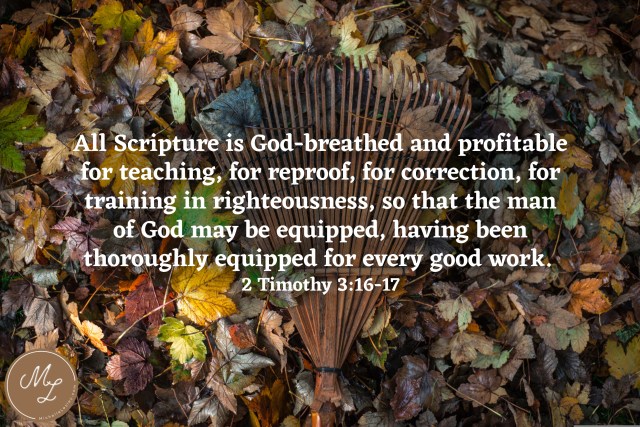
But this MSS is not selling you the right tool for your problem. Though I’m sure they have the noblest of intentions, they’re attempting to sell you a waffle iron to rake your yard with: movies as theology.

Though I’m sure they have the noblest of intentions, they’re attempting to sell you a waffle iron to rake your yard with: movies as theology.

I like movies. I watch them all the time with my family (at home- have you seen the price of a movie ticket lately?!?!). But movies are for leisure time fun and entertainment, not for proper instruction on how to live a godly life or the way to solve personal problems, and certainly not for what to believe about God, as we’ve recently seen with The Shack debacle. When Christians have issues, questions, and problems, we don’t go to the movies, we go to the Bible.

When Christians have issues, questions, and problems, we don’t go to the movies, we go to the Bible.

God’s word is the primary source document for Christians. It is the authority that governs our thoughts, words, and deeds. It is the sufficient answer to any question we might have about life and godliness. Above any other advice, instruction, help, or input, we need the Bible, and we can rest assured that its counsel is always right and trustworthy since its words come straight from the lips of God.

But just for the sake of argument, let’s try it the MSS’s way. Let’s say you do have the problem of being bullied. And let’s say this MSS has a good movie about a character in similar life circumstances to yours who overcomes being bullied. So you watch it, hoping to get some advice on how to handle your own problem. You’re a Christian, so, by definition, you want to address the situation without sinning, in a way that pleases God, and, hopefully, in a way that is conducive to sharing the gospel with the bully.

How do you know whether or not the character in the movie overcame her bullying problem in a godly way? That’s right- you have to open your Bible, study it, and compare what she did in the movie with rightly handled, in context Scripture. So why not just go straight to the Source and spend the hour and a half you invested in the movie studying Scripture instead?

Another issue with watching movies to learn how to solve your problems or teach you how to live rightly is that doing so subtly trains you in poor hermeneutics. It trains you to follow the example of a character who is just as broken, sinful, and unwise as you are instead of looking directly to the perfect, holy, infallible instruction of God Himself. Which is often the way people incorrectly read the Bible.

As I’ve previously mentioned, there are two main types of Scripture: descriptive and prescriptive. Like a movie, descriptive passages describe something that happened: Noah built an ark. Esther became queen. Paul got shipwrecked. These passages simply tell us what happened to somebody. Prescriptive passages are commands or statements to obey. Don’t lie. Share the gospel. Forgive others.

If we wanted to know how to have a godly marriage, for example, we would look at passages like Ephesians 5:22-33, 1 Corinthians 7, and Exodus 20:14,17. These are all passages that clearly tell us what to do and what not to do in order to have a godly marriage.

What we would not do is look at David’s and Solomon’s lives and conclude that polygamy is God’s design for marriage. We would not read about Hosea and assume that God wants Christian men to marry prostitutes. We would not read the story of the woman at the well and think that being married five times and then shacking up with number six is OK with Jesus. All of which is the same reason we should not be watching movies – even “Christian” movies – as a resource for godly living.

“But,” the kind MSS lady would probably reassure me, “our MSS also has non-fiction videos of pastors and Bible teachers that could be helpful.” And indeed they do. There are a handful of documentaries on missionaries, some of the Reformers, current moral and societal issues, and Bible teaching that look like they could be solid. The problem is, they’re mixed in with the likes of Joyce Meyer, John Hagee, Henri Nouwen, Greg Laurie, a plethora of Catholic leaders, and even those who don’t claim to be Christians like Betty White, Frank Sinatra, and Liberace. The few videos with good teaching are combined with many that teach worldly ideas, signs and wonders, mysticism, Bible “codes” and “secrets,” false prophecy, faulty eschatology, and other false doctrine.

It’s a great example of why God tells Christians we’re not to receive false teachers nor to partner with them, as, sadly, this MSS has chosen to do. Mixing biblical truth with false teaching confuses people. A little leaven leavens the whole lump.

When a little bit of truth is mixed in with the false, how are we to know which is which? We have to do exactly what the Bereans did with Paul- examine the teachings against Scripture, accept what matches up and reject what doesn’t. Again, why spend the time and confusion searching for, hoping you’ve found, and watching a video you’re not sure will teach you biblical truth when you could simply pick up your Bible, study it, and confidently believe what God says about the issue instead?

There are some good, clean movies on this MSS that would make for an enjoyable evening of family fun, and there’s certainly nothing wrong with that. But for instruction in holy living and resolving the dilemmas of life in a godly way, we need to use the right tool for the job: the Bible.

Rake your yard with a rake, not a waffle iron.

Rake your yard with a rake, not a waffle iron.

Discernment

Discernment: What’s Love Got to Do with It?

Originally published January 22, 2016

…so that we may no longer be children, tossed to and fro by the waves and carried about by every wind of doctrine, by human cunning, by craftiness in deceitful schemes. Rather, speaking the truth in love, we are to grow up in every way into him who is the head, into Christ…

Ephesians 4:14-15

Christians who know what discernment is have a variety of perspectives about how it should be practiced. Should we teach about false doctrine at all or just make sure our church is teaching sound doctrine? Should we name the names of false teachers or speak about them anonymously? Should we warn people away from false teachers or just pray for them privately? What’s the biblical precedent for using a stringent tone when speaking of those who teach false doctrine?

Recently, I’ve been thinking a lot about the phrase “speaking the truth in love” from Ephesians 4:15 as it pertains to speaking and writing about false doctrine and false teachers.

Many Christian women have the mistaken idea that “speaking the truth in love” equals being “nice.” We’re always smilingly sweet and never say anything that might hurt someone’s feelings or could rock the boat at church.

Many Christian women have the mistaken idea that “speaking the truth in love” equals being “nice.”

Are we to be kind? Yes. Are we to do our best not to hurt others? Of course. Should we be making waves over every little thing that rubs us the wrong way? Absolutely not. We are to deny ourselves, setting aside our personal preferences and, in many cases, even our own rights, to the point of laying down our lives for others.

We need to understand the distinction between personal preferences and biblical doctrine. We die *to* personal preferences. We die *for* the purity of biblical doctrine.

But we need to understand the distinction between personal preferences and biblical doctrine. And that’s where I think a lot of people get confused. We die to personal preferences. We die for the purity of biblical doctrine. The enemy is stealthily infiltrating and conquering church after church with false doctrine. We are at war. And that’s going to mean ruffling feathers, rocking the boat, and hurting feelings sometimes. Because the full armor of God doesn’t come with a white flag or a pen for signing peace treaties.

The full armor of God doesn’t come with a white flag or a pen for signing peace treaties.

But how do we war for the truth “in love”?

Well, think about the concept and practice of “love.” Love always has an object. We don’t just say, “I love.” We say, “I love my children,” or “I love peanut butter and chocolate ice cream.” Speaking the truth “in love” is not as much about our demeanor or tone of voice as it is about the object of our love. It’s our love for others that compels us to speak biblical truth. And it’s that same love for others that should drive the manner in which we speak the truth.

So when it comes to speaking the truth about false doctrine, how should we be motivated by love? And love for whom?

We love Christ– As Christians, our love for Christ should motivate everything we do. If we’re speaking truth from fleshly motives such as pride, the desire to make a name for ourselves, or the competitive drive to win an argument, everything we say can be 100% factually right and we can still be spiritually in the wrong because the motive of our heart is wrong. God isn’t a debate judge awarding us points for compelling arguments. God weighs the heart.

We love God’s Word– To love Christ is to love the Bible because Scripture is literally God Himself speaking to us. Besides the cleansing of the temple, the passage in which we see Jesus’ righteous anger displayed most clearly is Matthew 23. Here, Jesus delivers a scorching rebuke to the scribes and Pharisees for twisting God’s Word and, in doing so, leading people away from the truth of Scripture. It is only natural for those of us who have the mind of Christ and are indwelt by the Holy Spirit to have that same love for God’s word and feel righteous anger over the maligning of it.

We love the church– To love Christ is also to love His bride, the church. Christ gave his life to cleanse the church “so that he might present the church to himself in splendor, without spot or wrinkle or any such thing, that she might be holy and without blemish.” Seeing Christ’s bride blemished and corrupted by false doctrine should grieve us deeply and motivate us to call the church to be cleansed “by the washing of water with the Word.”

We love the captives– Paul speaks of false teachers “who creep into households and capture weak women.” Often, the women who follow false teachers simply don’t know any better. Though Scripture is clear that they’re complicit in their own captivity, they are casualties and prisoners of war held hostage by the enemy. We are to love them enough to show them the truth of God’s word so that “they may come to their senses and escape from the snare of the devil, after being captured by him to do his will.”

We love the enemyEvery Christian was at one time an enemy of the cross. Every last one of us. Until someone loved us enough to intervene with the truth of the gospel. False teachers – those who, despite biblical correction, unrepentantly teach doctrine which is plainly refuted by Scripture – have made themselves enemies of the cross, even if they call themselves “Christian,” even if they wear the title of “pastor,” even if they’re holding a Bible in their hands and refer to it occasionally as they “teach” us.

In the same way that a loving sister would not turn a blind eye and hope for the best if her sibling began using drugs and became increasingly addicted, it is not loving to stand idly by and allow false teachers to continue to sink deeper and deeper into Satan’s clutches by doing his bidding without making every effort to stop them in order to rescue them.

*It is not loving* to stand idly by and allow false teachers to continue to sink deeper and deeper into Satan’s clutches by doing his bidding without making every effort to stop them in order to rescue them.

Sometimes – just as with the drug abuser – this can be accomplished early on with a private word of correction. And sometimes – as with the addict – more extreme measures of “tough love” and intervention must be employed. But we always love them enough to desire that they come to repentance and embrace the truth.


Our love for these also drives the manner in which we speak truth to them. A good soldier would never deal with a civilian casualty in the same way he would fight off an enemy bent on waging war. Likewise, part of discernment is knowing who the enemy is (and is not) and dealing with people in a biblically appropriate way. This requires humility, wisdom, thorough proficiency with our tools and weapons, unceasing prayer, and complete dependence on and self-crucifying love for our King. We trust in Him and His Word to guide us in the wise and loving way to humbly speak His truth.

Discernment. Speaking truth. What’s love got to do with it?

Everything.

Discernment. Speaking truth. What’s love got to do with it? Everything.

Christian women, Heaven

Weak Women and the Idolatry of Personal Experience

Originally published April 17, 2015

Well, here we go again. Another child claims to have taken another trip to Heaven complete with another face to face conversation with Jesus. Oh, and the child’s mother has written a book about it which prosperity pimp, T.D. Jakes, has optioned for his second unbiblical “I went to Heaven” movie. (Heaven is for Real was the first one.)

The gist of the story is that this sweet little girl, Annabel, was climbing a tree when a branch broke, causing her to fall head first, thirty feet into a hollow tree, where she was stuck for five hours. It’s unclear from the reports I’ve read whether this was actually a near death experience, the reports mentioning only that she was “unconscious” at some point (this is when she supposedly “went to Heaven”), and that she was rescued without injury. Additionally, Annabel had suffered for years with a very serious intenstinal disease, and after her accident, became asymptomatic.

These are nice people. Sincere people. The kind of people I’d probably be friends with if they went to my church.

And they have nicely, sincerely, and with the best of intentions fallen into what I think is the number one theological error facing Christian women today, namely, believing and trusting in human experience over God’s Word.

It’s perhaps the number one theological error facing Christian women today: believing and trusting in human experience over God’s Word.

Now, I don’t doubt the facts of this story: that Annabel had a dangerous and frightening accident, that she lost consciousness and had some sort of experience before awakening, that she had a serious intestinal disease, and that, in God’s perfect timing, He chose to heal Annabel shortly after this tree accident.

And the reason I don’t doubt any of that is that it is all based in verifiable fact (unless someone comes forward with documented evidence to the contrary) and none of it conflicts with God’s Word.

But an actual “trip to Heaven”? That’s not based in verifiable fact and it does conflict with God’s Word.

If you feel upset with me right now for saying that, I’d like to ask you to examine why that is. Why are you upset? On what do you base your belief that this child (or anyone else outside of documented cases in Scripture) has actually made a real trip to Heaven and come back to tell about it? Her say so? This child was nine years old when this happened. Nine. Colton Burpo (Heaven is for Real) was three. Alex Malarkey (The Boy Who Came Back from Heaven– which Alex has been recanting for years) was six.

Have you ever spent any time talking to a nine year old, a six year old, a three year old? A lot of them will tell you they believe in Santa Claus and the tooth fairy, or that they have an imaginary friend, or that they’re a super hero. They’re very sincere and they aren’t lying, but they’re also very wrong because their beliefs are not based in fact and are strongly influenced by their immaturity. So why are we so quick to believe, based solely on their own say so, that the experiences these children had while unconscious were actual trips to Heaven?

For the same reason we love chick flicks and fairy tales and Hallmark movies, ladies. These stories appeal to our emotions. They make us feel good just like a rich piece of chocolate on a stressful day. And when you slap the “God” label on a story of childlike wonder coming out of a nice Christian family, our belief not only makes us feel good, we also feel justified in believing the story.

And God’s word says that kind of mindset is not for strong, discerning, godly women, it’s for weak women.

But understand this, that in the last days there will come times of difficulty. For people will be lovers of self, lovers of money, proud, arrogant, abusive, disobedient to their parents, ungrateful, unholy, heartless, unappeasable, slanderous, without self-control, brutal, not loving good, treacherous, reckless, swollen with conceit, lovers of pleasure rather than lovers of God, having the appearance of godliness, but denying its power. Avoid such people. For among them are those who creep into households and capture weak women, burdened with sins and led astray by various passions, always learning and never able to arrive at a knowledge of the truth.

2 Timothy 3:1-7

When we hold these “I went to Heaven” experiences (whether from children or adults) up to the light of Scripture, they crumble, from Hebrews 9:27, to the descriptions of God, Jesus, and Heaven that clearly contradict Scripture (and contradict the descriptions from other people who supposedly went to Heaven and came back), to the sufficiency of Scripture, to the stark difference between Paul’s and John’s scripturally verified trips to Heaven and the trips supposedly being taken today (interestingly, Paul was stricken with a “thorn” after his trip to Heaven “to keep me from becoming conceited because of the surpassing greatness of the revelations” while Annabel’s healing is being offered, in a whirlwind of publicity events, as proof that she went to Heaven), to the fact that the Bible doesn’t say anywhere that this kind of spiritual experience is valid or appropriate for Christians today.

The people who claim to have gone to Heaven had some sort of experience while unconscious, no doubt, but if they say that experience was an actual trip to Heaven, they are either mistaken or lying. It could have been a dream, a hallucination, an experience initiated by demons (let’s not forget that Satan was once an angel and continues to disguise himself as an angel of light), or a lie they’ve concocted, as was the case with Alex Malarkey. Yet, for some reason, Christian women, who, if asked point blank, would say that they believe the Bible is our ultimate authority for Christian belief, plunk down money for these books, movies, and other accessories, and eat these stories up with a spoon without ever engaging their brains and checking these supposed eyewitness accounts of Heaven against Scripture.

For some reason, women who would *say* they believe the Bible is our ultimate authority, eat these stories up with a spoon without ever engaging their brains and checking these supposed eyewitness accounts against Scripture.

But “heavenly tourism” stories aren’t the only area in which we’re choosing to believe someone’s experience over Scripture.

Do you follow someone like Joyce Meyer, Beth Moore, Priscilla Shirer, Christine Caine, Lysa TerKeurst, or Paula White? These women all say that God “called” them to do what they do, which includes preaching to and instructing men in the church setting. Do you believe them when they say God “called” them? If so, you’re believing their supposed experience over the crystal clear Word of God in 1 Timothy 2:11-3:7 (and plenty of other passages) which expressly forbids women from instructing men in the Scriptures or holding authority over men in the church.

And even putting aside the false and unbiblical doctrine these women teach, how many times have you heard one of them begin a sermon or teaching – not by reading God’s word and accurately teaching what the Bible says- but by telling a story about how God ostensibly “spoke” to them, acted in their lives in some way, or sent them a dream or a sign, and then basing their teaching on that experience rather than on God’s word? If you heed that kind of teaching, you’re believing their experience, not God’s Word.

What about when it hits a little closer to home? You know God’s Word says that homosexuality is a sin, but your 20 year old comes home and announces he’s marrying his boyfriend. So you just throw out that part of God’s Word in favor of a happy experience with your son. You defend your right to swear like a sailor despite what God’s Word says to the contrary. You “feel” that it was just fine for you to divorce your husband because you fell out of love with him, even though that’s not a biblically acceptable reason for divorce.

Ladies, if God’s word says it ain’t so, it ain’t so, no matter what you or I or anyone else experiences to the contrary.

Ladies, if God’s Word says it ain’t so, it ain’t so, no matter what you or I or anyone else experiences to the contrary. And it doesn’t matter how real or vivid or intense that experience was or how right or godly it seemed– God’s Word, and God’s Word alone defines reality, truth, existence, right and wrong. And we’d better get with the program and submit to its authority. If not, well, I guess we’ll prove the truth of what Paul said by choosing to be those women he talked about: weak, burdened with sins, led astray by our emotions, and always learning yet never able to arrive at a knowledge of the truth.

God doesn’t want you to be weak. He wants you to be a mighty woman of His word.

God doesn’t want you to be weak. He wants you to be a mighty woman of His word.

Sanctify them in the truth; your word is truth.
John 17:17


90 Minutes in Heaven on the Big Screen?

The Burpo-Malarkey Doctrine

Heaven Tourism

LifeWay Christian Stores Remove All ‘Heaven Tourism’ Books From Shelves After ‘Boy Who Came Back From Heaven’ Story Confirmed as a Lie

Discernment, False Teachers

You Might Be Apostate

Originally published June 3, 2016

Comedian Jeff Foxworthy hit the big time several years ago with his “You Might Be a Redneck” one-liners. He frequently introduced the bit by saying, “I’ve found that there are rednecks all over, but sometimes people don’t know they’re rednecks. So, I came up with this little test…” and continued with such gems as:

“If you’ve ever had to carry a bucket of paint to the top of a water tower to defend your sister’s honor, you might be a redneck.”

“If your wife has ever said, ‘Honey, come get this transmission out of the tub so I can take a bath!’ you might be a redneck.”

“If you’ve ever been accused of lying through your tooth, you might be a redneck.”

It was a routine that a lot of us in the South found hilarious because we knew someone (or were someone) who fit nearly every one of Jeff’s jabs.

Like rednecks, there are apostate false teachers all over the place out there, only a lot of them (and their disciples) don’t know they’re false teachers. And the fruit of their lives and ministries is far wackier than anything a redneck has ever dreamed up. That fruit is a sign that we’d better examine the root of doctrine from which the fruit sprang.

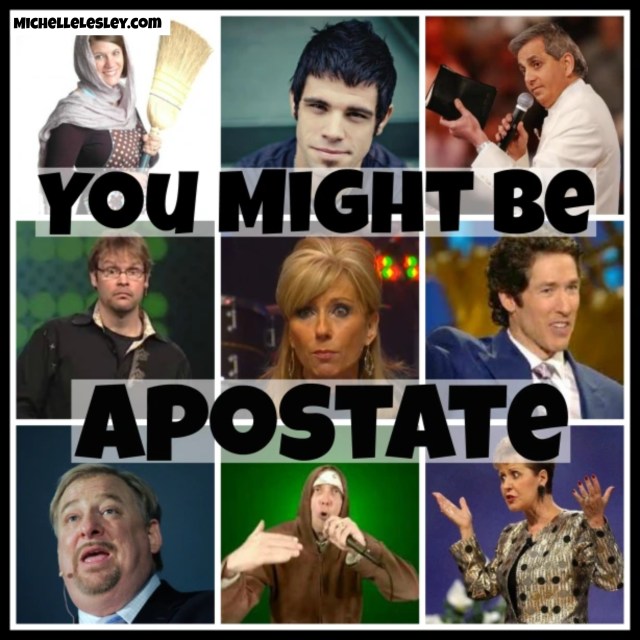
So if any of the preachers and teachers you’re following have ever said or done the following things (or something even crazier), watch out, because they Might Be Apostate.

HoNuthaLevel

If you’re a middle aged pastor who makes embarrassing rap videos, who publicly extols the virtues of Spanx for men (even though it gives you gas) and who calls himself a Ferrari you might be apostate.

If you feature a Naked Cowboy impersonater (aka- your youth “pastor”) at your “Christian” women’s conference, you might be apostate.

If you’ve ever purposefully applied the pronoun “herself” to God, you might be apostate.

If you celebrated your 35th birthday by preaching at the “church” of your mentor, T.D. Jakes, and placing a $35,000 check in his offering wheelbarrow, you might be apostate.

If God has ever told you to go up to a stranger in the airport and ask if you can brush his hair, you might be apostate.

If you’ve ever given your congregation a sob story about needing a new $70 million Gulfstream jet, because the old one is worn out, you might be apostate.

If you think of the Holy Spirit as the “sneaky,” “silly,” “funny,” “blue genie from Aladdin,” you might be apostate.

If you’re a woman who thinks God is OK with you preaching to men despite what His Word clearly says to the contrary, you might be apostate.

If you’ve ever said, regarding your church’s worship service, “I probably wouldn’t have a stripper on stage…” but leave the door open to the idea because “God told Isaiah to walk around naked for three years,” you might be apostate.

Benny Hinn at Maple Leaf Gardens on Sept. 28, 1992 photos by Tony Bock/Toronto Star and handout photo.

If you think smacking people in the face with your Nehru jacket is a ministry of the Holy Spirit, you might be apostate.

If you’ve ever typed a Facebook status in tongues, you might be apostate.

If you say you’re a trinitarian, but think the Father, Son, and Holy Ghost are three “manifestations” of God rather than three Persons, you ARE apostate.

If you think Proverbs 21:9 means you should camp out on your roof in a quest for biblical womanhood, you might be apostate.

If your senior pastor father sexually abused boys at your church and paid them off to keep them quiet and you, as the subsequent pastor, knew about it but didn’t speak up, you might be apostate.

If you officiated at your homosexual son’s “wedding,” you might be apostate.

If you’re a pastor who thinks expository preaching is “cheating” because it’s “too easy” and that “it’s not the way you grow people” AND that we shouldn’t say “the Bible says…” AND that parents who take their children to a small church instead of a mega church are “stinkin’ selfish,” AND that we shouldn’t use the Bible to convince the lost of their need for Christ, AND that we need to “unhitch” from the Old Testament, you might be apostate.

If you’re Oprah’s idea of an awesome pastor, you might be apostate.

download

If your preaching, ministry, and theology have ever been publicly rebuked by John MacArthur, Paul Washer, or Justin Peters, you might be apostate.

If you partnered with a Roman Catholic mystic with a degree in spiritual psychology to make a completely unbiblical movie about the Bible featuring ninja angels and Mary Magdalene bossing the disciples around, you might be apostate.

If you and your 80s rock star third husband stand in the pulpit and tell people to watch porn to improve their sex life, you might be apostate.

If a feature of your “worship service” is people laughing uncontrollably or barking like dogs, you might be apostate.

If you’ve ever decided to “p*ss off the religious people” on Easter Sunday by playing AC/DC’s Highway to Hell to open the service, you might be apostate.

If you’ve written a book entitled “I Am” and it’s about positive confession rather than Jehovah, you might be apostate.

If you think you have the power to control the weather by the words you speak, you might be apostate.

Joyce-Meyer-600x450

If you think that between the cross and the resurrection Jesus went to Hell and that Satan and the demons jumped up and down on His back, you might be apostate.

If the top three “pastors” you encourage people to follow on Twitter are T.D. Jakes, Rick Warren, and Joel Osteen, you might be apostate.

If a currently practicing homosexual couple wants to serve in leadership at your church and your only problem with it is that one of them isn’t yet divorced from his wife, you might be apostate.

If you’ve ever been accused of having an affair with Benny Hinn, you might be apostate.

If, a hundred years ago, your worship leaders might have been carted off to the funny farm or treated to an exorcism for conducting themselves like this, you might be apostate.

And, if you’re about to write a comment rebuking me for marking false teachers to avoid and exposing unfruitful works of darkness because Jesus would never do such a thing then you don’t know your Bible.

And you just might be apostate.

Christian women, False Doctrine

Throwback Thursday ~ 8 Unbiblical Notions Christian Women Need to Be Set Free From

Originally published June 2, 2017

Your recent article on prayer really helped me. I was always taught that prayer was a two-way conversation. For years, I would talk to God and wait for Him to talk back to me, but He never did. I thought it was because there was unknown sin in my life, or that I didn’t have enough faith, or that God just wasn’t interested in me. It’s so freeing to know the truth.

Comments like this from readers are always bittersweet for me. It makes me practically giddy to hear from Christian women who have been set free from false doctrines they’ve been taught, but it also grieves me deeply to reflect on the years they spent thinking they were somehow deficient as Christians or doubting God’s love for them simply because they were taught, and believed, unbiblical notions and ideas.

Let’s see if we can dispel a few of those today:

1. Prayer is this big, complicated, mystical thing.
Nope. Prayer is simply talking to God about whatever is on your heart. What’s made prayer complicated is the unbiblical teachings that have grown up around it such as praying in “tongues,” listening prayer, contemplative prayer, sozo prayer, soaking prayer, etc.

8 Things You Need to Know about Prayer

2. “Women’s Ministry” equals fluff and silliness.
There’s nothing wrong with having a little fun from time to time. Hey, we all need to blow off steam, right? But if cookie exchanges and teas and painting parties and dress up parties and sleepovers and makeup parties and fashion shows and movie nights are all your women’s ministry does, it’s unhealthy. And it’s not really a ministry, either. If something is a “ministry” it should exist to point people to Christ and disciple them once they get to Him. Your women’s ministry should include ministry of the Word, discipleship, evangelism, comfort ministry (to the ill, shut-ins, new moms, new members, etc.), serving the church, encouragement, supporting your pastor and elders, and so on.

Mary and Martha and Jesus and Women’s Ministry
Biblical Women’s Ministry – Part 1
Practical Women’s Ministry – Part 2

3. Women’s Bible study- great balls of fire, don’t get me started.
♦ A Bible verse (or half a Bible verse) plus an inspiring story from the author’s or someone else’s life is not Bible study. Bible study is picking up your Bible and studying it.

Bible Study
Bible Studies

Bible study is picking up your Bible and studying it.

♦ If you’re hosting a women’s Bible study, you do not have to use books and DVDs written by someone else. In fact, I would recommend against doing so. Get someone who is able to teach – yes, it could even be a man – and study a book of the Bible from beginning to end.

You’re Not as Dumb as You Think You Are: Five Reasons to Put Down that Devotional and Pick Up the Actual Bible

McBible Study and the Famine of God’s Word
Can you recommend a good Bible study for women/teens/kids?

♦ One reason I recommend against using “canned” women’s Bible studies is that the vast majority of them (95% in my estimation- not an exaggeration) teach false doctrine. When you walk into most Christian bookstores the first thing you’ll see is the best sellers shelf, and the majority of those books are written by false teachers such as Beth Moore, Priscilla Shirer, Christine Caine, Lysa TerKeurst, Sarah Young, and others.

Popular False Teachers
The Mailbag: “We need to stop relying on canned studies,” doesn’t mean, “We need to rely on doctrinally sound canned studies.”.

♦ If you do decide to occasionally do a book study, you do not have to use one written by a woman. In fact, if you want a book that’s doctrinally sound, you have a much better chance of finding one written by a man than by a woman, sad to say. Check out some godly men who are pastors, authors, and teachers at…

Recommended Bible Teachers

4. Faithful church attendance isn’t that important.
If you think you don’t need church or that you can skip it whenever something more fun comes along, your thinking isn’t biblical. God thinks it’s important enough for His people to gather regularly for worship that He emphasizes it throughout the entirety of Scripture- Old and New Testament. Get your heiney in the pew every week, honey, and find a place to serve.

7 Reasons Church is Not Optional and Non-Negotiable for Christians
Searching for a new church?

5. I am woman, hear me roar.
♦ Beth Moore and many other female teachers who rebel against Scripture by preaching to and teaching men in the church say that they are doing so “under their husband’s and/or pastor’s authority”. Neither your husband nor your pastor has the OK from God to allow you, or any other woman, to teach men in the church. God says women aren’t to teach or hold authority over men in the church, and when God says no, no one has the authority to say yes. Furthermore, there isn’t a single passage of Scripture that allows any man to give any woman this type of “under my authority” dispensation to teach men. To say that it’s permissible for a woman to teach men “under her husband’s/pastor’s authority” is just as biblically absurd as saying it’s OK for a woman to lie, commit adultery, gossip, or steal “under her husband’s/pastor’s authority.” Sapphira sinned under her husband’s authority and look what happened to her.

Fencing Off the Forbidden Fruit Tree
Jill in the Pulpit

Ten Things You Should Know About 1 Timothy 2:11-15 and the Relationship Between Men and Women in the Local Church at CBMW

Neither your husband nor your pastor has the OK from God to allow you, or any other woman, to teach men in the church.

Egalitarians are often so vehement in their insistence that women should teach men and hold authority over men in the church, that they are essentially saying that the only way a woman’s service or leadership in the church can have any value is if it’s exercised over men. I’ve heard many of them turn up their noses at the idea of teaching women and children and other forms of service (that don’t involve teaching or authority over men), in a haughty “we’re better than that” kind of way.

No way.

Have you seen the garbage women and children are being taught in the church under the guise of “Sunday School” or “Bible study”? Women’s and children’s classes at your church are in desperate need of women who are doctrinally sound and able to teach. What about the need to visit church members who are in the hospital or shut-ins? How about record-keeping, working in the sound booth, welcoming visitors, serving on committees, mowing the church’s lawn, participating in outreach activities, fixing a meal, chaperoning youth activities, hosting a visiting pastor or missionary? There’s a ton of important and valuable work for women to do in the church. We don’t have time to worry about teaching and holding authority over men. Let the men worry about that.

Servanthood
Let Me Count the Ways: 75 Ways Women Can Biblically Minister to Others

6. My feelings and opinions reign supreme.
Uh uh. Not if you’re a Christian, they don’t. That’s how lost people operate. If you’re a Christian, you’re not entitled run your life or make decisions by any opinion other than that of your Master. What He says – in His written word – goes. Period. Regardless of how you feel about it or whether or not you agree with it. That means if a “Bible” teacher you really like is teaching things that conflict with Scripture, you dump her. You love Mr. Wonderful and want to marry him, but he’s not saved? Nope. You’re a woman who’s certain God has called her to preach? No way. Your husband has said no about something, but you want to do it anyway? Forget it.

The Bible is our Authority
Bad Fruit, Diseased Trees, and the Authority of God’s Word

7. If something or someone claims to be a Christian, it is.
I suppose at some point in Christian history, there might have been a time when, if someone handed you a “Christian book,” it was a pretty safe bet it was doctrinally sound. Or if someone said she was a Christian, you could be fairly certain she was truly born again.

Not so much these days.

You cannot take at face value that someone who says she’s a Christian is using the Bible’s definition of Christianity and has been genuinely regenerated. You cannot trust that just because something is sold at LifeWay or another Christian retailer that it’s doctrinally sound. You can’t assume that just because someone is a “Christian” celebrity, writes “Bible” studies, speaks at “Christian” conferences, and has a large following, that she’s handling God’s word correctly (or at all) and teaching you biblical truth. There’s just too much false doctrine running rampant in evangelicalism and too many people who believe and teach it.

Don’t be a weak and naïve Christian woman. Jesus Himself said, “Not everyone who says to me, ‘Lord, Lord’ will enter the kingdom of Heaven…” There are many people who draw near to God with their lips, but their hearts are far from Him. It is God’s will for you to be a good Berean and to test everything according to Scripture. We will know the truly Christian from the false by their fruits, not their platitudes.

8. Sugar and spice and everything nice- that’s what Christian girls are made of.
That’s not a Bible verse, but rather and unspoken rule among most Christian women. Somewhere we’ve gotten the idea that Christian unity or love means “being nice” to people. We’re always smilingly sweet and never say anything that might hurt someone’s feelings or could rock the boat at church.

Are we to be kind? Yes. Are we to do our best not to hurt others? Of course. Should we be making waves over every little thing that rubs us the wrong way? Absolutely not.

But neither is it loving to see a Mack truck bearing down on an oblivious sister in Christ and refrain from yanking her out of harm’s way because it might dislocate her shoulder. It is not unity to see Satan deceiving a friend through sin or false doctrine and not plead with her to turn to Christ and His word because she might think we’re rude. And that’s the situation we often find ourselves in at church or with Christian friends.

Was Jesus – our perfect example of love – being unloving, unkind, hateful, or divisive when He rebuked the Pharisees, cleared the temple, or said, “Get behind Me, Satan!” to Peter?

Love for the brethren isn’t “being nice.” It’s caring so much about a fellow saint that we want what’s best for her in Christ. Sometimes that requires being firm, confrontational, or demonstrating “tough love.” People’s eternities and spiritual health are at stake. How loving is it to stand aside and let a sister waltz into Hell or struggle for years on end in her walk with the Lord because she’s living in sin or believing false doctrine? “Being nice” isn’t a fruit of the Spirit. It’s time we stop being nice and start being biblical.

I Can’t Sit Down, Shut Up, and Play Nice
Discernment: What’s Love Got to Do with It?

“Being nice” isn’t a fruit of the Spirit. It’s time we stop being nice and start being biblical.

Do you believe any of these unbiblical notions? If so, set them aside, repent, and believe and practice what Scripture says. Any time we believe something that’s in conflict with God’s word, it’s a hindrance to the abundant life and growth in Christ that He wants to bless us with.

False doctrine enslaves. It places a yoke of confusion, anxiety, and “try harder” on the shoulders of those who embrace it. Christ did not set us free from sin so that we might turn right around and become captives to a new, pseudo-Christian type of sin: false teaching. It is for freedom and a healthy spiritual life that Christ has set us free.

Christ did not set us free from sin so that we might turn right around and become captives to a new, pseudo-Christian type of sin: false teaching.