Relationships

How Can We Be Friends? 4 Biblical and Practical Considerations for Co-Ed Christian Friendships

Any time an issue regarding the roles and relationships between Christian men and women comes up, there’s bound to be an airing of opinions. Strong opinions. And the social media opinions du jour are about friendships between Christian men and women. What’s appropriate? What’s not? Can Christian men and women have genuinely platonic friendships? Twitter is currently all a-chirp over Aimee Byrd’s new book Why Can’t We Be Friends? which addresses…

…the way to stand against culture is not by allowing it to drive us apart—it is by seeking the brother-and-sister closeness we are privileged to have as Christians. Here is a plan for true, godly friendship between the sexes that embraces the family we truly are in Christ and serves as the exact witness the watching world needs.
P&R Publishing, About: Why Can’t We Be Friends by Aimee Byrd

I guess it’s just the way my brain is wired, but when I first heard about Aimee’s book, my initial reaction was along the lines of, “Oh. OK. Sounds interesting…Why do we need a book about this?”. It was the same kind of reaction I’d have if somebody came out with a book about humans needing to breathe air or fire being hot. Yeah. That’s a given. Brothers and sisters in Christ have been friends for upwards of 2000 years now. I don’t understand what else there is to say about that.

But the more I thought about it – the way people have lost their ever lovin’ minds about how to properly relate to, even talk to, one another – the more I thought maybe this book was a good idea. In a world where a man can’t even stand next to Beth Moore and be taller than her without being accused of misogyny, perhaps a remedial course on the most basic of human relationships is in order.

I haven’t read Aimee’s book, so this isn’t a critique or review of it (you can read a detailed review by Amy Mantravadi here), but I did listen to her interview about Why Can’t We Be Friends on Theology Gals, and I didn’t hear anything problematic in Aimee’s description of her perspective on the subject. From what I’ve heard and read, I probably wouldn’t agree with Aimee about every single thing in the book, but I have no reason to believe she is advancing any unbiblical ideas, and that Why Can’t We Be Friends will likely prove a helpful biblical resource for many. My advice: If you want to know what Aimee thinks and whether or not it’s biblical, read the book and compare it to rightly handled Scripture.

But as I continued to think about and read discussions about the issue – especially in light of words like “misogyny”, “sexism”, and “abuse” being bandied about in evangelicalism like so many badminton birdies – I started seeing some aspects of this topic I wanted to address. Why can’t Christian men and women be friends? How can we be friends? Are there any potential problems we need to anticipate? Here are four practical and biblical things to take into consideration as we contemplate friendships between the sexes.

1.
Defining Our Terms

One of the first whiffs of controversy I caught about Aimee’s book was a Christian gentleman’s emphatic no to the question of whether or not men and women could be friends. His reasoning? Co-ed friendships would inevitably lead to adultery. As the conversation progressed, comments were made by more than one man suggesting that the only female friend a man should have is his wife. Why? Because these gentlemen were defining friendship as a deeply emotionally intimate relationship- the kind of spiritually bonded relationship you should only have with your spouse.

Well, OK, if that’s the way you define friendship, you’re right. You shouldn’t have that kind of relationship with anyone of the opposite sex. Or the same sex either. That “oneness” kind of friendship is restricted to one person on the planet- your spouse. Defining friendship this way essentially restricts you to no friends until you get married, and one friend thereafter.

The thing is, that’s not how 99.999% of people define the word “friendship.” That’s how people define the word “spouse.” That’s why we have two different words – friend and spouse – because they denote two different types of relationships. Your spouse should certainly be your friend, but your friend doesn’t have to be your spouse.

The concept of friendship is much more fluid, and generally, more broadly defined than unhelpfully equating “friend” with “spouse”. There is a spectrum of intimacy with others that ranges from “I just met this person” on one end to “I’ve been blissfully married to this person for 80 years” on the other end, and all kinds of levels of affinity in between.

There’s the “hello at the mailbox, can I borrow your rake” neighbor whose last name you might not even know, casual acquaintances like store clerks and stylists whom you see occasionally and make perfunctory small talk with, regular acquaintances like co-workers and people you’re friendly with at church but don’t socialize with outside that venue, couples you and your spouse are friends with and spend time with, “shared interest” friends (Civil War buff buddies, gardening buddies, etc.), social media friends, good friends who share a very emotionally close, personal relationship, and then there’s your spouse.

All of those people can be classified, at one level or another, as “friends”. Maybe the question shouldn’t be “Can Christian men and women be friends?” but “Which levels of friendship are biblically appropriate for Christian men and women to engage in?”

2.
Talk About It

If you’re married, especially if there have ever been issues of infidelity or insecurity for either of you, it’s wise to talk out what you’re both comfortable with when it comes to friendships outside the marriage.

It should be a no-brainer that neither of you should have any friendships that even come close to the emotional intimacy, affection, energy, and time you expend with each other. That’s not usually much of a problem for men, but, ladies, what about that close relationship you have with your mother, your sister, or your dearest girl friend? When you get phenomenal news – or devastating news – who is the first person you want to run to and share it with? If it’s anybody other than your husband, that’s a signal that you’re probably too close to that friend and not close enough to your husband.

But beyond being first in each others’ lives, what would be helpful and godly in your marriage regarding opposite sex (or even same sex) friendships? How much time is too much time to spend with a friend? What about going places together, talking on the phone, exchanging e-mails or private messages on social media? Which of the aforementioned “levels” of friendship should be restricted to members of the same sex? Discuss what each of you are OK with and not OK with, and why, avoiding the appearance of evil, and be sure to discuss practical safeguards you can each take against temptation.

If you’re single, these things are just as important to consider. Pray about them, discern how God would have you prioritize your friendships, and the time and emotional intimacy He would have you invest in them. And in the same way you reserve sexual intimacy for marriage, determine to reserve your deepest emotional intimacy for marriage, should that be God’s plan for you, as well.

3.
Different Ways to Be Friends

I think one thing that people who give a staunch and unwavering “no” to friendships between men and women might not be taking into consideration is that a proper, biblical, platonic friendship between a man and a woman isn’t going to look like a proper, biblical, platonic friendship between two women or two men.

My good friend, Darlene, and I text back and forth all the time, private message each other on Facebook, go out to lunch, and spend hours talking one on one. We even went to a conference earlier this year, driving several hundred miles back and forth and rooming together once we got there.

I am also friends with Darlene’s husband. Do I spend as much time with him? Do I spend time with him the same way I spend time with Darlene? Of course not. I talk to him at church, at fellowships, when the four of us spend time together as couples, sometimes (publicly) on social media, and the once in a blue moon informational-type e-mail. The dynamic is totally different. First of all, I’m on a lower level of “friendship intimacy” with him than I am with Darlene. Second of all, it would appear – and would be – inappropriate for me to spend time with him in the same ways I do with Darlene. And, finally, I wouldn’t want to make Darlene or my own husband uncomfortable.

I’m friends with both Darlene and her husband, but I’m friends with each of them on different levels of intimacy and I’m friends with each of them in different ways. To maintain biblical decorum, and to guard our hearts against temptation, friendships between men and women are necessarily going to look different from same gender friendships in the ways we spend time together and how much time we spend together.

4.
Can You Handle It?

An interesting dynamic about this back and forth over whether or not men and women can be friends is that, at least in the conversations I observed, men were more likely to say no, and women were more likely to be the ones promoting the idea of friendship between the sexes and not seeing a problem with it.

Ladies, we don’t get to make the across-the-board pronouncement that co-ed friendships between Christians are fine just because it wouldn’t be problematic for us. Furthermore it should give us pause that good, godly men are saying, “No. There are concerning issues here.” We need to sit down and actually listen to what they’re saying as a group and as individuals.

God created men and women differently. We are wired for relationships differently. That doesn’t mean women are wired right and men are wired wrong and they just need to get over it. It means we approach relationships differently. God created those different approaches and they are both good.

And when our brothers in Christ are saying, “We can’t handle this kind of relationship with you the way you want us to,” we need to respect and value that input into the conversation as much as we respect and value the input from our side of the aisle.

When it comes to individual friendships between a particular man and woman, that same respect and value for what another person can or can’t handle also has to hold sway. Every person is different. There are men you could put into a room full of naked women and they’d be obliviously critiquing the way the painter spackled the walls. There are other men for whom lust is such a temptation that they would have difficulty carrying on a five-minute conversation with a moderately attractive woman. Women are the same way. We all have varying levels of temptation to physical or emotional lust.

Through study of the Word, prayer, and, if you’re married, a healthy relationship with your husband, know your own limitations. Walk circumspectly, wisely, and obediently to Christ. Respect your male friends and acquaintances, and give them the space they need. They are probably trying to walk obediently, too.


Can men and women be friends? Of course. It’s how to be friends with one another that we need to pursue with wisdom, love, respect, holiness, purity of heart, and biblical propriety.

Mailbag

The Mailbag: Potpourri (Calvinism, Baptism, Modesty…)

Welcome to another “potpourri” edition of The Mailbag, where I give short(er) answers to several questions rather than a long answer to one question. I also like to take the opportunity in these potpourri editions to let new readers know about my comments/e-mail/messages policy. I’m not able to respond individually to most e-mails and messages, so here are some helpful hints for getting your questions answered more quickly. Remember, the search bar can be a helpful tool!


I was very troubled by a recent stance the discernment ministry Lighthouse Trails has taken – calling Calvinism heresy – and wondered if you had seen it. It’s one thing to just have a difference of opinion on Calvinism, but to put it this category?¹

Yes, I saw it when they made the big announcement on social media a few months ago. I expressed my disappointment to LT and have decided, going forward, not to use their materials or point readers to them as a trustworthy resource. There are several reasons for this:

1. The tone used in most of the LT anti-Calvinist posts, comments, and articles was derisive and condemnatory at best. There is no place for that among Believers, regardless of their stance on Calvinism (frequent readers will note I don’t recommend Reformed resources that take this sort of tone either).

2. It was clear from the LT materials I read that they don’t even have a complete and accurate understanding of what Calvinism is. Indeed, some of what they addressed was not Calvinism (which is biblical Christianity) but Hyper-Calvinism (which is heresy). That does not speak well of a discernment ministry. You must have a correct understanding of a doctrine before attempting to address it biblically, especially if you’re going to come to the conclusion that something is “another gospel” (heresy) as LT did with Calvinism.

3. Addressing a doctrine they haven’t thoroughly researched, as well as anathematizing something that is clearly biblical Christianity (even if they don’t agree with it), calls the discernment and biblical understanding of the entire organization into question and casts doubt on LT’s previous and future evaluations of doctrine. In other words, if they’re going to make this egregious an error over such a simple – and settled – biblical construct, how can any of their conclusions on other, more nuanced aspects of theology be trusted?

Here are some additional resources you may find helpful:

What is Calvinism? by Maurice Roberts

Calvinism & the Bible by Brian Godawa

What’s the Difference Between Arminianism, Calvinism and Hyper-Calvinism? by Tom Ascol

Calvinism Is Not Hyper-Calvinism by Josh Buice


I had viewed the Gospel Message video embedded on your site and had concern for the presentation. It is apparent you have hermeneutical concern for today’s God study, so I wanted to clarify what your view may be on baptism.

I hold to a Reformed Southern Baptist, credo-baptist understanding of baptism. You can find further details at these links:

Statement of Faith (tab at top of this page)

Basic Training: Baptism

(Remember, the search bar and the tabs at the top of the blog are your friends! :0)


I have only recently come to understand 1 Timothy 2:12. However, why do we so passionately receive verse 12, yet neglect verse 9? Why do people choose which parts of the Bible to obey?

No Christian should be making a conscious choice to disobey any command(s) of Scripture that pertains to Christians. Willful disobedience is sin which needs to be repented of, and might even indicate that the person is not saved. Genuinely regenerated Christians desire from the heart to keep God’s commands.

I am not sure whether your question is based on your own church (or local churches you’re familiar with) in which women embrace their biblical roles but are dressing immodestly, or if you’re seeing a lot of attention focused on verse 12 (in books, online articles, conferences, organizations, sermons, social media, etc.) and not as much on verse 9.

If it’s the latter, I would say that you’re seeing a lot of attention focused on verse 12 rather than verse 9 for the same reason you see firemen hosing down a house that’s on fire rather than hosing down one that’s not. When the day comes that celebrity “Christian” women get up on stage dressed immodestly, write books about how dressing immodestly is perfectly biblical, form organizations to push the immodest dress agenda, hold conferences extolling immodest dress, and encourage other women to dress immodestly as they worship, I think you’ll see the same kind of pushback with verse 9 that you’re seeing now with verse 12.

If what you’re asking about is women at your church who embrace their biblical roles but seem not to be obeying verse 9, first make sure you have a correct understanding of what verse 9 is talking about:

likewise also that women should adorn themselves in respectable apparel, with modesty and self-control, not with braided hair
and gold or pearls or costly attire,

a) The context of 1 Timothy, including chapter 2, is instructions for the gathering of the church. So, while Christian women should dress in a way that glorifies God at all times simply because we belong to Christ, this particular verse is about how we dress for church, not for a gala, the beach, or the gym.

b) “Braided hair and gold or pearls” are examples – much like head coverings – of specific things that were considered immodest in the time and culture in which 1 Timothy was written. If a woman comes to your church with her hair in a French braid or wearing an understated pearl necklace, she is not necessarily dressing immodestly. There is nothing intrinsically immodest about gold, pearls, or braids, but rather the meaning a culture attaches to them or the statement they make in a particular venue.

c) The term “modest” has more than one meaning in this verse. It does mean to dress in a way that is not sexually provocative (“respectable apparel”). But in the same way we would use the phrase “a modest income” or “a modest home”, it also means to dress in a way that’s not flashy (which, in the first century meant bling like gold, pearls, and extravagantly braided hairstyles), and that doesn’t attempt call attention to yourself or show off your wealth (“costly attire”).

So, in this sense, a woman who walks into the average American church wearing a dress she got at Target is probably not dressing immodestly, whereas a woman who walks in wearing uber-expensive designer clothes, shoes, and handbag, and dripping with jewels probably is, necklines and hemlines notwithstanding. That goes for outlandish apparel or clothing that’s meant to grab attention as well. If your hair is three shades of green and fashioned into a unicorn horn, that’s going to be immodest in most churches. If you walk into church wearing scuba gear or a space suit, that also fits what this verse means by immodest.

In a nutshell, we’re to fit in, not to be a distraction from worship with our clothes and coifs. You are not supposed to be the center of attention in church, God is.

If this is an issue with the women of your church in general, or with one woman in particular, set up an appointment with your pastor and get some counsel from him on the best way to address the situation.


I have a bone to pick with you.

This is a verbatim quote of the opening line of the reader’s e-mail. Normally, I would just hit “delete” without giving such rudeness the time of day, but I thought I’d make an example of it instead. Ladies, rudeness and displays of self-centered anger dishonor Christ, and if you’re e-mailing someone like me who struggles against the sin of impatience, you’re not only tempting a sister in Christ to sin, but you’re probably not going to get a hearing.

I have personally known [female Bible teacher you’ve written about] for over 30 years.

The name of the teacher is irrelevant, but it is not someone I’ve warned against nor whom I consider a false teacher. Additionally, this reader bases her defense of said Bible teacher (below) on knowing her personally and on the reader’s personal opinions and experiences, not on what Scripture says, which does not speak well of what she has learned from the Bible teacher. I don’t think the reader’s rudeness or her lack of biblical understanding are a fair representation of this particular teacher, so that’s another reason I’m leaving her name out.

She gets permission from her husband and her pastor [and the male head of her ministry] before she teaches with men in the audience…I have met some of the men on the board and they have no problem [with her] lecturing with men in the audience.

Please point me to the passage of Scripture, chapter and verse, that says a husband, pastor, or ministry head or board can give a woman permission to do something God has prohibited. No one has the authority to say “yes” where God has said “no.” I’ve addressed in detail this idea of a woman teaching men “under her husband’s/pastor’s authority” in my article Fencing off the Forbidden Fruit Tree.

Additionally, it does not matter how many people give approval to something or how important they are – that is not what makes something right or biblical. God is the arbiter of right and wrong, biblical and unbiblical, not people.

When you see the men in audience she is giving a lecture not teaching.

But you just said in the previous sentence, “She gets permission from her husband and her pastor before she teaches with men in the audience.” Which is it?

Furthermore, it doesn’t matter whether you call it preaching, teaching, lecturing, sharing, proclaiming, exhorting, or delivering a soliloquy, if it’s instructing men in the Scriptures in the gathered body of Believers, it violates 1 Timothy 2:12, and it’s sin.

The men chose to listen to [her] lead the lectures.

That’s true. That means that they are also guilty of violating 1 Timothy 2:12, not that they are guilty and she is not.

You need to come to [one of this Bible teacher’s events]. You will see what is actually being done and said.

When I wrote the article you read about this Bible teacher, I provided videos of her teaching, quotes from her materials, and other objective, verifiable evidence of what she says, does, and teaches. That’s not “what is actually being done and said”?

I am basing my evaluation of this teacher’s words and actions on Scripture, not on my personal experience. I don’t need to be physically present at one of her events in order to do that.

[This Bible teacher] and other teachers: When [this Bible teacher] gets an invitation to speak she asks God if she should do it or not. So you need to ask God if [she] is sinning because she only goes wherever God sends her.

I believe what the reader is addressing here is that I have pointed out as unbiblical that the Bible teacher in question has joined in ministry activities with demonstrably false teachers.

God has given us His written Word. Whatever He might subjectively “tell” us in prayer does not override what He has objectively told us in the Bible. God gave His answer to her question about 2,000 years ago in 2 John 9-11, Romans 16:17-18, 2 Corinthians 6:14-18, and many other passages. If someone is invited to partner in ministry with false teachers, her answer is to be “no.” God is not “sending her” to partner with false teachers because He has already instructed her not to do that in His written Word. And if she is so learned in the Scriptures that she’s qualified to be a Bible teacher, she should already know that without having to ask Him. And if you’ve known her for thirty years, she should have taught you that by now as well. I don’t need to “ask God if she is sinning,” I only have to open my Bible and read what He’s already said about it.

Before you say anything about a Christian speaker you need to do more research and go to that ministry personally.

“More research” meaning, “keep researching until you agree with me”? I did multiple hours of research on the article you read. I sufficiently substantiated every point I made with Scripture and accurate, verifiable evidence from the teacher’s own words and actions.

As I previously stated, my conclusions about the Bible teacher are not based on my personal experience, so there is no need for me to visit the ministry in person. If you’re alluding to Matthew 18:15-20, that passage does not apply to commenting on and evaluating a teacher’s publicly available statements and materials as I’ve explained in detail in my article Answering the Opposition- Responses to the Most Frequently Raised Discernment Objections (#1).


¹Please note, I do not participate in, nor provide a forum in the comments section for, Calvinism-Arminianism debates. Please refer to the Welcome tab (top of this page) for comment guidelines before commenting.

If you have a question about: a Bible passage, an aspect of theology, a current issue in Christianity, or how to biblically handle a family, life, or church situation, comment below (I’ll hold all questions in queue {unpublished} for a future edition of The Mailbag) or send me an e-mail or private message. If your question is chosen for publication, your anonymity will be protected.

Christian women, Church, Southern Baptist/SBC

Is the SBC’s Tent Big Enough for ALL Marginalized Christian Women?

It started with Paige Patterson’s gobsmackingly horrible and unbiblical advice to an abused to wife to return to her husband. Then it was the lurid remarks he made about a teenage girl, with which he regaled a congregation during a sermon. Next came the allegations of his mishandling of two separate sexual assault cases at two different seminaries.

In response to all this turmoil, Beth Moore added to the conversation some vague stories of various unnamed men in Christian circles who had, in her perception, condescended to her or otherwise not treated her as an equal, leaving the impression that there is widespread, systemic misogyny within modern evangelicalism. Jen Wilkin, from a more biblical – yet, troublingly, similarly vague – perspective, joined the chorus, and has been afforded a wider audience for the “they can’t be pastors, natch, but we need more women in church leadership” platform she has been advancing for the past several years. (Which leadership positions or roles? We’re still waiting for Jen to specify.)

And the icing on the cake was SBC pastor, Dwight McKissic, publicly declaring that the way to “heal” all of these woes against Christian women and “right historic patterns of wrong against women” is to elect Beth Moore as president of the Southern Baptist Convention.

So this nebulous idea has been introduced that Christian women are getting the short end of the stick across the board in evangelicalism (specifically in the SBC) and that the way to fix things – all the way from genuine abuse and rape on one end of the spectrum to women whose feelings have been hurt because they’re not seen as equal to pastors on the other end – is to make sure, somehow, that women’s voices are heard and validated.

That’s a pretty “big tent” idea. And if it’s going to be a big tent, there’s room under there for everybody, right? To be consistent, compassionate, and fair, wouldn’t these folks have to make space for the voices of, and give influential positions to, any Christian woman who feels she’s been diminished? Let’s find out.

Allow me to introduce you to a group of Christian women who have been silenced and brushed aside for years, often by the very same people who are now hypocritically crying out that women need to be heard in order to keep them from being marginalized.

I give you discerning, doctrinally sound, often Reformed, Christian women.

We are women who have been subjected to insults, and accusations of heresy and hatred of the lost, because we hold to the doctrines of grace. We are women who have been attacked by pastors, pastors’ wives, women’s ministry leaders, and fellow church members for pointing out the false doctrine of popular women’s “Bible” study materials and merely asking to properly be taught the Word of God in our own churches. We are women who have been shouted down or ruled “out of order” at denominational meetings for asking that our Christian retailers stop selling materials containing false teaching. We are women who have been forced out of our own churches for taking a biblical stand against women preaching to, teaching, or exercising authority over men in the church. We are women who have been called haters, legalistic, divisive, threats to unity, jealous, and all other manner of slander simply for holding to Scripture and refusing to budge from it.

All this mistreatment of women at the hands of Christian celebrities, denominational leaders, pastors and other church leadership, and fellow church members.

Do we qualify as marginalized? We’ve been hurt, and in many cases, sinned against outright. No church discipline. No redress or recourse. Nobody wants to make sure we have a voice or a place of power – quite the opposite, in fact. A lot of us saw our own pastors hand-wringingly share Beth Moore’s detailing of her grievances against Christian men even as they pushed us and our biblical concerns aside.

Everybody feels sorry for Beth Moore. Who will cry for us?

We don’t want much, just a return to what’s biblical.

We want sound doctrine in the church and solid preaching in the pulpit.

We want this nonsense about a female SBC President – especially a false teacher like Beth Moore – to stop. Not only is it not biblical, it’s a patronizing toss of a trinket or pat on the head attempting to dry the tears of fussy little girls, and it won’t work to solve any of the real problems that are going on.

We want false doctrine off the shelves of LifeWay, and for LifeWay, the ERLC, and others in leadership to stop organizing and promoting conferences and other events headlined by people they have already been informed (yea, as seminary trained pastors and leaders, should know without having to be told) are false teachers. Among the many things Jen Wilkin has rightly said is that we need to promote biblical and theological literacy among Christian women. When you go on a diet, the first thing you do is go through your kitchen and throw out all the junk food. You’ll never start eating healthy if you have an endless supply of candy bars in the pantry. The only way to begin to properly train women in Scripture and theology  is by “putting off” false doctrine in order to “put on” sound doctrine.

We want LifeWay to demonstrate that it actually cares about the spiritual health of women by putting its money where its mouth is. Ridding the shelves of false doctrine and the event docket of false teachers is going to cost LifeWay a lot of revenue. Women who want their itching ears scratched will quickly find another source of false teaching to pour their cash into. There’s not a lot of money to be made in encouraging women to study straight from their Bibles, sit faithfully under the teaching of a doctrinally sound pastor, and humbly serve the local church. Are Christian women worth it to you, LifeWay?

We want a strong doctrine of sin and church discipline to be understood and taught by our pastors and denominational leaders. The fact of the matter is that a woman who has been genuinely sinned against by a man who has abused her is in a different category from a woman whose feelings are hurt because she’s been told she can’t teach a co-ed adult Sunday School class. The first woman needs compassionate brothers and sisters in Christ to come alongside her and walk with her as God begins to heal her body and her heart. The abuser needs to be prosecuted to the full and appropriate extent of the law as well as to be placed under church discipline. The second woman is either in sin and rebellion (in which case she may need to be placed under church discipline) or she just hasn’t been taught God’s Word properly and someone needs to disciple her in that area. To put these two women underneath the same “big tent” just because they’ve both experienced some sort of hurt diminishes and confuses their situations and the solutions that would be biblically appropriate for each.

We want pastors and leaders to herald, praise, and validate the biblical role of women in the church. Women should not be taught only the things we cannot do in the church, we must also be taught what we must do in the church – what only women are uniquely and ontologically gifted by God to do. Women need to hear – particularly from the mouths of pastors and denominational leaders – the vital necessity of women discipling other women, women training the church’s children in the Scriptures, women serving in hospitality and mercy ministries, women properly using their administrative gifts, and so much more. Train us to teach. Equip us to serve. Encourage us to use our gifts in obedience to Scripture and for the glory of God.

We want men – from the heads of our denominations to the newly saved sinner in the pew – to step up and be godly men. We desperately need you to biblically and fearlessly lead the church. Don’t be afraid to stand up and put your foot down squarely on Scripture. Even if it makes you unpopular. Even if it rocks the boat at church. Even if people leave and never come back. As godly women, we can’t do our job if you’re not doing yours.

So how about it, brothers and sisters who are crying out for Christian women to be heard? Do doctrinally sound women get a seat at the table? Do we get to be heard? Will anything be done to correct the mistreatment we’ve received?

Or are there only certain women you want to hear from? Women who fit the popular social narrative. Women the world and most of the church will applaud you for listening to. Solutions that do more to glorify people than to glorify God.

Just how big is that tent…really?

Basic Training, Evangelism

Basic Training: The Great Commission

For more in the Basic Training series, click here.

Have you ever heard the phrase “The Great Commission“? Do you know what it means? If not, you’re not alone…

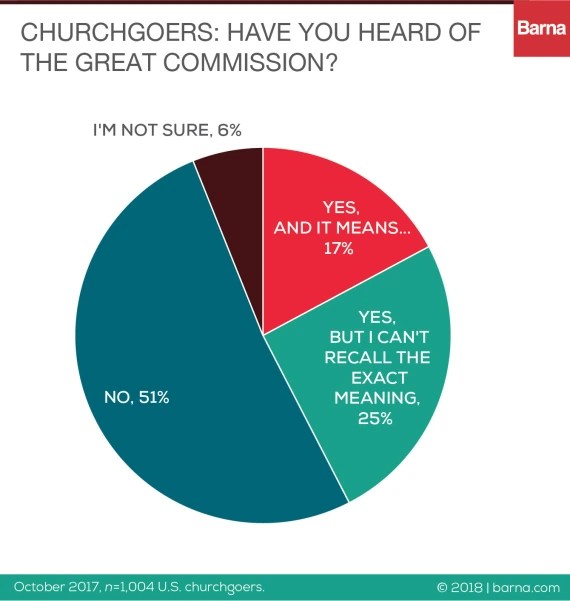
photo courtesy of barna.com

The Barna Group recently conducted a study asking churchgoers if they had previously “heard of the Great Commission.” In their report, 51% of Churchgoers Don’t Know of the Great Commission the results of the study were summarized thusly:

“…half of U.S. churchgoers (51%) say they do not know this term. It would be reassuring to assume that the other half who know the term are also actually familiar with the passage known by this name, but that proportion is low (17%). Meanwhile, ‘the Great Commission’ does ring a bell for one in four (25%), though they can’t remember what it is. Six percent of churchgoers are simply not sure whether they have heard this term ‘the Great Commission’ before.”

Now, if you know anything about statistics, you know how important it is to structure your questions carefully and get a representative sampling of the population you’re surveying in order to get the most accurate results. What does “churchgoer” mean? Is it possible people have never heard the term “The Great Commission” simply because churches don’t use this particular phrase any more? It’s important to take things like this into consideration because it affects the results of the survey. (You can find out more about Barna’s structuring process for this study at the end of the article linked above.) But even if the numbers of the Barna survey aren’t exact, I think it’s safe to say there are a lot of people out there in churchland who aren’t familiar with The Great Commission.

Just for fun, let’s see what the results would be if we surveyed readers of my blog:

The Great Commission refers to some of Jesus’ final words to the disciples before His ascension and is cited from Matthew 28:18-20:

And Jesus came and said to them, ‘All authority in heaven and on earth has been given to me. Go therefore and make disciples of all nations, baptizing them in the name of the Father and of the Son and of the Holy Spirit, teaching them to observe all that I have commanded you. And behold, I am with you always, to the end of the age.’

With these words Jesus commissioned the eleven remaining disciples to go out into the world and carry on His mission. Since every Christian is a disciple, or follower, of Christ, this is our commission from Him as well. Let’s examine what it says.

All authority in heaven and on earth has been given to Me.
Before commissioning his disciples, Jesus reminds them that everything He’s about to say is founded on and imbued with His authority. Jesus alone has the divine authority to establish the church and to dictate the way in which His church is to be set up and to grow.

We 21st century Christians would do well to keep forefront in our minds and hearts the authority of Christ over His church. There is no need for churches to “cast vision” or come up with mission statements. Christ is the head of the church and has already given us His vision for it. The Great Commission is His mission statement for the church.

Go therefore
“Therefore” in this little phrase refers back to what Christ has just said about His authority. In other words, because all authority in heaven and on earth has been given to Me, I am telling you to go.

“Go” is a very generic verb in English. We can “go” into the kitchen or we can “go” to the moon or we can “go” out and conquer the world. We can “go” anywhere from our own personal microcosm to the edges of the known universe. And that is the same sense the Greek word πορεύω captures: as you “go your way,” as you “go forth,” as you “walk”, as you “pursue the journey on which [you have] entered.” Wherever life takes us, whether it’s across the street or across the world, we go as ambassadors of Christ, carrying the good news of the gospel with us.

All nations
Revelation 7:9 tells us that God will save people from “every nation, from all tribes and peoples and languages.” So that’s who we share the gospel with as we go our way. Everybody. Regardless of where they’re from, what they look like, or how they talk. We are not to withhold the gospel from anyone, and we’re to make sure the church is proactively carrying the gospel to every populated geographical location on earth.

Make disciples…teaching them to observe all that I have commanded you
Notice the language Jesus uses here. He doesn’t say “make converts” or “make Christians”. He says “make disciples.”

Think about what the disciples did while Jesus was on earth. First, they answered His call to follow Him. Then, they began the journey of following Him wherever He went. He trained and equipped them day and night. They loved Him and worshiped Him. They imitated the things He did and said. They carried on His work after He ascended. Jesus is saying to the disciples, and to us, “Replicate yourselves. Make more like you.”

That means that the Great Commission starts with sharing the gospel with a lost person, but it doesn’t end there. There’s more to our mission than just evangelism. We are to train and equip Christians to follow Jesus daily, to love and worship Him, to imitate Him in obedience, and to carry on His work.

Baptizing them in the name of the Father and of the Son and of the Holy Spirit
After salvation, baptism is the first step a new Christian takes on the road of discipleship. It is not optional. Baptism publicly identifies a person – to the church and to the world – as a Christian, and is a personal pledge to follow Christ obediently all the days of one’s life.

Being baptized “in the name of the Father and of the Son and of the Holy Spirit” carries several layers of meaning.

💧Again, pay careful attention to the language in this phrase. Jesus does not say “in the nameS” – plural. He says, “in the name” – singular. This is a boldly Trinitarian statement directly from two of its members: Jesus, who spoke these words to the disciples, and the Holy Spirit, who breathed them out through the pen of Matthew. This is God Himself telling us who He is. Jesus spoke these words to good Jewish boys who were born and bred on the shema: “Hear, O Israel: The Lord our God, the Lord is one.” There was to be no confusion for new Believers back then, Believers today, or to the onlooking world, as to who these Christians are following. They are not following three different gods. They are following the one true God in three Persons: God the Father, God the Son, and God the Holy Spirit – the whole ball of wax.

💧Names meant far more in biblical times than they do to us today. We see God changing people’s names – Abram to Abraham, Jacob to Israel, Simon to Peter, etc. – when He commissioned them for a new mission or phase of life. Being baptized “in the name of” the Father, Son, and Holy Spirit echoes that tradition of God changing people’s names. You are no longer your own, you are Christ’s. You are no longer “Sinner”, you are “Saint”. You no longer go forth in your own name, but in the name of the Father, Son, and Holy Spirit as their emissary, endowed with the power and authority of God to live for Him and to proclaim the gospel to a lost and dying world.

💧Because Christians are, by definition, Trinitarians, and because baptizing a Believer is commissioning her to go forth into the world as a representative of Christ, it’s appropriate for pastors to take this verse literally when performing a baptism and verbalize its words: “I baptize you in the name of the Father, and of the Son, and of the Holy Spirit.”

Basic Training: Baptism

And behold, I am with you always, to the end of the age.
What a sweet promise, both to the disciples and to us today. Obediently following Christ in our daily lives, sharing the gospel, and making disciples can be lonely, exhausting, and discouraging at times. But we don’t have to do it alone, and we don’t have to do it in the flesh. Christ is with us and He knows all too well how hard it can be. God has given the Holy Spirit to indwell and empower Believers to live for Him and to carry out The Great Commission.

Additional Resources

What is the Great Commission? at Got Questions

The Great Commission by John MacArthur

The Great Commission by Burk Parsons

Mailbag

The Mailbag: How can the problems in the SBC (or any denomination/church) be fixed?

I read your article, It’s Time for a Reformation in the SBC – 3 Issues We Need to Set Right. In that article you only covered the issues needing correction, not the solutions. How would you suggest the Southern Baptist Convention, or any other church or denomination with similar problems, address those issues?

One of the reasons I addressed only the issues in that article is that a discussion of the issues and the solutions would have made the article extremely long. Another reason is that I know most of my readers are probably not Southern Baptist. Some of the solutions that first came to my mind would have been very “in house” to the SBC and would not have been of interest – nor made sense, without a lot of explanation (making the article even longer), of Southern Baptist polity – to those outside the SBC. However, the more I thought about the spiritual side of the issues, the more my perspective on the solutions changed. And addressing spiritual issues is relevant to every church and denomination.

As I mentioned in the previous article, the three most pressing issues I see facing the SBC are the sufficiency and authority of Scripture, false teachers/false doctrine, and disfellowshipping errant churches.

Because of the SBC’s commitment to the autonomy of the local church, I don’t think any of these things are going to be corrected from the top down with resolutions and studies and committees and appointed/elected leaders. I can only speak from my own perspective, and others may disagree, but I don’t see those things making any of these issues better, and in some cases they’re making things worse. I think turning the ship around is going to have to be a “bottom up” thing, starting at the church level.

So, what are some grassroots steps we can take?

✢ We’re going to have to stop giving lip service to prayer and actually start doing it. Individual prayer, yes, but what I’m really talking about is corporate prayer. Not “organ recitals”, not Bible studies or worship services that we call “prayer meetings”, but actual, protracted corporate prayer meetings where we concentrate on praying for the spiritual health of our own church, other churches, and our denomination at large. The problems we’re facing are, at their root, spiritual problems, and only God can change people’s hearts. It’s high time we started crying out to Him to do so.

I know it’s hard to get people to show up for actual prayer meetings. I used to be the Associational Prayer Coordinator for my local SBC association. Believe me, I get that it’s like pulling teeth. Pastors are going to have to get as many of their teachers and leaders as possible on board and start by praying with them. Next, we need our pastors to spend some weeks and months training their people in how to pray, why we pray, what we pray for, the importance of prayer, and what the Bible says about prayer. And then we’ll need pastors to proactively encourage people to be there. In my experience, corporate prayer has to be pastor initiated and led. If it’s delegated to a lay person or even an associate pastor, the rest of the church will see it as just one more optional program.

✢ We have to emphasize the authority of Scripture over every aspect of church life. Is the church considering buying a new piece of property? Sending messengers to the annual meeting? Joining with another church in a particular endeavor? Planning a mission trip? Receiving a new member? Having a potluck? Whatever is going on in the life of the church, the very first thing that needs to be brought to the table at committee meetings, business meetings, even just casual discussions or brainstorming sessions, is an open Bible and the question, “What does Scripture say about this?” I think many times we’re either assuming that most people already know what the Bible says about it, or we’re doing what we think is best without consulting God’s Word, neither of which is healthy. We need to make sure we’re doing what we do because the Bible says to do it, but approaching church decisions this way also trains individual members to think and act the same “What does Scripture say about this?” way in their own lives. That grows a healthier and more mature church body.

This helps drive home the concept of the sufficiency of Scripture, too. If your church is laser focused on “What does the Bible say?”, it’s going to biblically train your people how to find the answers they need for their own lives, and church life, in the Bible. Instead of “God told me” extra-biblical revelation, instead of taking polls and surveys, sometimes even instead of forming a committee or having one more meeting, the Body will begin to depend on God’s Word as its sufficient source for making decisions.

✢ Another way to emphasize the sufficiency of Scripture is to stop being so dependent on “canned” Sunday School curricula and Bible study books, workbooks, DVDs etc., and simply teach straight from the Bible expositionally (it’s cheaper too).

This scenario has played itself out in hundreds of SBC churches over the years: The women’s ministry committee gets together to decide what the next women’s Bible study will be. This author is suggested. That DVD series is suggested. Finally one brave soul pipes up and says, “Why don’t we just study Ephesians?”. The looks on the other women’s faces demonstrate that studying straight from the Bible is a totally foreign concept.

My husband is a minister of music. He was on staff at a small church many years ago that was in a budget crunch. Something was going to have to be cut. I suggested cutting out Sunday School literature and just teaching the Bible. They opted instead to slash my husband’s salary (which was pretty paltry to begin with).

When we’ve become so dependent on materials other than the Bible that church members have never heard of simply studying from the Bible or that the church would rather hurt one of its pastors than give up its literature, we’ve become too dependent on outside resources and we’re not viewing the Bible as sufficient.

✢ If and when we do decide to use a curriculum or a study, we must vet the study itself and the author(s). I know this is an unpopular thing to say among Southern Baptists, but I was asked for solutions, so I’m going to say it: LifeWay sells some materials authored by false teachers and some materials that contain false doctrine. You can’t just assume that because LifeWay sells it, it’s doctrinally sound. Get some discerning church members and put them to work reading the materials and comparing them to Scripture, and examining the fruit of the author’s life.

✢ We’re going to have to be good Bereans and stop being so flippant and laissez-faire about false teachers and false doctrine. Eradicating false doctrine and false teachers from the house of God is a major theme of the Bible. If it’s that serious to God, it should be that serious to us.

If somebody mentions that a certain Christian author, pastor, or teacher is a false teacher, don’t mock, insult, and blow that person off as “one of those crazy discernment people.” We don’t have to (and shouldn’t) just blindly believe her, but we shouldn’t just dismiss the allegation out of hand, either. Look into it. Do the research. Examine the evidence. Compare that teacher’s life and teaching to rightly handled Scripture, and if she’s not walking blamelessly and teaching what accords with sound doctrine, stop allowing her and her materials into your church.

✢ [Note: This part is more SBC-ish. Most other denominations have a process and governing body for dismissing errant churches. But because the SBC is technically not a denomination but a group of cooperating churches, the leadership of the SBC has very little ecclesiastical authority, including the authority to disfellowship churches.] As far as disfellowshipping errant churches goes, first, we need to make sure our church isn’t one of them. We need our pastors to exposit the Word, not entertain. We need to make sure we equip our membership in rightly handling God’s Word, prayer, evangelism, worship, and caring for one another. We need to make sure our church is biblically healthy.

Next, get involved with the local association and, whatever the procedure is, formulate a set of criteria for disfellowshipping errant churches, employ it when necessary, and pursue it to the state and national convention levels when possible. There are a variety of doctrinal issues that could be included (A couple I would suggest: disfellowshipping churches that violate tenets of the Baptist Faith and Message 2000 and/or teach any of the historic heresies {Arianism, Modalism, etc.}), but as I mentioned in the above linked article there’s got to be a higher standard than just giving money and being on the right side of homosexuality. We should be holding up the highest standards of biblical doctrine for churches who want the right to be called Southern Baptist, not minimizing and reducing our requirements to the least common denominator.

Pray long and pray hard. Build spiritually healthy and mature churches and church members. Get them involved at the associational and state convention level. Then send them to represent your church at the annual meeting. If God is pleased to change hearts, and if we get enough healthy churches and church members working together, that’s what will bring change at the national level.


If you have a question about: a Bible passage, an aspect of theology, a current issue in Christianity, or how to biblically handle a family, life, or church situation, comment below (I’ll hold all questions in queue {unpublished} for a future edition of The Mailbag) or send me an e-mail or private message. If your question is chosen for publication, your anonymity will be protected.