Mailbag

The Mailbag: Potpourri (Abuse: Grounds for divorce?… Life Groups… The women at Jesus’ tomb were NOT pastors/preachers… SBC 2026)

Welcome to another โ€œpotpourriโ€ edition of The Mailbag, where I give short(er) answers to several questions rather than a long answer to one question.

I like to take the opportunity in these potpourri editions to let new readers know about my comments/e-mail/messages policy. Iโ€™m not able to respond individually to most e-mails and messages, so here are some helpful hints for getting your questions answered more quickly. Remember, the search bar (at the very bottom of each page) can be a helpful tool!

Or maybe I answered your question already? Check out my article The Mailbag: Top 10 FAQs to see if your question has been answered and to get some helpful resources.


Is physical or sexual spousal or child abuse biblical grounds for divorce in a Christian marriage?

I hate that this question even needs to be addressed, because I wish abuse didn’t exist and no one needed this question answered.

This question was posed by a friend (who’s not in this situation, herself) on social media recently. Here’s how I answered (slightly edited):

I think this is why God only specified two objective criteria for biblical divorce – adultery and abandonment. These are much easier to measure objectively than abuse. Either someone has committed adultery or he has not. Either someone is still living in the home or he is not.

Here’s how I generally counsel Christian women in situations of spousal or child abuse (And just for the record for anyone else reading this, I’m talking about real physical or sexual abuse. “He hurt my feelings,” may be wrong or sinful, but it isn’t abuse in this context.)

  1. Anyone who lives in habitual, unrepentant sin is not a Christian, regardless of what he claims or believes himself to be (see 1 John 1:5-10, 2:3-6, 3:4-10, 5:3, Matthew 7:16-23). So, right off the bat, in cases of abuse, we’re almost certainly not dealing with a marriage in which both spouses are Christians.
  2. Step one in cases of abuse is ALWAYS to get yourself and your children to a safe place. Many abused Christian women are hesitant to do this because they are confusing or conflating getting somewhere safe with initiating a sinful divorce. That is NOT the case, and it is sad that many Christian women have to be taught that at the worst time of their lives. Getting to a safe place DOES NOT EQUAL initiating a sinful divorce. I hope everyone reading this is clear on that.
  3. The next step is to call law enforcement, report the abuse, and follow through with pressing charges, a restraining order, etc. If the abuser is in jail or prohibited from being within a certain distance of you, he has, by default, as a consequence of his own sinful behavior, abandoned you, which meets the 1 Corinthians 7:15 criterion. The government (which is to punish lawbreakers, and to which you are to submit) has taken that decision out of your hands. That is God’s grace to you.
  4. Next, assuming you’re a member of a doctrinally sound church, set up an appointment with your pastor (or a certified biblical counselor, if not) for counsel as to whether or not you should pursue a divorce. Different states have different laws, and it’s my understanding that in some states, the only way to protect yourself, your children, and your finances is via a legal divorce. Your pastor or local biblical counselor will have the resources to guide you about your specific situation.

If the husband gets genuinely saved while in jail or separated, reconciliation should be considered, as God’s preference is against divorce and for reconciliation, but that MUST be pursued with great care, much prayer, a copious amount of time and fruit-bearing, and extensive pastoral/biblical counseling. (I’ve addressed this at greater length here.)

So, all of that to say, I strongly recommend against making a blanket statement about whether or not divorce is biblically permissible in cases like abuse, on which the Bible is silent. Rather, it’s best to get to safety and work through your unique situation in the context of the local church and pastoral counsel, since that is God’s plan for us (on a case by case basis) for handling things like this.

Additional Resources:

The Mailbag: Is it all right for a Christian to get divorced?

The Mailbag: Must I reconcile with my abusive ex-husband?

From Victimhood to Victory: Biblically Helping Abused Women Heal


What are your thoughts on churches that have abandoned Bible study groups for Life Groups? Where the Life Group may or may not have a meal, then go over the sermon from Sunday morning?

In the interest of full disclosure, I lead a Life Group of women at my own church. We not only review the sermon, but also the Sunday School lesson, everyone’s personal Bible study, prayer requests and answers, evangelism, and Scripture memorization, plus any questions anyone has, or “I just need to talk,” issues. We have not “abandoned” Bible study groups, though. Our Sunday School classes are “Bible study groups,” plus I teach on a biblical topic at our monthly women’s meeting.

If your pastor is preaching the Word, and your group is reviewing, discussing, and applying the sermon, is that not Bible study?

I don’t ask that to be sassy or snarky at all, I’m asking because there are a variety of different factors at play here:

Is the pastor actually carrying out his 2 Timothy 4:1-2 mandate to “preach the Word” or are these groups discussing a sermon made up of illustrations, self help tips, and personal anecdotes from the pastor’s life?

When you say the church has “abandoned Bible study groups,” are you including Sunday School in that, or are you only talking about Bible study groups outside of Sunday School and the worship service?

Sunday School and Bible study groups are a relatively recent invention. The church survived and thrived without them for centuries.

What was the pastor’s motivation for replacing Bible study groups with sermon discussion groups?

I think this should probably be evaluated on a case by case basis. There are some situations in which it could be perfectly fine and other situations in which it could signal a theological or ecclesiological problem.


How can you say women can’t be pastors or preach to men? What about Mary and the women at Jesus’ tomb who went and preached to the disciples? What about the Great Commission? We’re all supposed to preach the gospel!

It seems like every time I say something on social media about God’s prohibition against women “pastoring,” preaching, teaching the Bible to, or exercising authority over men in the gathering of the church body, several people pop off with some version of one or both of these unbiblical arguments. The short answer is…

  • You’re conflating evangelism with pastoring and preaching. Evangelism is sharing the gospel with lost people outside the church, which all Christians are commanded to do. Pastoring and preaching is biblical instruction to saved people inside the church, which God has restricted to biblically qualified men. Evangelism and pastoring/preaching are two completely different, separate things. We have to keep our biblical categories straight.
  • Neither Mary, nor any of the other women at the tomb, were preaching or pastoring in the church. The church did not even exist at the time of Jesus’ resurrection. What these women did could barely even be compared to evangelism. All they did -in a private gathering of friends, not the church- was a) give eyewitness testimony to what they had seen at the tomb, and b) pass along a message from Jesus of where He wanted the disciples to meet Him.
  • The account of the women at Jesus’ tomb is a DEscriptive passage (narrative; it simply tells us what happened), not a PREscriptive passage (commands/instructions for Christians to follow). Descriptive passages may support, but never override prescriptive passages.
  • God does not contradict Himself or instruct people to sin.ย 

    God clearly tells us in 1 Timothy 2:11-3:7 (a prescriptive passage), that women are not to pastor, preach, teach the Bible to, or exercise authority over men in the gathering of the Body. If the gospel accounts of the women at the tomb mean that women can do those things in the gathering of the Body, then God has contradicted Himself, is a liar, and has ceased to be God.

    Furthermore, in light of God’s clear command in 1 Timothy, if what these women did was the same as pastoring or preaching to men, then God had the angel at the tomb instruct the women to sin by “preaching to men”.

For the longer answer…

Additional Resources:

Rock Your Role: Oh No She Di-int! Priscilla Didnโ€™t Preach, Deborah Didnโ€™t Dominate, and Esther Wasnโ€™t an Egalitarian

Women Preaching the Gospel? at A Word Fitly Spoken

Rock Your Role: Jill in the Pulpit? (1 Timothy 2:11-12)

The Mailbag: Counter Arguments to Egalitarianism

Sinners and False Teachers: The Women Who โ€œPastorโ€ and Preach

Rock Your Role articles


What are the issues I should be aware of at the Southern Baptist Convention this year?

Michelle, will I see you at the Convention?

This year’s annual meeting will take place June 8-9 in Orlando, Florida. Although I’d love to be there, unless someone walks up to me and hands me plane tickets and hotel reservations within the next two weeks, it’s just not in our family budget for me to attend.

If you’ll be attending as a messenger, I would encourage you to go to the Center for Baptist Leadership website and drown yourself in their articles and “Countdown to Orlando” podcast episodes so you’ll be up to speed on all the latest issues and details.

Two major things I would offer some direction on:

Vote for Willy Rice for president. He is the conservative candidate and our best shot at steering the ship back to biblical waters.

Vote FOR Dr. Albert Mohler’s “Truth and Unity” amendment to the constitution and FOR the suspension of standing rule 6 so the amendment can be debated and considered this year.

There will be numerous ancillary events going on before and during the Convention. One of these is the annual Pastors’ Conference, which any registered messenger or guest may attend.

There will also be a number of women’s (and other) events.

As I write this, there seems to be no information publicly available regarding who will be speaking at the Pastorsโ€™ Wives & Women in Ministry Conference (Monday, June 8). Call me paranoid, but it’s less than two weeks until this event, and I find this lack of information suspect, especially since I’ve run into this same brick wall over the past few years when searching for speaker information about this and other women’s events at the Convention. This event is purported to be part of the aforementioned Pastors’ Conference, but I don’t see it mentioned anywhere on the Pastors’ Conference website. (If any of my readers know who will be speaking, please let me know. Please note the exact title, date, and time of this event as there are several different events this one might be confused with. This is not the Women’s Expo or the Ministers’ Wives Luncheon {see below}, or the aforementioned Pastors’ Conference.)

The SBC Ministersโ€™ Wives Luncheon (Tuesday, June 9) will be headlined by Amy Hannon, an Arkansas pastor’s wife who has created her own hospitality brand (think: Martha Stewart or Joanna Gaines). I’ve never heard of her before, but after poking around for a few minutes, I’m hoping she might be doctrinally sound. She has a very small digital footprint, I found no obvious connections with false teachers, and I appreciated that a couple of times on her website, regarding speaking engagements, she says she speaks “to women”. If you’re familiar with Amy, let me know if she’s the real deal!

You will probably find the Annual Meeting website and app to be helpful both prior to and at the Convention.

Remember, the resolutions committee can change resolutions any way they like – even to mean the opposite of what the person who wrote and submitted the resolution intended it to mean. So read resolutions carefully before voting, and make sure you understand all other motions, proposals, etc., before voting.

Have fun, but if you’re there as a messenger, please do the duty your church sent you to do and be in the room and vote when votes are taken.


If you have a question about: a Bible passage, an aspect of theology, a current issue in Christianity, or how to biblically handle a family, life, or church situation, comment below (Iโ€™ll hold all questions in queue {unpublished} for a future edition of The Mailbag) or send me an e-mail or private message. If your question is chosen for publication, your anonymity will be protected.

Complementarianism, Movies, Southern Baptist/SBC

Movie Time: Battle for the Minds

Originally published May 21, 2019

Ladies- have you read my Mailbag article, Counter Arguments to Egalitarianism? If not, I would encourage you to read it before watching today’s movie. And if you’re new to the complementarian vs. egalitarian kerfuffle, I would encourage you to read, not only that article, but all of the articles in the “Additional Resources” section of that article as well.

Why?

Because today’sย movie, Battle for the Minds, approaches the issue from the egalitarian perspective, and you need to be sure you’re firmly grounded in the biblical perspective so that “no one takes you captive by philosophy and empty deceit, according to human tradition, according to the elemental spirits of the world, and not according to Christ.”

Also, today’s movie is kind of like a homework assignment. How would you apply the complementarian apologetics you learned in the Mailbag article as well as your knowledge of Scripture to the egalitarian arguments and pronouncements being made in this movie?

Battle for the Minds was released on PBS in 1997. It presents the egalitarian viewpoint on the stage of Southern Baptist Theological Seminary’s transition from theological liberalism to biblical theological conservatism under the then-new leadership of Dr. Albert Mohler, and delves into a bit of the Conservative Resurgence in the Southern Baptist Convention around that time as well. (As an aside, I am not familiar with any of the people in the film presented as being on the egalitarian side except for Anne Graham Lotz. I’m only familiar with a few of those on the complementarian side: Albert Mohler, David Miller, and Paige Patterson.)

If you are Southern Baptist, I strongly encourage you to watch and carefully consider these events from our history in light of the battle we are now facing in the SBC concerning the role of women in the church and in the Convention. Because what Nancy Ammerman says at the 37:04 mark is correct. Since all SBC churches are autonomous, many Southern Baptists only concern themselves with their own churches and don’t trouble themselves to worry about what’s going on at the national level. But when you do this, you fail to take into consideration that what’s going on at the national level trickles down to your local church in the form of what’s being taught to your next pastor or staff member at our seminaries; the authors, musicians, and other content creators being sold (and not being sold) at LifeWay; the theology in the Sunday School and VBS curriculum your church uses, etc. It also affects the theology and ecclesiology our IMB and NAMB missionaries and church planters use and teach. And finally, the leadership and issues at the national level are the face the Southern Baptist Convention presents to the world.

But even if you’re not Southern Baptist, you will probably still find this movie informative to the way your own church or denomination is responding to the issue of the biblical role of women in the church.

A couple of things to be on the lookout for, and give consideration to, as you watch Battle for the Minds:

โ€ขNotice the amount of Scripture presented in the movie. Is any Scripture presented that backs up the egalitarian view? Is egalitarianism vs. complementarianism presented as a biblical and spiritual issue or an “our position vs. their position” issue?

โ€ขNote the sex of each person on the egalitarian side and the sex of each person on the complementarian side. Are any complementarian women presented? Do you think there were absolutely no women on the complementarian side of the issue when these events were transpiring? Do you see how the exclusion of complementarian women in this film gives the subtle illusion that a) all women are egalitarian, and b) the reason men are complementarian is because they’re sexist and trying to protect their power and position – the same argument people like Beth Moore are attempting to make today?* Do you think it was sexist to exclude women from the complementarian side?

*(Screenshot 1, 2)

Mailbag, Southern Baptist/SBC

The Mailbag: Where can I get info on #SBC23?

Will you be attending the Southern Baptist Convention in New Orleans this year? I am interested in any news or updates on the Convention. Do you know where I can get reliable information?

The 2023 annual meeting of the Southern Baptist Convention will be held June 13-14 at the Morial Convention Center in New Orleans, Louisiana. The actual business and voting will take place Tuesday, the 13th and Wednesday, the 14th. Ancillary events and activities will take place Saturday June 10 – Wednesday, June 14th. (See the Convention website for more details.)

Yes, Lord willing, I am planning to attend, at least the 13th and 14th. I will probably do some pop up “meet and greets” at the convention center for anyone who would like to stop by and say hello. Those were a lot of fun last year, and meeting so many of you was one of the best things about the ’22 Convention. The timing and location of these will be impromptu, and I will announce them only on Twitter, so be sure to follow me to catch those announcements.

Over the past couple of years, I have written detailed articles (like this one, this one, and this one) in anticipation of the annual meeting to keep my readers informed on the issues and events, and to encourage them to vote biblically. Many thanks to those who have contacted me this year to ask about a similar article for 2023, and have kindly mentioned how helpful previous years’ articles were. For a variety of reasons, I’ve decided against writing an article about this year’s Convention. Other than this one, that is. ๐Ÿ™‚

I would recommend following these ministries, organizations, and accounts on Twitter (or wherever you can) for reliable information and a biblical perspective (except Baptist Press) about the latest happenings in the SBC:

I would strongly suggest following these accounts on Twitter rather than another platform because a lot of information comes out in interpersonal conversations rather than just in links to blog posts and such.

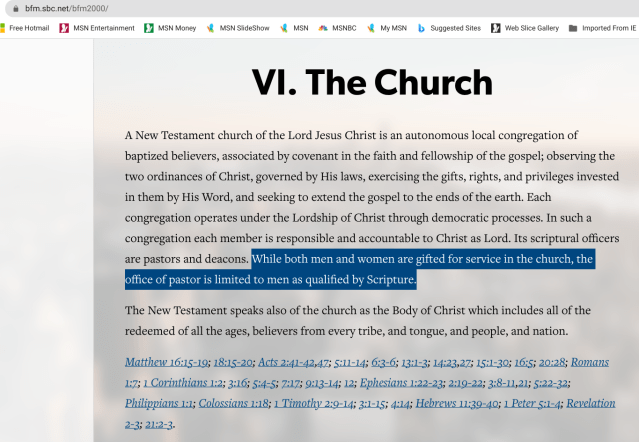
One item of business that is unfolding is a proposed amendment to the SBC constitution (not the BFM) that would exclude churches with women “pastors” from being in friendly cooperation with the SBC. This includes women who bear the title of pastor, even if they’re not functioning as pastors (e.g. “Women’s Pastor” “Children’s Pastor”) as well as women who are functioning as pastors even if they don’t bear the title of pastor (e.g. “Worship Leader” “Director of Education and Discipleship”). Churches with women in these positions or bearing these titles would not be allowed to “join” the SBC. If such a church is already a “member” of the SBC, it would be disfellowshipped (excommunicated) from the SBC.

At the moment, it has not been determined whether or not messengers will get to vote on this amendment. There is a letter of support pastors can sign, and you can get much more information at the SBC Amendment website.

The spotlight issue is going to be Rick Warren’s challenge of the Executive Committee’s decision to disfellowship (cut ties with) the “church” he “pastored” for over forty years – Saddleback, in Lake Forest, California. Saddleback currently has husband and wife “co-pastors” at the helm (appointed by Rick Warren prior to his retirement).

Earlier this year, the Executive Committee announced that Saddleback had been disfellowshipped for this reason, causing quite the stir among Southern Baptists in the know. Less than a year ago at the 2022 Convention, the head of the Credentials Committee, which is responsible for assessing whether or not a church seems to be in friendly cooperation with the SBC, proposed that messengers approve a year long study committee so the CC could figure out what a pastor is.

But apparently, they managed to figure it out without the study committee and quickly determined that Saddleback is, indeed, not closely enough aligned with the Baptist Faith and Message (the SBC’s statement of faith) to remain in fellowship with the SBC.

Conspicuously quickly, that is. Some have suggested that this was a strategic move designed to maneuver Rick Warren (or in collusion with him) into challenging the disfellowshipping. If he can successfully convince the messengers (voting attendees) to vote to overturn the decision (and judging from the standing ovation they gave him after his 6 minute, out of order, ode to himself last year, that’s very likely), the four other churches that were disfellowshipped at the same time as Saddleback can push to have their decisions overturned. And, assuming they’re successful, how much time and energy do you think the CC is going to put into any future complaints about other churches with women pastors? (None. That’s how much.) Not long after that, they’ll amend the BFM and remove the part above about women being pastors.

And that’s how the approval of women pastors is going to end up codified into SBC policy. It’s not a stretch. I think the first time I said that the SBC would affirm women “pastors” within five years was last year. Barring a certifiable miracle, I still believe that.

Now, just because that’s going to be the spotlight issue doesn’t mean that’s all you have to worry about. The whole abuse issue (Guidepost, the ARITF, etc.) is going to be another fairly major issue as well. Plus, there are going to be people who are counting on messengers being so distracted by Warrengate and the abuse advocacy grifters that they won’t be paying attention to any other issues. Keep your eyes and ears open, and pay attention. I’d bet my bottom dollar somebody’s going to try to pull a fast one with some sort of unbiblical issue while everybody’s out of the room.

So, if you haven’t already, talk to your pastor about becoming a messenger, get to New Orleans in June and…

  • Read or listen carefully to anything that’s up for a vote, make sure you understand it correctly, and vote according to Scripture.
  • Be in the room for every vote.
  • Vote against anything Rick Warren / Saddleback proposes
  • Vote for Mike Stone for president. (God bless him, he is not only godly but courageous and tenacious to boot.)
  • Support the constitutional amendment to disfellowship churches with women pastors (read it carefully before voting – sometimes items like this are re-worded from the original)
  • Don’t just blindly trust whoever’s at the podium or let them tug at your heartstrings. Listen, engage your brain, and think critically, biblically, and objectively about the issue.

…and prepare yourself to lose, and lose big time. I was prepared to lose every vote last year. And we did. And it still took a spiritual and emotional toll.

And it was worth it. I would do it all over again – which I kinda am, since I’ll be there again this year.

It’s worth it to know that one day I’ll stand before the Lord and say (speaking only for myself and my own conscience) about this moment, “Lord, by Your grace and strength, I didn’t give up. I did my best with what You gave me in order to honor and glorify You.”.

Won’t you join me in June in New Orleans?


If you have a question about: a Bible passage, an aspect of theology, a current issue in Christianity, or how to biblically handle a family, life, or church situation, comment below (Iโ€™ll hold all questions in queue {unpublished} for a future edition of The Mailbag) or send me an e-mail or private message. If your question is chosen for publication, your anonymity will be protected.

Podcast Appearances, Southern Baptist/SBC

The Anaheim Agenda

OK, y’all. Dance in the aisles with me. Barring anything out of the ordinary, I’m planning for this post to be my last Southern Baptist Convention-related content for quite a while. Thanks for hanging in there with me over the past few months of my wall to wall coverage of SBC shenanigans, especially if you’re not Southern Baptist (You people are just gluttons for punishment, aren’t you? :0) ).

Thank you for your prayers as (and after!) I attended the SBC annual meeting in Anaheim last month. The absolute best part of the trip was spending time with my daughter (who went with me and represented her church), the other members of my church family who went as messengers, and dear friends from other parts of the country whom I don’t get to see very often.

Also phenomenal was getting to meet so many of you who also attended and took time out of your busy schedules to stop by one of my “pop up meet & greets” to say hello. There are still many good, godly people in the SBC, and it was a pleasure and an encouragement to chat with you.

By now, most of you have probably heard about the more publicized “highlights” of the Convention (such as Rick Warren’s ode to himself – Ick. Don’t get me started.) But I didn’t want to walk away from this whole thing and leave a bunch of loose ends. So let’s box everything up neatly with a little wrap up before we stick SBC22 on the closet shelf way, way, waaaay back there in the corner.

Recently, I had the pleasure of sitting down and discussing my experience at the annual meeting with one of my pastors, Travis McNeely, for his new podcast, At the Crossroads. (You might remember I’ve featured some of Travis’ excellent work before.) Be sure to go subscribe to At the Crossroads on Travis’ YouTube channel or on your favorite podcast platform.

I think the previous episode Travis released – with another of my pastors, Laramie Minga, about his SBC22 experience – is excellent. You’ll want to listen in as Laramie talks about the worship and music aspect of the annual meeting along with his encounter with a female senior “pastor” of an SBC church, along with her two female deacons, who were representing their church as messengers in Anaheim.


In addition to these, if you’d like further details and more perspectives on SBC22, I commend to you the following:

Additional Resources

Watch the entirety of SBC22 on Baptist Press’ YouTube channel

Thinking Out Loud at A Word Fitly Spoken

Californication: Anaheim, the SBC, and Spiritual Adultery by Allen Nelson

The Liberal Drift of the Southern Baptist Convention (Part 1) (Part 2) by Gabriel Hughes SBC22 Recap – Encouragements and Disappointments with Tom Ascol and Graham Gunden

Is it time to leave the Southern Baptist Convention? And, whatโ€™s a secondary issue? by Elizabeth Prata

Will Egalitarianism Rule the SBC? by Josh Buice

Will Feminists Win the Pulpit? by Virgil Walker

Mailbag, Southern Baptist/SBC

The Mailbag: How could anyone stay in the SBC now?

In the past, I’ve received some responses/comments on this issue from Christians who seem very angry that anybody is still in the SBC. While I share your righteous anger at the sin being committed in the SBC (and at those committing it), please don’t let your anger spill over onto your brothers and sisters who are still attempting to navigate this situation in a godly way in the context of their own families and local churches. Angry/accusatory comments will not be published.

“How could any doctrinally sound Christian possibly stay in the Southern Baptist Convention after all of this?”

“I’ve been watching what’s going on in the SBC. I know all SBC churches are autonomous, but, after what I’ve seen, I’m now suspicious of the doctrine of any church that decides to stay in the SBC. As a doctrinally sound Christian, I’ll never set foot in another SBC church.”

“If you don’t like what’s going on in the SBC, why don’t you just leave? If you stay in, you have no right to complain!”

This is just a representative sampling of the scores of comments and questions I’ve received and seen over the past couple of months regarding Christians remaining in Southern Baptist churches, and Southern Baptist churches remaining in the Southern Baptist Convention.

Here’s a blow by blow (see “Additional Resources” section) of the specifics of the 2022 annual meeting of the SBC which took place last month in Anaheim. After reading about it, maybe you’ll be scratching your head and asking some of these same questions.

I’m kinda scratching my own head about how to answer, because, to be perfectly transparent, I have some of these same questions.

I’ve been Southern Baptist since the day I was born. It’s not like I just jumped on this turnip truck last week. I’ve been watching the downward spiral of the SBC for years, and it’s only picking up speed.

I’m neither a prophet, nor the son of a prophet, but I can tell you this (maybe from years of experience studying the culture of false teachers, false doctrine, and apostate churches) – without God directly intervening in a miraculous way, the SBC is not coming back from this. We are not going to turn anything around at next year’s Convention in New Orleans. The biblical side of the aisle will continue to lose and the unbiblical side of the aisle will continue to win. The worldly powers that be in the SBC are going to keep pursuing this course of downgrade until it hits rock bottom. I see unconditional acceptance of female “pastors” happening in the next 5-8 years. Acceptance of homosexuality will be next.

The SBC is *not* coming back from this. We are not going to turn anything around at next year’s Convention in New Orleans.

I hope I’m wrong. No one will rejoice more loudly than I if I’m wrong. But I don’t think it’s going to shake out that way.

So, if it were as easy as pushing a button or snapping my fingers, I, as an individual, would have been out of the SBC about 5+ years ago.

But it’s not that simple, so maybe I’d better explain.

The first thing that’s imperative to understanding why your doctrinally sound friend might be staying in the SBC is our doctrine of the autonomy of the local church. The SBC isn’t technically a denomination, like Presbyterians or Lutherans. We do not have a hierarchy that rules over every church or organization under its purview. The SBC is a voluntary cooperative of individual, autonomous churches.

When we first got started back in 1845, the main idea was for all these little tiny, far flung rural churches to band together to pool their resources to send out and support missionaries, because they couldn’t afford to do so individually. And that’s still one of our main purposes today. But we didn’t set up a governing hierarchy. Each church governed itself as it saw fit according to Scripture and congregational conscience. The leadership structure we now have in place is basically for the purpose of administrating the business (properties, entities, money, etc.) of the Convention as directed by the churches. We are a “bottom up,” not “top down,” organization. The president of the SBC isn’t the “Baptist Pope”. The Executive Committee isn’t an ecclesiastical court. The annual meeting isn’t some sort of SBC legislature handing down edicts that every Southern Baptist church and individual is required to obey. In theory, every SBC church could disagree with and operate in opposition to virtually everyone and everything at the national, state, and local level of the SBC, and still be a member in good standing of all three. Local churches govern themselves.

Next, you need to understand that most Southern Baptists aren’t Southern Baptists because they woke up one morning, did a comparative analysis of the doctrines of all denominations, liked SBC doctrine the best, and, thus, went in search of an SBC church to join. Usually, it’s a) someone was born and raised Southern Baptist and she agrees with SBC doctrine and theology, so she hasn’t been compelled to (or can’t) find a better denomination and leave the SBC, or, b) someone who, for whatever reason, is looking for a new church, and the most doctrinally sound church she can find in her area is a Southern Baptist church (which is not uncommon). For many of us, it’s a combination of both.

In other words, Southern Baptist individuals aren’t Southern Baptist because they set out to join a denomination. They’re Southern Baptist because they joined a local church. And because that local church is a member of the SBC, that individual is now Southern Baptist, too, whether she wants to be or not.

So when you ask a Southern Baptist individual, “If you don’t like the SBC, why don’t you just leave it?” it’s not like asking her to cancel her Netflix subscription and opt for Hulu instead. You’re not asking her to write a letter of resignation to some impersonal national organization and stop paying her membership dues. You’re asking her to leave her local church. A church which may have been her spiritual family for decades. A church which might be perfectly doctrinally sound. In her area, it might be the most doctrinally sound church available, and you’re asking her to leave it to go to a less doctrinally sound church, just to cut ties with the SBC.

When you ask a Southern Baptist individual, “If you don’t like the SBC, why don’t you just leave it?” it’s not like asking her to cancel her Netflix subscription and opt for Hulu instead. You’re asking her to leave her *local church*.

So, considering all the Southern Baptists I know and have heard from, and taking all of the above into account, there are three main categories of people who are still in the SBC that I’d like to take a moment to address, and anywhere from three to a scrillion different ways they could biblically deal with being Southern Baptist while seeing all of these godless things taking place on the national SBC stage:

  • You’re a doctrinally sound, discerning Christian in a local SBC church whose pastor and leadership agree with the unbiblical goings on at the national level. You need to get out of that church, probably immediately, and find a doctrinally sound local church to join. You should strongly and prayerfully consider finding a non-SBC, and honestly, probably a non-denominational (because most of the problems in the SBC are happening in all the other denominations, too, or soon will) or independent church. However, if the best church you can find in your area is an SBC church that’s fighting against the sin and evil at the national level, don’t hesitate to join it and join them in the fight.
  • You’re a doctrinally sound, discerning Christian in a doctrinally sound local SBC church whose pastor and leadership are fighting against the unbiblical goings on at the national level. If your position is, “I want our church to leave the SBC immediately,” and your pastor’s / elders’ position is, “We’ve prayed about it and searched the Scriptures about it, and for X, Y, and Z biblical reason, we believe God would have us stay in one more year and fight,” and that’s basically the only disagreement you have with them, that’s not a reason to leave a good, solid church. Submit to your pastors’ leadership, trust them, support them, trust God, hang in there, be patient, and be sanctified by this as you watch and pray.
  • You’re a pastor of a doctrinally sound local SBC church and you’re positionally against and/or actively fighting against the unbiblical goings on at the national (and probably state and local, too) level. How long do you stay in and keep fighting? Obviously, it’s not my place to tell you what to do, but, from the perspective of a church member who’s been carefully keeping apprised of the SBC situation for a lot of years, could I just throw out a few questions you may want to consider between you and the Lord as you pray through the monumental decision of whether to lead your congregation to get out now or to stay in and fight for a while?

    –Have you carefully examined your reasons and motivations for wanting to stay in and fight? Are those reasons and motivations drawn from Scripture? Pragmatism? The flesh? Have you considered these Scriptures with regard to leaving?

    –What is your exit strategy? Will you stay in until you see how next year’s Convention goes? Until the SBC approves of women pastors? Homosexuality? Biblically, do you not have a responsibility as a shepherd and a Christian to draw a “this far and no farther” line in the sand? Where is that line?

    –How much time, energy, and money have you and your church already expended on what will almost certainly be a losing fight? Is it good stewardship of your resources to continue to put them toward this fight? Could they be better spent in another way to get more Kingdom “bang for your buck”?

    –I’ve heard some pastors say, “I want to stay in because of our missionaries.”. The sinful ideologies poisoning the SBC have not and will not leave the IMB untouched (and we know NAMB already requires its church planters to preach a false gospel). If it’s not happening already, your missions money may soon be funding the spread of false doctrine. Can you have that on your conscience? If you’re certain the SBC missionaries your church currently directly supports are doctrinally sound, have you looked into how you could support them from outside the SBC? Can you trust God to provide for them if you’re biblically compelled to lead your church to leave the SBC? What about supporting non-SBC, doctrinally sound missions agencies like TMAI and HeartCry?

    –Carefully consider the second bolded quote at the beginning of this article. Is it possible your church’s good reputation is being tarnished by remaining in the SBC? “The world is watching!” we’ve been hearing for a couple of years now. Maybe it was said with the wrong motives, but it’s true. And the rest of Christendom has been watching too. Will staying in the SBC lead doctrinally sound Christians looking for a good solid church to pass yours over because they think you agree with the SBC’s sinful shenanigans since you haven’t left yet?

    –If youโ€™re going to stay in and fight, may I encourage you to start now? Right now. Today. I love all my brothers and sisters in the “stay in and fight” camp, but the past few years I’ve been extremely frustrated at the general way everything seems to be thrown together in a last minute scramble to rally the troops in the last few months, weeks, and days before the Convention.

    Make plans to attend the New Orleans meeting now, raise funds to send messengers now, nominate godly candidates for SBC offices now, and tour them around to local churches all year long to build momentum. And most importantly, educate your church and your local association’s churches on the issues and the biblical response to those issues, now. Don’t wait until April, May, and June of next year, start now.

    –Watch and listen to this SBC pastor talk about the issues in the SBC that led to his decision to lead his church out of the SBC. A must watch for every pastor and congregation that’s still in the Southern Baptist Convention:

Last year, I wrote When is it time to leave the SBC?. I can’t decide that for your church or mine. I just want to know, what’s one good, compelling, biblical reason to stay? Because I can think of lots of good, compelling, biblical reasons to leave.

I just want to know, what’s one good, compelling, biblical reason to stay in the SBC? Because I can think of lots of good, compelling, biblical reasons to leave.

Additional Resources

Watch the entirety of SBC22 on Baptist Press’ YouTube channel

Thinking Out Loud at A Word Fitly Spoken

Californication: Anaheim, the SBC, and Spiritual Adultery by Allen Nelson

The Liberal Drift of the Southern Baptist Convention (Part 1) (Part 2) by Gabriel Hughes

SBC22 Recap – Encouragements and Disappointments with Tom Ascol and Graham Gunden

Is it time to leave the Southern Baptist Convention? And, whatโ€™s a secondary issue? by Elizabeth Prata

Will Egalitarianism Rule the SBC? by Josh Buice

Will Feminists Win the Pulpit? by Virgil Walker


If you have a question about: a Bible passage, an aspect of theology, a current issue in Christianity, or how to biblically handle a family, life, or church situation, comment below (Iโ€™ll hold all questions in queue {unpublished} for a future edition of The Mailbag) or send me an e-mail or private message. If your question is chosen for publication, your anonymity will be protected.