Mailbag, Prayer

The Mailbag: Help! Our ladies’ prayer meeting is a disaster!

I am married to a pastor of a small SBC church. Every Sunday evening I have a 30-minute prayer time for the ladies of the church. It feels like a disaster! Women ramble on and on with “prayer requests” that really seem to be either gossip or current news events. When it comes time to actually pray, I’m the one who is praying and everyone else is completely silent. Recently, the women were so out of control with talking that they didn’t even notice when I said it was time to pray, so I canceled the prayer meeting until further notice.

I know praying together as sisters couldn’t be a bad thing, but what do I do if it seems like no one else is actually praying? Am I giving up too soon? And just to be clear I’ve tried different “formulas” for the meeting (having specific scriptures that we pray, having a specific theme for the prayer, etc.).

Oh dear sister, I’m so sorry for your frustration! I have led a few ladies’ prayer groups myself, and I know it isn’t easy. If I could offer you one word of encouragement, though – your ladies are showing up! One of my dilemmas was having ladies who didn’t see prayer as important enough to even come to a prayer meeting. You’ve got them there – that’s a huge hurdle that’s out of your way.

But once you’ve got them there, what do you do with this gaggle of gals? Let’s see if we can figure that out together.

A few things I’m surmising from your e-mail:

First, I’m guessing you’re a sweet, younger lady and that at least some of the ladies in your group are 10+ years older than you are. (Even if I’m wrong, I’m going to go with this for a minute because there are probably some ladies reading this who are in that dynamic.)

Trying to lead ladies who are older than you are can be intimidating, especially when you have the added pressure of your husband being the pastor – you want to reflect well upon him and not be the cause of any issues he would have to deal with. If your personality is very easy going and less assertive, that’s going to add to the challenge and result in things like the ladies ignoring you when you say it’s time to start praying.

Another dynamic that’s probably affecting your group is that at least some of the ladies are there mainly because you’re the pastor’s wife, and they either feel a sense of duty to be there or they want to support you with their presence because they love you, or both. Neither of which are bad things, because it’s getting them to show up (and, hey, a little love and support never hurts, right?). But it may mean that prayer isn’t the primary reason some of them are there.

The way you describe the ladies’ talking, behavior, and “prayer requests” leads me to believe that they probably don’t know how to pray in a corporate prayer meeting, especially one that’s not an “organ recital” (all the prayer requests revolve around people who are sick, having surgery, etc.). Sadly, this is pretty typical for SBC churches in my experience.

The extensive conversing may also signal that these ladies are starved for meaningful fellowship with one another.

So taking all of that into consideration, here are a few thoughts I had:

๐Ÿ™ I think taking a hiatus was a good idea. It will give you time to regroup and reorganize your approach. My counsel would be that as long as you have ladies who are willing to attend, it’s too soon to give up (assuming, of course, that your husband is in agreement with that).

๐Ÿ™ Set aside a block of time to talk this through with your husband and ask his advice. Just by virtue of being a man, he has a different perspective than you do, and probably has some helpful ideas and suggestions. As your pastor, he likely has additional insight on the ladies in your group, as well as some leadership strategies and experiences that could be beneficial to you.

๐Ÿ™ When you start the group up again, you might want to consider, if it’s possible, having your husband lead for a couple of months. It’s just a fact of life that people act differently around pastors than they do around others. My guess is that your ladies will sit quietly and attentively for your husband. If you can develop that habit in them over the course of a couple of months, it will be easier for you to step in with more confidence and assertiveness when you resume leading the group.

๐Ÿ™ Find an older godly lady who has experience teaching and leading women’s classes and ask her to mentor you. 

๐Ÿ™ If that older godly lady is one of your church members, and you and she are both willing, maybe it would work for her to lead the group for, say, six months to a year while you attend as a participant. That could be helpful in two ways: a) You could learn by observing her leadership, and, b) You could model for the other ladies what it should look like to be a participant in this group, and they could learn from your example.

๐Ÿ™ It sounds like these ladies need to be discipled regarding what prayer is and how to do it. Instead of immediately diving back into praying when you start the group back up, consider taking a few months to study prayer together first. You’re welcome to use any of my articles on prayerย (I’d recommendย this one andย this one in particular.) Or, you could take them through my Bible study: Sweet Hour of Prayer: Learning to Pray from the People of Scripture. And be sure to check the bookstores atย GTYย andย Ligonier.

๐Ÿ™ It also sounds like your ladies need more structure and guidance. One thing you might want to do is dispense with the verbal sharing of prayer requests as it’s traditionally done and restructure that aspect of the meeting. There are several different ways you can do this:

โ‡’ You decide the prayer focus (praying for the lost, missionaries, revival, an upcoming church event, etc.) for each week. Write down specific things to pray for – nearly verbatim, if you have to – on an index card or piece of paper and hand one to each lady as she comes in. For example, if you’re praying for missionaries, give the name of the missionary and a few needs he has.

โ‡’ Homework assignments. At the end of each meeting, tell the ladies what the prayer focus will be for the next week, give each one a card with a different aspect of that topic, ask her to be praying about it during the week and to come prepared to pray aloud about it at the next meeting. For example, if you’re going to be praying about VBS next week, the cards might say things like leaders, teachers, students, gospel presentation, safety, etc.

โ‡’ “Conversation prayer“. This works really well with children and people who are inexperienced with corporate prayer. Basically, what you’re doing is replacing prayer request time with praying for the request as it’s mentioned. You open with a brief prayer. After that, the floor is open for anyone to pray about anything they would ordinarily have mentioned as a prayer request. The only catch is, they have to keep it to three sentences, max (You’ll want to stress this rule and remind them of it often). This keeps the prayer time from being dominated by long-winded people, and it introduces an idea others can build on in prayer which encourages more people to participate. Additionally, it takes the pressure off of those who are nervous about praying out loud. For example, one person might pray, “Lord, please comfort and strengthen Sally in the death of her husband,” which might prompt the next person to pray, “Please provide for her material needs now that she’s without George’s income,” and the next: “Please show us ways we can minister to Sally.” There are going to be long silences at first. That’s OK. Wait it out. When it’s time to wrap up, you lead the closing prayer.

โ‡’ Guided conversation prayer. Same as conversation prayer, but more structured. You choose a few areas of prayer focus and let the ladies know what they are before the prayer time begins. Open in prayer, introducing the first topic. The floor is now open for anyone to pray up to three sentences on that topic (and, of course, people can pray more than once if they want to, but only three sentences at a time). When it’s time to move on, announce the next topic or pray a brief prayer introducing it.

โ‡’ Small group prayer. If you have enough people, break them into groups of 2-4, and assign each group a topic to pray about. When the groups start getting quiet, hand them another topic to pray about. (Be sure you’re giving them plenty of time to pray, though. I’ve been in prayer meetings using this method where the leader hops from one topic to the next so fast that the first person in the group doesn’t even finish praying before the topic is changed.) For a 30 minute meeting and groups of 2-4, I’d recommend no more than 3-4 topics for each group.

๐Ÿ™ If you think lack of fellowship might be a factor in the ladies’ behavior, there is nothing wrong with making the last “prayer meeting” of each month a low key fellowship – a “three weeks on, one week off” kind of thing – where they have the unprogrammed space to just sit and talk (and snack – gotta have snacks!). Fellowship is vital to the life of the church, and, believe me, as they get to know each other better and bear one another’s burdens, they will bring more things to the table to pray about during the three weeks of prayer meetings.

๐Ÿ™ Most importantly, you pray. Pray for patience and confidence as you lead. Pray for each of the ladies in your group. Pray that God will grow them in maturity in prayer. Pray that He will help everyone stay focused. Pray that those who are timid will be emboldened and that God will rein in those who have a tendency to dominate. Prayer is an area of spiritual growth, and only God can produce that growth. Ask Him to.


If you have a question about: a Bible passage, an aspect of theology, a current issue in Christianity, or how to biblically handle a family, life, or church situation, comment below (Iโ€™ll hold all questions in queue {unpublished} for a future edition of The Mailbag) or send me an e-mail or private message. If your question is chosen for publication, your anonymity will be protected.

Christian women, Complementarianism, Ministry, Sin

Women Preaching: It’s Not a Secondary Doctrinal Issue

When it comes to Christianity, are the specifics of what people believe important?

I think most of us would answer a resounding “yes” to that question. Of course, the various concepts we believe are important. You can’t just believe anything you like and still be a Christian. There are certain things you must believe in order to become a Christian at all, and there are certain things you will come to believe because you are a genuinely regenerated Christian. But what are those things, and how do we know which is which?

You can’t just believe anything you like and still be a Christian.

Maybe you’ve heard the terms “essential doctrines” or “primary, secondary, and tertiary theological issues” or “first, second, and third tier levels of doctrine”? For years, theologians have been attempting to organize beliefs of the Christian faith – all drawn from the Bible, naturally – into nice neat categories in order to make things a little simpler. As someone who thrives on organization and categories, I’m grateful for their efforts. But if you begin to study this categorization of beliefs, you’ll find that we haven’t reached an across the board consensus yet.

Generally speaking, “essential”, “primary”, or “first tier” doctrines are those which you, biblically, have to believe in order to become a Christian and/or be considered a Christian. For example:

โœข Sin is a thing, and I am a sinner.

โœข God exists and is the supreme authority of the universe.

โœข Jesus was God in human flesh.

โœข Jesus rose bodily from the grave.

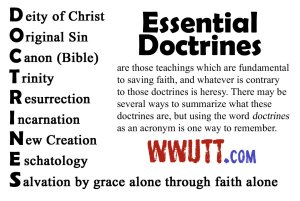
See how this works? If you don’t believe you’re a sinner, you’re not saved. If you don’t believe in the bodily resurrection of Christ, you’re not saved. Here’s how our friend, Pastor Gabriel Hughes, briefly outlines essential doctrines:

(Gabe later tweaked the acrostic a little and added an “S”, which I think is helpful.)

The vast majority of brand new Christians have only the most basic understanding of most of these tenets at the moment of salvation. But it’s not an issue of fully understanding – or else we’d all have to be theologians in order to get saved – it’s an issue of believing. Someone who is genuinely regenerated may not completely understand how the Trinity works (honestly, no one does), but when she’s introduced to the biblical idea of the Trinity, she believes it, learns more about it, and does not reject it.

There is typically agreement among most reputable theologians regarding what constitutes first tier doctrine. Scripture is clear about these things, and several of these issues were settled long ago by the church fathers in assorted church councils (Nicea, Chalcedon, etc.)

Secondary issues are routinely defined as non-salvific but still extremely biblically important, if not quite as biblically clear-cut as primary issues. Doctrines surrounding baptism (credo versus paedo, affusion versus immersion), for example, are usually cited as a secondary issue. A disagreement on a secondary issue doesn’t mean one person is saved and another isn’t, but it normally prevents close partnership in ministry activities involving these issues. For example, my Presbyterian friends and I can join together in pro-life ministry, but we would most likely not plant a church together.

Tertiary issues are non-salvific, less immediately urgent, biblical issues in which the Bible is even less clear-cut and open to wider (yet still biblical) interpretation. These are issues over which Christians can disagree and still maintain close doctrinal fellowship, even in the same church, if they’re in agreement on first and second tier doctrine. Eschatology – the order and timing of events at Jesus’ second coming – is a doctrine that’s often considered third tier. Someone can hold a different eschatological view than mine, yet, for the most part, it shouldn’t affect our ability to worship together, work together, or participate in the ordinances together in the same church.

Some theologians add a fourth category – issues of adiaphora, conscience, or Christian liberty. Usually these are issues of much less importance that the Bible either doesn’t specifically address, or doesn’t give commands about one way or the other. Individual Christians may use biblical principles to inform their consciences and decide for themselves. These would be things like whether or not to take your child trick-or-treating or deciding whether to dress formally or casually for church.

While theologians are largely in agreement about primary doctrines, there is wider spread disagreement on which doctrines are secondary and tertiary (many consider eschatology to be a second tier doctrine, for example) and whether or not there is a need for a category of adiaphora, since such issues are normally not considered to be “doctrinal” issues. In fact, there’s enough space for disagreement that pastors and theologians often wisely refrain from making concrete lists of secondary and tertiary doctrines.

But when we’re talking about the different levels of doctrine, what you won’t find is questions like these: Is murder a first, second, or third tier doctrine? What about gossip? Rape? Adultery? Lying? Gluttony? Pride?

And it’s not because these issues aren’t important or because the Bible doesn’t address them. It’s because they’re in a different category from the other issues: the category of sin. They aren’t doctrines upon which salvation hinges, they aren’t open to interpretation, and the Bible is clear that we are absolutely not to do these things.

The category of doctrine deals with beliefs. The category of sin deals with behavior.

In 2005, Dr. Albert Mohler wrote an excellent article about the different levels of doctrine entitled A Call for Theological Triage and Christian Maturity. He carefully explains the importance of each level of doctrine and what it covers in a plea to keep each level’s urgency in its proper place of significance during discussion, debate, and decision-making.

It was a helpful article to which I always refer people who have questions about tiers of doctrine, and I agree with Dr. Mohler’s thoughts in the article wholeheartedly1 …except on one point:

“In recent years, the issue of women serving as pastors has emerged as another second-order issue.”

Women serving as pastors, women preaching, women teaching men Scripture, and women exercising authority over men in the gathering of the Body is not a secondary issue. Nor is it a primary or tertiary issue. It does not belong in the category of “doctrine” in the same way baptism and eschatology do. It belongs in the category of sin in the same way murder, gossip, and adultery do. Let’s take a look at the reasons for this.

Women serving as pastors, preaching, teaching men Scripture, and exercising authority over men in the gathering of the Body is *not* a secondary issue. Nor is it a primary or tertiary issue. It is a sin.

I do not permit a woman to teach or to exercise authority over a man; rather, she is to remain quiet. 1 Timothy 2:12

(The preponderance of Scripture supports and affirms this concept, so to keep things simple, we’ll use this verse as an exemplar.)

โœข The prohibition in 1 Timothy 2:12 is a clear command against a certain behavior. And when we behave in a way God has prohibited, that is called “sin”. All of the tenets in the three levels of doctrine are affirmative statements regarding beliefs (you must believe in the resurrection of Christ, we believe in baptism by immersion, etc.). None of them are commands, in the negative, against sinful behavior (Thou shalt not murder, I do not permit a woman to teach… etc.)

โœข Secondary and tertiary doctrines can be open – to varying degrees – to biblical interpretation. Every stripe of non-heretical eschatological thought can provide you with chapter and verse passages that can, depending on the angle from which you approach the subject, be biblically plausible and scripturally supported. There is no biblical support for anything God prohibits. No one can cite a properly handled, in context Bible verse in which God says, “It’s OK to commit adultery,” or “Women are allowed to preach.” There can be multiple views on a secondary or tertiary issue that can all be considered biblical, but there can only be one view of sin that is biblical.

โœข Differing beliefs on true secondary and tertiary issues are not sin. My Presbyterian friends have a different view of baptism than I do. That doesn’t mean either of us is sinning. I may think their interpretations of the verses they believe support paedo baptism are incorrect, but they are not breaking any of God’s commands. Differing behavior (again, we see the distinction between doctrinal belief and sinful behavior) on issues of sin is sin. If someone behaves differently from God’s command about lying, she is sinning. If a woman behaves differently from God’s command in 1 Timothy 2:12, she is sinning.

โœข Differing beliefs on secondary and tertiary issues are not born of disobedience and rebellion toward God. Usually, it’s quite the opposite. When someone has studied a theological issue enough to hold a particular position on it, it’s usually because she is striving to please God and to be biblical in her beliefs. Differing behavior on issues of sin is born out of disobedience and rebellion toward God. Someone who steals has already decided in her heart that her desires are better than God’s command. A woman who knowingly holds improper authority over men in her church is doing so because she has already decided to defy God’s clear command against such.

โœข Because different beliefs on secondary and tertiary issues are not born of rebellion and are not sin, they do not require church discipline. Sin does require church discipline. If someone in your church is openly dishonoring her parents, she is sinning and should be subject to church discipline. If a woman is pursuing a career as a pastor, she is sinning and should be subject to church discipline. 

Since the publication of Dr. Mohler’s article (and perhaps as a result of others teaching the same thing) the idea of the violation of 1 Timothy 2:12 being a “secondary doctrine” has spread in a most unhelpful way, leading many Christians to treat the issue in a c’est la vie, “We can just agree to disagree on this,” manner.

No, we cannot.

The idea of the violation of 1 Timothy 2:12 being a “secondary doctrine” has spread in a most unhelpful way, leading many Christians to think “We can just agree to disagree on this.”. No, we cannot.

We would not say, “We can agree to disagree,” on lying or adultery or homosexuality or abortion, and we cannot say it about women preaching, teaching men, or holding unbiblical authority, either. We disciple and teach a sister in Christ who is unaware of what the Bible says on these matters, and if she is committing any of these sins, we begin the process of church discipline. But it would not be loving toward her, or honoring God, to allow her to continue in biblical ignorance or in willful sin.

Furthermore, the violation of 1 Timothy 2:12 brings with it dangers to the church that true secondary and tertiary issues, and even many sins, do not…

The violation of 1 Timothy 2:12 brings with it dangers to the church that true secondary and tertiary issues, and even many sins, do notโ€ฆ

She may not say it with her lips, but when a woman preaches to men in defiance of Scripture, sheโ€™s teaching false doctrine through her behavior. What is the false doctrine sheโ€™s teaching? โ€œI donโ€™t have to obey Godโ€™s Word, and neither do you. If thereโ€™s a part of the Bible you donโ€™t like, youโ€™re free to disregard it.โ€ If your pastor stood up in the pulpit on Sunday morning and said that in words, youโ€™d run him out of town on a rail, and rightly so. Neither should a woman be able to teach that same false doctrine via her actions.

Additionally, I have mentioned several times when dealing with this issue that women preaching to men is highly correlated with women teaching other forms of false doctrine. I have researched scores of women teachers. Every single one of them who unrepentantly teaches men also teaches false doctrine in some other aspect of her theology (usually progressivism, Word of Faith, or New Apostolic Reformation). In other words, if a woman teaches men, you can just about take it to the bank that she also teaches additional false doctrine. False doctrine and heresy are infecting the church – via female preachers – at an alarming rate.

We dare not simply “agree to disagree” on this.

The violation of God’s command that women are not to instruct men in the Scriptures nor hold improper authority over men is a sin like any other. It is not a doctrinal issue in the same sense that other second and third tier doctrines are. If left undisciplined, however, it can lead to first tier doctrinal issues infiltrating a church and eventually destroying it. It is detrimental to the church to label and treat any sin as a secondary doctrinal issue.

Additional Resources

Is Women Preaching a Secondary Issue? on A Word Fitly Spoken

What Are Essentials and Non-Essentials? on A Word Fitly Spoken

Christian Liberty on A Word Fitly Spoken

The importance of Primary and Secondary Doctrines on the Truth Be Known Podcast


1In the years since 2018, when this article was originally written, Dr. Mohler has said, done, and supported various biblically questionable things, leading some to question whether or not he has “gone woke”. While I don’t support his stance on those questionable things, I also don’t believe he has reached the point at which I need to warn against him (although I don’t proactively recommend him, either). To my knowledge, at this time, he is still generally doctrinally sound.

Church, Marriage, Ministry

The Mailbag: My husband is a pastor. How do we know when it’s time to leave a church?


My wonderful conservative, seminary-trained pastor husband is in such a battle against evil forces in our church.ย 

There are a few women members who are angry he doesnโ€™t endorse their favorite false teacher, women preachers, or women teaching men. Another woman, who was actively involved in two previous church splits is stirring up division.

Praise God our church has attracted strong Christian men who have come alongside my husband, standing firm, supporting Biblical Truth. When does one know when itโ€™s Godโ€™s testing or when He’s nudging to move us along?ย I donโ€™t enjoy seeing my husband hurt. Do you have any advice?

I can definitely empathize with your situation. As I’ve mentioned in the past, my husband is a minister of music, and God has seen fit to send us to several…shall we say… “challenging” churches in the past. Most have been smaller churches in which the only staff members were my husband and the pastor, so my husband had more of a leading elder-type role than a minister of music in a larger church with several on-staff pastors might have.

We have also faced this dilemma of “We don’t want to give up just because it’s difficult, but maybe these difficulties are God’s way of telling us it’s time to shake the dust off our feet and move on to somewhere where we can be more biblically productive.” It can be a confusing situation to be in because you want to be pleasing to the Lord and serve His people, but the Bible speaks to both hanging in there through adversityย and leaving people who refuse to be led as appropriate in various situations.

Like so many scenarios in life, there’s no “one size fits all” answer because every situation is different. But maybe we can look at a few basic principles that can help ministry wives (and even those whose husbands aren’t in the ministry) when church difficulties strike and you’re wondering whether or not to leave.

Take Off the Rose-Colored Glasses

If you’re new to being a ministry wife, you may have romanticized ideas of what it will be like. It’s no accident that God calls pastors “shepherds.” Shepherding is not like those pastoral landscape paintings you’ve seen where the shepherd is sitting under a stately, spreading tree on lush carpet of verdant grass by a babbling brook, happily petting a docile lamb. There are moments like that, but generally, shepherding is hard, hot, sweaty, often thankless, often underpaid, tirelessย labor. Sheep can be stubborn animals who have no idea where to go, what to do, or what’s best for them, and leading them is, at times, no picnic.

I don’t say this to discourage you, only to make sure that you’re going in to this thing with your eyes wide open. No pastor steps into the pulpit at a perfect, problem-free church. Every church has its issues. You need to be prepared for that, and you need to be prepared to roll up your sleeves andย work, not run, the first time a problem comes up.ย The church isn’t there to serve you. You are there to serve the church.

Pray, Pray, Pray, and Don’t Jump Ship at the First Sign of Trouble

All of us should be praying for our churches daily, but we need to double down when problems arise. Pray for all those involved in the problem, including your husband.

We also need to initially approach problems with the desire to work through them and bring them to a point of biblical resolution. As a ministry wife, if you approach every problem that arises in the church with an attitude of despair, giving up, and wanting to leave the church, it’s going to discourage your husband. Now, not only does he have the problem itself to deal with, he has the added pressure of making his wife happy. Try to be part of the solution rather than an added problem.

Remember – and Be Thankful for – Your Position

When you’re a ministry wife, especially in a small church, it can feel like you and your husband areย bothย in his ministry position. You’re probably helping him with various job-related tasks, you know all the problems and issues that are going on in the church, you talk together about possible solutions, you know about the big meeting that’s coming up, etc. It even comes out in the way we talk sometimes: “Whenย we pastored ABC Church…” or “Whenย we were on staff at XYZ Church…” (I finally realized I needed to be more careful about using that kind of wording so that people would not think I was a co-pastor!)

But, even though it can feel like you’re shouldering almost as big a load as your husband, you’re not. You’re not the pastor. You’re also not the husband. Be thankful for that because it’s one of the blessings of being a woman. You’re theย helper. You do everything you can to help, support, and encourage your husband, but the burden and responsibility of makingย the decision whether to leave or stay is on his shoulders, not yours. Be grateful, and use that relief you feel to help you understand what enormous pressure your husband is under. He has to make the right and godly decision for the church, for his family, and for his career. That’s a heavy weight.

Not My Will, but Thy Will

Examine your own heart before attempting to help your husband. Do youย reallyย want what God wants in this situation, or do you want whatย you want? Will you be able to joyfully, peacefully, and contentedly stay at a church you want to leave or leave a church you want to stay at? Ask God to so delight your heart in Him that your desires will match His and that He will help you to pray rightly and act wisely and obediently.

Pray for Your Husband

Ask God to give him the biblicalย wisdomย to make the right decision about staying or leaving. Pray that God will give him peace, strength, and comfort. Ask that He will bring the right Scriptures to your husband’s mind at just the right time. Ask God to make His will clear to your husband.

In one church my husband and I were on staff at :0) the situation was very 50/50 as to whether we should stay or go. We studied the Scriptures and found support for staying as well as for leaving. We really didn’t know what to do.

After much discussion and prayer, we decided we would stick with this church until God moved us. I began praying that if God wanted us to leave that He would make it impossible for us to stay. And a few months later, that’s exactly what happened. God orchestrated circumstances in such a way that it was impossible for us to stay at that church. It brought both of us a great deal of peace to know that we were not giving up just because it was difficult, but that God was answering prayer and moving us Himself.

Study Your Bible

In the situation I just described, my husband and I didn’t find overwhelming Scriptural evidence that made his decision a clear-cut one. That’s not always the case. Sometimes you will find clear biblical support for staying or for leaving.

Ask your husband if it would be helpful to him for you to search the Scriptures for passages that apply to the situation at your church. Be careful toย rightly handleย God’s Word in context, and discuss the passagesย objectively with your husband. Make sure you’re not twisting Scripture in an effort to sway your husband to do whatย youย want him to do.

Be Your Husband’s Biggest Supporter and Encourager

Pray fervently for your husband, and let him know you’re praying for him. Affirm him by reminding him that you trust him, that he’s doing a good job, that you’re proud of him. When he’s under a lot of stress at church, do what you can to offer practical help, perhaps by running errands for him or taking over some of his household chores. Make sure he’s getting the amount of joyful physical intimacy he needs from you. Do what you can to make sure he’s eating right and getting the amount of rest he needs. Most of all, let him know you’re behind him and that you’ll support his decision about staying or leaving.

When we were trying to decide whether to stay at or leave the aforementioned church, one thing that helped take some of the pressure off my husband was that I told him, “If you decide we’re leaving, I’m ready to walk out that door. But if you decide we’re staying, I’m ready to stay and keep working.” Knowing he had my support either way helped him to be able to focus on whatย God wanted him to do rather than what I wanted him to do.


The decision to stay at or leave a difficult church is often tedious and stressful for pastors. It’s hard for us, as their wives, to watch them suffer at the hands of trouble-making people. Our position as helpmates is to do everything we can onย ourย part to make things easier on them.


If you have a question about: a Bible passage, an aspect of theology, a current issue in Christianity, or how to biblically handle a family, life, or church situation, comment below (Iโ€™ll hold all questions in queue {unpublished} for a future edition ofย The Mailbag) or send me anย e-mail or private message. If your question is chosen for publication, your anonymity will be protected.

Church, Top 10

Top 10 Features Your Church Website Needs

One of my favorite parts of this ministry can be found at the Searching for a New Church?ย tab at the top of this blog. Whether you’re moving to an unfamiliar area or you’re forced to leave your current church due to false doctrine, it can be difficult to find a doctrinally sound church to join.

I’m trying, in my own small way, to make that easier. In addition to providing church search engines and biblical resources delineating the things you should look for in a church, I’ve asked my readers to recommend any doctrinally sound churches they’re familiar with. They have generously given of their time to respond, and I’m overjoyed to report that we’ve had many happy “matchmakings” of brothers and sisters in Christ to wonderful church families.

I recently culled through and organized the nearly 250 reader-recommended churches into an easily navigable master list. I wanted to make sure the list was as helpful as possible, so I provided the web site of every church on the list. Which means I’ve looked atย a lot of church websites lately.ย Most have been very helpful and well-designed. A few, well… let’s just say there was room for improvement.

If you want your church’s website to be helpful to visitors considering your church, as well as to your members, here are ten features (in no particular order…well, except #1) that would be beneficial:

1.
A Website

In other words, your church needs toย have a website. All of the 250 churches on my master list have a website (or at least a Facebook page), so I’m guessing that means the vast majority of churches have some sort of website. However, in the past, I have attempted to find information on a particular church only to discover that they had no online presence.

When somebody puts your church’s name into Google and the only hits they get are Yelp or Yellow Pages listings, that communicates something about your church: “We don’t really care whether outsiders can find out information about our church in order to visit.” or “We are stubbornly digging our heels in against technology, even though it would benefit others.” or “We are an elderly congregation that won’t make the effort to understand how to use technology.” (Please don’t try to tell me technology is too complicated for elderly folks. My 97-year-old grandmother has a Facebook page and understands computer guts better than I do.)

Also, while having a Facebook page for your church is great (see below), I would recommend that youย also have a web site. Many people, for various reasons, are not on Facebook, and even if your page is public, they have no idea how to navigate a Facebook page if they land on it. There are many free and simple web site hosts out there with a wide variety of designs such as WordPress, Free Church Websites, Doodlekit, and others. Ask around at other churches, examine a variety of church websites, or just Google “website builder”, and play around with the results until you find something that works for your church.

Finally, make the web address for your church simple, logical, and as brief as possible. If the name of your church is First Baptist Church of Anytown, make it something like FBCA.com or FirstBaptistAnytown.org, not PleaseComeVisitOurChurch.com or John316.org.


2.
A Facebook Page

What? I thought you just said we needed a website! Right. It’s very helpful to have both, for potential visitors as well as members. For visitors, a Facebook page has a friendlier, more interactive feel to it than just a web page. On your website they get “Just the facts, ma’am”: your address, statement of faith, staff, etc. On your Facebook page, they get to see the day to day goings on that members are involved in, comments from members, pictures, and so forth. For members, a Facebook page means up to the minute announcements and prayer requests, and a way to stay connected with their church family between Sundays.

But just as having no website can send the wrong message, havingย onlyย a Facebook page and no website can also send a negative message: “We’re a young, hip church. We don’t care enough about the non-tech savvy crowd to make our information easily available to them.” or “Senior citizens aren’t welcome here.”

And notice, I specifically said a “Facebook” page. Yes, there are problems with Facebook, but it is the platform the majority of people on social media use. Maybe you personally prefer Google+ or Twitter, but if you want to reach the greatest number of people, go with Facebook. And be sure to post your Facebook address on your website, and your website address on your Facebook page, so that anybody landing on one will easily be able to click over to the other.


3.
The Church’s Accurate, Specific Physical Address

“Off Highway 20, just past the tire factory” isn’t specific enough for people who aren’t familiar with the area and are trying to input your address into their GPS or maps app. Give the specific, correctly spelled, street name and number, and be sure to include Dr., Ave., St., etc., especially if there’s another street in your town with an identical name (ex: Oak Dr. and Oak St.). Then, if you want to give additional landmarks, that would be helpful. Also include the full, correctly spelled name of your city and state (believe it or not, I’ve run across a few church websites that never mention which state they’re located in). People unfamiliar with your area may not know what DFW, NOLA, or Jax means.

Be sure that if the address of your church has recently changed, or if you’re temporarily meeting in another location for some reason, that youย immediatelyย update this information on your website, social media, etc. If people make the effort to get up, get dressed, and visit your church, only to arrive at your abandoned, old location, that’s a surefire way to make a bad first impression and practically guarantee that they won’t come back.

Put your physical address on the home page in an easily visible spot. Most of the church websites I visited did this beautifully, but it was annoying that some of them required me to hunt around for the address for several minutes. Was it on the “contact” page? The “about” page? The “FAQ” page? Don’t youย want people to be able to find your address so they can visit?

4.
The Church’s Contact Information

This should include the church e-mail address, phone number, and mailing address at a minimum. It’s preferable to have these on the home page, but if that’s absolutely impossible, at least put them under a clearly marked, easily accessible tab marked “contact information”. Not under something less specific like the “about”, “learn more”, or “Got questions?” tab. Not under something cutesy or vague like a “Walk the journey with us” tab. Contact information.ย If you don’t have your social media icons on your home page, this would be a good place for those as well. You want potential visitors as well as members to be able to get in touch with your church, and most people don’t use phone books anymore.

If you use a website contact form rather than providing an actual e-mail address, be sure somebody in the church office is assigned to check those messages daily and respond to them in a timely manner. I’ve had the misfortune of trying to contact several churches through their website forms and never receiving a response. Likewise, someone should be checking and returning voice mails in a timely manner. Failing to respond to messages makes a bad impression on potential visitors and aggravates your members.


5.
Statement of Faith And Denominational Affiliation

It disturbs me that so many churches seem to be trying to hide their denominational affiliation or are being vague about their statement of faith in order to be “seeker sensitive” and not “turn people off”. That foolishness needs to stop. It’s deceptive, which is another word forย lying, which is aย sin. Churches need to unashamedly tell people who they are and what they stand for. If you’re so ashamed of the denomination you’re affiliated with that you feel the need to hide it from people, you don’t need to be part of that denomination any more.

Don’t depend on your church’s name to state your denomination for you. “Calvary Baptist” could mean Southern Baptist, Independent Baptist, American Baptist, Missionary Baptist, Reformed Baptist, etc. You can offer any caveats or explanations you like, but be up front about which tribe you belong to. If I’m specifically looking for a Southern Baptist church, I want to know if that’s what you are before I waste a bunch of time slogging through your website in an attempt to find out. And the same holds true if I definitelyย don’tย want a Southern Baptist church. Don’t bait-and-switch me.

Your statement of faith should be specific, biblical, and include Scripture references. I think the Baptist Faith and Message 2000ย is an excellent template to follow. And, indeed, if the denomination you belong to has a solid, specific statement of faith on its website, why reinvent the wheel? Just link to it and say, “this is what we believe.” The same goes for any creeds or confessions your church holds to. Give the text or link to a site that gives the full text.

Having no statement of faith or a flimsy statement faith on your website raises immediate red flags. Not having a statement of faith says you’re hiding what you believe, or what you believe is so unimportant that you forgot to put it on the website. A flimsy statement of faith (A handful of short, extremely broad statements with no Scripture references like, “We believe the Bible is God’s Word.” Yeah? So do about 80% of Americans, most of whom aren’t even Christians.) says your church is doctrinally flimsy or wishy-washy.


6.
A Gospel Presentation

Most of the time, people perusing church websites to find information on how to visit your church are already Christians, but sometimes a false convert or a run of the mill lost person will happen upon your site. Christians should seize every opportunity to share the gospel with the lost, and putting a gospel presentation on your website is an easy way to do so.

If it’s a written explanation of the plan of salvation, make sure it’s long enough to be specific and accurate, but short enough that people will actually read it. Or, you could post a video like the one to your upper left, or maybe one that your pastor has recorded. Or, if your denomination’s website has a good gospel presentation page, you could link to that.


7.
Sermons

Christians looking for a new church want to know what the preaching is like. Church members who are out sick or traveling want to listen to any sermons they might have missed. A lost person who “stumbles across” (hey, we all know that’s Providence, right?) your website could listen to your pastor preach and get saved.

If you have the technology to record your pastor’s sermons and put them on the church website, do it! It can only serve as a benefit and a blessing. And if you don’t have that recording technology, prayerfully consider investing in it.


8.
Staff

It helps potential visitors feel more at home if they can get to know a little bit about the pastor they’ll be listening to or the youth director who oversees their children’s Sunday School department. A little personal information is nice, but be sure to also include some “resume” type of information, such as where he went to seminary and how many years of experience he has. A few websites I’ve looked at have includedย  the names of well-known pastors and authors or books that have been influential on the pastor’s spiritual life or philosophy of ministry. I find those very insightful.

9.
What to Expect

Some churches include a page on their website that gives all the details a first time visitor would want to know. If you have a welcome center where they can meet someone who will show them around, explain where it is and which exterior door is closest to it. Do you have visitor parking? Give directions to it or post a diagram. What time and in which room(s) are the worship service, Sunday School classes, etc.? Where is the nursery? Are there special accommodations for disabled visitors? Is next Sunday the monthly potluck? How do people usually dress for the worship service? Is a map or directory of the campus available? Ask new members what information they found helpful on your church’s website and what improvements could be made.

10.
Updates

If your church website has the same interface it had in 1997, it’s time for an update. Get a more streamlined, user-friendly, contemporary looking layout. It doesn’t have to look like something out of Star Wars, but it shouldn’t look like the site you had when the internet was brand new and AOL was the hottest thing going, either.

Make sure that when people click on the “about” or “contact information” or “staff” tab that there’s actually something there once they get there, not a “404 Error. This page does not exist.” type of thing. Old looking websites with pages that don’t work are not the way to introduce your church to the world. They send the message that, “Nobody here really knows what they’re doing, technologically speaking. Somebody tried to put a web page together about 20 years ago, but it was too hard, or she got too busy, and she gave up, and nobody else cared enough to handle this project.”

Additionally, keep the information on your website up to date. Sermons should be posted within a week or two max. Your calendar page should be the current month with up to date events, not the calendar from last September. If a staff member has left, the staff page shouldn’t look like he’s still there.ย As previously mentioned, all of your contact information should be kept up to date.

Not Absolutely Necessary, But Extremely Helpful:
Recommended Resources

More and more churches are dedicating a section of their website to a list of recommended books (and sometimes, blogs, websites, and music, as well) on various theological topics such as salvation, eschatology, marriage, etc. I’m sure this is a wonderful resource for their own members who want to study up on these topics, but I’ve found it is the fastest and easiest way to tell where a church stands, theologically, depending on which authors’ materials are recommended. If I were looking for a new church, the book page of the church’s website is the first page I’d check out. It often says more, specifically, about the church’s theology than the statement of faith page.


Your church website can be wonderfully helpful to potential visitors and church members alike. Take some time to make it the best, most welcoming and informative introduction to your church you can.

What are some helpful things you think should be included
on church websites for potential visitors? For church members?


Podcast Appearances

Theology. Driven. Podcast Guest Appearance: Beth Moore, the SBC, and Christian Women


I had an awesome time, recently, chatting with Kevin, Scott, and James from theย Theology. Driven. podcast. What an honor to be their first ever female guest! We covered a variety of topics: what to do if your church is hosting a Beth Moore study, my background in writing and teaching ministry, the Southern Baptist Convention’s slouching toward egalitarianism, studying the Bible without using Bible study books…and more!

Click here to listen.

Theology. Driven. is also offering a special giveaway in connection with my episode. If you tweet a link to the episode (or re-tweet a post about the episode such asย this one) and include the hashtagย #MichelleTheologyDriven, you’ll be entered into the drawing. Listen all the way to the end of the episode to find out all the details.

Give this episode a listen, and share it around! You can subscribe to Theology. Driven. on iTunes, Google Play, Overcast, and Podbean, or just listen online at theย Theology. Driven. websiteย (episode 27). And don’t forget to follow Theology. Driven. on Facebook and Twitter!

Resources mentioned on the podcast:

How should I approach my church leaders about a false teacher theyโ€™re introducing?

Five Reasons Itโ€™s Time to Start Exercising โ€œMooreโ€ Discernment

(Information on the theological problems with Beth Moore. For information on others, please see the “Popular False Teachers” tab at the top of this page.)

Is the SBCโ€™s Tent Big Enough for ALL Marginalized Christianย Women?

Speaking Engagement Information


Got a podcast of your own or have a podcasting friend who needs a guest? Need a speaker for a womenโ€™s conference or church event? Click the โ€œSpeaking Engagementsโ€ tab at the top of this page, drop me an e-mail, and letโ€™s chat!