Discernment

Discernment Hysteria and the God Who Wins

discernment hysteria god wins

There are a lot of different facets to Christianity. There’s worship. Fellowship with other Christians. Studying God’s word alone, with our families, and with the local church. Evangelism. Serving at church. Teaching. Discipling other believers. Prayer. All of these things, and others, are vital to a healthy, growing relationship with Christ.

But things can get out of whack if we focus too much on any one of these areas to the neglect of others. Spend too much time in prayer, and you could overlook serving others. Focus on evangelism too much, and your Bible study time might suffer. It can be tricky, but it’s important that we keep a good balance in our walk with the Lord.

If you’re like me you probably have one or two areas that you’re tempted to go overboard in. My temptation is studying, particularly in the area of discernment- false doctrine and false teachers. It’s a fascinating topic, and people educated in the field of discernment and doctrine are desperately needed in the church today.

But if you spend a lot of time studying discernment –and many do- it can get pretty discouraging pretty quickly. You begin to realize just how pervasive false doctrine is and how many false teachers there are. It’s in your church, at your child’s Christian school, on your Christian radio and TV stations, in your Christian bookstore. It’s everywhere. And it’s not just the home grown heretics who spring from the soil of already apostate “churches.” We’ve also got men and women who were once trustworthy teachers and preachers of God’s word turning traitor and joining the forces of evil at an alarming rate. They just keep coming and coming, always more and more. It’s starting to feel like Invasion of “The Body” Snatchers.

I hear often from women approaching panic and frenzy over the state of the church. And I get that, because I regularly feel the same way. But for all of us, there are some great reasons to take a step back when we get overwhelmed. To breathe, to relax, and to rejoice in some good news in the midst of the heresy hurricane.

God is both sovereign and just.

And praise His name for that. Nothing, and I mean nothing, escapes His notice. He sees everything- every thought, every action. There is going to come a day of reckoning for the enemies of God. They will get exactly what they deserve, and God will be good for punishing them. When it’s all said and done, nobody’s getting away with anything, and nothing is going to slip through the cracks.

And no creature is hidden from his sight, but all are naked and exposed to the eyes of him to whom we must give account.
Hebrews 4:13

It is God’s job to preserve the church, not ours.

Thousands of years. Extreme idolatry and blasphemy. War. Exile. And yet God preserved a remnant of His people throughout the Old Testament. He preserved the church through its infancy of persecution and heresy. And He will continue to preserve His church today. Should we fight false doctrine the best we can? Yes. Will some local churches fold and apostasize? Yes. But, saving the church is way too big a job for us. Ultimately, the burden of preserving the Bride is on the Bridegroom.

Christ loved the church and gave himself up for her, that he might sanctify her, having cleansed her by the washing of water with the word, so that he might present the church to himself in splendor, without spot or wrinkle or any such thing, that she might be holy and without blemish.
Ephesians 5:25b-27

God’s word isn’t changing.

It doesn’t matter how loudly people scream that this sin or that sin is OK. It doesn’t matter how many people teach the most unbiblical false doctrine or how widespread its acceptance is. God’s word is God’s word. And God’s word changes for no man. The Bible – not anyone’s opinion or the general consensus of sinful humans – is the standard God has issued and the rod of judgment He will wield. God’s word isn’t going anywhere.

for
“All flesh is like grass
    and all its glory like the flower of grass.
The grass withers,
    and the flower falls,
but the word of the Lord remains forever.”
1 Peter 1:24-25

The gospel still has the power to save.

God is mightier to save than any false teacher is to deceive. Get out there and keep faithfully scattering that gospel seed and proclaiming God’s truth. A lot of people will reject it – just like they did when Jesus preached it – but some will listen and be saved. They’re worth it.

Behold, the Lord’s hand is not shortened, that it cannot save, or his ear dull, that it cannot hear;
Isaiah 59:1

Heaven awaits.

Look around. This is all just temporary. In Heaven, there is no false doctrine. There are no false teachers. There will be no more contending for the faith. We will all finally be able to worship Christ in the splendor of His holiness with out any hint of error impeding us or infiltrating the Body.

Then I saw a new heaven and a new earth, for the first heaven and the first earth had passed away, and the sea was no more. And I saw the holy city, new Jerusalem, coming down out of heaven from God, prepared as a bride adorned for her husband. And I heard a loud voice from the throne saying, “Behold, the dwelling place of God is with man. He will dwell with them, and they will be his people, and God himself will be with them as their God.
Revelation 21:1-3

Be encouraged my sisters, and don’t grow weary in well doing. Because God is mighty. He is still on His throne. He is still saving souls.

And hear me, and cling to this as you walk through this evil world: God wins.

Let that sink in and drive you to rejoice and worship. The devil may do his worst in the world, but God wins.


he wins

Parenting, Throwback Thursday

Throwback Thursday ~ 12 Techniques for Raising Bible-Saturated Kids

Phew. That’s a pretty tall order, isn’t it? God may have said this through Moses to Old Testament Israel, but His words are just as relevant for 21st century Christian parents. God wants our children immersed in His Word as they go about their daily lives. Ephesians 6:4 reminds fathers that they are to bring their children up “in the discipline and instruction of the Lord,” and as moms, we have the joy of supporting our husbands in that venture by bringing Scripture and prayer to bear on all those little daily “walk by the way” moments. But how? Here are some practical ways I’ve discovered for capturing those teachable moments and pouring God’s Word into them.

1. Set an example.

Be faithful to your own Bible study and prayer time. Let your children “catch you in the act” from time to time. Share with them what you’re learning from God’s Word, things you’re praying about, things you’ve asked God to forgive you for, etc.

2. Train your children to have their own daily Bible study time.

You might be surprised at how early you can start developing this godly habit in your child. With an infant, you might simply take a few minutes of her morning feeding to read aloud from your Bible and pray. With a toddler, you can regularly set aside five or ten minutes (when she’s not tired or hungry) for her to sit down and look at pictures in a children’s Bible, maybe while you’re sitting nearby with your own Bible, modeling for her. As children get a little older and can read, you can set aside a block of time before their bedtime for individual Bible study and prayer. When they’re very small, children aren’t going to understand much from the Bible (although they will surprise you sometimes!), but they will still be absorbing some valuable things: the Bible is an important book, God is the top priority in my family, and God and His Word should be preeminent in my life.

3. Establish a regular time of family worship at home.

If your husband is a believer, be careful not to usurp his leadership in this area. It is ultimately His responsibility to lead his family in worship. Help each other think of ways to make your family worship time age appropriate for the children, and support your husband as he teaches God’s Word. Also, understand that with children comes chaos. (My four children who are still at home range in age from 11 to 19, and I still have to remind them to quiet down and stay on track during family worship.) It’s going to happen. Just tuck and roll and don’t give up.

4. Sing.

Who cares if you can’t carry a tune in a bucket? God doesn’t, that’s for sure. Sing some hymns while you’re washing the dishes. Sing along with some worship music (doctrinally sound, of course) in the car. Music is a great way to get God’s truths into your child’s heart and mind.

5. Conversation Prayer

During our family worship time, we used to go around and share prayer requests, then one or two people would pray. We found that the children were either forgetting the prayer requests or we would have to spend time writing them down. So now we often do what we have dubbed “conversation prayer”. One parent will say a brief opening prayer, and then the “floor is open” for anyone to say a (or several) one or two sentence prayer about whatever is on his heart (“Please help me do well on my math test tomorrow,” or “Lord, please save Grandmamma.”). When it seems like everyone is finished, the other parent says a closing prayer.

6. What is God up to?

Sometimes it’s hard for children (and even adults) to recognize and remember the ways God is answering prayers and working in their lives. When our children were smaller, I put up a piece of posterboard on the wall of the breakfast room with the title “What is God up to?” at the top. Whenever God answered something we had been praying about, provided for us, moved in our lives in some way, or blessed us, we made a little note about it, along with the date. It had big things – like my daughter getting saved – as well as little things – like my son finally learning to tie his shoes. It helped my children to recognize God’s sovereignty over all areas of our lives, that He does answer prayer, and that He gets the glory for everything.

7. Let’s pray about this.

Your children are going to struggle with things. They’re going to have times of rejoicing and times of sorrow. There will be times when they have disobeyed and need to repent of their sin. What better opportunities to teach them to take everything to God in prayer? Teach them how to ask God for help when something is too hard. Teach them to thank God for blessing them and ask Him to comfort them when they’re sad. Show them how to ask God for forgiveness when they’ve done wrong.

8. Sprinkle life with Scripture.

(In order to do this, you’re going to have to know Scripture, so be sure to be faithful to your own study of God’s Word.) When you see a beautiful sunset, talk about how God created the sun and moon. When your child is kind to someone, praise him and tell him God wants us to be kind to others. When you discipline him, show him his sin from Scripture, and talk about repentance and God’s forgiveness.

9. Memorize Scripture together.

There is a wonderfully wide variety of Scripture memory resources out there. My children were all involved in a Scripture memory program at church when they were small, and we worked on their memory verses together at home. Our home schooling curriculum, at the kindergarten level, had a 26 verse Scripture memory program in which we memorized a verse beginning with each letter of the alphabet. Seeds Kids Worship is a fantastic program with word for word Scripture songs and other great resources. There are even apps that can help. And you can always make up your own fun programs, songs, and contests to help the whole family memorize God’s Word.

10. Ask questions.

“Would God be pleased with the way you’re acting? How do you know?” “What does the Bible say about the way we should treat each other?” “What does the Bible say about _____?” Questions like these get your children thinking. They take your children from simply reading and hearing God’s Word to applying Scripture to their lives and recognizing that they must submit to it.

11. The Gratitude Game

Forget the tablets and the radio. This is a great way to harness that down time in the car (or anywhere else) and use it to teach your kids about prayer and thankfulness. It’s kind of like playing “I Spy.” Just look out the window and take turns thanking God for what you see: “Thank You, God, for making birds.” “Thank You for ice cream.” “Thank You for police officers who help us.” Or pray for people as you pass by various buildings. “God, please help the sick people in that hospital…help the pastor of that church do a good job of preaching Your Word…provide homes for the people in that shelter…” We also made it a habit to pray for victims of accidents or tragedies whenever we saw an ambulance or fire truck.

12. Kiddievangelism

Our kids need to see us sharing the gospel with people as a normal part of everyday life, and we need to explain to them why it’s so important. There’s an easy way to get your kids personally involved, too, especially when they’re small: tracts. Get some doctrinally sound tracts (my favorites are from Bezeugen) and let your child leave one in the waiting room at the doctor’s office, on the table when you leave McDonald’s, or hand one to the cashier at the store. I’ve had people turn me down when I offer them a tract, but who’s going to refuse an adorable three year old? Get them started on a lifelong habit of sharing the gospel wherever they go.


As Christian parents it’s our responsibility before God to train our children in the Scriptures, prayer, and godliness. If we slow down and ask God to direct us, He will show us all kinds of ways we can teach them diligently to our children, when we sit in our houses, and when we walk by the way, and when we lie down, and when we rise.

What are some fun or unique ways you’ve found
to pour God’s word into your children’s everyday lives?

Wednesday's Word

Wednesday’s Word ~ 2 John

2 john 10 11

2 John

The elder to the elect lady and her children, whom I love in truth, and not only I, but also all who know the truth, because of the truth that abides in us and will be with us forever:

Grace, mercy, and peace will be with us, from God the Father and from Jesus Christ the Father’s Son, in truth and love.

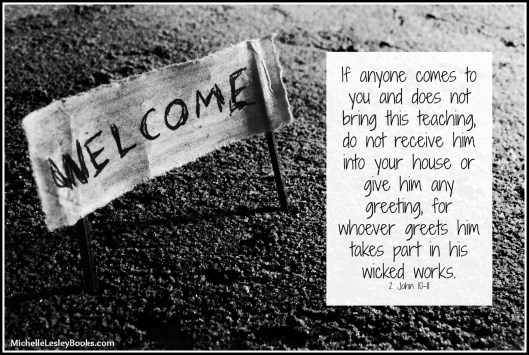
I rejoiced greatly to find some of your children walking in the truth, just as we were commanded by the Father. And now I ask you, dear lady—not as though I were writing you a new commandment, but the one we have had from the beginning—that we love one another. And this is love, that we walk according to his commandments; this is the commandment, just as you have heard from the beginning, so that you should walk in it. For many deceivers have gone out into the world, those who do not confess the coming of Jesus Christ in the flesh. Such a one is the deceiver and the antichrist. Watch yourselves, so that you may not lose what we have worked for, but may win a full reward. Everyone who goes on ahead and does not abide in the teaching of Christ, does not have God. Whoever abides in the teaching has both the Father and the Son. 10 If anyone comes to you and does not bring this teaching, do not receive him into your house or give him any greeting, 11 for whoever greets him takes part in his wicked works.

12 Though I have much to write to you, I would rather not use paper and ink. Instead I hope to come to you and talk face to face, so that our joy may be complete.

13 The children of your elect sister greet you.


The Holy Bible, English Standard Version Copyright © 2001 by Crossway Bibles, a publishing ministry of Good News Publishers.


Questions to Consider:

1. Which genre of biblical literature (epistle, prophecy, history, etc.) is the book of 2 John? Who wrote this book, and to whom was it written? What are two major topics this book deals with in verses 5-6 and in verses 7-11?

2. How many times does the word “truth” appear in this passage? In light of the topic of verses 7-11, why does John place so much emphasis on truth in verses 1-4? Which word, used twice in verse 7, stands in direct contrast to the word “truth” and serves as a pivot point into the topic of verses 7-11?

3. What is the “commandment” in verses 5-6? How does verse 6 say that we demonstrate our love for God? What can we learn about obedience to God from these verses? Can you think of any ways you have shown your love for God today by obeying Him?

4. Which false teaching was John speaking against in verse 7? What does verse 9 say about people who “go on ahead” of what the Bible says Christianity is and believe (or teach) false doctrine? Are they saved? Compare verse 9 to Galatians 1:6-9.

5. What does verse 10 say we should not do when we come across a false teacher? Why? (11) Think about how verses 10-11 might apply today with regard to attending conferences headlined by, or using materials written by, false teachers, following false teachers on social media, re-posting or retweeting false teachers, etc. How is this giving a “greeting” to false teachers and taking part in their wicked works?

Often, when someone is told she’s following a false teacher, she will say, “But she says some good things, too! I just chew up the meat and spit out the bones.” Is this line of thinking supported by verses 10-11 and passages such as Romans 16:17?

Mailbag

The Mailbag: David Jeremiah

So we’re “beta testing” a new weekly feature today and for the foreseeable future: The Mailbag. I get lots of great questions from readers, and I figure if one person is asking, there are probably several more wondering the same thing.

If you have a question about: a well known Christian author/leader, a Bible passage, an aspect of theology, a current issue in Christianity, or how to biblically handle a family, life, or church situation, comment below (I’ll hold all questions in queue {unpublished} for a future edition of The Mailbag) or send me an e-mail or private message. If your question is chosen for publication, your anonymity will be protected.

mailbag

Have you listened to/researched anything on Dr. David Jeremiah? I have heard a couple of his sermons on Turning Point Radio and they have both been sound, but I am wondering more about him.

Photo via DavidJeremiah.org

I have not read any of David Jeremiah’s books nor listened to more than a few excerpts from his sermons, so I suppose it is possible his materials themselves, especially older ones, may be OK, doctrinally. I would, however, urge caution and careful discernment should you decide to use any of his materials.

That being said, while David Jeremiah, generally speaking, has a reputation for preaching and teaching sound doctrine, at least in the past, he is not someone I would recommend due to his extremely poor discernment.

Over the past several years, David Jeremiah has been associating and partnering with a variety of popular false teachers and engaging in questionable practices:

In 2012, he went on Trinity Broadcasting Network’s Praise-A-Thon to help raise money for the indisputably Word of Faith television network. He had all kinds of laudatory words for Paul Crouch and TBN, and his remarks about stewardship, sowing and reaping, etc., were worrisome at best.

Jeremiah has engaged in the same unethical practice as Mark Driscoll and others of buying his way onto the best seller lists.

Jeremiah has partnered with Catholic mystic, Roma Downey, writing a companion book to her A.D. miniseries. (This article also asserts that Jeremiah has connections to T.D. Jakes {modalist, Word of Faith} and Jesse Duplantis {Word of Faith, New Apostolic Reformation}. I don’t doubt the author, but I have not been able to find those connections through my own research. T.D. Jakes was a consultant on Roma Downey’s The Bible miniseries, so it’s possible they know each other through her.)

Last year, Jeremiah joined with Word of Faith heretics Kenneth Copeland, Paula White, and Jan Crouch in laying hands on, and praying for, Donald Trump.

In May, Jeremiah will be sharing the stage with Joyce Meyer and Joel Osteen at the Jumpstart conference. UPDATE: “Due to other conflicts” Jeremiah will no longer be appearing at the Jumpstart conference. A reader shared with me this email she received from Turning Point ministries:

Screenshot_2016-04-09-21-08-13_kindlephoto-665909

In the same way I do not recommend female authors and teachers who preach to men because they are living in ongoing, unrepentant sin (1 Timothy 2:12), I cannot recommend a pastor or teacher (male or female) who is living in ongoing, unrepentant sin by partnering with and endorsing false teachers regardless of how sound his own doctrine might be. Scripture is very clear that this is forbidden:

Everyone who goes on ahead and does not abide in the teaching of Christ, does not have God. Whoever abides in the teaching has both the Father and the Son. 10 If anyone comes to you and does not bring this teaching, do not receive him into your house or give him any greeting, 11 for whoever greets him takes part in his wicked works.
2 John 9-11

Do not be unequally yoked with unbelievers. For what partnership has righteousness with lawlessness? Or what fellowship has light with darkness? 15 What accord has Christ with Belial? Or what portion does a believer share with an unbeliever? 16 What agreement has the temple of God with idols? For we are the temple of the living God; as God said,

“I will make my dwelling among them and walk among them,
    and I will be their God,
    and they shall be my people.
17 Therefore go out from their midst,
    and be separate from them, says the Lord,
and touch no unclean thing;
    then I will welcome you,
18 and I will be a father to you,
    and you shall be sons and daughters to me,
says the Lord Almighty.”
2 Corinthians 6:14-18

Additionally, it is dangerous to fellowship with false teachers because they can corrupt even sound theology.

Do not be deceived: “Bad company ruins good morals.”
1 Corinthians 15:33

Instead of David Jeremiah, I would recommend that you check out one of these fine, doctrinally sound teachers.

Church

Prideful and Prejudiced: Racism, Diversity, and Southern Baptists

prideful prejudiced


Racism. The word practically emits the hum of electrical voltage. No decent person wants to be accused of being a racist, and no one wants to be mistreated on the basis of race. If there’s a more powerful word in the American vernacular right now, I’m not sure what it is.

Racism isn’t something I normally think about or have to deal with on a daily basis even though it would seem to be swirling all around me here in the Deep South. I’m white. The majority of my friends are white. Either I don’t know anyone who’s racist or those who are racist are wise enough, polite enough, or ashamed enough to keep it to themselves. But despite the fact that I don’t have much one on one experience with it, race is an issue that gets a lot of attention, and the main place I’m encountering racial issues of late is in my denomination, the Southern Baptist Convention.

Whether you see it as “too little, too late,” or “it’s about time,” the upper echelons of the SBC have been talking a good game (and, in many instances, making progress) about diversity for the last couple of decades. It started in 1995 with the Resolution On Racial Reconciliation, in which the SBC confessed, apologized for, and sought forgiveness for past involvement with and support of slavery, racism, segregation, and other civil rights issues. Next came the task force that studied changing the name of the SBC to “Great Commission Baptists” due to the negative perceptions and racial implications of the word “Southern.” This was followed by the election of Fred Luter, the first black president of the Southern Baptist Convention.

Fast forward to 2016. So far this year, three well-known pastors have declared their candidacy for president of the SBC, and each has indicated that diversity is an issue he will give attention to.

J.D. Greear: “I want to see minority leaders take places of real prominence in the SBC, such that diversity might become a hallmark of our denomination.”

Steve Gaines: At Bellevue, we don’t just talk about racial reconciliation – we actually experience it and live in it as a reality. It works in our church because we focus on Jesus-centered racial reconciliation.

David Crosby (who will be nominated by Fred Luter): I hope to make [diversity] a matter of consideration from the very first as we seek to structure in the present for a future gospel strategy that is ever wider in its reach.

OK, great. More people of diverse racial backgrounds appointed to executive offices in the SBC. More books and resources about diversity. More seminars, conferences, panel discussions, and breakout sessions about race. Super. All of those things are wonderful and well intentioned, and will hopefully have some sort of positive impact at the administrative level.

But I really don’t think it’s going to make much of a dent in the actual problem.

I have a friend whose seminary graduate husband has been searching for a senior pastor position in an SBC church for about a year now. He’s a great guy who loves God’s people and rightly handles God’s word. And he’s been turned down by church after church. Why? I’m sure the churches who have rejected him would list a variety of factors, but one of the reasons is that he’s black and his wife is white.

Several years ago, my husband was on staff at an SBC church that was located across the street from a lower income housing project inhabited mostly by black, single parent families. The vast majority of our members were retired and I was a stay at home mom. We had a lot of people with a lot of free time on their hands. I suggested we start an after school tutoring program for the kids who lived in the housing project to minister to and reach out to our neighbors. The idea was quickly dismissed by a vocal few because “we don’t want those people in our church.”

That’s where real racism lives in the SBC, not at the national, upper management level, but in the hearts of some of our individual church members.

  • Church members who excuse their sin by saying, “Well, that’s just the way I was raised,” or “I’m too old to change.”
  • Deacons, elders, and search committees who – instead of dealing with sin in the camp – make provision for the flesh of their churches by quietly pushing aside the resumes of minority pastors because they don’t want to deal with the hassle of racist congregants making a stink or risk losing the money they contribute.
  • Churches who sell their buildings and move to a whiter part of town when the surrounding neighborhood “goes black.”
  • Christians whose offerings go around the world to share the gospel with people of all colors but who won’t go across the sanctuary to share a pew with people of another race.

Racism is an issue of the heart. It’s sin.

And sin can’t be solved by appointments based on skin color or some sort of “trickle down” diversity. It can only be solved by individuals repenting before a holy God, receiving His forgiveness, and growing in Christlikeness.

God’s way in the body of Christ is not “top down,” with administrators creating programs, holding meetings and conferences, and strategically moving people into various positions like pawns on a chess board. God’s way is “bottom up,” with local pastors preaching the truth of God’s word to their people and calling them to repent. It begins with Christ working in people’s hearts, one by one, convicting them of their arrogance and self-righteousness, their pride and their prejudice, their failure to see others through God’s eyes, and their failure to love one another the way God has commanded.

1 pet 1 22

The solution to racism and diversity in the SBC?
It’s right there in black and white.