When my kids were toddlers, I knew that there was no way they could wrap their little undeveloped brains around the abstract concept of God. It is certainly true, though, that God has made Himself evident within each of our hearts (Romans 1:19), because when the kids and I would pray together or talk about God, none of them ever once asked me who God was, even though they couldn’t see, hear, or touch Him. Teaching our kids to pray fans that little spark of knowing God into flame. Start from birth, and help them to make it a lifelong discipline.
I’m not a big fan of “Now I lay me down to sleep”, “God is great; God is good” and other memorized prayers. Assuming they’re biblically sound, there’s nothing intrinsically wrong with them, and they do contain some spiritual truths, but in my own experience the more familiar, rote, and repetitious something is, the less meaningful it can become over time. I think it’s important to teach kids that prayer is away of talking with God that should have meaning for our lives.
When we teach children to pray, they need to know that they don’t have to use “thee’s” and “thou’s” and a bunch of fancy language in order to be heard. There are millions of Christians all over the globe who wouldn’t know flowery speech if it smacked them upside the head, and yet God listens to them just the same.
It is also essential that we teach them that while God is indeed our friend, He is also holy, and must be addressed with reverence for that holiness. When we recognize His holiness in our prayers by acknowledging Him as Creator of all things in the universe, listing and proclaiming His attributes (such as goodness, mercy, justice, grace, love, forgiveness, etc.), and humbling ourselves before Him, it puts us in the right spiritual attitude for doing business with God.
Another vital distinction to make is that God is not Santa Claus. He’s not sitting up there waiting for our wish lists, granting them if we’ve been nice and denying them if we’ve been naughty. Kids are naturally self-centered, so it helps them to take their focus off self if we teach them to thank God for the things that they already have, to pray for others, and to confess their sins.
Jesus gave us a great example of how to pray in the Lord’s Prayer (Matthew 6:9-13):
Our Father who is in heaven, Hallowed be Your name. Your kingdom come Your will be done, On earth as it is in heaven. We humble ourselves before God, recognizing His position and submitting to His sovereignty and authority.
Your will be done on earth as it is in Heaven. We intercede for ourselves as well as others. We ask that God’s will, not ours or anyone else’s, be done in each situation, and that He will receive the glory in every circumstance.
Give us this day our daily bread. We ask for God’s provision for our needs and recognize that it is only by His hand that we have anything.
And forgive us our debts, as we also have forgiven our debtors. We confess and ask forgiveness for our sins. We ask God to help us forgive those who have sinned against us.
And do not lead us into temptation, but deliver us from evil. We ask for God’s protection and the strength to obey Him and resist temptation.
For Yours is the kingdom and the power and the glory forever. Amen. We again recognize God’s sovereignty, give Him glory, and leave all of our requests with Him to deal with as He sees fit.
Your 5 year old’s prayer, encompassing these areas, might look something like this:
Dear Lord,
Thank you for being good and loving. Thank you for my family and my dog. Thank you for making the park so I can play there. Thank you for the food we’ve eaten today, and please give us the food we need tomorrow. Please help my friend Jason to feel better and get over the flu. I’m sorry I hit my brother this morning. Please forgive me and help me to be kind to him. I love You.
In Jesus’ name, Amen.
Of course, he probably isn’t going to come up with all of that on his own. The best way to teach kids to pray is to pray with them. You might go first, praying a simple prayer, and then have him pray, or you might want to try what I call a “ping pong” prayer. You pray one sentence, and he prays the next, and so on, until you’re done. For example:
Mom: Dear Lord, thank you for being kind.
Kid: Thank you for being forgiving.
Mom: Please help the Jones family because they’re sad that their cat died.
Kid: Please take care of our missionaries in South America.
etc……
One of the ways we can teach our kids that God hears us when we pray is to keep track of His answers to our prayers. At our house, I was concerned that, while we were all praying together, the kids were not making the connection between their prayers and what God was doing in our lives. I decided a good way to help them make that connection would be to keep track of answered prayers as well as blessings we hadn’t thought to ask for, and other ways God was working in our family.
It was as simple as a trip to the dollar store. I bought a piece of posterboard and entitled it “What is God up to?” It now graces one wall of our breakfast room. Every time we have an answered prayer (even if the answer is no), an unexpected blessing, or an obvious move of God in our lives, I write it down on the poster. It has really helped the kids to see where God is moving. I can tell, because now they are the ones to remind me of an answer to prayer or something else that needs to go on the poster!
It has also helped them to learn that our prayers don’t just bounce off the ceiling. God does care for us. He does want to hear from us. We can bond with Him by spending time talking to Him. Those are priceless precepts for kids and parents alike.
And these words that I command you today shall be on your heart. You shall teach them diligently to your children, and shall talk of them when you sit in your house, and when you walk by the way, and when you lie down, and when you rise.
Deuteronomy 6:6-7
Phew. That’s a pretty tall order, isn’t it? God may have said this through Moses to Old Testament Israel, but His words are just as relevant for 21st century Christian parents. God wants our children immersed in His Word as they go about their daily lives. Ephesians 6:4 reminds fathers that they are to bring their children up “in the discipline and instruction of the Lord,” and as moms, we have the joy of supporting our husbands in that venture by bringing Scripture and prayer to bear on all those little daily “walk by the way” moments. But how? Here are some practical ways I’ve discovered for capturing those teachable moments and pouring God’s Word into them.
Capture those teachable moments with your kids and pour God’s Word into them!
Be faithful to your own Bible study and prayer time. Let your children “catch you in the act” from time to time. Share with them what you’re learning from God’s Word, things you’re praying about, things you’ve asked God to forgive you for, etc.
2. Train your children to have their own daily Bible study time.
You might be surprised at how early you can start developing this godly habit in your child. With an infant, you might simply take a few minutes of her morning feeding to read aloud from your Bible and pray. With a toddler, you can regularly set aside five or ten minutes (when she’s not tired or hungry) for her to sit down and look at pictures in a children’s Bible, maybe while you’re sitting nearby with your own Bible, modeling for her. As children get a little older and can read, you can set aside a block of time before their bedtime for individual Bible study and prayer. When they’re very small, children aren’t going to understand much from the Bible (although they will surprise you sometimes!), but they will still be absorbing some valuable things: the Bible is an important book, God is the top priority in my family, and God and His Word should be preeminent in my life.
3. Establish a regular time of family worship at home.
If your husband is a believer, be careful not to usurp his leadership in this area. It is ultimately His responsibility to lead his family in worship. Help each other think of ways to make your family worship time age appropriate for the children, and support your husband as he teaches God’s Word. Also, understand that with children comes chaos. (My four children who are still at home range in age from 11 to 19, and I still have to remind them to quiet down and stay on track during family worship.) It’s going to happen. Just tuck and roll and don’t give up.
4. Sing.
Who cares if you can’t carry a tune in a bucket? God doesn’t, that’s for sure. Sing some hymns while you’re washing the dishes. Sing along with some worship music (doctrinally sound, of course) in the car. Music is a great way to get God’s truths into your child’s heart and mind.
Music is a great way to get God’s truths into your child’s heart and mind.
During our family worship time, we used to go around and share prayer requests, then one or two people would pray. We found that the children were either forgetting the prayer requests or we would have to spend time writing them down. So now we often do what we have dubbed “conversation prayer”. One parent will say a brief opening prayer, and then the “floor is open” for anyone to say a (or several) one or two sentence prayer about whatever is on his heart (“Please help me do well on my math test tomorrow,” or “Lord, please save Grandmamma.”). When it seems like everyone is finished, the other parent says a closing prayer.
6. What is God up to?
Sometimes it’s hard for children (and even adults) to recognize and remember the ways God is answering prayers and working in their lives. When our children were smaller, I put up a piece of posterboard on the wall of the breakfast room with the title “What is God up to?” at the top. Whenever God answered something we had been praying about, provided for us, moved in our lives in some way, or blessed us, we made a little note about it, along with the date. It had big things – like my daughter getting saved – as well as little things – like my son finally learning to tie his shoes. It helped my children to recognize God’s sovereignty over all areas of our lives, that He does answer prayer, and that He gets the glory for everything.
Help your children recognize God’s sovereignty over all areas of our lives, that He does answer prayer, and that He gets the glory for everything.
Your children are going to struggle with things. They’re going to have times of rejoicing and times of sorrow. There will be times when they have disobeyed and need to repent of their sin. What better opportunities to teach them to take everything to God in prayer? Teach them how to ask God for help when something is too hard. Teach them to thank God for blessing them and ask Him to comfort them when they’re sad. Show them how to ask God for forgiveness when they’ve done wrong.
8. Sprinkle life with Scripture.
(In order to do this, you’re going to have to know Scripture, so be sure to be faithful to your own study of God’s Word.) When you see a beautiful sunset, talk about how God created the sun and moon. When your child is kind to someone, praise him and tell him God wants us to be kind to others. When you discipline him, show him his sin from Scripture, and talk about repentance and God’s forgiveness.
9. Memorize Scripture together.
There is a wonderfully wide variety of Scripture memory resources out there. My children were all involved in a Scripture memory program at church when they were small, and we worked on their memory verses together at home. Our home schooling curriculum, at the kindergarten level, had a 26 verse Scripture memory program in which we memorized a verse beginning with each letter of the alphabet. Seeds Kids Worship is a fantastic program with word for word Scripture songs and other great resources. There are even apps that can help. And you can always make up your own fun programs, songs, and contests to help the whole family memorize God’s Word.
10. Ask questions.
“Would God be pleased with the way you’re acting? How do you know?” “What does the Bible say about the way we should treat each other?” “What does the Bible say about _____?” Questions like these get your children thinking. They take your children from simply reading and hearing God’s Word to applying Scripture to their lives and recognizing that they must submit to it.
Take your children from simply reading and hearing God’s Word to applying Scripture to their lives and recognizing that they must submit to it.
Forget the tablets and the radio. This is a great way to harness that down time in the car (or anywhere else) and use it to teach your kids about prayer and thankfulness. It’s kind of like playing “I Spy.” Just look out the window and take turns thanking God for what you see: “Thank You, God, for making birds.” “Thank You for ice cream.” “Thank You for police officers who help us.” Or pray for people as you pass by various buildings. “God, please help the sick people in that hospital…help the pastor of that church do a good job of preaching Your Word…provide homes for the people in that shelter…” We also made it a habit to pray for victims of accidents or tragedies whenever we saw an ambulance or fire truck.
12. Kiddievangelism
Our kids need to see us sharing the gospel with people as a normal part of everyday life, and we need to explain to them why it’s so important. There’s an easy way to get your kids personally involved, too, especially when they’re small: tracts. Get some doctrinally sound tracts (my favorites are from Bezeugen) and let your child leave one in the waiting room at the doctor’s office, on the table when you leave McDonald’s, or hand one to the cashier at the store. I’ve had people turn me down when I offer them a tract, but who’s going to refuse an adorable three year old? Get them started on a lifelong habit of sharing the gospel wherever they go.
Get your children started on a lifelong habit of sharing the gospel wherever they go.
As Christian parents it’s our responsibility before God to train our children in the Scriptures, prayer, and godliness. If we slow down and ask God to direct us, He will show us all kinds of ways we can teach them diligently to our children, when we sit in our houses, and when we walk by the way, and when we lie down, and when we rise.
What are some fun or unique ways you’ve found to pour God’s Word into your children’s everyday lives?
Welcome to another “potpourri” edition of The Mailbag, where I give short(er, kinda? sometimes?😀) answers to several questions rather than a long answer to one question.
Or maybe I answered your question already? Check out my article The Mailbag: Top 10 FAQs to see if your question has been answered and to get some helpful resources.
I recently commented on a post on X regarding a husband determining how his household votes and I took the position that if the husband votes against biblical principles, the wife should not have to also do so.
After reading your article I “feel led” in a different direction from my husband, I think my position is wrong. My husband generally votes liberal and I conservative. I try to keep quiet regarding my opinions which do not align with his, but my husband knows how I vote and he does not like it. Like the lady in the article, I would like to know that I am doing the right thing if I vote according to my husband’s choices.
Great question! I’m so glad you’re trying to think this through biblically and that you want to submit to your husband.
There’s a pretty big difference between the situation the lady in the “I ‘feel led'” article was asking about and the situation you’re asking about.
Her husband wasn’t doing anything sinful or unbiblical. He was doing something morally neutral and potentially beneficial for his family. Your husband is doing something sinful and unbiblical (especially if he professes to be a Christian), and potentially harmful to thousands or millions of people. Remember this paragraph of the article?
Unless your husband is…encouraging you to do something sinful, God’s will is for you to graciously submit to his decisions. Denying your request to move to another state may not make you happy, but it does not qualify as…sin.
Your initial position was correct. No Christian should vote for things that conflict with rightly handled, in context Scripture, and that includes Christian wives whose husbands vote in favor of those things. No, you would not be doing the right thing if you vote in favor of unbiblical issues simply because your husband does.
God is a God of order who established and runs His world according to a hierarchy of authorities that we are to submit to. The Christian woman’s hierarchy of authorities to submit to looks like this:
God Your husband Other authorities in their appropriate spheres (your pastor, the government, your boss, etc.)
You should absolutely submit to your husband, even if your husband isn’t a Believer. But God outranks your husband, and if God tells you to do something (in rightly handled, in context Scripture), and your husband tells you to do something else, you submit to God, not your husband. As Peter said in Acts 5:29, “We must obey God rather than men.”.
Sit down with your husband and have a conversation about this. Acknowledge that you’re aware he doesn’t like the way you vote, but that you can’t vote for things that are unbiblical. Reassure him that you will never lie to him about how you plan to vote and that you will vote the way he does on any issue that does not conflict with Scripture.
But on the items that do conflict with Scripture, there are two options on the table:
You can continue to vote on the issue in alignment with Scripture
You can refrain from voting on those items
Let him know you’ll graciously abide by whatever he decides. That way you will be submitting to him, but in a way that doesn’t cause you to sin against your conscience.
I have followed you for 6-7 years (or more-time flies!) and have learned so much about false teachers and discernment. This has also cost me many friends. I am deeply sad that so many are led astray. Would you please read the following Facebook post that my friend posted and comment on how you would respond to this? Thank you for your time and consideration.
Thank you so much for your kind words of encouragement and for being a loyal follower!
Yep, that’s me – if you have too many friends or too many social media followers, just start sharing my articles with them. I guarantee that will whittle your friend list down to an easily manageable number!😀
This is one of those things that sounds kinda “Christiany” on the surface, but the minute you start giving it any actual biblical thought, it collapses like the house of cards it is. I mean, just take the very last sentence.
Do you think any evangelical woman who swears by all this stuff -let’s call her “Vivian Virtue Signaler”- is going to find joy by surrounding herself with me (or any other doctrinally sound Christian who would tell her this is all a bunch of holier-than-thou hoo hah)? I give Vivian five minutes before she takes a swing at me – someone who, undoubtedly, lives “differently” than she does.
BEFORE READING FURTHER, let me issue all of my readers a little challenge. Go through each of the points listed on the meme, read them carefully, and see if you can explain – from rightly handed, in context, chapter and verse Scripture – why each statement is either biblical or unbiblical. Then, read my answers below and let’s see if we’re on the same page!
Here we go!
The title of this meme, “I Care About You,” is a lie for any Christian who agrees with many of the things listed in items 1-9.
Who you choose to love, and how you love, is your business. Anyone with a pulse knows this is code for, “Homosexuality is fine, and nobody better say any different.”. It’s a veiled threat. No one who’s actually been born again would ever say something so hateful to someone enslaved to the sin of homosexuality or any other sexual sin. When we see someone who desperately needs a Savior, it’s our business to call that person to repent and believe the gospel.
Furthermore, Vivian, if someone chooses to “love” your husband, your nine year old, or your dog in a sexually immoral way, is that still just his or her business? I think you’d say that’s now your business. X
I respect your pursuit of happiness. Again, this is code for, “Sin all you like, in any way you like! I’ll never confront you!”. How is that “I care about you,” for a Christian?
Vivian, what if my “pursuit of happiness” includes stealing your car, drowning kittens, or correcting all of these unbiblical beliefs you hold? You’re going to stand by and joyfully “respect” my pursuit of those things without telling me to stop? I don’t believe that for a second. X
I will live and let live. Riiiiiiight. No one who has ever said this truly believes it or lives it out. No one. Eventually, everyone confronts someone about something and tells him to stop. Why? First, because the law is written on our hearts. We all have a basic sense of right and wrong, justice and injustice. We’re not going to “let live” someone whose “pursuit of happiness” includes harming someone we love. Second, we idolize the comfort of our own flesh. If someone walks up to you and starts repeatedly poking you in the arm, exactly how many pokes will it take before “live and let live” goes right out the window?
(How ya doing over there, Vivian Virtue Signaler? Finding a lot of joy in this dismantling of your ridiculous and unbiblical platitudes?) X
I will follow my faith, knowing that Jesus calls me to love. Yo Viv, how about you follow the Bible, knowing that your “faith” is in the world’s definition of “love”. I got your love right here:
Do not love the world nor the things in the world. If anyone loves the world, the love of the Father is not in him. For all that is in the world, the lust of the flesh and the lust of the eyes and the boastful pride of life, is not from the Father, but is from the world. 1 John 2:15-16
You love the world and its ideologies. You love people thinking you’re a wonderful person. You don’t love Christ and His Word.
Greater love has no one than this, that one lay down his life for his friends. John 15:13
You won’t even lay your life down enough to call sinners to repent and believe the gospel. You hate them by leaving them to die in their sins. X
I will try to use my time on this earth wisely, choosing understanding over judgment. This whole screed is you judging other “Christians” who aren’t as awesome and virtuous as you are. It’s dripping with unbiblical, hypocritical judgment against the Christian clodhoppers who are so backwards and hick as to actually believe the Bible and do what it says.
I will not name call or belittle. This is a great – and, in fact, biblical – aspiration, Vivian, but this entire meme implicitly belittles everyone who isn’t as wonderful as you are. Furthermore, it’s the very “Christians” who say things like this and parade their awesomeness around in front of everybody who are the first to attack doctrinally sound Christians for humbly obeying Scripture and calling others to do the same. X
I am not better than you. This is a true and biblical statement, Vivian. If you believed this, you wouldn’t have created and posted this virtue signaling meme. X
We are all humans, created by God, not robots programmed to think, act, or live the same way. Accurate, at least on the surface. But in the context of all the other things Vivian is saying in this meme, what she seems to mean is that, for example, living as a Satan worshiping, transsexual, abortionist is just as valid a way of life as living as a genuinely regenerate Christian who thinks, acts, and lives according to Scripture.
It’s not. There’s a vast difference between “not thinking, acting, or living the same way” when it comes to morally neutral life choices like urban vs. rural, vegetarian vs. carnivore, or white collar vs. blue collar, and “not thinking, acting, or living the same way” when it comes to life choices that are not morally neutral, like Satanist vs. Christian, homosexual vs. heterosexual, or drunkenness vs. sobriety.
When it’s a matter of “not thinking, acting, or living the same way” as the Bible commands, that’s sin. And people living in sin must be called to repent and believe the gospel. That’s the only way “I Care About You” can be true. X X
I will love you as you express your kind, honest, true self. Well, Viv, I’ve expressed my kind, honest, true self to you, and I am kindly, honestly, and truly telling you that you need to repent of all these unbiblical notions and of the pride that motivated you to create and post this meme. Do you love me?
From experience, I’ve found joy in surrounding myself with those who live differently than I do. I don’t, because, broadly speaking, people who “live differently than I do” with regard to those life choices that aren’t morally neutral, aren’t saved.
And I find no joy in surrounding myself with sinners who are determined to fling themselves into the bowels of Hell for all eternity.
I find that heartbreaking.
I want them to know Christ. I want them to know the same forgiveness, peace, love, and hope I found when I came to know Him.
That’s what “I Care About You” means for a Christian.
Now, my dear reader who submitted this question, you asked how I would respond to this. The above is how I respond to the content of the meme.
If you’re asking how you should respond to your friend who found this meme somewhere and shared it on Facebook, I would take into consideration your friend’s spiritual state (lost or saved?) and, if she’s saved, her level of spiritual maturity, and I would most likely just scroll on by without comment.
If, for some reason, you do find it necessary to discuss it with her, I would do so privately and in person. Just take her through the various points of the meme, kindly and patiently ask her questions about what she understands each statement to mean, and point her to Scripture.
Be prepared for her not to react well. Maybe she’s just a young Christian who doesn’t know any better and will be thankful to learn from you. I hope that’s the case. But she could also be someone who’s entrenched in this drivel, doesn’t want you raining on her parade of good vibrations, and will not take kindly to anyone contradicting it. Don’t let her reaction deter you from standing firmly, yet kindly, on the truth of Scripture.
My question is, for childrens ministry, is it appropriate or biblical to have Sunday lessons as well as Wednesday night lessons for the children? I find myself being stretched thin and believe the responsibility should be for parents to primarily teach their children. I think of Titus, where Paul exhorts the older women to teach the younger women. I believe that though I have a passion to teach both women and children, I am being led to teach the mothers to teach their own children. While still continuing in Sunday lessons at least until the kids reach 12 yrs.
I think I understand what you’re asking, but I’m going to have to read between the lines a bit, because a few key pieces of information seem to be missing. So please forgive me if I misread between the lines.
There is absolutely nothing wrong or unbiblical, and everything right and biblical, with a church that has children’s Bible classes on Sunday morning and Wednesday night, just like they might have adult Bible classes on Sunday morning and Wednesday night. In fact, among the churches I’m familiar with, this is exactly what most of them do.
I’m inferring from your statements about being “stretched thin” and your passion for teaching children that perhaps you are the only one teaching the children’s classes and you’re starting to get a little burned out or your life has gotten busier and you no longer have time to prepare for and teach both Sunday and Wednesday.
If that’s the case, there are two separate issues at play here, and I would encourage you to keep them separate in order to handle each of them biblically.
First, while it’s important to keep our commitments, to be women of our word, and to follow through with things we’ve agreed to do, sometimes life just happens. This is why it is important to make sure our priorities in life are in a biblical order and that we learn to say no to lower priority things that impinge on higher priority things.
A Christian woman’s priorities and obligations should be:
Her personal relationship with Christ Her husband (if she’s married) Her children and grandchildren (if any) Her church Relationally close extended family / loved ones Her job or other work outside of managing her household Leisure, hobbies, optional volunteer work
Naturally, emergencies and other situations may temporarily shift some of these things around a bit. Caring for an aging parent may force you to miss church sometimes. If your neighbor’s house is on fire, the Lord does not want you to finish your morning Bible study time instead of helping them.
But if, for instance, you’ve entered a season of life in which your children or husband need more of your time at home, it’s OK to finish out, and cut back on, your commitments (those that are over and above attending Bible study and worship service) at church.
Too many Christian women do not know how to say a holy “no,” and end up overextending themselves in a way that is a disservice to themselves and their families, and is actually displeasing to the Lord. You do not have to say “yes” to everything you’re asked to do. (And trust me, the more you say yes, the more you’ll be asked.)
When someone asks you to take on a long term responsibility like teaching a class, or serving on a committee, or cooking the Wednesday night fellowship meal, or whatever, your immediate response should be something along the lines of, “I’m honored that you asked me. Let me talk to my husband about it and pray about it. Could I get back to you next week with my answer?”. And then take that time to think, pray, and discuss with your husband whether or not this new responsibility would be a fit for you, your family, and your schedule.
If it’s not, there’s no shame in that, and you don’t need to make up excuses (which can turn out to be lies, if you’re not careful). All you have to say is, “Myrtle, I’m so honored you asked me to teach the three year old class every week, but after discussing it with my husband, praying about it, and evaluating my schedule, I’m afraid I can’t commit to that right now. I’ll pray with you that you’ll find just the right person for the job.”.
Just because there’s a vacancy or a need doesn’t necessarily mean you have to be the one to fill it.
So if that’s the type of situation you’re in – you’re overextended, or you’ve been teaching the children forever and you just need a break, or God truly is changing the direction He wants you to go in serving Him (from teaching children to teaching adult women) that’s OK in and of itself. You don’t need to lean on “parents should be their children’s primary Bible teachers” or any other “loftier” theological reason to cut back or shift gears.* Prayerfully and honestly decide what you need to do to honor God, finish out your commitment or give plenty of notice, and do it.
*(I’m not saying the lady who asked the question is doing this, I just know that among hard-working, constantly serving Christian women, sometimes we feel like we have to have some sort of super spiritual sounding reason for saying no to something. We don’t. Keeping your priorities in a biblical order is a “super spiritual” reason.)
The principle of parents needing to be their children’s primary Bible teachers is a separate issue. Yes, parents should be pouring the Word and prayer into their children every day. Two Bible classes a week at church is not going to prevent or interfere with parents who are committed to doing that.
For parents who are not already committed to teaching their children the Bible at home, but are relying on the children’s Bible classes at church to do their job for them, canceling one or both of the classes is not the answer. That’s not going to suddenly inspire those parents to start teaching their children the Bible. All it’s going to do is reduce or eliminate the only Bible teaching the children are currently receiving.
My advice (depending on what your husband and your pastor say, of course – you’ll need to check with them first) would be to find however many people you need to either help you with or take over the children’s classes, and then begin discipling the mothers to teach their children the Bible at home during the week. Or maybe do both. Disciple the mothers, but also have them come with their children to either or both of the weekly classes so they can learn how to teach their children the Bible. Maybe even have the moms rotate teaching the children’s classes so they can get some “on the job training”! That might be a good way to get the help you need in the children’s classes.
If you have a question about: a Bible passage, an aspect of theology, a current issue in Christianity, or how to biblically handle a family, life, or church situation, comment below (I’ll hold all questions in queue {unpublished} for a future edition of The Mailbag) or send me an e-mail or private message. If your question is chosen for publication, your anonymity will be protected.
Is your family getting ready for Advent? Loosely defined, Advent is the period of time leading up to Christmas when we commemorate Christ’s first coming and anticipate His second coming. And what better way to do so than by making Bible study and worship part of your family tradition? Here are some awesome Advent resources1 for young and old alike. Most of them are free, but the ones that aren’t, I’ve marked with a 💰.
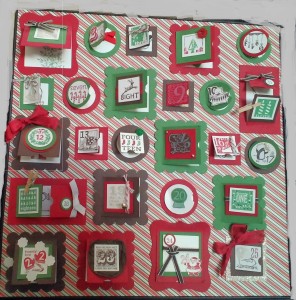
December Advent!– Here’s an advent calendar, craft, and devotional all rolled into one! Naomi’s Table is a women’s Bible study resource that I highly recommend for sound doctrine and right handling of God’s Word. Have a listen to their daily Advent podcasts and make the Advent calendar that goes with them!
Need a good Advent playlist? I’ve created one on YouTube. Your favorite Advent (not Christmas) song isn’t included? Leave a comment and I’ll add it if appropriate.
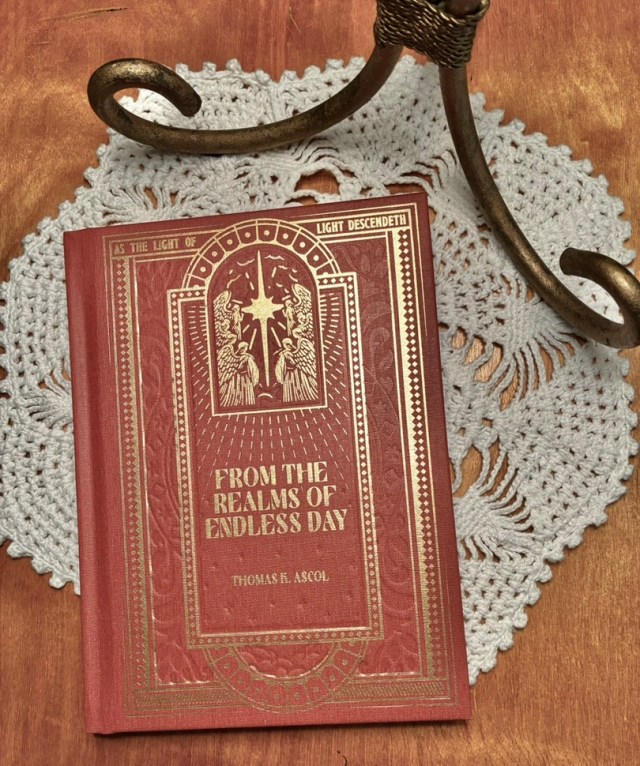
From the Realms of Endless Day by Dr. Tom Ascol. “This little book is meant to be used as a daily devotional guide throughout the Christmas season. It is broken into five sections of five devotions. Each section focuses on one passage of Scripture that is considered verse-by-verse.” Designed for family or individual use, with Scripture memory passages in each section and study questions at the end of each of the 25 lessons. Encouraging Christmas poetry from Dr. Tom Nettles is also sprinkled throughout the book.💰
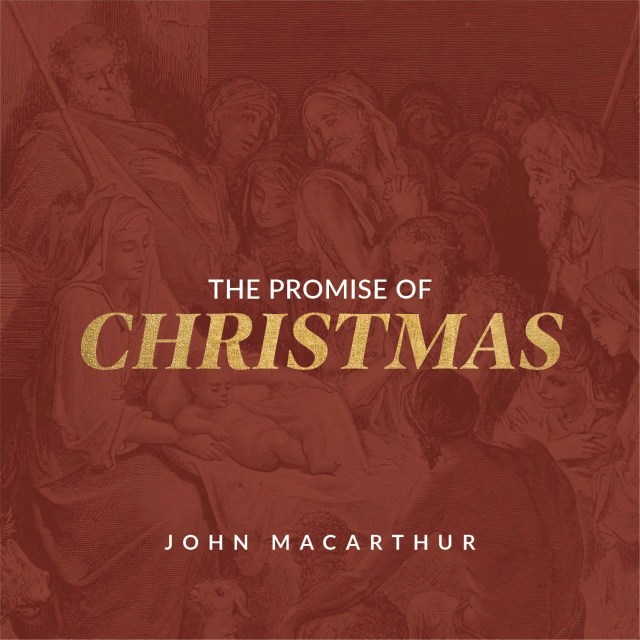
The Promise of Christmas by John MacArthur. “…What would it have been like to be in Bethlehem for the very first Christmas? Would you have been waiting for Jesus? What would you have been anticipating? Would you have expected the Savior, King, and deliverer promised in Scripture to arrive unheralded by men—born in a lowly stable, surrounded by animals and society’s outcasts?…In The Promise of Christmas, John MacArthur answers those questions and more as he takes you back in time to first-century Israel.” A series of six sermons.
Is observing Advent new for your family? Children are often “hands on” learners, and this Advent wreath craft could be a great way to explain the significance of Advent, the wreath, and each candle as they create it. Follow the step-by-step instructions here, using your own design, or subscribe to the email list to download the free printables.
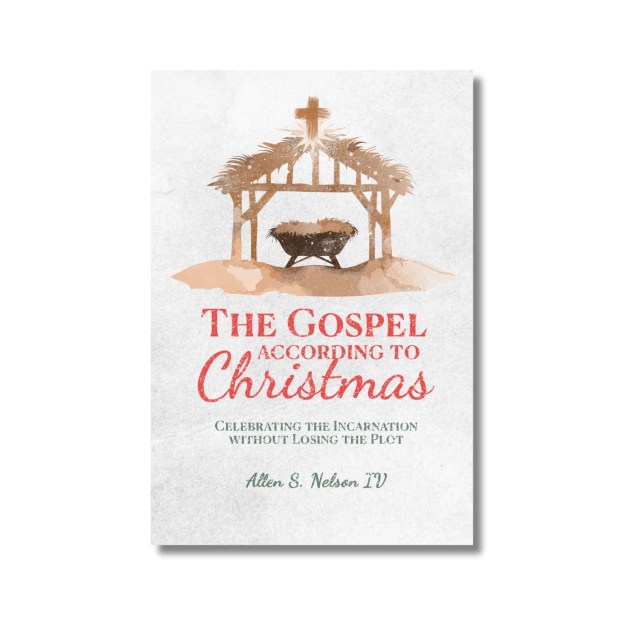
The Gospel According to Christmas by Allen Nelson. In a world where Christmas is often reduced to twinkling lights and fleeting sentiments, The Gospel According to Christmas is a clarion call to rediscover the holiday’s true heartbeat: the gospel of Jesus Christ. With pastoral warmth, Allen Nelson IV guides readers through 1 Peter 2:24 to unveil the staggering reality of Christ’s incarnation and sacrifice…Read it, share it, and let it rekindle your love for the Christ of Christmas. Reflection questions in each chapter make this book a perfect fit for group study or family devotions.”💰
The Jesse Tree– A charming precursor to the Advent calendar, the Jesse tree traces the story of Jesus from Creation to His birth. Using your Christmas tree or a crafted tree, hang an ornament each day that represents the Bible story for that day. This site has a free Jesse Tree tool kit with ideas for making your own Jesse Tree, the Scripture references for each day, and printable ornaments. (They also offer a family devotional and a individual devotional. If you’re considering using them, please do so carefully and discerningly. I read several of the family devotions and they seemed OK, but the Reformed Church in America {which sponsors this site} appears to have struggled with progressivism in their theology.)
Manger in Danger– This charming family devotional and game centering on the incarnation of Christ was created by Pastor Grant Castleberry and his wife, GraceAnna. “Manger in Danger is a fun, interactive family tradition that brings the Christmas story from the Bible to life in 25 days of family devotionals!”💰
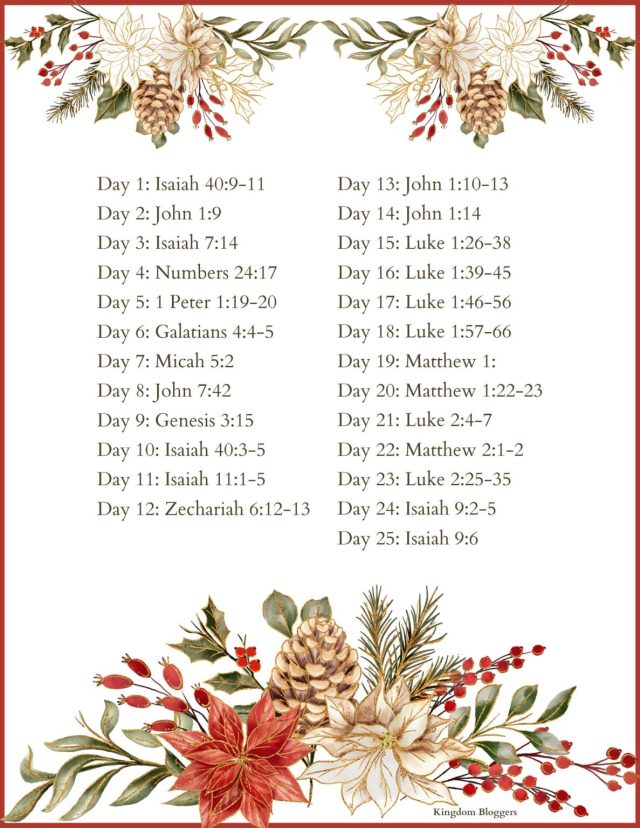
I thought this was a cute idea – an Advent Countdown Candle. Just grab a taper, make 25 marks down the side of it, and each night burn away one more day. Simple! You might even like to read one of these Advent Scriptures…
…every night by candlelight. Or use my Advent playlist above, and sing one of the hymns there as each day burns away.
How about combining Advent and prayer with an Advent Prayer Calendar? Choose from dozens of designs, print out the one you like best, and color, decorate, or fancy it up any way you like. Each day, simply fill in the name of the person or ministry you’re praying for and spend a few minutes interceding for them. It’s a great way to start a habit of family prayer and count down to Christmas at the same time!
(This is a site1 where you’ll want to grab only the printable and leave everything else behind.)
Christmas Messages by R.C. Sproul- “In this set of Christmas sermons, Dr. R.C. Sproul examines the account of the Magi in the gospel according to Matthew and the relationship of David and Saul in order to unfold the significance of Christmas and the incarnation of Christ. With theological insight and attention to scriptural detail, Dr. Sproul demonstrates how these events and relationships contribute to our understanding of the person and role of Christ.”
Waiting for the Promise from Answers in Genesis. “As you reflect through this devotional on the promises of God for 4,000 years before the birth of Christ, be reminded of his great love for you that he would send his only Son to offer salvation for sinners!”💰(Free sample chapters available)
What’s your favorite Advent resource?
1I do not endorse anything on any of these sites nor any of these creators who deviate from Scripture or conflict with my beliefs as outlined in the “Welcome” or “Statement of Faith” tabs at the top of this page.
And these words that I command you today shall be on your heart. You shall teach them diligently to your children, and shall talk of them when you sit in your house, and when you walk by the way, and when you lie down, and when you rise.
Deuteronomy 6:6-7
Phew. That’s a pretty tall order, isn’t it? God may have said this through Moses to Old Testament Israel, but His words are just as relevant for 21st century Christian parents. God wants our children immersed in His Word as they go about their daily lives. Ephesians 6:4 reminds fathers that they are to bring their children up “in the discipline and instruction of the Lord,” and as moms, we have the joy of supporting our husbands in that venture by bringing Scripture and prayer to bear on all those little daily “walk by the way” moments. But how? Here are some practical ways I’ve discovered for capturing those teachable moments and pouring God’s Word into them.
Capture those teachable moments with your kids and pour God’s Word into them!
Be faithful to your own Bible study and prayer time. Let your children “catch you in the act” from time to time. Share with them what you’re learning from God’s Word, things you’re praying about, things you’ve asked God to forgive you for, etc.
2. Train your children to have their own daily Bible study time.
You might be surprised at how early you can start developing this godly habit in your child. With an infant, you might simply take a few minutes of her morning feeding to read aloud from your Bible and pray. With a toddler, you can regularly set aside five or ten minutes (when she’s not tired or hungry) for her to sit down and look at pictures in a children’s Bible, maybe while you’re sitting nearby with your own Bible, modeling for her. As children get a little older and can read, you can set aside a block of time before their bedtime for individual Bible study and prayer. When they’re very small, children aren’t going to understand much from the Bible (although they will surprise you sometimes!), but they will still be absorbing some valuable things: the Bible is an important book, God is the top priority in my family, and God and His Word should be preeminent in my life.
3. Establish a regular time of family worship at home.
If your husband is a believer, be careful not to usurp his leadership in this area. It is ultimately His responsibility to lead his family in worship. Help each other think of ways to make your family worship time age appropriate for the children, and support your husband as he teaches God’s Word. Also, understand that with children comes chaos. (My four children who are still at home range in age from 11 to 19, and I still have to remind them to quiet down and stay on track during family worship.) It’s going to happen. Just tuck and roll and don’t give up.
4. Sing.
Who cares if you can’t carry a tune in a bucket? God doesn’t, that’s for sure. Sing some hymns while you’re washing the dishes. Sing along with some worship music (doctrinally sound, of course) in the car. Music is a great way to get God’s truths into your child’s heart and mind.
Music is a great way to get God’s truths into your child’s heart and mind.
During our family worship time, we used to go around and share prayer requests, then one or two people would pray. We found that the children were either forgetting the prayer requests or we would have to spend time writing them down. So now we often do what we have dubbed “conversation prayer”. One parent will say a brief opening prayer, and then the “floor is open” for anyone to say a (or several) one or two sentence prayer about whatever is on his heart (“Please help me do well on my math test tomorrow,” or “Lord, please save Grandmamma.”). When it seems like everyone is finished, the other parent says a closing prayer.
6. What is God up to?
Sometimes it’s hard for children (and even adults) to recognize and remember the ways God is answering prayers and working in their lives. When our children were smaller, I put up a piece of posterboard on the wall of the breakfast room with the title “What is God up to?” at the top. Whenever God answered something we had been praying about, provided for us, moved in our lives in some way, or blessed us, we made a little note about it, along with the date. It had big things – like my daughter getting saved – as well as little things – like my son finally learning to tie his shoes. It helped my children to recognize God’s sovereignty over all areas of our lives, that He does answer prayer, and that He gets the glory for everything.
Help your children recognize God’s sovereignty over all areas of our lives, that He does answer prayer, and that He gets the glory for everything.
Your children are going to struggle with things. They’re going to have times of rejoicing and times of sorrow. There will be times when they have disobeyed and need to repent of their sin. What better opportunities to teach them to take everything to God in prayer? Teach them how to ask God for help when something is too hard. Teach them to thank God for blessing them and ask Him to comfort them when they’re sad. Show them how to ask God for forgiveness when they’ve done wrong.
8. Sprinkle life with Scripture.
(In order to do this, you’re going to have to know Scripture, so be sure to be faithful to your own study of God’s Word.) When you see a beautiful sunset, talk about how God created the sun and moon. When your child is kind to someone, praise him and tell him God wants us to be kind to others. When you discipline him, show him his sin from Scripture, and talk about repentance and God’s forgiveness.
9. Memorize Scripture together.
There is a wonderfully wide variety of Scripture memory resources out there. My children were all involved in a Scripture memory program at church when they were small, and we worked on their memory verses together at home. Our home schooling curriculum, at the kindergarten level, had a 26 verse Scripture memory program in which we memorized a verse beginning with each letter of the alphabet. Seeds Kids Worship is a fantastic program with word for word Scripture songs and other great resources. There are even apps that can help. And you can always make up your own fun programs, songs, and contests to help the whole family memorize God’s Word.
10. Ask questions.
“Would God be pleased with the way you’re acting? How do you know?” “What does the Bible say about the way we should treat each other?” “What does the Bible say about _____?” Questions like these get your children thinking. They take your children from simply reading and hearing God’s Word to applying Scripture to their lives and recognizing that they must submit to it.
Take your children from simply reading and hearing God’s Word to applying Scripture to their lives and recognizing that they must submit to it.
Forget the tablets and the radio. This is a great way to harness that down time in the car (or anywhere else) and use it to teach your kids about prayer and thankfulness. It’s kind of like playing “I Spy.” Just look out the window and take turns thanking God for what you see: “Thank You, God, for making birds.” “Thank You for ice cream.” “Thank You for police officers who help us.” Or pray for people as you pass by various buildings. “God, please help the sick people in that hospital…help the pastor of that church do a good job of preaching Your Word…provide homes for the people in that shelter…” We also made it a habit to pray for victims of accidents or tragedies whenever we saw an ambulance or fire truck.
12. Kiddievangelism
Our kids need to see us sharing the gospel with people as a normal part of everyday life, and we need to explain to them why it’s so important. There’s an easy way to get your kids personally involved, too, especially when they’re small: tracts. Get some doctrinally sound tracts (my favorites are from Bezeugen) and let your child leave one in the waiting room at the doctor’s office, on the table when you leave McDonald’s, or hand one to the cashier at the store. I’ve had people turn me down when I offer them a tract, but who’s going to refuse an adorable three year old? Get them started on a lifelong habit of sharing the gospel wherever they go.
Get your children started on a lifelong habit of sharing the gospel wherever they go.
As Christian parents it’s our responsibility before God to train our children in the Scriptures, prayer, and godliness. If we slow down and ask God to direct us, He will show us all kinds of ways we can teach them diligently to our children, when we sit in our houses, and when we walk by the way, and when we lie down, and when we rise.
What are some fun or unique ways you’ve found to pour God’s Word into your children’s everyday lives?