Guest Posts

Guest Post: The Broken Definition of Brokenness

If your theology pretty much matches up with mine (as outlined in the “Welcome” and “Statement of Faith” tabs) and you’d like to contribute a guest post, drop me an e-mail at MichelleLesley1@yahoo.com, and let’s chat about it.
The Broken Definition of Brokenness
by Teresa Lawrence

Brokenness is a popular buzzword in the professing Christian world today. It’s a word that evokes emotion and sympathy; it seems to appropriately describe our perception of ourselves as sinful people in a cursed world. We feel broken. We feel the effects of sin in the world and know this isn’t how it is supposed to be. We know this not only through our experience, but even more clearly through the revelation of scripture.

In some cases, the term is appropriate. It is true that we hurt and suffer, and that life is hard. However, words matter. If we want to communicate carefully and biblically, caution is called for. Brokenness, as a term, is being increasingly used by fuzzy writers and soft-tongued teachers to describe the problems of our lives and world, without regard to defining the term according to Scripture. “We are broken people living in a broken world,” is a mantra echoed by many in one form or another. And we tend to be quick to agree. The description seems to fit.

So, what’s wrong with it? Isn’t it true, even scriptural? What about Psalm 51:17, which says “The sacrifices of God are a broken spirit; a broken and contrite heart, O God, you will not despise”? What about Jeremiah 6:14 and 8:11 and 21 where the Bible talks about “the brokenness of my people”?

It’s important when we are going to describe anything of a spiritual nature to study scriptural uses. The Bible uses this word in quite an interesting variety of ways. A search reveals 325 uses of variations of the word “broken” in the NASB, including 3 of “brokenness”. Here are some literal biblical ways it is used:

broken out, as in a disease on the skin

break forth, as in song

broken through, as in a wall or a barrier

broken down, as in old and worn out

literally broken, a thing that is no longer able to be functionally used, as in a pot or a ship or an arm

broken law or covenant

Then there are two other, metaphoric, uses. First, there is the broken heart (Ps. 69:20, Jer. 23:9), signifying great, uncomforted grief.  There are instances like Psalm 51 and Job 17:1 where a broken spirit is used to refer to a person at the end of his own resources, and in desperate need of God’s mercy and help. There are surprisingly few biblical references to this kind of brokenness (I found 12).

Secondly, and perhaps also surprisingly, a large percentage of the biblical uses of “broken” (I counted around 67) refer to a position to be feared rather than embraced. These refer to being under the judgment of God–the results of the justice of God against his enemies or the discipline of his own people. This is the “brokenness of my people” referred to in Jeremiah–the judgment of God on Israel because of their rebellion and hard hearts. It also refers to the act of God in regard to His enemies and the finality of their defeat, as in Proverbs 6:12,15:

“A worthless person, a wicked man,
his calamity will come suddenly;
Instantly he will be broken and there will be no healing.”

(See also Psalm 60:1; Proverbs 29:1; Isaiah 65:14; and Ezekiel 32:28, among many others.)

The problem with many modern uses of broken/brokenness” is that while the biblical word is used, it is defined generally as an accurate description of us and life in our fallen world—a definition the Bible never uses. This unbiblical usage serves to emphasize our own experiences and perspectives and soften some rather unattractive realities that need to be faced about ourselves rather than softened: Sin. Rebellion. Selfishness. Pride. Hatred toward God.

This cushioning of hard truths produces consequences in our thinking. Using “brokenness” to describe our cursed condition can be a subtle way of shifting responsibility from ourselves to some other, nebulous cause (Satan, maybe?) that got us into these troubles in which we find ourselves. It softens the responsibility we ourselves have for rebelling against God. We aren’t rebels, we’re broken. We aren’t sinners, we’re broken. We readily adopt a more forgiving opinion of our own hearts, and see ourselves as victims of circumstance. Even unbelievers are comfortable taking on the “broken” identity, a fact which ought to give thoughtful Christians pause.
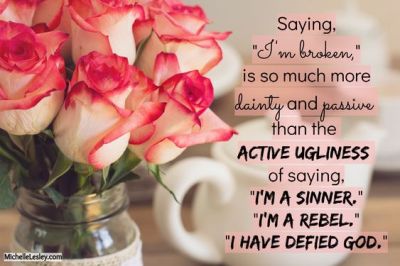
The term “broken” is passive. It begs the question, “Who broke us?” It implies that the fact we are broken is someone else’s fault. Somehow, someone broke us and our world and we are living with and dealing with the consequences as best we can. We can tend to see ourselves as bravely facing our problems; responsible only for being as gentle with ourselves and others as possible, to prevent further breakage. We suspend all judgment, even biblical judgment, because who are we, who are just as broken as you are, to point fingers?

We do need to be gentle with the hurting around us. We ourselves do suffer. However, when these things dominate our thinking, and we begin to describe ourselves in these terms, we are in danger of minimizing or overlooking our own sin and responsibility altogether. The fact that other people sin against us, sometimes grossly, doesn’t negate the fact that we ourselves are guilty of hurting others, and more seriously, sinning against our holy and righteous Creator.

Dear Christian, this is the subtlety of the devil. If he can convince people that to be Christian means to admit that we are merely broken and need healing, we readily settle on a distorted picture of who we really are and what we truly need. That we are hurting is easy to see and admit. But a more serious diagnosis is necessary.

The Bible describes mankind in his natural, godless, sinful state in the most unsavory of terms. We are not only wicked, we are thoroughly wicked.

“Then the LORD saw that the wickedness of man was great on the earth,
and that every intent of the thoughts of his heart was only evil continually.” Gen. 6:5

We are also called fools. And corrupt. 

“The fool has said in his heart, “There is no God.”
They are corrupt, they have committed abominable deeds;
There is no one who does good.
Psalm 14:1

How about deceitful? And desperately sick?

“The heart is more deceitful than all else
And is desperately sick;
Who can understand it?” Jeremiah 17:9

The brokenness of the Bible comes when we realize these things are true about ourselves. We have nothing good in us and are in serious trouble with God, however uncomfortable we are in admitting this is true. This is when we arrive at the point of spiritual bankruptcy, where we are brought to understand that we are “dead in our trespasses and sins” (Eph. 2:1). This is the brokenness David referred to in Psalm 51, to which he had come as a result of his own terrible sin. This brokenness can be defined as humility before God. David recognizes that his sin against Bathsheba and Uriah (adultery and murder), while heinous, are nothing compared to the weight of sin he has committed against God:

Against You, You only, I have sinned
And done what is evil in Your sight,
So that You are justified when You speak
And blameless when You judge. (v. 4)

The Bible never uses the word broken to describe the world or the state of all mankind. The brokenness the Bible describes is not our problem, it is what we need. To be broken is to come to God with nothing in our hands, knowing all we have to offer Him is our sin, and asking only for His mercy.

The brokenness the Bible describes is not our problem, it is what we need.

The sacrifices of God are a broken spirit;
A broken and a contrite heart, O God,
You will not despise. (Psalm 51:17)

These are the brokenhearted that the Lord is near to and helps:

The Lord is near to the brokenhearted and saves those who are crushed in spirit.” (Psalm 34:18)

This isn’t just someone who is sad or grieving. This is someone sad and grieving over their sin. We aren’t just “broken people living in a broken world”. We are proud sinners living in a rebellious and cursed world–in need of being broken. We need to be humbled, and brought to where we see our desperate need. Those who do not will face serious and lasting consequences.

A man who hardens his neck after much reproof
Will suddenly be broken beyond remedy. (Prov. 29:1)

Interestingly, both of these biblical uses of “broken” fit its passive voice. When God judges a person or a nation, they are broken by His decree and His might, and none can stop Him. Psalm 75:6-8 says,


But God is the Judge;
He puts down one and exalts another.
For a cup is in the hand of the LORD, and the wine foams;
It is well mixed, and He pours out of this;
Surely all the wicked of the earth must drain and drink down its dregs.”

And, just as much as the other, when a person comes to the place of a broken spirit, realizing their sin and utter lack of any resource, and their great need for mercy, this also is a work of God’s sovereignty and grace.


I will give them a heart to know Me, for I am the LORD…”  Jeremiah 24:7a

“…God has chosen you from the beginning for salvation through sanctification by the Spirit and faith in the truth. 2 Thessalonians 2:13b

Describing ourselves unbiblically as “broken” shifts our perspective just enough to cause God’s judgment to seem cruel (what kind of God sends broken people to hell?) and His salvation to be something He ought to rightfully give us (it would be unkind to do anything but help and rescue a broken person). But until we are saved, we aren’t broken—yet. We’re proud sinners who would rather work our way into God’s good graces than accept that there’s nothing we can do for ourselves.

One of two paths is available to us: either we will be broken before the Lord, and saved by His mercy, or we will be broken by the Lord, justly judged, and condemned. And while it is true that we hurt and suffer, this doesn’t reduce our responsibility. If we want to be called broken, humility or condemnation are the biblical choices.

As believers, we ought to be aware of the gradual drift away from these biblical meanings, and how this drift affects our thinking. Increasingly, brokenness has become a useful word for sidestepping the culpability that sinful people are already trying to avoid facing. We need to speak compassionately, with kindness, but without softening the hard edges of the message. It is true that we suffer. But our suffering doesn’t negate our sinfulness. The Israelites were abused horribly by the Egyptians. God had compassion on them, and brought them out of slavery, but he also judged them for their rebellion in the desert. The suffering didn’t nullify the sin. We need to be careful not to obscure the real need for salvation from our own sin and its consequences.

This world isn’t just broken. It’s lost. It’s condemned. All its wickedness and rebellion will someday be permanently broken under the mighty sword of God’s righteous judgment. Let us be humble enough to see ourselves not only as hurting people, but as sinful people who offend our gracious Creator. Let us be loving enough to tell people of their dangerous position before God–not of their “brokenness”, but of their sinfulness. Then let us tell them also of a holy, yet merciful Savior who desires that they turn to Him and be saved. Let us boldly hold out God’s powerful gospel to His enemies, extending to them the good news of peace with Him before it is too late.


Teresa has been married to her husband Adam for 23 years, and they have 8 children, ranging from ages 5 to 22. She lives in the Dallas/Ft Worth area, serves as a musician in her church orchestra, and mentors in their one on one discipleship ministry. She is passionate about knowing God and understanding the truths in His word, and loves nothing better than teaching, encouraging, and being encouraged by like-minded women. She blogs very occasionally at Your Word Is Truth.

Forgiveness, Mailbag

The Mailbag: Can unforgiveness cause you to you lose your salvation?

Can unforgiveness cause me to lose my salvation?

Forgiving (or refusing to forgive) others as it relates to our salvation is such an important issue. I’m so glad you asked!

Let’s break this question down a bit.

Can you lose your salvation?

The first thing we need to tackle is whether or not someone whom Christ has genuinely saved can lose her salvation – for unforgiveness or any other reason. And the answer to that question is no.

Why? The short answer is that if God saves someone, and that person can subsequently “unsave” herself, that makes her more powerful than God, which, as we know, can’t happen. You can’t save yourself, and you can’t unsave yourself. Salvation is all of God.

You can’t save yourself, and you can’t unsave yourself. Salvation is all of God.

When God saves you, you are His new creation in Christ. You can’t “uncreate” your new spiritual life any more than you can “uncreate” your body, or a tree, or a planet. You can kill or do damage to those things, but you cannot reverse God’s creative process. To use another example, oh so relevant to today, God created you female. You can mutilate your body til kingdom come trying to appear male, but that will not change the fact that at your genetic level – the very essence of your being – you are female. And you can’t undo that because God created you that way, and you’re not more powerful than God. If you can’t even change God’s creation of your physical body, how in the world can you change God’s creation of your spiritual being?

The moment God saves you, He forgives all your sins, past, present, and future, and robes you in the righteousness of Christ.

In addition to the fact that you can’t uncreate the new creature God has created you to be, you need to remember that the moment God saves you, He forgives all your sins, past, present, and future, and robes you in the righteousness of Christ. That swear word you’re going to say next week? Already forgiven. That lie you’re going to tell five years from now? Already forgiven. And if you decide to commit the sin of refusing to forgive someone, that sin has already been forgiven too. (So since all our sins are already forgiven, we can just commit as much sin as we want and we don’t have to worry about it, right? Wrong.) We still need to confess those sins to God and be cleansed from them because they disrupt our fellowship with God, but in His accounting office, that sin debt has already been marked “paid in full”.

Furthermore, Jesus tells us plainly that if He’s got you, He’s got you:

My sheep hear my voice, and I know them, and they follow me. I give them eternal life, and they will never perish, and no one will snatch them out of my hand. My Father, who has given them to me, is greater than all, and no one is able to snatch them out of the Father’s hand. I and the Father are one.”

No one. That includes you and your sin. The power of your sin is not greater than God’s power to forgive that sin.

The power of your sin is not greater than God’s power to forgive that sin.

They will never perish. To say that a person about which Jesus Himself has said, “I give them eternal life,” can lose her salvation is to call Jesus a liar. He says that person “will never perish.” End of story.

Still not convinced that someone whom Christ has genuinely saved can’t lose her salvation? Try these passages on for size.

Now the reason it can look to us like someone can lose her salvation comes from two places: experience and misunderstanding the Bible.

The reason it can look to us like someone can lose her salvation comes from two places: experience and misunderstanding the Bible.

Experience:
It’s happened plenty of times in the past, but in the last few weeks, we’ve seen two high profile evangelicals “walk away from the faith,”: Joshua Harris and Marty Sampson. Maybe you know someone personally – a friend, a loved one, even a pastor – who gave every appearance of being a Christian and then suddenly left Christianity, and the church, behind.

How does this compute when the Bible teaches that genuinely born again Christians cannot lose their salvation? Well, we need to remember something else the Bible teaches that’s very important:

Not everyone who claims to be a Christian actually is one.

Some people consciously know they’re not really saved and are just trying to pull the wool over the eyes of others. But many (my guess is “most” – these days there’s not a lot of social cachet in calling yourself a Christian) are deceived into believing they’re saved. Maybe they heard some sort of unbiblical gospel presentation and have put their faith in a decision they made in response. Maybe they just assume they’re saved because they’re good church-going people and their church doesn’t teach them otherwise. Who knows? It could be a lot of things. But we know for sure that there are many people who call themselves Christians and believe they are Christians who aren’t. Why? Because the Bible says so:

“Not everyone who says to me, ‘Lord, Lord,’ will enter the kingdom of heaven, but the one who does the will of my Father who is in heaven. On that day many will say to me, ‘Lord, Lord, did we not prophesy in your name, and cast out demons in your name, and do many mighty works in your name?’ And then will I declare to them, ‘I never knew you; depart from me, you workers of lawlessness.’
Matthew 7:21-23

Many will say”…False converts are common, not few and far between. And it’s not just your average Joe or Jane in the pew, either. People who “prophesy…cast out demons…do mighty works” under the auspices of Christianity? They’re pastors, elders, deacons, Bible study teachers, seminary professors, “Christian” authors, evangelical celebrities. And Christ does not know them, because they don’t know Him. They talk the talk, and might even look like they walk the walk, but they’ve never truly believed the biblical gospel, repented of their sin, and trusted the Jesus of Scripture to save them. First John 2:18-19 puts it this way:

Children, it is the last hour, and as you have heard that antichrist is coming, so now many antichrists have come. Therefore we know that it is the last hour. They went out from us, but they were not of us; for if they had been of us, they would have continued with us.

People whom Jesus has genuinely saved may fall into sin for a season, but they do not fall away from the faith. Those who leave the faith were never part of it in the first place, despite appearances or their claims to the contrary. It might be difficult, but this is one of those occasions when we have to believe what Scripture says over what we can see.

Those who leave the faith were never part of it in the first place, despite appearances or their claims to the contrary.

Jesus also tells us in the parable of the sower that there will be be “rocky ground” folks who will appear to be Christians, but because they have no root, they “endure for a while, and when tribulation or persecution arises on account of the word, immediately they fall away.” Jesus follows up this parable with the parable of the wheat and tares which further drives home His point that there will be impostors in the visible church.

So even though we observe people who appear to be Christians “falling away from the faith,” through unforgiveness or any other sin, we know that what’s really happening is that a lost person got tired of pretending to be saved and went back to being a lost person. Second Peter 2:22 puts it this way:

What the true proverb says has happened to them: “The dog returns to its own vomit, and the sow, after washing herself, returns to wallow in the mire.”

If Christ has never fundamentally changed your spiritual nature from dog or pig into a new creature in Christ, you’re still a dog or a pig. And even if you manage to clean up on the outside you’ll eventually return to the vomit of being a dog and the mud of being a pig because that’s your nature.

Misunderstood Scripture
There are passages in the Bible that, when misunderstood, when taken out of their immediate context, or when taken out of the overall context of Scripture can seem to teach that a person can lose her salvation. But as we’ve seen, there are way too many rightly handledin context passages of Scripture that refute that idea.

Can you lose your salvation by refusing to forgive someone?

You mentioned in your original question that you believe unforgiveness can cause someone to lose her salvation because, “It is so clear in so many ways in Scripture, even parables that Jesus told.” But, you did not mention any of the Scriptures you think teach this. My guess is that one of the Scriptures you’re thinking of is Matthew 6:14-15:

For if you forgive others their trespasses, your heavenly Father will also forgive you, but if you do not forgive others their trespasses, neither will your Father forgive your trespasses.

In context, we can see that these two verses come at the end of the Lord’s Prayer. In verse 12, Jesus has just taught us to pray that God would “forgive us our debts,
as we also have forgiven our debtors,” and He’s giving us a little addendum on this in 14-15.

Remember, even though all our sins from birth to death were forgiven at the moment of our salvation, we still need to confess our sins in prayer and ask God to cleanse us from our wrongdoing to bring us back into right fellowship with Him. But if you’re willfully in the middle of committing the sin of unforgiveness against someone, you’re still actively sinning. You haven’t turned from that sin in order to be cleansed. You’re essentially rolling around in the mud and asking God to cleanse you while you have no intention of getting out of the mud. How is that supposed to work? It doesn’t make any sense. If you want to get cleaned up (“forgiven”), you have to get out of the mud (stop committing the sin of unforgiveness – “forgive”). Otherwise, you’re asking God to restore the fellowship you’re still actively damaging with your sin.

Another passage you might be thinking of is the parable of the unforgiving servant. The takeaway from this passage is not that God will rescind the salvation of Christians who commit the sin of unforgiveness. This passage doesn’t say that and we already know that idea conflicts with what Scripture teaches about the security of the Believer.

The takeaway from this passage is that God has forgiven us a sin debt that is incomprehensible. Knowing and having experienced that forgiveness, how could we not forgive some paltry little sin another human commits against us? First John 4:19 says, “We love because He first loved us,” and the way He loved us was to forgive us our sin. So we also forgive because He first forgave us. And if we can giddily and unrepentantly harbor unforgiveness in our hearts against someone else, we’d better start testing ourselves against Scripture to see if we’re really in the faith. Because that kind of unforgiveness is not the fruit of a redeemed life, it’s the fruit of someone who’s unsaved.

No, a genuinely regenerated Christian cannot lose her salvation by committing the sin of unforgiveness. But if she is genuinely regenerated, she will repent of that sin and forgive.

A genuinely regenerated Christian cannot lose her salvation by committing the sin of unforgiveness. But if she *is* genuinely regenerated, she will repent of that sin and forgive.

Additional Resources:

Walking Away from Faith? at A Word Fitly Spoken Podcast

The Mailbag: Must I reconcile with my abusive ex-husband?

Forgiving Like Kings and Servants

You Can’t Love Jesus with a Heart Full of Hate: 7 Reasons to Love and Forgive Your Enemies

Am I Really Saved? A 1 John Check Up


If you have a question about: a Bible passage, an aspect of theology, a current issue in Christianity, or how to biblically handle a family, life, or church situation, comment below (I’ll hold all questions in queue {unpublished} for a future edition of The Mailbag) or send me an e-mail or private message. If your question is chosen for publication, your anonymity will be protected.

Sanctification

Throwback Thursday ~ Jesus Wants You to Be a Hater

Originally published February 26, 2015

hater

Hater. It’s a word that gets tossed around a lot these days. If you disagree with someone, you’re a hater. If you believe the Bible when it says something is a sin, you’re a hater. If you vote pro-life or pro-marriage, you’re a hater. Gone are the days when a Christian could stand on her convictions without being accused of hating everyone else who does not hold those same convictions.

In fact, when you first read the title of this article, I’m betting that’s what you thought I was saying Jesus wants us to do: hate everyone who doesn’t agree with us.

And I hate that.

I hate the fact that Satan has sold the world – and even the church – the lie that those of us who love Christ with all our hearts hate the sinners He died for.

Did you know that the Bible actually tells us to hate certain things? Not people who disagree with us or people enslaved by sin- that’s the world’s definition of being a hater. Luke 6:27-28 tells us:

But I say to you who hear, Love your enemies, do good to those who hate you, bless those who curse you, pray for those who abuse you.

We are not to hate, but to love, do good to, bless, and pray for those who, because they are at enmity with Christ, are at enmity with us.

But as Christians, the Bible tells us there are certain things it is good and holy for us to hate. If we don’t hate them, we’re being disobedient to our Lord.

We are to hate evil:

The fear of the Lord is hatred of evil. Pride and arrogance and the way of evil and perverted speech I hate. Proverbs 8:13

We hate evil, pride, arrogance, and perverted speech because God is good and holy. Evil stands in rebellion against God’s person and in opposition to God’s purposes. Pride and arrogance exalt self over God, who alone is to have preeminence in all things. Dishonest, wicked speech can damage God’s beloved children and lead them away from Him.

We are to hate opposition to God’s word:

Therefore I consider all your precepts to be right; I hate every false way. Psalm 119:128

When we love the Lord and His ways, we will necessarily come to hate false ways and false doctrine which defy His word and lead us, and others, away from Him.

We are to hate our own sin:

For we know that the law is spiritual, but I am of the flesh, sold under sin. For I do not understand my own actions. For I do not do what I want, but I do the very thing I hate. Romans 7:14-15

While it is good to hate evil in the world, we must also hate the evil that lurks within us in the form of sin. Those who have been born again loathe their sin and continually and sorrowfully turn from it, flinging themselves upon the mercy of Christ for forgiveness.

We are to “hate” all things in comparison to our love for Christ:

If anyone comes to me and does not hate his own father and mother and wife and children and brothers and sisters, yes, and even his own life, he cannot be my disciple. Luke 14:26

Our devotion to Christ must run so deep that we are gladly willing to sacrifice any relationship -even with our closest family members- any worldly goods, even our lives, if required to by our Lord in His word. Our love for Him should so far surpass our affections for all others that any other love relationship seems like hate in comparison.

There is a time to love, and a time to hate. When we love Christ, we will hate what is evil and cling to what is good. The hatred of the things the Lord calls us to hate is evidence that we love Him and are having our hearts and minds conformed to His.

If you’re a Christian, by God’s definition, you’re a hater. And that’s not a bad thing.


THIS ARTICLE WAS ORIGINALLY PUBLISHED AT SATISFACTION THROUGH CHRIST.
Random Ramblings Ruminations Resources

Random Ramblings, Ruminations, and Resources

What a summer! From a lovely trip to visit with my family to the Open Letter to Beth Moore (by the way, ladies, you can still sign it if you haven’t already) to podcast interviews to a hurricane (everything’s fine, thanks – praise God!) to both of my young adult children’s cars dying in the same week and my husband and me playing chauffeur for them (please pray that God will provide the vehicles they need), my summer has been a non-stop whirlwind. I can’t believe next week will already be August!

Let’s jump into some Random Ramblings, Ruminations, and Resources, shall we?

Light (Blog) Housekeeping

If you’re relatively new to the blog, you might not be aware of all the features and resources available to you here. Check out Blog Orientation for New Readers and Old Friends.

But even if you’ve been around a while, I’ve updated a few things you might not have noticed:

I’ve changed the Popular False Teachers tab (at the top of this page) to Popular False Teachers & Unbiblical Trends. That’s because I’ve added resources on the Enneagram and I’m planning to add info on more unbiblical trends in the future. I’ve also added information on MOPS to this tab in case I forgot to mention it.

I think The Servanthood Survey (published last week) is going to be a helpful resource for churches (and individuals), so I created a new tab to have that always at the ready.

If you’ve used my discernment article on Beth Moore lately, you may have noticed that it has a new look. I’ve changed the title and the introduction, fixed broken links and added a few new ones, and added some updated material, but it’s still the same article with the same link: Living Proof You Should Follow Beth (No) Moore.

Recently, I was put in “Facebook timeout” (I couldn’t post to my Facebook page from certain devices) for sharing what the powers that be deemed to be “hate speech” – a meme that quoted 1 Timothy 2:12. If you’re on Facebook, you’re probably hearing more and more about things like this happening to Christians for posting biblical views (no matter how kindly worded).

As many are predicting, there will probably come a time when Christians who share biblical posts will be banned from Facebook. In case something like this happens to me, I’ve opened up a MeWe page. MeWe is a social media platform that’s extremely similar to Facebook, except they pride themselves on their customer service, their privacy policy, and their “no political agenda” policy (meaning they don’t censor every little thing like Facebook does). If you’re familiar with Facebook, you’ll find MeWe’s interface nearly identical, plus it has a few neat features Facebook doesn’t have.
If you’d like to connect on MeWe, set up an account, then, just search Michelle Lesley, or go directly to my page and click the “add contact” button. If you’d rather do it later, I’ve added a link to my MeWe page to the Contact and Social Media tab at the top of this page.

And finally, would you like to write up a testimony (anything from a paragraph to a full length article) for Testimony Tuesday or an article or book review for a guest post? If your theology pretty much matches up with mine (see the Statement of Faith and Welcome tabs at the top of this page), look over the articles at these two links to get a feel for what I’m looking for and drop me an e-mail so we can chat about it.

Book Report

I’ve mentioned before that I don’t write solicited book reviews, but there are extremely rare circumstances in which I will break that rule. There are also occasions when I will pick up a book of my own volition and commend it to you if I end up liking it. Today, you’re getting one of each.

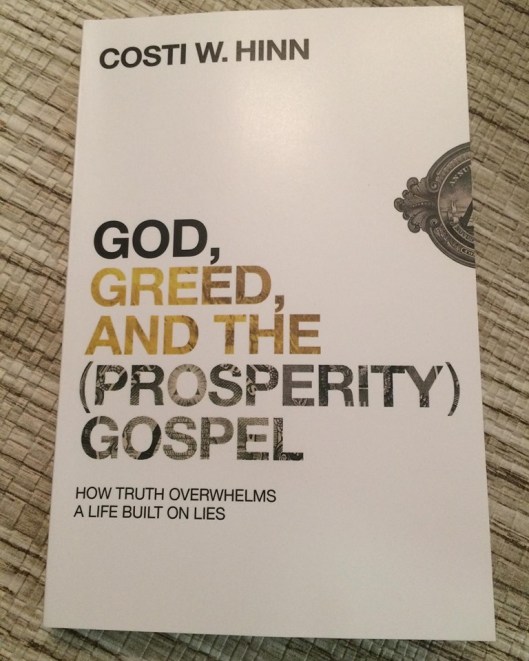
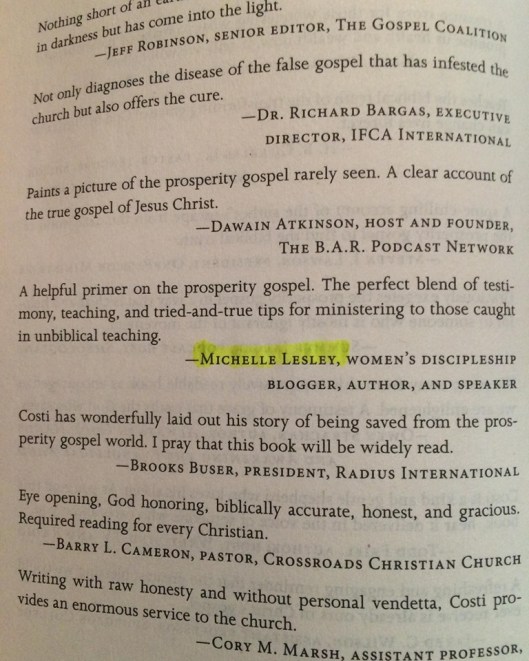
A few months ago, Costi Hinn reached out and asked if I’d read and write an endorsement for his new book, God, Greed, and the (Prosperity) Gospel. While his first book, Defining Deception, was an instructional introduction to the history and doctrine of the New Apostolic Reformation, I had been keeping up with Costi, and I knew that this second book was going to approach NAR/prosperity gospel false doctrine from the perspective of his personal testimony of growing up in (and being saved out of) Benny Hinn’s “ministry”. I had already heard Costi’s testimony several times and I knew my readers would find it encouraging and edifying. God, Greed, and the (Prosperity) Gospel did not disappoint, and it is my joy to commend it to you:

A helpful primer on the prosperity gospel. The perfect blend of testimony, teaching, and tried-and-true tips for ministering to those caught in unbiblical teaching.


My two favorite genres of fiction are biblical historical fiction, and legal/political thrillers. Chris Skates writes both, so I’m looking forward to reading more of his books.

In order for me to enjoy a work of biblical historical fiction (a fictionalized account of a true Bible story), it has to be true to everything Scripture actually says happened (events, dialogue, chronology, etc.), and whatever the author “fills in the blanks” of the biblical account with has to be biblically and culturally plausible, and must not directly contradict clear Scripture.

Chris accomplished this beautifully in his first book, The Rain, his rendition of Noah and the ark. Chris paints a grim picture of a debauched society that refuses to repent. Noah’s wife and daughters-in-law receive names, and we get to imagine what they and Ham, Shem, and Japheth might have been like. It was interesting to ponder along with the story just how long, tedious, and treacherous the journey on the ark was. And let’s not forget the lack of light and air conditioning and…well…the lovely smells of all those animals!

The Rain is a fun, leisure time read. I think you’ll like it if you enjoy biblical historical fiction.

Stop Jumping the Gun 

Y’all know I’m all about discernment, right? I mean, I think my track record speaks for itself. But there’s an area of discernment we all need to get serious about right quick.

It’s that “right quick” part. We need to stop being reactionary and haphazardly tossing the “false teacher” label (or other spiritual aspersions) around any time somebody says something that causes us to raise an eyebrow, especially when that person has an impeccable record of sound doctrine, faithful preaching, and contending for the faith once for all delivered to the saints.

Since Tuesday’s release of the Founders Ministries cinedoc trailer By What Standard? God’s World…God’s Rules, I have been appalled at the rush to judgment regarding Tom Ascol and Albert Mohler. Neither of these brothers has committed any clear-cut sin, but I want to put the details of the accusations aside and focus on the general principle of jump-the-gun aspersion-casting against these two men and others like them.

Each of these gentlemen, as well as Founders Ministries itself, has a decades-long track record of being doctrinally sound and fighting the good fight for biblical truth – longer than some of you younger sisters have been alive. They, and other pastors, teachers, and folks in long-time doctrinally sound ministry, have earned the right to have brothers and sisters in Christ – especially mature and discerning brothers and sisters in Christ – give them the benefit of the doubt when no clear-cut sin has been committed.

Obviously, when we’re talking about high profile pastors and teachers we don’t know personally, this isn’t a local church issue, but I think we would do well to remember the principles behind 1 Timothy 5:17,19-20.

Let the elders who rule well be considered worthy of double honor, especially those who labor in preaching and teaching…Do not admit a charge against an elder except on the evidence of two or three witnesses. As for those who persist in sin, rebuke them in the presence of all, so that the rest may stand in fear.

We rebuke those who persist in sin in the presence of all. We do not make off the cuff accusations, based on a single “iffy” incident or presumptions, against doctrinally sound elders who have proven themselves faithful through the years. And we also need to remember that in situations like these we don’t know the whole behind-the-scenes story. I think we could extend some grace, give them the honor and respect Scripture says they’re due, and reserve judgment until sin is committed or the incident is resolved.

Scripture calls us to be better than this to our elders. Let’s live up to that.

Is it really God’s judgment?

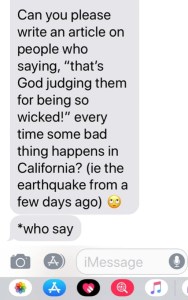
My daughter texted me this shortly after the recent earthquake in California. And when your heart of hearts asks you to write an article, you write an article! (Only I didn’t think it needed to be as long as a full article, so you’re getting it here instead, Sweetie.)

For those of us who don’t live in California, some of the news stories we hear about the sinful things going on there leave us slack-jawed. And for Christians, our frame of reference for gobsmacking sin is the Old Testament. God dealt with sin in some pretty intense ways in the OT, not the least of which, in one case, was causing the ground to split apart and swallow sinners alive. So I guess there is precedent for God using an earthquake to deal with sin. Is it possible the earthquake in California was God’s judgment upon their sin? Yes, it’s within the realm of possibility.

However, that kind of judgment is not normative, especially after the cross, and there are a lot of holes in that theory. If you’re tempted to use the line of reasoning that a natural disaster is, definitively, God’s judgment on California (or any other place) for their sin, could I just encourage you to think through the following points?

•In the past few months New York and Illinois have both passed hideous, from-the-bowels-of-hell laws protecting the sins of abortion and infanticide. Where are their earthquakes?

•Louisiana just passed one of the most abortion-restrictive laws in the nation. And then we had a hurricane. Was that storm a judgment on Louisiana?

•If “it is time for judgment to begin at the household of God…” (1 Peter 4:17), why wasn’t Redding, California – where Bethel “Church” is located – at the epicenter of the earthquake?

•Is it God’s judgment on sin if a tornado hits a doctrinally sound church in the Midwest?

•North Korea has been at the top of the list for years as the world’s worst persecutor of Christians. Why don’t we ever hear about natural disasters there?

•There are scads of doctrinally sound churches (including John MacArthur’s church) and Christians in California. Wouldn’t God protect California on their account or at least get them out of California before He exercises judgment there? There’s biblical precedent for that, too.

I don’t think we can biblically say that a natural disaster is definitely God’s judgment on California’s, or any other state’s or nation’s sin. God will judge the world in righteousness when Christ returns. Until that time, what we can biblically say about natural disasters is that they are the result of the Fall. And that sometimes they’re the best thing in that could ever happen to someone. Because sometimes during a natural disaster, people hear the gospel or cry out to God and get saved.

Obedience, Prayer, Sanctification, Sin

Throwback Thursday ~ When God Answers the “Wrong” Prayer

Originally published July 27, 2018

“Lord, I’m just so frustrated!” I fussed, as I approached the time I had set aside for prayer this morning. Once again, the “I don’t want to” of my flesh was pulling against the “I know I need to” of my spirit like a heavy duty tow truck tugging on a kitten.

So I just ditched it. Well…sort of.

Prayer is pouring out your heart to God, right? Well, I turned on the water cannon. Reverently, of course…but with passion.

I told God how sick I was of this all-too-frequent stumbling block my flesh presented when it was time to pray, especially when I knew from experience that the feeling was fleeting and would go away after I had been praying for a few minutes. I told Him I was tired of a million other things I’d rather be doing, that I needed to do, coming to mind and further crowding out my desire to pray. I told Him I was sorry for all the times I had given in to the flesh and skipped my prayer time. I told Him I wanted Him to make this feeling go away and never come back.

As I poured out my complaint before Him, the Holy Spirit began leading me to examine the why of this whole situation. What was bringing about this pull of the flesh against prayer?

And that’s when it happened. God answered the “wrong¹” prayer.

You see, one of the things I pray every day is that God will reveal to me any sins I’m unaware I’m committing and lead me to repent of and forsake them.

And in that moment, that’s the prayer He chose to answer.

Not the prayer for the provision of an item my family needs. Not the prayer for healing of a loved one. Not the prayer that He would save all the lost people on my list.

Not the prayer I really wanted Him to answer.

God chose to reveal my sin to me.

You know why my flesh so often balks at prayer? Because in the dark, unsanctified recesses of my heart, I’m frustrated with God for not doing what I ask Him to do – now. I come to Him day after day, month after month, sometimes year after year, confessing the same sins, asking for the same provisions, and presenting the same requests, and I don’t see Him doing what I want Him to do when I want Him to do it.

Never mind that I could list hundreds of my prayers that He actually has answered, many of them in amazing ways. Never mind that I know what the Bible says about prayer well enough to teach on it and write articles about it. Never mind that I really do believe that God will answer my prayers for His glory and my good.

Uh uh. My flesh throws all of that right out the window and wants God to be my cosmic errand boy, delivering the goods on my timetable. I am selfish. I want everything to go my way immediately.

So that was pretty humiliating…but God didn’t stop there. No, there was more.

He opened my eyes to the fact that this sin problem I have relating to Him vertically is basically the same sin problem I have relating to people horizontally.

I yell at people in traffic to get out of my way. I get annoyed with my husband, irritated with my children, and impatient with fellow church members because I want them to do what I want, and I want them to do it now. I am selfish. I want everything to go my way immediately.

Oh, wretched man that I am! Who will deliver me from this body of death? 

Paul was really onto something there. Fortunately, he answers his own question in his very next sentence:

Thanks be to God through Jesus Christ our Lord!
Romans 7:25a

Jesus. Jesus can help me to mortify this sin. And I can obey Him as He does His good work in me. How?

assuming that you have heard about [Jesus] and were taught in him, as the truth is in Jesus, to put off your old self, which belongs to your former manner of life and is corrupt through deceitful desires, and to be renewed in the spirit of your minds, and to put on the new self, created after the likeness of God in true righteousness and holiness.
Ephesians 4:21-24

I stop doing the sin (put off the old self). I remember what God’s Word says about that sin and about the righteousness I’m supposed to do instead (be renewed in mind). I do the righteous thing instead of the sin (put on the new self).

Ephesians 4 goes on to give some examples of what this looks like when dealing with real life sin:

Therefore, having put away falsehood, let each one of you speak the truth with his neighbor, for we are members one of another. Be angry and do not sin; do not let the sun go down on your anger, and give no opportunity to the devil. Let the thief no longer steal, but rather let him labor, doing honest work with his own hands, so that he may have something to share with anyone in need. Let no corrupting talk come out of your mouths, but only such as is good for building up, as fits the occasion, that it may give grace to those who hear. And do not grieve the Holy Spirit of God, by whom you were sealed for the day of redemption. Let all bitterness and wrath and anger and clamor and slander be put away from you, along with all malice. Be kind to one another, tenderhearted, forgiving one another, as God in Christ forgave you.
Ephesians 4:25-32

See how that works?

Stop lying. Remember what God’s Word says about lying and truth. Speak truth instead of lying.

Stop stealing. Remember what God’s Word says about stealing and the godly way to acquire and steward material things. Work an honest job and share with others instead of stealing.

Seems pretty simple and logical, right? It’s pretty clear cut when we’re talking about sinful actions. I can keep my mouth shut so lies and corrupting talk don’t come out and choose kind and truthful words to speak instead. I can keep my hands in my pockets or avoid that tempting store so I won’t steal, and get a job and share with others instead. But how in the world do I “put off” a sinful attitude like bitterness, wrath, anger and malice (and in my case, selfishness) when it’s just a feeling that pops up in my heart unbidden?

The world will tell you that you can’t control your feelings. And for the world, that’s true. It’s part of the sin nature of a lost person, the “old self”, to live your life by your feelings, even to be controlled by them. But that’s not the case for someone who has been genuinely born again and is indwelt by the Holy Spirit.

Part of the Fruit of the Spirit (the evidence that the Spirit is indwelling you) is self-control. That doesn’t just mean saying no to that second piece of cake. It’s the idea that sin is not our master anymore. We do not have to listen to and be controlled by sin, we can say no to it because we want to say yes to our new Master – Christ – and be controlled by Him.

Let not sin therefore reign in your mortal body, to make you obey its passions. Do not present your members to sin as instruments for unrighteousness, but present yourselves to God as those who have been brought from death to life, and your members to God as instruments for righteousness. For sin will have no dominion over you, since you are not under law but under grace.
Romans 6:12-14

Notice the wording here. It’s not “do your best” or “try” not to let your old master control you. It’s an authoritative, weighty, no-nonsense command: “Let not sin reign…sin will have no dominion”. God would not command us to do something that we’re incapable of doing, or that the Holy Spirit will not empower us to do. We can control and put off sinful thoughts, feelings, and attitudes.

Martin Luther once helpfully said:

“You cannot keep birds from flying over your head, but you can keep them from building a nest in your hair.”

I think about that quote often when it comes to putting off ungodly thoughts that pop into my brain. Here’s how it works:

First, preemptively pray the “wrong” prayer – the one your flesh won’t want God to answer – that He will make you aware of and convict you of sinful thoughts, feelings, and attitudes.

Next, when one of those thoughts rears its ugly head, stop what you’re doing, repent, and kick that rotten vulture right out of your hair. Make a definitive, proactive, Holy Spirit empowered decision of the will that you are not going to think that way. It helps me to say it out loud: “No. That thought is wrong. The Bible says ____ about that. I am not going to think that.” You might get some weird looks if you’re in public, but, hey, mortifying sin is worth it, right?

I tend to combine the “put off” (stop it) and “renew your mind” (What does the Bible say?) steps because pulling the Sword out of its sheath is a good way to kill sin. It’s the way Jesus modeled for us.

But how can I “put on” a right thought, feeling, or attitude? I mean, you can’t just conjure up godly feelings, can you? No. But what you can do is gather up nest-building materials for that “sweet Heavenly dove²”, the Holy Spirit, so He can shape your thoughts, feelings, and attitudes in a godly way:

Finally, brothers, whatever is true, whatever is honorable, whatever is just, whatever is pure, whatever is lovely, whatever is commendable, if there is any excellence, if there is anything worthy of praise, think about these things. What you have learned and received and heard and seen in me—practice these things, and the God of peace will be with you.
Philippians 4:8-9

There are godly things we can think about and godly things we can do (“practice”) that cooperate with the work the Holy Spirit is doing in our hearts.

Instead of thinking about that prayer that God isn’t answering right now, I can think about the prayers He has answered. And I can do something too. I can thank Him for those answered prayers and all of His good attributes in answering prayer.

Instead of thinking about how and when I want God to do things, I can think about His sovereignty and how good that is for me and everyone else. I can also do something: I can recite Bible verses I’ve memorized about the situation and sing songs of praise to Him.

Instead of thinking about how someone else is frustrating me by not doing what I want her to do, I can think about how she is made in the image of God, valuable to Him, and precious in His sight. What can I do? I can stop and pray for her. I can speak a word of encouragement to her. I can bless her with a gift or by serving her.

Thinking and practicing ungodly things feeds and grows your ungodly thoughts, feelings, and attitudes. But thinking and practicing godly things feeds and develops your godly thoughts, feelings, and attitudes.

Back in the Stone Age when dinosaurs roamed the earth and computers were brand new, programmers used to have a saying: “Garbage in, garbage out.” In other words, if you fed faulty commands into the computer, the performance you got out of the computer was going to be faulty, too.

The Christian heart is very much the same. “Godly in, godly out.” If you feed godliness into your heart, godliness will start coming out in your thoughts, words, and actions.

We don’t have to be mastered by sinful thoughts, feelings, and attitudes. Through the power of the Holy Spirit and by putting off the old self, renewing our minds through God’s Word, and putting on the new self by thinking and practicing godly things, we can grow more and more obedient to our Lord and Master, Jesus Christ, in our thoughts, words, and actions.

I don’t know about you, but I’m going to try to remember that the next time God answers the “wrong” prayer.


¹Please note that the word “wrong” as it refers to God answering prayer refers to my having the wrong attitude or perspective. God is perfect and has never, and will never, do anything wrong.
²From the hymn Sweet, Sweet Spirit by Doris Akers