Forgiveness, Mailbag

The Mailbag: Can unforgiveness cause you to you lose your salvation?

Originally published August 19, 2019

Can unforgiveness cause me to lose my salvation?

Forgiving (or refusing to forgive) others as it relates to our salvation is such an important issue. I’m so glad you asked!

Let’s break this question down a bit.

Can you lose your salvation?

The first thing we need to tackle is whether or not someone whom Christ has genuinely saved can lose her salvation – for unforgiveness or any other reason. And the answer to that question is no.

Why? The short answer is that if God saves someone, and that person can subsequently “unsave” herself, that makes her more powerful than God, which, as we know, can’t happen. You can’t save yourself, and you can’t unsave yourself. Salvation is all of God.

You can’t save yourself, and you can’t unsave yourself. Salvation is all of God.

When God saves you, you are His new creation in Christ. You can’t “uncreate” your new spiritual life any more than you can “uncreate” your body, or a tree, or a planet. You can kill or do damage to those things, but you cannot reverse God’s creative process. To use another example, oh so relevant to today, God created you female. You can mutilate your body til kingdom come trying to appear male, but that will not change the fact that at your genetic level – the very essence of your being – you are female. And you can’t undo that because God created you that way, and you’re not more powerful than God. If you can’t even change God’s creation of your physical body, how in the world can you change God’s creation of your spiritual being?

The moment God saves you, He forgives all your sins, past, present, and future, and robes you in the righteousness of Christ.

In addition to the fact that you can’t uncreate the new creature God has created you to be, you need to remember that the moment God saves you, He forgives all your sins, past, present, and future, and robes you in the righteousness of Christ. That swear word you’re going to say next week? Already forgiven. That lie you’re going to tell five years from now? Already forgiven. And if you decide to commit the sin of refusing to forgive someone, that sin has already been forgiven too. (So since all our sins are already forgiven, we can just commit as much sin as we want and we don’t have to worry about it, right? Wrong.) We still need to confess those sins to God and be cleansed from them because they disrupt our fellowship with God, but in His accounting office, that sin debt has already been marked “paid in full”.

Furthermore, Jesus tells us plainly that if He’s got you, He’s got you:

My sheep hear my voice, and I know them, and they follow me. I give them eternal life, and they will never perish, and no one will snatch them out of my hand. My Father, who has given them to me, is greater than all, and no one is able to snatch them out of the Father’s hand. I and the Father are one.โ€

No one. That includes you and your sin. The power of your sin is not greater than God’s power to forgive that sin.

The power of your sin is not greater than God’s power to forgive that sin.

They will never perish. To say that a person about which Jesus Himself has said, “I give them eternal life,” can lose her salvation is to call Jesus a liar. He says that person “will never perish.” End of story.

Still not convinced that someone whom Christ has genuinely saved can’t lose her salvation? Try these passages on for size.

Now the reason it can look to us like someone can lose her salvation comes from two places: experience and misunderstanding the Bible.

The reason it can look to us like someone can lose her salvation comes from two places: experience and misunderstanding the Bible.

Experience:
It’s happened plenty of times in the past, but in the last few weeks, we’ve seen two high profile evangelicals “walk away from the faith,”: Joshua Harris and Marty Sampson. Maybe you know someone personally – a friend, a loved one, even a pastor – who gave every appearance of being a Christian and then suddenly left Christianity, and the church, behind.

How does this compute when the Bible teaches that genuinely born again Christians cannot lose their salvation? Well, we need to remember something else the Bible teaches that’s very important:

Not everyone who claims to be a Christian actually is one.

Some people consciously know they’re not really saved and are just trying to pull the wool over the eyes of others. But many (my guess is “most” – these days there’s not a lot of social cachet in calling yourself a Christian) are deceived into believing they’re saved. Maybe they heard some sort of unbiblical gospel presentation and have put their faith in a decision they made in response. Maybe they just assume they’re saved because they’re good church-going people and their church doesn’t teach them otherwise. Who knows? It could be a lot of things. But we know for sure that there are many people who call themselves Christians and believe they are Christians who aren’t. Why? Because the Bible says so:

โ€œNot everyone who says to me, โ€˜Lord, Lord,โ€™ will enter the kingdom of heaven, but the one who does the will of my Father who is in heaven. On that day many will say to me, โ€˜Lord, Lord, did we not prophesy in your name, and cast out demons in your name, and do many mighty works in your name?โ€™ And then will I declare to them, โ€˜I never knew you; depart from me, you workers of lawlessness.โ€™
Matthew 7:21-23

Many will say”…False converts are common, not few and far between. And it’s not just your average Joe or Jane in the pew, either. People who “prophesy…cast out demons…do mighty works” under the auspices of Christianity? They’re pastors, elders, deacons, Bible study teachers, seminary professors, “Christian” authors, evangelical celebrities. And Christ does not know them, because they don’t know Him. They talk the talk, and might even look like they walk the walk, but they’ve never truly believed the biblical gospel, repented of their sin, and trusted the Jesus of Scripture to save them. First John 2:18-19 puts it this way:

Children, it is the last hour, and as you have heard that antichrist is coming, so now many antichrists have come. Therefore we know that it is the last hour. They went out from us, but they were not of us; for if they had been of us, they would have continued with us.

People whom Jesus has genuinely saved may fall into sin for a season, but they do not fall away from the faith. Those who leave the faith were never part of it in the first place, despite appearances or their claims to the contrary. It might be difficult, but this is one of those occasions when we have to believe what Scripture says over what we can see.

Those who leave the faith were never part of it in the first place, despite appearances or their claims to the contrary.

Jesus also tells us in the parable of the sower that there will be be “rocky ground” folks who will appear to be Christians, but because they have no root, they “endure for a while, and when tribulation or persecution arises on account of the word, immediately they fall away.” Jesus follows up this parable with the parable of the wheat and tares which further drives home His point that there will be impostors in the visible church.

So even though we observe people who appear to be Christians “falling away from the faith,” through unforgiveness or any other sin, we know that what’s really happening is that a lost person got tired of pretending to be saved and went back to being a lost person. Second Peter 2:22 puts it this way:

What the true proverb says has happened to them: โ€œThe dog returns to its own vomit, and the sow, after washing herself, returns to wallow in the mire.โ€

If Christ has never fundamentally changed your spiritual nature from dog or pig into a new creature in Christ, you’re still a dog or a pig. And even if you manage to clean up on the outside you’ll eventually return to the vomit of being a dog and the mud of being a pig because that’s your nature.

Misunderstood Scripture
There are passages in the Bible that, when misunderstood, when taken out of their immediate context, or when taken out of the overall context of Scripture can seem to teach that a person can lose her salvation. But as we’ve seen, there are way too many rightly handledin context passages of Scripture that refute that idea.

Can you lose your salvation by refusing to forgive someone?

You mentioned in your original question that you believe unforgiveness can cause someone to lose her salvation because, “It is so clear in so many ways in Scripture, even parables that Jesus told.” But, you did not mention any of the Scriptures you think teach this. My guess is that one of the Scriptures you’re thinking of is Matthew 6:14-15:

For if you forgive others their trespasses, your heavenly Father will also forgive you, but if you do not forgive others their trespasses, neither will your Father forgive your trespasses.

In context, we can see that these two verses come at the end of the Lord’s Prayer. In verse 12, Jesus has just taught us to pray that God would “forgive us our debts,
as we also have forgiven our debtors,” and He’s giving us a little addendum on this in 14-15.

Remember, even though all our sins from birth to death were forgiven at the moment of our salvation, we still need to confess our sins in prayer and ask God to cleanse us from our wrongdoing to bring us back into right fellowship with Him. But if you’re willfully in the middle of committing the sin of unforgiveness against someone, you’re still actively sinning. You haven’t turned from that sin in order to be cleansed. You’re essentially rolling around in the mud and asking God to cleanse you while you have no intention of getting out of the mud. How is that supposed to work? It doesn’t make any sense. If you want to get cleaned up (“forgiven”), you have to get out of the mud (stop committing the sin of unforgiveness – “forgive”). Otherwise, you’re asking God to restore the fellowship you’re still actively damaging with your sin.

Another passage you might be thinking of is the parable of the unforgiving servant. The takeaway from this passage is not that God will rescind the salvation of Christians who commit the sin of unforgiveness. This passage doesn’t say that and we already know that idea conflicts with what Scripture teaches about the security of the Believer.

The takeaway from this passage is that God has forgiven us a sin debt that is incomprehensible. Knowing and having experienced that forgiveness, how could we not forgive some paltry little sin another human commits against us? First John 4:19 says, “We love because He first loved us,” and the way He loved us was to forgive us our sin. So we also forgive because He first forgave us. And if we can giddily and unrepentantly harbor unforgiveness in our hearts against someone else, we’d better start testing ourselves against Scripture to see if we’re really in the faith. Because that kind of unforgiveness is not the fruit of a redeemed life, it’s the fruit of someone who’s unsaved.

No, a genuinely regenerated Christian cannot lose her salvation by committing the sin of unforgiveness. But if she is genuinely regenerated, she will repent of that sin and forgive.

A genuinely regenerated Christian cannot lose her salvation by committing the sin of unforgiveness. But if she *is* genuinely regenerated, she will repent of that sin and forgive.

Additional Resources:

Walking Away from Faith? at A Word Fitly Spoken Podcast

The Mailbag: Must I reconcile with my abusiveย ex-husband?

Forgiving Like Kings and Servants

You Canโ€™t Love Jesus with a Heart Full of Hate: 7 Reasons to Love and Forgive Your Enemies

Am I Really Saved? A 1 John Check Up


If you have a question about: a Bible passage, an aspect of theology, a current issue in Christianity, or how to biblically handle a family, life, or church situation, comment below (Iโ€™ll hold all questions in queue {unpublished} for a future edition of The Mailbag) or send me an e-mail or private message. If your question is chosen for publication, your anonymity will be protected.

Discernment, False Doctrine, Southern Baptist/SBC

A Naked Emperor in the Southern Baptist Convention

Originally published April 6, 2018

Think back to your childhood. Remember the story, The Emperor’s New Clothes?

Once upon a time, there lived an emperor. One day two swindlers came to his palace and told him they could weave cloth for his royal robes that was magical: to those who were foolish or unfit for their jobs, it would appear invisible. Only the wise and worthy would be able to see this fine fabric. The emperor hastily agreed to pay the “weavers” an exorbitant amount of money to make him such an amazing garment, thinking he would use it to weed out anyone unfit for royal service.

The weavers set about pretending to weave. From time to time, the emperor sent various folk to check on the progress the weavers were making, and – though in reality, none of them could see the non-existent fabric – all reported back that the garments were coming along nicely and the cloth was beautiful. But strangely enough, when the emperor himself looked in on the weavers, they held up the magnificent fabric, and he could not see it. Not wanting word to leak out that he was unfit to serve as emperor, he pretended to examine the cloth and complimented the weavers lavishly on their fine work.

Finally, the weavers informed the emperor that the garments were finished. They had the emperor strip down to his skivvies and pretended to help him on with his fine new “garments”. Word had spread among the emperor’s subjects about the magical properties of the fabric, and as the royal procession made its way through town, all shouted out praise for the emperor’s fine new clothes.

All. Except for one little boy.

“But he hasn’t got anything on!” the boy shouted.

It took the innocent honesty of a simple child to shock the emperor’s subjects back to their senses. The truth spread like wildfire, and the crowd began to cry out: “The emperor is naked!” “The emperor has no clothes on!” “He’s not wearing anything!”

But did the emperor admit to his foolishness, return to the palace, and get dressed? No. Sadly the story ends this way:

“The Emperor shivered, for he suspected they were right. But he thought, ‘This procession has got to go on.’ So he walked more proudly than ever, as his noblemen held high the train that wasn’t there at all.”ยน

And so the “emperor” of leadership in the Southern Baptist Convention and those who carry its train march proudly on, despite the cries of simple peasants and innocent little children crying at the top of our lungs, “The emperor is naked!” “There are issues that need to be addressed, here!” “Listen to us!”

You’ll note that the story doesn’t say that the emperor was a cruel man, that he overtaxed the people, oppressed them into slavery, was a warmonger, or was in any other way an evil leader. In fact, one could argue that he had good intentions of making sure the people who served at various posts in his empire were of the finest caliber.

And while there are many issues that need to be addressed in my denomination, I think this could generally be said of the leadership of the Southern Baptist Convention as well. Call me a Pollyanna, but I have no reason to believe our denominational leadership – as a whole – is evil or has anything less than the best of intentions for the SBC.

There are many good and praiseworthy things going on in SBC life. We have hundreds of doctrinally sound pastors faithfully preaching the gospel week in and week out. Discernment and biblical literacy among Southern Baptist church members is slowly but steadily growing. The SBC takes a public, biblical stand on abortion and homosexuality while many other denominations do not. Our organizational structure for funding and sending out missionaries, while sometimes flawed in its execution, is without peer. Southern Baptist Disaster Reliefย is one of the finest relief organizations in the world. And there’s so much more. Find a godly Kingdom effort going on somewhere, and you’ll probably find a Southern Baptist involved in it. By the grace of God, while we’re far from perfect, we’re getting a lot of thingsย right.

But even benevolent emperors get things wrong sometimes, and, Southern Baptist leadership, your drawers are flapping in the breeze on this oneยฒ:

Sin. The public sin our leaders commit that we excuse and the public sin our leaders commit that we discipline, and the fact that there’s a discrepancy between the two.

Southern Baptist leadership, your drawers are flapping in the breeze on this one.

Recently, Frank Page, president and chief executive officer of the Executive Committee of the Southern Baptist Convention (one of the top positions of SBC leadership at the national level) resigned his position due to “a morally inappropriate relationship in the recent past,” which, we are left with little choice but to assume means “adultery”. (As an aside, Christians, when confessing sin, let’s knock off the the terminological hem-hawing and call a spade a spade. “I had a six month extra-marital romantic and sexual relationship with a married woman in my church,” or whatever. You don’t have to give all the gory details or name names, but, for crying out loud, if you’re going to confess, confess- don’t finesse.)

It was right and biblical for Dr. Page to publicly confess and express sorrow over his sin as well as to resign (it would also have been right and biblical for the SBC to remove him had he refused to resign, which, undoubtedly would have happened). He sinned against God, his family, the woman and her family, his church, his co-workers, and the entire denomination. He publicly embarrassed the Southern Baptist Convention and gave unbelievers fodder for scoffing when the report of his sin made the national news. This was a case of a well known Southern Baptist leader whose public, observable sin was handled biblically by SBC leadership. I am thankful for this witness to Christians and to the world that sin is not to be swept under the rug, but that sinners are to repent, be disciplined, and then be restored to fellowship (although, in cases like this, not leadership).

But we don’t handle all cases of public sin that way. Some public sin we reward by making the sinner into a wealthy, lauded celebrity.

“Impossible!” you say?

Check the shelves at LifeWay. Select twenty average SBC churches with women’s ministries and see whose books, DVDs, and simulcasts are being used again and again. Peruse the speakers at popular SBC conferences.

You’ll find names like Beth Moore, Priscilla Shirer, Lysa TerKeurst, Christine Caine, Ann Voskamp, Sarah Young, Andy Stanley, Steven Furtick, Rick Warren, and T.D. Jakes, just to name a few.

Have they committed adultery? Voiced approval of of homosexuality? Committed theft, abused their spouses, or promoted pornography? No. But those aren’t the only types of sins the Bible prohibits.

Every single one of them teaches false doctrine, from Sarah Young’s blasphemous “channeling” of Jesus, to T.D. Jakes’ denial of the Trinity, to Christine Caine’s Word of Faith heresy, to Lysa TerKeurst’s teaching of contemplative prayer.

All of these women who do speaking engagements unashamedly and unrepentantly preach to co-ed audiences. All of these men allow women to preach to co-ed audiences from their pulpits.

All of them who join in ministry with others have yoked or affiliated themselves with false teachers. Beth Moore and Joyce Meyer. Priscilla Shirer and T.D. Jakes. Steven Furtick and Joyce Meyer and T.D. Jakes. Rick Warren and the Pope.

Scripture plainly prohibits the teaching of false doctrine. It’s a major theme of the New Testament, for goodness sake. The Bible tells us that women are not to preach to men or exercise authority over them in the gathered body of Believers. And God’s Word makes very clear that we are to have nothing to do with false teachers, especially not partnering with them in “ministry”.

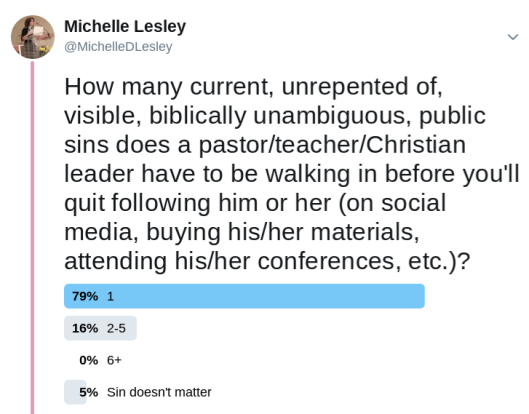
In the wake of Frank Page’s resignation, I asked this poll question on Twitter

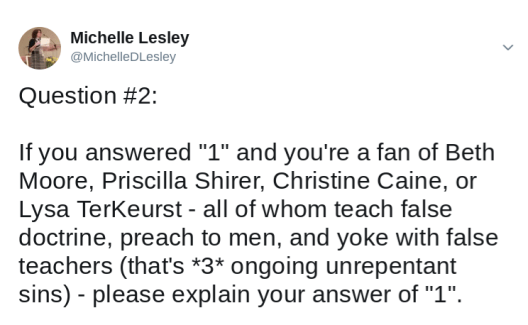
followed by this one

Why are Southern Baptists leaders so quick to – rightly and biblically – oust Frank Page for, as far as we know, one isolated sin which he publicly confessed to and repented of, and yet overlook three major – and much more publicly observable and harmful to Southern Baptists – ongoing sins from pastors and teachers who have been rebuked and refuse to repent? Why, instead of disciplining them for their sin, do those in leadership give them fat book deals, invite them to speak at all the cool conferences, fawn over them on social media, and make them into celebrities?

How many sins will it take to disqualify and discipline these people? Four? Eleven? Ninety-six? Is there any amount of sin these pastors and teachers, and those like them, can commit that will cause those in SBC leadership to pull their materials off the shelves of LifeWay, deny them a seat at the table, and urge them to repent and step down from their positions?

I’ve been a Southern Baptist from the day I was born. I’ve been taught since the cradle roll that if God’s Word says not to do something and you do it anyway, that’s a sin. If God’s Word says to do something and you don’t do it, that’s a sin. And that sin is sin in the eyes of God.

Well is it, or isn’t it, Emperor?

If sin is sin in God’s eyes, why aren’t you treating Beth Moore’s sin like Frank Page’s sin? Why are you rewarding her for her sin and disciplining him for his?

Why does the SBC reward some sins while disciplining others?

The Bible says in James 3:1:

Not many of you should become teachers, my brothers, for you know that we who teach will be judged with greater strictness.

Those who teach and lead bear more responsibility to teach sound doctrine and walk worthy because they are teaching and leading us by example.

Why are all the aforementioned pastors and teachers better examples to us in their rebellion and unrepentant sin than Frank Page was in his repentance of sin?

Why?

Southern Baptist peasants and little children see right through your foolishness on parade on this issue and we want answers. Biblical answers.

Don’t just stand there shivering, suspecting we are right, but thinking, “This procession has got to go on,” and walking more proudly than ever. Go back to the palace. Repent. Clothe yourselves with humility and obedience to Scripture, and come back and lead us rightly. Biblically.

Because the Emperor of Southern Baptist leadership has been naked for far too long.

The Emperor of Southern Baptist leadership has been naked for far too long.


ยนH.C. Andersen Centret (The Hans Christian Andersen Centre). The Emperor’s New ClothesAccessed April 5, 2018.

ยฒI am well aware that this is not the only problem in the SBC that needs to be addressed. It would be impossible to address every issue in one article, so this time I’ve chosen to focus on this one particular issue.

Church

Throwback Thursday ~ Is It Really All Our Fault?

Originally published July 15, 2016

all our fault

“If the church would just _________,
the world would flock to us.”

“The world is in the state it’s in because
the church has fallen down on the job.”

Over the past few years, I’ve been hearing and reading statements like these more and more frequently. But are they true? Is the world really in such sad shape as a result of the failings of the church?

Yes!…and…no.

It is absolutely true that the visible church – everything that wears the label “church” or “Christian,” whether or not it’s biblical Christianity – has a lot to be ashamed of. Westboro. TBN. Homosexual church leaders and members. Pastors caught in adultery. Child molestation scandals. Female “pastors.” All manner of demonic behavior masquerading as “worship,” blasphemously attributed to the “Holy Spirit.”

Even churches with an orthodox statement of faith – which, to onlookers, seem to be doing fine, biblically – water down the gospel in the name of being seeker sensitive, use materials produced by false teachers, invite false teachers to speak at their conferences, fail to evangelize, place women in unbiblical positions of leadership, have pastors and teachers whose main form of teaching is eisegesis and pandering to felt needs, fail to provide for the needs of their members and their surrounding community, focus on fun and silliness in their youth and children’s ministries instead of Scripture and holiness, allow members to gossip, backbite, and exercise selfishness, fail to practice church discipline, make their worship services into irreverent entertainment-fests, have “pastors” who are little more than stand up comedians, and have largely biblically ignorant congregations.

Some churches are spiritually healthier than others, but nobody’s getting out of this one with clean hands. Even the healthiest church is doing something wrong in some little nook or cranny. And as Christ’s bride, it is incumbent upon us, whenever we discover those nooks and crannies, to repent, set things right, and do things biblically as we move forward.

Christ loved the church and gave himself up for her, that he might sanctify her, having cleansed her by the washing of water with the word, so that he might present the church to himself in splendor, without spot or wrinkle or any such thing, that she might be holy and without blemish. Ephesians 5:25b-27

That’s Christ’s vision of the church. A vision all churches fall woefully short of. And when the church fails in any area, it does contribute to the downhill slide of the world, because it is not being the city on the hill Christ wants it to be, and it is producing individual Christians (or false converts) who aren’t being the salt and light Christ wants them to be.

But is it fair to lay all the world’s woes and sinfulness at the doorstep of the church? Is it really true that if we would just clean up our act in this area or on that issue that we’d magically see an influx of pagans begging, “Sirs, what must I do to be saved?”

No, it isn’t.

The world isn’t steeped in sin because of the failings of the church. The world is steeped in sin because of the Fall.

Look back over history. The world was vicious and depraved long before the church ever came on the scene. And, for that matter, long before God set apart and established Israel as His chosen people. (Hello? The ante-diluvian world? Sodom and Gomorrah? Ancient Egypt? Baal and Molech worship?)

Examine any era in the last two millenia when you think the church was doing a better job than it is now and take a look at the society that church was situated in. The New Testament church? It was surrounded by a world of war, oppression, torture, debauchery, sexual deviance, slavery, misogyny, poverty, famine, and child abuse.

The head of the church, Jesus Christ, spent over thirty years physically present on this earth. We know He conducted His ministry perfectly. Not once did He fail to preach the gospel or provide for people’s needs or fall short in any other way. He even went so far as to lay His life down for the sin of the world. And what impact did that have on His immediate society? Did all the Pharisees repent and temple worship was restored to godliness? No. Did Rome stop ruling the world with an iron fist? No. Did acts of sedition and perversion and persecution suddenly disappear? No. In fact, some of those things actually got worse during and after Jesus’ time.

Just like He prophesied.

You see, Jesus didn’t say, “Be more like Me and the world will come running,” or “The church can solve the ills of the world.” He said:

If you were of the world, the world would love you as its own; but because you are not of the world, but I chose you out of the world, therefore the world hates you. John 15:19

Indeed, all who desire to live a godly life in Christ Jesus will be persecuted, while evil people and impostors will go on from bad to worse, deceiving and being deceived. 2 Timothy 3:12-13

The more the church and individual Christians look and act like Christ, the more world will hate, persecute, and ostracize us.

The church is not going to fix all the evils of society. And it’s not fair to lay that burden of responsibility – one that even Jesus’ earthly ministry didn’t accomplish – on believers who genuinely love their Savior and want to serve Him. Holding out the stick and carrot of a utopian world to the church – if only we’ll get our act together – does nothing but breed hopelessness, despair, and futility in the pews.

Does the church have a lot of repenting to do? Yes. Are there right hands we need to chop off and right eyes we need to gouge out in order to facilitate obedience to Christ? You bet. Should we be exponentially more proactive and passionate about preaching the gospel and meeting the needs of a lost and dying world? Absolutely.

But we do not do those things because we’re failing the world. We do those things out of love for and faithfulness to Christ. Christ is our goal, not a changed world. Christ is the prize we’re to fix our eyes on, not a society that behaves itself. Christ is the finish line we press toward, not domestic tranquility and morality.

Christ.

Because if it’s the church’s job to set the world right, we’re doomed. The world sins because the world is made up of sinners. And the world will continue to sin – even if every church on the planet suddenly becomes perfect – because the world is made up of sinners. But if the church’s highest attainment is love for Christ, faithfulness to Christ, and obedience to Christ, then we are successful in God’s eyes regardless of what the world around us looks like.

Let’s be faithful and trust God to handle changing the world.

Guest Posts

Guest Post: The Blessing of a Bothered Conscience

If your theology pretty much matches up with mine (as outlined in my โ€œWelcomeโ€ and โ€œStatement of Faithโ€ tabs in the blue menu bar at the top of this page) and youโ€™d like to contribute a guest post, drop me an e-mail, and letโ€™s chat about it.

The Blessing of a Bothered Conscience
by Cale Fauver


The Infused Courtroom

The Apostle Paul unfolds for us in Romans 2 that even the Gentiles who donโ€™t have the Law actually know it by nature because it โ€œis written on their heartsโ€ (2:15). Paul then communicates to us the global, natural purpose of this God-infused courtroom in the heart of every man: to either accuse or excuse (2:15b). Therefore, everyone knows Godโ€™s Law (literally: con [with] + science [knowledge]). Every sin, every trespass against Godโ€™s moral Law expressed in the 10 Commandments is a known sin, i.e. the sinner knows that when he lied, committed adultery, stole, blasphemed Godโ€™s name, etc. it was wrong, and his conscience will either accuse him or excuse him. The unbeliever knows with absolute certainty that it is sinful to lie on that paperwork at the office, and so does the one who has been born again. So, what is the difference?

Bothered, or a Holy Bothered

Perhaps one of the most concrete examples of this distinction can be found in the life of Joseph in Genesis 39. At this point in Josephโ€™s life, he has been bought by Potiphar (the captain of the guard in Egypt) as a slave to work in his house. Thus, after some time he moves up the ranks and is now in charge of Potipharโ€™s house and is entrusted with the care of it all.

Enter Potipharโ€™s wife who finds the very handsome Joseph, handsome (v.6-7). She throws herself at Joseph and Joseph responds thus: โ€œ[Potiphar has not] kept back anything from me except you, because you are his wife. How then can I do this great wickedness and sin against God?โ€ (39:9).

According to Romans 2, the typical unbeliever might respond with thoughts similar to Josephโ€™s, but different. And the distinction is an eternity of difference.

If Joseph were a pagan, he may have initially responded the way he did with, โ€œNo, I’d better not, youโ€™re the boss-manโ€™s wife.โ€ But then he could think, โ€œWell, Potiphar is a jerk. And his wife is here alone with me. And who would find out anyway?โ€. It is possible to keep sin enclosed and secret for a lengthy amount of time if there is the utmost precaution. The sinnerโ€™s conscience would be, by the Apostleโ€™s authority, bothered. It would accuse him for doing that to someone. Adultery against another manโ€™s wife, even to a pagan, is pretty messed up at the least, especially considering the husband becoming angry if he finds out (cf. Proverbs 6:30-35).

Even unbelievers can have a bothered conscience, but Joseph had a holy bothered conscience. His concern was that he had sinned – not primarily against his neighbor, but against God.

Signs of Life

Christian, consider your life. When you have the opportunity to (or are in the act of) sin, your conscience is going to sound like the tornado alarm, similar to a paganโ€™s. But, consider the strength of your conscienceโ€™s appeal – not to man, but to God. Yes, part of obeying our conscience is loving our neighbor as is summed up in the Law, but when we sin, the primary offense is always against God (cf. Psalm 51).

Do you know that loud, keeping-you-awake-at-night, bothersome conscience? Do you feel that holy bothered conscience? Thought it is painful, though it is strong, when you respond in repentance and faith in Godโ€™s Law and Godโ€™s promise and find your conscience clean before the Lord, rejoice! Rejoice that this is a sign of your being made alive together with Christ (Ephesians 2:4-5)! Your new and highest desire is to please the Lord, to fear God and to keep his commandments because they have been supernaturally written on your heart as part of the New Covenant (cf. Jeremiah 31:31-34). Unbelievers do not feel any guilt about offending the God who created them because there is no fear of God before their eyes (Romans 3:18). Their main thought in this process is one of great rebellion, as if God didnโ€™t exist in the first place (Psalm 10:4).

When Godโ€™s Word convicts you and accuses you of trespassing against Godโ€™s Law, your conscience will loudly remind you and accuse you for your good. You have a fear of God before your eyes. It is good that this is your experience; this is a gracious blessing that the Spirit has worked within you. You are alive to Christ and his glory! How could you sin against that God?

Your Conscience Before the Court

The good news of the gospel is that as you stand before God, Christian, you can do so with a clean conscience cleansed from evil (Hebrews 10:22) because you are standing in the New Covenant. We can have full assurance that God has declared us righteous in Christ because of โ€œthe blood of Jesusโ€ (Hebrews 10:19). Your final courtroom day before the Most High will be one of absolute freedom of judgment for your sins. There is no condemnation for those who are in Christ. Therefore, your rest ultimately lies in Christโ€™s work for your rest and safety from condemnation and not in your conscience.

But, because of Christโ€™s work for us and his cleansing blood, we must listen to and work to obey our conscience when it accuses us before God and his Law. Seek renewal and direction from Godโ€™s Word by seeing more of his revealed will in the Scriptures. Desire wisdom and direction from your local church and your pastor when you are unclear or unsure about an issue. Trust your conscience by binding it to Godโ€™s Word. And may we sing with Charles Wesley:

Almighty God of truth and love,
to me thy power impart;
the mountain from my soul remove,
the hardness from my heart.
O may the least omission pain
my reawakened soul,
and drive me to that blood again,
which makes the wounded whole.

Cale is an MDiv student at Midwestern Baptist Theological Seminary. He and his wife Kelly live in Kansas City with their son, Jude, and baby #2 expected imminently. You can find some of his other writings at News From Afar, and follow him on Twitter.

Sanctification, Sin

Guilt and Shame- Burden or Blessing?

ย “I agree with what you’re saying, I’m just afraid it might arouse guilt and shame in newer believers, as well as those with sensitive consciences,” a follower recently said in response to a statement of biblical truth I posted on social media. I’ve been pondering that ever since she said it. It was good food for thought.

Guilt and shame are not subjects we often talk about outright. Rather, they seem to be a taboo silently woven into the fabric of our collective consciousness in 21st century Western culture – even in evangelicalism. It’s an unspoken law with the direst of consequences: “Thou shalt never say or do anything that causes anyone to feel guilty or ashamed for the choices she has made or the way she lives her life.” If you do, cancel culture will hunt you down and publicly eviscerate you. You’ll be shunned, and you can kiss your reputation goodbye. Why? Because our society tells us that guilt and shame are the absolute worst things someone can feel.

But is that really true? Or could it be that the prince of the power of the air is lying to us yet again?

While the church has historically done a stellar job of sharing the good news that Christ took away our guilt and shame on the cross, it has not always done a good job of explaining what the emotionsยน of guilt and shame are or the proper function they are to serve in the lives of both Believers and unbelievers.

There are two kinds of emotional guilt and shame: biblically appropriate and biblically inappropriate. Biblically appropriate guilt and shame is when you feel guilty and ashamed as a result of doing something wrong. Biblically inappropriate guilt and shame is when you feel guilty and ashamed when you haven’t done anything wrong.

Biblically appropriate guilt and shame are good gifts from God. They are like a fever that tells you you’re sick and need to take some medicine. Lost or saved, new Believer or seasoned Saint, sensitive conscience or not, if someone is sinning, she should feel guilt and shame, because she has transgressed a holy God. For the lost person, that guilt and shame is an internal reminder that she stands forensically (legally) guilty before God and needs a Savior. For the Believer, that guilt and shame is the conviction of the Holy Spirit leading her to repent and obey Christ instead of sinning. Biblically appropriate guilt and shame are biblically appropriate because your feelings about what you’ve done match the facts of what you’ve done. You feel guilty and ashamed because you are guilty of doing something shameful: sin.

The warning sign of guilt and shame is a blessing from a good, kind, and merciful God calling us to repent immediately and return to Him before we dig ourselves into a deeper pit of sin. Like a loving father who starts with a stern look when his child first misbehaves and then progressively moves on to increasing levels of discipline, God does not pour out the full fury of His wrath at our first bobble toward sin. He starts with the “stern look” of guilt and shame.

Have you ever read the Old Testament and explored some of the more drastic warning signs God had to send His people, and the pagans they lived among, when they sinned and hardened their hearts against the guilt and shame He blessed them with? Have you contemplated the horrors of eternal conscious torment in Hell, lately? When we consider…

  • how dangerous sin is for us in this life,
  • how petrifying the prospect of what God could do to us, has everyย right to do to usย in His anger over our sin if He were so inclined,
  • how the heart of God is not to punish and destroy, but to redeem and reconcile

…it is much easier to recognize biblically appropriate guilt and shame as an act of unfathomable love from God.

If a professing Christian doesn’t normally feel guilt and shame when she has clearly sinned, she should be extremely concerned. That is usually the fruit of someone who is unregenerate, not someone who is saved, and she would do well to follow Scripture’s mandate to examine herself against rightly handled Scripture to see if she is indeed in the faith.

But what about experiencing biblically inappropriate shame and guilt? In the life of a genuinely regenerated Christian, biblically inappropriate shame and guilt mainly takes one of two forms:

  • feeling shame and guilt for your own pre-salvation sins, or post-salvation sins you’ve already repented of
  • feeling shame and guilt for someone else’s sin or for something else outside your control

This kind of shame and guilt is inappropriate because it is misapplied. God intended shame and guilt to bring you to repentance for your sin, not to haunt you for sin you’ve already repented of or for someone else’s sin or something outside your control.

If you have bowed the knee to Christ in repentance and faith that His death on the cross, burial, and resurrection paid the penalty for your sin, then God’s good gift of guilt and shame has done its job. It’s over. Christ took your guilt and shame and sin, nailed it all to the cross – and it died there. It did not come down off the cross with Jesus, and it was not resurrected with Him. You have the glorious privilege as one robed in the righteousness of Christ, to rebuke those feelings of guilt and shame over past sins any time they rear their ugly heads, armed with the knowledge that you are forgiven and free. Christ paid with His blood to give you the right not to have to feel those feelings. Send them packing by praising God for His wonderful gift of grace and mercy to you in Christ.

And what about feeling guilt and shame for someone else’s sin? Perhaps you did your best to raise your child in a godly way, but he grew up to become a rapist or murderer, and you feel guilty. Maybe someone committed the sin of abuse against you and you’re dying of shame inside. If I just hadn’t done this, or if I had only done that, he wouldn’t have done what he did. It’s my fault.

May I make a suggestion? Do a good, long, hard study of Ezekiel 18. God is crystal clear – in such a loving and comforting way – that He does not hold you responsible for anyone’s sin but your own. You are – not as a matter of subjective opinion or feelings, but as a matter of forensic, objective fact – not guilty of that person’s sin. So if you’re feeling guilt and shame, your feelings don’t match the facts. Your feelings are boldly and brashly lying to you in the face of what God says is true about you. He says you’re not guilty. Your feelings say you are. Who are you going to believe?

That’s why it’s incredibly important that we believe God’s objectively true written Word over and above our feelings. It’s also why it makes me so angry when seeker driven churches and women’s “Bible” study materials focus on your personal feelings, opinions, preferences, and life experiences instead of properly teaching you the Bible. How can you believe God’s Word over your feelings if you don’t even know God’s Word? When all you know is your raw emotions and not what God says, that leaves you trapped, a slave to your con artist feelings, when you could be completely set free from the shame and guilt God never intended for you to feel for someone else’s sin.

And, finally, you could be feeling biblically inappropriate guilt for an accident or something else outside your control. If we had just bought a different house, we wouldn’t have been living in this one when the tornado hit, and my husband would still be alive. If I had just taken a different route, I wouldn’t have encountered that unexpected traffic accident and missed my daughter’s senior recital.

There’s a key truth all Christians need to come to grips with here: God is sovereign over every atom and event in the universe. You are not. God knows the future. You do not. God is God. You are not. When you feel guilty for things you had no way of knowing, preventing, or avoiding, you are essentially saying you should have God’s omnipotence and omniscience. You’re feeling guilty for not being God.

And your feelings of guilt over something like this are also saying that God was wrong for allowing what happened to happen, because if you were God, you wouldn’t have let it happen. Take a moment and let that sink in. Your feelings of guilt over something unforeseen and unavoidable say that you think you could do a better job of being God than He can. Well, let me tell you what we both already know. You can’t.

God determined from the foundations of the earth exactly which day, and how, and where, your husband was going to die. If it wasn’t God’s will that he die in a tornado on that day, in that house, he wouldn’t have. If God wanted you at your daughter’s recital, you would have been there.

You don’t have control. Control is an illusion. God has control. (And that’s good. Because God knows faaaaaaaaaaaaaaaaaaaaar better than we do the right thing to do in every situation.) And if you don’t have control, then you didn’t do anything wrong. And if you didn’t do anything wrong, feeling guilty is biblically inappropriate, a) because God’s purpose for guilt is to draw you to repentance over your sin, not for failing to achieve Godhood, and b) because your feelings (“I’m guilty!”) don’t match the facts (you’re not).

God is sovereign. He always does what is right and best in every situation, even if you can’t see it and don’t understand. And because He always does what is right and best, you can trust Him in those terrible incomprehensible situations. Take some time to study what God’s Word says about trusting Him.


A major problem in evangelicalism today is that we have followed the world’s lead and made people’s feelings into a god. We are more worried about hurting people’s feelings than providing them actual biblical help. And we all, including me, need to repent of that and stop it. It is infinitely better to fleetingly hurt someone’s feelings with biblical truth that leads her to Christ, than to allow her feelings to be an untouchable idol that keeps her in sin.

There has to be something higher, more important, than protecting someone from feeling biblically appropriate guilt and shame. There has to be something lofty enough to rescue people out of biblically inappropriate guilt and shame.

There is: God and His Word.

Exalting God and His Word to their proper and deserved place of preeminence and authority, and submitting to them in our hearts, minds, churches, and relationships is not simplistic, it’s foundational. And when it comes to the veneration of people’s feelings (and far too many other issues) we have become the foolish man who has traded a foundation on the rock of God’s truth and His ways for one on the enticingly sandy beach of worldly “wisdom”.

And, y’all…

…it’s starting to rain.


ยนThere is also a forensic definition of guilt. For example, if you rob a bank, you are forensically (legally), objectively guilty of the crime of robbery regardless of how you feel about it. This article deals mainly with the emotion of guilt– feeling guilty, or having a guilty conscience.

Additional Resources:

Guilt, Shame, and Regret at A Word Fitly Spoken

What Embarrassment Reveals About Your Heart at Transformed with Dr. Greg Gifford

Donโ€™t Let Embarrassment Dictate Your Spiritual Life at Transformed with Dr. Greg Gifford