Holidays (Other), Marriage

Throwback Thursday ~ My Husband Brought Me Flowers Today

Originally published June 27, 2014

โ€œIโ€™m so tired of flowers,โ€ sighed the elderly woman in the TV commercial as my jaw hit the floor. She had just described how her husband of fifty years, seated next to her, brought her flowers on their first date, and every year since had given her the same bouquet on that day.

And she was tired of flowers.

It wasnโ€™t enough that she had a husband who stayed with her for fifty years. Or that he actually remembered the day of their first date every year. Or that he was caring enough to send her flowers on that date. Or that he was sentimental and romantic enough to send her the same flowers every year.

No. She was tired of flowers. She wanted the product the commercial was trying to sell.

I wanted a shoe to throw at the TV.

My husband brought me flowers today. I know, in the picture they look rather more like birthday candles than flowers. Thatโ€™s because, technically, my flowers were birthday candles.

I was getting ready for our youngest sonโ€™s birthday party. I had already made a trip to the store and thought I had everything I needed. Until I discovered I was nearly out of baking powder. My husband was out running errands, so I sent him a text asking if he could pick some up for me. He did. No problem. Until I remembered I didnโ€™t have any candles for the birthday cake. And he had already left the store. And it was raining.

โ€œAnd it was raining.โ€ I say that like itโ€™s just so pedestrian, like itโ€™s some normal, everyday thing, which, in south Louisiana in June, I assure you, it is not. Every day, yes. Normal, no. Remember that scene in one of those โ€™90โ€™s โ€œasteroid crashes into the earthโ€ movies where the asteroid has just hit and the man and his daughter are standing on the beach watching the huge resulting tidal wave roll in to engulf them? Well if, instead of the beach, you can imagine yourself trying to navigate a WalMart parking lot with a buggy full of groceries and four kids in tow in the middle of that tidal wave, youโ€™ll have some idea of what monsoon season is like down here.

And you know what my husband did when I asked him to go get birthday candles in that mess? He did it gladly. No complaints. No asking, โ€œWhy didnโ€™t you think about this sooner?โ€ He just walked in the house, soaked and smiling, and handed me the candles.

No bouquet could have been better.

Ladies, my husband has a lot of faults. Iโ€™ll bet yours does too. Because just like us, theyโ€™re sinful human beings. Often, like the lady in the commercial, we trample over a dozen roses to plant our feet in a briar patch. We overlook the ways our husbands are a blessing to us and focus only on our complaints.

Maybe he didnโ€™t get you exactly what you wanted for your birthday, but does he work hard every day to support your family? So, he didnโ€™t notice your new haircut right away. Does he give the kids their bath every night? Yes, his dirty socks are constantly on the floor in front of the hamper, but didnโ€™t he change the oil in the car yesterday?

1 Thessalonians 5:16-18 says:

Rejoice always, pray without ceasing, give thanks in all circumstances; for this is the will of God in Christ Jesus for you.

The next time youโ€™re tempted to complain about your husbandโ€™s shortcomings, why not praise God instead for a way that he has blessed you or done something admriable? And letโ€™s make sure to thank our husbands for those little โ€œflowersโ€ they bring us every day.


This article was originally published at Satisfaction Through Christ.
Christian women

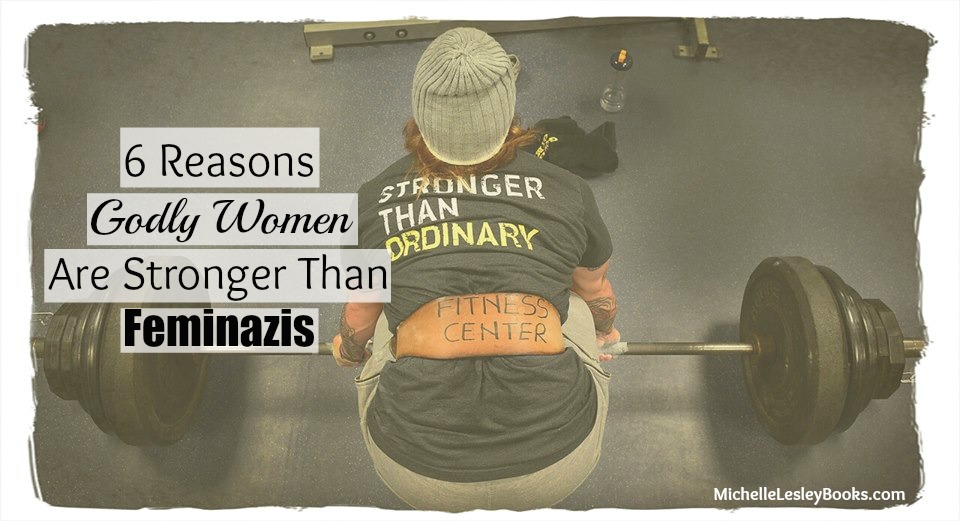
Throwback Thursday ~ 6 Reasons Godly Women are Stronger Than Feminazis

Originally published June 12, 2015

feminazis

Gloria Steinem. Bra burning. The ERA. “I Am Woman Hear Me Roar.” Maybe you remember them, or have at least heard of them. That was the heyday of feminism. It was going to be a new era of strong, powerful women. And they’re still fighting the battle today. Never let a man get the upper hand. Sacrifice whatever you have to for a successful career. And Christian women who submit to their husbands or choose to stay home with their children are sneered at or dismissed as weak, barefoot and pregnant ignoramuses.

But as any woman brave enough to follow in the footsteps of Christ can tell you, it ain’t necessarily so. Secular feminists will never understand the kind of strength it takes to strive towards godly womanhood.1

1. Only the strongest of women can voluntarily relinquish the right to be in control.

It’s easy (at least for decisive, type A control-freaks like me) to walk into a room assess a situation, lay down the law, and expect your instructions to be carried out. It’s much harder to step back and hand off the decision-making to your husband, or to offer your input and stand aside and watch when he decides not to follow it. But God expects us to follow in the footsteps of our Savior, who voluntarily surrendered control of His very life to the men who took it from Him.

2. It takes a strong woman to trust God enough to put her life and her children’s lives into her husband’s hands.

Let’s just get real here for a minute. It can be hard to trust God sometimes. Even though we know He is perfect and has our best interests at heart, we can’t see Him or touch Him. We can’t ask Him a question and get an audible yes or no answer.

It can be even harder to trust our husbands. Even though we can see, hear, touch, and talk to them, we know all too well that they’re fallible. Sometimes they have their own interests at heart. Sometimes they mean well and still make the wrong decisions.

But God tells us to trust Him. Even when it’s hard. Even when we don’t understand what’s going on. Even when we think we could lead better than our husbands. We trust God enough to obey His word even when.

3. It takes tremendous strength to control our mouths.

James tells us “no human being can tame the tongue,” and all who have tried know how true that statement is. Still, God expects godly women to control our speech. We’re not to nag and be quarrelsome. We’re to speak wisely and kindly. Sometimes, we’re not to speak at all, but let our actions do the talking. The strength to bite your tongue or think before you speak? It’s a daily trial by fire for Christian women.

4. Godly women have to be incredibly strong to deal with the heartaches that come our way.

John once said, “I have no greater joy than to hear that my children are walking in the truth.” (3 John 4). While he was talking about his spiritual “children,” godly wives and mothers have that same joy when our husbands, children and loved ones are walking in the truth of the gospel. And unspeakable agony when they are not. We not only have to cope with the regular griefs of life that everyone experiences, we also must deal with the pain of those closest to us who rebel against Christ and His word, all the while trusting God and walking in His ways.

5. We must develop the godly strength it takes to stand against the culture.

It’s easy to do the godly thing when everybody’s rooting for you, but in a society that is openly hostile to biblical womanhood, we often (sadly, even in the church) find ourselves fighting our way upstream like so many spawning salmon. Many times, we are seen as – and called – doormats, uneducated, gullible, traitors to the cause of women’s rights. We must rely on the strength God has promised us to stand for godliness in the face of opposition.

6. Only strong, godly women can joyfully deny self and serve rather than being served.

In a “because you’re worth it” world, putting our own desires aside to serve our husbands, children, and others is utterly incomprehensible to many, and, often, even to ourselves. The flesh rears its ugly head again and again, demanding to have its every wish fulfilled by the very people God put us here to serve. It takes a mighty woman of God to do battle with that enemy, send it packing, humble herself, and tend to the needs of others. But we have been bought by the blood of a Savior who declared that He “came not to be served but to serve,” and we conform to His wishes, not our own.

They can push and nag and argue and boss and control. They can be soldiers, construction workers, CEOs, and President. They can wear the pants in their families and have cowed husbands. But the shrillest of feminazis will never know the strength it takes to be a godly woman, because what they’re attempting is miniscule compared to the high standard God calls His daughters to. And any fleshly strength they can conjure up couldn’t in a million eternities touch the supernatural, mighty, rushing force that is the power of the Holy Spirit which God promises to His own, enabling us to say, “I can do all things through him who strengthens me.”

God doesn’t call us to have dominance over men, He calls us to become like a man, the God-man, Jesus Christ. And in our feebleness and brokenness, He gives us the power to attempt that feat of greatness for His glory. That, my sisters, is where real strength lies.


1As always in my articles which mention biblical submission in marriage, my standard caveat: Please understand that this article applies to the vast majority of reasonably healthy marriages. Biblical submission has nothing to do with allowing yourself to be abused. If you are being abused please get yourself and your children somewhere safe immediately and call your pastor, the police, and/or anyone else who can help.

Biblical Womanhood Bible Study

Imperishable Beauty: Lesson 11- A Beautiful Wife

Previous Lessons: 1, 2, 3, 4, 5, 6, 7, 8, 9, 10

Read These Selected Scriptures

Lesson 10 focused on our role as godly daughters. In lesson 11, we’ll be examining God’s design for women who are wives.

Questions to Consider

1. In lessons 2 and 3 (links above) we took a look at some of the attributes of a godly wife that we can emulate. Because Proverbs 31 mainly zeroes in on godly character, most of that passage easily applied to most women regardless of marital status. In today’s lesson, rather than attributes to emulate, we’ll be focusing on God’s instructions to obey for wives. Some of these instructions can also apply to unmarried women. Read over today’s passages and explain how unmarried women might apply some of these Scriptures. Why is it important for unmarried women to study passages about married women and vice versa?

2. Examine the Genesis 2 passage. What are the main points God is making about wives and marriage in this passage? What word does this passage use (18,20) to encapsulate a woman’s role in marriage? What does it mean for a woman to be a helper “fit for” or “corresponding to” her husband? Whom did God create first, man or woman? Second? Whom did God create to be the helper, man or woman? How do these two things point to and undergird male headship in marriage? Does the Genesis passage mean that all women have to marry or that the only purpose for which women were created was to be wives?

3. Look at the Ephesians and Colossians passages together. Explain how the relationship between husband and wife is a picture of the relationship between Christ and His church. Write a character sketch of a godly husband and a character sketch of a godly wife according to these passages. Why does God instruct husbands to “love” their wives, but wives to “respect” their husbands? (33) What is the difference, and why doesn’t God give the same instruction to husbands as to wives? What should motivate a wife to submit to her husband? Pretend you are discipling a newly married, newly saved woman who has never read these passages. How would you explain biblical submission to her? How is it “fitting in the Lord” (3:18) to submit to your husband?

4. Study the 1 Peter passage. In verse 1, what is the spiritual state (lost or saved?) of the wives Peter is addressing? The husbands? Imagine Peter wrote this part of his letter to answer a question he had been asked by some of the women of the church. What was the question they asked? Carefully examine the end of verse 1. Does this mean a wife should never share the gospel with her unsaved husband and that he can be saved simply by watching her good behavior? What does it mean? How is biblical submission an aspect of holiness? (5) Some women believe they only have to submit to their husbands if their husbands are saved or if their husbands are acting in a godly way. How does this passage answer that misconception?

What does “adorning” (3-4) mean? Why and how do women usually adorn themselves? How are godly women to adorn themselves? For whom? Why? Explain external adorning versus internal adorning. Which do you think is more winsome to your husband? Compare 3-4 with 1 Samuel 16:1-13. Which is more important to God, the external or internal? Why?

Explain what it means to have a “gentle and quietย spirit“. (4) Can a woman with an outgoing, vivaciousย personalityย still have a gentle and quiet spirit? How? How is your spirit different from your personality? How should a godly spirit inform a godly personality? Explain why a gentle and quiet spirit is beautiful and how that beauty is imperishable. Why is a gentle and quiet spirit precious in God’s sight?

5. Make a list, in your own words, of God’s instructions about a husband’s and wife’s sexual relationship found in the 1 Corinthians 7 passage. God considered these instructions important enough to include in the Bible. Why? How is the marriage bed a protection against sexual temptation and sin? (2) How does this passage teach and emphasize the mutuality of the sexual relationship? Is this mutuality limited to the bedroom, or does it extend to other aspects of marriage? Explain the terms “rights” (3) and “authority” (4) in the context of this passage. In our culture, we most often think of sex in terms of pleasure or recreation. Is pleasure or recreation the main concern of this passage? What adjective would you choose to describe the perspective of this passage toward sex?


Homework

Consider the concepts each of today’s passages addresses: the husband’s headship, the wife’s role as helper, respecting your husband, submitting to your husband, your marriage imaging the relationship between Christ and the church, witnessing to an unsaved husband, external adornment vs. internal adornment, the sexual relationship, etc. Pinpoint one aspect you need growth in. Repent of any sin in this area, and spend the next week praying that God will grow you to more Christlikeness in this area. You may even wish to memorize and meditate on a verse you found particularly helpful.


Suggested Memory Verse

Do not let your adorning be externalโ€”the braiding of hair and the putting on of gold jewelry, or the clothing you wearโ€” but let your adorning be the hidden person of the heart with the imperishable beauty of a gentle and quiet spirit, which in God’s sight is very precious.
1 Peter 3:3-4

Discernment, Mailbag

The Mailbag: Potpourri (Replacement Theology, Spiritual Gifts Test, Books by false teachers…)

Welcome to another “potpourri” edition of The Mailbag, where I give short(er) answers to several questions rather than a long answer to one question. I also like to take the opportunity in these potpourrri editions to let new readers know about my comments/e-mail/messages policy. Iโ€™m not able to respond individually to most e-mails and messages, so here are some helpful hints for getting your questions answered more quickly. Remember, the search bar can be a helpful tool!


Can you explain what replacement theology is?

I can, but there are pastors and theologians way smarter than I am who have done a much better job of it than I could. I reached out to my friend Pastor Gabe “WWUTT” Hughes for some help and he addressed the question in this episode of the When We Understand the Text podcast (starting at about 1:30):

WWUTT 565 Q&A Replaced Protesting Eligibility?

You may also find the following resources helpful:

The Church and Israel: The Issue at Ligonier

What is replacement theology / supersessionism? at Got Questions

What is replacement theology? at CARM

Supersessionism at Theopedia


I want to get more involved in serving my church. Can you recommend a spiritual gifts survey web site so I can find out what my spiritual gifts are and how I should be serving?


If you have a question about: a Bible passage, an aspect of theology, a current issue in Christianity, or how to biblically handle a family, life, or church situation, comment below (Iโ€™ll hold all questions in queue {unpublished} for a future edition of The Mailbag) or send me an e-mail or private message. If your question is chosen for publication, your anonymity will be protected.

Mailbag, Marriage

The Mailbag: My fiance and I don’t agree on theology.

After struggling to find a solid local church, I finally found one that’s gospel-centered. I have been fellowshipping there for close to 6 months now and am planning to pursue membership soon. My fiancรฉ is a godly man, but he lives in another town, so he fellowships and serves in a church which he knows has some unbiblical doctrinal issues I won’t compromise on. After our wedding, we plan to live in the town he currently resides in. There are no Bible believing churches around (all are prosperity gospel churches). I am confused because I am not ready to listen to unsound teaching and later bring up my children in a community I don’t agree with theologically.

That’s such a difficult dilemma to be caught in, and I certainly do sympathize. An engagement period should be a joyful time of planning your wedding and your subsequent life together, not agonizing over major disagreements.

That said, it is good that you recognized this problem before the wedding rather than after, and I would strongly encourage you not to move ahead with the marriage unless and until the two of you have come to a biblical agreement on the matter.

Marriage can be challenging even when you agree on all the important stuff. But when you staunchly disagree on what should be the most important issue in your marriage – Christ, His Word, and His church – it can be devastating. Even if you think you are spiritually mature enough to work through the issue and remain committed to your vows, your husband might not be, and could decide he’d rather give up on the marriage than continue to struggle.

There are a couple of Scripture passages I’d encourage you to take a look at as you continue to work through this dilemma:

2 Corinthians 6:14-18: Though verse 14 of this passage clearly says, “Do not be unequally yoked with unbelievers,” (You said your fiancรฉ was a godly man, so I’m assuming he’s a Believer.) and though the context of this passage is more broadly about the church yoking with unbelievers than it is about marriage, there are still some important applications to your situation.

Get a good picture in your mind of two oxen being yoked together to pull a plow or wagon, because that’s the image the Holy Spirit is giving us in this passage. Even if you’re both oxen (i.e. both Believers) what’s going to happen if you’re pulling one direction and your husband is pulling the other direction? Or if you’re pulling one direction and he digs his hooves in and refuses to budge? To plow rightly, you’ve got to be pulling in the same direction together. What would happen if you yoked a full grown ox with a small calf? Even if you’re pulling the same direction, that yoke is going to rub one or both of you raw, cause blisters, etc. Prayerfully think about the words “yoked,” “partnership,” “fellowship,” “accord,” “share,” and “agreement” in this passage in light of the spiritual differences between you and your fiancรฉ.

Ephesians 5:22-33: Examine what this passage calls you to in your role as a wife: Submit to your husband. Respect your husband. Already you have an issue because when it comes to your husband requiring you to do something ungodly (such as attend and raise your children in a heretical “church”) you, as a Believer, must obey God rather than men.”

Now examine the role this passage calls your husband to. Is he giving himself up for you as Christ did for the church in order to make sure you grow and flourish in sound doctrine in your relationship with the Lord? (v. 25-27) Is he nourishing and cherishing your sanctification? Is he loving you as his own flesh?

In addition to praying and studying the Scriptures, it would be very helpful to make an appointment with your pastor (not his) for pre-marital counseling. He can lead the two of you to talk through the issue and determine whether or not you can resolve it in a biblical way. Yourย fiancรฉ’s responses should give you a clearer picture of what to do, and if he refuses pastoral counseling, that should also be an indicator about which direction your relationship should go.

Husbands and wives do not have to agree verbatim – although it’s wonderful if they do – on every teensy tinsy molecule of doctrine or the marriage is doomed. (My husband and I have a few minor theological disagreements, but we’re in agreement about 98% of the time, and certainly on all the most important tenets of doctrine.) But heresy versus sound doctrine is not a teensy tinsy molecule of doctrine. It is a major issue that will harmfully impact your marriage and your children – in more ways than you can now imagine – for the rest of your lives. I would strongly encourage you to put the wedding on hold until this issue is resolved in a biblical way. Your love for and loyalty to Christ must take precedence over your love for and loyalty to any man:

โ€œIf anyone comes to me and does not hate his own father and mother and wife and children and brothers and sisters, yes, and even his own life, he cannot be my disciple.”
Luke 14:26

โ€œDo not think that I have come to bring peace to the earth. I have not come to bring peace, but a sword. For I have come to set a man against his father, and a daughter against her mother, and a daughter-in-law against her mother-in-law. And a person’s enemies will be those of his own household. Whoever loves father or mother more than me is not worthy of me, and whoever loves son or daughter more than me is not worthy of me.” 
Matthew 10:34-37


If you have a question about: a Bible passage, an aspect of theology, a current issue in Christianity, or how to biblically handle a family, life, or church situation, comment below (Iโ€™ll hold all questions in queue {unpublished} for a future edition of The Mailbag) or send me an e-mail or private message. If your question is chosen for publication, your anonymity will be protected.