Mailbag

The Mailbag: Potpourri (Non-Christian students at Christian schools?… Christian women & sports?… Conviction over an intimate act…)

Welcome to another โ€œpotpourriโ€ edition of The Mailbag, where I give short(er) answers to several questions rather than a long answer to one question.

I like to take the opportunity in these potpourri editions to let new readers know about my comments/e-mail/messages policy. Iโ€™m not able to respond individually to most e-mails and messages, so here are some helpful hints for getting your questions answered more quickly. Remember, the search bar (at the very bottom of each page) can be a helpful tool!

Or maybe I answered your question already? Check out my article The Mailbag: Top 10 FAQs to see if your question has been answered and to get some helpful resources.


Should Bible believing private schools allow non-Christian families to enroll?

It’s a great question, and I think the answer could rightly be yes or no depending on the school, its purpose, and those leading it.

Many, many moons ago in the 1980’s, I attended and graduated from a Christian school. (It was a pre-K through 12 school. I attended 9th-11th grade there, and graduated at the end of my 11th grade year.) My mother was also a science and math teacher there, so I was privy to some of the administrative goings on.

I taught kindergarten for a couple of years at a private Christian school.

Three of my children attended private Christian schools at various times during their middle and high school years. I served on the board of one of them since it was a ministry of our church.

What my experience as a Christian school student, teacher, parent, and board member has taught me is that there are typically two main types of students whose parents enroll them in a Christian school:

  1. Christian parents who want to protect their children from the ungodliness and violence of the public school system and give them a Christ-centered education
  2. Non-Christian parents with a child whose behavior problems are so bad that either a) the child has been expelled from other schools and the Christian school is the only one that will take him, or b) the child is on the road to expulsion, and the parents see a Christian school as a way to straighten him out.

All of the schools I mentioned above sought to provide a quality, Christ-centered education and environment to students, and all were a mixture of those two main types of students.

So long as the “type 2” students outwardly conformed to the rules and the environment, things went well. But that rarely happened for long, and serious and disruptive discipline problems often arose. (Imagine what your church would be like if, say, unrepentant criminals were forced by their probation officers to attend and participate, and it will give you some idea of the conflict-laden environment.)

I would be interested to see what it would look like for a Christian school to “specialize” in only “type 1” or “type 2” students. Personally, I think that would work better, but there are people with far more expertise and professional experience in the field of Christian education than I who could give better insight and wisdom than I can.


I love fitness and recently have been thinking about getting more involved in volleyball, but I’m concerned about whether it’s okay for women to be involved in sports – and then concerned about its appropriateness whether a woman is playing against other women or other men (or a mixed group of people). 

Well, we are really traveling back down memory lane in The Mailbag today, because, while I was a student at the aforementioned Christian school, I was also on the volleyball team! I am not athletically inclined, and it’s the only sport I ever enjoyed or was marginally any good at. But anyway…

I can’t think of anything in Scripture that would prohibit or even discourage women from being involved in recreational-level sports, especially if the purpose for doing so is exercise and fitness. While we’re not to focus on strengthening our bodies to the exclusion of strengthening ourselves spiritually, God’s Word is clear that our bodies are a gift from God and that we’re to steward them well because they house the Holy Spirit and are the means by which we’re able to physically serve Him and others.

To that end, many churches offer sports or exercise classes. When I was growing up, my local Baptist association of churches had a softball league among all the churches with children’s, youth, men’s, and women’s teams. It can be a lot of fun to fellowship together while getting some exercise!

But I don’t think co-ed sports are wise. We’ve seen enough of the pitfalls of men inserting themselves into women’s sports in news story after news story. Women get injured because men are stronger, bigger, and more powerful (or men have to hold themselves back and be extremely careful not to injure women). Healthy competition comes to a standstill because men usually win. Many women’s sports uniforms are immodest. There are just too many issues that arise, especially for Christians, when sports aren’t sex-segregated.

If you’re married, discuss it with your husband. If you’re not (or you need further input), bounce it off ๐Ÿ˜€ a godly older woman in your church or set (but not bump or spike!) up an appointment with your pastor for counsel.


I would like to ask you what specific intimate acts in the marriage bed are sinful and if either spouse has the authority to demand it and withhold intimacy all together if the demand isn’t met regardless of how long said act has been practiced in their relationship.  

If one spouse grows in Christ and becomes uncomfortable with this certain act commonly practiced and over time convicted that it is sin for them to continue to engage in and the other spouse feels unfairly treated (cheated) due to this conviction and desire to stop doing it and this specific issue is seriously threatening the marriage. The person feeling cheated has stopped attending worship and stopped engaging in family worship, and is not willing to seek elder/church or any counsel although claims to be in Christ and convinced they are right. 

Please address respecting the conscience of the other person if a specific act is not clearly forbidden in scripture but can be indirectly defended by scripture by stressing the natural function of the woman vs unnatural. 

I apologize for being a little vague.  I know it is a topic the church shys away from and I believe many couples struggle in the area of intimacy and are afraid to go to their church about it due to embarrassment of one or both spouses. 

How would you counsel both spouses in this situation? Specifically the spouse who is no longer comfortable with the act and is seeking help. Or who (other than the local church) would you direct them to for help.ย 

Should the conscience be violated for the sake of saving the marriage and “being submissive to each other”?

Wow. There’s a lot going on here, and I’m afraid I can’t be of much specific help without more specific details (which I do not want; please don’t send them), but I’ll do my best.

I would like to ask you what specific intimate acts in the marriage bed are sinful…

I’m sorry, but there’s no way I can – or will – answer that. Even if it were appropriate for this venue (it’s not), my knowledge of what I can only imagine to be hundreds of possible acts of intimacy is – praise God for His mercy and protection – extremely limited.

You and your husband should not be participating in any acts which:

  • the Bible specifically prohibits (lust {for other people; sexual desire for your spouse is biblical and not properly termed “lust”}, pornography, bestiality, rape, homosexuality, prostitution, adultery, or anything that would fall under the category of sexual immorality), or fantasizing about or pretending to do any of these things
  • are illegal
  • involve other sins or things the Bible prohibits (e.g. drunkenness)
  • intentionally harm, humiliate, or injure yourself or your spouse (the entire posture of Scripture is that we’re to steward our own bodies for God’s glory and we’re to love, care for, and protect others, laying aside our own desires)

…if either spouse has the authority to demand it and withhold intimacy all together if the demand isn’t met…

Spouses should not be “demanding” anything – sexual or not – from one another. Marriage, and the Christian life itself, are about dying to self, loving others, and laying your life down for them. That’s what Jesus did for us.

It is also unbiblical to deny your spouse sex (except temporarily, for the purpose of prayer, and then, only by agreement). God is crystal clear about that in 1 Corinthians 7:3-5:

The husband must fulfill his duty to his wife, and likewise also the wife to her husband. The wife does not have authority over her own body, but the husband does; and likewise also the husband does not have authority over his own body, but the wife does. Stop depriving one another, except by agreement for a time, so that you may devote yourselves to prayer, and come together again so that Satan will not tempt you because of your lack of self-control.

If one spouse grows in Christ and becomes uncomfortable with this certain act…and…convicted that it is sin for them to continue to engage in and the other spouse feels unfairly treated (cheated) due to this conviction…

It’s understandable that the spouse who does not feel convicted about this particular act you’ve been doing for years would feel cheated when it’s suddenly taken away. S/he might even feel a bit judged, too.

I would encourage the spouse with the conviction about the act to do two things:

First, your convictions must be informed by rightly handled Scripture. By way of example: some people have a strong conviction that alcohol is sinful. But that is not a biblical conviction, because Scripture does not teach that alcohol is sinful. It teaches that drunkenness is sinful. I would urge you to search the Scriptures and consider the bullet point list I gave above, and make sure your conviction is based on rightly handled Scripture.

Second, think creatively (yet still biblically), and see if there’s some sort of compromise you can reach with your non-convicted spouse. Perhaps there’s a part of the act you’re not convicted is wrong that you could still do, or you could adjust the act in some sort of way you both agree on that you would not be convicted about.

Do whatever you can, biblically, and in good conscience, to deny your spouse as little as possible.

The person feeling cheated has stopped attending worship and stopped engaging in family worship, and is not willing to seek elder/church or any counsel although claims to be in Christ and convinced they are right. 

I’m sorry, but this is not the fruit of someone who has been genuinely regenerated. Punishing your spouse, or lashing out against God, by sinning (disobeying God’s commands to gather with the church and properly lead or participate in worship in the family setting) because you’ve been denied a sex act is the fruit of a lost person, not a saved person. At a minimum, this spouse should be under church discipline for his/her failure to gather, and if it gets to step 3 (bringing it before the church), the reason for failing to gather is going to come out to the pastor and elders whether s/he likes it or not.

Please address respecting the conscience of the other person if a specific act is not clearly forbidden in Scripture…

Scripture is clear that we are not to sin against our own consciences. It is, therefore, sinful to force, pressure, or manipulate someone else – let alone your spouse! – to sin against his/her conscience.

but can be indirectly defended by scripture by stressing the natural function of the woman vs. unnatural. 

I’m sorry, I don’t know what this means the way you’ve worded it, and I don’t think it would be wise for me to try to figure it out.

All I can advise you – touching back to the issue of making sure your conscience is informed by rightly handled Scripture – is that this phraseology comes from Romans 1:26-27, which is specifically about homosexuality. If you’re applying the phrase, “the natural function of woman” to anything other than homosexuality, like, “I’m post-menopausal. The natural function of sex for women is to have babies. Therefore, I don’t want to have sex any more because sex for post-menopausal women is not the natural function,” you would be using that passage out of context, your conscience would not be biblically informed, and you’d be violating 1 Corinthians 7:3-5. (I know it’s not the greatest example, but, hopefully, you get what I’m saying.)

I believe many couples struggle in the area of intimacy and are afraid to go to their church about it due to embarrassment of one or both spouses.

Yeah. Everybody’s got to get over that. My husband used to be a pastor. I’ve had dozens of pastors as friends over the years. Trust me, in most cases, whatever you need to disclose to your pastor about your sex life, he’s heard it before and your situation probably isn’t the weirdest or most embarrassing situation he’s heard before. Get over your embarrassment – that’s just Satan’s little tool to keep you in bondage.

How would you counsel both spouses in this situation? Specifically the spouse who is no longer comfortable with the act and is seeking help. Or who (other than the local church) would you direct them to for help.

I would advise the couple to immediately set up an appointment with their pastor for counsel. If one of the spouses refuses to go, the other should go without him/her. Briefly explain the issue to your pastor. He may then decide to counsel the two of you himself (probably along with his wife), or he may have a godly older woman in the church counsel the wife and he or a godly older man in the church may counsel the husband, or he may suggest a certified biblical counselor. (Please read the info at the link if you’re not familiar. This is not the same as “Christian counseling,” which I would not recommend.)

Should the conscience be violated for the sake of saving the marriage and “being submissive to each other”?

No, if you conscience is informed by rightly handled Scripture, you should not violate it.

Scripture does not teach that husbands and wives are to be “submissive to each other”. It teaches that wives are to submit to their husbands. Husbands are not instructed to submit to their wives. Read Ephesians 5 in its entirety. When you do, it’s easy to see that verses 1-21 are addressed to the church. “Being subject to one another in the fear of Christ,” (verse 21) is the final instruction in the section to the church. Verses 22-33 are specifically about marriage, and verse 22 kicks that section off by saying, “Wives, be subject to your own husbands…”.

I’m so sorry this is an issue in your marriage, and I wish I could be of more help. This is just one more reason why God’s plan for Christians is the pastor and the local church. We certainly need them in situations like this.


If you have a question about: a Bible passage, an aspect of theology, a current issue in Christianity, or how to biblically handle a family, life, or church situation, comment below (Iโ€™ll hold all questions in queue {unpublished} for a future edition of The Mailbag) or send me an e-mail or private message. If your question is chosen for publication, your anonymity will be protected.


Mailbag, Worship

The Mailbag: Potpourri (Boundaries… Submit vs. address sin?… Discernment- Who do you think you are?)

Welcome to another โ€œpotpourriโ€ edition of The Mailbag, where I give short(er) answers to several questions rather than a long answer to one question.

I like to take the opportunity in these potpourri editions to let new readers know about my comments/e-mail/messages policy. Iโ€™m not able to respond individually to most e-mails and messages, so here are some helpful hints for getting your questions answered more quickly. Remember, the search bar (at the very bottom of each page) can be a helpful tool!

Or maybe I answered your question already? Check out my article The Mailbag: Top 10 FAQs to see if your question has been answered and to get some helpful resources.


This comment was left on my article, Taking Offense:

Thank you for this biblical truth: โ€œJesusย taught usย toโ€ฆlove our enemies, do good to those who hate us, bless those who curse us, pray for people who abuse us, turn the other cheek, give to those who want to take from us, treat others the way we want to be treatedโ€. Are boundaries biblical then? Do we stick around when someone is pouring out non-stop criticism and verbally abusing us or talking behind our back? Family members can be the worst. People who are not following Jesus and who are consumed with darkness, hate people who are walking in the Light. I understand not taking offense, but in my experience, when I turn the other cheek to abusers, they keep abusing and hate you more. It is not good to allow them to sin against us because when their sin flows freely, it not only harms me but it harms them too. Thoughts?

Great question! It’s one Amy Spreeman and I have received numerous times over the past few years, so we’ve recorded a podcast mini-series on it!

Beautiful Biblical Boundaries- part 1 deals with the Scriptures and biblical precepts addressing boundaries. We discuss how and when to erect boundaries (and how and when not to). This episode is currently scheduled to drop next Wednesday, November 12.

In Beautiful Biblical Boundaries- part 2, we’ll answer listeners’ questions about boundaries in their own lives and relationships. This episode is currently scheduled to drop in about two weeks, on Wednesday, November 19.

Please note that the links above will not work until the dates specified.


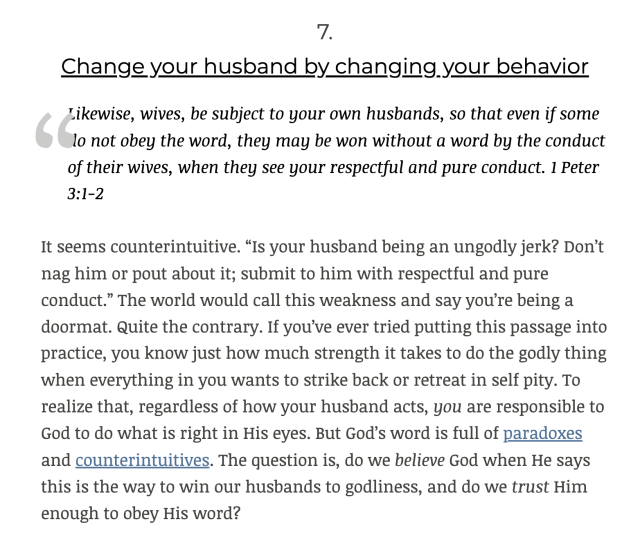
This comment was left on my article, Marriage: Itโ€™s My Pity Party and Iโ€™ll Cry if I Want To ~ 7 Ways to Take Your Focus Off Yourself and Put it Back onย Christ (By the way, yes, I realize that the length of the titles of some of my articles rivals those of many of the Puritans’ books and pamphlets. I’m OK with that.๐Ÿ˜€)

I have a question about number 7…

This article pertains to normal, relatively healthy, Christian marriages. In other words, not abusive marriages. If you are being abused, get yourself and your children to a safe place, and call the police, your pastor, or a loved one for help.

Of course, I agree that we should be subject to our husbands. However, are we not to call them out gently on their sin when they are acting like โ€œan ungodly jerkโ€ according to various verses such as Proverbs 27:5, Luke 17:3, Matthew 18:15, and Galatians 6:1? I guess Iโ€™m just confused because both commands seem to contradict each other.

This is another super question! The short answer is, “Yes,” but as Ecclesiastes 3:1,7 tells us, “there is a time for every matter under heaven…a time to be silent and a time to speak,” and in the moment when your husband is acting like “an ungodly jerk,” he’s apt to respond poorly to his sin being exposed and corrected, which just compounds his sin. (And frankly, we wives usually respond just as poorly in that moment when the shoe is on the other foot.)

In that moment, generally speaking, it’s usually a time to be silent, and, assuming he’s not asking you to sin, do whatever it is he’s gruffly or impatiently asking you to do with a gracious, kind, willing, and loving attitude and demeanor, as opposed to pouting and feeling sorry for yourself – which is the theme of the article (and also why #7 focuses on the “a time to keep silent” aspect of submission rather than the “a time to speak” aspect of addressing your husband’s sin).

Have you ever heard the phrase “killing someone with kindness”? God has an amazing way of taking our example of godly obedience, kindness, and refusing to retaliate, and using that to convict the other person of his sin. He does that Himself with us:

Or do you think lightly of the riches of His kindness and forbearance and patience, not knowing that the kindness of God leads you to repentance?

Romans 2:4

So, yes, there’s a time to speak and – approaching your husband the way you would want to be approached – kindly and humbly address his sin. That time is usually… later. Not in the moment.


What makes you confident in your ability to determine who is a true or false teacher of the Bible? Are you a theologian or do you have background in studying theology and the Bible? Just curious.

(I’ve distilled this question down from a much longer laundry list of complaints from a follower about a Facebook post in which I warned against false teacher Priscilla Shirer. It’s hard to tell from the wording in the brief excerpt above, but this was not a genuine, good faith question from someone desiring to grow in her discernment skills. It was tossed out in a snarky, accusatory, “Who do you think you are?” tone. My tone below, per Proverbs 26:5, is a biblically appropriate response to hers.)

The Bible makes me confident in my ability to determine who is a true or false teacher of the Bible. And if you’re a genuinely regenerated Christian, it should make you confident too.

Our authority as Christians comes from God’s Word, not from a seminary. You don’t have to go to seminary to be a discerning Christian (in fact, many seminaries are so rife with false doctrine that you’d better be discerning before you get there). If you think about it, none of the people who wrote the Bible’s teachings on false teachers and false prophets ever went to seminary, including the Bereans, whom God praised for their discernment.

Scripture tells us:

Beloved, do not believe every spirit, but test the spirits to see whether they are from God, because many false prophets have gone out into the world.

1 John 4:1


Examining teachers and comparing their teaching and behavior with Scripture is a command from God for Christians, not an option, and certainly not something for Christians to criticize and scorn other Christians for doing (as long as they’re doing it biblically, which I am).

So the question here is not why am I obeying God’s Word, testing this spirit against Scripture, and when she’s found to be a false teacher, warning other Christians about her. The question is, if you’re a Christian, why aren’t you? Why aren’t you studying your Bible so that you understand it, and can see how Shirer’s words and actions conflict with it? Why aren’t you warning others against her? I would be very concerned about that for my own spiritual life if I were you.

I hope this resource will answer any other objections to the Bible’s command for discernment that you may have.

I later added these remarks (slightly edited here) to the remainder of the commenters on that post:

I would encourage you younger ladies (especially those who have been commenting in the “Where do you get off?!?!” vein to me) to consider this:

“When one becomes so familiar with His Word you can spot a false teacher a mile away – I told my girls that when you walk close to God and His WORD you become sensitive to the clanging gong of false teachers.”

This quote is from a 70+ year old “Titus 2:3-5 woman” who has been walking with the Lord and a passionate student of God’s Word for over 50 years. And she’s right. And as a younger woman (I’m 56), I’m very thankful for the wisdom she just spoke into my life.

As I said, I’m 56. I have been a faithful member of decent churches since 9 months before I was born. I’ve been saved since I was 12. That means I’ve been walking with the Lord and studying His Word at church, a Christian high school and college, in other Christian organizations, and on my own for 44 years. Longer than many of you have been alive. Furthermore, I’ve been blogging and “doing discernment ministry” for over 17 years.

If you had a doctor with 44 years of training and 17 years of diagnostic experience and he gave you a diagnosis you didn’t like, would you immediately throw it back in his face with a sassy, disrespectful, “What qualifies YOU to say so?” or “What makes you so sure you’re right? MY opinion is…”. I doubt it. You might respectfully ask him some questions or request some resources to help you understand. You might even politely seek a second or third opinion, but you would not be so brash and arrogant to immediately assume he has no idea what he’s talking about and is just being mean to you, and you know better than he does.

I’m not saying this to toot my own horn or “look down on anyone’s youth” (that would be out of context, anyway), and I’m certainly not saying I’m without sin or never make mistakes. I’m saying there’s a reason Titus 2:3-5 specifies that older women are to train younger women. (Which implies that younger women should listen to older women instead of immediately dismissing us out of hand when we say something you don’t like – especially when it’s backed up with rightly handled Scripture and other mature, doctrinally sound Christians corroborate it.) Younger women do not have the same spiritual maturity, life experience, wisdom, and biblical training that older women have who have been walking with the Lord for decades. (I definitely didn’t have it when I was a younger woman!)

By all means, get a second opinion from rightly handled, in context Scripture. Politely ask questions. Do the research on your own. But stop being so reactionary and lashing out every time you hear something biblical that you don’t like. All you’re doing is showcasing your spiritual immaturity and ignorance of Scripture and your lack of self control. Or, worst case scenario, you’re bearing the fruit of someone who isn’t saved.

I’m far from perfect, but I didn’t just fall off the turnip truck and start slinging the label of “false teacher” around willy nilly. By God’s incredible grace, mercy, wisdom, and sanctification, I’ve been doing this a long time, and I know what I’m talking about – all glory to Him.


If you have a question about: a Bible passage, an aspect of theology, a current issue in Christianity, or how to biblically handle a family, life, or church situation, comment below (Iโ€™ll hold all questions in queue {unpublished} for a future edition of The Mailbag) or send me an e-mail or private message. If your question is chosen for publication, your anonymity will be protected.
Mailbag, Worship

The Mailbag: Potpourri (Judas in Hell?… Dementia & submission… Supporting Israel… Replace the sermon with ___?)

Welcome to another โ€œpotpourriโ€ edition of The Mailbag, where I give short(er) answers to several questions rather than a long answer to one question.

I like to take the opportunity in these potpourri editions to let new readers know about my comments/e-mail/messages policy. Iโ€™m not able to respond individually to most e-mails and messages, so here are some helpful hints for getting your questions answered more quickly. Remember, the search bar (at the very bottom of each page) can be a helpful tool!

Or maybe I answered your question already? Check out my article The Mailbag: Top 10 FAQs to see if your question has been answered and to get some helpful resources.


Did Judas go to Hell when he died?

Although there is no Bible verse that says verbatim, โ€œJudas died and went to Hell,โ€ and we always have to be very careful with speculating, I believe we can safely infer from two passages (and their surrounding contexts) that Judas is, indeed in Hell.

The first passage is Matthew 26:20-25. This is the scene at the Last Supper when Jesus has just told the disciples that one of them (Judas) will betray Him. He says about His betrayer in verse 24, โ€œwoe to that man by whom the Son of Man is betrayed! It would have been better for that man if he had not been born.โ€ โ€œWoe,โ€ and โ€œbetter if he had not been born,โ€ are not phraseology anyone, let alone omniscient Jesus, would use to describe someone who would be entering Heaven mere hours later.

The second passage is John 17, Jesusโ€™ high priestly prayer for His disciples just prior to His crucifixion. In verse 12, Jesus says, โ€œnot one of them perished but the son of perdition,โ€ referring to Judas. Again, Jesus knows Judasโ€™ death is only hours away. He also knows whether Judas will be in Heaven or Hell afterward. If Jesus knew Judas would be in Heaven, why would He call him โ€œthe son of perditionโ€? Furthermore, the Greek word translated “perdition” or in other Bible translations, “destruction,” is apoleia. This word can carry the connotation, โ€œdamnable,โ€ and โ€œthe destruction which consists of eternal misery in Hellโ€ (Strongs, G684).

So, yes, Scripture indicates that Judas is spending eternity in hell.

Additional Resources:

Was Judas Iscariot forgiven / saved? at Got Questions?

Did Judas repent? by John MacArthur


This question was submitted in response to my article The Mailbag: What Is Submission?

My cousin’s (a professing Christian) husband has Alzheimerโ€™s, and his mental state has gone downhill very quickly (she is 59 and he is 77.) At one point in the conversation, she mentioned all the responsibilities sheโ€™s taken on that he used to handle, and said that she was now the head of the household. Iโ€™m wondering if any Biblical texts address a wifeโ€™s role in that situation.

My heart goes out to your cousin. Alzheimer’s Disease and other forms of dementia are such cruel conditions, both for the patient and his or her loved ones.

There is nothing in the Bible that specifically addresses caring for a spouse with dementia or any other mental incapacitation, or what a wife’s submission to her husband might look like in that situation.

I think what your cousin probably meant by her remark about being “head of the household” is that she now has to take over all of the family “business” responsibilities her husband used to handle: paying the bills, getting things around the house fixed, handling legal paperwork and taxes, making decisions, and so on. And, sadly, her husband is also not able to lead her in Bible study, prayer, and spiritual matters, so she’s having to handle that as well.

These are all things she would immediately have to take over and handle if her husband suddenly dropped dead of a heart attack, and we wouldn’t think a thing of it.

What’s happening to your cousin’s husband is a slow death. His body isn’t dying all at once, but day by day, bit by bit. So, she’s gradually taking over the things his body has died to and is unable to handle any more. And, biblically, that’s not just OK, that is being a faithful, godly helper.

If she came to me for counsel, I’d advise her to keep doing what she’s doing. If her husband has moments of lucidity in which she can tell he’s making a reasonable decision or request, she should certainly submit to that. If her husband made non-sinful decisions before he became ill, she should continue to submit to and carry out those decisions*. But otherwise, she should continue to love and serve him the best she can, and that includes gradually taking over what he can no longer do.

*(Thank you to “hiltonjp5c174e0fe6” for her comment below on 10/8/25, which reminded me of this.)


Are Christian Americans ALWAYS supposed to back Israel? The people of Israel now may not even be Jesus believing Christians or even God believing Jews. Should we support everything they say and do, just because they live in the country? Iโ€™m not implying anything, one way or another, but it seems a lot of Christians say, โ€œwe back Israel so we will be blessedโ€ and it sometimes seems like a blind backing.

Much has been written and said in the last hundred years or so about Israel, eschatology, end times prophecy, and so on, but sometimes it gets a little complicated and convoluted. I think there might be a simpler way to look at things.

First, I would have to ask: What does it mean for a Christian individual in 2025, who’s not a politician or a pastor, to “back Israel”? What does that look like in your daily life? Posting supportive things about Israel on social media? Voting for politicians who promise to create legislation and policies that are favorable to Israel? Those are really the only things I can think of. You and I have no power to do anything substantive to “back Israel” in our day to day lives, so this question is mostly moot for the majority of us as individuals.

Second, Christians handle and evaluate situations according to Scripture as they come up. If an issue comes up with Israel, we look at it biblically:

Did Israel’s government make a decision that the Bible clearly says is sin? Christians can’t support that. God certainly has never supported Israel’s sin just because they’re Israel. Just take a gander at how He responded to Israel’s sin in the Old Testament. He sent diseases, natural disasters, the armies of pagan nations to attack them, and finally exiled them for 70 years. In Jeremiah 7, God essentially tells them they can’t go out and commit a bunch of abominations and then expect Him to deliver them.

Did Israel’s government make a decision that doesn’t conflict with God’s commands or biblical principles? Then we evaluate the wisdom of it according to Scripture, and we have the freedom in Christ to support or not support that decision (whatever that might mean) accordingly.


Iโ€™m curious if replacing the preaching of Godโ€™s Word on the Lordโ€™s Day during the morning worship service with a gospel music concert or a VBS commencement is biblically appropriate and/or considered to be our worship of Him? I am seeing a doctrinal shift toward the progressive left in some areas of my local church, and Iโ€™m burdened and heartbroken as I pray for God to make clear what I perceive as concerns and how I can glorify Him in this matter.

I’m so sorry. I know firsthand what it’s like to be in a good church that goes bad. It is heartbreaking and stressful.

Scripture doesn’t give us a line by line order of service to follow for the worship service, but that doesn’t mean anything goes, either. Typically, churches follow either the regulative principle of worship (RPW) or the normative principle of worship (NPW). The NPW is the idea that we can do anything in the worship service that isn’t prohibited in Scripture. The RPW basically says that we are only to do things in the worship service that are prescribed in Scripture: preaching the Word, worshiping God through song, praying, giving offerings, and so on.

Now, you’ll notice that God commands both the preaching of the Word and singing in His church, but He doesn’t specify how much time we’re to devote to each. However, when we look at the overall picture of the church that the New Testament presents, it’s easy to see that the preaching and teaching of the Word should be central as a general rule.

That being said, it is my opinion that it’s perfectly OK for a doctrinally sound church to occasionally (maybe a couple of times a year) have a service in which the music portion of the worship service is longer than the preaching portion, as long as the Word is being proclaimed through the music.

For example, my church usually holds a worship service a couple of weeks before Christmas called “Lessons and Carols”. Scriptures pertaining to Christ’s incarnation are alternated with Christmas carols and hymns that echo those Scriptures. That takes up most of the service. At the end, my pastor gives a briefer than normal gospel presentation / sermon.

I think something like that or a Christmas or Easter cantata is fine.

I would not agree that it would be appropriate to replace the sermon with a “gospel music concert” (if, by that, you mean a singer/group comes in and gives a performance) or a VBS commencement, to the exclusion of the sermon. Neither a concert-style performance nor a commencement program are elements of worship prescribed in Scripture. And if you’re seeing other doctrinal problems alongside these things, it’s probably indicative of the overall declining spiritual health of your church. Time to make an appointment with the pastor, and kindly and lovingly express your concerns.

I pray your pastor will listen, and I hope you won’t need this, but just in case you do, you can always find the Searching for a new church? tab in the blue menu bar at the top of this page.


If you have a question about: a Bible passage, an aspect of theology, a current issue in Christianity, or how to biblically handle a family, life, or church situation, comment below (Iโ€™ll hold all questions in queue {unpublished} for a future edition of The Mailbag) or send me an e-mail or private message. If your question is chosen for publication, your anonymity will be protected.

Mailbag, Marriage

The Mailbag: What is submission?

How is biblical submission defined, with specifics?

It’s a great question that a lot of women wonder about. “Just give me a list of all of the things I need to do to be ‘doing submission,’ and I’ll do them!” Unfortunately, that’s not how this, and so many other biblical concepts, works.

“Just give me a list of all of the things I need to do to be ‘doing submission,’ and I’ll do them!” Unfortunately, that’s not how this, and so many other biblical concepts, works.

Asking “How is biblical submission defined, ‘with specifics’?” is kind of like asking someone to define “modesty” or “parenting” with specifics. A lot of those “specifics” are situation dependent and vary from family to family or person to person.

For example, you can’t make a law for Christians that a woman’s skirt must be a certain length, because the length of women’s legs vary, and the same length requirement will be modest on one woman and immodest on another. It’s the same idea with submission. It’s going to vary from marriage to marriage.

In a godly marriage1, a husband and wife come together and discuss how they’re going to handle various issues, chores, responsibilities, etc. If there’s agreement, great! But that’s not really submission because both spouses are getting what they want.

If there’s agreement, great! But that’s not really submission because both spouses are getting what they want.

When there’s an area of disagreement, both spouses offer their input. If, after discussing it, the husband comes to the conclusion that he was wrong or that it would work just as well to do things the wife’s way, then he leads the family to do things the way she has suggested.

But if, after hearing his wife out, he concludes that his way is the wisest way to do things, that’s where submission comes in. The husband is responsible before God for how he’s leading in this situation. The wife is responsible before God for maintaining a posture of heart that says, “I may think he’s wrong, but I’m going to trust God in this situation, and obey Him by putting my will aside and graciously doing things my husband’s way.” That is biblical submission whatever the specific circumstances may be.

I may think he’s wrong, but I’m going to trust *God* in this situation, and obey *Him* by putting my will aside and graciously doing things my husband’s way.

Obviously, that’s an ideal situation between a godly husband and a godly wife, but the same applies to a godly wife with an unsaved or not so godly husband. First Peter 3:1-6 and 1 Corinthians 7:12-16 are crystal clear that a wife’s godly submission can be instrumental in his salvation or sanctification.

Likewise, wives, be subject to your own husbands, so that even if some do not obey the word, they may be won without a word by the conduct of their wives, when they see your respectful and pure conduct.

For how do you know, wife, whether you will save your husband? Or how do you know, husband, whether you will save your wife?

2 Peter 3:1-2, 1 Corinthians 7:16

“But what if his way turns out to be the wrong way?” Sometimes you’re going to submit to your husband and he’s going to end up being wrong. He’s going to have to answer to God for that. You’re going to have to answer to God for whether or not you obeyed Him and submitted to your husband.

We don’t obey God only when we think that doing so will yield the results we want. We obey God’s commands every time, we leave the results up to Him, and we trust Him to carry us through and provide for us regardless of what happens. That’s called faith.

We don’t obey God *only* when we think that doing so will yield the results we want.

1If your knee jerk reaction to the word “submission” is to immediately reject this biblical command outright because there are men who abuse their wives (whether or not your husband is one of them), your attitude is not in line with Scripture. Abuse is a separate situation with a separate, biblical way of handling it that has nothing to do with biblical submission. Please note that this article is to be understood in the context of a godly (by definition, not abusive) marriage.

Additional Resources:

Why is submission so scary? at A Word Fitly Spoken

Toxic (Evangelical) Femininity

Imperishable Beauty Bible Study, Lesson 11- A Beautiful Wife

Godly Womanhood โ€“ Submission part 1  part 2

CBMW (type โ€œsubmissionโ€ into the search bar)


If you have a question about: a Bible passage, an aspect of theology, a current issue in Christianity, or how to biblically handle a family, life, or church situation, comment below (Iโ€™ll hold all questions in queue {unpublished} for a future edition of The Mailbag) or send me an e-mail or private message. If your question is chosen for publication, your anonymity will be protected.

Christian women, Church, Complementarianism

Throwback Thursday ~ Unforbidden Fruits: 3 Ways Women MUST Lead and Teach the Church

Originally published April 20, 2018

Ladies, we whine too much.

Like petulant little girls, we look at what’s off limits to us, stomp our Mary Janes on the floor and cry “Why can’t I? I want to!” instead of giddily jumping into all the opportunities God has blessed us with. Instead of being happy and thankful for what we have, our greedy little fingers stretch out to grasp what God has said we can’t have because it’s not good for us or anybody else.

God has instructed pastors – who are, in turn, to instruct us – that, in the gathered body of Believers, women are not to preach to men, instruct men in the Scriptures, or exercise authority over men. And that’s what we focus on, and whine and kick our feet about. That part – the childish rebellion and discontent with the role God has graciously placed us in – that’s on us.

But pastors, we badly need your help on this one. Many pastors do a wonderful job of rightly and biblically explaining what women are not to do (And may I take a moment to say, from the bottom of my heart, thank you. I know how difficult that can be and that you take a lot of undeserved flak for simply teaching God’s Word on this subject.), but that “no” teaching has often not been coupled with the “yes” teaching of what women must do and how they must lead in order for women, and the church, to be healthy and function properly.

The “no” teaching of what the Bible forbids has often not been coupled with the “yes” teaching of what women *must* do and how they must lead in order for women, and the church, to be healthy and function properly.

You’ve loved us well to tell us not to bite at the apple from the forbidden tree, but we also desperately need you to take us on a tour of the Garden and introduce us to the all-you-can-eat buffet of pear and peach and cherry and pecan trees that we have the privilege and the responsibility to feast on.

๐ŸŠ The Other Institution ๐ŸŠ

Did you ever notice that the “do” for women in the church comes before the “don’t”? We tend to totally skip over that enormous little word that kicks off 1 Timothy 2:11: “Let a woman learn…”. We have no idea of, nor appreciation for, how huge and groundbreaking it was for the Holy Spirit, through Paul, to proactively instruct pastors: “Hey, get these women in here, make sure they listen up, and train them properly in the Scriptures so they’ll be equipped to fortify their homes with biblical truth.”

We completely miss the fact that, though God installs men as the teachers and leaders in one of His foundational institutions – the church – He has very much made women the functional, boots on the ground, day to day, teachers and leaders by example – of His other foundational institution – the family. The church didn’t even exist for the first few millennia of human history, but the family has existed since Creation. And people who are members of families populate and lead the church. Raising and molding those people is a tremendous position and responsibility. A position and responsibility God has largely given to women.

Wives pray for our husbands’ growth in Christ. We build them up with Scripture. With a gentle and quiet spirit, we set a godly example for them as they observe our respectful and pure conduct. We encourage and help them in their leadership roles at church.

Moms pray for our children’s salvation. We pour the gospel into them at every turn. We train up our children in the way that they should go – in the nurture and admonition of the Lord – so that when they are old they do not depart from it. We teach them to love and serve and invest in the church both directly and by modeling these things for them.

And our single, widowed, and childless sisters work right alongside us in this labor, praying for church leaders and members, nurturing children at church whose parents are unsaved or unequipped to raise them biblically, encouraging and assisting brothers and sisters in Christ.

We grow and develop, nourish and support, exhort and sharpen the population of the body of Christ.

Men may lead the church, but women raise the church.

Men may lead the church, but women *raise* the church.

๐Ÿ Woman to Woman ๐Ÿ

Essential to the health of any church is the component of women training women, whether in the formal setting of a Bible study class and structured women’s ministry programs or an impromptu “let’s get together for coffee this week” discipleship discussion.

Though we receive instruction in Scripture from our pastors, elders, and teachers, there are some counseling and teaching situations it’s not appropriate for a man to address with a woman, or that a woman understands better than a man. There are issues women face that men just don’t “get” in the same way a sister in Christ does. There are insights and perspectives a woman can use to explain Scripture to another woman that a man just doesn’t have. There are times when a woman needs someone to walk through a long term emotional journey with her that requires a personal intimacy which would be inappropriate for a man to engage in with her. And in the same way men are better equipped than women to train men to be godly husbands, fathers, and church members, women are better equipped than men to train women to be godly wives, mothers, and church members.

God knew all of this back when He breathed out the words of Titus 2:3-5…

Older women likewise are to be reverent in behavior, not slanderers or slaves to much wine. They are to teach what is good, and so train the young women to love their husbands and children, to be self-controlled, pure, working at home, kind, and submissive to their own husbands, that the word of God may not be reviled.

…and, again, 1 Timothy 2:11:

Let a woman learn quietly with all submissiveness.

Women must be trained properly in the Scriptures so we can take that training and pour it into other women, teaching and sharpening them into godly women, wives, mothers, and church members.

๐Ÿ‘ Super Models ๐Ÿ‘

Women instruct our brothers and sisters in the church in biblical truth when we lead by example. When we sin against someone, we go to that person and ask forgiveness. We demonstrate the importance of meeting together with the Body by being faithful in our church and Sunday School attendance. We model servanthood by serving the church and our brothers and sisters. We paint a picture of biblical compassion by ministering to the sick and others in need. We show Christians how to carry out the Great Commission by sharing the gospel. We set an example of trusting God when others see us depending on Him through difficult situations.

And one of the most important biblical concepts women have the privilege and responsibility of teaching the church through our example is submission to authority – a lesson the church is sorely in need of these days.

Because God blessed us by creating us as women, we have an opportunity to model submission to authority in a unique way that God has chosen to deny to men.

Because God blessed us by creating us as women, we have an opportunity to model submission to authority in a unique way that God has chosen to deny to men.

As we submit to our husbands, we teach the church what it means to submit to Christ. How to walk in humility and obey Him out of love. How to put selfishness aside. To trust Him to take care of us. To deny ourselves, take up our cross daily, and follow Him.

When we submit to God’s design for leadership in the church and joyfully carry out the work He has planned for us as godly women, we teach the church to submit to God’s authority and love Him by obeying His commands. We instruct our fellow church members in respecting and submitting to the pastors and elders God has placed in spiritual authority over us.

Submission to Christ, to God’s commands, and to pastors and elders is the bedrock of a healthy church. God has graciously given women the role – and the duty – of teaching these and other biblical principles to our churches in a way that men cannot -through our example as godly women.

Remember the series of fun little nutritional books that came out several years ago called Eat This, Not That? The idea the books centered around was, “Don’t eat that unhealthy thing. Eat this similar but healthy thing instead.”

Sadly, many Christian women have only been getting half the story. “Not that” (preaching to/teaching men and exercising authority over men) is biblically correct, but it’s not biblically complete. If all you tell someone is “Don’t eat that,” without showing her the “Eat this,” part, what she needs to eat to be healthy, she’s going to starve, and the church will be malnourished as well.

Christian women need our pastors to teach us to eat the fat of the land of being properly trained in the Scriptures and drink the sweet wine of leading and instructing the church the way God gifts us and requires us to. Only then will the Body be healthy and well nourished.