Biblical Womanhood Bible Study

Imperishable Beauty: Lesson 15- A Beautiful Portrayal of Biblical Womanhood in the Church

Previous Lessons: 1, 2, 3, 4, 5, 6, 7, 8, 9, 10, 11, 12, 13, 14

Read These Selected Scriptures

In lesson 14 we looked at the beauty of women’s position in the church. Today, we’ll examine how our character can beautifully portray biblical womanhood in the church.

Questions to Consider

1. Briefly review lesson 14 (link above). What did you learn about the position women occupy in the church? As you study today’s lesson think about some of the ways you can portray biblical womanhood to others from that position.

2. Carefully examine the 1 Corinthians 11 passage. (As you study this passage, it may help to keep in mind that, unless widowed, virtually every adult woman in the church would have been married. That was the cultural norm. So Paul is able to use the terms “women” and “wives” nearly interchangeably. Click on the “Read These Selected Scriptures” link above and read the footnote (c) for verse 5.)

Compare the format of this introduction (2-3) to the format of the introduction of the letters to three of the seven churches in Revelation. Describe this format noting how the word “but” acts as a pivot point for all four passages. For what does Paul commend the Corinthian church? (2) “But” in what area of church life does Paul imply the Corinthians are not “getting it”? (3) Explain what verse 3 means as it applies to the day-to-day functioning of the church both in Corinth and today. What is the authority “flow chart” for the church?

Verse 3 serves as the main idea or theme of this passage. What is the main theological point God is trying to drive home to the church?

To what event in biblical history is Paul referring in 7b-9? Compare these verses with 1 Timothy 2:12-14. Explain how the creative order (man created first, woman second / man as head, woman as helper) is the cornerstone of the authority structure (3) in the family and the church.

In 4-5 and 14-15, Paul uses two separate examples from Corinthian culture that demonstrate the differences between men and women in order to illustrate the concept of the hierarchy of authority in the church. What are those two examples? Is God commanding that Christian women today must have long hair and must cover their heads when praying? Is God commanding that Christian men today must have short hair and must never cover their heads while praying?

In Corinthian culture, one of the ways women could portray biblical womanhood in the church was to signify by wearing their veils that they embraced submitting to their husbands and to the authority structure of the church. Can you think of any similar ways women can portray biblical womanhood today?

3. Examine the 1 Timothy 2 and 1 Peter 3 passages. What is the venue or setting for the instructions in each? (You may need to look at more of each chapter.) Locate the word “but” in each of these passages (2:10, 3:4), noting the concept that comes before the word “but” and after it. Describe how women are not to adorn themselves. “But” describe how women are to adorn themselves. Are things like braids, jewelry, and clothes intrinsically sinful, or is Paul again giving cultural examples to illustrate a theological point he’s making? What is that point? What is it about the bent of women’s hearts that would cause God to give this instruction to women in the context of the home and the church, but not to give this instruction to men at all? As godly women, where is our focus to be? How does it benefit the church for us to “wear”, or portray, biblical womanhood by adorning ourselves modestly and with good works?

What similar themes do you see in these two passages and the 1 Corinthians 11 passage? How do these three passages work together to demonstrate to us how we may live out biblical womanhood in the church?

4. Locate, in the 1 Timothy 2 (10), 1 Peter 3 (6), and 1 Timothy 5 (10) passages the phrases about doing good works. How are good works a major responsibility of women in the church, and a main way we display biblical womanhood?

Explain the context of the 1 Timothy 5 passage. The passage is talking about women who are _______. But a large part of this passage talks about how these women lived and served the church prior to becoming widows. Make a two column list. On one side, list the good works of all the women (widowed, married, young widows, any believing woman, etc.) mentioned in this passage. On the other side, list some specific ways you and other women in the church can carry out these good works today.

What are the “bad works” to be avoided in this passage? How can focusing on doing good works help us to avoid the bad works?

5. Study the remaining passages (Luke, Acts, Romans, 1 Corinthians) in today’s lesson. How did the women who followed Jesus, Dorcas, Lydia, and Priscilla (Prisca) each portray biblical womanhood in the church by their character and good works? To whom did they minister? How did the church benefit from each of them robustly living out God’s plan for women in the church?


Homework

If you’d like to read more about some of the passages from today’s lesson, you might enjoy the following articles:

Rock Your Role: A Head of the Times- Head Coverings for Christian Women?

The Mailbag: Potpourri (Calvinism, Baptism, Modesty…)

Rock Your Role: Oh No She Di-int! Priscilla Didn’t Preach, Deborah Didn’t Dominate, and Esther Wasn’t an Egalitarian


Suggested Memory Verse

Nevertheless, in the Lord woman is not independent of man nor man of woman; for as woman was made from man, so man is now born of woman. And all things are from God.
1 Corinthians 11:11-12

Biblical Womanhood Bible Study

Imperishable Beauty: Lesson 14- A Beautiful Position in the Church

Previous Lessons: 1, 2, 3, 4, 5, 6, 7, 8, 9, 10, 11, 12, 13

Read These Selected Scriptures

For the past few lessons, we’ve looked at biblical womanhood in the family. Today, we’ll begin looking at biblical womanhood in the church setting, examining the beautiful position God has given women in the gathering of the Body.

Questions to Consider

1. Read Galatians 3:28 (if you have a moment, read all of chapter 3 for a fuller view of the context). What does this verse, especially in light of the remainder of chapter 3, mean? What does it mean to be “one in Christ Jesus”? How does this verse speak to the concept of unity in the church? How does this verse speak to the equal value of every person in the eyes of God? When it comes to a soul being saved, is there any difference between a woman or man, slave or freeman, Jew or Greek? Do Greeks have to repent more than Jews? Does Jesus have to work harder to save women than men?

2. Briefly review the topics of lessons 4-9 (links above). Are any of these concepts (identity in Christ, being created by God, etc.) specific to one sex, or do they apply to all people? Make two lists: “Things Christians Are” and “Things Christians Do”. List about 5-10 things Christians are (ex: forgiven, ambassadors for Christ) and things Christians do (ex: pray, show mercy). Are any of the things you listed specific to men only or women only? Considering all the things the Bible says Christians are and Christians do, what would you estimate is the percentage of things all Christians are to be and do versus the percentage of things that are only for men or only for women?

3. Examine the 1 Corinthians passage. Verse 33 is kind of the “theme verse” of 1 Corinthians 14. What is the main subject of this chapter? (Hint: See section heading here). What is the venue (home, church, marketplace, etc.) in which the instructions of chapter 14 apply? (33b) Briefly skim over the rest of chapter 14. What was the overall, “for the greater good,” reason for the instruction to women in v. 34-35? What were some other activities and people the Holy Spirit, via Paul, placed restrictions on in chapter 14? Why? What is the main priority of chapter 14? Does the instruction in 34-35 mean that women may never utter a word once they step through the doors of the church? How do you know that? What do these instructions mean, and how do they apply to women in the church today? What do these instructions teach us about our responsibility to pay attention to the preaching and teaching of the Word and learn from it? How can this passage help us to see the value and edification in discussing the Scriptures at home with our husbands?

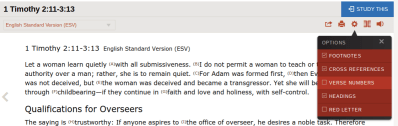
4. Go to the 1 Timothy and Titus passages by clicking on the “Read These Selected Scriptures” link at the top of today’s lesson. Recall that when the Bible was written, there were no chapter and verse numbers. (Those were added much later.) First Timothy and Titus would have read like one long, continuous letter or e-mail. Click on the “options” icon and uncheck the box next to “verse numbers”.

Now read the 1 Timothy passage, noting the flow of thought and how the end of chapter 2 is interconnected with chapter 3. What is the main idea of this passage? (OK, now click the verse numbers back on. :0)

What is the first word of verse 11? Think about women’s social status and value in Paul and Timothy’s culture, and in many cultures since that time, even today. Why does the Holy Spirit instruct pastors to “let” women learn? What does this teach us about the responsibility God places on us as women to learn His Word? Would you categorize verse 11 as a “do this” or “don’t do this” verse?

Examine verse 12. Is this mainly a “do this” or “don’t do this” verse? What two things does the Holy Spirit say women are not to do in the gathering of the church body? What does He say women are to do? Think about God’s nature and character. Does He ever give instructions arbitrarily or just to spoil our fun? Why does God give us commands and instructions, generally speaking? Are the instructions in verse 12 good for women and for the church?

Does God have to give us the reasons behind His instructions, or is “because I said so” sufficient reason for us to obey Him? Take a look at 13-14. God kindly gives not one, but two reasons for His instructions in verses 11-12. What are those two reasons? How do they fall in line with God’s design for male headship and leadership across biblical history in the hierarchical structures He has set up?

The 11-15 passage starts with a “do this” verse (11), followed by a “don’t do this” (12) “and here’s why” (13-14) section, then finishes up with another “do this” verse (15).

Verse 15 can be a little cryptic to us today because we equate the word “saved” with salvation. Does verse 15 mean that women gain salvation by having children? How do we know it doesn’t? The NASB helpfully, and more accurately, renders this word as “preserved“. We don’t feel it much today, but think about the stigma women (particularly Jewish women) carried at the time this was written simply because they were daughters of Eve. Paradise was lost and the curse of sin entered the world because of a woman, many men thought, and they viewed and treated women accordingly. Yet who was chosen to bring the Messiah into the world? And following in her footsteps, a major way godly women can “save” or “preserve” the reputation, esteem, and value of womankind is to “continue in” what 3 godly character traits? (15) Because if they continue in those three godly character traits, they will be raising up a godly seed to the Lord (even if the children they bear aren’t perfect like Mary’s child was :0)

So we’ve seen the position women are to occupy in the church, followed by the positions women aren’t to occupy, and that’s followed, in the 1 Timothy 3 and Titus 1 passages by the p_____s m__ are to o____.

According to the 1 Timothy 3 and Titus 1 passages, which positions are men to occupy in the church? What is an overseer? (Use your cross-references if necessary.) Go through these two passages circling any words or phrases that indicate that pastors, elders, and deacons are to be men. Are these positions open to all men in the church?

Examine each of the three sections (1 Timothy 3:1-7, 3:8-13, and Titus 1:5-9) individually. How could the wife of a pastor, elder, or deacon help him, or make things easier for him, to meet the biblical requirements for his office? (Ex: How could a pastor’s wife make it easier for him to be hospitable?)


Homework

If you’d like to dig deeper on some of these passages, you may enjoy reading the following articles from my Rock Your Role series:

All Things Being Equal (Galatians 3:28)

Order in His Courts: Silencing Women? (1 Corinthians 14:33b-35)

Jill in the Pulpit (1 Timothy 2:11-12)


Suggested Memory Verse

There is neither Jew nor Greek, there is neither slave nor free, there is no male and female, for you are all one in Christ Jesus.
Galatians 3:28

Basic Training, Bible Study, Sermons

Basic Training: Bible Studies and Sermons

For more in the Basic Training series, click here.

When I started the Basic Training series, I thought I’d be writing about foundational theological concepts and practices in Christianity. You know, like baptism or the sufficiency of Scripture. It never occurred to me that I might someday need to explain something so basic that most lost people could define it as well as (sometimes better than) many professed Christian leaders.

But the more “Bible” studies and sermons I take in, the more I think a remedial course in exactly what those things are supposed to consist of might be very beneficial to the church at large, and an unfortunate necessity for many pastors, teachers, and Christian celebrities.

I could be way off base here, but I’d almost bet that if you went up to ten random people on the street and asked them what a Bible study class is supposed to do, at least nine out of ten of them would answer, “Study the Bible.” If you asked those same people what a sermon is, you might get more varied answers, “It’s when the preacher explains what the Bible says,” or “It’s a pastor telling you how to be a good person,” (remember these are random, probably unsaved, people) or “A sermon tells you about God.” But I’m guessing none of them would answer, “It’s when a preacher gives a stand up comedy routine,” or “A sermon is mostly stories about the preacher, his family, and other people,” or “A sermon is when you watch a movie and then the preacher adds a few remarks at the end about what you can learn about God or life from the movie.”

Yet, that’s pretty much where way too many churches are these days.

So let’s take a look at what Bible studies and sermons are and aren’t supposed to be.

It’s All About The Bible

This is supposed to be a “duh” moment for Christians, pastors, teachers, and churches. If someone is teaching a Bible study or a pastor is preaching a sermon, the first thing he should reach for is his Bible. He is to be preaching or teaching God’s written Word. It’s right there in black and white in 2 Timothy 4:1-2:

I charge you in the presence of God and of Christ Jesus, who is to judge the living and the dead, and by his appearing and his kingdom: preach the word; be ready in season and out of season; reprove, rebuke, and exhort, with complete patience and teaching.

That’s a very solemn and weighty charge to pastors. In today’s vernacular, it’s almost like placing your right hand on the Bible, raising your right hand, and saying, “As God is my witness, I swear to God I will ______.” (and actually understanding the gravity of that and meaning it). God is witnessing this charge to you pastor – you’d better take seriously your duty to preach His Word.

And notice, there are only two times when a pastor is supposed to preach the Word: in season and out of season. When his people want to hear it and when they don’t. When he feels like it and when he doesn’t. When he’ll be persecuted and when he won’t. When it’s easy and when it’s hard. When it’s a pleasant, encouraging passage, and when it’s a passage that offends people. Pastors, and, by extension teachers, are to preach and teach the written Word of God in every sermon and teaching opportunity. Always.

It’s Not About the Preacher/Teacher/Author

There are a lot of awesome pastors, teachers, and authors out there who labor faithfully to rightly teach God’s Word to His people. I am unspeakably grateful to them and for them.

But let’s face it, there are also a lot of narcissistic gas bags out there who use the pulpit and the pages to pump up their already over-inflated egos by endlessly blathering on and on about themselves, their families, their friends, and their experiences. You can tell by the ratio of personal stories to Scripture who they love best and are most interested in.

I’ve read books and heard sermons that I walked away from thinking, “I know more about that pastor or author, his family, his trips, the charity work he does, and who his important friends are than I do about God and His Word.” (I’ll tell you this, he’s received his reward.)

Pastors, teachers, authors aren’t to preach themselves, they’re to preach the Word.

It’s Not About Gimmicks and Entertainment

A sermon series based on movies. A pastor riding a motorcycle into church. Ziplining during the sermon. Rock concerts and light shows. Raffles and giveaways of cars and other big ticket items. The pastor and his wife promoting a sermon series on sex. On the news. From a bed. On the roof of the church.

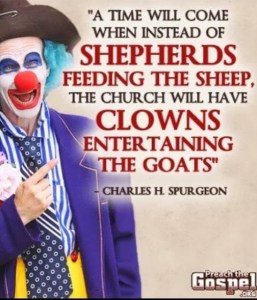
Pastors and teachers aren’t charged to entertain people or get them in the doors of the church and keep them there by any means necessary. Pastors and teachers are charged – with God as their witness – to faithfully preach and teach His written Word. Jesus said shepherds who love Him will feed His sheep, not entertain them.

Newsflash – the world isn’t going to find that interesting enough to get out of bed for on Sunday morning. Newsflash – That’s fine. The gathering of the church isn’t for the world. The gathering of the church is for the church – the people who have been saved out of the world and into the body of Christ – to give them an opportunity to worship the Savior they love with their brothers and sisters, to disciple them in God’s Word, and to equip them with God’s Word to go out and share the gospel with the world.

It’s Not About You, Either

The flip side of “it’s all about the Bible” is, it’s not about you. What does that mean? The sermon or the Bible study lesson should not teach us to look down in narcissistic navel-gazing, it should teach us to look up at God, who He is, what He has done, and what He says in His written Word.

Over the years, I’ve had the discouraging duty of reviewing various women’s “Bible” studies. Though some have been better than others, the theme running through the majority of them is “it’s all about you” – your feelings, your hurts, your ego, your opinions, your personal experiences. It’s evident in the way authors insert long stories about their own lives and base their ideas, agendas, and assertions on those personal experiences rather than on Scripture. It’s evident in the questions the reader is supposed to answer at the end of each lesson: “Have you ever experienced _____?” “How does ____ make you feel?” “If you could ____, how would you do it?” “What do you think others’ opinion of you is?”

Good Bible studies give you rightly handled, in context Scripture until it’s coming out of your ears, and then they ask questions like, “What are the attributes of God listed in this passage?” “Verse 3 talks about lying. What are some other verses that talk about lying, and how can we tell from these verses how God views lying and why?” “How does this passage point us to Christ?”

Is there a need for introspection during Bible studies and sermons? Sometimes. But the focus is not you and your feelings and experiences. The focus is on reflecting on the glory of God in the passage you’ve just heard, repenting of the sin the passage you’ve just read has convicted you about, obeying the command in the passage you’ve just heard, and things like that. It’s Bible-focused, driven, and governed, not me-focused, driven, and governed.

Context, Context, Context

It’s not just important to preach and teach the Bible, it’s important to handle the text of the Bible correctly and in context.

You’ve probably heard the old joke about the guy who wants God to tell him what he should do with his life. So he opens up the Bible to a random spot, closes his eyes, puts his finger down on the page, and looks at the verse he’s pointing at. It’s a New Testament verse: “Judas went and hanged himself.” “Hmm,” he thinks, “that doesn’t make much sense.” He shuts his Bible and tries the process again. This time, it’s an Old Testament verse, “Go and do thou likewise.”

We laugh at the silliness of this little story, but it hits frighteningly close to home for far too many pastors and teachers.

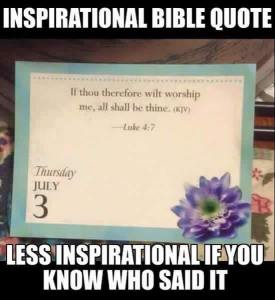
Perhaps you’ve read a devotional that quotes a Bible verse (or maybe even just part of a verse) at the top of the page. The author then goes on to teach on that verse or tell a personal story. When you look up the verse and read a little more of the chapter it’s in, you discover it has nothing to do with the author’s story or doesn’t mean what the author was teaching.

Or maybe you’ve sat in a church service where the pastor reads a verse or two at the beginning of the sermon and then basically closes his Bible and shares personal thoughts and stories for the rest of the sermon time that have nothing to do with the verses he read at the beginning. Or a sermon in which the pastor hopscotches all over the Bible (often using a myriad of translations) reading a verse here, half a verse there, in an effort to prove his homespun thesis or support the agenda he’s crafted.

Yes, technically, there’s Bible in all of those teachings, but none of those methods handle Scripture properly or in context. That’s called eisegesis, and it basically means reading your own ideas into the text of Scripture, or twisting Scripture to get it to say what you want it to mean.

The proper method of teaching Scripture is exegesis. Exegesis is taking a passage of Scripture in context, and “leading out” of it- teaching what the passage means. That’s nearly always going to require reading several verses from the passage to catch the reader or listener up on what’s going on in the story she’s just parachuted into.

Good pastors and teachers read and teach the biblical text in an organized way. When you sit down to study, say, a history book, you start at the beginning of the book and you work your way through to the end. You don’t start by reading two paragraphs out of the middle of chapter 7, then move on to the last three sentences of chapter 49, then the first half of chapter 1. That’s how people preach, teach, and “study” the Bible sometimes, and it’s just as crazy to read the Bible that way as it would be to study a history book, or math book, or science book that way, or even to read a novel or a magazine using that helter-skelter method.

Expository vs. Topical

This section is a brief, modified excerpt from my article The Mailbag: Expository or Topical Preaching: Which is better?.

For readers who might not be familiar with the terms, expository preaching and teaching is basically when a pastor preaches (or a teacher teaches) through books of the Bible from beginning to end carefully explaining what each passage means. (Ezra is an example of an expository Bible study.)

Topical preaching can have a couple of different meanings depending on who you’re talking to and what she understands the term to mean. Some people understand “topical preaching” to mean a sermon series, usually in a seeker driven church, that centers around something in pop culture. (For example, popular movies or the Olympics.) Normally, these sermons are very shallow, biblically – sometimes nothing more than a pep talk or self-help tips. This type of preaching and teaching is unbiblical, and if it makes up the bulk of the teaching at your church, I’d recommend finding a new church.

There is, however, a biblical form of topical preaching and teaching that can be very helpful, occasionally. If a doctrinally sound pastor sees an issue in the church that needs to be addressed, or a biblical topic to explore, there is nothing wrong with his taking a break from preaching through a certain book (or when he’s between books) to teach on this issue from the pulpit. (Imperishable Beauty: A Study of Biblical Womanhood is an example of a biblical, topical Bible study.)

In my opinion, the majority of a pastor’s preaching and a Bible study’s teaching should be expository with occasional breaks for (biblical) topical preaching and teaching as needed. There are a variety of reasons for this (more in the linked article):

• Expository preaching models for the congregation the proper, systematic way they should study the Bible at home.

• Expository preaching helps a pastor better preach the whole counsel of God.

• Expository preaching pushes pastors to tackle hard and unfamiliar passages as they come up in the text.

• Expository preaching should keep the Old Testament and certain books of the Bible from being neglected as much as they usually are.

• Expository preaching gives the congregation a better grip on the overall story arc of the Bible and the culture of the period being studied.

Expository and topical preaching are both helpful in their own ways, but the most important thing is that the pastor is “rightly handling the word of truth.”


There’s a lot of lousy preaching and teaching out there these days, but if you’ll look for good, solid biblical preaching and teaching (check the Recommended Bible Teachers and Bible Studies tabs above for ideas) God can use it mightily in your spiritual life to grow you to greater Christlikeness.

Biblical Womanhood Bible Study

Imperishable Beauty: Lesson 13- The Beauty of Single Sainthood

Previous Lessons: 1, 2, 3, 4, 5, 6, 7, 8, 9, 10, 11, 12

Read These Selected Scriptures

For the past few lessons, we’ve looked at biblical womanhood in the family – our roles as daughters, wives, and mothers. Today, we’re rounding out this portion of the study by examining the unique and honorable biblical role of the single woman. Next week, we’ll begin looking at biblical womanhood in the church setting.

(For the purposes of this lesson, we are simply looking at how a woman who is not currently married – regardless of how she came to be unmarried (never married, divorced, widowed) – can honor God in her daily life as an unmarried woman. We will not be delving into the various biblical/unbiblical aspects of divorce, whether or not never married women want to get married, whether widows today should remarry, etc. Those sorts of things are beyond the scope of this lesson and can be dealt with elsewhere.)

Questions to Consider

1. Briefly review Lesson 11, question 1 (link above). What were some of the character traits you listed from Proverbs 31 that should be traits of a godly woman regardless of her marital status? Today, we’ll be taking a look at some other qualities of godly single women and God’s instructions to them.

2. Examine the Luke 20 passage. Is marriage a temporal (earthly) state or an eternal (Heavenly) state? What will be the marital status of everyone in Heaven? How does the temporality of marriage demonstrate that being married and being single are simply two different avenues for serving Christ during our earthly lives?

3. Examine the Isaiah, Matthew, and Galatians passages together. Which two groups of people does the Isaiah passage talk about? (3) What was a eunuch? Go to the Matthew passage. In what three ways does verse 12 say that people can become eunuchs? How could the phrase “made eunuchs by men” apply to someone who is involuntarily single (wants to marry but hasn’t had the opportunity)? What does the phrase “made themselves eunuchs for the sake of the kingdom of heaven” mean?

How would the people Isaiah was addressing have understood the term “foreigner“? (3)

Think about the supreme importance Israel placed on marriage and offspring, and the importance they (should have) placed on separating themselves from pagan people from foreign nations. What would the social status of eunuchs and foreigners have been in the eyes of the average Israelite? What word does verse 8 use to describe them?

Yet, how does God view eunuchs and foreigners who love Him and are faithful to Him? (3-8) Does He judge them by their nationality or marital status? Is there a “back of the bus” section of the Kingdom for foreigners? (3a) Are eunuchs worthless to God because they have not married and borne children? (3b) What promises and comforts does God give these “outcasts”? (4-7) What is their worth in God’s eyes?

Galatians 3:28 is sometimes described with the phrase, “The ground is level at the foot of the cross.” Explain how this applies to salvation and membership in the Body with regard to the concept “there is neither single nor married”.

Unmarried church members sometimes lament that they are treated as second class citizens by their church families. How should these three passages inform the way married church members value, love, fellowship with, and include unmarried church family members? How should these passages inform the way single church members participate in the church body and reach out to and bond with brothers and sisters who are married?

4. Study the 1 Corinthians passages. Was Paul married or single at this point? (7-8) What is his preference regarding Christians marrying, assuming they can faithfully carry it out? (7-8) What word does Paul use to describe both marriage and singlehood? (7) Is this a positive word or a negative word? List some ways marriage and singlehood can both be good gifts when harnessed for the glory of God.

In your own words, what does verse 9 mean? What is the implicit instruction to single people about sex in this verse?

Look at 32-40. What are some of the reasons Paul’s preference (7-8) is for Christians to remain unmarried? What are some of the ways married people could be distracted from serving Christ? What are some ways single people could be distracted from serving Christ? (9, 36-37) List some ways you can, whether married or single, have an “undivided devotion to the Lord” and be “anxious about the things of the Lord, how to be holy in body and spirit.”

5. Study the 1 Timothy passage. Strictly in its immediate context, what is this passage about? What are the responsibilities of the church toward elderly widows? Toward young widows? What is the responsibility of the widow’s family to care for her (4,8,16)?

Now let’s take a broader view of this passage and examine it strictly for the godly and ungodly character traits and behaviors it describes. Make a list of the godly character traits and behaviors of a widow. Make a list of the ungodly character traits and behaviors of a widow. A widow is, fundamentally, a woman who does not currently have a husband. Could these character traits and behaviors apply to non-widowed unmarried women? What can you learn from this passage about pleasing God in your life as a single woman? What is the church’s responsibility toward single women? What is the single woman’s family’s responsibility toward her? What is her responsibility toward her family?


Homework

Consider the relationship between singles and marrieds in your church. Brainstorm some ways you as a single woman could reach out to, fellowship with, and disciple married women in your church. (Married women- vice versa.) This week, pray about, (and, if necessary, talk to your pastor/elders about) how you could put one of these ideas into practice.


Suggested Memory Verse

There is neither Jew nor Greek, there is neither slave nor free, there is no male and female, for you are all one in Christ Jesus.
Galatians 3:28

Biblical Womanhood Bible Study

Imperishable Beauty: Lesson 12- Beautiful Motherhood

Previous Lessons: 1, 2, 3, 4, 5, 6, 7, 8, 9, 10, 11

Read These Selected Scriptures

In lesson 11, we looked at God’s design for women who are wives. Lesson 12 focuses on the beauty of being a godly mother.

Questions to Consider

1. In lessons 2 and 3 (links above) we took a look at some of the attributes of a godly mother that we can emulate. What are some of those attributes or character traits from Proverbs 31? In today’s lesson, rather than attributes to emulate, we’ll be focusing on God’s instructions to obey for mothers. We’ll examine how we’re to regard motherhood and our children, how we’re to train our children in godliness, how we’re to discipline our children out of ungodliness, and the example we’re to set for our children. Some of these instructions can also apply to childless women in their relationships with their spiritual children (i.e. younger women or children they disciple) and others. As you read over today’s passages, explain how childless women might apply some of these Scriptures.

2. Examine the first three passages (Psalm 127-Titus 2) together. What do these passages say about how we are to regard motherhood and our children? What should the attitude of our hearts be? In what sense are children a reward? How do we know that Psalm 127:3 does not mean that if you act in a way that pleases the Lord He will reward your good behavior with children? What does this verse mean? Is loving your children (Titus 2:4) simply a feeling of affection toward them? If so, why would young women need to be trained to love their children? When you finish today’s lesson, come back to Titus 2:4 and give a fully-orbed biblical definition of what it means to love your children.

3. Examine the next five passages (Proverbs 22-Ephesians 6) together. Why does God want us to train our children in godliness? Explain the phrase “in the way he should go” (Proverbs 22:6). How does the gospel figure in to training your child? Look carefully at the three Old Testament passages. At what age should we begin training our children in godliness and the Scriptures and how long should this training continue? Is Proverbs 22:6 an iron-clad guarantee or promise from God that if we raise our children in a godly home they will definitely get saved and turn out to be godly adults? Why not? (Scroll down to the Deuteronomy 21 passage if you need help.)

To whom are the Colossians and Ephesians verses addressed? Does this mean they don’t apply to mothers or that it’s OK for mothers to provoke their children, but not fathers? If they apply to both parents, why are they addressed to fathers? How are we not to deal with our children according to these verses? What does it mean to provoke your children? Why are we not to provoke them (Colossians), and how are we to deal with them instead (Ephesians)? Compare Ephesians 6:4b to the Old Testament verses in this section. How are they similar?

3. Examine the next three passages (Proverbs 29-Deuteronomy 21) together. What is the purpose of godly discipline? What are the biblical definitions of the words “discipline” and “reproof”? Are discipline, reproof, and training the same as punishment? Why or why not? What are some of the consequences of disciplining your child? The consequences of refusing to discipline your child? According to Proverbs 13:24, what motivates someone to discipline her child? What motivates someone to refuse to discipline her child? Are “love” and “hate” simply emotional feelings in this verse or an attitude, posture, or orientation of mindset toward the child? Look closely at Deuteronomy 21:20. Is this passage most likely talking about a very young child or an older child/teenager? According to the Deuteronomy 21 passage, does godly discipline always result in an obedient son or daughter, or can there be exceptions to the rule?

Why is it important to both train your child in godly ways and discipline him out of ungodly ways? Explain how this fits into the “put off the ungodly, put on the godlymodel of biblical sanctification.

4. Examine the last five passages (Deuteronomy 21-Matthew 10) together. What do these passages teach us about the godly example we need to set for our children?

Sometimes we see implicit instructions to parents in passages that explicitly teach children how to treat and regard their parents. For example, if there were a verse that said, “Children, love your parents,” we could learn from that verse that we need to act in a way (lovable) that makes it easier for our children to obey that Scripture. Considering this concept, look at the Exodus 20 and Proverbs 1 passages. If your children are to honor you, in what manner should you behave? What should your teaching be like if your children are not to forsake it and to consider it a “graceful garland” and a “pendant”?

What is the context of Ezekiel 16? To whom is the parent/child metaphor in this  passage addressed? Explain the phrase “like mother, like daughter”. Why is it important to set a good example for our children with our own behavior, and why was this a good metaphor for God to use in addressing Israel’s unfaithfulness to Him?

Examine the Deuteronomy 21 and Matthew 10 passages together. What is to be a mother’s highest priority – her relationship with her child, even the life of her child, or her love for, obedience to, and loyalty to Christ? Do you love Christ more than your child? If you had to choose between your child and Christ, whom would you choose? What message does it send to our children when we show and tell them that we love Christ more than we love them? How can you demonstrate to your child that your highest love and loyalty is reserved for Christ?


Homework

Examine each of the instructions in Deuteronomy 6:6-9. Make a list of practical ways your family could put each of these instructions into practice and discuss it with your husband. Together, pick one of these practices and implement it with your children this week.


Suggested Memory Verse

Whoever loves father or mother more than me is not worthy of me, and whoever loves son or daughter more than me is not worthy of me.
Matthew 10:37