Biblical Womanhood Bible Study

Imperishable Beauty: Lesson 14- A Beautiful Position in the Church

Previous Lessons: 1, 2, 3, 4, 5, 6, 7, 8, 9, 10, 11, 12, 13

Read These Selected Scriptures

For the past few lessons, we’ve looked at biblical womanhood in the family. Today, we’ll begin looking at biblical womanhood in the church setting, examining the beautiful position God has given women in the gathering of the Body.

Questions to Consider

1. Read Galatians 3:28 (if you have a moment, read all of chapter 3 for a fuller view of the context). What does this verse, especially in light of the remainder of chapter 3, mean? What does it mean to be “one in Christ Jesus”? How does this verse speak to the concept of unity in the church? How does this verse speak to the equal value of every person in the eyes of God? When it comes to a soul being saved, is there any difference between a woman or man, slave or freeman, Jew or Greek? Do Greeks have to repent more than Jews? Does Jesus have to work harder to save women than men?

2.ย Briefly review the topics of lessons 4-9 (links above). Are any of these concepts (identity in Christ, being created by God, etc.) specific to one sex, or do they apply to all people? Make two lists: “Things Christians Are” and “Things Christians Do”. List about 5-10 things Christians are (ex: forgiven, ambassadors for Christ) and things Christians do (ex: pray, show mercy). Are any of the things you listed specific to men only or women only? Considering all the things the Bible says Christians are and Christians do, what would you estimate is the percentage of thingsย all Christians are to be and do versus the percentage of things that are only for men or only for women?

3. Examine the 1 Corinthians passage. Verse 33 is kind of the “theme verse” of 1 Corinthians 14. What is the main subject of this chapter? (Hint: See section heading here). What is the venue (home, church, marketplace, etc.) in which the instructions of chapter 14 apply? (33b) Briefly skim over the rest of chapter 14. What was the overall, “for the greater good,”ย reason for the instruction to women in v. 34-35? What were some other activities and people the Holy Spirit, via Paul, placed restrictions on in chapter 14? Why? What is the main priority of chapter 14? Does the instruction in 34-35 mean that women may never utter a word once they step through the doors of the church? How do you know that? Whatย do these instructions mean, and how do they apply to women in the church today? What do these instructions teach us about our responsibility to pay attention to the preaching and teaching of the Word and learn from it? How can this passage help us to see the value and edification in discussing the Scriptures at home with our husbands?

4. Go to the 1 Timothy and Titus passages by clicking on the “Read These Selected Scriptures” link at the top of today’s lesson. Recall that when the Bible was written, there were no chapter and verse numbers. (Those were added much later.) First Timothy and Titus would have read like one long, continuous letter or e-mail. Click on the “options” icon and uncheck the box next to “verse numbers”.
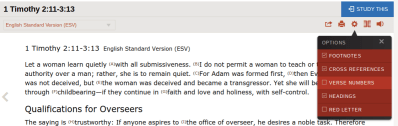
Now read the 1 Timothy passage, noting the flow of thought and how the end of chapter 2 is interconnected with chapter 3. What is the main idea of this passage? (OK, now click the verse numbers back on. :0)

What is the first word of verse 11? Think about women’s social status and value in Paul and Timothy’s culture, and in many cultures since that time, even today. Why does the Holy Spirit instruct pastors to “let” women learn? What does this teach us about the responsibility God places on us as women to learn His Word? Would you categorize verse 11 as a “do this” or “don’t do this” verse?

Examine verse 12. Is this mainly a “do this” or “don’t do this” verse? What two things does the Holy Spirit say women are not to do in the gathering of the church body? What does He say womenย are to do? Think about God’s nature and character. Does He ever give instructions arbitrarily or just to spoil our fun?ย Whyย does God give us commands and instructions, generally speaking? Are the instructions in verse 12 good for women and for the church?

Does God haveย to give us the reasons behind His instructions, or is “because I said so” sufficient reason for us to obey Him? Take a look at 13-14. God kindly gives not one, but two reasons for His instructions in verses 11-12. What are those two reasons? How do they fall in line with God’s design for male headship and leadership across biblical history in the hierarchical structures He has set up?

The 11-15 passage starts with a “do this” verse (11), followed by a “don’t do this” (12) “and here’s why” (13-14) section, then finishes up with another “do this” verse (15).

Verse 15 can be a little cryptic to us today because we equate the word “saved” with salvation. Does verse 15 mean that women gain salvation by having children? How do we know it doesn’t? The NASB helpfully, and more accurately, renders this word as “preserved“. We don’t feel it much today, but think about the stigma women (particularly Jewish women) carried at the time this was written simply because they were daughters of Eve. Paradise was lost and the curse of sin entered the world because of aย woman, many men thought, and they viewed and treated women accordingly. Yet who was chosen to bring the Messiah into the world? And following in her footsteps, a major way godly women can “save” or “preserve” the reputation, esteem, and value of womankind is to “continue in” what 3 godly character traits? (15) Because if they continue in those three godly character traits, they will be raising up a godly seedย to the Lord (even if the children they bear aren’t perfect like Mary’s child was :0)

So we’ve seen the position womenย are to occupy in the church, followed by the positions womenย aren’t to occupy, and that’s followed, in the 1 Timothy 3 and Titus 1 passages by the p_____s m__ are to o____.

According to the 1 Timothy 3 and Titus 1 passages, which positions are men to occupy in the church? What is an overseer? (Use your cross-references if necessary.) Go through these two passages circling any words or phrases that indicate that pastors, elders, and deacons are to be men. Are these positions open to all men in the church?

Examine each of the three sections (1 Timothy 3:1-7, 3:8-13, and Titus 1:5-9) individually. How could the wife of a pastor, elder, or deacon help him, or make things easier for him, to meet the biblical requirements for his office? (Ex: How could a pastor’s wife make it easier for him to be hospitable?)


Homework

If you’d like to dig deeper on some of these passages, you may enjoy reading the following articles from myย Rock Your Role series:

All Things Being Equal (Galatians 3:28)

Order in His Courts: Silencing Women? (1 Corinthians 14:33b-35)

Jill in the Pulpit (1 Timothy 2:11-12)


Suggested Memory Verse

There is neither Jew nor Greek, there is neither slave nor free, there is no male and female, for you are all one in Christ Jesus.
Galatians 3:28


Favorite Finds

Favorite Finds ~ January 14, 2019

Here are a few of my favorite recent online findsโ€ฆ

It’s a few years old, but this excellent episode of theย Issues, Etc. radio show:ย This Week in Pop-American Christianity: Priscilla Shirer on Hearing the Voice of God recently came across my news feed. Many false teachers (in this case, Priscilla Shirer)ย twist or misunderstand John 10 to mean that, if you’re a Christian, God will speak to you audibly. That’s not what it means, as anyone who takes the time to read the passage in context can attest. Pastor and podcasterย Chris Rosebroughย explains simply, carefully, and biblically, why this teaching is wrong and what John 10 actually means.


“I get dozens of emails each month from parents whose teens are leaving the church or being swept away by a false version of Jesus and the gospel…In this list Iโ€™ve compiled ten critical topics for the modern teen.” Great for youth directors and parents of teens, but the adults in your church probably need to read this too. Check out Ten Theological Topics for Parents of Modern Teens by our friend Costi Hinnย on his blog,ย For the Gospel.

 

Pornography is usually addressed as a “men’s problem”, but, increasingly, women are succumbing to this insidious temptation. Stephanie offers pastors three suggestions (these would be helpful for anyone) for counseling and discipling women who participate in the sin of pornography in her 9Marks articleย Helping Women Who Struggle with Pornography.

 

Thoroughly and knowledgeably written by Denny Burk (head of CBMW),ย What Does It Mean That Women Should โ€œRemain Quietโ€ in Church? (1 Timothy 2)ย from Crosswayย is one of the best commentaries I’ve ever read on 1 Timothy 2:11-14. I’ve added it as a resource to my own article on that passage:ย Rock Your Role: Jill in the Pulpit.

 

Fasting mirrors the hunger we should have for Christ. Do Christians Fast Because Food and Drink Are Bad? fromย Crosswayย explains more.

Top 10

Top 10 Articles of 2018

I always enjoy the annual “year in review” articles and TV shows that run in abundance in late December, so I thought I’d contribute my own. Several Mailbag articles were among this year’s most popular, so I decided to make two separate lists, the Top 10 Mailbag Articles of 2018, and the top 10 non-Mailbag articles of 2018. Here are my ten most popular non-Mailbag blog articles from 2018:

Christine Caine: Have No Regard for the Offerings of Caine

Unfortunately, Christineโ€™s teachings and some of her actions do not meet even these basic biblical standards, and it is my sad duty to recommend that you not sit under her teaching for the following reasons…

Women Preaching: Itโ€™s Not a Secondary Doctrinal Issue

The violation of Godโ€™s command that women are not to instruct men in the Scriptures nor hold improper authority over men is a sin like any other. It is not a doctrinal issue in the same sense that other second and third tier doctrines are…ย 

Answering the Opposition:
Responses to the Most Frequently Raised Discernment Objections

There are also occasional comments and messages from women who are disciples of the false teachers I warn against, who take me to task for doing so. The same unscriptural accusations are raised again and again against me and against others who take a biblical stand against false teachers and false doctrine. Here, in no particular order, are the most frequently raised objections to my discernment work and my answers to them…

A Naked Emperor in the Southern Baptist Convention

And so the โ€œemperorโ€ of leadership in the Southern Baptist Convention and those who carry its train march proudly on, despite the cries of simple peasants and innocent little children crying at the top of our lungs, โ€œThe emperor is naked!โ€ โ€œThere are issues that need to be addressed, here!โ€ โ€œListen to us!โ€…

Women and False Teachers:
Why Men Donโ€™t Get It, and Why Itโ€™s Imperative That They Do

Thereโ€™s at least one biblical issue women respond to differently at the core level of their spiritual DNA than men do. And men, itโ€™sย crucialย that you get it on this one. Youโ€™re the pastors. The elders. The husbands. The fathers. The ones responsible before God for leading your churches and your families in doctrinally sound spiritual growth. Youโ€™ve got to get this for the sake of the girls and women you lead…

ย A Few Good Men: 10 Doctrinally Sound Male Teachers

Let me introduce you to a few of my favorite male authors of Bible studies
and other great Christian books and resources…

ย 10 Biblically Sound Blogs and Podcasts by Christian Women

False teachers. You canโ€™t throw a rock out the windowย these days without hitting one. But are there any โ€œgood guysโ€ out there who are getting it right? Discipleship, Bible study,and theological issues bloggers who rightly divide Godโ€™s word? You bet…

Five Reasons Itโ€™s Time to Start Exercising โ€œMooreโ€ Discernment

This is not a request for you to believe me or agree with my personal opinion. Iโ€™m asking you to take a discerning look at the evidence and compare with Scripture what Beth Moore is currently doing and teaching. If you do, I think it will be obvious to you that, whatever she may have taught in the past, something is seriously wrong now…

Going Beyond Scripture:
Why It’s Time to Say Good-Bye to Priscilla Shirer and Going Beyond Ministries

Should she repent in these areas in which she has broken Scripture and align herself with biblical principles, she would have no bigger fan than I, and I would rejoice to be able to point Christian women to her as a doctrinally sound resource. Until that time, however, it saddens me to have to recommend that Christian women not follow Priscilla Shirer or any materials or activities from Going Beyond Ministries for the following reasons…

Leaving Lysa:
Why You Shouldn’t Be Following Lysa TerKeurst or Proverbs 31 Ministries

For these reasons, plus her habitual mishandling of Scripture, unfortunately, I must recommend that women not follow, support, or receive teaching from Lysa TerKeurst or Proverbs 31 Ministries(including any writers or speakers affiliated with Proverbs 31 Ministries)…

What was YOUR favorite article of 2018?

Podcast Appearances

Theology. Driven. Podcast Guest Appearance: Beth Moore, the SBC, and Christian Women


I had an awesome time, recently, chatting with Kevin, Scott, and James from theย Theology. Driven. podcast. What an honor to be their first ever female guest! We covered a variety of topics: what to do if your church is hosting a Beth Moore study, my background in writing and teaching ministry, the Southern Baptist Convention’s slouching toward egalitarianism, studying the Bible without using Bible study books…and more!

Click here to listen.

Theology. Driven. is also offering a special giveaway in connection with my episode. If you tweet a link to the episode (or re-tweet a post about the episode such asย this one) and include the hashtagย #MichelleTheologyDriven, you’ll be entered into the drawing. Listen all the way to the end of the episode to find out all the details.

Give this episode a listen, and share it around! You can subscribe to Theology. Driven. on iTunes, Google Play, Overcast, and Podbean, or just listen online at theย Theology. Driven. websiteย (episode 27). And don’t forget to follow Theology. Driven. on Facebook and Twitter!

Resources mentioned on the podcast:

How should I approach my church leaders about a false teacher theyโ€™re introducing?

Five Reasons Itโ€™s Time to Start Exercising โ€œMooreโ€ Discernment

(Information on the theological problems with Beth Moore. For information on others, please see the “Popular False Teachers” tab at the top of this page.)

Is the SBCโ€™s Tent Big Enough for ALL Marginalized Christianย Women?

Speaking Engagement Information


Got a podcast of your own or have a podcasting friend who needs a guest? Need a speaker for a womenโ€™s conference or church event? Click the โ€œSpeaking Engagementsโ€ tab at the top of this page, drop me an e-mail, and letโ€™s chat!

Christian women, Complementarianism, Mailbag

The Mailbag: Is it biblical for women to carry out The Great Commission?

Last week, I received some questions from a Facebook follower regarding my article Basic Training: The Great Commission. I thought they were very insightful and that other readers might have the same questions, so I’m sharing and expanding on my answers to her here. (I’ve edited/condensed the reader’s questions and comments {in bold type} for the sake of brevity.)

Given my understanding of what Jesus is commanding, and comparing it with other examples in the New Testament, it’s not for women to do the Great Commission. Our role is not to make disciples, teach, or baptize, but to keep the home, edify other women believers, etc. The Great Commission is for men, not women, to do because…

1. The Great Commission requires teaching and baptizing.

2. Jesus was speaking the Great Commission to His disciples, who were all male.

3. We don’t see any specific New Testament examples of women sharing the gospel with the lost through their own witness or example.

4. Because we don’t see any specific New Testament examples of women sharing the gospel or any explicit commands for women to share the gospel, it violates the regulative principle for women to share the gospel with the lost.

This reader’s questions really got me thinking and digging. I love questions that make me think hard and dig into Scripture and theology for answers!

First, let me briefly address the points of this issue that are not in dispute. As I understand her, the reader is in full agreement with Titus 2:3-5 and the example of Lois and Eunice. She agrees with the biblical principles of women training their own children in the gospel and discipling Christian women (already saved) inside the church. Her questions have mainly to do with sharing the gospel with the lost outside the church – evangelism.

Next, before we dive into the reader’s questions themselves, it is very important to distinguish between two types of Scripture:

Broadly speaking, there are two main types of Scripture: descriptive and prescriptive. Descriptive passages describe something that happened: Noah built an ark. Esther became queen. Paul got shipwrecked. These passages simply tell us what happened to somebody. Prescriptive passages are commands or statements to obey. Donโ€™t lie. Share the gospel. Forgive others.

If we wanted to know how to have a godly marriage, for example, we would look at passages like Ephesians 5:22-33, 1 Corinthians 7, and Exodus 20:14,17. These are all passages that clearly tell us what to do and what not to do in order to have a godly marriage.

What we would not do is look at Davidโ€™s and Solomonโ€™s lives and conclude that polygamy is Godโ€™s design for marriage. We would not read about Hosea and assume that God wants Christian men to marry prostitutes. We would not read the story of the woman at the well and think that being married five times and then shacking up with number six is OK with Jesus.

Descriptive passages may support, but never trump, the clear instruction of prescriptive passages.ยน

Now, let’s see if we can come to some biblical conclusions on her questions:

1. The Great Commission requires teaching and baptizing.

Teaching:
Often, when we’re looking at women’s roles in the church and being obedient to 1 Timothy 2:12, people conflate evangelism with teaching. Teaching Scripture to saved people inside the church gathering is not the same thing as sharing the gospel with lost people outside the church gathering. They are two separate, distinct things. First Timothy 2:12 (and other prohibitive passages) only prohibits the former, not the latter. The Great Commission, and the New Testament overall, commands the latter.

Teaching Scripture to saved people inside the church gathering is not the same thing as sharing the gospel with lost people outside the church gathering. They are two separate, distinct things.

As Christian women we want to be sure we keep these two things straight and carry out The Great Commission in the way God has prescribed for women to carry it out. May we share the gospel with a lost man or woman “as we are going”? Yes. If that person is a man, once he is saved is it biblically appropriate for a woman to teach and disciple him? No. If he is saved, he is supposed to be joined to a local church. Once inside the church body, he is to be taught Scripture and discipled by men.

As Christian women we want to be sure we keep teaching and evangelism straight and carry out The Great Commission in theย way God has prescribed forย *women* to carry it out.

Here are some resources which may be of further help:

Rock Your Role: Jill in the Pulpit

Rock Your Role FAQs (see #11 for using wisdom on sharing the gospel with men)

Basic Training: 7 Reasons Church is Not Optional and Non-Negotiable for Christians

Women Preaching the Gospel? at A Word Fitly Spoken (This is sort of the opposite {and unbiblical} argument: “Because the Bible says ‘preach the gospel’ -meaning, we’re to evangelize- that means women can preach in church, too!”. I thought you might find it interesting.)

Baptism:
When it comes to teaching inside the church, we have clear, prescriptive passages that specifically tell us what women are not to do. With evangelism, we also have clear commands in The Great Commission, and elsewhere, that disciples of Christ are to share the gospel.

But when it comes to baptism, we don’t have a clear “this or that person should or should not perform baptisms” passage, so we need to look at the principles and precedents surrounding baptism.

The people specifically named as personally performing baptisms in the New Testament were John the Baptist (who baptized Jesus), the twelve apostles, Philip the Evangelist, Paul and/or Silas, and Paul. All of these were men, and all held pastoral or pastoral/elder-type formal leadership positions in the embryonic or infancy stages of the church. All of them were commissioned, ordained, or set apart to their positions by God, Jesus, or the church. We do not see any New Testament instances of random church members – male or female – performing baptisms, only those in positions of church leadership.

Additionally, baptism is a formal, official, consecrated ordinance of the church, not a casual, personal, relational activity between individuals, friends, or loved ones. It should no more be administered by any church member who wants to do it than the Lord’s Supper should be. Both ordinances should be administered by an ordained pastor or elder of the church. That leaves out women as well as most men. Does the responsibility of pastors to baptize mean that men who aren’t pastors shouldn’t carry out the Great Commission? Of course not. We – men and women – share the gospel with someone, and if that person gets saved, part of our responsibility is to do what we can to get him plugged in to a local church where a pastor can baptize him. We don’t have to baptize him ourselves in order to be fulfilling The Great Commission.

Basic Training: Baptism

2. Jesus was speaking the Great Commission to His disciples, who were all male.
Yes, they were all male. They were all apostles, too. But first and foremost, they were all disciples – followers of Christ – just as Christians are today. Our identity in Christ – who we are, spiritually – trumps what we are, physically (male or female), and what we do (different roles and behaviors) as a result of who and what we are. Galatians 3:28 tells us:

There is neither Jew nor Greek, there is neither slave nor free, there is no male and female, for you are all one in Christ Jesus.

In Christ, there is only one type of being: Christian. There is only one kind of spiritual DNA. There’s no XX and XY. There’s just X. Ontologically, Christians are all the same kind of spiritual being.

The Great Commission is based on who the disciples, and we, are – followers of Christ – just as many of the other things that Jesus taught His disciples were. For example, when the disciples said, “Lord, teach us to pray,” and Jesus responded with the Lord’s Prayer, did Jesus mean that only the Twelve, or only men should use it as their model in prayer? When Jesus washed the disciples’ feet, did He mean that only the disciples or only men should serve one another in humility? When Peter asked Jesus how many times he had to forgive, did “seventy times seven” apply only to Peter, only to the disciples, or only to men? Of course not. Christ’s instructions to His followers apply to all who follow Him. It is in the way in which we carry these instructions out that Christ differentiates and delegates divergent and discrete responsibilities to men, women, and church leadership.

As disciples, we are to carry out The Great Commission. As Christian women, we carry it out in a different way from men and pastors.

As disciples, we are to carry out The Great Commission. As Christian women, we carry it out in a *differentย way* from men and pastors.

3. We don’t see any specific New Testament examples of women sharing the gospel with the lost through their own witness or example.
We don’t see any specific verses that say something along the lines of “Miriam shared the gospel with Simon, and he got saved,” that’s true. But how about these…

โœขThe woman at the well in John 4: “So the woman left her water jar and went away into town and said to the people, ‘Come, see a man who told me all that I ever did. Can this be the Christ?’ They went out of the town and were coming to him.” (28-30)

โœขThe widow (and townswomen) of Nain in Luke 7: “Fear seized them all, and they glorified God, saying, ‘A great prophet has arisen among us!’ and ‘God has visited his people!’ And this report about him spread through the whole of Judea and all the surrounding country.” (16-17)

โœขThe friends of Tabitha in Acts 9: ” And he gave her his hand and raised her up. Then, calling the saints and widows, he presented her alive. And it became known throughout all Joppa, and many believed in the Lord.” (41-42)

โœขLydia in Acts 16: “The Lordย opened her heart to pay attention to what was said by Paul.ย And after she was baptized,ย and her household as well…” (14-15)

โœข1 Corinthians 7:12-16: “If any woman has a husband who is an unbeliever, and he consents to live with her, she should not divorce him. For the unbelieving husband is made holy because of his wife…For how do you know, wife, whether you will save your husband?”

โœข1 Peter 3:1-6: “Likewise, wives, be subject to your own husbands, so that even if some do not obey the word, they may be won without a word by the conduct of their wives.”

The first four examples imply that various women, to one degree or another, were pointing people to Jesus. But, again, these are descriptive passages. They lend a bit of support to the idea of women sharing the gospel with others, but we build doctrine on prescriptive passages like The Great Commission. The last two examples are prescriptive passages instructing women in sharing the gospel with their lost husbands. These passages are supportive of women sharing the gospel.

4. Because we don’t see any specific New Testament examples of women sharing the gospel or any explicit commands for women to share the gospel, it violates the regulative principle for women to share the gospel with the lost.
Well, as I mentioned above, we do see descriptive passages that at least hint at women sharing the gospel, and we also see prescriptive passages that explicitly instruct women in sharing the gospel with their lost husbands. But The Great Commission and other passages that are general commands to all followers of Christ to share the gospel are the strong and emphatic passages we draw doctrine from, not the more tangential passages. So even if the regulative principle did apply to evangelism, it would be supported by Scripture.

But the regulative principleย doesn’tย apply to evangelism as the full terminology – the regulative principle of worship – helps us to understand. The regulative principle applies to the corporate worship service, not evangelism, not marriage, not finances, not employment, not parenting, nor any other biblical issue. Just corporate worship.

Are women to carry out The Great Commission? Yes. We are to carry it out in the way Christ has prescribed for godly Christian women.

Are women to carry out The Great Commission? Yes. We are to carry it out in the way Christ has prescribed for godly Christian women.


ยนRock Your Role: Oh No She Di-int! Priscilla Didnโ€™t Preach, Deborah Didnโ€™t Dominate, and Esther Wasnโ€™t an Egalitarian

If you have a question about: a Bible passage, an aspect of theology, a current issue in Christianity, or how to biblically handle a family, life, or church situation, comment below (Iโ€™ll hold all questions in queue {unpublished} for a future edition of The Mailbag) or send me an e-mail or private message. If your question is chosen for publication, your anonymity will be protected.