Wednesday's Word

Wednesday’s Word ~ Galatians 1

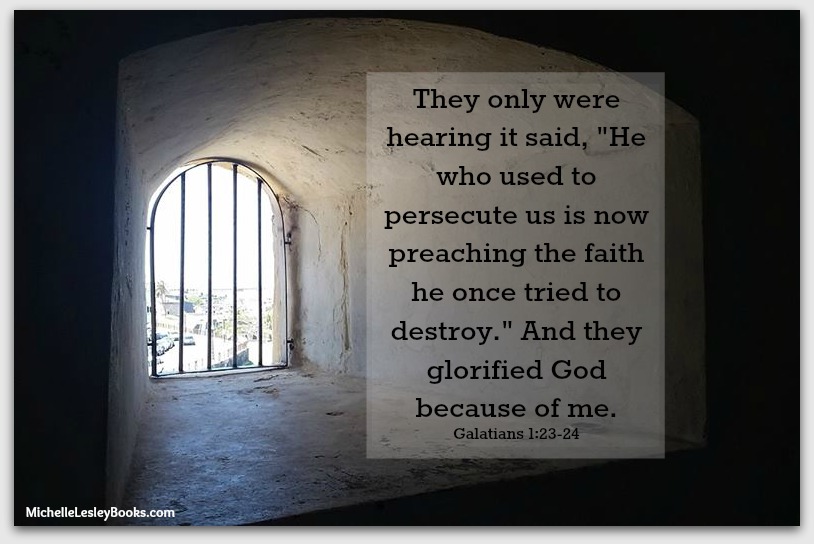
gal 1 23 24


Galatians 1

Paul, anย apostleโ€”not from men nor through man, butย through Jesus Christ and God the Father,ย who raised him from the deadโ€”ย 2ย and allย the brothersย who are with me,

Toย the churches of Galatia:

3ย Grace to you and peaceย from God our Father and the Lord Jesus Christ,ย 4ย who gave himself for our sins to deliver us from the presentย evil age, according to the will ofย our God and Father,ย 5ย to whom be the glory forever and ever. Amen.

6ย I am astonished that you areย so quickly desertingย him who called you in the grace of Christ and are turning toย a different gospelโ€”ย 7ย not that there is another one, butย there are some who trouble you and want to distort the gospel of Christ.ย 8ย But even if we orย an angel from heaven should preach to you a gospel contrary to the one we preached to you,ย let him be accursed.ย 9ย As we have said before, so now I say again: If anyone is preaching to you a gospel contrary to the one you received,ย let him be accursed.

10ย For am I now seeking the approval of man, or of God? Or am I tryingย to please man? If I were still trying to please man, I would not be aย servantย of Christ.

11ย Forย I would have you know, brothers, thatย the gospel that was preached by me is not man’s gospel.12ย For I did not receive it from any man, nor was I taught it, but I received itย through a revelation of Jesus Christ.ย 13ย For you have heard ofย my former life in Judaism, howย I persecuted the church of God violently and tried to destroy it.ย 14ย And I was advancing in Judaism beyond many of my own age among my people, so extremelyย zealous was I forย the traditions of my fathers.ย 15ย But when heย who had set me apartย before I was born,ย and whoย called me by his grace,ย 16ย was pleased to reveal his Son toย me, in orderย that I might preach him among the Gentiles, I did not immediately consult with anyone;ย 17ย nor did I go up to Jerusalem to those who were apostles before me, but I went away into Arabia, and returned again to Damascus.

18ย Thenย after three years I went up to Jerusalem to visit Cephas and remained with him fifteen days.19ย But I saw none of the other apostles except Jamesย the Lord’s brother.ย 20ย (In what I am writing to you,before God, I do not lie!)ย 21ย Then I went into the regions of Syria and Cilicia.ย 22ย And I was still unknown in person toย the churches of Judea that are in Christ.ย 23ย They only were hearing it said, โ€œHe who used to persecute us is now preaching the faith he once tried to destroy.โ€ย 24ย And they glorified God because of me.


The Holy Bible, English Standard Version Copyright ยฉ 2001 by Crossway Bibles, a division of Good News Publishers.


Questions to Consider:

1. Who called Paul to be an apostle, and by whose authority does he address the churches at Galatia? (1-3)

2. The Galatian churches (6-9) were being drawn away from the gospel by the Judaizers, who insisted that the new Gentile Christians could not be saved unless they were alsoย circumcised, observed Jewish law, feasts, festivals, etc. Why did Paul call the Judaizers’ ideas “another gospel”? What did Paul indicate would be the Judaizers’ fate? (8,9) Why would God be so harsh with these false teachers?

3. What are some ways false teachers today try to add requirements to the gospel (repent of your sin and place your faith in Christ’s death, burial, and resurrection as payment for your sin, and you will be saved)? Does God take false teaching as seriously today as He did in Paul’s time?

4. In verse 10, whose approval is Paul seeking by saying the things he said in verses 1-9? Why does he say he wouldn’t be serving Christ if he were trying to please men?

5. How did Paul learn the gospel? (12) What was the purpose of his three years in Arabia and Damascus (17)? What point is Paul trying to make to the Galatians by telling them the things in verses 11-24? (Hint- Read through Galatians 2:2)

Christian women, Guest Posts, Parenting

Avoiding the Creepers: Six Ways to Raise a Biblically Strong Woman

But understand this, that in the last days there will come times of difficulty. For people will be lovers of self, lovers of money, proud, arrogant, abusive, disobedient to their parents, ungrateful, unholy, heartless, unappeasable, slanderous, without self-control, brutal, not loving good, treacherous, reckless, swollen with conceit, lovers of pleasure rather than lovers of God, having the appearance of godliness, but denying its power. Avoid such people. For among them are those who creep into households and capture weak women, burdened with sins and led astray by various passions, always learning and never able to arrive at a knowledge of the truth. 
2 Timothy 3:1-7

If someone were to ask you, โ€œWhat kind of person do you want to raise your daughter to be?โ€ how would you answer? Caring? Independent? Loyal? Kind?

Iโ€™m betting none of us would answer โ€œweak,โ€ โ€œburdened with sins,โ€ โ€œeasily led astray by her passions,โ€ or โ€œunable to arrive at a knowledge of the truth.โ€ Yet in these last days in which we find ourselves, thatโ€™s exactly what many good-hearted Christian mothers with nothing but the best of intentions are raising their daughters to be. Itโ€™s not that they want their daughters to grow up to be spiritually weak or led astray by sin or unbiblical teaching, itโ€™s just that they lack the skills and tools necessary for properly training their daughters in the Scriptures and godliness.

Maybe youโ€™re one of those moms. You want to train your daughter to be a wise, godly, discerning woman, but youโ€™re not quite sure how. Hey, we all have those areas of our lives that we need a little help with. As an older mom myself, maybe I can lend a hand.

My daughter is almost twenty, and while sheโ€™s nowhere near perfect, by the grace of God, she is a godly young lady. Looking back, there are many things my husband and I did wrong as parents. But God, in His mercy, covered our failures and saw all of us through as He taught us through His word how to raise a biblically strong woman.

6 Ways to Raise a Biblically Strong Woman

1. Set an example.

Our daughters learn by watching us. Faithfully study your Bible, pray, attend church, obey Godโ€™s word, submit to your husband, repent and ask forgiveness when you sin, and serve others and your church together.

2. Learn, and teach your daughter, good hermeneutics.

Hermeneutics is just a fancy word for rightly handling Godโ€™s word. Use a reliable Bible translation. Understand Scripture in its immediate and overall context. What was the authorโ€™s intended meaning, his audience, genre, and culture? Point your daughter to Christ as you study Godโ€™s word together.

3. Find a doctrinally sound church, join it, and attend faithfully as a family.

Study Godโ€™s word and compare everything thatโ€™s preached and taught to Scripture (in context). Does your churchโ€™s teaching line up? Then be committed to attending every single week, not just when you feel like it or when thereโ€™s nothing better to do. Instill in your daughter a love for, and a commitment to, the church.

4. Fight the fluff.

Unfortunately, many of the most popular preachers, teachers, and Christian authors (including womenโ€™s Bible study authors) teach and write things that may sound good and make us feel good, but are in direct conflict with Scripture. These are the very people Paul was speaking of in 2 Timothy 3. Teach your daughter to follow only trustworthy teachers whose theology is in line with Scripture.

5. Bring prayer and Scripture into every situation.

She canโ€™t find her favorite doll? Kids picking on her at school? She wants to wear clothes that barely cover her? Discuss what the Bible say about these things. Pray together about them. Lead your daughter into prayer and Scripture as part of daily life, and it will teach her that God is to have authority over every aspect of our lives and that we are to obey Him in all things.

6. Teach her how to share the gospel.

If youโ€™re not sure how to properly present the gospel to someone, learn. You canโ€™t lead your daughter to Christ if you canโ€™t share the gospel with her. If your daughter is already saved, make sure she knows how to share the gospel correctly. The Great Commission was the last instruction Christ gave us before leaving earth, and we are all to be about the business of carrying it out until He returns.

The 2 Timothy passage at the beginning of this article is our commission to guard our households against ungodly ways and people โ€“ even those who may falsely call themselves Christians โ€“ who might creep in and steal our daughtersโ€™ hearts and minds away from Christ. He has charged us to train them in godliness, and we must faithfully answer His call to raise wise, discerning, and biblically strong women of God.

What advice would you offer moms who want to raise
biblically strong women?


This article was originally published at Kaylene Yoder’s Blog.

And for all you boy moms, be sure to check out…

Six Ways to Raise a Godly Man

Church

Axiom Questions, I’ll Tell You No Lies

axiomsWhy do churches do church the way churches do church?

Ever thought about that? Moreover, have you ever thought about why churches take for granted that they haveย to do certain things or do things a certain way? Is there an unspoken assumption at your church that you haveย to have a sermon outline in the bulletin (or for that matter, that you haveย to have a bulletin), that Vacation Bible School is a non-negotiable event, or that the deacons absolutely must wear ties when serving the Lord’s Supper? Has it gone on for so long that now “it goes without saying”?

Don’t get me wrong- sermon outlines and bulletins can be very helpful, VBS is a great outreach, and I’m in favor of more men wearing ties to church, period. And I’m not talking about irrefutable biblical truths, either, such as, “faith in Christ is the only way of salvation,” or “God created the world,” or “women are not to instruct or hold authority over men in the church.” What I’m trying to get at here is that there are lots of church practices, preferences, and philosophies that we take as axiomatic. We never question them. We just assume they’re true. We act on them as though they’re immutable laws of physics or something. And every once in a while, somebody notices this and wants to change things up.

When it’s an axiom that’s been around for a few decades, the people who hold to that particular ideal are often chided (sometimes deservedly, sometimes not) by those who are pressing for changes. They’re called “inflexible” or “enslaved to tradition.” They’re labled as the “We’ve never done it thatย way before,” or “We’ve always done it thisย way,” people.

But have we ever stopped to think that, in many cases, the changes people seek to make today are the outmoded preferences of tomorrow? Often, we’re not making the church better or more biblical, we’re just adding a new premise here or trading one axiom for another there. Like rearranging deck chairs on a cruise ship. Or the Titanic.

Let’s take a look at some of those new axioms that have materialized over the last couple of decades and are now assumed to be a “given” when it comes to ecclesiology.

1. Pastors need to “cast vision,” and churches need a vision/mission statement.
No, they don’t. Christ is the head of the church, the CEO, if you will. Therefore, He is the only one whose place it is to have a vision for the church and to set a mission statement for it. And He has already done that for us. It was one of the last items on His agenda before leaving earth. It’s called the Great Commission:

And Jesus came and said to them, โ€œAll authority in heaven and on earth has been given to me. Go therefore and make disciples of all nations, baptizing them in the name of the Father and of the Son and of the Holy Spirit, teaching them to observe all that I have commanded you. And behold, I am with you always, to the end of the age.โ€ Matthew 28:18-20

2. Churches have to be attractional.
Should you invite people to church? Absolutely. Should you be kind and welcoming to visitors? Of course. But that’s not what “attractional” means these days. Attractional means assimilating church into the culture so that lost people will think it’s a cool and groovy place and will flock through the door in droves. That’s why you see pastors coming out onto a stage and giving a Tonight Show-esque monologue while dressed like a teenager at a concert, churches playing music that sounds like what you hear on the radio (sometimes music that is on the radio) accompanied by bands that mimic whichever artist is popular at the moment, no choirs, no pews, no crosses, no pulpits, no hymnals, but a Starbucks in the lobby. Everything a sinner is used to in his daily life. Everything that will make him perfectly comfortable.

Where is this model of doing church found in the Bible? If you answered, “nowhere,” you’d be correct. The church, by definition, is made up of believers. Christ Himself is what is attractional to people who have genuinely been born again. And when we meet together, we have one purpose: to worship and grow in Him. The Bible never tells the church to make itself look like the world to bring lost people intoย the church. Christ tells us, believers, the church, to go outย and make disciples, to go out into the highways and byways and urge the lost to trust Christ so that His house might be filled…with believers.

3. Church should be fun.
Nope, not going to find that one in the Bible either. Worshiping Christ should bring us the deepest joy we can fathom, but that’s not the same thing as rock concert, bouncyย house, stand up comedian, outlandish props and gimmicks, music video back up dancers, cash and prizes giveaway, “fun”. Church should be joyful, welcoming, warm, and pleasant. It should also be reverent, solemn, and, often, serious. Worshiping Christ, handling and learning His word, partaking of communion and baptism– these are not frivolous things, and the climate of the church should reflect that.

4. When it comes to the size of a local church, bigger is not only better, but more spiritual.
I see articles from denominational leaders and church growth gurus all the time that start with the presupposition that if your church isn’t constantly growing until you’ve reached thousands in attendance and have to go multi-site, you need to get on that problem, pronto. Or that if your attendance numbers are “stuck” around the 200 or 300 mark, it’s a crisis that needs to be addressed. Pastor, you need to doย something about that. It’s assumed that you wantย to do something about that.

Says who? Says people who have made a lot of money selling church growth materials and want to make more, that’s who. The fact of the matter is, mega churches are the exception, not the rule. The average size of a church in the U.S. is 186 people, and 94% of church goers attend a church of under 500 members.

There are many perfectly legitimate and biblical reasons why a local church might be small. Smaller churches foster intimacy in fellowship, accountability in discipleship, and make it easier for pastors to shepherd individuals and small groups. Certainly, a church should welcome any newcomers wishing to join and should seek to minister to the surrounding community, but if zeal for the gospel is in place, there is no shame in being a small church.

5. Our worship music has to be contemporary.
Why? No, really. Why does it have to be pop-contemorary style? Because we’ll lose or fail to attract young people? First of all, there are plenty of young people who, believe it or not, like hymns and traditional worship music. Why aren’t we concerned about alienating them? What about the older people who like hymns? What about the young people who like country music, or classical music, or rap, or screamo, or death metal, or opera? How come we don’t cater to any of their musical preferences (assuming that’s the basis on which you choose the genre of worship music) during the worship hour?

Up until the early ’80’s or so, when you went to church, you expected to sing hymns out of a hymnal. There’s nothing wrong with adding new songs here and there to the church’s repertoire, but there is something wrong with trying to replicate what’s going on in the world in order to entice lost people into the church. When people go to a funeral they expect to hear funeral music. When they go to a fais do do they expect to hear Cajun music. And have you seen how incensed people get when somebody tries to put a fresh spin on the National Anthem? It’s perfectly all right for church music to sound churchy. We don’t need to apologize for that.

6. Leaving a church (or deciding not to join one) because you don’t like contemporary worship music is selfish, petty, and reeks of spiritual immaturity.
Really? I thought you just said we hadย to use contemporary music to get young people to join and keep them from leaving. Are they selfish, petty, and spiritually immature for having their music preference catered to? Why don’t they have to suck it up and sing hymns? Would you go to a church that used only a genre of music you hate, like rap or opera? Does that make you selfish, petty, and spiritually immature?

It’s time we stopped shaming people for wanting to leave a church that has changed to a genre of music or a worship style that they hate. There will be times in every church when a particular song (or maybe even several) is sung that you don’t like. That’s normal no matter which genre your church uses. But music is a huge part of our worship services, and if, even after making an effort to embrace the music, you are so distracted by the genre that you’re incapable of focus on Christ, you need to go to a church- a doctrinally sound one, mind you – where you can worship.

We make a lot of assumptions about the way we should do church. Maybe it’s time to start questioning some of them.

What are some other church axioms you’ve noticed?

Church, Complementarianism, Worship

Six Questions for a Potential Church

church questions1

Have you ever had to look for a new church? Even with recommendations from godly friends, it can be hard to know which churches and pastors are doctrinally sound, and, of those doctrinally sound churches (because you certainly don’t want to go to one that isn’t doctrinally sound), which ones would be a good fit for your family.

There are lots of great articles out there with good, probing questions you should ask about the theology and doctrine of a church you’re considering. (I would recommend this one, this one, and this one. Also, make sure you understand these doctrinal issues and that the church you’re considering lines up with Scripture on these issues.) However, there are times when the answers to these types of questions don’t give you the whole picture of what is actually going on in a church on a day to day basis. In other words, sorry to say, a church can give you all the right answers on paper (or on their web site), but their practices don’t mirror those answers. Additionally, there are some non-doctrinal issues that are important to know about that questions about soteriology, baptism, biblical inerrancy, etc., won’t give you the answers to.

My husband and I are currently looking for a new church for our family. Since we are Southern Baptist and somewhat familiar with the handful of Southern Baptist churches we’re looking at, we already know the answers to the most important questions (the inspiration of Scripture, the divinity of Christ, the way of salvation, etc.) But I want to zoom in a little more on the finer points of belief and practices of these churches, so here are some questions I might ask the pastor of the church we would potentially join.

1.
Which Christian authors have had the biggest impact on
your life, beliefs, and ministry?

When I ask this question (and look over the pastor’s shoulder at the titles on his bookshelf), I’m listening for the names of authors and pastors, living or dead, that I know are committed to sound biblical doctrine. If I hear a name like Joyce Meyer, TD Jakes, Andy Stanley, Steven Furtick, Perry Noble, Rick Warren, Beth Moore, or any Word of Faith or New Apostolic Reformation personality, I’m going back to ask more probing doctrinal questions. If I hear multiple names like those, I’m outta there.

2.
Are you/this church complementarian or egalitarian?

Now you may not be familiar with those terms but any Christian pastor should be. It is a current issue in evangelicalism, and it’s part of his job to stay abreast of such things. I’m not looking for a pastor to be an expert on this topic, but he should be familiar with the terms and have a working understanding of the issues at play as well as the applicable Scriptures, and he should embrace and practice complementarianism as the biblical position.

Because I have been given the right “on paper” answer to this question in the past only to find out later that the church’s practices didn’t match up with its profession, I will probably ask the follow up question: “In what positions of leadership are women currently serving? Do any of them hold authority over men or instruct men in the Scriptures?” If I hear that women are (or would be allowed to in the future) teaching co-ed adult Sunday School classes, giving instruction during the worship service, serving on committees in which they hold biblically inappropriate authority over men, etc., that’s problematic.

3.
Can you give me some examples, from any time during your career as a pastor, of church discipline issues that have arisen and how you have handled them?

I’m looking for three things here. First, what does this pastor think constitutes a church discipline issue? If he thinks it’s necessary to discipline a female church member for wearing pants instead of a skirt, that’s an issue, because he’s disciplining someone who’s not sinning. If he doesn’t think it’s necessary to discipline church members who are unmarried yet cohabiting, that’s an issue because he’s not disciplining people who are sinning. Church discipline should only be exercised over unrepentant sinful behavior.

Second, is he afraid to exercise church discipline? Generally speaking, someone who has been a pastor for many years and has never handled a church discipline issue is either woefully ignorant of the biblical requirement of a pastor to rebuke those in sin, or he is afraid to rock the boat because he might get fired. Both of these are huge red flags.

Third, how does he exercise church discipline? Does he follow the steps outlined in Matthew 18 and other Scriptures with a heart to see the church member repent and be reconciled to Christ and the church body? Is he harsh and condemning? Is he firm enough in his resolve to carry all the way through to disfellowshipping a church member if necessary?

4.
How much oversight do you (or an associate pastor or elder)
have over the women’s ministry at this church?

With this question, I’m trying to find out how much the pastor knows about what’s actually going on inside the women’s ministry (if they have one) and how much responsibility he takes to make sure all teaching and activities are in line with Scripture. Does he research and approve all teaching materials before a women’s Bible study commences? Does a women’s ministry director have complete autonomy over all materials and activities? Are all of the women in leadership positions in the women’s ministry godly and spiritually mature? Would any of the women’s ministry leadership raise a stink if someone showed them from Scripture that a Bible teacher whose materials they use or a women’s ministry activity they enjoy is unbiblical?

5.
Does the music ministry at this church follow a
minister of music model or a concert model?

There’s nothing wrong with Christian concerts per se, but my husband and I feel strongly (notice, I did not say “the Bible says”) that the worship service is not the place for one. We believe that a minister of music, preferably one who is ordained to the ministry, should lead and take responsibility for the church’s worship in a pastoral role. He should be trained in the Scriptures, preferably at seminary, in order to rightly handle and apply them to the music portion of the worship service and other music programs. He should also be trained in music theory and conducting so that he is able to lead in the practical aspects of music.

By contrast, we do not believe that making the music portion of the service like a concert, in which a band gets up and plays in a dark room with a laser light show and a smoke machine and the congregation can sing along if they want to, if they happen to know the songs, and if they are able to follow the ad libbing of the lead singer, is conducive to worship. We believe this tends to make the worship band into entertainers and the congregation into spectators, whereas the minister of music model fosters an atmosphere of “we’re all pulling together to do the work of worship as a unified body.”

This is not about contemporary music versus hymns, it is about one worship model versus another. It is our conviction (again, not a biblical mandate, but our strongly held conviction) after more than two decades in music ministry ourselves, that the minister of music model – regardless of the genre of worship music used – is the one most conducive to strong, biblical congregational worship. So this is something we’re going to want to know about, even though it is not necessarily a doctrinal issue.

6.
Do you preach topically or expositorily or both?

Topical preaching is when the pastor selects a topic to preach on (parenting, money, etc.) and uses biblical passages that apply to that topic to form his sermon. Pastors who preach expositorily usually preach through a book of the Bible from beginning to end before moving on to the next book.

Both are valid forms of preaching as long as God’s word is rightly handled and applied. However, it has been my experience that pastors who preach exclusively topically have more of a tendency to lift Bible verses out of their context in order to make them fit the topic they’re preaching. This is usually not as much of an issue for pastors who preach expositorily because they are simply preaching the Word, verse by verse, in its context.

Additionally, expository preaching gives church members a better understanding of Scripture and how it fits together, and exposes them more thoroughly to a wider range of biblical truth than exclusively topical preaching does. Therefore, I am looking for a pastor whose preaching style leans mostly towards expository, but who isn’t afraid to preach topically if he believes the church needs instruction on a certain topic.

So, those are some of the questions I’m thinking about asking. What questions would you ask when considering a new church?


For more resources on finding a new church, or what to look for in a church, click the Searching for a new church? tab in the blue menu bar at the top of this page.

Faith, Suffering

Six Reasons to Rejoice that Christ is Enough in Our Suffering

It seems like so many people are hurting these days. There are personal hurts that come our way like health issues and broken relationships. Many of us are hurting because we’re watching someone we love suffer- an adult child going through a divorce, an elderly relative with Alzheimer’s. And the birth pains the world is going through – ISIS murdering our brothers and sisters in Christ, the rampant filth and debauchery that’s flooding our own culture here in the U.S., and so much more – make it burdensome just to inhabit the planet. It’s no wonder so many of us are limping around in pain just trying to make it through. Everywhere we turn, it’s bad news.

But for those of us who are in Christ, there’s also good news. Good news that trumps any piece of bad news we could possibly receive.

Good news: It’s OK for you to feel sad or overwhelmed during difficult times.

I know that may sound obvious, but sometimes we need to be reminded. We’ve all heard stories about a person who received the diagnosis of some terminal disease with a smile and a “Praise the Lord!” We’ve all run into that lady whose hair could be currently on fire who would brush off our concerns for her with, “Honey, I’m too blessed to be stressed!” And if that’s genuinely the heart of those people, that’s great. They can be very inspiring.

But that doesn’t mean you’re any less of a Christian, or that you don’t trust God, if your doctor tells you that you have cancer and you fall apart. Or if you get that devastating news and you don’t bounce back right away.

Whether we realize it or not, there’s often a subtle pressure we church ladies put on ourselves to walk into God’s house and paste on a smile and pretend like these devastating things don’t bother us. We think that’s faith. We think that shows that we completely trust God. But is that what faith and trust really mean?

Whether we realize it or not, there’s often a subtle pressure we church ladies put on ourselves to walk into God’s house and paste on a smile and pretend like these devastating things don’t bother us.

Some of the greatest men and women of faith in the Bible were hurt deeply and mourned over that hurt.

God said David was “a man after God’s own heart,” yet look at so many of the Psalms he wrote, especially when he was running for his life from Saul.

I am weary with my moaning;
every night I flood my bed with tears;
I drench my couch with my weeping.
My eye wastes away because of grief;
it grows weak because of all my foes.
Psalm 6:6-7

Time and again, we see passages like that in David’s writings. God never rebukes him or tells him to just put on a happy face.

And what about Jesus? Remember the shortest verse in the Bible? In the story of Jesus raising Lazarus, John 11:35 says “Jesus wept.” The Bible doesn’t tell us precisely why He wept. Maybe it was for one of the same reasons we suffer- the personal pain of losing a loved one, the pain of watching Mary and Martha suffer, or the pain of experiencing a broken world where sin causes awful things like death and disease. But whatever the reasons for His pain, Jesus didn’t plaster on a fake smile and pretend everything was fine.

On the cross at Jesus’ moment of greatest anguish, when the weight of the sin of the world was bearing down on Him, and the wrath of God was being poured out on Him in all its fury, and Jesus was experiencing first hand that it was the will of God to crush Him, Jesus cried out from the depths of His soul, “My God, My God, why have You forsaken Me?”

David, Jesus, and so many other faithful men and women of God grieved. God’s people hurt sometimes, and that’s OK. You do not have to smile and pretend everything is OK when it’s not. It is OK to be sad when you’re hurting.

God’s people hurt sometimes, and that’s OK. You do not have to smile and pretend everything is OK when it’s not. It is OK to be sad when you’re hurting.

But the second piece of good news is this:

Good News: We may grieve, but we don’t “grieve as those who have no hope.” 

Because those of us who are truly born again believers have hope. And His name is Jesus. And He is enough. Jesus is enough for anything you’re going through.

If you watch “Christian TV” or read a lot of the books you’ll find in Christian bookstores by preachers with shiny teeth and even shinier hair, or, heaven help you, if you’re on Facebook, the message you will often hear about suffering is this:

“The pain you’re going through right now is nothing compared to the size of the blessing you’re about to receive.”

or

“It’s never God’s will for you to be sick or in lack. If you just have enough faith (and sow a seed into my ministry), God will bless you.”

or

“Your words create your reality. If you speak positive words (I’m wealthy, I’m successful, I’m healed), you will attract those positive things into your life. If you speak negative words, negative things will happen.”

So if you listen to these guys, in addition to the difficult circumstances that are going on in your life, you now have the pressure of “I’m still sick. I must not have enough faith.” or “Oh no, I accidentally spoke a negative word! I’m doomed to a life of poverty.” or “I thought my blessing was right around the corner. Why am I still suffering?”

Our hope is not found in “everything’s going my way” circumstances. Our hope is found in Christ, *regardless*ย of our circumstances.

Don’t believe those lies. God doesn’t promise any of that malarky in the Bible, because our hope is not found in “everything’s going my way” circumstances. Our hope is found in Christ, regardless of our circumstances. Your circumstances may not get better. You may get that terminal disease and die from it. Your husband who left you for another woman may never come back. Your baby might be born with a disability. Sometimes circumstances don’t get better, but Jesus gets only gets better and better with each passing day.

God never promised you “Your Best Life Now.” He promises you Christ. And Christ is enough. And you can rejoice in that.

God never promised you “Your Best Life Now.” He promises you Christ. And Christ is enough. And you can rejoice in that.

Why?

Because He knows what you’re going through.

Speaking of Jesus, Isaiah 53:3 says:

He was despised and rejected by men;
a man of sorrows, and acquainted with grief;
and as one from whom men hide their faces
he was despised, and we esteemed him not.

There’s nothing you can go through about which you can honestly say, “God doesn’t understand.” Jesus has been there. He knows what it’s like.

Why can you rejoice that Christ is enough?

Because He loves and cares for you more than you could ever imagine.

Jesus, King of Kings and Lord of Lords, left all his glory behind. For you. He lived a sinless life. For you. He endured being hated, mistreated, and misunderstood. For you. He was whipped, tortured, and humiliated. For you. He took the nails. He took your sin. He took the wrath of His Father. For you. And three days later, He got up out of the grave. For you.

Jesus loves you. He hurts when you hurt. He wants to be the one you run to and pour out your heart to when everything is falling apart so He can comfort you with His presence and His word. He wants you to “cast all your cares upon Him, because He cares for you.”

Why can you rejoice that Christ is enough?

Because the One who went through it all FOR you will walk through it all WITH you. And when you’re too weak to walk any more, He’ll carry you through it.

In Matthew 28:20, the Great Commission, Jesus says,

“I am with you always, to the end of the age.โ€

In Hebrews 13:5b, He says,

be content with what you have, for he has said, โ€œI will never leave you nor forsake you.โ€

Jesus isn’t going anywhere. He’s going to be right there with you no matter what.

Why can you rejoice that Christ is enough?

Because He sends you brothers and sisters in the faith to help you.

Church family is such a precious gift to us from Christ.

Matthew 25:36-40 is about the final judgment, and when Christ’s people stand before Him, He talks about how they have ministered to their brothers and sisters:

I was naked and you clothed me, I was sick and you visited me, I was in prison and you came to me.โ€™ Then the righteous will answer him, saying, โ€˜Lord, when did we see you hungry and feed you, or thirsty and give you drink? And when did we see you a stranger and welcome you, or naked and clothe you? And when did we see you sick or in prison and visit you?โ€™ And the King will answer them, โ€˜Truly, I say to you, as you did it to one of the least of these my brothers, you did it to me.โ€™

When we’re hurting, we allow our church family to minister to us because that is Christ’s gift to us. When we’re able, we turn around and minister to our church family out of love for Christ. We carry our brothers and sisters because Christ carries us.

Why can you rejoice that Christ is enough?

Because what He wants to do IN you is better than what you want Him to do FOR you.

You want Him to bring relief to a temporary problem. He wants to do the eternal in you- make you more like Christ. Romans 5:3-5 says:

we rejoice in our sufferings, knowing that suffering produces endurance, and endurance produces character, and character produces hope, and hope does not put us to shame, because God’s love has been poured into our hearts through the Holy Spirit who has been given to us.

We rejoice in our sufferings because, through them, God makes us more like Christ. And, as Christians, that’s our number one desire- to be like Him.

What Christ wants to do IN you is better than what you want Him to do FOR you.

Why can you rejoice that Christ is enough?

Because you have the hope of Heaven.

Some days the only thing that gets me through is knowing that this life with all its hurts and problems won’t last forever. One day all of this is going to be gone, and God is going to set everything right. In the scope of eternity, this life and the suffering we endure is so short. James says our lives are a “mist that appears for a little time and then vanishes.”

2 Corinthians 4:16-18 says:

So we do not lose heart. Though our outer self is wasting away, our inner self is being renewed day by day. For this light momentary affliction is preparing for us an eternal weight of glory beyond all comparison, as we look not to the things that are seen but to the things that are unseen. For the things that are seen are transient, but the things that are unseen are eternal.

Revelation 21:3-4:

And I heard a loud voice from the throne saying, โ€œBehold, the dwelling place of God is with man. He will dwell with them, and they will be his people, and God himself will be with them as their God. He will wipe away every tear from their eyes, and death shall be no more, neither shall there be mourning, nor crying, nor pain anymore, for the former things have passed away.โ€

Keep things in perspective by keeping your focus on the hope of Heaven.


If you are in Christ, you have every reason to rejoice in the Lord, even in suffering, because Christ is enough: He knows what you’re going through, He loves you, He’ll walk through it with you, He has given you church family to help, He’s making you more Christ-like, and because you have the hope of Heaven.

He is enough, so rejoice. Because if Christ isn’t enough, what is?

He is enough, so rejoice. Because if Christ isn’t enough, what is?