Christian women, Complementarianism, Mailbag

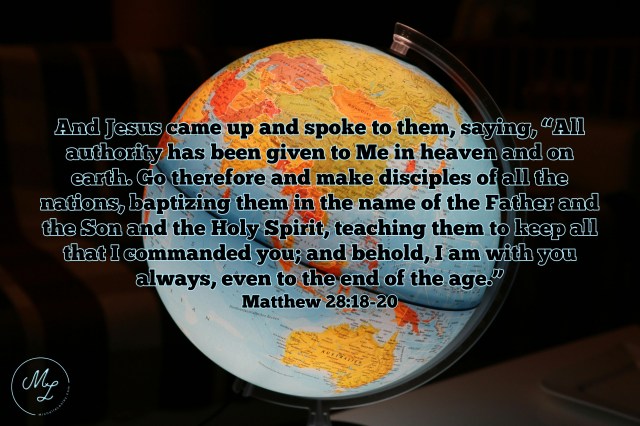
The Mailbag: Is it biblical for women to carry out The Great Commission?

Originally published June 18, 2018

Last week, I received some questions from a Facebook follower regarding my article Basic Training: The Great Commission. I thought they were very insightful and that other readers might have the same questions, so I’m sharing and expanding on my answers to her here. (I’ve edited/condensed the reader’s questions and comments {in bold type} for the sake of brevity.)

Given my understanding of what Jesus is commanding, and comparing it with other examples in the New Testament, it’s not for women to do the Great Commission. Our role is not to make disciples, teach, or baptize, but to keep the home, edify other women believers, etc. The Great Commission is for men, not women, to do because…

1. The Great Commission requires teaching and baptizing.

2. Jesus was speaking the Great Commission to His disciples, who were all male.

3. We don’t see any specific New Testament examples of women sharing the gospel with the lost through their own witness or example.

4. Because we don’t see any specific New Testament examples of women sharing the gospel or any explicit commands for women to share the gospel, it violates the regulative principle for women to share the gospel with the lost.

This reader’s questions really got me thinking and digging. I love questions that make me think hard and dig into Scripture and theology for answers!

First, let me briefly address the points of this issue that are not in dispute. As I understand her, the reader is in full agreement with Titus 2:3-5 and the example of Lois and Eunice. She agrees with the biblical principles of women training their own children in the gospel and discipling Christian women (already saved) inside the church. Her questions have mainly to do with sharing the gospel with the lost outside the church – evangelism.

Next, before we dive into the reader’s questions themselves, it is very important to distinguish between two types of Scripture:

Broadly speaking, there are two main types of Scripture: descriptive and prescriptive. Descriptive passages describe something that happened: Noah built an ark. Esther became queen. Paul got shipwrecked. These passages simply tell us what happened to somebody. Prescriptive passages are commands or statements to obey. Donโ€™t lie. Share the gospel. Forgive others.

If we wanted to know how to have a godly marriage, for example, we would look at passages like Ephesians 5:22-33, 1 Corinthians 7, and Exodus 20:14,17. These are all passages that clearly tell us what to do and what not to do in order to have a godly marriage.

What we would not do is look at Davidโ€™s and Solomonโ€™s lives and conclude that polygamy is Godโ€™s design for marriage. We would not read about Hosea and assume that God wants Christian men to marry prostitutes. We would not read the story of the woman at the well and think that being married five times and then shacking up with number six is OK with Jesus.

Descriptive passages may support, but never trump, the clear instruction of prescriptive passages.ยน

Now, let’s see if we can come to some biblical conclusions on her questions:

1. The Great Commission requires teaching and baptizing.

Teaching:
Often, when we’re looking at women’s roles in the church and being obedient to 1 Timothy 2:12, people conflate evangelism with teaching. Teaching Scripture to saved people inside the church gathering is not the same thing as sharing the gospel with lost people outside the church gathering. They are two separate, distinct things. First Timothy 2:12 (and other prohibitive passages) only prohibits the former, not the latter. The Great Commission, and the New Testament overall, commands the latter.

Teaching Scripture to saved people inside the church gathering is not the same thing as sharing the gospel with lost people outside the church gathering. They are two separate, distinct things.

As Christian women we want to be sure we keep these two things straight and carry out The Great Commission in the way God has prescribed for women to carry it out. May we share the gospel with a lost man or woman “as we are going”? Yes. If that person is a man, once he is saved is it biblically appropriate for a woman to teach and disciple him? No. If he is saved, he is supposed to be joined to a local church. Once inside the church body, he is to be taught Scripture and discipled by men.

As Christian women we want to be sure we keep teaching and evangelism straight and carry out The Great Commission in the way God has prescribed for *women* to carry it out.

Here are some resources which may be of further help:

Rock Your Role: Jill in the Pulpit

Rock Your Role FAQs (see #11 for using wisdom on sharing the gospel with men)

Basic Training: 7 Reasons Church is Not Optional and Non-Negotiable for Christians

Women Preaching the Gospel? at A Word Fitly Spoken (This is sort of the opposite {and unbiblical} argument: “Because the Bible says ‘preach the gospel’ -meaning, we’re to evangelize- that means women can preach in church, too!”. I thought you might find it interesting.)

Baptism:
When it comes to teaching inside the church, we have clear, prescriptive passages that specifically tell us what women are not to do. With evangelism, we also have clear commands in The Great Commission, and elsewhere, that disciples of Christ are to share the gospel.

But when it comes to baptism, we don’t have a clear “this or that person should or should not perform baptisms” passage, so we need to look at the principles and precedents surrounding baptism.

The people specifically named as personally performing baptisms in the New Testament were John the Baptist (who baptized Jesus), the twelve apostles, Philip the Evangelist, Paul and/or Silas, and Paul. All of these were men, and all held pastoral or pastoral/elder-type formal leadership positions in the embryonic or infancy stages of the church. All of them were commissioned, ordained, or set apart to their positions by God, Jesus, or the church. We do not see any New Testament instances of random church members – male or female – performing baptisms, only those in positions of church leadership.

Additionally, baptism is a formal, official, consecrated ordinance of the church, not a casual, personal, relational activity between individuals, friends, or loved ones. It should no more be administered by any church member who wants to do it than the Lord’s Supper should be. Both ordinances should be administered by an ordained pastor or elder of the church. That leaves out women as well as most men. Does the responsibility of pastors to baptize mean that men who aren’t pastors shouldn’t carry out the Great Commission? Of course not. We – men and women – share the gospel with someone, and if that person gets saved, part of our responsibility is to do what we can to get him plugged in to a local church where a pastor can baptize him. We don’t have to baptize him ourselves in order to be fulfilling The Great Commission.

Basic Training: Baptism

2. Jesus was speaking the Great Commission to His disciples, who were all male.
Yes, they were all male. They were all apostles, too. But first and foremost, they were all disciples – followers of Christ – just as Christians are today. Our identity in Christ – who we are, spiritually – trumps what we are, physically (male or female), and what we do (different roles and behaviors) as a result of who and what we are. Galatians 3:28 tells us:

There is neither Jew nor Greek, there is neither slave nor free, there is no male and female, for you are all one in Christ Jesus.

In Christ, there is only one type of being: Christian. There is only one kind of spiritual DNA. There’s no XX and XY. There’s just X. Ontologically, Christians are all the same kind of spiritual being.

The Great Commission is based on who the disciples, and we, are – followers of Christ – just as many of the other things that Jesus taught His disciples were. For example, when the disciples said, “Lord, teach us to pray,” and Jesus responded with the Lord’s Prayer, did Jesus mean that only the Twelve, or only men should use it as their model in prayer? When Jesus washed the disciples’ feet, did He mean that only the disciples or only men should serve one another in humility? When Peter asked Jesus how many times he had to forgive, did “seventy times seven” apply only to Peter, only to the disciples, or only to men? Of course not. Christ’s instructions to His followers apply to all who follow Him. It is in the way in which we carry these instructions out that Christ differentiates and delegates divergent and discrete responsibilities to men, women, and church leadership.

As disciples, we are to carry out The Great Commission. As Christian women, we carry it out in a different way from men and pastors.

As disciples, we are to carry out The Great Commission. As Christian women, we carry it out in a *different way* from men and pastors.

3. We don’t see any specific New Testament examples of women sharing the gospel with the lost through their own witness or example.
We don’t see any specific verses that say something along the lines of “Miriam shared the gospel with Simon, and he got saved,” that’s true. But how about these…

โœขThe woman at the well in John 4: “So the woman left her water jar and went away into town and said to the people, ‘Come, see a man who told me all that I ever did. Can this be the Christ?’ They went out of the town and were coming to him.” (28-30)

โœขThe widow (and townswomen) of Nain in Luke 7: “Fear seized them all, and they glorified God, saying, ‘A great prophet has arisen among us!’ and ‘God has visited his people!’ And this report about him spread through the whole of Judea and all the surrounding country.” (16-17)

โœขThe friends of Tabitha in Acts 9: ” And he gave her his hand and raised her up. Then, calling the saints and widows, he presented her alive. And it became known throughout all Joppa, and many believed in the Lord.” (41-42)

โœขLydia in Acts 16: “The Lord opened her heart to pay attention to what was said by Paul. And after she was baptized, and her household as well…” (14-15)

โœข1 Corinthians 7:12-16: “If any woman has a husband who is an unbeliever, and he consents to live with her, she should not divorce him. For the unbelieving husband is made holy because of his wife…For how do you know, wife, whether you will save your husband?”

โœข1 Peter 3:1-6: “Likewise, wives, be subject to your own husbands, so that even if some do not obey the word, they may be won without a word by the conduct of their wives.”

The first four examples imply that various women, to one degree or another, were pointing people to Jesus. But, again, these are descriptive passages. They lend a bit of support to the idea of women sharing the gospel with others, but we build doctrine on prescriptive passages like The Great Commission. The last two examples are prescriptive passages instructing women in sharing the gospel with their lost husbands. These passages are supportive of women sharing the gospel.

4. Because we don’t see any specific New Testament examples of women sharing the gospel or any explicit commands for women to share the gospel, it violates the regulative principle for women to share the gospel with the lost.
Well, as I mentioned above, we do see descriptive passages that at least hint at women sharing the gospel, and we also see prescriptive passages that explicitly instruct women in sharing the gospel with their lost husbands. But The Great Commission and other passages that are general commands to all followers of Christ to share the gospel are the strong and emphatic passages we draw doctrine from, not the more tangential passages. So even if the regulative principle did apply to evangelism, it would be supported by Scripture.

But the regulative principle doesn’t apply to evangelism as the full terminology – the regulative principle of worship – helps us to understand. The regulative principle applies to the corporate worship service, not evangelism, not marriage, not finances, not employment, not parenting, nor any other biblical issue. Just corporate worship.

Are women to carry out The Great Commission? Yes. We are to carry it out in the way Christ has prescribed for godly Christian women.

Are women to carry out The Great Commission? Yes. We are to carry it out in the way Christ has prescribed for godly Christian women.


ยนRock Your Role: Oh No She Di-int! Priscilla Didnโ€™t Preach, Deborah Didnโ€™t Dominate, and Esther Wasnโ€™t an Egalitarian

If you have a question about: a Bible passage, an aspect of theology, a current issue in Christianity, or how to biblically handle a family, life, or church situation, comment below (Iโ€™ll hold all questions in queue {unpublished} for a future edition of The Mailbag) or send me an e-mail or private message. If your question is chosen for publication, your anonymity will be protected.

Mailbag

The Mailbag: Potpourri (Cremationโ€ฆ ID-ing false teachersโ€ฆ Church membershipโ€ฆ Women translators)

Welcome to another โ€œpotpourriโ€ edition of The Mailbag, where I give short(er) answers to several questions rather than a long answer to one question.

I like to take the opportunity in these potpourri editions to let new readers know about my comments/e-mail/messages policy. Iโ€™m not able to respond individually to most e-mails and messages, so here are some helpful hints for getting your questions answered more quickly. Remember, the search bar (at the very bottom of each page) can be a helpful tool!

Or maybe I answered your question already? Check out my article The Mailbag: Top 10 FAQs to see if your question has been answered and to get some helpful resources.


I canโ€™t find any Scripture about cremation. Is this practice another pagan tradition Christians have accepted? I, myself was thinking itโ€™s okay, but now Iโ€™m unsure. Thanks.

Thank you so much for setting a super example for us all by a) wanting to do the godly thing about this, and b) searching the Scriptures to find your answer.

You didn’t find any Scriptures about cremation because Scripture doesn’t mention cremation, and there are no related biblical principles that directly indicate that we either should or shouldn’t participate in cremation. And, no, the way cremation is practiced today in Western culture, it is not a pagan practice. Therefore, cremation is an issue of adiaphora, or Christian liberty.

I think Todd Friel has done a good job of answering this question from his “burial is preferable” perspective…

…but I don’t find it compelling enough to move me from my “either way is fine with me” perspective, and I feel like some of the things he says are stretching it just a tiny bit. A few reasons:

  • In the same way that the overwhelming majority of people – even many Christians – don’t make the Ephesians 5 connection between husband and Christ, and wife and church in a wedding ceremony unless it’s explicitly explained to them, the overwhelming majority of people – even many Christians – aren’t going to make the connection between burying someone and the resurrection of the dead at a funeral unless it’s explicitly explained to them. Naturally, I’m all for those explicit explanations during those respective ceremonies. I’m just saying it’s not an automatic connection most people make merely from witnessing a wedding or burial.
  • If you’re buried long enough, your remains are going to decompose and disintegrate, just like someone who is cremated, dies in a fire, is buried or lost at sea, is eaten by a wild animal, etc. If you’re being buried instead of cremated because you want to be sure you have a body to be resurrected into, I would encourage you to do a little more study on the science of the decomposition of the human body. God is able to resurrect every saint no matter what happened to her body after death. And besides, you’re getting a new body anyway.
  • I think a perfectly biblical, and possibly even more strongly Scripturally supported argument could be made for stewardship. Burial is typically much more expensive than cremation. What about the person who would rather be cremated and give the difference in cost to his church? What about a struggling family who could scrape together enough for a cremation, but would have to go into debt for a burial?

This is an issue you will have to pray about, talk with your family about, and maybe even discuss with your pastor. If your conscience would bother you to be either buried or cremated, don’t violate your conscience. A few more resources that may help:

Burial vs. Cremation on Wretched TV

What does the Bible say about cremation? at Got Questions

What does the Bible say about cremation? by John MacArthur


Is Prophetess X a false teacher?

What do you think about the teaching of Apostle Y?

Can I get your thoughts on LifeWay Women’s newest divangelista1?

I’ve received several questions along these lines in recent weeks. Lemme just give you the quick and easy answers to these.

I would never literally bet my life on something, but if I were so inclined, I would feel perfectly comfortable betting that nobody who goes by the title Prophet/Prophetess or Apostle is doctrinally sound. In my experience, everyone I’ve encountered who has gone by one of those titles has been a New Apostolic Reformation heretic (NAR doctrine is literal heresy – another gospel). So, if you come across somebody who goes by one of those titles, there’s no need to sweat whether or not you should read her books or follow him on social media, just avoid all of them them all together.

I’ve mentioned this before, but I don’t think it has caught on widely, yet. It pains me to say this, but if you’re trying to find out if a certain female author or teacher is doctrinally sound and you need a quick rule out without doing hours of research on an someone youโ€™re not familiar with, I would recommend avoiding any author or conference speaker platformed or promoted by LifeWay Women (the womenโ€™s division of LifeWay).

I’m not saying every author and teacher LifeWay Women features is necessarily a heretic or false teacher, I’m just saying that enough of them are that it’s reasonable to draw the conclusion that that’s mainly the type of woman they like to promote. (I mean, you don’t see them promoting women like me or Susan Heck or Martha Peace, do you?) I’ve written articles on many of their featured teachers. I’m not familiar with all of them, but all of the ones I am familiar with are biblically problematic.

And, of course, you can always use my article Is She a False Teacher? 7 Steps to Figuring it Out on Yourย Own for tips on researching any of these or other teachers.

Can I please, one more time, beg y’all to stop searching for the diamond chip in the pile of Women’s “Bible” study poo and just study directly from the text of Scripture? You don’t have to vet the Bible or worry whether or not the Author is doctrinally sound. God took care of all that for us.

And if you’re looking for some great women to follow on social media, blogs, or podcasts, or some wonderful pastors to listen to in your leisure time, click here.

1“Divangelista” is just a slang term I coined because the phrase “popular women’s ‘Bible’ study authors” is too long and cumbersome for writing. It’s a combination of the words “diva” and “evangelical” and rhymes with “Sandinista” (if you’re old enough to remember them) for no particular reason.


I came out of the New Age and am looking for a good church. I went to your recommended list and found a church I was interested in. It looked great at first, but it appears they have a rather strange ‘membership’ proposition. It consists of you going to membership classes, then in front of a panel of elders, then you have to attend for up to six months before your ‘interview’. Honestly, I find this bizarre, unusual and is this really necessary? Please could you comment, or get back to me as we have been looking for a spiritual home for a few years now. Thanks.

I’m so happy for you that the Lord is leading you to seek out a doctrinally sound church!

If I were to hazard a guess, I would say, based on no other information than what you’ve given me, that this is probably a very doctrinally sound church. Typically, the reason churches have membership processes like this is that they’re trying to make sure, as best they can, that they don’t admit lost people into membership. The membership classes are for you to learn about the church – their doctrine, their practices, etc. The six month waiting period and the interview are for the church to get to know you and observe the fruit of your life – to see whether your walk matches your talk, so to speak. During this process, they can get a pretty good idea of whether or not you’re actually saved and growing in holiness, and you can get a good idea of whether or not this church is a good fit for you and your family.

Here’s what I would suggest. If I’m understanding correctly, you read all of this information on the church’s website, right? Why don’t you try visiting the church for several weeks and see if it even seems like a church you’re interested in. If not, the membership process is moot. If so, set up an appointment with the pastor or appropriate elder and ask him any questions you may have about the membership process.

If you end up needing to find another church, be sure you carefully peruse all of the church search engines and other resources at the Searching for a new church? tab in the blue menu bar at the top of this page.

I would also encourage you to listen to this brief sermon series my pastor preached earlier this year about church membership. (Our membership process is similar to, though not quite as extensive as the one you described.)


I agree with you about womenโ€™s preaching. But I have a question, what do you think about when a woman translates the message of the preacher? Iโ€™m a missionary in Mexico and over here they donโ€™t see a problem with women preaching in most of the churches. So one time at our church my husband gave his testimony in English to the American community and I translated in Spanish, and the other day someone asked me when I would like to preach on Sunday at the Mexican church and I was like โ€œno thank you, I donโ€™t think that is something I will ever doโ€ but this person said: you have preached already. When you translated for your husbandโ€ฆ. I personally donโ€™t think is the same. But what are your thoughts?

You are correct. Translating and preaching/teaching are not the same thing, and a woman translating for a pastor or teacher is not something that falls under the biblical prohibition against women pastoring, preaching, or instructing men in the Scriptures. I, myself, have translated for worship services in the past.

That being said, because of the confusion and biblical ignorance of the people you’re working with, it sounds like the wisest thing would be for a man to translate if at all possible, and for you to take the women aside and disciple them in a proper understanding of the Scriptures that govern the role of women in the church.


We understand and agree with the value and Biblical reasoning behind church membership. We are in a small town with limited church options. The most solid church here is a church that requires believerโ€™s baptism for membership. My husband would be more in line with paedo baptism and was baptized as an infant. He is a solid, Biblical, regenerate believer. Because of this we cannot be members. I have no idea what we should do in this situation.

OK, let’s take a deep breath and put things into biblical perspective. As you know, church membership is very important and shouldn’t be treated as trivial, but in a situation like this in which you’ve done everything you possibly can to pursue membership, but it’s impossible, your husband is not sinning by not going through the formal membership process. (You didn’t specify, but from your message, it sounds like you either have been baptized as a Believer or would be willing to submit to credo baptism.) Let me offer you a few thoughts:

  • (This first thought is for my unmarried readers, and is not meant as a criticism of you.) Single ladies considering marriage – it is extremely important that you and your intended be as close to 100% agreement in your theology as humanly possible before you get married. As you can see from this dear sister’s dilemma, differing views on things like baptism are not a “no big deal” proposition, and can cause issues in your marriage and in parenting.
  • If you haven’t already done so, the two of you need to make an appointment with the pastor and discuss your concerns, beliefs, and questions. Some churches have a provisional type of membership for situations like this.
  • Have you thoroughly scoured all of the church search engines at the Searching for a new church? tab in the blue menu bar at the top of this page? Perhaps there’s a new church you’re not aware of, or another church in a neighboring town that would be a better fit for your family.

If this church is absolutely the only option available, and you’ve talked with the pastor, my counsel would be for you to go through the membership process (assuming you’re credo baptist) and for both of you to attend and serve faithfully, as far as is possible (most churches don’t allow non-members to serve in certain ways or positions). If your husband’s convictions about baptism change at some point, he can then pursue membership.

And, as I suggested to the previous reader who asked about church membership, I would also encourage you to listen to this brief sermon series my pastor preached earlier this year about church membership. I think you’ll find it encouraging.


If you have a question about: a Bible passage, an aspect of theology, a current issue in Christianity, or how to biblically handle a family, life, or church situation, comment below (Iโ€™ll hold all questions in queue {unpublished} for a future edition of The Mailbag) or send me an e-mail or private message. If your question is chosen for publication, your anonymity will be protected.

Mailbag

The Mailbag: Potpourri (What is Word of Faith?… Readers’ help needed… Foreign language resources… How to find a wife… Fundraisers… Should I get re-baptized?)

Welcome to another โ€œpotpourriโ€ edition of The Mailbag, where I give short(er) answers to several questions rather than a long answer to one question.

I like to take the opportunity in these potpourri editions to let new readers know about my comments/e-mail/messages policy. Iโ€™m not able to respond individually to most e-mails and messages, so here are some helpful hints for getting your questions answered more quickly. Remember, the search bar (at the very bottom of each page) can be a helpful tool!

Or maybe I answered your question already? Check out my article The Mailbag: Top 10 FAQs to see if your question has been answered and to get some helpful resources.


Do you have an article somewhere on this site about the deceptiveness of the word of faith movement? I tried using the search bar to find it but didnโ€™t come up with anything. I have family members deeply rooted in this and have my own conflicting views on it and would love a nice breakdown of why you are so against it. Thank you so much for your blog and for your time.

You know, I never did write an article specifically on the Word of Faith movement, and I really should have. All I can say is that at the point in time several years ago when I was thinking about writing one, it was looking rather like the New Apostolic Reformation (NAR) was going to swallow up the Word of Faith movement all together, so that’s where I concentrated my efforts.

To some extent, that “swallowing up” has happened, but we do still see some “churches” that are still mostly “pure” Word of Faith. In my opinion, Joel Osteen’s Lakewood is one good example of that. He’s still all about the health, wealth, and prosperity, but has never really gotten into the crazy antics of the NAR like faith healing, raising the dead, prophesying, holy laughter, being slain in the spirit, the apostolic structure and hierarchy of the NAR, and things of that nature.

The reason “I’m against” (and every genuinely regenerated Christian should be) both WoF and NAR is because they’re both literal heresy. They’re both the “different gospel” Galatians 1:6-9 anathematizes.

  • Neither of them worships the God of the Bible, but an idol they’ve created to appease the lusts of their flesh. They’ve simply stolen the names “God,” “Jesus,” “Holy Spirit,” etc., from the Bible and plastered them on these false gods they’ve created to do their bidding.
  • The “salvation” they promise is not salvation from sin unto obedience to Christ, but “salvation” from poverty, problems, illness, lack of success, and so on.
  • They don’t teach that we need to come to Jesus in repentance and faith because we’re sinners in need of a Savior, but rather that their “Jesus” can make all our problems disappear and all our dreams come true, very much like the crowds who followed Jesus just to see a miracle, get healed, get fed, or because they thought He was going to overthrow Rome and lift their oppression.

And there’s so much more. Let me give you some resources I hope will help:

The Mailbag: Should I Say, or Should I Go?

The Mailbag: What is the New Apostolic Reformation?

The Mailbag: Should Christians listen to โ€œReckless Loveโ€?

Godโ€™s Not Like โ€œWhatever, Dude,โ€ About The Way Heโ€™s Approached in Worship

Is the Word of Faith movement biblical? at GotQuestions

White Paper: Word of Faith at Berean Research

Blessed: A History of the American Prosperity Gospel by Kate Bowler (You may want to check your local public library for this one to save a little money. It was available at mine.)

Defining Deception, God, Greed, and the (Prosperity) Gospel, and More than a Healer by Costi Hinn


Our church ladies are searching for a presentation of Christ’s redemptive work from Genesis to Revelation. Supposedly it’s out there but no one can recall who authored it and/or put the study togetherโ€ฆ

I suspect John MacArthur and/or R.C. Sproul have some sort of teaching, book, etc., on this, but at the moment it’s not ringing a bell for me.

Readers, it sounds like they’re looking for something in particular rather than suggestions. Does this sound familiar to anybody? Comment below (not on social media), and I’ll alert the lady who sent in the question to keep an eye on the comments section.


I have a friend who speaks very little English and she wants to know more about the Bible and I would like to recommend a solid teacher who speaks Portuguese or has an interpreter as she really needs to grow in the Word of God.

I don’t personally know of any well known pastors or teachers who speak Portuguese, but many have had their materials translated into Portuguese. Here are a few to get you started:

John MacArthur’s books and materials (Just type “Portuguese” into the search bar)

Ligonier’s books and materials

Paul Washer’s books

I also found a number of sermons on YouTube that have either been captioned, dubbed, or translated into Portuguese. (For example: Paul Washer, John MacArthur)

Here’s what I would suggest. Go up to the blue menu bar at the top of this page and click on Recommended Bible Teachers. Scroll down to the men, gather up some names, and start typing them into both Google and YouTube followed by the word “Portuguese” (ex: “John MacArthur Portuguese”). Also try it without the last “e” as “Portuguรชs” is the Portuguese word for “Portuguese” (like Espaรฑol is the Spanish word for “Spanish”). I don’t think any of the women on that list have had anything translated into Porguguese with the possible exceptions of Martha Peace and Susan Heck.

Hiโ€”do you have any recommendations for pastors who put out content in Spanish? My boyfriend cannot benefit from the teachings of any of the wonderful Biblically-sound pastors that you recommend, because he doesnโ€™t speak English!

Try the websites and suggestions above, substituting “Spanish / Espaรฑol” for “Portuguese / Portuguรชs”. I think you’ll find some good resources.

Alsoโ€”do you know of sound churches in Tijuana?

I don’t personally know of any, but I would encourage you to exhaust all of the church search engines at the Searching for a new church? tab in the blue menu bar at the top of this page.


What advice for a Christian who is looking for a female to marry. [This Instagram “Christian” dating page] follows one of the Bethel Churches, and Iโ€™m skeptical on attending [their dating event].

I would guess that most “Christian” dating sites are a lot like most “Christian” book stores: lots of anything and everything that calls itself “Christian” (regardless of whether or not it’s biblical) and a tiny handful of actual Christian.

I’ve been married almost 30 years, so this is not really my wheelhouse. The best advice I can give you is to join a doctrinally sound church if you’re not already a member of one. The first and most important reason for this is that Scripture commands it, and if you’re a Christian, you’re to obey God’s Word. (If you need some help in your search, click here.)

But a side effect of being a faithful, invested member of a doctrinally sound local church is that, as you’re growing into a more godly man, the single women of your church are growing into godly women with the same beliefs and theology as yours, which is vital to a healthy, Christ-centered marriage.

If your church is short on single women, set up an appointment with your pastor and talk things over with him. I would also suggest talking with a few of the spiritually mature older women in your church, letting them know you’re looking for a godly woman to marry so they can be on the lookout, but it would be a good idea to bounce this off your pastor first.


I absolutely love your page and the wisdom you share! Would you please share the link to my fundraiser on your social media?

I am so sorry, but I don’t feel comfortable sharing fundraisers of people I don’t know or have any sort of relationship with. There are soooooo many online scammers out there, and there’s really no way for me to vet you and your fundraiser and find out if you’re legit. My followers trust me, and I don’t want to pass along something that might turn out to be a scam.


I did not grow up in the church, let along hearing Godโ€™s word, and it wasnโ€™t until I got married that I started going to church and reading my Bible. My husband was Lutheran, so I went through confirmation class and then was baptized by sprinkling. It never occurred to me what baptism really meant and itโ€™s definition until we became reformed Baptist. I have been studying and learning about baptism more lately and it has been convicting me to be baptized; again. I feel that my understanding of the outward expression of what baptism is definitely has changed. I truly believe that baptism should be full immersion; symbolizing the death, burial, and resurrection of Jesus, and myself dying with Jesus and being born again in Jesus. So should I be baptized by full immersion, with the new understanding of what it is, or is my first baptism just as good? My pastor told me that because I was not fully immersed that technically I should not be taking communion because he said both go hand-in-hand. I donโ€™t want to do something wrong by being baptized again but I also donโ€™t want to do something wrong by not being baptized by full immersion. My conviction has been on my heart for a while now to be baptized again but I want to make sure that itโ€™s the Holy Spirit convicting me and not just my heart telling me to do something.

I think your pastor is right, and you should trust him. If you’re unclear about the reasons he has given you for being re-baptized, ask him to explain again.

Please accept this in the spirit of love and concern in which I offer it – I hope you will give this some thought: Why would you trust the counsel of a stranger on the internet over your pastor’s counsel? If you don’t trust him and/or you disagree with the theology he’s teaching you, why are you still a member of that church? Just something to think about.


If you have a question about: a Bible passage, an aspect of theology, a current issue in Christianity, or how to biblically handle a family, life, or church situation, comment below (Iโ€™ll hold all questions in queue {unpublished} for a future edition of The Mailbag) or send me an e-mail or private message. If your question is chosen for publication, your anonymity will be protected.

Mailbag

The Mailbag: Potpourri (Pianist leading worship, hosting a women’s event, re-baptism…)

Welcome to another โ€œpotpourriโ€ edition ofย The Mailbag, where I give short(er) answers to several questions rather than a long answer to one question. I also like to take the opportunity in these potpourri editions to let new readers know about my comments/e-mail/messages policy. Iโ€™m not able to respond individually to most e-mails and messages, so here are someย helpful hintsย for getting your questions answered more quickly.ย Remember, the search bar can be a helpful tool!

In these potpourri editions of The Mailbag, I’d also like to address the three questions I’m most commonly asked:

“Do you know anything about [Christian pastor/teacher/author] or his/her materials? Is he/she doctrinally sound?”

Try these links:ย 
Popular False Teachersย /
ย Recommended Bible Teachersย /ย search bar
Is She a False Teacher? 7 Steps to Figuring It Out on Your Own
(Do keep bringing me names, though. If I get enough questions about a particular teacher, I’ll probably write an article on her.)

“Can you recommend a good women’s Bible study?”

No. Here’s why:
The Mailbag: Can you recommend a good Bible study for women/teens/kids?
The Mailbag: โ€œWe need to stop relying on canned studies,โ€ doesnโ€™t mean, โ€œWe need to rely on doctrinally sound canned studies.โ€.

“You shouldn’t be warning against [popular false teacher] for [X,Y,Z] reason!”

Answering the Opposition- Responses to the Most Frequently Raised Discernment Objections


Usuallyย The Mailbag is all about mail I’ve received from readers, but today, I want to start by sending a thank you note to you!

Thank you from the depths of my heart to each and every one of you who donated so graciously and made it possible for me to speak at the Cruciform Conference in Indianapolis this October. I was floored by your generosity and it was a great way to celebrate my birthday. I’m so honored that you would partner with me in ministry to the ladies at the conference. Thank you and God bless you.

(I tried to make sure I sent an individual thank you message/e-mail to each donor, but if you donated anonymously or I somehow missed being notified of your donation, I apologize and hope you’ll accept my thanks here.)

If you’re going to be in the area, come on out toย Cruciform. It will be a blessing to you, and I’d love to meet you!


I’m the pianist at my church, and my pastor has asked me to select the hymns for our worship services because it takes a lot off him and helps him out. I select the songs from a certain hymnal and two other doctrinally sound sources. Am I in an unbiblical position of “leading” the worship service when I select these songs?

This is a great question. It’s so encouraging when Christian women want to be godly in every aspect of their ministry at church!

No, that’s not leading, that’s serving your pastor and your church. Basically what you’ve got here is a body of songs your pastor already approves of, and he has asked you to whittle it down to four or five songs each week from this pre-approved “list”.

If you choose a song he doesn’t like for some reason or that doesn’t fit with what he’s preaching that week, he always has the prerogative to say, “This song isn’t a fit this week. Could you please choose a different one?” In essence, you’re presenting him with suggestions and he makes the final decision, so he’s still the one in the position of authority. I used to do the same thing for my husband when he was a minister of music at one of our former churches.

Thank you for serving your pastor and your church!


I loved your article Women’s Events on a Shoestring Budget. The funding tips encouraged me to put on an event for our ladies, but our small church has never done anything like this before. What kind of event should we have and how should we get started?

I was so encouraged to get a couple of questions like this in response to my article. Even at a small church (and sometimesย especially at a small church) a women’s event can really help refresh and build up the ladies of your church. It can be a great outreach to the ladies of your community, too.

I would recommend starting small and then growing year by year. For example, if I were in a church with an attendance of 50-150, I would start with an in-house (only ladies from your own church) mini-conference. A Saturday morning simple breakfast (coffee, doughnuts, fruit – food that’s easy to get, serve, and handle), followed by a local speaker (maybe the pastor’s wife at a sister church, or even one of the ladies in your own church) and a couple of songs. You could end there, or possibly have a time of discussion around the tables afterward, or just allow the ladies to hang around and fellowship with each other.

The next year, you could build on that. Maybe the speaker does two sessions with a break between, and you invite/publicize to other local churches. The following year, you could do an overnight retreat or you could expand the conference to an all day thing and have more than one speaker. If you start small and grow your event each year, you’ll learn things you should and shouldn’t do differently along the way, and you won’t be biting off more than you can chew the first time out.

Another thing that might be a good idea is to have a meeting with all of your ladies and ask them what kind of event they’d like. You might be thinking “conference” and they might be thinking “movie night”. It’s good to brainstorm and take the pulse of your ladies on what they’d prefer.

You could also get the men of your church involved in putting together and serving at your conference or event. I spoke at one conference where the men of the church actually put on the conference for their ladies – to honor and thank them. That was one happy bunch of ladies!

Just remember what I said in the article: Donโ€™t try to compete with the expensive glitz, glam, and giveaways of mega-conferences. You do you, your church or host organization…And remember, itโ€™s the caring and hospitality of the hosts that will make the greatest impact on your attendees, not the swanky food, decorations and swag bags.


I wanted to let you know I saw an inappropriate advertisement on your blog.

Thank you so much for letting me know. Rest assured, I don’t choose those ads, nor do I have any control over them. I can’t even see them from my end. I’m in the process of considering some formatting changes to the blog that may (or may not) put an end to the ads.

In the meantime, my articleย Advertising Reduxย explains what you can do to avoid those inappropriate and annoying ads on my site and on other sites as well.


I have a friend who was baptized as an infant, but since she was baptized in the name of the Trinity, she feels as though she can not be re-baptized as an adult believer. How would you speak to her?

I’ll bet that’s kind of a challenging road to navigate as her friend, isn’t it? Without a great deal more information I’m hesitant to give a definitive answer, but hopefully I can point both of you in a helpful direction.

I’m assuming if your friend is considering being baptized, she’s either a member of a local church or a candidate for membership at a local church. The first thing I would want to make sure of is that she’s in a doctrinally sound local church, because the second thing I’m going to advise is that she set up an appointment with her pastor to discuss this issue of baptism. (If the church she’s in isn’t doctrinally sound, getting her into one that is is job one, not baptism. Check out the Searching for a new church? tab at the top of this page.)

Different churches and denominations have different understandings of baptism. Her pastor can explain to her how her church views baptism, why it is requiring(?) her to be re-baptized for membership, and how it understands Trinitarian paedo (infant) baptism versus credo (Believer’s) baptism.

Once she has sat down with the pastor and had all of her questions answered, she will need to search the Scriptures, pray for wisdom, and make sure her understanding of baptism lines up with that of the church she’s considering being baptized into. If it does not, she will need to further study the Scriptures to determine whether or not her personal view of baptism is indeed biblical. If it is but does not align with her current church, she will probably need to find a new church whose view on baptism she agrees with.


If you have a question about: a Bible passage, an aspect of theology, a current issue in Christianity, or how to biblically handle a family, life, or church situation, comment below (Iโ€™ll hold all questions in queue {unpublished} for a future edition ofย The Mailbag) or send me anย e-mail or private message. If your question is chosen for publication, your anonymity will be protected.