Mailbag, New Apostolic Reformation

The Mailbag: My friend just graduated from “prophecy school”


What would you say to a woman who just graduated from a “school of prophecy“? How do you handle this subject in a graceful way to help her see the truth?

Wow, that’s a tough one! These prophecy, healing, and other apostolic gifts “schools” similar to Bethel’s notorious School of Supernatural Ministry, are popping up everywhere and leading people astray into damnable New Apostolic Reformation heresy.

We love our friends and don’t want to see them deceived by false doctrine, but it can be a difficult topic to address. Why? Because when you get down to the nitty gritty of loving false doctrine and false teachers, the foundational issue is idolatry. And when people love their idols enough to follow them for years, and invest a lot of time, energy, and money in their idols’ schools, conferences, or materials, it’s very likely their reaction to being told they’re following an idol is not going to be…shall we say…pleasant and polite.

Fear of a negative reaction, however, is not something that should keep us from loving our friends enough to speak biblical truth to them. Remember what the Bible says:

Faithful are the wounds of a friend; profuse are the kisses of an enemy. Proverbs 27:6

In other words, if you’re a faithful, godly friend, you’ll risk hurting your friend’s feelings with kindly spoken Scriptural truth. If you lie to her or affirm her in falsehood in order to preserve her feelings, you’re her enemy, not her friend.

Ironically, in this situation, if you’re a true friend to this woman, you will likely lose your friendship with her. If she’s excitedly telling you about the prophecy school she just graduated from, she doesn’t want a true, godly friend who’s looking out for her best spiritual interests and will tell her that she just wasted precious time and money on something that’s dangerously unbiblical. She wants the kisses of the enemy to affirm her in her beliefs.

But, again, that’s OK. It really is OK if your “friend” chooses false doctrine over you (In which case, she isn’t being a good friend to you, is she?). It might be painful, but with the help and comfort of the Holy Spirit, you will not only survive, God will bless you.

“Do not think that I have come to bring peace to the earth. I have not come to bring peace, but a sword. For I have come to set a man against his father, and a daughter against her mother, and a daughter-in-law against her mother-in-law. And a person’s enemies will be those of his own household. Whoever loves father or mother more than me is not worthy of me, and whoever loves son or daughter more than me is not worthy of me. And whoever does not take his cross and follow me is not worthy of me. Whoever finds his life will lose it, and whoever loses his life for my sake will find it. Matthew 10:34-39

Jesus said, “Truly, I say to you, there is no one who has left house or brothers or sisters or mother or father or children or lands, for my sake and for the gospel, who will not receive a hundredfold now in this time, houses and brothers and sisters and mothers and children and lands, with persecutions, and in the age to come eternal life. Mark 10:29-30

So, here are my suggestions for responding to your friend in a godly way.

Pray for yourself. Pray that God will help you speak boldly, yet kindly, to your friend. That He will give you the right words to say. That He will prepare your heart for the possibility of losing this friend by trying to help her.

 Pray for your friend. Pray for her salvation. People who are this far gone into heresy are not saved. (See John 10.) Pray that the Holy Spirit will open her eyes to the deception she’s under and the biblical truth you’re speaking to her.

Remember that you don’t have to say everything in one conversation. In fact, depending on the situation, it’s probably better that you don’t. Most women don’t respond well emotionally to drinking from a fire hose of informational rebuke, and she will probably not hear about 90% of what you say. Shorter conversations over a protracted period of time (as you’re continually praying for her) are much more likely to be effective.

✢ Asking questions is helpful. Instead of sitting down with an, “OK, girlfriend, here’s how it is,” approach, try asking your friend questions about the prophecy school and her beliefs. This will help in two ways. First, it helps you get up to speed on exactly what she was taught at this prophecy school and where she is, spiritually, so you’ll be able to give an informed response. Second, asking questions gives the conversation an “I care about you,” tone, which most women will respond to better than an “I’m here to set you straight because you’re wrong,” tone. If you demonstrate by your questions that you care about her and want to learn what she believes, she will be much more likely to reciprocate and listen when you share what you believe.

✢ Share the gospel. A really good verse to keep in mind during this whole process is 1 Corinthians 2:14:

The natural person does not accept the things of the Spirit of God, for they are folly to him, and he is not able to understand them because they are spiritually discerned.

Here’s what this means in your situation: You can perfectly present – the right tone, an uber-caring demeanor, all the right verses, the exact right words – every biblical argument against the things your friend was taught at prophecy school and she’s still not going to “get it” if she’s not saved. It will be “folly” to her and she will not be “able to understand them,” because she does not have the Holy Spirit indwelling her. Saved people embrace and submit to Scripture even when it’s hard because the Holy Spirit enables them to. Lost people kick against Scripture’s requirements because they’re devoid of the Holy Spirit.

Your friend needs the gospel first. You may want to show her my article Basic Training: The Gospel or some of the Scriptures in it, and ask some questions like,  “What do you think this article is trying to say?” or “What did the prophecy school teach you about this passage?” or “You said the prophecy school taught you _____. How does that match up with this verse?”. Another great question for assessing someone’s understanding of the gospel is, “If I had five minutes to live and I asked you how I could go to Heaven when I died, how would you answer me?”.

Once she’s saved, the Holy Spirit will do the heavy lifting of correcting her theology. He is the one who will have to open her heart and mind to the truth of Scripture.

✢ Give her a graduation gift: A MacArthur Study Bible (I’d recommend the ESV translation.). Tuck in a bookmark with the gospel printed on it.

Share biblical resources. If your friend is open to it, give her gospel-centered, Scripture-rich books to read, sermons to listen to, podcast recommendations, etc. Invite her to services and events at your doctrinally sound church. (Do this occasionally. Don’t bombard her constantly.)

✢ Share Lindsay’s testimony. Last year, Lindsay Davis, while a student at Bethel’s School of Supernatural Ministry, got saved after viewing the film American Gospel (a wonderful biblical resource to share with your friend), and was subsequently expelled for sharing the gospel with her fellow students and questioning the unbiblical teaching at the school. Lindsay has given her testimony in dozens of video, audio, and print interviews. Just Google “Lindsay Davis testimony” or “Lindsay Davis Bethel” and choose the one you think your friend would respond to best.


I hope things go well when you talk with your friend. I’m taking a moment to pray for both of you now, and I ask that everyone reading this would do the same.

Additional Resources:

Basic Training: The Bible Is Our Authority

Basic Training: The Bible Is Sufficient

Weak Women and the Idolatry of Personal Experience

God’s Not Like “Whatever, Dude,” About The Way He’s Approached in Worship

Clinging to the Golden Calf: 7 Godly Responses When Someone Says You’re Following a False Teacher

Words with Friends: How to contend with loved ones at A Word Fitly Spoken

Words With Friends at Berean Examiner


If you have a question about: a Bible passage, an aspect of theology, a current issue in Christianity, or how to biblically handle a family, life, or church situation, comment below (I’ll hold all questions in queue {unpublished} for a future edition of The Mailbag) or send me an e-mail or private message. If your question is chosen for publication, your anonymity will be protected.

Guest Posts

Guest Post: The Broken Definition of Brokenness

If your theology pretty much matches up with mine (as outlined in the “Welcome” and “Statement of Faith” tabs) and you’d like to contribute a guest post, drop me an e-mail at MichelleLesley1@yahoo.com, and let’s chat about it.

The Broken Definition of Brokenness
by Teresa Lawrence

Brokenness is a popular buzzword in the professing Christian world today. It’s a word that evokes emotion and sympathy; it seems to appropriately describe our perception of ourselves as sinful people in a cursed world. We feel broken. We feel the effects of sin in the world and know this isn’t how it is supposed to be. We know this not only through our experience, but even more clearly through the revelation of scripture.

In some cases, the term is appropriate. It is true that we hurt and suffer, and that life is hard. However, words matter. If we want to communicate carefully and biblically, caution is called for. Brokenness, as a term, is being increasingly used by fuzzy writers and soft-tongued teachers to describe the problems of our lives and world, without regard to defining the term according to Scripture. “We are broken people living in a broken world,” is a mantra echoed by many in one form or another. And we tend to be quick to agree. The description seems to fit.

So, what’s wrong with it? Isn’t it true, even scriptural? What about Psalm 51:17, which says “The sacrifices of God are a broken spirit; a broken and contrite heart, O God, you will not despise”? What about Jeremiah 6:14 and 8:11 and 21 where the Bible talks about “the brokenness of my people”?

It’s important when we are going to describe anything of a spiritual nature to study scriptural uses. The Bible uses this word in quite an interesting variety of ways. A search reveals 325 uses of variations of the word “broken” in the NASB, including 3 of “brokenness”. Here are some literal biblical ways it is used:

broken out, as in a disease on the skin

break forth, as in song

broken through, as in a wall or a barrier

broken down, as in old and worn out

literally broken, a thing that is no longer able to be functionally used, as in a pot or a ship or an arm

broken law or covenant

Then there are two other, metaphoric, uses. First, there is the broken heart (Ps. 69:20, Jer. 23:9), signifying great, uncomforted grief.  There are instances like Psalm 51 and Job 17:1 where a broken spirit is used to refer to a person at the end of his own resources, and in desperate need of God’s mercy and help. There are surprisingly few biblical references to this kind of brokenness (I found 12).

Secondly, and perhaps also surprisingly, a large percentage of the biblical uses of “broken” (I counted around 67) refer to a position to be feared rather than embraced. These refer to being under the judgment of God–the results of the justice of God against his enemies or the discipline of his own people. This is the “brokenness of my people” referred to in Jeremiah–the judgment of God on Israel because of their rebellion and hard hearts. It also refers to the act of God in regard to His enemies and the finality of their defeat, as in Proverbs 6:12,15:

“A worthless person, a wicked man,
his calamity will come suddenly;
Instantly he will be broken and there will be no healing.”

(See also Psalm 60:1; Proverbs 29:1; Isaiah 65:14; and Ezekiel 32:28, among many others.)

The problem with many modern uses of broken/brokenness” is that while the biblical word is used, it is defined generally as an accurate description of us and life in our fallen world—a definition the Bible never uses. This unbiblical usage serves to emphasize our own experiences and perspectives and soften some rather unattractive realities that need to be faced about ourselves rather than softened: Sin. Rebellion. Selfishness. Pride. Hatred toward God.

This cushioning of hard truths produces consequences in our thinking. Using “brokenness” to describe our cursed condition can be a subtle way of shifting responsibility from ourselves to some other, nebulous cause (Satan, maybe?) that got us into these troubles in which we find ourselves. It softens the responsibility we ourselves have for rebelling against God. We aren’t rebels, we’re broken. We aren’t sinners, we’re broken. We readily adopt a more forgiving opinion of our own hearts, and see ourselves as victims of circumstance. Even unbelievers are comfortable taking on the “broken” identity, a fact which ought to give thoughtful Christians pause.

The term “broken” is passive. It begs the question, “Who broke us?” It implies that the fact we are broken is someone else’s fault. Somehow, someone broke us and our world and we are living with and dealing with the consequences as best we can. We can tend to see ourselves as bravely facing our problems; responsible only for being as gentle with ourselves and others as possible, to prevent further breakage. We suspend all judgment, even biblical judgment, because who are we, who are just as broken as you are, to point fingers?

We do need to be gentle with the hurting around us. We ourselves do suffer. However, when these things dominate our thinking, and we begin to describe ourselves in these terms, we are in danger of minimizing or overlooking our own sin and responsibility altogether. The fact that other people sin against us, sometimes grossly, doesn’t negate the fact that we ourselves are guilty of hurting others, and more seriously, sinning against our holy and righteous Creator.

Dear Christian, this is the subtlety of the devil. If he can convince people that to be Christian means to admit that we are merely broken and need healing, we readily settle on a distorted picture of who we really are and what we truly need. That we are hurting is easy to see and admit. But a more serious diagnosis is necessary.

The Bible describes mankind in his natural, godless, sinful state in the most unsavory of terms. We are not only wicked, we are thoroughly wicked.

“Then the LORD saw that the wickedness of man was great on the earth,
and that every intent of the thoughts of his heart was only evil continually.” Gen. 6:5

We are also called fools. And corrupt. 

“The fool has said in his heart, “There is no God.”
They are corrupt, they have committed abominable deeds;
There is no one who does good.
Psalm 14:1

How about deceitful? And desperately sick?

“The heart is more deceitful than all else
And is desperately sick;
Who can understand it?” Jeremiah 17:9

The brokenness of the Bible comes when we realize these things are true about ourselves. We have nothing good in us and are in serious trouble with God, however uncomfortable we are in admitting this is true. This is when we arrive at the point of spiritual bankruptcy, where we are brought to understand that we are “dead in our trespasses and sins” (Eph. 2:1). This is the brokenness David referred to in Psalm 51, to which he had come as a result of his own terrible sin. This brokenness can be defined as humility before God. David recognizes that his sin against Bathsheba and Uriah (adultery and murder), while heinous, are nothing compared to the weight of sin he has committed against God:

Against You, You only, I have sinned
And done what is evil in Your sight,
So that You are justified when You speak
And blameless when You judge. (v. 4)

The Bible never uses the word broken to describe the world or the state of all mankind. The brokenness the Bible describes is not our problem, it is what we need. To be broken is to come to God with nothing in our hands, knowing all we have to offer Him is our sin, and asking only for His mercy.

The brokenness the Bible describes is not our problem, it is what we need.

The sacrifices of God are a broken spirit;
A broken and a contrite heart, O God,
You will not despise. (Psalm 51:17)

These are the brokenhearted that the Lord is near to and helps:

The Lord is near to the brokenhearted and saves those who are crushed in spirit.” (Psalm 34:18)

This isn’t just someone who is sad or grieving. This is someone sad and grieving over their sin. We aren’t just “broken people living in a broken world”. We are proud sinners living in a rebellious and cursed world–in need of being broken. We need to be humbled, and brought to where we see our desperate need. Those who do not will face serious and lasting consequences.

A man who hardens his neck after much reproof
Will suddenly be broken beyond remedy. (Prov. 29:1)

Interestingly, both of these biblical uses of “broken” fit its passive voice. When God judges a person or a nation, they are broken by His decree and His might, and none can stop Him. Psalm 75:6-8 says,


But God is the Judge;
He puts down one and exalts another.
For a cup is in the hand of the LORD, and the wine foams;
It is well mixed, and He pours out of this;
Surely all the wicked of the earth must drain and drink down its dregs.”

And, just as much as the other, when a person comes to the place of a broken spirit, realizing their sin and utter lack of any resource, and their great need for mercy, this also is a work of God’s sovereignty and grace.


I will give them a heart to know Me, for I am the LORD…”  Jeremiah 24:7a

“…God has chosen you from the beginning for salvation through sanctification by the Spirit and faith in the truth. 2 Thessalonians 2:13b

Describing ourselves unbiblically as “broken” shifts our perspective just enough to cause God’s judgment to seem cruel (what kind of God sends broken people to hell?) and His salvation to be something He ought to rightfully give us (it would be unkind to do anything but help and rescue a broken person). But until we are saved, we aren’t broken—yet. We’re proud sinners who would rather work our way into God’s good graces than accept that there’s nothing we can do for ourselves.

One of two paths is available to us: either we will be broken before the Lord, and saved by His mercy, or we will be broken by the Lord, justly judged, and condemned. And while it is true that we hurt and suffer, this doesn’t reduce our responsibility. If we want to be called broken, humility or condemnation are the biblical choices.

As believers, we ought to be aware of the gradual drift away from these biblical meanings, and how this drift affects our thinking. Increasingly, brokenness has become a useful word for sidestepping the culpability that sinful people are already trying to avoid facing. We need to speak compassionately, with kindness, but without softening the hard edges of the message. It is true that we suffer. But our suffering doesn’t negate our sinfulness. The Israelites were abused horribly by the Egyptians. God had compassion on them, and brought them out of slavery, but he also judged them for their rebellion in the desert. The suffering didn’t nullify the sin. We need to be careful not to obscure the real need for salvation from our own sin and its consequences.

This world isn’t just broken. It’s lost. It’s condemned. All its wickedness and rebellion will someday be permanently broken under the mighty sword of God’s righteous judgment. Let us be humble enough to see ourselves not only as hurting people, but as sinful people who offend our gracious Creator. Let us be loving enough to tell people of their dangerous position before God–not of their “brokenness”, but of their sinfulness. Then let us tell them also of a holy, yet merciful Savior who desires that they turn to Him and be saved. Let us boldly hold out God’s powerful gospel to His enemies, extending to them the good news of peace with Him before it is too late.


Teresa has been married to her husband Adam for 23 years, and they have 8 children, ranging from ages 5 to 22. She lives in the Dallas/Ft Worth area, serves as a musician in her church orchestra, and mentors in their one on one discipleship ministry. She is passionate about knowing God and understanding the truths in His word, and loves nothing better than teaching, encouraging, and being encouraged by like-minded women. She blogs very occasionally at Your Word Is Truth.

1&2 Peter Bible Study

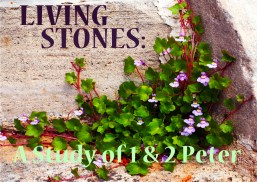
Living Stones: A Study of 1 & 2 Peter ~ Lesson 1- Introduction

Welcome to our new study, Living Stones: A Study of 1 &2 Peter!

How can we live lives of holiness as the world, and even the church, become increasingly unholy? For the next several weeks we’ll work our way through the books of 1 & 2 Peter, and learn how Jesus is the Living Stone – our perfect example of holiness – that we are to build our lives and churches upon.

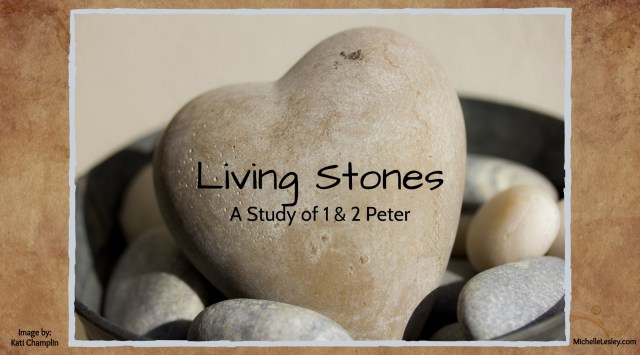
Our lovely title pic for the study was designed by Kati Champlin, who is a pastor’s wife in Montana. Many thanks to all of those who worked so hard on their entries for our title pic contest. You ladies were very creative and did some beautiful work! 

Terri Mobley


Lesley Hazen


Carey


Clare McNaul
 

(Clare pointed out the crosses etched into the rock. Can you see them?)

Debra Gartland

If you’re new to using my Bible studies, just a few housekeeping items and helpful hints:

The studies I’ve written (you can find all of them at the Bible Studies tab in the blue menu bar at the top of this page) are like “training wheels”. They’re designed to teach you how to study the Bible for yourself and what kinds of questions to ask of the text so that, when you get the hang of it, you won’t have to depend on other people’s books and materials – even mine – any more. To that end, I do not provide answers for the study questions in the studies I’ve written.

My studies are meant to be extremely flexible and self-paced so that you can use them in the way that works best for you. You can do an entire lesson in one day or work on the questions over the course of the week (or longer). You do not need to feel obligated to answer all (or any) of the questions. If the Holy Spirit parks you on one question for several days, enjoy digging deep into that one aspect of the lesson. If He shows you something I haven’t written a question about that captures your attention, dive in and study it! Those are ways the Holy Spirit speaks to us through His Word. This is your time to commune with the Lord, not a school assignment or work project you are beholden to complete in a certain way by a certain deadline.

I will post a new lesson on the blog every Wednesday, so there is nothing to sign up for or commit to. Simply stop by the blog each week, or subscribe to the blog via e-mail to have the lessons delivered to your inbox.

I use hyperlinks liberallyThe Scriptures for each lesson will be linked at the beginning of the lesson and in the lesson questions. As you’re reading the lesson, whenever you see a word in a different color text, click on it, and it will take you to a Scripture, article, or other resource that will help as you study.

All of the studies I’ve written are suitable for groups or individuals. You are welcome to use them as a Sunday school or Bible study class curriculum (for free) with proper attribution.

You are also welcome to print out any of my Bible studies (or any article I’ve written) for free and make as many copies as you’d like, again, with proper attribution. I’ve explained more about that in this article (3rd section).


Introduction to 1 Peter

Before we begin studying a book of the Bible, it’s very important that we understand some things about that book. We need to know…

Who the author was and anything we might be able to find out about him or his background.

Who the audience of the book is: Jews or Gentiles? Old Testament Israelites or New Testament Christians? This will help us understand the author’s purpose and approach to what he’s writing.

What kind of biblical literature we’re looking at. We approach books of history differently than books of wisdom, books of wisdom differently than books of prophecy, etc.

What the purpose of the book is. Was it written to encourage? Rebuke? Warn?

What the historical backdrop is for the book. Is Israel at war? At peace? In exile? Under a bad king? Good king? Understanding the historical events surrounding a piece of writing help us understand what was written and why it was written.

When the book was written. Where does the book fall on the timeline of biblical history? This is especially important for Old Testament books which are not always arranged in chronological order.

So this week, before we start studying the actual text of the book of 1 Peter, we need to lay the foundation to understanding the book by finding the answers to these questions.

Read the following overviews of the book of 1 Peter, taking notes on anything that might aid your understanding of the book, and answer the questions below:

Bible Introductions: 1 Peter at Grace to You

Overview of the Book of 1 Peter at Reformed Answers

Book of 1 Peter at Got Questions

1. Who wrote the book of 1 Peter? How do we know this?

2. Approximately when was 1 Peter written? What is the geographical setting of the book of 1 Peter? Here are some maps (scroll down to “1 Peter”) that may be helpful as you study through the book of 1 Peter.

3. Who is the original, intended audience of the book of 1 Peter? Describe the historical setting (historic events, politics, sociology of the time, etc.) of 1 Peter.

4. Which genre of biblical literature is the book of 1 Peter: law, history, wisdom, poetry, narrative, epistles, or prophecy/apocalyptic? What does this tell us about the approach we should take when studying this book versus our approach to books of other genres?

5. What is the theme or purpose of the book of 1 Peter?

6. What are some of the major topics of instruction in the book of 1 Peter? How do these topics relate to the theme of 1 Peter?

7. What are some ways 1 Peter points to and connects to Jesus?

8. What else did you learn about 1 Peter or the setting of this book that might help you understand the text of the book better?

Take some time in prayer this week to begin preparing your heart for this study. Ask God to grow you in holiness and in following the example of Christ as we study together Living Stones: A Study of 1&2 Peter.

Movies

Movie Tuesday: By What Standard?

…it seems like evangelicals, including Southern Baptists, are in danger of loosening their commitments to…basic, Christian commitments. Dangerous ideologies like Critical Theory and Intersectionality are gaining inroads into the thinking of some leaders, churches and organizations.

These ideologies are even being promoted among some evangelicals as reliable analytical tools that can assist our understandings and efforts in gospel ministry.

The result is that, in the name of social justice, many unbiblical agendas are being advanced under the guise of honoring and protecting women, promoting racial reconciliation, and showing love and compassion to people experiencing sexual dysphoria.

By What Standard? God’s World, God’s Rules is a documentary that presses those questions by showing how godless ideologies are influencing evangelical thought and life.

If you’re a Southern Baptist – especially if you don’t know what’s going on in your denomination outside the four walls of your own church – you desperately need to watch this documentary.

Because our local churches are autonomous, many Southern Baptists think, “It doesn’t really matter what’s going on at the national level of the SBC as long as my church is doing well.” When you watch, you’ll see why that’s such a dangerous attitude to take. The insidious and sinful concepts of critical race theory, intersectionality, egalitarianism, and other false doctrines have made their way into our SBC seminaries,  where your next pastor is currently being trained, into LifeWay, where your next Sunday school, women’s Bible study, or VBS curriculum is coming from, and into the national leadership of the SBC, which represents us and our denomination to the world.

But even if you’re not Southern Baptist, these concepts are almost certainly slithering in to your denomination or church as well.

Be ready by informing yourself.

Click here to watch By What Standard?.

Mailbag

The Mailbag: Husbands, pastors, and mentors- Which roles do they play in a Christian woman’s life?


I have three questions that are kind of related to each other:

1 Corinthians 14:35 says women should ask their husbands questions at home; how does this fit with women mentoring other women in Titus 2?

Where does a husband’s role end and where does the role of a godly older woman begin in terms of teaching younger women?

Are there areas where a pastor’s authority trumps a husband’s authority?

Thank you for your help.

These are really awesome questions. I love it when women ask questions that demonstrate that they’re digging into Scripture and thinking deeply about the things of God. It’s so exciting to me!

(Before I begin answering, let me just stipulate, as I usually do in articles about marriage, that the following statements assume a normal, relatively healthy, average marriage, not abusive marriages, extremely aberrant marriages, etc. Also, it’s not my intent to leave out my single sisters, but the reader asked specifically about married women, so that’s how I’m answering the questions.)

So let’s take each question separately…

1 Corinthians 14:35 says women should ask their husbands questions at home; how does this fit with women mentoring other women in Titus 2:3-5?

The first thing we need to do when we’re addressing questions like this is to look at each of these passages in context. This is a very simple study skill that will clear up nearly all instances of supposed contradictions in Scripture.

Read 1 Corinthians 14:26-40. What is the venue for Paul’s instructions in this passage? In other words, is he telling people how to behave at home? At work? At the movies? Look at the key phrases in verses 26 (“when you come together”) and 28,33b-35 (“in church”). Paul is giving instructions for how an orderly worship service is to be conducted. He is not making a blanket statement that any time any woman wants to know anything about Scripture or God or life in general that the only person she can ever ask questions of is her husband. What he’s saying is that in order to avoid chaos in the worship service, women are to sit down and be quiet during the preaching and teaching, rather than interrupting to comment or ask questions (one of the reasons Paul says this is that the women in the Corinthian church were doing just that – interrupting the preaching and teaching with questions and comments). If you read further in chapter 14, you’ll notice he places similar restrictions on prophesying and speaking in other languages to prevent chaos and confusion during the worship service. I’ve discussed this passage in further detail in my article Rock Your Role ~ Order in His Courts: Silencing Women?

Now read Titus 2. What’s the main idea of this chapter? Is it the same as the main idea of 1 Corinthians 14 – instructions for an orderly worship service? No. Verse 12 gives a nice summary of chapter 2: “renounce ungodliness and worldly passions, and to live self-controlled, upright, and godly lives in the present age.” That’s what this chapter is about. “Titus, here’s what your church members (and you) are to do and how they’re to conduct themselves as they go about the business of living as Christians in this world and in community with one another.” The older women teaching and training the younger women in verses 3-5 is not taking place during the worship service, but as these women go about daily life with one another. Today, this kind of teaching and training takes place in women’s Bible study classes, women’s fellowship groups, and in one on one discipleship, not in, nor instead of, the gathering of the whole church for worship.

So as we can see when we examine the context of both passages, 1 Corinthians 14:35 and Titus 2:3-5 are not in conflict, they’re actually in harmony, addressing two distinct ways women are to conduct themselves in two completely different venues.


Where does a husband’s role end and where does the role of a godly older woman begin in terms of teaching younger women?

I don’t think it’s really that discrete and linear, i.e. the husband teaches this list of topics the wife needs to be taught about and the godly older woman teaches that list of topics she needs to be taught about, and never the twain shall meet. It’s a much more informal and “whatever is needful at the moment” type of thing. Additionally, it’s going to vary from marriage to marriage. Some women have unsaved husbands. Some women are newly saved with husbands who have been saved for decades. Some husbands and wives are very private about everything, some are very open to others. So the balance between who (husband or older woman mentor) teaches what, and how much, and when, is going to look different in every marriage.

I would just offer a few guidelines:

• After your relationship with Christ, if you’re married, your highest allegiance is to your husband. He should be your best friend and first confidant, not a woman who’s mentoring you (or even your mother, sister, or female best friend). He should never feel like he’s in competition for your time, interest, or affinity with the woman who’s mentoring you, or that you esteem her on the same (or, perish the thought, higher) level of loyalty or emotional intimacy with him. If you’ve gotten that close to your mentor, you’re too close. Turn your attention toward your husband.

• Along those same lines, always keep in mind that God instructs you to submit to your husband, not your mentor. The only time you should ever follow your mentor’s advice over your husband’s desires is if your husband is asking you to do something the Bible clearly calls sin and your mentor is advising you to obey Scripture instead. (But even in that case, you’re not really choosing your mentor over your husband, you’re choosing to obey God rather than to sin.)

• There are some things that are private between a husband and wife that shouldn’t be shared with anyone, including a mentor. Which things? Again, that’s going to vary from marriage to marriage, but a few no no’s might include the private details of your sex life, your finances, and anything your husband would be embarrassed for someone else to know. Talk with your husband and ask if there’s anything he would rather you didn’t share with your mentor.


Are there areas where a pastor’s authority trumps a husband’s authority?

It really depends on what you have in mind when you ask that question.

If you’re talking about personal decisions made between a husband and wife, let’s say, for instance, whether or not to move to a certain part of town or whether or not the wife should take a part time job, it is not the pastor’s place to step in and overrule the husband’s decision, nor should the pastor have any expectation that the couple would obey any edicts he issues. If the couple goes to him for counseling or asks for his advice, he can certainly give it, but we never see any place in Scripture where a pastor has authority over another family’s decisions. The husband is responsible before God for leading his family, not the pastor.

But if you’re talking about a situation in the church, then yes, a pastor’s (or the elders’) authority – assuming he’s abiding by Scripture – trumps a husband’s authority, and pretty much every other church member’s authority as well. For example, a husband does not have the authority to walk up to the pastor and say, “I’m going to let my wife preach the sermon next Sunday,” or “My wife is going to take over this Sunday School classroom and use it as her personal office.”. If a husband were to say something like that, the pastor is well within his authority as shepherd of the church to say, “Oh no she’s not.”. The buck stops with the pastor when it comes to how the church runs, and he is responsible before God for making godly decisions for the church.

I’m aware that there are aberrant, fringe “churches” (many of them are some stripe of New Apostolic Reformation or extreme legalism/fundamentalism) out there in which the “pastor” has ultimate authority over every decision a family makes: where they live, how many children they have, what to name their children, whether and where each spouse should work, etc. If you’re in a so-called church like that, leave immediately and find a doctrinally sound church to join. A church doesn’t plunge to that depth of spiritual abuse without succumbing to other dangerous false doctrines along the way.


If you have a question about: a Bible passage, an aspect of theology, a current issue in Christianity, or how to biblically handle a family, life, or church situation, comment below (I’ll hold all questions in queue {unpublished} for a future edition of The Mailbag) or send me an e-mail or private message. If your question is chosen for publication, your anonymity will be protected.