
Mailbag

The Mailbag: Potpourri (Answering a discernment objection… Scripture is your authority, not Michelle… A sticky submission situation)

Welcome to another โ€œpotpourriโ€ edition of The Mailbag, where I give short(er, kinda? sometimes?๐Ÿ˜€) answers to several questions rather than a long answer to one question.

I like to take the opportunity in these potpourri editions to let new readers know about my comments/e-mail/messages policy. Iโ€™m not able to respond individually to most e-mails and messages, so here are some helpful hints for getting your questions answered more quickly. Remember, the search bar (at the very bottom of each page) can be a helpful tool!

Or maybe I answered your question already? Check out my article The Mailbag: Top 10 FAQs to see if your question has been answered and to get some helpful resources.


The other day, a man left this comment on my Facebook page on a 2022 post* in which I shared my article about Tara Leigh Cobble / The Bible Recap / D-Group (henceforth, “TLC”). I wanted to share my response to him with you (below, slightly edited) to provide an example of how to think biblically and critically, as well as respond biblically to one unbiblical claim professing Christians often make about false teachers.

(*Why do people dig up Facebook posts from years ago to comment on? I’m baffled.)

A doctrine that’s crucial to keep front of mind in situations like this is the doctrine of the authority of Scripture. When we’re presented with a choice of believing rightly handled (2 Timothy 2:15), in context Scripture or believing a fallen, sinful human being’s personal testimony, beliefs, opinions, etc., which conflict with Scripture, we are commanded and obligated to believe Scripture over that person’s testimony.

You are sadly mistaken! She has completely changed my bible study for the better by making the scriptures speak to me. She and her ministry are truly blessed by God!!

I’m afraid all your comment has accomplished is to prove that everything I said in the article is true.

  • You’re a man who apparently doesn’t know that God doesn’t want women teaching the Bible to men in the gathering of the Body. If TLC is such a great Bible teacher, how come she’s never taught you that? Maybe because she’s too busy rebelling against that part of God’s Word?
  • No human being can “make the Scriptures speak to” anyone. Only the indwelling Holy Spirit does that, and only for genuinely regenerate Believers. It’s called illumination. I’m sure you didn’t mean to, but by attributing the role and the work of the Holy Spirit to a human being, you’ve been unintentionally blasphemous. If TLC is such a great Bible teacher, how come she’s never taught you all of that?
  • God does not “bless” false teachers and their ministries. False teachers and their ministries are God’s judgment on those who follow them. If TLC is such a great Bible teacher, how come she’s never taught you that?
  • If TLC is such a great Bible teacher, how come your comment has no Scripture in it whatsoever? All I see is your feelings about her and your personal, subjective opinion about her. If you’re a Christian, your authority for life and the practice of Christianity is Scripture, not your feelings and opinions. That’s called the doctrine of the authority of Scripture. If TLC is such a great Bible teacher, she would have taught you how to defend her with rightly handled, in context Scripture.
  • You’re judging me unbiblically, because you’re judging my warnings about TLC by your feelings and opinions instead of judging them by rightly handled, in context Scripture. If TLC is such a great Bible teacher, how come she’s never taught you the difference between biblical and unbiblical judgment and how to judge biblically?
  • A minor point, but how come TLC has never taught you that the words “Bible” and “Scripture” are capitalized?

In Matthew 7:15-27, Jesus teaches us about the fruit false teachers bear. Not just the fruit of their personal character and practices (such as teaching men and yoking with false teachers) but also the fruit of their ministries.

As someone who follows, receives teaching from, and defends TLC, you are the fruit of her ministry. And, as I’ve outlined above, that fruit is ignorance of, misunderstanding of, and disobedience to Scripture. That is bad fruit (you) from a bad tree (TLC), once again proving that Scripture is true and everything I’ve said in the article is true.

TLC isn’t the great Bible teacher you’ve been deceived into thinking she is. Get out now while you still can.

For further reading: Answering the Opposition- Responses to the Most Frequently Raised Discernment Objections


I get two or three emails or DMs like this a month, usually about teachers who are more on the obscure side that I’ve never heard of…

Hi Michelle- What do you think about Jane Smith, the women’s Bible teacher and conference speaker? I’ve done a little research on her and found out that she preaches to men, yokes with false teachers X, Y, and Z, and teaches this, that, and the other unbiblical thing. I guess I probably shouldn’t be following her, right?

My dear readers who have sent questions similar to this one, I can’t tell you how much it encourages me that you are out there doing the research and comparing what these teachers do and teach with Scripture. You are exercising your God given discernment and being good Bereans. Way to go!

If you have researched a teacher to see whether or not you should be following her, you’ve compared her actions and teaching to rightly handled, in context Scripture, and you’ve found clear evidence that her actions or teachings don’t align with what the Bible teaches, then don’t follow her.

Although I’m honored and humbled you would want my feedback, and you’re always welcome to email and ask (though I’m usually not able to answer), I want to make sure you understand that you do not need validation or confirmation from me. I am not your authority for who to follow. Scripture is. If Scripture says you shouldn’t be following someone, there’s your answer.

If you feel a little unsure of yourself when it comes to doing the research on a teacher, I’ve got some resources to help you.

First, grab some of my long form articles (for example: this one or this one) I’ve written about various teachers at the Popular False Teachers & Unbiblical Trends tab (in the blue menu bar at the top of this page) and read through a few of them to get a feel for the kinds of things you should be looking for.

Second, use the resource I designed specifically to help you do the research on your own: Is She a False Teacher? 7 Steps to Figuring it Out on Your Own.

Ask God to give you wisdom and discernment, and to help you handle His Word accurately, and trust Him to do so.


We have had trouble finding a doctrinally sound church, but finally found one. My husband spoke to leadership and everything seemed good. He met with the pastor for lunch and we were very enthusiastic about it. Solid verse by verse preaching. He started with Ephesians and it took about 6 months to finish. No heretical church music either.

One thing. My husband noticed a box of “surgical masks” at the entrance to the sanctuary. We both agree it’s ridiculous to wear them but he feels it is “promoting a lie” by just having them there for those who want one. No one is currently wearing them. He spoke to the pastor and deacon chairman and they disagreed. The box stays for those who feel “more comfortable” wearing one. My husband will not commit to joining this church because of this one issue. I am heartbroken. I know it’s eating him as well. Everything  else checks out. Just this. Is he being hyper-critical? Is this a good reason to not join a church. Praying without ceasing over this.  Your advice is welcomed and appreciated. 

Great question! These disagreements in marriage do come along, don’t they? It’s never pleasant when they do, but, praise God, He has explained to us how to handle them.

A few months ago, I posted an article called Prayers for a Godly Marriage that contained this graphic. Now, not only do we need to pray that God will help us to do these things, we also have to do them!
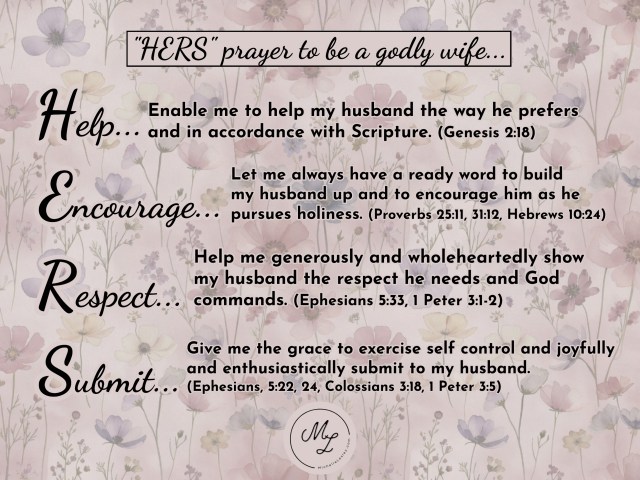
I would start by having a calm, kind, loving conversation with your husband than doesn’t contain even a hint of nagging, complaining, or otherwise expressing your displeasure. Whether you end up agreeing with him or not, you want to make sure you fully understand his heart on this issue.

You might say something like, “Honey, I really want to be clear on what you’re thinking about all of this. Can you help me understand all of the reasons why you feel so strongly about the masks being available in the lobby?”. And then really listen and do your best – whether you agree with him or not – to understand his position.

When he gets finished explaining, reflect back to him what you’ve understood him to say: “So here’s what I’m hearing you say- You don’t like the masks because they’re purple. The company that makes the masks supports abortion. And, you’re concerned that people will trust the masks more than they trust God to keep them healthy (or whatever his reasons might be). Did I get all of that correct?”.

When he says, “Yes,” thank him and let him know you’re going to think about and pray about what he’s said for a few days – and do that. Ask the Lord to help you understand and accept where your husband is coming from – even if you don’t agree with him. Pray that God will give you wisdom, love, and respect for your husband when you revisit the issue with him. Pray for wisdom for your husband as he makes this decision for your family.

When you go back a few days later to talk to your husband again, start things off with submission: “Honey, I love you, and I want you to know that I’ve been praying that the Lord will help you and give you wisdom as you make the decision for our family about whether or not to join this church. Whatever you decide, I will joyfully support you and follow you. If you would like, I have a few thoughts about the situation that I would be glad to share if you think that input would be helpful to you in your decision-making process. Would you like to hear them?”

If he says no, accept that answer graciously and don’t share your thoughts. If he says yes, pick the two or three points that are most important or urgent to you, frame them logically, objectively, and helpfully, not emotionally, manipulatively, or naggingly, and be as concise as possible.

You’re his helper. You’re doing this to provide helpful information so your husband can make the most godly decision possible. Think of yourself as a surgical nurse handing your husband, the surgeon, the instruments he asks for at the right time. You hand him that retractor, and that’s where your role ends. He takes it from there.

Once you’ve provided your input, again reassure your husband that you’ll continue to pray for him and gladly support whatever decision he makes, and let him take it from there. Bear a few things in mind that may help:

  • The Bible doesn’t command you to join this particular church, but it does command you to respect and submit to your husband.
  • This is a situation God is using to sanctify you. Be sure you’re being obedient to Him as you walk through it.
  • Matthew 7:12, the Golden Rule, tells us to treat others the way we want to be treated. If the shoe were on the other foot and you felt strongly against joining a certain church for what you had determined was a good reason, would you want your husband to insist on joining?
  • God could very well be using your husband’s uneasiness about the masks to keep you from joining a church He doesn’t want you to join, or to protect you from something that could happen in the future. What if, instead of submitting to your husband, you insist that your family join this church, your husband gives in, and a year from now the church implodes in some sort of horribly sinful situation? How are you going to feel then? How is your husband going to feel?

    About 20+ years ago, I was a member of a church whose women’s ministry was just getting started, and they decided to kick things off with a Beth Moore Bible study. Well, Beth wasn’t as well known back then as she is now, and I had no idea what discernment was. So before shelling out the money for the book, I went to the library and checked it out to see if I liked it.

    I didn’t. Beth’s writing style grated on my last nerve. It was the literary equivalent of a hummingbird flitting from one thing to the next and doubling back every two seconds. I knew there was no way I’d make it through that book without throwing it up against the wall, so I chose not to sign up for the class.

    Imagine if I had signed up for it and had gotten hooked on Beth Moore. But God used something so stupid and inconsequential as my irritation at her writing style to protect me from what could have been years of deception. He could be doing the same kind of thing in your situation. You never know, so it’s always best to obey Scripture and submit to your husband. Even if your husband turns out to be wrong, you still did the right thing.X

If you have a question about: a Bible passage, an aspect of theology, a current issue in Christianity, or how to biblically handle a family, life, or church situation, comment below (Iโ€™ll hold all questions in queue {unpublished} for a future edition of The Mailbag) or send me an e-mail or private message. If your question is chosen for publication, your anonymity will be protected.

Mailbag

The Mailbag: Husbands, pastors, and mentors- Which roles do they play in a Christian woman’s life?

Originally published January 20, 2020

I have three questions that are kind of related to each other:

1 Corinthians 14:35 says women should ask their husbands questions at home; how does this fit with women mentoring other women in Titus 2?

Where does a husbandโ€™s role end and where does the role of a godly older woman begin in terms of teaching younger women?

Are there areas where a pastorโ€™s authority trumps a husbandโ€™s authority?

Thank you for your help.

These are really awesome questions. I love it when women ask questions that demonstrate that they’re digging into Scripture and thinking deeply about the things of God. It’s so exciting to me!

(Before I begin answering, let me just stipulate, as I usually do in articles about marriage, that the following statements assume a normal, relatively healthy, average marriage, not abusive marriages, extremely aberrant marriages, etc. Also, it’s not my intent to leave out my single sisters, but the reader asked specifically about married women, so that’s how I’m answering the questions.)

So let’s take each question separately…

1 Corinthians 14:35 says women should ask their husbands questions at home; how does this fit with women mentoring other women in Titus 2:3-5?

The first thing we need to do when we’re addressing questions like this is to look at each of these passages in context. This is a very simple study skill that will clear up nearly all instances of supposed contradictions in Scripture.

Read 1 Corinthians 14:26-40. What is the venue for Paul’s instructions in this passage? In other words, is he telling people how to behave at home? At work? At the movies? Look at the key phrases in verses 26 (“when you come together”) and 28,33b-35 (“in church”). Paul is giving instructions for how an orderly worship service is to be conducted. He is not making a blanket statement that any time any woman wants to know anything about Scripture or God or life in general that the only person she can ever ask questions of is her husband. What he’s saying is that in order to avoid chaos in the worship service, women are to sit down and be quiet during the preaching and teaching, rather than interrupting to comment or ask questions (one of the reasons Paul says this is that the women in the Corinthian church were doing just that – interrupting the preaching and teaching with questions and comments). If you read further in chapter 14, you’ll notice he places similar restrictions on prophesying and speaking in other languages to prevent chaos and confusion during the worship service. I’ve discussed this passage in further detail in my article Rock Your Role ~ Order in His Courts: Silencing Women?

Now read Titus 2. What’s the main idea of this chapter? Is it the same as the main idea of 1 Corinthians 14 – instructions for an orderly worship service? No. Verse 12 gives a nice summary of chapter 2: “renounce ungodliness and worldly passions, and to live self-controlled, upright, and godly lives in the present age.” That’s what this chapter is about. “Titus, here’s what your church members (and you) are to do and how they’re to conduct themselves as they go about the business of living as Christians in this world and in community with one another.” The older women teaching and training the younger women in verses 3-5 is not taking place during the worship service, but as these women go about daily life with one another. Today, this kind of teaching and training takes place in women’s Bible study classes, women’s fellowship groups, and in one on one discipleship, not in, nor instead of, the gathering of the whole church for worship.

So as we can see when we examine the context of both passages, 1 Corinthians 14:35 and Titus 2:3-5 are not in conflict, they’re actually in harmony, addressing two distinct ways women are to conduct themselves in two completely different venues.

Where does a husbandโ€™s role end and where does the role of a godly older woman begin in terms of teaching younger women?

I don’t think it’s really that discrete and linear, i.e. the husband teaches this list of topics the wife needs to be taught about and the godly older woman teaches that list of topics she needs to be taught about, and never the twain shall meet. It’s a much more informal and “whatever is needful at the moment” type of thing. Additionally, it’s going to vary from marriage to marriage. Some women have unsaved husbands. Some women are newly saved with husbands who have been saved for decades. Some husbands and wives are very private about everything, some are very open to others. So the balance between who (husband or older woman mentor) teaches what, and how much, and when, is going to look different in every marriage.

I would just offer a few guidelines:

โ€ข After your relationship with Christ, if you’re married, your highest allegiance is to your husband. He should be your best friend and first confidant, not a woman who’s mentoring you (or even your mother, sister, or female best friend). He should never feel like he’s in competition for your time, interest, or affinity with the woman who’s mentoring you, or that you esteem her on the same (or, perish the thought, higher) level of loyalty or emotional intimacy with him. If you’ve gotten that close to your mentor, you’re too close. Turn your attention toward your husband.

โ€ข Along those same lines, always keep in mind that God instructs you to submit to your husband, not your mentor. The only time you should ever follow your mentor’s advice over your husband’s desires is if your husband is asking you to do something the Bible clearly calls sin and your mentor is advising you to obey Scripture instead. (But even in that case, you’re not really choosing your mentor over your husband, you’re choosing to obey God rather than to sin.)

โ€ข There are some things that are private between a husband and wife that shouldn’t be shared with anyone, including a mentor. Which things? Again, that’s going to vary from marriage to marriage, but a few no no’s might include the private details of your sex life, your finances, and anything your husband would be embarrassed for someone else to know. Talk with your husband and ask if there’s anything he would rather you didn’t share with your mentor.

Are there areas where a pastorโ€™s authority trumps a husbandโ€™s authority?

It really depends on what you have in mind when you ask that question.

If you’re talking about personal decisions made between a husband and wife, let’s say, for instance, whether or not to move to a certain part of town or whether or not the wife should take a part time job, it is not the pastor’s place to step in and overrule the husband’s decision, nor should the pastor have any expectation that the couple would obey any edicts he issues. If the couple goes to him for counseling or asks for his advice, he can certainly give it, but we never see any place in Scripture where a pastor has authority over another family’s decisions. The husband is responsible before God for leading his family, not the pastor.

But if you’re talking about a situation in the church, then yes, a pastor’s (or the elders’) authority – assuming he’s abiding by Scripture – trumps a husband’s authority, and pretty much every other church member’s authority as well. For example, a husband does not have the authority to walk up to the pastor and say, “I’m going to let my wife preach the sermon next Sunday,” or “My wife is going to take over this Sunday School classroom and use it as her personal office.”. If a husband were to say something like that, the pastor is well within his authority as shepherd of the church to say, “Oh no she’s not.”. The buck stops with the pastor when it comes to how the church runs, and he is responsible before God for making godly decisions for the church.

I’m aware that there are aberrant, fringe “churches” (many of them are some stripe of New Apostolic Reformation or extreme legalism/fundamentalism) out there in which the “pastor” has ultimate authority over every decision a family makes: where they live, how many children they have, what to name their children, whether and where each spouse should work, etc. If you’re in a so-called church like that, leave immediately and find a doctrinally sound church to join. A church doesn’t plunge to that depth of spiritual abuse without succumbing to other dangerous false doctrines along the way.


If you have a question about: a Bible passage, an aspect of theology, a current issue in Christianity, or how to biblically handle a family, life, or church situation, comment below (Iโ€™ll hold all questions in queue {unpublished} for a future edition of The Mailbag) or send me an e-mail or private message. If your question is chosen for publication, your anonymity will be protected.

Mailbag

The Mailbag: Husbands, pastors, and mentors- Which roles do they play in a Christian woman’s life?


I have three questions that are kind of related to each other:

1 Corinthians 14:35 says women should ask their husbands questions at home; how does this fit with women mentoring other women in Titus 2?

Where does a husbandโ€™s role end and where does the role of a godly older woman begin in terms of teaching younger women?

Are there areas where a pastorโ€™s authority trumps a husbandโ€™s authority?

Thank you for your help.

These are really awesome questions. I love it when women ask questions that demonstrate that they’re digging into Scripture and thinking deeply about the things of God. It’s so exciting to me!

(Before I begin answering, let me just stipulate, as I usually do in articles about marriage, that the following statements assume a normal, relatively healthy, average marriage, not abusive marriages, extremely aberrant marriages, etc. Also, it’s not my intent to leave out my single sisters, but the reader asked specifically about married women, so that’s how I’m answering the questions.)

So let’s take each question separately…

1 Corinthians 14:35 says women should ask their husbands questions at home; how does this fit with women mentoring other women in Titus 2:3-5?

The first thing we need to do when we’re addressing questions like this is to look at each of these passages in context. This is a very simple study skill that will clear up nearly all instances of supposed contradictions in Scripture.

Read 1 Corinthians 14:26-40. What is the venue for Paul’s instructions in this passage? In other words, is he telling people how to behave at home? At work? At the movies? Look at the key phrases in verses 26 (“when you come together”) and 28,33b-35 (“in church”). Paul is giving instructions for how an orderly worship service is to be conducted. He is not making a blanket statement that any time any woman wants to know anything about Scripture or God or life in general that the only person she can ever ask questions of is her husband. What he’s saying is that in order to avoid chaos in the worship service, women are to sit down and be quiet during the preaching and teaching, rather than interrupting to comment or ask questions (one of the reasons Paul says this is that the women in the Corinthian church were doing just that – interrupting the preaching and teaching with questions and comments). If you read further in chapter 14, you’ll notice he places similar restrictions on prophesying and speaking in other languages to prevent chaos and confusion during the worship service. I’ve discussed this passage in further detail in my article Rock Your Role ~ Order in His Courts: Silencing Women?

Now read Titus 2. What’s the main idea of this chapter? Is it the same as the main idea of 1 Corinthians 14 – instructions for an orderly worship service? No. Verse 12 gives a nice summary of chapter 2: “renounce ungodliness and worldly passions, and to live self-controlled, upright, and godly lives in the present age.” That’s what this chapter is about. “Titus, here’s what your church members (and you) are to do and how they’re to conduct themselves as they go about the business of living as Christians in this world and in community with one another.” The older women teaching and training the younger women in verses 3-5 is not taking place during the worship service, but as these women go about daily life with one another. Today, this kind of teaching and training takes place in women’s Bible study classes, women’s fellowship groups, and in one on one discipleship, not in, nor instead of, the gathering of the whole church for worship.

So as we can see when we examine the context of both passages, 1 Corinthians 14:35 and Titus 2:3-5 are not in conflict, they’re actually in harmony, addressing two distinct ways women are to conduct themselves in two completely different venues.


Where does a husbandโ€™s role end and where does the role of a godly older woman begin in terms of teaching younger women?

I don’t think it’s really that discrete and linear, i.e. the husband teaches this list of topics the wife needs to be taught about and the godly older woman teaches that list of topics she needs to be taught about, and never the twain shall meet. It’s a much more informal and “whatever is needful at the moment” type of thing. Additionally, it’s going to vary from marriage to marriage. Some women have unsaved husbands. Some women are newly saved with husbands who have been saved for decades. Some husbands and wives are very private about everything, some are very open to others. So the balance between who (husband or older woman mentor) teaches what, and how much, and when, is going to look different in every marriage.

I would just offer a few guidelines:

โ€ข After your relationship with Christ, if you’re married, your highest allegiance is to your husband. He should be your best friend and first confidant, not a woman who’s mentoring you (or even your mother, sister, or female best friend). He should never feel like he’s in competition for your time, interest, or affinity with the woman who’s mentoring you, or that you esteem her on the same (or, perish the thought, higher) level of loyalty or emotional intimacy with him. If you’ve gotten that close to your mentor, you’re too close. Turn your attention toward your husband.

โ€ข Along those same lines, always keep in mind that God instructs you to submit to your husband, not your mentor. The only time you should ever follow your mentor’s advice over your husband’s desires is if your husband is asking you to do something the Bible clearly calls sin and your mentor is advising you to obey Scripture instead. (But even in that case, you’re not really choosing your mentor over your husband, you’re choosing to obey God rather than to sin.)

โ€ข There are some things that are private between a husband and wife that shouldn’t be shared with anyone, including a mentor. Which things? Again, that’s going to vary from marriage to marriage, but a few no no’s might include the private details of your sex life, your finances, and anything your husband would be embarrassed for someone else to know. Talk with your husband and ask if there’s anything he would rather you didn’t share with your mentor.


Are there areas where a pastorโ€™s authority trumps a husbandโ€™s authority?

It really depends on what you have in mind when you ask that question.

If you’re talking about personal decisions made between a husband and wife, let’s say, for instance, whether or not to move to a certain part of town or whether or not the wife should take a part time job, it is not the pastor’s place to step in and overrule the husband’s decision, nor should the pastor have any expectation that the couple would obey any edicts he issues. If the couple goes to him for counseling or asks for his advice, he can certainly give it, but we never see any place in Scripture where a pastor has authority over another family’s decisions. The husband is responsible before God for leading his family, not the pastor.

But if you’re talking about a situation in the church, then yes, a pastor’s (or the elders’) authority – assuming he’s abiding by Scripture – trumps a husband’s authority, and pretty much every other church member’s authority as well. For example, a husband does not have the authority to walk up to the pastor and say, “I’m going to let my wife preach the sermon next Sunday,” or “My wife is going to take over this Sunday School classroom and use it as her personal office.”. If a husband were to say something like that, the pastor is well within his authority as shepherd of the church to say, “Oh no she’s not.”. The buck stops with the pastor when it comes to how the church runs, and he is responsible before God for making godly decisions for the church.

I’m aware that there are aberrant, fringe “churches” (many of them are some stripe of New Apostolic Reformation or extreme legalism/fundamentalism) out there in which the “pastor” has ultimate authority over every decision a family makes: where they live, how many children they have, what to name their children, whether and where each spouse should work, etc. If you’re in a so-called church like that, leave immediately and find a doctrinally sound church to join. A church doesn’t plunge to that depth of spiritual abuse without succumbing to other dangerous false doctrines along the way.


If you have a question about: a Bible passage, an aspect of theology, a current issue in Christianity, or how to biblically handle a family, life, or church situation, comment below (Iโ€™ll hold all questions in queue {unpublished} for a future edition ofย The Mailbag) or send me anย e-mail or private message. If your question is chosen for publication, your anonymity will be protected.