Entertainment, Marriage, Movies, Throwback Thursday

Throwback Thursday ~ “No Greater Love”– Movie Review

Originally published March 21, 2011

I stumbled across this movie at my local library a few days ago, and, boy am I glad I did.

Jeff and Heather were the “lucky ones”.  Best friends from childhood, high school sweethearts, and married by 22, they were inseperable soul mates.

After the birth of her first and only child, Heather Baker (Danielle Bisutti) fell into a deep depression.  Hopelessly lost, she did the unthinkable– she abandoned her husband and her infant son –and vanished.  Jeff Baker (Anthony Tyler Quinn) was forced to raise their son Ethan as a single father.

Ten years after his wife’s disapperance, Jeff is finally ready to move on and is on the verge of marrying his new girlfriend.  His world, however, is dramatically rocked when Heather shockingly reappears in the most unusual place.
(From the “No Greater Love” web site.)

If you liked the movie Fireproof, you’ll almost certainly like No Greater Love.  The acting is much better, and so is the production quality.  Of course, that’s to be expected when a movie is made by a professional studio hiring professional actors rather than by a church using mostly church members as actors.  (That’s certainly not a dig at Sherwood Baptist Church.  They did a fantastic and admirable job with both Fireproof and Facing the Giants –both of which you should see, if you haven’t already –it’s just that professional studios and production companies have the resources and budget to put together a more polished product.)

The storyline of No Greater Love is unique and endearing, but believable.  The only thing I found to be a bit of a stretch was, well, how do I say this without giving too much away?  Let’s just put it like this: It can take a long time and a lot of difficult, painful emotional work for the most Godly among Christians to forgive someone who has wounded them unfathomably.  Generally speaking, one would expect that, for a similarly wounded unsaved person, forgiveness would probably come much more slowly and with even greater difficulty.  But I suppose there are exceptions to the rule.

Theologically, this movie is right on target.  Director, Brad Silverman, says in his commentary on the movie that his goal was to be as theologically correct as possible, and I think he nailed it.  To be honest, one of the reasons I picked up this movie was to see if there were any false doctrine or theology in it, so I was on the lookout for Biblical error.  None to be found as far as I could tell.

Does No Greater Love overtly share the Gospel, spelling it out step by step?  No.  That’s your job and mine, not the job of a movie.  I think, primarily, this is an entertaining movie which reinforces Biblical truth that Christian viewers (should) already know.  But it would also be a great movie to share with unsaved friends as a conversation starter for sharing the Gospel in detail.

For more information on No Greater Love, visit the web site and “like” the Facebook page.

No Greater Love is available for purchase at:
Lionsgate Studios
ChristianBook.com
Amazon.com

1 John Bible Study

Am I Really Saved?: A First John Check Up ~ Lesson 4: Truth and Righteousness

1 John Study

Am I Really Saved? A First John Check Up
Lesson 4: Truth and Righteousness
Please Read: 1 John 2:18-29

Previous Lessons: 1, 2, 3

Examine yourselves, to see whether you are in the faith. Test yourselves. Or do you not realize this about yourselves, that Jesus Christ is in you?—unless indeed you fail to meet the test!
2 Corinthians 13:5

1 John 2:18-20

Am I Really Saved? Checkpoint 6: Do I want to be faithful to a doctrinally sound church?

Children, it is the last hour, and as you have heard that antichrist is coming, so now many antichrists have come. Therefore we know that it is the last hour. 19 They went out from us, but they were not of us; for if they had been of us, they would have continued with us. But they went out, that it might become plain that they all are not of us. 20 But you have been anointed by the Holy One, and you all have knowledge.

Let’s start off by looking at a few words in verses 18 and 19: “children,” “antichrist,” “antichristS,” and “they”.

It’s always helpful to keep in mind who the audience of a passage of Scripture is. “Children,” as I mentioned last week, reminds us that John is addressing the church, his “children” in the faith (which, by extension, includes Christians today). Apparently, the church had already been taught that Christ would be coming back and that the antichrist would be making his appearance before the Lord’s return. This antichrist is the one-world leader who will fight against and attempt to overthrow Jesus at the end of time.

But just as John has children in the faith, the antichrist (Satan) also has children, and these are the “many antichristS” to whom John refers. These were people, who at one time had been meeting with the church and seemed to be Christians, but who had left the church and become (or joined with) false teachers (see lesson 1 for more info.). This is who “they” in verse 19 is referring to.

John is making clear to the church that those who leave the fellowship of biblical Christianity to follow false teachers and teachings do so because they were never truly saved (“not of us”) in the first place. This is one way we can tell (“that it might become plain”) who is a believer and who is not. Those who are saved desire to stay in fellowship and assembly with a doctrinally sound body of true believers.

  • Have you left sound biblical doctrine behind to follow after false teachers (for example: Joel Osteen, Joyce Meyer, TD Jakes, Beth Moore, Paula White, Benny Hinn, etc.)? Do you argue with biblically knowledgeable Christian friends who show you from Scripture that you’re following a false teacher?
  • Have you stopped going to (a doctrinally sound) church because…

…you’re not sure you believe in God, the truth of Scripture, or that Jesus is the only way of salvation any more?

…what your professors are teaching, what your friends believe, or the tenets of a group you’ve joined seem to make more sense than the Bible?

…you’re just not interested in church any more and have better things to do?

…you’re tired of feeling guilty for participating in your favorite sin?

  • Do you love fellowshipping, worshiping, and studying God’s word with other believers? Do you faithfully attend (a doctrinally sound) church because your heart craves it? Would you rather hear sound teaching in which God’s word steps on your toes than false teaching that tickles your ears?

1 John 2:21-28

  • Again, John uses two polarizing words (as he did with “light” and “darkness” in chapter 1) several times in this passage to draw a sharp distinction between those who are saved and those who are not. What are the two words John uses? (v. 21, 22, 27)

Am I Really Saved? Checkpoint 7: Do I believe in the Jesus of Scripture?

I write to you, not because you do not know the truth, but because you know it, and because no lie is of the truth. 22 Who is the liar but he who denies that Jesus is the Christ? This is the antichrist, he who denies the Father and the Son. 23 No one who denies the Son has the Father. Whoever confesses the Son has the Father also. 24 Let what you heard from the beginning abide in you. If what you heard from the beginning abides in you, then you too will abide in the Son and in the Father. 25 And this is the promise that he made to us—eternal life.

Here, John continues to explain to the church what constitutes an antichrist and why antichrists are not believers. Notice what he says in verse 21, “no lie is of the truth.” It seems like such an obvious statement, but have you ever said, when told that a teacher you’re following teaches things that are unbiblical, “Oh I just chew up the meat and spit out the bones”? John is saying that if the teacher you were following were biblical, there wouldn’t be any bones to spit out. Doctrinally sound preachers, teachers, and authors might make a mistake and repent of it from time to time, but they don’t persist in teaching lies. No lie is of a true teacher.

Another thing to take note of in this passage, again, is that John is talking to believers. When he uses words like “Jesus,” “Christ,” “Father,” and “Son,” they, and we, understand that he means Jesus, Christ, Father, and Son as defined in Scripture alone. Even as early as John’s day there were false teachers who led people to believe in a Jesus who was a mere man, others who taught he was only God at certain times, and others who completely twisted the biblical definition of who God and Jesus are.

It’s the same today. Mormons are one good example. They say the believe in Jesus, but they aren’t using the biblical definition of who Jesus is. They’re using the Mormon definition of Jesus, the spirit brother of Lucifer, born of a sexual relationship between God and Mary. John is saying that if you deny the Jesus of the Bible, you are not a Christian.

  • Mormons may be a clear cut example of people who deny the biblical Christ, but are you sure you believe in the Jesus of Scripture? Have you ever said anything like:

The God I believe in would never send people to hell.

Jesus was just a good moral teacher.

God is love. He forgives everybody.

Jesus just wants people to be happy. He would be fine with me divorcing my husband/being a homosexual/living with my boyfriend/not attending church/etc.

  • What is “what you heard from the beginning” in v. 24, and what does it mean for “what you heard from the beginning” to “abide” in you? How does this phrase/concept help John pivot from talking about what an unbeliver is to what a believer is?
  • What is the “if/then” statement John makes in verse 24? What does God promise in verse 25 to the “then” people?
  • John uses the word “abide” several times in verses 26-28. Examine his meaning in each use of the word. What does verse 28 say the ultimate result of abiding in Christ will be?

1 John 2:29

Am I Really Saved? Checkpoint 8: Do I practice righteousness?

If you know that he is righteous, you may be sure that everyone who practices righteousness has been born of him.

Last week we were careful not to get the cart before the horse in that it is not good or righteous behavior that turns someone into a Christian. It’s the opposite. Genuine, visible righteousness springs from a heart that has truly been born again.

John also makes sure we know he’s talking about habitually being righteous like Christ was righteous. Remember, the Pharisees acted righteous, and Jesus saw right through them and gave them a piece of His mind.

  • Describe what it means that Jesus is “righteous”. What are some Scriptures that show how Jesus’ righteousness manifested itself during His earthly ministry?
  • Is Christlike righteousness a habit that springs from your heart because you love Jesus? What are some ways you see the righteousness of Christ working itself out in your daily life?
  • Do you ever find yourself having to “put on” outward righteous behavior in front of others to keep up the appearance that you’re a Christian?

This week we’ve looked at three more “Am I Really Saved?” checkpoints:

Do I want to be faithful to a doctrinally sound church?

Do I believe in the Jesus of Scripture?

Do I practice righteousness?

A saved person will be able to honestly answer “yes” to all of these questions. While none of us are perfect at it, we trend towards a desire for righteousness of both heart and behavior. We love the Jesus of Scripture and the churches, pastors, and teachers who dare to teach Him in all of His glorious truth and splendor.

An unsaved person might be able to put on righteous behaviors, but has no righteousness of heart, because she is still dead in her trespasses and sins. She may believe in a “Jesus” who conforms to her own opinions and worldly standards, but not the true Jesus of Scripture. And she certainly has no desire to attend a doctrinally sound church where her self-made label of “Christian” or “good person” will be challenged by a call to repentance and faith in the true Christ of the Bible.

Additional Resources:

1 John 2– Matthew Henry’s Commentary

Are You Really a Christian? by Todd Friel

True or False? A Study in 1 John– at Naomi’s Table (lessons 10-11)

Church

Persecution in the Pew

persecution in the pewBeheadings of Christians by ISIS. Crosses forcibly torn off churches by the Chinese government. Pastors imprisoned. Believers tortured for leaving Islam or sharing the gospel.

The treatment our brothers and sisters across the globe receive at the hands of pagans is nearly unfathomable. They are made to suffer – simply for claiming the name of Christ – by those who openly hate God and want nothing more than to stamp out Christianity.

This is how we, as the American church, have come to define persecution. Outsiders, non-Christians, and the government, all on the attack against the Bible, our faith, our practices, and other beliefs we have long held dear. It’s a correct definition, but it’s not a complete definition.

While we already see a “light” form of this type of persecution in the U.S. – mainly over the issue of homosexuality – there’s another kind of Christian persecution that is mushrooming right under our noses, which most church members either seem oblivious to, or are actually participating in. It’s the persecution in the pew.

If you’re a Christian who has ever dared to vocally take a stand on the truth of God’s word against the false teaching so prevalent in today’s pop Christianity, you’ve almost certainly experienced this type of persecution at the hands of people who call themselves “Christians.”

Don’t believe me?

Try posting a Facebook status that says the Bible prohibits women from being pastors or teaching men.

Demonstrate from Scripture to a Beth Moore, Joyce Meyer, or Joel Osteen groupie that she’s following a false teacher.

Talk to a church member who supports Planned Parenthood because they provide health care.

Explain why Christians ought not attend same sex weddings.

Discuss the Bible’s account of Creation with someone from your church who has embraced Darwinian evolution.

Certainly, there are new and immature Christians who simply don’t know these things are unbiblical and are still struggling to embrace God’s word in these areas. And there are those who know what God’s word says, but rebel against it in these areas, who silently ignore Christians who espouse biblical truth, or can politely discuss why their “Christian” views differ from Scripture. However, the willfully biblically ignorant, “screaming banshee” contingent is growing, both in volume and in number.

Surprised? Me too. I’ve been on the receiving end of verbal abuse (and I do mean abuse – name calling, swearing, mocking, the questioning of my salvation, and any number of other nasty and condescending remarks) from “Christians” defending these and other unbiblical views numerous times and I still can’t get over my shock every time it happens.

Call me crazy, I guess I just expect people who claim to be Christians to believe and defend the Bible, not attack those who uphold it.

But this kind of thing really shouldn’t be cause for wonder and amazement. We should expect it. Persecution of God’s people by those who claim to be God’s people has been happening since the Old Testament.

Jeremiah:
Now Pashhur the priest, the son of Immer, who was chief officer in the house of the Lord, heard Jeremiah prophesying these things. 2 Then Pashhur beat Jeremiah the prophet, and put him in the stocks that were in the upper Benjamin Gate of the house of the Lord. Jeremiah 20:1-2

Amos:
Then Amaziah the priest of Bethel sent to Jeroboam king of Israel, saying, “Amos has conspired against you in the midst of the house of Israel. The land is not able to bear all his words…12 And Amaziah said to Amos, “O seer, go, flee away to the land of Judah, and eat bread there, and prophesy there, 13 but never again prophesy at Bethel, for it is the king’s sanctuary, and it is a temple of the kingdom.” Amos 7:10, 12-13

Isaiah:
For they are a rebellious people, lying children, children unwilling to hear the instruction of the Lord; 10 who say to the seers, “Do not see,” and to the prophets, “Do not prophesy to us what is right; speak to us smooth things, prophesy illusions, 11 leave the way, turn aside from the path, let us hear no more about the Holy One of Israel.” Isaiah 30:9-11

Perhaps Jesus had in mind some of these instances of Israel’s persecution of the prophets when He said in the Sermon on the Mount:

Blessed are those who are persecuted for righteousness’ sake, for theirs is the kingdom of heaven. 11 “Blessed are you when others revile you and persecute you and utter all kinds of evil against you falsely on my account. 12 Rejoice and be glad, for your reward is great in heaven, for so they persecuted the prophets who were before you. Matthew 5:10-12

The balance of the New Testament is rife with examples of Christians, and even Jesus Himself, being persecuted by those who claim to be God’s people:

Stephen was martyred by “the people and the elders and the scribes,” while Paul, “circumcised on the eighth day, of the people of Israel, of the tribe of Benjamin, a Hebrew of Hebrews; as to the law, a Pharisee;” who went on to be a zealous “persecutor of the church” held their coats.

It was the “high priest, the senate of the people of Israel, and the Pharisees” who imprisoned and flogged the apostles and “charged them not to speak in the name of Jesus” in Acts 5:17-42.

Peter and John were arrested by “the priests and the captain of the temple and the Sadducees” and threatened by “Annas the high priest and Caiaphas and John and Alexander, and all who were of the high-priestly family.”

Even Jesus “came to his own, and his own people did not receive him.” He was nearly stoned twice by Jewish leaders. And, even though it was the Romans who actually carried out the crucifixion, it was only because it was illegal, under current Roman law, for the temple authorities to execute their own criminals.

It was one of Jesus’ own followers who betrayed him to the chief priests. It was the “chief priests and the elders” who arrested Jesus. It was “the high priest…scribes and the elders” who presided over the kangaroo court that condemned Jesus to death. And it was “all the chief priests and the elders of the people” who finally handed Jesus over to Rome.

We may think of these people as Jews, scribes, and Pharisees, but they were the “church people” of their day. It was these “church people” – as much, if not, at times, more so than pagans – who were the ones shouting down, threatening, persecuting, and murdering Jesus and Christians who upheld the truth of His word.

Jesus knew this would happen. In John 16:2-4 He warned the disciples:

They will put you out of the synagogues. Indeed, the hour is coming when whoever kills you will think he is offering service to God. 3 And they will do these things because they have not known the Father, nor me. 4 But I have said these things to you, that when their hour comes you may remember that I told them to you.

And so it goes today. Deceived, self-proclaimed “Christians”, those inside the church who are often just as unsaved as the pagans outside the church, those who prove that they don’t belong to Christ by fighting against His word instead of loving and obeying it, these “church people” are the ones viciously attacking Christians who dare to stand on and for the truth of Scripture. And they think they’re doing God a favor by acting this way.

Continue to cling to Christ and His word and you’ll be one of their victims. It’s inevitable. Jesus said, “If they persecuted me, they will also persecute you.” But keep your eyes on Jesus, not on your circumstances, and remember He also said, “Blessed are those who are persecuted…theirs is the kingdom of heaven.” When you’re persecuted, even by “Christians” you can “rejoice and be glad, for your reward is great in heaven!”


Money, Sanctification, Throwback Thursday

Throwback Thursday ~ To Tithe or Not to Tithe…

Originally published August 22, 2013tithetithe_challenge

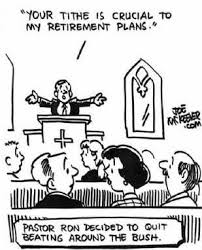
…that is the question. But should it be? And is it really as simple as that? Yes. And no. On the “simple answer” side, there are two things to keep in mind:

First, Christians today are not required to keep any of the civil or ceremonial laws of Old Testament Israel. If you disagree, I hope you’ve got a parapet around the perimeter of your roof  and that when you harvest your wheat you’re sure to leave the gleanings on the ground. (Christians are, however, called to obey God’s moral laws –many of which are initially laid down in the Old Testament– not in order to earn or keep our salvation, but because we love our Savior and want to flee as far away from sin as possible.)

If you’re interested in the whys and wherefores of the reasons Christians are not required to keep the law of the tithe, there downloadare a number of great articles out there to help you understand. Check out this one, this one, and this one  for starters.

Second, the words “tithing” and “giving” are not synonymous. The New Testament is rife with admonitions to Christians to give, and examples of Christians giving (many of which went far beyond the amount that would have been required by tithing laws) to meet the needs of the church.

So, tithing- no. Giving- yes.

But there’s another aspect of this question, a bigger picture, that doesn’t fit neatly into a “yes or no” category. It’s the heart of the matter. The matter of our hearts.

There are those who will read the articles I’ve linked to above, and, despite solid biblical teaching on why Christians are not required to keep the law of the tithe, will balk at the idea. I know this because that’s exactly what I did when I was first introduced to this teaching. Most of the churches I’ve attended have taught that tithing is a requirement for Christians. It wasn’t a question of “should we or shouldn’t we,” it was the parsing of “gross or net”. Tithing was just assumed. And when you hear something that goes against what you’ve been taught in church all your life, you just naturally resist it. (As well you should. Many of the “new teachings” and “fresh approaches” you’ll encounter out there are nothing but centuries old heresies with a shiny new coat of paint on them.) But sometimes somthing we’ve been taught in church all our lives is wrong. Once you put your Berean spectacles on and thoroughly examine the Scriptures, do you still bristle at the idea of throwing out the requirement to tithe? Why?

Because it’s easier to write a check on autopilot than to take the time to examine our hearts.

Raise your hand if you remember offering envelopes in Sunday School. When I was a little girl, we filled out an offering envelope every Sunday in Sunday School whether we were giving an offering or not. There were little check boxes on the front of the envelope that said things like “Bible brought,” “Attending worship,” “Bible read daily,” etc. It was the way the teachers counted attendance and organized statistics. 

As fallen creatures, we are bent towards keeping one of those offering envelopes in the back of our minds. “Read my Bible today.” Check. “Prayed.” Check. “Wrote out my tithe check.” Check. And our spiritual lives never go deeper than a check on a checklist.

Remind you of anybody? The Pharisees, perhaps? Ouch.

Time and again, Jesus told them that their relationship with God wasn’t about surface behaviors, but a heart to heart –my heart to God’s heart—communion and intimacy with their Creator and Redeemer.

And I don’t know about you, but my fallen, broken, old nature resists that like the devil. Why? Because it’s messy and dirty. There’s no clear cut, singular, magic “right answer”. It requires a lot of time and effort and trial and error. It can get frustrating and discouraging. It’s inefficient.

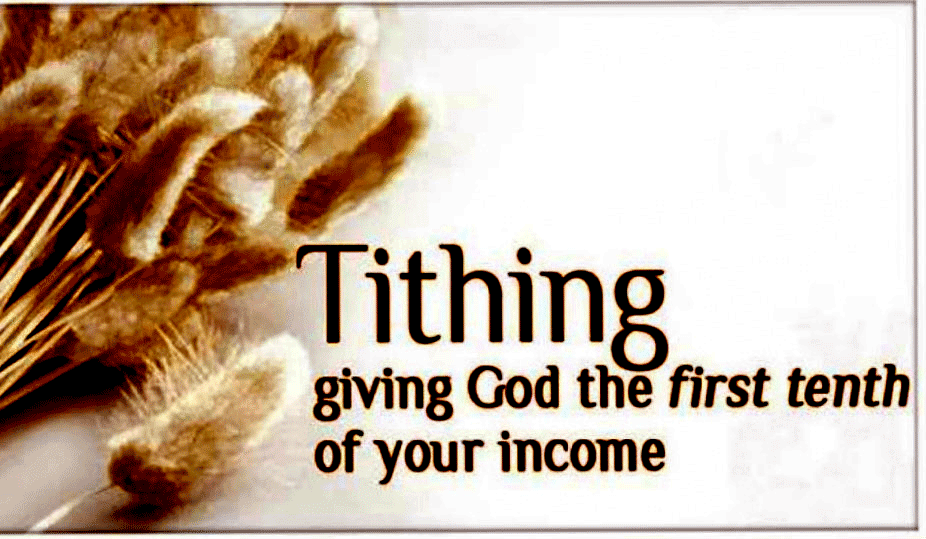
tithingIt’s so much easier to just check off a few boxes, be done with it, and be on my way.

But that bent of our hearts is exactly the opposite of what God wants. He doesn’t want to receive our remuneration; He wants to consume our hearts.

“You have heard it said…” Jesus said to the Pharisees, quoting the law, “but I say to you…” it goes much deeper than that.

It’s not enough to keep from murdering somebody. What are the selfish motives in your heart that made you angry with your brother in the first place?

It’s not enough to refrain from the act of adultery. What’s going on in your heart that you’re even looking at that woman?

It’s not enough just to dutifully fulfill the requirement of the law. I want you to have a heart that is so dead to self and alive to Christ that it goes the extra mile joyfully.

Woe to you, scribes and Pharisees, hypocrites! For you tithe mint and dill and cumin, and have neglected the weightier matters of the law: justice and mercy and faithfulness. These you ought to have done, without neglecting the others. You blind guides, straining out a gnat and swallowing a camel!

Woe to you, scribes and Pharisees, hypocrites! For you clean the outside of the cup and the plate, but inside they are full of greed and self-indulgence. You blind Pharisee! First clean the inside of the cup and the plate, that the outside also may be clean.
Matthew 23:23-26

How’s that cup and plate looking? What’s going on in our hearts that we’re not already –simply as a result of being a new creature in Christ—giving of what we have whenever we see a need? It didn’t occur to the early church to quibble over percentages and gross vs. net. Their brothers and sisters were in need, and they dipped into the coffers of the treasure of their heartstheir love for Christ and the brethrenand met those needs.

Maybe we’re just not as acutely aware of the need today. Well get aware, and rejoice in your opportunity to give!

Your pastor and your worship leader and, depending on the dynamics and circumstances of your church, other church staffimages members, need to be able to support their families above the poverty level.

There are people in your church who have lost their jobs, and despite their best efforts, haven’t been able to find new ones. They need your help.

There are pregnant teenagers all over your city who don’t want to abort their babies but don’t see any other options. What can your offering do to help them?

There are people groups all over the globe who have never seen a Bible or heard the name of Jesus. How can we best steward our money to get the gospel to them?

People are dying and spending eternity in hell. Starving to death. Being abused. Living on the streets. Risking their lives to get their hands on a Bible. Trying to put food on the table as they labor to bring you God’s word. The check you put in the offering plate every Sunday can help them.

Forget the percentages and requirements of the law. How can a follower of Christ look upon those needs and ask, “Where’s my calculator?”

Where’s your heart?

1 John Bible Study

Am I Really Saved?: A First John Check Up ~ Lesson 3: Love and Hate

1 John Study

Am I Really Saved? A First John Check Up
Lesson 3: Love and Hate
Please Read: 1 John 2:1-17

Previous Lessons: 1, 2

(Helpful Hint: Using the cross-references {footnotes to related verses} provided in your Bible or in the Bible Gateway links I’ve provided will be very helpful as you study.)

Examine yourselves, to see whether you are in the faith. Test yourselves. Or do you not realize this about yourselves, that Jesus Christ is in you?—unless indeed you fail to meet the test!
2 Corinthians 13:5

1 John 1:8-2:2

The closing verses of chapter 1, as we saw in last week’s lesson, deal with whether or not a person walks in unrepentant sin. Lost people deny that they are sinners and continue, unrepentantly, in their sin. (1:8, 10) Saved people confess their sin and are forgiven through Christ. (1:9)

John continues his line of thought in the opening verses of chapter 2 (Remember, when he wrote this, there were no chapters and verses. It was just a letter like you might write today.). He’s not writing just to point out sin and how lost and saved people deal with sin differently. He’s writing so that people will not sin. (2:1)

But when Christians (“my little children” refers to John’s “children” in the faith), do sin, John reminds us, Christ has already paid the penalty for our sin. Verses 1-2 of chapter 2 encourage us to remember this, repent, and be forgiven.

And that’s not all. Look at those great little words at the end of verse 2: “but also for the sins of the whole world.” That means that if you examined yourself according to 1 John 1 and found that you are indeed a liar who walks in the darkness while claiming to belong to Christ (1:6), or someone who denies that she’s a sinner, or claims she’s not sinning when she does things the Bible clearly labels as sin (1:8, 10), and you’re grieved over that and want to repent, there is hope.

The perfectly sinless son of God, Jesus Christ, stepped between you and God (“advocate,” 2:1) and propitiated God’s wrath against you for your sin so that you could be reconciled to God. He offers this precious gift of salvation to anyone who will turn from her sin and place her faith in Christ. (2:2)

  • What did you discover last week when you examined yourself according to 1 John 1? Do you walk in the darkness or in the light? Do you agree with the Bible’s definition of sin and confess your sins, or argue against the Bible and continue in sin?
  • Has there ever been a time in your life when you came before God, confessed and admitted that He is right about your sin and you are wrong, asked His forgiveness, and placed your faith in Christ’s death, burial, and resurrection as payment for your sin? If not, I urge you to do so now.
  • If you are saved, this passage is also an encouragement to remember, when you sin – and you will – that Christ has already paid the penalty for your sin. Remember the hope you have in Christ. Repent and be forgiven.

1 John 2:3-6

Am I Really Saved? Checkpoint 3: Do I keep God’s commands?

And by this we know that we have come to know him, if we keep his commandments. 4 Whoever says “I know him” but does not keep his commandments is a liar, and the truth is not in him, 5 but whoever keeps his word, in him truly the love of God is perfected. By this we may know that we are in him: 6 whoever says he abides in him ought to walk in the same way in which he walked.

With this passage, we have to make sure we don’t get the cart before the horse. John is not, I repeat, not saying that you become a Christian by being a good person and obeying all of God’s rules. The Bible is exceedingly clear that salvation does not come from our good works but by grace alone, through faith alone, in Christ alone.

John is saying that people who have genuinely been born again keep God’s word out of a heart of love for Him. Apple trees just naturally grow apples because they’re apple trees. You could buy a bag of apples at the store and tie them to an oak tree, but that would not make it an apple tree. It would just be an oak tree with fake fruit hanging from it. See?

  • Examine your heart- do you desire to keep God’s commandments? Why? What is your motive for obedience to God’s word? Are you an apple tree growing apples or an oak tree trying to pass yourself off, with fake fruit, as an apple tree?
  • Verse 4 is very similar to 1:6. Do you claim to be a Christian while actively disobeying Scripture, justifying your sin, or giving no consideration to keeping God’s commands? What do 1:6 and 2:4 call people who do this? Is this the description of a saved person or an unsaved person?
  • What does it mean to “walk in the same way in which [Jesus] walked”? Are there any areas of your life that don’t match up with the way Jesus lived?

1 John 2:7-14:

Am I Really Saved? Checkpoint 4: Do I hate others? (9-11)

9 Whoever says he is in the light and hates his brother is still in darkness. 10 Whoever loves his brother abides in the light, and in him there is no cause for stumbling. 11 But whoever hates his brother is in the darkness and walks in the darkness, and does not know where he is going, because the darkness has blinded his eyes.

  • This passage talks about living a lifestyle of hate. Do you have an ongoing pattern of hate in your life? Do you hate a certain person? People who behave a certain way? A a certain racial group or class of people?
  • Compare this passage to 1:5-7. Which two words does John again use to draw a sharp contrast between sin and holiness? What does 2:9 say about people who claim to be Christians, yet whose lives are characterized by hate? What does 2:10 say about the one who loves his brother? Which characterizes the life of the Christian, love or hate?
  • Which three groups of people does John address in verses 12-14? What are the reasons he gives for writing to them?

1 John 2:15-17:

Am I Really Saved? Checkpoint 5: Do I love worldliness?

15 Do not love the world or the things in the world. If anyone loves the world, the love of the Father is not in him. 16 For all that is in the world—the desires of the flesh and the desires of the eyes and pride of life—is not from the Father but is from the world. 17 And the world is passing away along with its desires, but whoever does the will of God abides forever.

  • What does verse 15 mean when it says not to love “the things in the world”? How does verse 16 define this phrase? Can you give some real life examples of “the desires of the flesh”? “The desires of the eyes”? “The pride of life”? Why does verse 16 say these things are “not from the Father”?
  • What does verse 15 say about people who love the things of the world? If “the love of the Father is not in” a person, is that person a Christian? Instead of loving the world, what characterizes a Christian, according to verse 17? Which is temporary, the world, or the one who does the will of God? Which is eternal? (17)

This week, we are examining our salvation with three questions:

1. Do I keep God’s commands?

2. Do I hate others?

3. Do I love worldliness?

Christians, out of love for God, desire to obey Him, love others, and reject worldliness. Lost people may behave outwardly in a way that looks like obedience to God’s commands, but, because they have not been born again, there is no love for Him leading to true obedience and love for others. The lost person’s true love is the things of this temporal world.

Where do you stand in light of 1 John 2:1-17? Do you love the right things, such as God’s word, others, and the things of God? Do you hate the right things, like sin and worldliness? Prayerfully examine your heart, comparing your motives and actions to these Scriptures. Surrender your life to Christ if you find that you are not truly saved. If you are saved, repent of any sin God reveals to you and ask Him to help you “walk in the same way in which [Jesus] walked.”

Additional Resources:

1 John 2– Matthew Henry’s Commentary

Propitiation: How the Cross Affected God by Steve Lawson

True or False? A Study in 1 John– at Naomi’s Table (lessons 7-9)