Ministry, Throwback Thursday

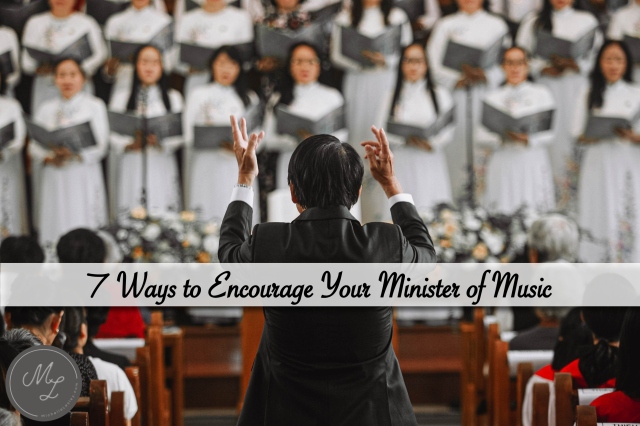
7 Ways to Encourage Your Minister of Music

Originally published November 18, 2014

Numerous articles have been written about how you, as a church member, can be an encouragement to your pastor- how you can constructively praise his sermon, pray for him, get him a great gift for Pastor Appreciation Month, etc. These are good things. Please be sure to support your pastor. Being a pastor is one of the toughest and most thankless jobs out there, and if you’ve read the statistics you know pastors need and deserve all the encouragement they can get.

Your preaching pastor isn’t the only person on your church’s staff who needs your support. So does your minister of music.

But your preaching pastor isn’t the only person on your church’s staff who needs your support. So does your minister of music. And, having been married to one for over twenty years, I can tell you there aren’t many articles out there letting you know how church members can encourage their ministers of music. Ready to show some love? Here are seven ways you can be an encouragement to your minister of music.

1.
Make practice a priority.

Before you join the choir or praise team or volunteer to play an instrument, find out how much of a time commitment it will be, and consider whether or not you can diligently keep that commitment. Once you’ve joined or volunteered, attend rehearsals, worship services, and performances faithfully, and be sure to arrive on time. You have no idea how much it means to your minister of music that he can count on you.

2.
Get to church on time.

Think about how you would feel if you planned a dinner party, worked hard all week cooking and cleaning, and then one of the couples you invited carelessly showed up halfway through the meal. You’d probably think that was kind of rude and feel somewhat discouraged. That’s sort of the way a minister of music can feel when people (especially the same people every week) habitually arrive late to church for non-emergency reasons. Not only that, but it’s a distraction to others when you come in late, plus you’re missing out on praising God and getting your heart prepared to receive His Word during the sermon. Being on time and ready for worship benefits everybody!

3.
Sing!

If you were in a meeting at work or in a college class, would you pick up your knitting, clip your nails, walk around the room chatting with friends, or bury your nose in your phone the whole time? Probably not, yet, over the years I have seen church members do all these and more during the music portion of the worship service. It’s disrespectful to the God we’re supposed to be worshiping and to the minister of music who is trying to do the work God has called him to. On the other hand, I love it when we get in the car after church and my husband says, with a smile on his face, “Wow, they were really singing today!” We have an incredible Savior who has given us the privilege of praising Him, so let’s take Him up on it. Sing out! You can worship and be an encourager all at the same time.

4.
Smile!

It’s pretty disheartening for a minister of music to stand up front, giving it all he’s got, and then look out over the congregation and see a bunch of people looking like they’d rather be at the dentist. Think about Who you’re singing to and all the reasons why you’re singing to Him, and I challenge you to keep a frown on your face! Just the simple act of smiling while you’re singing will do wonders for your minister of music (and for you!).

5.
Think before you complain.

Has your minister of music said or done something that’s clearly a sin or false doctrine? If so, you have a biblical obligation  to go to him -kindly and in love- and talk to him about it directly.

Is your complaint a matter of personal preference- style of music, whether or not he wears a tie, etc.? Give it 24 hours. Does it still seem just as important? Could you possibly be a servant to him (and others in the congregation whose opinion is the opposite of yours) by overlooking an offense and not complaining?

If you do feel the need to voice your concern (and there are valid concerns that aren’t sin-related), approach your minister of music the way you would want to be approached. Instead of, “Turn that dadgum volume DOWN!” how about, “I was wondering if it would be possible to ask the sound tech to lower the volume in the house speakers a little? My baby’s ears are very sensitive and she gets fussy when it’s that loud. I hate missing worship when I have to take her out to the lobby.” Instead of, “Hymns are so boring. I don’t see why we have to sing them half the time,” how about, “I really loved those two worship songs we sang this morning! Do you think we might be able to sing more songs like that soon?” Christ wants us to be kind to one another, so show your minister of music a little “Golden Rule” love.

6.
Speak encouraging words often.

It’s been our experience, and seems to be the general consensus among ministers of music, that the most common kind of feedback they get is negative feedback. People are much quicker to complain than affirm. Buck the trend. Did he choose one of your favorite songs for the service? Did a certain song help you to understand one of God’s attributes better? Did the choir do a nice job on their anthem? Are you praying for him? Tell him. He appreciates it more than you know.

7.
Show tangible appreciation.

It is amazing what even the smallest gift can do to lift my husband’s spirits. A card of appreciation (I have come across cards that he has saved for years), something related to one of his hobbies, a church member buying him lunch at a fast food place. They might be small items monetarily speaking, but their message is, “I care about you, and I appreciate your hard work.” And that’s priceless.

We have been blessed over the last two decades to serve at several churches that had members who were very good at encouraging their minister of music. Their love and support made my husband’s ministry a joy. What are some ways you can think of to encourage the minister of music at your church and spread that same kind of joy?

Christian women, Church, Discernment

And the top article of 2015 is…

At the end of the year lots of bloggers re-publish their top post(s), so I thought I’d jump on the bandwagon. Nine Reasons practically went viral this year (well, viral for me, anyway) with a whopping 100,000 views, followed by:

Leaving Lysa: Why You Shouldn’t Be Following Lysa TerKeurst or Proverbs 31 Ministries

Five Reasons It’s Time to Start Exercising “Moore” Discernment (Beth Moore)

Going Beyond Scripture: Why It’s Time to Say Good-Bye to Priscilla Shirer and Going Beyond Ministries

and

10 Biblically Sound Blogs and Podcasts by Christian Women

rounding out the top five articles of 2015. And now, without further ado, I bring you my top article of 2015:
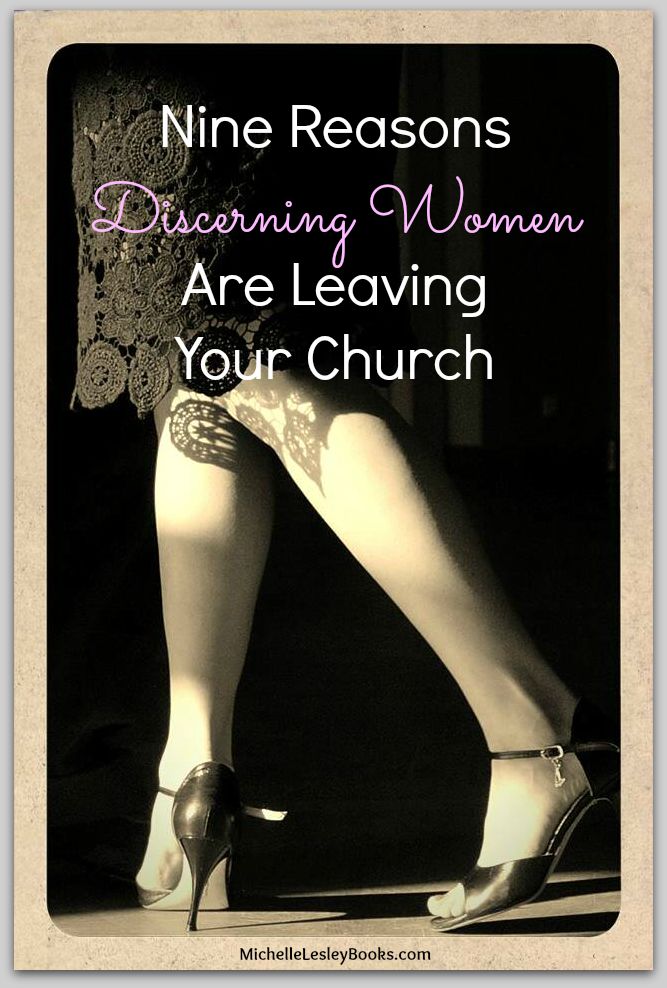
9 disc women leave

Earlier this week, Thom Rainer, president and CEO of LifeWay, pubished a blog article entitled “Six Reasons Why Women May Be Leaving Your Church.” Although I am not particularly a fan of Dr. Rainer (due to his allowing heretical materials to be sold at LifeWay), I thought this article was a good one, and I agreed with several of the issues he raised, especially, that these issues need to be addressed by church leadership.

As a ministry wife and someone in the field of women’s ministry myself, I, too, have noticed women leaving the church. Not just women in general, but a certain subset of church-attending ladies: discerning women. While Scripture is pretty clear that we can expect women (and men) who are false converts to eventually fall away from the gathering of believers, why are godly, genuinely regenerated women who love Christ, His word, and His church, leaving their local churches?

1. Eisegetical or otherwise unbiblical preaching
Discerning women don’t want to hear pastors twist God’s word. The Bible is not about us, our problems, and making all our hopes and dreams come true. We don’t want to hear seeker-driven or Word of Faith false doctrine. We don’t need self-improvement motivational speeches or a list of life tips to follow. We want to hear a pastor rightly handle God’s word from a trustworthy translation and simply exegete the text.

2. The worship hour has become a variety show
Skits, guest stars, movie clips, dance routines, rock concerts, elaborate sets, light shows, and smoke machines. We didn’t sign on for Saturday Night Live on Sunday. This is supposed to be church. Get rid of all that junk, turn the lights on, give us solid preaching, prayer, and some theologically sound songs we can actually sing, and maybe we’ll stick around.

*3. Women in improper places of church leadership
The Bible could not be more clear that women are not to be pastors, instruct men in the Scriptures, or hold authority over men in other capacities in the church. If your church has a female pastor, worship leader, or elders, or if women are teaching and leading men in Sunday school, small groups, or from the platform in the worship service, or if women are heading up certain committees, departments, or ministries which place them in improper authority over men, you’re disobeying Scripture, and we don’t want to help you do that by attending your church.

4. Children are being entertained, not trained
There’s nothing wrong with a bit of play time or crafts for younger children, but we want our children trained in the Scriptures, not entertained for a couple of hours. We want their teachers to open God’s word and read and explain it to them at a level they can understand. We want them memorizing verses, learning to pray, and demonstrating an age-appropriate comprehension of the gospel. We want them to understand that church is joyful, yet, serious, not a Jesus-laced party at Chuck E. Cheese. We need church to bolster the Scriptural training we’re giving our kids at home.

5. Women’s “Bible” Studies
The majority (and I don’t use that term flippantly) of churches holding women’s Bible studies are using materials written by Beth Moore, Priscilla Shirer, Joyce Meyer, Lysa TerKeurst, Sarah Young, and others who teach unbiblical ideas and false doctrine. Not minor denominational differences of opinion. Not secondary and tertiary unimportant issues that can be overlooked. False doctrine. While we long to study God’s word with other women, discerning women will not sacrifice sound doctrine nor the integrity of Scripture to do so.

6. Ecumenism
Is your church partnering with other “churches” whose orthodoxy and/or orthopraxy are at odds with Scripture? “Churches” which approve of homosexuality or female pastors, or which hold to an unbiblical soteriology (grace plus works, baptismal regeneration, Mary as co-redemptrix with Christ, etc.)? Are you partnering with those who deny the biblical Christ altogether such as Muslims, Jews, Jehovah’s Witnesses, Hindus, Mormons, or Buddhists? Discerning women know Scripture forbids yoking ourselves to unbelievers and we want no part of it.

7. Ageism
Look around at your pastor and staff, your lay leadership, your music team, the “face” of your church. How many of those people are over 40? Usually, discernment and spiritual maturity come through walking with the Lord over many years, yet, increasingly, churches are run by twentysomething pastors, staff, and other leadership, who are often spiritually immature and/or lack the wisdom and life experience that come with age. The counsel and wisdom mature, godly men and women have to offer is brushed off as old fashioned, and middle aged and older church members feel alienated and unwanted. Discerning women value the wisdom and teaching of their godly elders.

8. The “troublemaker” label
Discerning women who see unbiblical things happening in their churches and stand up for what God’s word says about biblical ecclesiology and teaching are often villified and labeled as troublemakers. We are called haters, threats to unity, complainers, gossips, negative, and a myriad of other scornful names. All this for wanting things done according to Scripture. Can you blame us for shaking the dust off our high heels and leaving?

9. Spineless or stiff-necked pastors
Discerning women have little respect for, and find themselves unable to submit to the authority of pastors who see people in their churches acting overtly sinful or propagating false teaching yet are so afraid of confrontation that they will not set things right. By the same token, we cannot continue to attend a church in which we bring scriptural evidence of false teaching or sin to the pastor and he outright denies the biblical truth we present to him. We cannot be members of churches in which pastors will not submit to Scripture or carry out biblical mandates.


Frequently, the discerning women you see tearfully leaving your church have been there for years. Sometimes they leave your church because it was never doctrinally sound to begin with, and God has opened their eyes to this as they grow and mature in Christ. Sometimes they leave because false doctrine and unbiblical practices have crept in and taken over a church that was once a refuge of trustworthy biblical teaching. Either way, these things should not be.

Maybe it’s not that discerning women are leaving the church**, but that the church is leaving them.


*If you disagree with this point and are considering writing a comment arguing that women SHOULD be pastors and have other unbiblical positions of leadership, please save yourself some time, because I will not be printing it. As it says in my “welcome” tab (top of this page), I do not print false doctrine without refuting it, and at the moment, I do not have the time. If you are truly interested in what the Bible ACTUALLY says about the proper role of women in the church, click here and explore the Scriptures that address this topic.

**While it may be necessary to leave a church that is not operating biblically, Hebrews 10:24-25 makes it clear that meeting together for worship and the teaching of God’s word is not optional for Christians. Please see my follow up article, Six Ways Not to Forsake the Assembly for more on this topic.


I’ve closed comments for this article since it’s a reprint, but you can comment at the original article if you’d like.


Gratitude, Top 10

Top Ten Bible Verses on Giving Thanks

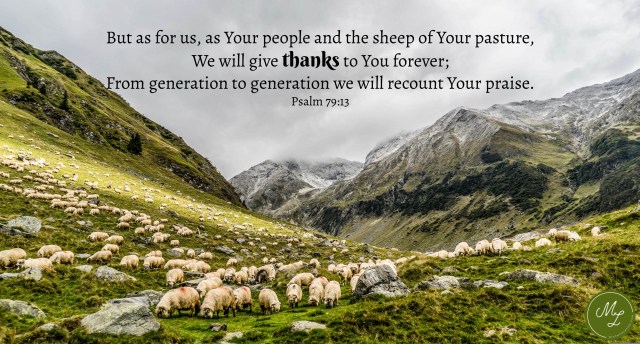
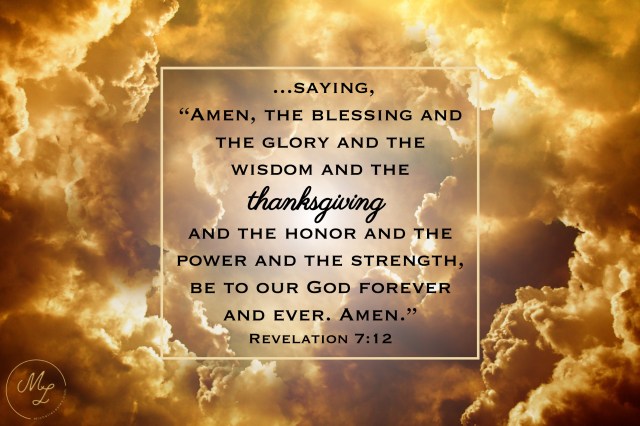
Next to Easter and Christmas, there’s no better holiday that Christians could celebrate than Thanksgiving. Scripture reminds us over and over that we have a precious Savior and innumerable blessings to thank God for. Here are ten of my favorite Bible verses about giving thanks. Feel free to share them around on social media or print them out to use in your Thanksgiving decor…

  • As place cards at the dinner table.
  • As tags on goody bags
  • Print out two copies of each, scramble them up face down, and let the kids play “Concentration” or “Memory” with them. (Each player takes turns flipping over two at a time until they find two that match.)
  • Have one person read part of his verse and see who can finish it. Or read the whole verse and see who can guess the reference.

1.
Psalm 100:4

2.
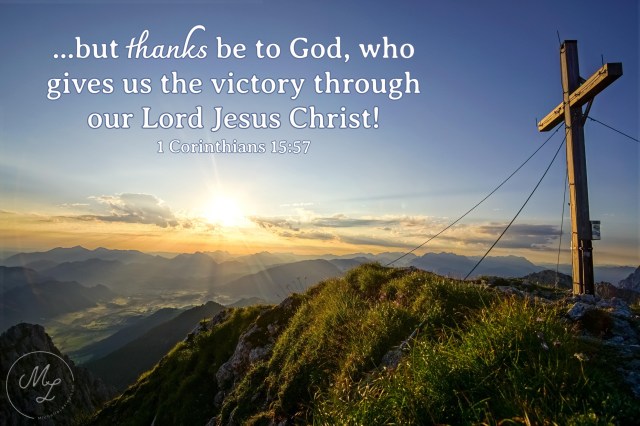
1 Corinthians 15:57

3.
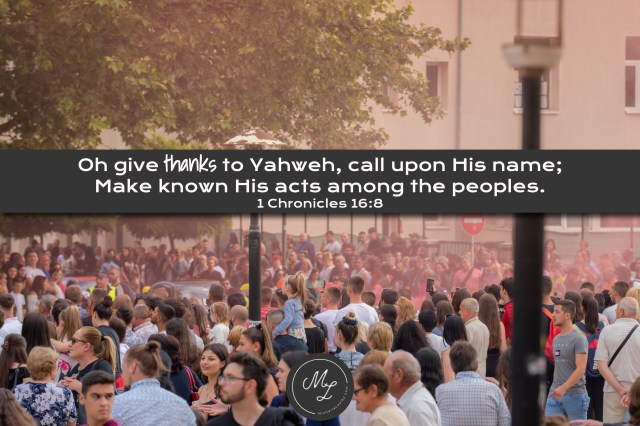
1 Chronicles 16:8

4.
Ephesians 5:20

5.
Psalm 69:30

6.
Colossians 3:17

7.
Psalm 79:13

8.
1 Thessalonians 5:18

9.
Psalm 86:12

10.
Revelation 7:12

What’s your favorite Bible verse about giving thanks?

Wednesday's Word

Wednesday’s Word ~ Job 1

job 1 21

Job 1

There was a man in the land of Uz whose name was Job, and that man was blameless and upright, one who feared God and turned away from evil. 2 There were born to him seven sons and three daughters. 3 He possessed 7,000 sheep, 3,000 camels, 500 yoke of oxen, and 500 female donkeys, and very many servants, so that this man was the greatest of all the people of the east. 4 His sons used to go and hold a feast in the house of each one on his day, and they would send and invite their three sisters to eat and drink with them.5 And when the days of the feast had run their course, Job would send and consecrate them, and he would rise early in the morning and offer burnt offerings according to the number of them all. For Job said, “It may be that my children have sinned, and cursed God in their hearts.” Thus Job did continually.

6 Now there was a day when the sons of God came to present themselves before the Lord, and Satan also came among them. 7 The Lord said to Satan, “From where have you come?” Satan answered the Lord and said, “From going to and fro on the earth, and from walking up and down on it.” 8 And the Lord said to Satan, “Have you considered my servant Job, that there is none like him on the earth, a blameless and upright man, who fears God and turns away from evil?” 9 Then Satan answered the Lord and said, “Does Job fear God for no reason? 10 Have you not put a hedge around him and his house and all that he has, on every side? You have blessed the work of his hands, and his possessions have increased in the land. 11 But stretch out your hand and touch all that he has, and he will curse you to your face.” 12 And the Lord said to Satan, “Behold, all that he has is in your hand. Only against him do not stretch out your hand.” So Satan went out from the presence of the Lord.

13 Now there was a day when his sons and daughters were eating and drinking wine in their oldest brother’s house, 14 and there came a messenger to Job and said, “The oxen were plowing and the donkeys feeding beside them, 15 and the Sabeans fell upon them and took them and struck down the servants with the edge of the sword, and I alone have escaped to tell you.” 16 While he was yet speaking, there came another and said,“The fire of God fell from heaven and burned up the sheep and the servants and consumed them, and I alone have escaped to tell you.” 17 While he was yet speaking, there came another and said, “The Chaldeans formed three groups and made a raid on the camels and took them and struck down the servants with the edge of the sword, and I alone have escaped to tell you.” 18 While he was yet speaking, there came another and said, “Your sons and daughters were eating and drinking wine in their oldest brother’s house, 19 and behold, a great wind came across the wilderness and struck the four corners of the house, and it fell upon the young people, and they are dead, and I alone have escaped to tell you.”

20 Then Job arose and tore his robe and shaved his head and fell on the ground and worshiped. 21 And he said,“Naked I came from my mother’s womb, and naked shall I return. The Lord gave, and the Lord has taken away; blessed be the name of the Lord.”

22 In all this Job did not sin or charge God with wrong.


The Holy Bible, English Standard Version Copyright © 2001 by Crossway Bibles, a publishing ministry of Good News Publishers.


Questions to Consider:

1. Read verses 1-5. Reflecting on this passage, what are some words you would use to describe Job, his family, and his life? Does the word “blameless” (1) mean “sinless”? How does your description of Job match up with God’s description of Job in verse 8 and what Satan says about Job in verse 10?

2. Why does Satan think Job loves and fears God? (9-11) Is he correct? (20-22)? Is it biblical to follow God in order to receive material or temporal blessings? Can you think of any churches or Christian celebrities who teach this? What should be our motivation for following Christ?

3. Was Job privy to the conversation between God and Satan (6-12)? Did he know why all these terrible things happened to him? Did he know that God would eventually restore what he had lost? How is Job’s situation similar to the blind man’s in John 9:1-3? Was Job being punished for sin? (8)

4. Make a list of all the things Job lost (13-19). Consider the repeated phrase, “while he was yet speaking.” What does this phrase tell us about the timing of these events?

5. Which three actions did Job take in verse 20? Which two indicate to us that Job was upset? Was Job’s grief sinful or an indication that he didn’t trust God? (21-22) How would you summarize Job’s response to tragedy? How do verses 20-21 correlate to Philippians 4:11-13? How are Christians to respond to suffering?

Wednesday's Word

Wednesday’s Word ~ Nehemiah 8

neh 8 6

Nehemiah 8

And all the people gathered as one man into the square before the Water Gate. And they told Ezra the scribe to bring the Book of the Law of Moses that the Lord had commanded Israel. 2 So Ezra the priest brought the Law before the assembly, both men and women and all who could understand what they heard, on the first day of the seventh month. 3 And he read from it facing the square before the Water Gate from early morning until midday, in the presence of the men and the women and those who could understand. And the ears of all the people were attentive to the Book of the Law. 4 And Ezra the scribe stood on a wooden platform that they had made for the purpose. And beside him stood Mattithiah, Shema, Anaiah, Uriah, Hilkiah, and Maaseiah on his right hand, and Pedaiah, Mishael, Malchijah, Hashum, Hashbaddanah, Zechariah, and Meshullam on his left hand. 5 And Ezra opened the book in the sight of all the people, for he was above all the people, and as he opened it all the people stood. 6 And Ezra blessed the Lord, the great God, and all the people answered, “Amen, Amen,” lifting up their hands. And they bowed their heads and worshiped the Lord with their faces to the ground. 7 Also Jeshua, Bani, Sherebiah, Jamin, Akkub, Shabbethai, Hodiah, Maaseiah, Kelita, Azariah, Jozabad, Hanan, Pelaiah, the Levites, helped the people to understand the Law, while the people remained in their places. 8 They read from the book, from the Law of God, clearly, and they gave the sense, so that the people understood the reading.

9 And Nehemiah, who was the governor, and Ezra the priest and scribe, and the Levites who taught the people said to all the people, “This day is holy to the Lord your God; do not mourn or weep.” For all the people wept as they heard the words of the Law. 10 Then he said to them, “Go your way. Eat the fat and drink sweet wine and send portions to anyone who has nothing ready, for this day is holy to our Lord. And do not be grieved, for the joy of the Lord is your strength.” 11 So the Levites calmed all the people, saying, “Be quiet, for this day is holy; do not be grieved.” 12 And all the people went their way to eat and drink and to send portions and to make great rejoicing, because they had understood the words that were declared to them.

13 On the second day the heads of fathers’ houses of all the people, with the priests and the Levites, came together to Ezra the scribe in order to study the words of the Law. 14 And they found it written in the Law that the Lord had commanded by Moses that the people of Israel should dwell in booths during the feast of the seventh month, 15 and that they should proclaim it and publish it in all their towns and in Jerusalem, “Go out to the hills and bring branches of olive, wild olive, myrtle, palm, and other leafy trees to make booths, as it is written.” 16 So the people went out and brought them and made booths for themselves, each on his roof, and in their courts and in the courts of the house of God, and in the square at the Water Gate and in the square at the Gate of Ephraim. 17 And all the assembly of those who had returned from the captivity made booths and lived in the booths, for from the days of Jeshua the son of Nun to that day the people of Israel had not done so. And there was very great rejoicing. 18 And day by day, from the first day to the last day, he read from the Book of the Law of God. They kept the feast seven days, and on the eighth day there was a solemn assembly, according to the rule.


The Holy Bible, English Standard Version Copyright © 2001 by Crossway Bibles, a publishing ministry of Good News Publishers.


Questions to Consider:

1. What were some of the events that led up to Nehemiah 8? Why would this “worship service” have been especially meaningful for the people?

2. Which phrase in verse 2, repeated in verse 3, show us God’s desire for all people to hear and understand His word? How does this phrase hint at the love God has for women and children?

3. Read verses 2-8 and describe the scene in your own words or make a sketch of what it might have looked like. Which elements of this worship service are similar to the elements of the services at your church today? Why are these elements important? Why do you think they have lasted until the present time?

4. Why were the people weeping (9)? Why were they told not to weep (10-11)? Were the spiritual leaders ignoring the people’s desire to repent? What was the Feast of Booths (14)? How was the recent return from exile (17) similar to the original event the Feast of Booths commemorated?

5. Two key words in this chapter are “understand” and “rejoice/joy.” How many times do you see these words mentioned? What does God want us to learn from this chapter about understanding His word and taking joy in His word and in obedience to it?