Biblical Womanhood Bible Study

Imperishable Beauty: Lesson 12- Beautiful Motherhood

Previous Lessons: 1, 2, 3, 4, 5, 6, 7, 8, 9, 10, 11

Read These Selected Scriptures

In lesson 11, we looked at God’s design for women who are wives. Lesson 12 focuses on the beauty of being a godly mother.

Questions to Consider

1. In lessons 2 and 3 (links above) we took a look at some of the attributes of a godly mother that we can emulate. What are some of those attributes or character traits from Proverbs 31? In today’s lesson, rather than attributes to emulate, we’ll be focusing on God’s instructions to obey for mothers. We’ll examine how we’re to regard motherhood and our children, how we’re to train our children in godliness, how we’re to discipline our children out of ungodliness, and the example we’re to set for our children. Some of these instructions can also apply to childless women in their relationships with their spiritual children (i.e. younger women or children they disciple) and others. As you read over today’s passages, explain how childless women might apply some of these Scriptures.

2. Examine the first three passages (Psalm 127-Titus 2) together. What do these passages say about how we are to regard motherhood and our children? What should the attitude of our hearts be? In what sense are children a reward? How do we know that Psalm 127:3 does not mean that if you act in a way that pleases the Lord He will reward your good behavior with children? What does this verse mean? Is loving your children (Titus 2:4) simply a feeling of affection toward them? If so, why would young women need to be trained to love their children? When you finish today’s lesson, come back to Titus 2:4 and give a fully-orbed biblical definition of what it means to love your children.

3. Examine the next five passages (Proverbs 22-Ephesians 6) together. Why does God want us to train our children in godliness? Explain the phrase “in the way he should go” (Proverbs 22:6). How does the gospel figure in to training your child? Look carefully at the three Old Testament passages. At what age should we begin training our children in godliness and the Scriptures and how long should this training continue? Is Proverbs 22:6 an iron-clad guarantee or promise from God that if we raise our children in a godly home they will definitely get saved and turn out to be godly adults? Why not? (Scroll down to the Deuteronomy 21 passage if you need help.)

To whom are the Colossians and Ephesians verses addressed? Does this mean they don’t apply to mothers or that it’s OK for mothers to provoke their children, but not fathers? If they apply to both parents, why are they addressed to fathers? How are we not to deal with our children according to these verses? What does it mean to provoke your children? Why are we not to provoke them (Colossians), and how are we to deal with them instead (Ephesians)? Compare Ephesians 6:4b to the Old Testament verses in this section. How are they similar?

3. Examine the next three passages (Proverbs 29-Deuteronomy 21) together. What is the purpose of godly discipline? What are the biblical definitions of the words “discipline” and “reproof”? Are discipline, reproof, and training the same as punishment? Why or why not? What are some of the consequences of disciplining your child? The consequences of refusing to discipline your child? According to Proverbs 13:24, what motivates someone to discipline her child? What motivates someone to refuse to discipline her child? Are “love” and “hate” simply emotional feelings in this verse or an attitude, posture, or orientation of mindset toward the child? Look closely at Deuteronomy 21:20. Is this passage most likely talking about a very young child or an older child/teenager? According to the Deuteronomy 21 passage, does godly discipline always result in an obedient son or daughter, or can there be exceptions to the rule?

Why is it important to both train your child in godly ways and discipline him out of ungodly ways? Explain how this fits into the “put off the ungodly, put on the godlymodel of biblical sanctification.

4. Examine the last five passages (Deuteronomy 21-Matthew 10) together. What do these passages teach us about the godly example we need to set for our children?

Sometimes we see implicit instructions to parents in passages that explicitly teach children how to treat and regard their parents. For example, if there were a verse that said, “Children, love your parents,” we could learn from that verse that we need to act in a way (lovable) that makes it easier for our children to obey that Scripture. Considering this concept, look at the Exodus 20 and Proverbs 1 passages. If your children are to honor you, in what manner should you behave? What should your teaching be like if your children are not to forsake it and to consider it a “graceful garland” and a “pendant”?

What is the context of Ezekiel 16? To whom is the parent/child metaphor in this  passage addressed? Explain the phrase “like mother, like daughter”. Why is it important to set a good example for our children with our own behavior, and why was this a good metaphor for God to use in addressing Israel’s unfaithfulness to Him?

Examine the Deuteronomy 21 and Matthew 10 passages together. What is to be a mother’s highest priority – her relationship with her child, even the life of her child, or her love for, obedience to, and loyalty to Christ? Do you love Christ more than your child? If you had to choose between your child and Christ, whom would you choose? What message does it send to our children when we show and tell them that we love Christ more than we love them? How can you demonstrate to your child that your highest love and loyalty is reserved for Christ?


Homework

Examine each of the instructions in Deuteronomy 6:6-9. Make a list of practical ways your family could put each of these instructions into practice and discuss it with your husband. Together, pick one of these practices and implement it with your children this week.


Suggested Memory Verse

Whoever loves father or mother more than me is not worthy of me, and whoever loves son or daughter more than me is not worthy of me.
Matthew 10:37

Biblical Womanhood Bible Study

Imperishable Beauty: Lesson 11- A Beautiful Wife

Previous Lessons: 1, 2, 3, 4, 5, 6, 7, 8, 9, 10

Read These Selected Scriptures

Lesson 10 focused on our role as godly daughters. In lesson 11, we’ll be examining God’s design for women who are wives.

Questions to Consider

1. In lessons 2 and 3 (links above) we took a look at some of the attributes of a godly wife that we can emulate. Because Proverbs 31 mainly zeroes in on godly character, most of that passage easily applied to most women regardless of marital status. In today’s lesson, rather than attributes to emulate, we’ll be focusing on God’s instructions to obey for wives. Some of these instructions can also apply to unmarried women. Read over today’s passages and explain how unmarried women might apply some of these Scriptures. Why is it important for unmarried women to study passages about married women and vice versa?

2. Examine the Genesis 2 passage. What are the main points God is making about wives and marriage in this passage? What word does this passage use (18,20) to encapsulate a woman’s role in marriage? What does it mean for a woman to be a helper “fit for” or “corresponding to” her husband? Whom did God create first, man or woman? Second? Whom did God create to be the helper, man or woman? How do these two things point to and undergird male headship in marriage? Does the Genesis passage mean that all women have to marry or that the only purpose for which women were created was to be wives?

3. Look at the Ephesians and Colossians passages together. Explain how the relationship between husband and wife is a picture of the relationship between Christ and His church. Write a character sketch of a godly husband and a character sketch of a godly wife according to these passages. Why does God instruct husbands to “love” their wives, but wives to “respect” their husbands? (33) What is the difference, and why doesn’t God give the same instruction to husbands as to wives? What should motivate a wife to submit to her husband? Pretend you are discipling a newly married, newly saved woman who has never read these passages. How would you explain biblical submission to her? How is it “fitting in the Lord” (3:18) to submit to your husband?

4. Study the 1 Peter passage. In verse 1, what is the spiritual state (lost or saved?) of the wives Peter is addressing? The husbands? Imagine Peter wrote this part of his letter to answer a question he had been asked by some of the women of the church. What was the question they asked? Carefully examine the end of verse 1. Does this mean a wife should never share the gospel with her unsaved husband and that he can be saved simply by watching her good behavior? What does it mean? How is biblical submission an aspect of holiness? (5) Some women believe they only have to submit to their husbands if their husbands are saved or if their husbands are acting in a godly way. How does this passage answer that misconception?

What does “adorning” (3-4) mean? Why and how do women usually adorn themselves? How are godly women to adorn themselves? For whom? Why? Explain external adorning versus internal adorning. Which do you think is more winsome to your husband? Compare 3-4 with 1 Samuel 16:1-13. Which is more important to God, the external or internal? Why?

Explain what it means to have a “gentle and quiet spirit“. (4) Can a woman with an outgoing, vivacious personality still have a gentle and quiet spirit? How? How is your spirit different from your personality? How should a godly spirit inform a godly personality? Explain why a gentle and quiet spirit is beautiful and how that beauty is imperishable. Why is a gentle and quiet spirit precious in God’s sight?

5. Make a list, in your own words, of God’s instructions about a husband’s and wife’s sexual relationship found in the 1 Corinthians 7 passage. God considered these instructions important enough to include in the Bible. Why? How is the marriage bed a protection against sexual temptation and sin? (2) How does this passage teach and emphasize the mutuality of the sexual relationship? Is this mutuality limited to the bedroom, or does it extend to other aspects of marriage? Explain the terms “rights” (3) and “authority” (4) in the context of this passage. In our culture, we most often think of sex in terms of pleasure or recreation. Is pleasure or recreation the main concern of this passage? What adjective would you choose to describe the perspective of this passage toward sex?


Homework

Consider the concepts each of today’s passages addresses: the husband’s headship, the wife’s role as helper, respecting your husband, submitting to your husband, your marriage imaging the relationship between Christ and the church, witnessing to an unsaved husband, external adornment vs. internal adornment, the sexual relationship, etc. Pinpoint one aspect you need growth in. Repent of any sin in this area, and spend the next week praying that God will grow you to more Christlikeness in this area. You may even wish to memorize and meditate on a verse you found particularly helpful.


Suggested Memory Verse

Do not let your adorning be external—the braiding of hair and the putting on of gold jewelry, or the clothing you wear— but let your adorning be the hidden person of the heart with the imperishable beauty of a gentle and quiet spirit, which in God’s sight is very precious.
1 Peter 3:3-4

Top 10

Top 10 Articles of 2018

I always enjoy the annual “year in review” articles and TV shows that run in abundance in late December, so I thought I’d contribute my own. Several Mailbag articles were among this year’s most popular, so I decided to make two separate lists, the Top 10 Mailbag Articles of 2018, and the top 10 non-Mailbag articles of 2018. Here are my ten most popular non-Mailbag blog articles from 2018:

Christine Caine: Have No Regard for the Offerings of Caine

Unfortunately, Christine’s teachings and some of her actions do not meet even these basic biblical standards, and it is my sad duty to recommend that you not sit under her teaching for the following reasons…

Women Preaching: It’s Not a Secondary Doctrinal Issue

The violation of God’s command that women are not to instruct men in the Scriptures nor hold improper authority over men is a sin like any other. It is not a doctrinal issue in the same sense that other second and third tier doctrines are… 

Answering the Opposition:
Responses to the Most Frequently Raised Discernment Objections

There are also occasional comments and messages from women who are disciples of the false teachers I warn against, who take me to task for doing so. The same unscriptural accusations are raised again and again against me and against others who take a biblical stand against false teachers and false doctrine. Here, in no particular order, are the most frequently raised objections to my discernment work and my answers to them…

A Naked Emperor in the Southern Baptist Convention

And so the “emperor” of leadership in the Southern Baptist Convention and those who carry its train march proudly on, despite the cries of simple peasants and innocent little children crying at the top of our lungs, “The emperor is naked!” “There are issues that need to be addressed, here!” “Listen to us!”…

Women and False Teachers:
Why Men Don’t Get It, and Why It’s Imperative That They Do

There’s at least one biblical issue women respond to differently at the core level of their spiritual DNA than men do. And men, it’s crucial that you get it on this one. You’re the pastors. The elders. The husbands. The fathers. The ones responsible before God for leading your churches and your families in doctrinally sound spiritual growth. You’ve got to get this for the sake of the girls and women you lead…

 A Few Good Men: 10 Doctrinally Sound Male Teachers

Let me introduce you to a few of my favorite male authors of Bible studies
and other great Christian books and resources…

 10 Biblically Sound Blogs and Podcasts by Christian Women

False teachers. You can’t throw a rock out the window these days without hitting one. But are there any “good guys” out there who are getting it right? Discipleship, Bible study,and theological issues bloggers who rightly divide God’s word? You bet…

Five Reasons It’s Time to Start Exercising “Moore” Discernment

This is not a request for you to believe me or agree with my personal opinion. I’m asking you to take a discerning look at the evidence and compare with Scripture what Beth Moore is currently doing and teaching. If you do, I think it will be obvious to you that, whatever she may have taught in the past, something is seriously wrong now…

Going Beyond Scripture:
Why It’s Time to Say Good-Bye to Priscilla Shirer and Going Beyond Ministries

Should she repent in these areas in which she has broken Scripture and align herself with biblical principles, she would have no bigger fan than I, and I would rejoice to be able to point Christian women to her as a doctrinally sound resource. Until that time, however, it saddens me to have to recommend that Christian women not follow Priscilla Shirer or any materials or activities from Going Beyond Ministries for the following reasons…

Leaving Lysa:
Why You Shouldn’t Be Following Lysa TerKeurst or Proverbs 31 Ministries

For these reasons, plus her habitual mishandling of Scripture, unfortunately, I must recommend that women not follow, support, or receive teaching from Lysa TerKeurst or Proverbs 31 Ministries(including any writers or speakers affiliated with Proverbs 31 Ministries)…

What was YOUR favorite article of 2018?

Christmas, Random Ramblings Ruminations Resources

Random Ramblings, Ruminations, and Resources

A couple of months ago, I “beta tested” a new feature here at the blog, which I alliteratively titled Random Ramblings, Ruminations, and Resources. People seemed to like it … or … at least the majority of readers didn’t seem to hate it too much. So I decided to bring it back every once in a while when I’m feelin’ it.

I’m feelin’ it today. So here’s the Christmas/New Year’s edition of Random Ramblings, Ruminations, and Resources.

Christmas Cards

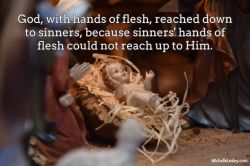
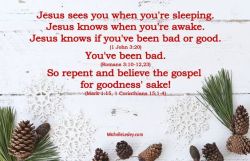
If you don’t follow me on Facebook, Twitter, or Pinterest you might have been missing the Christmas-themed memes I’ve been posting since Thanksgiving. Here are a few:

Need Gift Ideas?

I was going to do a whole article on this, but I felt like with this article and this one, readers might be getting tired of articles on Christmas shopping. So, let me just recommend three items I’ve personally gotten my hands on recently that would make great gifts for your pastor or the theology nerd in your family.

Herman Who?– This is an awesome little DVD series from Wretched that will teach you all the ins and outs of biblical hermeneutics (the science of interpreting Scripture) in a four- or twelve-week course. Teacher and student guides are included, and right now, they’re also throwing in a copy of It’s Not Greek to Me (an introduction to biblical Greek) for free.


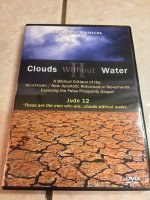
Clouds Without Water II– If you’ve never had the privilege of attending a Justin Peters lecture on the New Apostolic Reformation, this DVD set (revised and updated from the original) is the next best thing. You’ll get the history of the NAR, key figures in the movement, an explanation of NAR “theology” and much more. Helpful for any Christian, but, I’m telling you, your pastor needs this in his personal library. And while you’re over there at his online store, pick him up a copy of Do Not Hinder Them, too, especially if you’re Southern Baptist. (Be sure to scroll all the way down the page. Justin has some special deals on combo packages.)


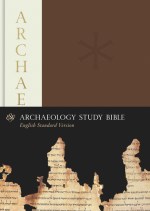
ESV Archaeology Study Bible– I got this the other day as an early Christmas present, and I already love it. Tons of articles, study notes, photos, maps, and diagrams pairing the biblical text with what’s been dug up that relates to that text. It’s just fascinating. You can order directly from Crossway, but they’re offering a special deal through ChristianBook.com right now where you can get the hardcover edition for only $24.99! (Word to the wise- go ahead and get a Bible cover for it now if this is going to be someone’s “walking around” Bible.)

Mary Was the First One to Carry the Gospel

(Ugh, that song skeeves me out.)

But Joseph was a close second. Matthew 1:18-20,24-25 tells us:

Now the birth of Jesus Christ took place in this way. When his mother Mary had been betrothed to Joseph, before they came together she was found to be with child from the Holy Spirit. And her husband Joseph, being a just man and unwilling to put her to shame, resolved to divorce her quietly. But as he considered these things, behold, an angel of the Lord appeared to him in a dream, saying, “Joseph, son of David, do not fear to take Mary as your wife, for that which is conceived in her is from the Holy Spirit…When Joseph woke from sleep, he did as the angel of the Lord commanded him: he took his wife, but knew her not until she had given birth to a son. And he called his name Jesus.

In Joseph and Mary’s day, a pregnancy outside of wedlock was much scarier than it is today. Old Testament law called for the death penalty for adultery. If Mary had really committed adultery, Joseph would have been well within his rights to haul her out into the public square and cast the first stone.

But notice that verse 19 says Joseph was both “just” and “unwilling to put her to shame.” He had an obligation to the law, but he loved Mary and wanted to show her mercy so that she might live. Joseph’s dilemma shows us, albeit through a glass darkly, where God stands in relation to sinful mankind.

Though Mary only appeared to have sinned, we really have sinned. And the penalty for our sin is death. But God loves us and wants to show us mercy. And just as an innocent Joseph stepped between Mary and the wrath of the Law that might have been carried out against her, taking her as his wife and bearing her shame and scorn upon his own strong shoulders, God sent the sinless Christ to bear our punishment and our shame, taking us as His bride, so that we might live. But it wasn’t a dilemma for God. He had it all planned out from eternity past.
Mary might have been the first one to carry the gospel, but maybe Joseph was the first one to carry it out.

(I can’t take all the credit for this one. My pastor mentioned the idea of Joseph portraying the gospel in his treatment of Mary in his sermon last week and he said he got it from Herschel Hobbs. I can’t find where Dr. Hobbs shared this idea {if you know, fill me in} to cite it or quote him, so I’ve taken his original thought and used it as a springboard for my own observations.)

Reindeer Games

Need a fun game to play at your Christmas party? Give this one from ornamentshop.com a try!

Here are the answers. No cheating or it’s lumps of coal in your stocking this year!

A 2019 Canon Cleanse

My philosophy of Bible study is pretty simple: Christian women need to study the Bible. Not a steady diet of secondhand accounts of what somebody else has studied (or, heaven forbid, what somebody “heard” God say to her) in “canned” studies, but the Bible itself.

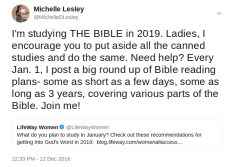
The other day, LifeWay Women tweeted out suggestions of canned studies (you guessed it – most of them authored by false teachers) to kick off the New Year with.

I’d like to challenge you to do something different.

Take this next year to set aside all the pre-fab books, workbooks, DVDs, etc. – even those you consider doctrinally sound – and cleanse your heart, mind, and spirit with the washing of the water of the Word. Just you, your Bible, and, if you’re so inclined, some paper to take notes on.

If you’re not sure how to get started, mark your calendar to check in here on January 1. It’s become my New Year’s Day tradition to post an annual round up of scads of Bible reading plans. Some of them are as short as a few days in length, others, as long as a few years. Some will take you through a biblical topic, some, through a certain part or book of the Bible, some through the whole Bible.

Tune out the noise of other people’s thoughts, ideas, and observations, and hear God speak directly to you through His written Word. Don’t watch someone else mine for gold. Grab your pick and your shovel and discover the joy that only comes from finding that gold for yourself!

Who’s up for the challenge?

Biblical Womanhood Bible Study

Imperishable Beauty: Lesson 10- Beautiful Daughterhood

Previous Lessons: 1, 2, 3, 4, 5, 6, 7, 8, 9

Read These Selected Scriptures

In lesson 9, we looked at having beautiful feet that take the good news of the gospel to a lost and dying world. Starting with lesson 10, our lessons will be focusing more specifically on God’s unique roles for women, beginning with our role as daughters.

Questions to Consider

1. Before we delve into the Scriptures, take a moment to think about your parents and your role as their daughter. Describe how your relationship functions. Is it loving and healthy, or strained and difficult? Are you a child, adolescent, or adult? Are your parents saved or unsaved? Living or deceased? Present in your life or absent? Caring or abusive? Every relationship is different, so you will need to be careful to wisely apply today’s Scriptures to your relationship with your parents. What can our relationship with our parents teach us about our relationship with God? How does being a godly daughter to your parents reflect being a godly daughter of God?

2. Examine the Exodus, Ephesians, and Colossians passages together. What are the similarities and differences among these verses? What is the main verb in Exodus 20:12? In the Ephesians and Colossians verses? To what group of people are the Ephesians and Colossians verses addressed? The Exodus verse? What is the difference between obeying your parents and honoring your parents? Is there ever an age at which adults no longer have to obey their parents, but continue to honor them? Describe this dynamic with your own parents.

What do these verses say are the consequences of obeying or honoring one’s parents? Be sure to consider the context of what was happening in Israel’s history with regard to the promise attached to Exodus 20:12. How does the Colossians verse best explain the consequences of honoring and obeying one’s parents?

How does God use the parent-child relationship to introduce us to the idea that He is our supreme Father? That we are to honor Him, obey Him, and submit to His authority?

3. Consider how a godly woman might show honor to parents who abused or neglected her. How could she honor them by sharing the gospel with them, praying for them, forgiving them, or blessing them? How can a godly woman honor parents who are deceased or whom she never knew?

4. Examine the John passage. How did Jesus set an example of honoring His mother? Can you think of any other instances from Jesus’ life that show Him honoring His parents? How can you imitate Him with regard to your parents?

5. Consider the Proverbs and 1 Timothy passages together. What do these passages teach us about caring for our parents in their old age? To whom does God reserve the ministry of caring for widows (and, by extension, elderly relatives) in 1 Timothy 5:16? Explain how God has uniquely equipped women to serve their families and their churches this way. Why does God choose to honor women with this special position of ministry instead of men? How can a woman be a daughter to elderly relatives she is caring for even if they are not her parents?

6. Study the Luke and Matthew passages together. Describe how the gospel can cause a rift between a believing daughter/(in-law) and her unsaved parents/(in-law). To Whom are we to give our highest love and loyalty? Why? Explain why Jesus’ remarks in the Matthew and Luke passages do not conflict with the Exodus/Ephesians/Colossians admonitions to honor and obey one’s parents. What are some ways a believing daughter/(in-law) honor her lost parents/(in-law)?

Explain Matthew 19:29 in terms of God blessing Believers with spiritual fathers and mothers, especially when their biological parents are lost. How can we, as godly daughters, honor our spiritual fathers and mothers? How is God a “Father to the fatherless” for those who have unbelieving parents?

7. Summarize, in your own words, a biblical perspective of “daughterhood”. How does obeying, honoring, and submitting to the authority of our parents teach us to obey, honor, and submit to the authority of God? How is being a godly daughter to your parents, those you love like parents, and your spiritual parents, a major component of biblical womanhood?


Homework

Read the book of Ruth and/or Esther, specifically examining their example as daughters. How did Ruth and Esther exemplify godly daughterhood as adults, even though Ruth was Naomi’s daughter-in-law and Esther was Mordecai’s cousin?


Suggested Memory Verse

Honor your father and your mother, that your days may be long in the land that the Lord your God is giving you.
Exodus 20:12