Favorite Finds

Favorite Finds ~ January 14, 2019

Here are a few of my favorite recent online finds…

It’s a few years old, but this excellent episode of the Issues, Etc. radio show: This Week in Pop-American Christianity: Priscilla Shirer on Hearing the Voice of God recently came across my news feed. Many false teachers (in this case, Priscilla Shirer) twist or misunderstand John 10 to mean that, if you’re a Christian, God will speak to you audibly. That’s not what it means, as anyone who takes the time to read the passage in context can attest. Pastor and podcaster Chris Rosebrough explains simply, carefully, and biblically, why this teaching is wrong and what John 10 actually means.


“I get dozens of emails each month from parents whose teens are leaving the church or being swept away by a false version of Jesus and the gospel…In this list I’ve compiled ten critical topics for the modern teen.” Great for youth directors and parents of teens, but the adults in your church probably need to read this too. Check out Ten Theological Topics for Parents of Modern Teens by our friend Costi Hinn on his blog, For the Gospel.


Pornography is usually addressed as a “men’s problem”, but, increasingly, women are succumbing to this insidious temptation. Stephanie offers pastors three suggestions (these would be helpful for anyone) for counseling and discipling women who participate in the sin of pornography in her 9Marks article Helping Women Who Struggle with Pornography.


Thoroughly and knowledgeably written by Denny Burk (head of CBMW), What Does It Mean That Women Should “Remain Quiet” in Church? (1 Timothy 2) from Crossway is one of the best commentaries I’ve ever read on 1 Timothy 2:11-14. I’ve added it as a resource to my own article on that passage: Rock Your Role: Jill in the Pulpit.


Fasting mirrors the hunger we should have for Christ. Do Christians Fast Because Food and Drink Are Bad? from Crossway explains more.

Mailbag

The Mailbag: Potpourri (Sexual abuse, Feminism, Serpent seed doctrine…)

Welcome to another “potpourri” edition of The Mailbag, where I give short(er) answers to several questions rather than a long answer to one question. I also like to take the opportunity in these potpourri editions to let new readers know about my comments/e-mail/messages policy. I’m not able to respond individually to most e-mails and messages, so here are some helpful hints for getting your questions answered more quickly. Remember, the search bar can be a helpful tool!


Can you please suggest an iPhone app Radio station that plays biblically sound worship, praise and messages?

A reader asked this question via Facebook recently. I mostly listen to podcasts, and though I’m aware of a few good sermon apps, I wasn’t familiar with any apps that provide both sermons and music. I asked my Facebook readers for some help and got lots of great answers. You can check out their suggestions here (even if you’re not on Facebook). I’m not personally familiar with all of these sites and apps, so use good discernment and make sure everything they’re teaching lines up with Scripture.


Do you have advice on Christian women and feminism? I have friends who are reading Jesus Feminist. The title makes me cringe.

Secular feminism is not something I handle a whole lot here on the blog, although I have touched on it in these articles:

Toxic (Evangelical) Femininity

Feminist Infiltration and the Emasculation of Christian Men

6 Reasons Godly Women are Stronger Than Feminazis


I would recommend that you head over to Sheologians. Summer and Joy have done several very good podcast episodes and articles on the history of feminism and its current influence on society and the church. I cannot remember whether they covered Jesus Feminist or not, so you may want to make use of the “contact us” link at the top of their site and ask. (Tell them I said hi!)


My husband and I are having sexual problems that stem from the fact that I was molested as a child. What should I do?

I have intentionally left out the specific details of this particular reader’s question, first, in order to protect her identity, second, because I have no doubt that many readers have this same general question, and third, because, being a stranger on the internet, I am not the person who can best help anyone in this situation, so I can only give a very general answer anyway.

I grieve with those of you who have had this terrible sin perpetrated against you. I hope the person who abused you was caught and prosecuted to the fullest extent of the law. It is also my prayer that God has taken what was meant for evil against you and used it for good in your life by drawing you to Himself, teaching you to depend on Him, and deepening your walk with Him.

As I mentioned, although I’m humbled and honored that readers sometimes reach out to me for help with staggering griefs and difficulties, I would be doing you a disservice if I tried to help you via e-mail or a blog article with complicated personal problems that require ongoing counseling from someone you have (or can develop) a face-to-face relationship with.

Generally speaking, it’s important that you understand that, as a child, the abuse was not your fault, regardless of how you responded to it at the time. A physiological response (orgasm) to the abuse does not mean you enjoyed being violated, wanted it to happen, or were “asking for it”. Neither does having kept it a secret, being friendly with the abuser, “allowing” the abuse to continue in order to receive gifts from the abuser, etc. You were a victim.

It’s important that your husband understand that the sexual difficulties you are experiencing are no reflection on him. Sex is a very personal thing, and he may be incorrectly assuming that your aversion to sex is an aversion to his performance or to him, personally. He will also need to come to grips with the fact that there’s no quick, cut-and dried, three or five or fifteen step plan to “fixing” this. It will be a growth process for both of you.

Assuming you’re in a doctrinally sound church, I would urge you and your husband in the strongest possible terms to set up an appointment with your pastor for counseling. Shepherding your souls through life’s difficulties is part of his biblical job description, and if he went to a decent seminary, he was trained in marital counseling.

If you absolutely don’t think you could look your pastor in the eye during the sermon every week after discussing such personal matters, ask him for a referral to a certified biblical counselor (not a “Christian counselor” – biblical counseling, formerly called nouthetic counseling, is different) who can help you and your husband heal by learning and walking out in your marriage the Scriptures that apply to your situation. If your pastor isn’t familiar with biblical counseling, find a referral through the Association of Certified Biblical Counselors, the counselor search links here, or contact a nearby (doctrinally sound) seminary or Christian university and ask if you can speak to someone in their school of biblical counseling.

I know it seems like it will be painful and embarrassing to discuss this situation with a third party, but don’t let it continue to fester. It will destroy your marriage. Getting biblical help will set you and your husband free.


What are your thoughts on a woman teaching an introductory class in biblical Greek to adults (men and women) at church?

Not knowing the context and spiritual climate of your church and assuming the class is taught in the same way other academic foreign language classes are taught – alphabet, vocabulary, grammar, etc. – I don’t see any more problem with it than if she were teaching French or Swahili or Chinese.

The biblical prohibition against women teaching men has to do with women instructing men in the content of the Bible, not the language the Bible was originally written in. Greek is just a language like any other. It is not holy or special just because that’s the language the majority of the New Testament was penned in. (Actually, the opposite is true. Greek was the most widely spoken language of the time, so God used it to get His Word out to the largest number of people.)

Even if the teacher has the class translate portions of Scripture or uses a word or phrase from a Bible verse to illustrate the meaning of a word – assuming she doesn’t veer off into preaching on that verse – she is still teaching a language, not giving Bible instruction to men in the way prohibited by Scripture.

As I said, I don’t know the context and spiritual climate of your church so there could be other factors along those lines that need to be taken into consideration as to whether or not it’s wise for a woman to teach this class, but strictly speaking as to whether or not it’s a violation of Scripture, no.


Do you have any teachings on the implications of the serpent seed doctrine?

No, I’ve never written about it because, until I was asked this question, I’d never heard of it.

I did a brief search, and I would say that the implications are racism, false doctrine, and poor hermeneutics. Apparently, the gist of this teaching is that when the serpent tempted Eve in the Garden of Eden, a sexual encounter took place between the two, leading to the conception of Cain. Therefore, everyone who is descended from Cain was conceived from the “serpent’s seed” and is of the devil.

This is a concoction of an evil imagination and has no basis in Scripture whatsoever. In fact, Genesis 4:1 clearly tells us who Cain’s father was. Even Cain’s name tells us God caused Eve to conceive him:

Now Adam knew Eve his wife, and she conceived and bore Cain, saying, “I have gotten a man with the help of the Lord.”

I mean, that’s pretty much a mic drop moment with regard to this ridiculous “doctrine”.

Here are a couple of good resources explaining more:

What is the Serpent Seed doctrine?

The serpent seed and the Kenites


If you have a question about: a Bible passage, an aspect of theology, a current issue in Christianity, or how to biblically handle a family, life, or church situation, comment below (I’ll hold all questions in queue {unpublished} for a future edition of The Mailbag) or send me an e-mail or private message. If your question is chosen for publication, your anonymity will be protected.


Mailbag

The Mailbag: Potpourri (Calvinism, Baptism, Modesty…)

Welcome to another “potpourri” edition of The Mailbag, where I give short(er) answers to several questions rather than a long answer to one question. I also like to take the opportunity in these potpourri editions to let new readers know about my comments/e-mail/messages policy. I’m not able to respond individually to most e-mails and messages, so here are some helpful hints for getting your questions answered more quickly. Remember, the search bar can be a helpful tool!


I was very troubled by a recent stance the discernment ministry Lighthouse Trails has taken – calling Calvinism heresy – and wondered if you had seen it. It’s one thing to just have a difference of opinion on Calvinism, but to put it this category?¹

Yes, I saw it when they made the big announcement on social media a few months ago. I expressed my disappointment to LT and have decided, going forward, not to use their materials or point readers to them as a trustworthy resource. There are several reasons for this:

1. The tone used in most of the LT anti-Calvinist posts, comments, and articles was derisive and condemnatory at best. There is no place for that among Believers, regardless of their stance on Calvinism (frequent readers will note I don’t recommend Reformed resources that take this sort of tone either).

2. It was clear from the LT materials I read that they don’t even have a complete and accurate understanding of what Calvinism is. Indeed, some of what they addressed was not Calvinism (which is biblical Christianity) but Hyper-Calvinism (which is heresy). That does not speak well of a discernment ministry. You must have a correct understanding of a doctrine before attempting to address it biblically, especially if you’re going to come to the conclusion that something is “another gospel” (heresy) as LT did with Calvinism.

3. Addressing a doctrine they haven’t thoroughly researched, as well as anathematizing something that is clearly biblical Christianity (even if they don’t agree with it), calls the discernment and biblical understanding of the entire organization into question and casts doubt on LT’s previous and future evaluations of doctrine. In other words, if they’re going to make this egregious an error over such a simple – and settled – biblical construct, how can any of their conclusions on other, more nuanced aspects of theology be trusted?

Here are some additional resources you may find helpful:

What is Calvinism? by Maurice Roberts

Calvinism & the Bible by Brian Godawa

What’s the Difference Between Arminianism, Calvinism and Hyper-Calvinism? by Tom Ascol

Calvinism Is Not Hyper-Calvinism by Josh Buice


I had viewed the Gospel Message video embedded on your site and had concern for the presentation. It is apparent you have hermeneutical concern for today’s God study, so I wanted to clarify what your view may be on baptism.

I hold to a Reformed Southern Baptist, credo-baptist understanding of baptism. You can find further details at these links:

Statement of Faith (tab at top of this page)

Basic Training: Baptism

(Remember, the search bar and the tabs at the top of the blog are your friends! :0)


I have only recently come to understand 1 Timothy 2:12. However, why do we so passionately receive verse 12, yet neglect verse 9? Why do people choose which parts of the Bible to obey?

No Christian should be making a conscious choice to disobey any command(s) of Scripture that pertains to Christians. Willful disobedience is sin which needs to be repented of, and might even indicate that the person is not saved. Genuinely regenerated Christians desire from the heart to keep God’s commands.

I am not sure whether your question is based on your own church (or local churches you’re familiar with) in which women embrace their biblical roles but are dressing immodestly, or if you’re seeing a lot of attention focused on verse 12 (in books, online articles, conferences, organizations, sermons, social media, etc.) and not as much on verse 9.

If it’s the latter, I would say that you’re seeing a lot of attention focused on verse 12 rather than verse 9 for the same reason you see firemen hosing down a house that’s on fire rather than hosing down one that’s not. When the day comes that celebrity “Christian” women get up on stage dressed immodestly, write books about how dressing immodestly is perfectly biblical, form organizations to push the immodest dress agenda, hold conferences extolling immodest dress, and encourage other women to dress immodestly as they worship, I think you’ll see the same kind of pushback with verse 9 that you’re seeing now with verse 12.

If what you’re asking about is women at your church who embrace their biblical roles but seem not to be obeying verse 9, first make sure you have a correct understanding of what verse 9 is talking about:

likewise also that women should adorn themselves in respectable apparel, with modesty and self-control, not with braided hair
and gold or pearls or costly attire,

a) The context of 1 Timothy, including chapter 2, is instructions for the gathering of the church. So, while Christian women should dress in a way that glorifies God at all times simply because we belong to Christ, this particular verse is about how we dress for church, not for a gala, the beach, or the gym.

b) “Braided hair and gold or pearls” are examples – much like head coverings – of specific things that were considered immodest in the time and culture in which 1 Timothy was written. If a woman comes to your church with her hair in a French braid or wearing an understated pearl necklace, she is not necessarily dressing immodestly. There is nothing intrinsically immodest about gold, pearls, or braids, but rather the meaning a culture attaches to them or the statement they make in a particular venue.

c) The term “modest” has more than one meaning in this verse. It does mean to dress in a way that is not sexually provocative (“respectable apparel”). But in the same way we would use the phrase “a modest income” or “a modest home”, it also means to dress in a way that’s not flashy (which, in the first century meant bling like gold, pearls, and extravagantly braided hairstyles), and that doesn’t attempt call attention to yourself or show off your wealth (“costly attire”).

So, in this sense, a woman who walks into the average American church wearing a dress she got at Target is probably not dressing immodestly, whereas a woman who walks in wearing uber-expensive designer clothes, shoes, and handbag, and dripping with jewels probably is, necklines and hemlines notwithstanding. That goes for outlandish apparel or clothing that’s meant to grab attention as well. If your hair is three shades of green and fashioned into a unicorn horn, that’s going to be immodest in most churches. If you walk into church wearing scuba gear or a space suit, that also fits what this verse means by immodest.

In a nutshell, we’re to fit in, not to be a distraction from worship with our clothes and coifs. You are not supposed to be the center of attention in church, God is.

If this is an issue with the women of your church in general, or with one woman in particular, set up an appointment with your pastor and get some counsel from him on the best way to address the situation.


I have a bone to pick with you.

This is a verbatim quote of the opening line of the reader’s e-mail. Normally, I would just hit “delete” without giving such rudeness the time of day, but I thought I’d make an example of it instead. Ladies, rudeness and displays of self-centered anger dishonor Christ, and if you’re e-mailing someone like me who struggles against the sin of impatience, you’re not only tempting a sister in Christ to sin, but you’re probably not going to get a hearing.

I have personally known [female Bible teacher you’ve written about] for over 30 years.

The name of the teacher is irrelevant, but it is not someone I’ve warned against nor whom I consider a false teacher. Additionally, this reader bases her defense of said Bible teacher (below) on knowing her personally and on the reader’s personal opinions and experiences, not on what Scripture says, which does not speak well of what she has learned from the Bible teacher. I don’t think the reader’s rudeness or her lack of biblical understanding are a fair representation of this particular teacher, so that’s another reason I’m leaving her name out.

She gets permission from her husband and her pastor [and the male head of her ministry] before she teaches with men in the audience…I have met some of the men on the board and they have no problem [with her] lecturing with men in the audience.

Please point me to the passage of Scripture, chapter and verse, that says a husband, pastor, or ministry head or board can give a woman permission to do something God has prohibited. No one has the authority to say “yes” where God has said “no.” I’ve addressed in detail this idea of a woman teaching men “under her husband’s/pastor’s authority” in my article Fencing off the Forbidden Fruit Tree.

Additionally, it does not matter how many people give approval to something or how important they are – that is not what makes something right or biblical. God is the arbiter of right and wrong, biblical and unbiblical, not people.

When you see the men in audience she is giving a lecture not teaching.

But you just said in the previous sentence, “She gets permission from her husband and her pastor before she teaches with men in the audience.” Which is it?

Furthermore, it doesn’t matter whether you call it preaching, teaching, lecturing, sharing, proclaiming, exhorting, or delivering a soliloquy, if it’s instructing men in the Scriptures in the gathered body of Believers, it violates 1 Timothy 2:12, and it’s sin.

The men chose to listen to [her] lead the lectures.

That’s true. That means that they are also guilty of violating 1 Timothy 2:12, not that they are guilty and she is not.

You need to come to [one of this Bible teacher’s events]. You will see what is actually being done and said.

When I wrote the article you read about this Bible teacher, I provided videos of her teaching, quotes from her materials, and other objective, verifiable evidence of what she says, does, and teaches. That’s not “what is actually being done and said”?

I am basing my evaluation of this teacher’s words and actions on Scripture, not on my personal experience. I don’t need to be physically present at one of her events in order to do that.

[This Bible teacher] and other teachers: When [this Bible teacher] gets an invitation to speak she asks God if she should do it or not. So you need to ask God if [she] is sinning because she only goes wherever God sends her.

I believe what the reader is addressing here is that I have pointed out as unbiblical that the Bible teacher in question has joined in ministry activities with demonstrably false teachers.

God has given us His written Word. Whatever He might subjectively “tell” us in prayer does not override what He has objectively told us in the Bible. God gave His answer to her question about 2,000 years ago in 2 John 9-11, Romans 16:17-18, 2 Corinthians 6:14-18, and many other passages. If someone is invited to partner in ministry with false teachers, her answer is to be “no.” God is not “sending her” to partner with false teachers because He has already instructed her not to do that in His written Word. And if she is so learned in the Scriptures that she’s qualified to be a Bible teacher, she should already know that without having to ask Him. And if you’ve known her for thirty years, she should have taught you that by now as well. I don’t need to “ask God if she is sinning,” I only have to open my Bible and read what He’s already said about it.

Before you say anything about a Christian speaker you need to do more research and go to that ministry personally.

“More research” meaning, “keep researching until you agree with me”? I did multiple hours of research on the article you read. I sufficiently substantiated every point I made with Scripture and accurate, verifiable evidence from the teacher’s own words and actions.

As I previously stated, my conclusions about the Bible teacher are not based on my personal experience, so there is no need for me to visit the ministry in person. If you’re alluding to Matthew 18:15-20, that passage does not apply to commenting on and evaluating a teacher’s publicly available statements and materials as I’ve explained in detail in my article Answering the Opposition- Responses to the Most Frequently Raised Discernment Objections (#1).


¹Please note, I do not participate in, nor provide a forum in the comments section for, Calvinism-Arminianism debates. Please refer to the Welcome tab (top of this page) for comment guidelines before commenting.

If you have a question about: a Bible passage, an aspect of theology, a current issue in Christianity, or how to biblically handle a family, life, or church situation, comment below (I’ll hold all questions in queue {unpublished} for a future edition of The Mailbag) or send me an e-mail or private message. If your question is chosen for publication, your anonymity will be protected.

Mailbag

The Mailbag: Potpourri (Spanking, Women teaching men, Working a homosexual “wedding”…)

Welcome to another “potpourri” edition of The Mailbag, where I give short(er) answers to several questions rather than a long answer to one question. I also like to take the opportunity in these potpourri editions to let new readers know about my comments/e-mail/messages policy. I’m not able to respond individually to most e-mails and messages, so here are some helpful hints for getting your questions answered more quickly. Remember, the search bar can be a helpful tool!


Can you share some Scripture with us that supports the idea that spanking is not abuse? I am genuinely curious as I have a young toddler of my own and go back and forth between the idea of spanking or not spanking.

The first way we know that a loving, properly administered spanking by godly parents is not abuse is that God would not tell us to do it if it were. The God who does not even want us abusing animals (see passages like Proverbs 12:10, Exodus 23:5, Deuteronomy 25:4) would certainly never tell us to abuse our children.

To equate proper spanking with abuse or to pejoratively call spanking “hitting” is a worldly idea, not a biblical one. The world’s (Satan’s) agenda is to get people to believe that spanking is abuse so that they will stop doing it. Since spanking began falling out of favor several decades ago, the cumulative result has been a greater number of children sinning with impunity and not being brought up in the discipline and instruction of the Lord, which is exactly what Satan wants. (Yes, I understand that is a general statement. There are always exceptions, but exceptions don’t negate the rule.) Christians parents might choose not to spank, but they may not biblically accuse others of abuse who choose to spank.

Beyond that, let me direct you to some resources that not only give you the Scriptures but give instruction in those Scriptures as well:

What the Bible Teaches About Spanking by Denny Burk (there are several additional resources linked in this article)

Capitol Hill Baptist Church Core Seminars: Parenthood Class 7- The Rod of Correction

Parenting in an Anti-Spanking Culture by John MacArthur

Shepherding a Child’s Heart by Tedd Tripp

How should Christians discipline their children? What does the Bible say? at Got Questions


We occasionally have guest speakers at our Wednesday church services that worry me. Charlotte Gambill [co-lead “pastor” of LIFE “Church”] for instance. I am a firm believer that women should not be teachers of Scripture to men, but I guess my question is this, should I leave my church because this is allowed in these Wednesday evening gatherings?

Well…I mean, I don’t mean this to sound facetious or anything, but sin is sin no matter what time of day or day of the week it takes place on. While there are certain circumstances in which it might be biblically appropriate for a woman to address a mixed gathering of Believers, preaching and teaching Scripture during a worship service is not one of them. And certainly no church or other Christian organization should be affirming a female “pastor” in her sin by inviting her to be a guest speaker for any sort of event.

I would not just quietly slip out the door, though. Set up an appointment to discuss the matter with your pastor. (You might want to use the principles and suggestions in my article How should I approach my church leaders about a false teacher they’re introducing? as a guide.) His response about the matter will probably tell you everything you need to know about whether or not you should begin looking for a new church.


Do you have a page on your website on how you verbally share the gospel with others?

I don’t recall ever having written an article on my approach in witnessing, but here’s what I would recommend.

1. Listen to Todd Friel’s Witness Wednesday every week on Wretched Radio. Todd is very good at opening up conversations with random strangers and quickly transitioning to a gospel presentation. (You might also want to order the resource Terrified.)

2. Watch the witnessing encounters in Ray Comfort’s Living Waters University YouTube videos. Ray has a standard (nearly the same, verbatim, every time) way of presenting the gospel and makes it look so easy!

These are the guys I attempt to emulate when witnessing as I trip all over my tongue and stammer around. You would do much better to follow their example than to follow mine.


If a Christian has a job as a banquet server doing weddings and one day there’s a gay wedding and the person is scheduled to work, would that be sinful to work and serve guests at the gay wedding? Would you say this is just like a Christian baking a cake for a gay wedding or is it different?

I think this is different. A business owner has the freedom to choose which jobs and clients he will accept and which he will not (at least, in America, he is supposed to have this freedom). An employee does not have any say so in which clients the business will and won’t serve. So, the employer is serving the client, but the employee is serving the employer.

If you feel uncomfortable working at homosexual “weddings,” try talking to your boss about it. Maybe you could volunteer to work a different shift, or in a different position in the business that would not require you to work at weddings. If your conscience bothers you a great deal about it, that’s totally understandable, and you might want to begin looking for a new job. Set up an appointment with your pastor for biblical counsel on this situation if it’s a decision that’s really weighing on you.

Basic Training: Homosexuality, Gender Identity, and Other Sexual Immorality

Should Christians Attend Homosexual “Weddings”?


I know women should not be pastors, but is it OK for women to teach men Scripture outside of church?

It depends on what you mean by “teach Scripture” and “church”. If you’re asking about sharing the gospel with someone, that’s not teaching Scripture to men in the church, it’s evangelizing those outside the church, and that’s fine. If you’re talking about teaching a Bible study to a mixed group in someone’s home, we need to remember that the church is not a building, it’s Believers, and that the churches in existence when 1 Timothy 2:12 was written were meeting in homes. So, that would be a “no.”

I think my article Rock Your Role FAQs might be helpful as you explore this more.


What do you think about _____ teacher, author, or ministry? Is he/she/it doctrinally sound?

I’m so sorry I don’t have the time to research all the teachers and ministries I’m asked about. If you’re trying to find out whether or not you should be following a certain person or organization, I encourage you to do the research and find out. Here are the steps I take when researching someone:

Is She a False Teacher? 7 Steps to Figuring it Out on Your Own


If you have a question about: a Bible passage, an aspect of theology, a current issue in Christianity, or how to biblically handle a family, life, or church situation, comment below (I’ll hold all questions in queue {unpublished} for a future edition of The Mailbag) or send me an e-mail or private message. If your question is chosen for publication, your anonymity will be protected.

Mailbag, Speaking Engagements

The Mailbag: Potpourri (Joni’s testimony, “Messy”, Female seminary profs…)

Welcome to another “potpourri” edition of The Mailbag, where I give short(er) answers to several questions rather than a long answer to one question. I also like to take the opportunity in these potpourrri editions to let new readers know about my comments/e-mail/messages policy. I’m not able to respond individually to most e-mails and messages, so here are some helpful hints for getting your questions answered more quickly. Remember, the search bar can be a helpful tool!


Our church has a ministry for the homeless where once a week, lunch is provided and a Bible Study is given usually by a woman, occasionally by a man to a mixture of both men and women. Some might be saved, probably most are not. What are your thoughts in regard to this situation from a Biblical perspective?

Great question! I’ve answered it in #11 of my article Rock Your Role FAQs.


We watched a video of Joni Eareckson Tada speaking at a recent Shepherds Conference. She gave her testimony and shared the meaning of Scripture and what some Greek words were so there was teaching going on as well as testimony. I know she is thought of highly but I was wondering about her speaking and teaching to groups of men.

Joni is not someone I follow closely, though I did read her first book, Joni, when I was a teenager. John MacArthur heads up the Shepherds Conference, which is a conference for men in church leadership, particularly pastors (“shepherds”).

Just to give a little background for anyone not familiar with him, Dr. MacArthur is a staunch complementarian and is a doctrinally sound pastor, teacher, and author I am happy to recommend to my readers. He would never invite a woman to preach at ShepCon nor invite a doctrinally unsound speaker. So I trust Dr. MacArthur’s judgment and reasons for inviting her to speak – that he was not inviting her to preach.

That foundation being laid, there are instances in which it is perfectly biblically appropriate for a woman to speak in front of a co-ed Christian group or a group of Christian men, and giving her testimony – so long as she does not veer off into preaching (instructing and/or exhorting men in the Scriptures) – is one of them. I’ve written more about that, giving examples, in these articles:

Rock Your Role FAQs (#7, 14)

The Mailbag: Should women give testimonies and reports, lead prayer and worship in church?

I have not listened to the talk Joni gave at ShepCon. It is possible that I would think her explanations of Scripture crossed the line into teaching, but it is also possible I would not. I just can’t say since I haven’t listened to it. (I would not consider giving the definition of a Greek word or two to be the type of biblical instruction prohibited by 1 Timothy 2:12.)

I would be more inclined to look at Joni’s history and intentions. Did she come to ShepCon with the intent of preaching or instructing men in the Scriptures? Does she have a track record of preaching sermons or giving Bible instruction to men at conferences? If the answer to both is no and she is normally very careful to stay within the parameters of biblical womanhood, I’d be inclined to extend grace on any bobbles she made during her testimony at ShepCon. It’s a very fine line to walk, and I’m sure I would probably make a few mistakes too if I were in that situation.

Update: Thanks to reader DebbieLynne (see comments section) for the heads up that Joni actually gave her testimony at the Strange Fire Conference (2013, also spearheaded by John MacArthur), not at the Shepherds Conference. Strange Fire was co-ed rather than men only. Whether or not women were in attendance at the conference doesn’t really change my answer to the reader, but it’s good to have the facts straight.


Is it OK for women to teach pastors-in-training at seminaries?

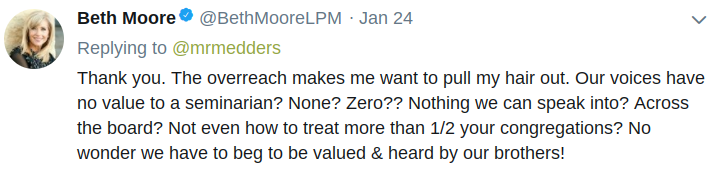
John Piper recently answered this question on an episode of Ask Pastor John. You should read his response for yourself (it’s not long), but, essentially his answer was that experienced pastor-mentors should be training up young pastors, and since it is unbiblical for women to serve as pastors themselves, they lack the experience necessary to mentor pastors-in-training. And, my word, the egalitarian world had a fit – including Beth Moore and her daughter Melissa (who helps run Beth’s ministry):

While I consider him to be a generally doctrinally sound brother in Christ, I’m not particularly a fan of John Piper, but I do want to say that I think his answer was taken wildly out of context by those pushing unbiblical agendas, that he was treated shabbily by many on social media, and that I thought his answer was very good, biblical, and just plain old made sense. Women are not qualified to serve as pastors. Why on earth would we want them training pastors? Moreover, what student wouldn’t want the most qualified and experienced professors he could get for his tuition money?

Let’s say you were the dean of the neurosurgery department at a medical school. A gentleman, totally blind from birth, comes in and applies for a position teaching surgical practicum (cutting, suturing, removing tumors, etc.). He has held positions teaching various subjects at other universities so his ability to impart information is not in question, but he has never performed surgery in his life because he’s blind. Would you hire him to train neurosurgeons to perform brain surgery?

The reason Dr. Piper’s answer caused a bit of a kerfuffle is that he limited his answer to the question he was asked. Imagine that. He was asked if women should train pastors and that’s the question he answered. The agenda-driven screaming neemies took his answer of “no” to mean that no woman should ever teach anything to anyone in any seminary anywhere ever. That is not what Dr. Piper said. He said women should not train men for the pastorate.

I would have answered the same way. However, if I were to expand on Dr. Piper’s answer, what I would further explain is that most seminaries (at least the ones I’m familiar with) do far more than simply train men for the pastorate. Take the seminary my husband attended for example, New Orleans Baptist Theological Seminary. If you’ll click on the “Academics and Admissions” tab at the top of the page and examine the various degree and non-degree programs, you’ll find that most of them are not strictly preaching programs. There are programs for women’s ministry and children’s ministry (Surely we wouldn’t say women are unqualified to teach in these areas?), college ministry, urban ministry, music ministry, missions, counseling, languages, and many more. There’s nothing wrong with women teaching things like music theory, finance, general education classes like math, history, and English, archaeology, legal issues, languages, business, etc., even in a seminary.

There are definitely some classes women shouldn’t be teaching in seminaries, but there are plenty of other classes that would be fine for them to teach.


Since we’ve become parents my husband and I have mostly attended churches that were larger and offered childcare. We were saved out of Mormonism eight years ago which has its own order of services and no childcare provided for the main service, but I don’t know what to expect from a Christian service that doesn’t offer childcare. I don’t know what will be expected of me and my family. I have a four-year-old and I worry that he will end up running around or asleep on the pew. Do we call ahead? Pack a busy bag? Are snacks alright? How do you ever get anything out of the service for yourself?

Before I answer, I want to encourage readers who are experienced church members to really let this precious sister’s question sink in and inform the way you respond to visitors and new members. Increasingly, the people who are new to your church will have very little church background. Church culture may be old hat to you, but it’s like landing on Mars to many of them. They have no idea where to go or what to do, and they don’t speak Christianese. Make sure you warmly welcome and encourage newbies and let them know that it’s OK to ask questions.

I think my article Churchmanship 101: Training Your Child to Behave in Church will help with some practical tips and expectations. You should not allow your child to run around the sanctuary during the worship service any more than you would allow him to run around a restaurant if you went out to eat, or a store if you were shopping, but I would not get overly stressed about him making a few minor noises or dropping the occasional Bible during church. If a church doesn’t offer childcare, they’re surely used to children making a little noise during the service from time to time. Sermon-time naps at four years old are not the end of the world, but you’ll want to curb those as he approaches school-age (if he can stay awake all day in school, he can stay awake for 30 minutes or an hour in church).

Until your child gets into the routine of attending worship and learns how you expect him to behave, you may not get very much out of the service. That’s just one of those parts of being a mom that we all have to accept – like stretch marks :0) But if you will be consistent and diligent as you train your child, he’ll get with the program soon enough.

When you ask if you should “call ahead”, if what you mean is calling the church office prior to Sunday and asking any questions you might have, that is a super idea! Most pastors I know would be delighted to chat on the phone or in person to welcome you to the church and help you feel at ease. That is the point at which I would ask about snacks. Different churches have different policies about food and drink in the sanctuary. I’ve never heard of one that wouldn’t allow a baby bottle, but some may not be keen on the idea of Cheerios ground into their carpet. You could also ask if they have a “cry room”. Some churches have set aside a room near the sanctuary where you can take a fussy baby or jumpy toddler. Many of them have the sermon “piped in” so you can listen until you go back into the worship service. You might also want to ask if the worship service is recorded and posted online so you can listen at home to any parts of the sermon you may have missed. Never be afraid to ask an honest and polite question.


I have been hearing the word messy a lot in reference to our lives..has this word replaced the word sin?

Well…I suppose it may have for those who are trying to sand off the sharp edges of the gospel, but the biblical term is sin, so that’s the correct word to use, despite how popular “messy”, or any other trendy word, might be.


Can you recommend any doctrinally sound female speakers for women’s events?

(I promise this is an actual question I recently received, not one I made up for promotional purposes! :0)

Yes, me. Click the “Speaking Engagements” tab at the top of this page for more information.

If I’m not really your cup of tea, or I’m too far away for your travel budget, I happily recommend any of the women listed under the “Recommended Bible Teachers” tab at the top of this page (although I’m not positive all of them do speaking engagements).


If you have a question about: a Bible passage, an aspect of theology, a current issue in Christianity, or how to biblically handle a family, life, or church situation, comment below (I’ll hold all questions in queue {unpublished} for a future edition of The Mailbag) or send me an e-mail or private message. If your question is chosen for publication, your anonymity will be protected.