Mailbag

The Mailbag: Potpourri (Calvinism, Baptism, Modesty…)

Welcome to another โ€œpotpourriโ€ edition ofย The Mailbag, where I give short(er) answers to several questions rather than a long answer to one question. I also like to take the opportunity in these potpourri editions to let new readers know about my comments/e-mail/messages policy. Iโ€™m not able to respond individually to most e-mails and messages, so here are someย helpful hintsย for getting your questions answered more quickly.ย Remember, the search bar can be a helpful tool!


I was very troubled by a recent stance the discernment ministry Lighthouse Trails has taken –ย calling Calvinism heresyย – and wondered if you had seen it. Itโ€™s one thing to just have a difference of opinion on Calvinism, but to put it this category?ยน

Yes, I saw it when they made the big announcement on social media a few months ago. I expressed my disappointment to LT and have decided, going forward, not to use their materials or point readers to them as a trustworthy resource. There are several reasons for this:

1. The tone used in most of the LT anti-Calvinist posts, comments, and articles was derisive and condemnatory at best. There is no place for that among Believers, regardless of their stance on Calvinism (frequent readers will note I don’t recommend Reformed resources that take this sort of tone either).

2. It was clear from the LT materials I read that they don’t even have a complete and accurate understanding of what Calvinism is. Indeed, some of what they addressed was not Calvinismย (which is biblical Christianity)ย but Hyper-Calvinismย (which is heresy). That does not speak well of a discernment ministry. You must have a correct understanding of a doctrine before attempting to address it biblically, especially if you’re going to come to the conclusion that something is “another gospel” (heresy) as LT did with Calvinism.

3. Addressing a doctrine they haven’t thoroughly researched, as well as anathematizing something that is clearly biblical Christianity (even if they don’t agree with it), calls the discernment and biblical understanding of the entire organization into question and casts doubt on LT’s previous and future evaluations of doctrine. In other words, if they’re going to make this egregious an error over such a simple – and settled – biblical construct, how can any of their conclusions on other, more nuanced aspects of theology be trusted?

Here are some additional resources you may find helpful:

What is Calvinism? by Maurice Roberts

Calvinism & the Bible by Brian Godawa

What’s the Difference Between Arminianism, Calvinism and Hyper-Calvinism?ย by Tom Ascol

Calvinism Is Not Hyper-Calvinism by Josh Buice


I had viewed the Gospel Message video embedded on your site and had concern for the presentation. It is apparent you have hermeneutical concern for today’s God study, so I wanted to clarify what your view may be on baptism.

I hold to a Reformed Southern Baptist, credo-baptist understanding of baptism. You can find further details at these links:

Statement of Faithย (tab at top of this page)

Basic Training: Baptism

(Remember, the search bar and the tabs at the top of the blog are your friends! :0)


I have only recently come to understand 1 Timothy 2:12. However, why do we so passionately receive verse 12, yet neglect verse 9? Why do people choose which parts of the Bible to obey?

No Christian should be making a conscious choice to disobey any command(s) of Scripture that pertains to Christians. Willful disobedience is sin which needs to be repented of, and might even indicate that the person is not saved. Genuinely regenerated Christians desire from the heart to keep God’s commands.

I am not sure whether your question is based on your own church (or local churches you’re familiar with) in which women embrace their biblical roles but are dressing immodestly, or if you’re seeing a lot of attention focused on verse 12 (in books, online articles, conferences, organizations, sermons, social media, etc.) and not as much on verse 9.

If it’s the latter, I would say that you’re seeing a lot of attention focused on verse 12 rather than verse 9 for the same reason you see firemen hosing down a house that’s on fire rather than hosing down one that’s not. When the day comes that celebrity “Christian” women get up on stage dressed immodestly, write books about how dressing immodestly is perfectly biblical, form organizations to push the immodest dress agenda, hold conferences extolling immodest dress, and encourage other women to dress immodestly as they worship, I think you’ll see the same kind of pushback with verse 9 that you’re seeing now with verse 12.

If what you’re asking about is women at your church who embrace their biblical roles but seem not to be obeying verse 9, first make sure you have a correct understanding of what verse 9 is talking about:

likewise also that women should adorn themselves in respectable apparel, with modesty and self-control, not with braided hair
and gold or pearls or costly attire,

a) The context of 1 Timothy, including chapter 2, is instructions for the gathering of the church. So, while Christian women should dress in a way that glorifies God at all times simply because we belong to Christ, this particular verse is about how we dress for church, not for a gala, the beach, or the gym.

b) “Braided hair and gold or pearls” are examples – much like head coverings – of specific things that were considered immodest in the time and culture in which 1 Timothy was written. If a woman comes to your church with her hair in a French braid or wearing an understated pearl necklace, she is notย necessarily dressing immodestly. There is nothing intrinsically immodest about gold, pearls, or braids, but rather the meaning a culture attaches to them or the statement they make in a particular venue.

c) The term “modest” has more than one meaning in this verse. It does mean to dress in a way that is not sexually provocative (“respectable apparel”). But in the same way we would use the phrase “a modest income” or “a modest home”, it also means to dress in a way that’s not flashy (which, in the first century meant bling like gold, pearls, and extravagantly braided hairstyles), and that doesn’t attempt call attention to yourself or show off your wealth (“costly attire”).

So, in this sense, a woman who walks into the average American church wearing a dress she got at Target is probably not dressing immodestly, whereas a woman who walks in wearing uber-expensive designer clothes, shoes, and handbag, and dripping with jewels probably is, necklines and hemlines notwithstanding. That goes for outlandish apparel or clothing that’s meant to grab attention as well. If your hair is three shades of green and fashioned into a unicorn horn, that’s going to be immodest in most churches. If you walk into church wearing scuba gear or a space suit, that also fits what this verse means by immodest.

In a nutshell, we’re to fit in, not to beย a distraction from worship with our clothes and coifs.ย You are not supposed to be the center of attention in church, God is.

If this is an issue with the women of your church in general, or with one woman in particular, set up an appointment with your pastor and get some counsel from him on the best way to address the situation.


I have a bone to pick with you.

This is a verbatim quote of the opening line of the reader’s e-mail. Normally, I would just hit “delete” without giving such rudeness the time of day, but I thought I’d make an example of it instead. Ladies, rudeness and displays of self-centered anger dishonor Christ, and if you’re e-mailing someone like me who struggles against the sin of impatience, you’re not only tempting a sister in Christ to sin, but you’re probably not going to get a hearing.

I have personally known [female Bible teacher you’ve written about] for over 30 years.

The name of the teacher is irrelevant, but it is not someone I’ve warned against nor whom I consider a false teacher. Additionally, this reader bases her defense of said Bible teacher (below) on knowing her personally and on the reader’s personal opinions and experiences, not on what Scripture says, which does not speak well of what she has learned from the Bible teacher. I don’t think the reader’s rudeness or her lack of biblical understanding are a fair representation of this particular teacher, so that’s another reason I’m leaving her name out.

She gets permission from her husband and her pastor [and the male head of her ministry] before she teaches with men in the audience…I have met some of the men on the board and they have no problem [with her] lecturing with men in the audience.

Please point me to the passage of Scripture, chapter and verse, that says a husband, pastor, or ministry head or board can give a woman permission to do something God has prohibited.ย No one has the authority to say “yes” where God has said “no.” I’ve addressed in detail this idea of a woman teaching men “under her husband’s/pastor’s authority” in my articleย Fencing off the Forbidden Fruit Tree.

Additionally, it does not matter how many people give approval to something or how important they are – that is not what makes something right or biblical. God is the arbiter of right and wrong, biblical and unbiblical, not people.

When you see the men in audience she is giving a lecture not teaching.

But you just said in the previous sentence, “She gets permission from her husband and her pastor before she teaches with men in the audience.” Which is it?

Furthermore, it doesn’t matter whether you call it preaching, teaching, lecturing, sharing, proclaiming, exhorting, or delivering a soliloquy, if it’s instructing men in the Scriptures in the gathered body of Believers, it violates 1 Timothy 2:12, and it’s sin.

The men chose to listen to [her] lead the lectures.

That’s true. That means that they areย also guilty of violating 1 Timothy 2:12, not that they are guilty and she is not.

You need to come to [one of this Bible teacher’s events]. You will see what is actually being done and said.

When I wrote the article you read about this Bible teacher, I provided videos of her teaching, quotes from her materials, and other objective, verifiable evidence of what she says, does, and teaches. That’s not “what is actually being done and said”?

I am basing my evaluation of this teacher’s words and actions on Scripture, not on my personal experience. I don’t need to be physically present at one of her events in order to do that.

[This Bible teacher] and other teachers: When [this Bible teacher] gets an invitation to speak she asks God if she should do it or not. So you need to ask God if [she] is sinning because she only goes wherever God sends her.

I believe what the reader is addressing here is that I have pointed out as unbiblical that the Bible teacher in question has joined in ministry activities with demonstrably false teachers.

God has given us His written Word. Whatever He might subjectively “tell” us in prayer does not override what He has objectively told us in the Bible. God gave His answer to her question about 2,000 years ago in 2 John 9-11, Romans 16:17-18, 2 Corinthians 6:14-18, and many other passages. If someone is invited to partner in ministry with false teachers, her answer is to be “no.” God is not “sending her” to partner with false teachers because He has already instructed her not to do that in His written Word. And if she is so learned in the Scriptures that she’s qualified to be a Bible teacher, she should already know that without having to ask Him. And if you’ve known her for thirty years, she should have taught you that by now as well. I don’t need to “ask God if she is sinning,” I only have to open my Bible and read what He’s already said about it.

Before you say anything about a Christian speaker you need to do more research and go to that ministry personally.

“More research” meaning, “keep researching until you agree with me”? I did multiple hours of research on the article you read. I sufficiently substantiated every point I made with Scripture and accurate, verifiable evidence from the teacher’s own words and actions.

As I previously stated, my conclusions about the Bible teacher are not based on my personal experience, so there is no need for me to visit the ministry in person. If you’re alluding toย Matthew 18:15-20, that passage does not apply to commenting on and evaluating a teacher’s publicly available statements and materials as I’ve explained in detail in my articleย Answering the Opposition- Responses to the Most Frequently Raised Discernment Objectionsย (#1).


ยนPlease note, I do not participate in, nor provide a forum in the comments section for, Calvinism-Arminianism debates. Please refer to the Welcome tab (top of this page) for comment guidelines before commenting.

If you have a question about: a Bible passage, an aspect of theology, a current issue in Christianity, or how to biblically handle a family, life, or church situation, comment below (Iโ€™ll hold all questions in queue {unpublished} for a future edition ofย The Mailbag) or send me anย e-mail or private message. If your question is chosen for publication, your anonymity will be protected.
Mailbag

The Mailbag: Potpourri (Spanking, Women teaching men, Working a homosexual “wedding”…)

Welcome to another โ€œpotpourriโ€ edition ofย The Mailbag, where I give short(er) answers to several questions rather than a long answer to one question. I also like to take the opportunity in these potpourri editions to let new readers know about my comments/e-mail/messages policy. Iโ€™m not able to respond individually to most e-mails and messages, so here are someย helpful hintsย for getting your questions answered more quickly.ย Remember, the search bar can be a helpful tool!


Can you share some Scripture with us that supports the idea that spanking is not abuse? I am genuinely curious as I have a young toddler of my own and go back and forth between the idea of spanking or not spanking.

The first way we know that a loving, properly administered spanking by godly parents is not abuse is that God would not tell us to do it if it were. The God who does not even want us abusing animals (see passages like Proverbs 12:10, Exodus 23:5, Deuteronomy 25:4) would certainly never tell us to abuse our children.

To equate proper spanking with abuse or to pejoratively call spanking “hitting” is a worldly idea, not a biblical one. The world’s (Satan’s) agenda is to get people to believe that spanking is abuse so that they will stop doing it. Since spanking began falling out of favor several decades ago, the cumulative result has been a greater number of children sinning with impunity and not being brought up in the discipline and instruction of the Lord, which is exactly what Satan wants. (Yes, I understand that is a general statement. There are always exceptions, but exceptions don’t negate the rule.) Christians parents might choose not to spank, but they may notย biblicallyย accuse others of abuse who choose to spank.

Beyond that, let me direct you to some resources that not only give you the Scriptures but give instruction in those Scriptures as well:

What the Bible Teaches About Spanking by Denny Burk (there are several additional resources linked in this article)

Capitol Hill Baptist Church Core Seminars: Parenthood Class 7- The Rod of Correction

Parenting in an Anti-Spanking Culture by John MacArthur

Shepherding a Child’s Heart by Tedd Tripp

How should Christians discipline their children? What does the Bible say? at Got Questions


We occasionally have guest speakers at our Wednesday church services that worry me. Charlotte Gambill [co-lead “pastor” of LIFE “Church”] for instance. I am a firm believer that women should not be teachers of Scripture to men, but I guess my question is this, should I leave my church because this is allowed in these Wednesday evening gatherings?

Well…I mean, I don’t mean this to sound facetious or anything, but sin is sin no matter what time of day or day of the week it takes place on. While there are certain circumstances in which it might be biblically appropriate for a woman to address a mixed gathering of Believers, preaching and teaching Scripture during a worship service is not one of them. And certainly no church or other Christian organization should be affirming a female “pastor” in her sin by inviting her to be a guest speaker for any sort of event.

I would not just quietly slip out the door, though. Set up an appointment to discuss the matter with your pastor. (You might want to use the principles and suggestions in my articleย How should I approach my church leaders about a false teacher theyโ€™re introducing?ย as a guide.) His response about the matter will probably tell you everything you need to know about whether or not you should begin looking for a new church.


Do you have a page on your website on how you verbally share the gospel with others?

I don’t recall ever having written an article on my approach in witnessing, but here’s what I would recommend.

1. Listen to Todd Friel’s Witness Wednesday every week on Wretched Radio. Todd is very good at opening up conversations with random strangers and quickly transitioning to a gospel presentation. (You might also want to order the resource Terrified.)

2. Watch the witnessing encounters in Ray Comfort’s Living Waters Universityย YouTube videos. Ray has a standard (nearly the same, verbatim, every time) way of presenting the gospel and makes it look so easy!

These are the guys I attempt to emulate when witnessing as I trip all over my tongue and stammer around. You would do much better to follow their example than to follow mine.


If a Christian has a job as a banquet server doing weddings and one day thereโ€™s a gay wedding and the person is scheduled to work, would that be sinful to work and serve guests at the gay wedding? Would you say this is just like a Christian baking a cake for a gay wedding or is it different?

I think this is different. A business owner has the freedom to choose which jobs and clients he will accept and which he will not (at least, in America, he isย supposed to have this freedom). An employee does not have any say so in which clients the business will and won’t serve. So, the employer is serving the client, but the employee is serving the employer.

If you feel uncomfortable working at homosexual “weddings,” try talking to your boss about it. Maybe you could volunteer to work a different shift, or in a different position in the business that would not require you to work at weddings. If your conscience bothers you a great deal about it, that’s totally understandable, and you might want to begin looking for a new job. Set up an appointment with your pastor for biblical counsel on this situation if it’s a decision that’s really weighing on you.

Basic Training: Homosexuality, Gender Identity, and Other Sexual Immorality

Should Christians Attend Homosexual โ€œWeddingsโ€?


I know women should not be pastors, but is it OK for women to teach men Scripture outside of church?

It depends on what you mean by “teach Scripture” and “church”. If you’re asking about sharing the gospel with someone, that’s not teaching Scripture to men in the church, it’s evangelizing those outside the church, and that’s fine. If you’re talking about teaching a Bible study to a mixed group in someone’s home, we need to remember that the church is not a building, it’s Believers, and that the churches in existence when 1 Timothy 2:12 was written were meeting in homes. So, that would be a “no.”

I think my article Rock Your Role FAQs might be helpful as you explore this more.


What do you think about _____ teacher, author, or ministry? Is he/she/it doctrinally sound?

I’m so sorry I don’t have the time to research all the teachers and ministries I’m asked about. If you’re trying to find out whether or not you should be following a certain person or organization, I encourage you to do the research and find out. Here are the steps I take when researching someone:

Is She a False Teacher? 7 Steps to Figuring it Out on Your Own


If you have a question about: a Bible passage, an aspect of theology, a current issue in Christianity, or how to biblically handle a family, life, or church situation, comment below (Iโ€™ll hold all questions in queue {unpublished} for a future edition ofย The Mailbag) or send me anย e-mail or private message. If your question is chosen for publication, your anonymity will be protected.
Complementarianism

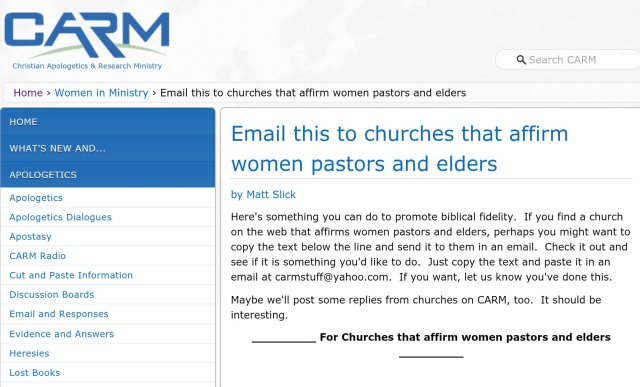
CARM Resource on Female “Pastors”

CARM has a great resource for sharing biblical truth about female "pastors".


Are you familiar with the Christian Apologetics & Resource Ministry (CARM)? You should be. It’s an invaluable resource. From answers to tough questions, to apologetics training, to information on tons of cults, world religions, and heresies, CARM is a treasure trove of materials that will inform you, help you grow in your faith, and evangelize and disciple others.

Recently, I came across this resource article for churches which approve female pastors and elders. Readers often ask me for information like this that they can send out, so I thought I’d pass it along. Click here for the full article.

Christian women, Church, Discernment

And the top article of 2015 is…

At the end of the year lots of bloggers re-publish their top post(s), so I thought I’d jump on the bandwagon. Nine Reasons practically went viral this year (well, viral for me, anyway) with a whopping 100,000 views, followed by:

Leaving Lysa: Why You Shouldnโ€™t Be Following Lysa TerKeurst or Proverbs 31ย Ministries

Five Reasons Itโ€™s Time to Start Exercising โ€œMooreโ€ Discernmentย (Beth Moore)

Going Beyond Scripture: Why Itโ€™s Time to Say Good-Bye to Priscilla Shirer and Going Beyondย Ministries

and

10 Biblically Sound Blogs and Podcasts by Christianย Women

rounding out the top five articles of 2015. And now, without further ado, I bring you my top article of 2015:
9 disc women leave

Earlier this week, Thom Rainer, president and CEO of LifeWay, pubished a blog article entitled “Six Reasons Why Women May Be Leaving Your Church.” Although I am not particularly a fan of Dr. Rainer (due to his allowing heretical materials to be sold at LifeWay), I thought this article was a good one, and I agreed with several of the issues he raised, especially, that these issues need to be addressed by church leadership.

As a ministry wife and someone in the field of women’s ministry myself, I, too, have noticed women leaving the church. Not just women in general, but a certain subset of church-attending ladies: discerning women. While Scripture is pretty clear that we can expect women (and men) who are false converts to eventually fall away from the gathering of believers, why are godly, genuinely regenerated women who love Christ, His word, and His church, leaving their local churches?

1. Eisegetical or otherwise unbiblical preaching
Discerning women don’t want to hear pastors twist God’s word. The Bible is not about us, our problems, and making all our hopes and dreams come true. We don’t want to hear seeker-driven or Word of Faith false doctrine. We don’t need self-improvement motivational speeches or a list of life tips to follow. We want to hear a pastor rightly handle God’s word from a trustworthy translation and simply exegete the text.

2. The worship hour has become a variety show
Skits, guest stars, movie clips, dance routines, rock concerts, elaborate sets, light shows, and smoke machines. We didn’t sign on for Saturday Night Live on Sunday. This is supposed to be church. Get rid of all that junk, turn the lights on, give us solid preaching, prayer, and some theologically sound songs we can actually sing, and maybe we’ll stick around.

*3. Women in improper places of church leadership
The Bible could not be more clear that women are not to be pastors, instruct men in the Scriptures, or hold authority over men in other capacities in the church. If your church has a female pastor, worship leader, or elders, or if women are teaching and leading men in Sunday school, small groups, or from the platform in the worship service, or if women are heading up certain committees, departments, or ministries which place them in improper authority over men, you’re disobeying Scripture, and we don’t want to help you do that by attending your church.

4. Children are being entertained, not trained
There’s nothing wrong with a bit of play time or crafts for younger children, but we want our children trained in the Scriptures, not entertained for a couple of hours. We want their teachers to open God’s word and read and explain it to them at a level they can understand. We want them memorizing verses, learning to pray, and demonstrating an age-appropriate comprehension of the gospel. We want them to understand that church is joyful, yet, serious, not a Jesus-laced party at Chuck E. Cheese. We need church to bolster the Scriptural training we’re giving our kids at home.

5. Women’s “Bible” Studies
The majority (and I don’t use that term flippantly) of churches holding women’s Bible studies are using materials written by Beth Moore, Priscilla Shirer, Joyce Meyer, Lysa TerKeurst, Sarah Young, and others who teach unbiblical ideas and false doctrine. Not minor denominational differences of opinion. Not secondary and tertiary unimportant issues that can be overlooked. False doctrine. While we long to study God’s word with other women, discerning women will not sacrifice sound doctrine nor the integrity of Scripture to do so.

6. Ecumenism
Is your church partnering with other “churches” whose orthodoxy and/or orthopraxy are at odds with Scripture? “Churches” which approve of homosexuality or female pastors, or which hold to an unbiblical soteriology (grace plus works, baptismal regeneration, Mary as co-redemptrix with Christ, etc.)? Are you partnering with those who deny the biblical Christ altogether such as Muslims, Jews, Jehovah’s Witnesses, Hindus, Mormons, or Buddhists? Discerning women know Scripture forbids yoking ourselves to unbelievers and we want no part of it.

7. Ageism
Look around at your pastor and staff, your lay leadership, your music team, the “face” of your church. How many of those people are over 40? Usually, discernment and spiritual maturity come through walking with the Lord over many years, yet, increasingly, churches are run by twentysomething pastors, staff, and other leadership, who are often spiritually immature and/or lack the wisdom and life experience that come with age. The counsel and wisdom mature, godly men and women have to offer is brushed off as old fashioned, and middle aged and older church members feel alienated and unwanted. Discerning women value the wisdom and teaching of their godly elders.

8. The “troublemaker” label
Discerning women who see unbiblical things happening in their churches and stand up for what God’s word says about biblical ecclesiology and teaching are often villified and labeled as troublemakers. We are called haters, threats to unity, complainers, gossips, negative, and a myriad of other scornful names. All this for wanting things done according to Scripture. Can you blame us for shaking the dust off our high heels and leaving?

9. Spineless or stiff-necked pastors
Discerning women have little respect for, and find themselves unable to submit to the authority of pastors who see people in their churches acting overtly sinful or propagating false teaching yet are so afraid of confrontation that they will not set things right. By the same token, we cannot continue to attend a church in which we bring scriptural evidence of false teaching or sin to the pastor and he outright denies the biblical truth we present to him. We cannot be members of churches in which pastors will not submit to Scripture or carry out biblical mandates.


Frequently, the discerning women you see tearfully leaving your church have been there for years. Sometimes they leave your church because it was never doctrinally sound to begin with, and God has opened their eyes to this as they grow and mature in Christ. Sometimes they leave because false doctrine and unbiblical practices have crept in and taken over a church that was once a refuge of trustworthy biblical teaching. Either way, these things should not be.

Maybe it’s not that discerning women are leaving the church**, but that the church is leaving them.


*If you disagree with this point and are considering writing a comment arguing that women SHOULD be pastors and have other unbiblical positions of leadership, please save yourself some time, because I will not be printing it. As it says in my “welcome” tab (top of this page), I do not print false doctrine without refuting it, and at the moment, I do not have the time. If you are truly interested in what the Bible ACTUALLY says about the proper role of women in the church, click here and explore the Scriptures that address this topic.

**While it may be necessary to leave a church that is not operating biblically, Hebrews 10:24-25 makes it clear that meeting together for worship and the teaching of God’s word is not optional for Christians. Please see my follow up article, Six Ways Not to Forsake the Assembly for more on this topic.


I’ve closed comments for this article since it’s a reprint, but you can comment at the original article if you’d like.


Rock Your Role

Rock Your Role: Jill in the Pulpit? (1 Timothy 2:11-12)

Rock Your Role is a series examining the โ€œgo toโ€ and hot button Scriptures that relate to and help us understand our role as women in the church. Donโ€™t forget to prayerfully consider our three key questions
as you read.

Let a woman learn quietly with all submissiveness. I do not permit a woman to teach or to exercise authority over a man; rather, she is to remain quiet.
1 Timothy 2:11-12

I’ve never met a Christian woman, who, upon reading these verses for the first time joyfully embraced them without the slightest hint of balking, surprise or, “Wait, what?”. I have no doubt that such women are out there, somewhere, it’s just that I’ve never met one of them.

For 21st century American Christian women, these are hard verses. Whether you’re old enough to remember bra burnings and hard line feminists like Gloria Steinem and Jane Fonda or you were born into a world replete with female engineers, construction workers, and urologists, you’ve probably been inundated with the “anything boys can do, girls can do better” message since the doctor announced, “It’s a girl!”

And that’s exactly why this passage seems to us like a cold bucket of water. It’s what we bring to the table, our presuppositions, that make these verses feel like a big, fat, arbitrary “no” from a God who just wants to spoil our plans, when everything else in the world says “yes” to whatever we might aspire to.

I’ve struggled with God’s instruction in these verses, trying to stretch it, Silly Putty style, into what I wanted it to mean, so that I could do what I wanted to do and still be “covered” biblically. And, ladies, let me tell you something- that is a sinful, wicked, self-seeking, and self-centered way of approaching this or any other Scripture. An approach from which I have had to repent many, many times.

Looking for loopholes and exceptions and trying to see how close to the line of sin we can get without actually putting a toe over is a characteristic of a carnal mind, not a mind set on pleasing God. Godly women don’t look for ways to get around Scripture. Godly women look for ways to obey Scripture. It’s God’s desire that we flee as far away from sin as we possibly can, and, instead, “pursue righteousness, faith, love, and peace.” He wants us to love, embrace, and obey His word, not rebel against it, even in our hearts, even in the name of “ministry” or “serving God.” So let’s keep that in mind as we take a look at this passage.

Has the Lord as great delight in burnt offerings and sacrifices, as in obeying the voice of the LordBehold, to obey is better than sacrifice, and to listen than the fat of rams. For rebellion is as the sin of divination, and presumption is as iniquity and idolatry. 1 Samuel 15:22-23a

As always, we must examine every biblical passage in context, which means we need to start off by understanding a little background about the book and its author, and by reading the whole chapter.

First Timothy (along with 2 Timothy and Titus) is one of the pastoral epistles. It was written by Paul to young pastor Timothy as sort of a job description and operations manual for pastors, elders, and the church. So right off the bat, an important point we often miss about 1 Timothy is that it was written to a man, Timothy, a pastor, who would use this letter to train his elders (also men) and, subsequently, his congregation. That doesn’t mean that 1 Timothy doesn’t apply to women, or shouldn’t be studied by women, or that women aren’t required to obey 1 Timothy. It just means that when we open the letter of 1 Timothy, we need to understand that we, as women, are reading somebody else’s mail. Mail that pertains to us, yes, but mail that’s addressed to Timothy, and by extension, to pastors and elders today. That will help us better understand the tone and perspective of the passage.

The focal verse of this chapter is verse 4

God our Savior, who desires all people to be saved and to come to the knowledge of the truth.

Everything else Paul talks about in chapter 2 revolves around the idea that God wants to save people. He wants the church to pray for people, including governmental officials so that they will be saved. Paul was appointed a preacher and apostle so that people might be saved. Men shouldn’t detract from the gospel by quarreling or anger so that people can be saved. Women’s attire should not distract from the preaching of the gospel, and their good works should point people to the gospel so that people can be saved.

And, finally – an exhortation to men – Timothy and the elders are to allow women to be taught the gospel so that they might be saved. See that word “let” right there at the beginning of verse 11? Timothy and the elders have the responsibility to step up and make sure women are allowed to come into the church and be taught the gospel. That’s something we take for granted now, but in a time when women were routinely regarded with the same value and intelligence as a stick of furniture or the family cow, this was huge. This just reinforces what we learned from Galatians 3:28: everybody is welcome at God’s table. There are no second class citizens in God’s kingdom. God wants to save women, too. We modern women rarely appreciate how precious this concept would have been to first century women hungry to know and be known by God. And the men were to make sure it happened.

But, as Jesus said, “to whom much was given, of [her] much will be required.” The men had the responsibility to make sure women were taught God’s word so they could be saved and grow spiritually, but the women had the responsibility to listen, learn, and conduct themselves in a way that would not hinder others (or even themselves) from learning and hearing the gospel.

Paul goes on to explain in verse 12 what he means by “quietly with all submissiveness”: Women are not to teach men or exercise authority over them. In the first century church, this would have been relatively easy to understand, since church services were fairly simple and didn’t include programs, parachurch organizations, Christian conferences, etc. But in our day, perhaps a little more explanation would be helpful.

Teaching includes any situation in the gathering of the body of Christ in which women would be giving instruction to men in the Scriptures and/or on spiritual matters (which, in a biblical church gathering, would necessarily include Scripture), whether in an official position of teacher (pastor, teaching elder, Sunday School/Bible study teacher, or other leadership position) or any other situation requiring exhorting, teaching, or explaining of the Scriptures.

Exercising authority includes any official position (pastor, pastoral positions, certain committee positions, elder, teacher, director, or other leadership position) or other situation which places a woman in charge of, over, or responsible for men or places men in a role subordinate to a woman.

But why? Why would God reserve the positions of teaching and authority over male or mixed groups to men? He gives two reasons in verses 13-14. God’s design for male headship, and Eve’s deception and sin.

For Adam was formed first, then Eve– Starting with Creation (not the Fall), God began laying out the pattern of male headship in the foundational institutions of His kingdom: Creation, the family, and the church. Man was created first, woman second. Man was given authority over Creation, woman was specifically created for him, to be his helper. We also see male headship in the family. God requires husbands to take the primary leadership role and wives to submit to and respect their husbands.

And, finally, we see God’s design for male headship in the church, not only in overt passages like 1 Timothy 2 and 1 Corinthians 14, the description of qualifications for pastors and elders, and the precedent of male leadership in the Old Testament temple, but also in the beautiful picture of Christ, the bridegroom, as head of the church, His bride, who lovingly submits to Him. Starting with the very first man and woman, before sin entered the world, God initiated a pattern of male leadership.

And Adam was not deceived, but the woman was deceived and became a transgressor– Here, Paul reminds us that, when Eve listened to the serpent, she stepped out from under her husband’s oversight, was deceived, and sinned. Eve’s sin reminds us that she not only was deceived into rebelling against God’s command about eating the fruit, but she also broke His design for male headship in marriage. In establishing male leadership in the church, God is recalling, reflecting, and restoring His pattern of male headship that started in the Garden.

But I’ve been taught that 1 Timothy 2:12 only applied to the particular time and culture in which it was written.

No, that’s not the case. We’ve just seen that clearly spelled out in verses 13-14. God explains exactly why He’s delegating the teaching of men, and authority over men, to men. There’s nothing in these two verses that even hint that this command is temporary or restricted to the women in the first century Ephesian church. The first reason was the Creative order โ€“ Adam was formed first, then Eve. The second reason is that Eve was deceived. Both of those reasons are universal (applying to all women and churches everywhere regardless of era or culture). It makes no sense that these two reasons related to Eve would apply only to first century Ephesus any more than it would make sense for them to apply only to tenth century Damascus or seventeenth century Paris.

Next, again, we examine the context of 1 Timothy 2. There are all sorts of instructions to the church in that chapter. Was the instruction to pray for governmental leaders (1-2) limited to the first century Ephesian church? Were only the men of the first century Ephesian church to pray without quarreling (8)? Was modesty (9-10) only required of women in the first century Ephesian church? Then why pick out this one instruction in verse 12 and claim it was limited to that time and culture?

Finally, look at the overall general pattern of male headship and leadership in Scripture. First human created? A man. The Patriarchs? As the word implies โ€“ all men. Priests, Levites, Scribes? Men. Heads of the twelve tribes of Israel? Men. Major and minor prophets? Men. All kings of Israel and Judah? Men. Noahic, Abrahamic, Mosaic, and Davidic Covenants? All established between God and men. Authors of Scripture? Men. The forerunner of Christ? John the Baptist โ€“ a man. Messiah? A man. All of the apostles? Men. All of the pastors, elders, and deacons of churches in the New Testament? Men. Founder and head of the church? Christ โ€“ a man. Leader and head of the family? Men. Now which fits better with this pattern, women preaching to, teaching, and exercising authority over men in the church, or women not preaching to, teaching, and exercising authority over men in the church?

But what about women in the Bible who served in leadership roles like Deborah, Esther, or Priscilla? Doesn’t that mean it’s OK for women to preach, teach men, and exercise authority over men in the church?

No it doesn’t. The Bible does not contradict itself because its author, the Holy Spirit, doesn’t contradict Himself. If you’d like to read more about how Deborah, Esther, Priscilla and other women of the Bible were actually acting in obedience to God’s role for women, please read my article Rock Your Role: Oh No She Di-int! Priscilla Didnโ€™t Preach, Deborah Didnโ€™t Dominate, and Esther Wasnโ€™t an Egalitarian.

But I’ve been told it’s OK for women to teach co-ed Bible classes or preach to co-ed audiences as long as they don’t hold the office of pastor and as long as they’re preaching/teaching “under the authority” of their husband and/or pastor.

No, that’s not OK with Scripture. First Timothy 3 and Titus 1 restrict the office of pastor to biblically qualified men, but, as we’ve seen in this article, 1 Timothy 2:12 prohibits women from carrying out two of the functions of pastors (preaching/teaching the Bible to men, and exercising authority over men) as well, and neither 1 Timothy 2 nor any other passage of Scripture gives husbands or pastors the authority to grant women permission to violate God’s Word. For more information on this question, see my article Fencing off the Forbidden Fruit Tree.

In God’s perfect plan, Janes and Jills are not to serve as pastors. They are not to preach to or teach men at Christian conferences or other gatherings of the body of Christ. They are not to teach co-ed Sunday School classes. They are not to serve in positions or places of authority over men in the church.

But even though we daughters of Eve bear the taint of her reproach in this small way all these years later, God has graciously provided us with many, many ways to redeem the name of womankind by serving Him if we “continue in faith and love and holiness, with self-control.” (15) One of those ways is the gospel influence mothers are able to have in their children’s lives. Think about it. Samuel had a godly mother. Timothy had a godly mother and grandmother. Jesus had a godly mother. It is no small thing to pour the gospel into your children and raise them up to be mighty men and women of God.

So, ladies, let’s stop clinging to the fence God has placed around the pulpit, bemoaning the fact that He doesn’t want us to cross it, and trying to figure out a way to sneak over, under, or around it. If we’ll just turn around and leave that fence behind us, we’ll find a wide open field of opportunities to serve God in His church, His way.

Photo courtesy of Our State.
If you’re wondering about the title of this article, this is called a Jack-in-the-Pulpit.


Additional Resources:

Rock Your Role FAQs

Women in Ministry and the Authority of Scripture by Mike Stone

No, Women Can’t Preach by Scott Aniol

The Role of Women from Grace Community Church’s doctrinal distinctives

Women Pastors are a Fundamental Problem for Southern Baptists by Gabriel Hughes (The bulk of this article is an exegesis of the Scriptures dealing with the biblical roles of men and women in the church and is not specific to Southern Baptists.)

Ten Things You Should Know About 1 Timothy 2:11-15 and the Relationship Between Men and Women in the Local Church at The Council on Biblical Manhood and Womanhood (CBMW) This is a refutation of the most common egalitarian arguments against the plain meaning of 1 Timothy 2:11-15.

Why Women Should Not Teach the Bible to Men by Josh Buice

Will the Next SBC Resurgence Include a Redefining of Complementarianism? by Tom Buck The springboard issue for this article series was the movement to elect a female president of the Southern Baptist Convention, however, it is largely an exposition of the text of 1 Timothy 2:11-15. Regardless of whether or not you’re familiar with this issue, and even if you’re not Southern Baptist, these articles are helpful and easy to understand. Part 1  Part 2  Part 3  Part 4

Only Men May be Pastors at Founders Ministries

What Does It Mean That Women Should โ€œRemain Quietโ€ in Church? at Crossway

Why Asking Women to Preach Is Spiritual Abuse by Josh Buice

Should Women Be Pastors? by Virgil Walker

Has God Really Said on the Just Thinking podcast

The Paul-Side Gambit: How A Proper Understanding of Apostolic Authority Defeats Womenโ€™s Ordination by Chris Rosebrough