
Christian women, Complementarianism

Toxic (Evangelical) Femininity

Toxic masculinity. It’s a buzzword that’s gaining momentum as it’s bandied about in pop culture like a shuttlecock over a badminton net. There’s a clinical definition of the term (which, in the ivory towers of the scholarly world is, properly, “hegemonic masculinity“):

Hegemonic masculinity is defined as a practice that legitimizes men’s dominant position in society and justifies the subordination of women, and other marginalized ways of being a man. Conceptually, hegemonic masculinity proposes to explain how and why men maintain dominant social roles over women, and other gender identities, which are perceived as “feminine” in a given society.

And then there’s the sort of similar working definition of the huddled masses: Anything a man does that others, especially women, don’t like that can, by any stretch of the imagination, be blamed on the fact that he’s a man.

If a man cuts you off in traffic, it’s not that he’s a jerk or didn’t see you, it’s toxic masculinity. If a man holds a door open for a woman, it’s not that he’s polite and helpful, it’s toxic masculinity. If a man leaves his socks on the bathroom floor, it’s not that he’s sloppy and has no home training, it’s toxic masculinity. In other words, he’s not doing these things because he’s a polite or rude or aggressive or helpful human being, it’s because he’s a man who just wants to keep women down and exercise dominance over them.

Pardon my French, but what a bunch of malarkey.

Yes, I’m sure there’s a fringe element of men out there whoย consciouslyย think they’re better than women, that women shouldn’t have any rights or hold any positions of responsibility, blah, blah, blah. And you know what? They’re considered fringe kooks, and rightly so. But I’m not buying this business of these elitist gnostics telling us that every little move a man makes is a subconscious act of belittling women or exercising domination over them, and neither should you. It’s like the race-baiters who say that every single white person is racist, deep down, and this latent racism manifests itself in everything we do, from the way we tie our shoes to the breakfast cereal we buy at the store. We’re just not aware of it, supposedly.

Poppycock.

You want to know where this notion of toxic masculinity came from? It sprang from the loins of toxic feminism. Zoom out and look at the big picture. This is a manufactured concept, baptized in the (assumed) credibility of academia, designed to help women leverage power and control over men. How? By denigrating them at every turn, thereby convincing the world that men are intrinsically bad and women are good and must be elevated to prominence. Call me crazy if you want to, but it doesn’t take a prophet or the son of a prophet to look down the road and see that the feminist end game here is a matriarchal world where women rule and men drool. And there are plenty of brazen females out there who would openly and unashamedly admit this.

That, however, is not my concern. Sinners gonna sin, and God’s going to deal with them in His own way and in His own good time.

My concern is the way this attitude is fleshing (pun intended) itself out in Christian families and the visible church, and creeping into evangelical women’s (and men’s) hearts. Because, whether or not we’d like to admit it, this worldliness is advancing upon us, and we need to be aware of – and biblically approach – the facets of this issue that are already at our doorstep:

On the Top of the World Looking Down on Creation

I actually laughed out loud when reading some of the academic definitions of so-called toxic masculinity. There seemed to be an air of, “We just don’t understand it! This pattern of male dominance seems to transcend all cultures and time periods!”

Well here’s a really academic response to that: Duh.

I mean, you have to wonder if these researchers and scholars have ever said toย  themselves, “I wonder if there’s a reason for that. I wonder if this tendency in men that defies time and culture can be traced back to a pinpointed source.”

There is, and it can. It’s called Creation, and God is the one responsible. God created man first and then woman. God created husbands to lead and wives to be helpers. God set up the Old Testament patriarchal society that became the nation of Israel, which was led by male tribal heads and, later, male kings. God established male leadership in the temple, and subsequently, in the church. The major and minor prophets were male, Jesus was male, the apostles were male, the writers of Scripture were male. And all of this traces back to that one moment in Genesis 2 in which God decided to create man first and hard-wire him to lead, protect, and git ‘er done. Broadlyยน speaking, the reason we see a generalยน pattern of male leadership across time and culture is because God set those wheels in motion.

As Christians, we recognize that sinful men sometimes abuse the positions of leadership God has given them, but that doesn’t negate the entire pattern and call for us to turn it on its head. We study our Bibles and embrace and submit to the way God has instructed men and women to behave in the roles He has bestowed upon us.

(Don’t) Do the Woke-Emotion

One of the components of God’s creative work that adds inexplicable beauty to this world is the tender-heartedness, passion, and empathy He built into women in a uniquely feminine way. Emotions. Feelings. God created them, and they areย good. What a dreary and heartless world this would be if women didn’t bring nurturing, caring, sympathy, and love to the table. God uses us to soften the hard edges of life and make the planet pleasantly inhabitable.

But along with that good gift comes the challenge to steward it wisely and in obedience to God so that we may use it to glorify Him rather than dishonoring Him.

I see Christian women wisely stewarding their emotions to the glory of God every day as they care for their husbands and families, friends and co-workers, and serve in their churches. It is a beautiful picture of the mature fruit of biblical womanhood.

Unfortunately, I also see the exact opposite. I see (ostensibly) Christian women who scream like banshees any time their pastor preaches on the passages of Scripture dealing with women’s roles in marriage or the church. I’ve seen women who claim to believe and follow the Bible throw an everloving fit when someone points out – from Scripture – that their favorite women’s “Bible” study author is a false teacher. I see women formulating their beliefs and practices about God, worship, the Bible, their own behavior, their families, and their churches based on their own personal opinions, experiences, and feelings rather than on rightly handled Scripture.

And, just like secular feminists demand domination over men because they feel oppressed, have experienced sexism, or resent the world’s history of male dominion, I see Christian women letting their emotions rule the day as they demandย unbiblical solutions to their real or perceived personal experiences with men and male leadership.

The anger, the outrage, the hurt feelings, and being offended are nearly as evident in evangelicalism as they are in society at large.

Godly women are not ruled by their feelings. We are ruled by the Bible. We make our feelings submit to and obey God’s Word. We don’t make decisions based on what we like or don’t like, or what makes us feel good about ourselves. We base our decisions on what the Bible says. When our feathers get ruffled, we take a step back and evaluate the situation with rightly handled Scripture. Maybe we’re upset because someone actually sinned against us, but maybe we’re upset because our pride or vanity was wounded, or our unbiblical notions were biblically challenged, or because God used someone to expose an idol we’re worshiping. Maybe it’s not that the other person sinned, but that we’re in sin. Those hurt feelings could be a wake up call from God to humble ourselves and repent.

Ladies, weย must learn to put our feelings aside and act on the objective truth of God’s Word instead of our fickle and deceptive emotions. If we display the same sorts of fleshly emotionalism as unsaved women, how are we being salt and light in the world, pointing the way to Christ? We’re supposed to be set apart and different from the world.

Why Can’t a Woman Be More Like a Man?

Because – speaking of salt and light – embracing and submitting to our biblical roles in the family and in the church sets us apart from the world. Now, more than ever, we have a unique opportunity to be counter-cultural – simply by obeying God’s Word.

Women being hired as pastors and teaching and exercising authority over men in the church and leading denominations and becoming popular evangelical conference speakers with co-ed audiences – that’s what the worldย expects because that’s the way they do things. But a Christian woman who happily puts her foot down and refuses to teach men in the church setting or joyfully insists on submitting to her husband? That’sย different. It’s against the grain, not the norm.

Remember that out of the ordinary burning bush that caught Moses’ attention and he turned aside out of curiosity to investigate? And remember how, when Moses was watching it burn, wondering what in the world was going on, that God called to him out of that fiery shrub – “Follow Me.”? God can do the same thing with our obedience to Scripture.

Lost people see this anomaly of our “weird” behavior, and they want to know what in the world is going on. Why do we act differently than they do? And that’s when we get to explain it to them. We get to share the gospel. God can call to them out of our passionate burning for Christ and His Word, “Follow Me.”.

People in darkness gravitate toward light. Salt makes people thirsty. Do we care more about giving them the Light of the World and the Living Waterย or our own selfish and fleshly desires for power and position? Our embrace of and obedience to the biblical roles God has laid out for us as Christian women is one gateway to sharing the gospel with the lost.


Toxic femininity is worldlyย and fleshly. It has no place in Christian homes and churches. How do we combat it? We take up the sword. We submit to the authority and sufficiency of Scripture. We recognize that God is the authority in our lives, not self, and that we are to obey Him at any cost – even at the cost of our convenience and pleasure. We trade our desires for His.

ยนI’m well aware that there are plenty of exceptions to this generalization. I’m referring to a broad pattern across time and culture, here. There are many biblical ways women can contribute and lead in the family, society, and the church.
Mailbag

The Mailbag: I’m a female executive in the workplace. Is this OK with God?


Women executives and managers in the secular workplace…. I have been battling this and feel I should no longer have the position. My husband is not quite in agreement. I want to honour God. I have been in upper level management since I was 25 years old- 33 years…. About two years ago God started to deal with me here. I do not have a peace.

I’m a tad bit unclear on your question. I’m not sure whether you’re asking if you should be working outside the home at all or if you’re thinking you shouldn’t be working in an executive/management position because it places you in authority over men.

If it’s the former, the short answer is that God’s design is for a wife and mother’s primary focus to be caring for her family and her home. There are seasons in life (for example: before you have children, after they’re grown and have left the home, etc.) in which a woman can do that just fine while holding down a part-time or full-time job, and there are seasons in life in which working outside the home would cause a woman to neglect her primary responsibility of home and family (and sometimes there are emergency situations in which a woman has no choice but to work outside the home).

If your question is whether or not you should work at all, you and your husband will need to sit down, consider all the factors, pray over it, and try to reach a consensus. If you cannot, Scripture is clear that you are to submit to his final decision on the matter.

But I’m guessing your question is the latter: “Is it biblically permissible for a woman to hold a position of authority over men in the workplace?”

Technically, the answer to that question is yes. (Unless, of course, your workplace is a church and it’s a 1 Timothy 2:12 situation.) Scripture does not prohibit women from holding positions of secular authority over men in the workplace, politics, volunteer or civic positions, etc. What the Bible forbids is women preaching to, teaching Scripture to, and holding authority over men in the gathered body of Believers (the church). This command does not apply to non-church gatherings, events, or positions. (Click here for more detailed information.)

However, it’s a little more nuanced than a simple “yes, you can” or “no, you can’t”.

One of the reasons Scripture doesn’t address the issue of women holding positions of authority over men in the workplace is that this wasn’t an issue in the culture and time when Scripture was breathed out by God. Generally speaking, women of the Bible weren’t career women. At that time and in that culture, a woman’s “career” was wife and mother.

We do see women like the Proverbs 31 wife and Lydia earning money from their work, but it was an extension of their work in the home as wives and mothers (Also, in Lydia’s case, her work is mentioned before her conversion. We don’t know whether or not she continued her sales business after she got saved.) They weren’t leaving the home every day to go work in someone else’s business.

The point is, the mere fact Scripture doesn’t address a particular scenario doesn’t give us blanket permission to do whatever we want about it, nor does it mean the Bible blanketly prohibits something. We have to look further.

When Christians make decisions, we always make them by correctly handling and applying Scripture. The first thing we look at is clear cut commands and biblical principles. For example, if you were looking for a job and there was an opening for a stripper or an abortion doctor, or a job that required you to lie, or a job that said you couldn’t (even in your off time) read your Bible or share the gospel, you would know right off the bat that those jobs violate clear commands and principles of Scripture.

So the first thing you’ll want to do in your situation is sit down and think about any clear commands of Scripture or broader biblical principles that apply to your situation. Scripture does not prohibit you from working in a supervisory position over men, but it does command you to submit to your husband and to live peaceably with others (including him) as far as it depends on you.

If, “My husband is not quite in agreement,” means the two of you need to talk about this issue more, then by all means, keep discussing it until a decision is reached. (It might even be helpful to set up an appointment with your pastor for counseling.) But, if it means he has stated that he wants you to continue in your position (and your job does not cause or require you to sin), you need to respect and submit to his decision. You can certainly keep praying about the situation in your personal time with the Lord. You can also revisit the issue if the situation changes (ex: an opportunity to work from home arises, you’re offered a better job or early retirement, etc.). But today, joyfully and graciously submit to your husband.

The next thing Christians need to consider when making a decision is, “Is it wise? Is it helpful?” Just because youย can do something doesn’t mean youย should.

โ€œAll things are lawful for me,โ€ but not all things are helpful. โ€œAll things are lawful for me,โ€ but I will not be dominated by anything. 1 Corinthians 6:12

โ€œAll things are lawful,โ€ but not all things are helpful. โ€œAll things are lawful,โ€ but not all things build up. Let no one seek his own good, but the good of his neighbor. 1 Corinthians 10:23-24

Both of these verses are written in the context of setting aside your personal rights to do something non-sinful for Christ’s higher calling to serve or do good to your neighbor. And remember, your husband and family are your closest neighbors.

Ask yourself some probing questions. Will this non-sinful thing I want to do, and have a right to do, make it more difficult for me to share the gospel with someone? Is it best for my family? Will it be good in the short term, but detrimental in the long term? Is it wise stewardship of the blessings, resources, and positions of influence God has given me? Will it create unnecessary strife in my marriage? Could denying myself the right to do this thing be more impactful for the Kingdom than doing it?

Has the desire to do this non-sinful thing become an obsession you can’t let go of? Repent and determine in your heart not to be dominated by it.

One of the “wisdom questions” you and your husband might want to ponder in your situation is, “Is it difficult for me to transition from being the boss of men at work to submitting to a man at home?”. If your job is tempting you to sin against your husband or making it more difficult to obey Scripture’s command to submit to him, that’s a weighty factor to consider.

You might have noticed that I have not said anything about the necessity of “having a peace” about whatever decision you and/or your husband have reached. That’s because there’s nothing in the Bible about a peaceful easy feeling being a sign that you’ve made a godly decision. Feelings are subjective (and often deceitful and wicked). We can’t depend on them to lead us in a godly direction. Scripture is objective. We can always depend on Scripture to steer us right, regardless of our feelings.

So dig through Scripture with your husband, pray together about the situation, get some wise counsel from your pastor or other mature believers, and come to a mutual conclusion if at all possible. But in the end, make sure you’re submitting first to Christ and His Word, and second, to your husband.


If you have a question about: a Bible passage, an aspect of theology, a current issue in Christianity, or how to biblically handle a family, life, or church situation, comment below (Iโ€™ll hold all questions in queue {unpublished} for a future edition ofย The Mailbag) or send me anย e-mail or private message. If your question is chosen for publication, your anonymity will be protected.

Christian women, Church, Complementarianism

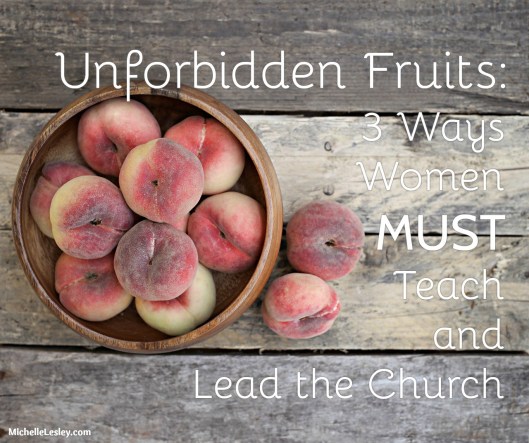
Unforbidden Fruits: 3 Ways Women MUST Lead and Teach the Church

Ladies, we whine too much.

Like petulant little girls, we look at what’s off limits to us, stomp our Mary Janes on the floor and cry “Why can’t I? I want to!” instead of giddily jumping into all the opportunities God has blessed us with. Instead of being happy and thankful for what we have, our greedy little fingers stretch out to grasp what God has said we can’t have because it’s not good for us or anybody else.

God has instructed pastors – who are, in turn, to instruct us – that, in the gathered body of Believers, women are not to preach to men, instruct men in the Scriptures, or exercise authority over men. And that’s what we focus on, and whine and kick our feet about. That part – the childish rebellion and discontent with the role God has graciously placed us in – that’s on us.

But pastors, we badly need your help on this one. Many pastors do a wonderful job of rightly and biblically explaining what women are not to do (And may I take a moment to say, from the bottom of my heart, thank you. I know how difficult that can be and that you take a lot of undeserved flak for simply teaching God’s Word on this subject.), but that “no” teaching has often not been coupled with the “yes” teaching of what women must do and how they must lead in order for women, and the church, to be healthy and function properly.

The “no” teaching of what the Bible forbids has often not been coupled with the “yes” teaching of what women *must* do and how they must lead in order for women, and the church, to be healthy and function properly.

You’ve loved us well to tell us not to bite at the apple from the forbidden tree, but we also desperately need you to take us on a tour of the Garden and introduce us to the all-you-can-eat buffet of pear and peach and cherry and pecan trees that we have the privilege and the responsibility to feast on.

๐ŸŠ The Other Institution ๐ŸŠ

Did you ever notice that the “do” for women in the church comes before the “don’t”? We tend to totally skip over that enormous little word that kicks off 1 Timothy 2:11: “Let a woman learn…”. We have no idea of, nor appreciation for, how huge and groundbreaking it was for the Holy Spirit, through Paul, to proactively instruct pastors: “Hey, get these women in here, make sure they listen up, and train them properly in the Scriptures so they’ll be equipped to fortify their homes with biblical truth.”

We completely miss the fact that, though God installs men as the teachers and leaders in one of His foundational institutions – the church – He has very much made women the functional, boots on the ground, day to day, teachers and leaders by example – of His other foundational institution – the family. The church didn’t even exist for the first few millennia of human history, but the family has existed since Creation. And people who are members of families populate and lead the church. Raising and molding those people is a tremendous position and responsibility. A position and responsibility God has largely given to women.

Wives pray for our husbands’ growth in Christ. We build them up with Scripture. With a gentle and quiet spirit, we set a godly example for them as they observe our respectful and pure conduct. We encourage and help them in their leadership roles at church.

Moms pray for our children’s salvation. We pour the gospel into them at every turn. We train up our children in the way that they should go – in the nurture and admonition of the Lord – so that when they are old they do not depart from it. We teach them to love and serve and invest in the church both directly and by modeling these things for them.

And our single, widowed, and childless sisters work right alongside us in this labor, praying for church leaders and members, nurturing children at church whose parents are unsaved or unequipped to raise them biblically, encouraging and assisting brothers and sisters in Christ.

We grow and develop, nourish and support, exhort and sharpen the population of the body of Christ.

Men may lead the church, but women raise the church.

Men may lead the church, but women *raise* the church.

๐Ÿ Woman to Woman ๐Ÿ

Essential to the health of any church is the component of women training women, whether in the formal setting of a Bible study class and structured women’s ministry programs or an impromptu “let’s get together for coffee this week” discipleship discussion.

Though we receive instruction in Scripture from our pastors, elders, and teachers, there are some counseling and teaching situations it’s not appropriate for a man to address with a woman, or that a woman understands better than a man. There are issues women face that men just don’t “get” in the same way a sister in Christ does. There are insights and perspectives a woman can use to explain Scripture to another woman that a man just doesn’t have. There are times when a woman needs someone to walk through a long term emotional journey with her that requires a personal intimacy which would be inappropriate for a man to engage in with her. And in the same way men are better equipped than women to train men to be godly husbands, fathers, and church members, women are better equipped than men to train women to be godly wives, mothers, and church members.

God knew all of this back when He breathed out the words of Titus 2:3-5…

Older women likewise are to be reverent in behavior, not slanderers or slaves to much wine. They are to teach what is good, and so train the young women to love their husbands and children, to be self-controlled, pure, working at home, kind, and submissive to their own husbands, that the word of God may not be reviled.

…and, again, 1 Timothy 2:11:

Let a woman learn quietly with all submissiveness.

Women must be trained properly in the Scriptures so we can take that training and pour it into other women, teaching and sharpening them into godly women, wives, mothers, and church members.

๐Ÿ‘ Super Models ๐Ÿ‘

Women instruct our brothers and sisters in the church in biblical truth when we lead by example. When we sin against someone, we go to that person and ask forgiveness. We demonstrate the importance of meeting together with the Body by being faithful in our church and Sunday School attendance. We model servanthood by serving the church and our brothers and sisters. We paint a picture of biblical compassion by ministering to the sick and others in need. We show Christians how to carry out the Great Commission by sharing the gospel. We set an example of trusting God when others see us depending on Him through difficult situations.

And one of the most important biblical concepts women have the privilege and responsibility of teaching the church through our example is submission to authority – a lesson the church is sorely in need of these days.

Because God blessed us by creating us as women, we have an opportunity to model submission to authority in a unique way that God has chosen to deny to men.

Because God blessed us by creating us as women, we have an opportunity to model submission to authority in a unique way that God has chosen to deny to men.

As we submit to our husbands, we teach the church what it means to submit to Christ. How to walk in humility and obey Him out of love. How to put selfishness aside. To trust Him to take care of us. To deny ourselves, take up our cross daily, and follow Him.

When we submit to God’s design for leadership in the church and joyfully carry out the work He has planned for us as godly women, we teach the church to submit to God’s authority and love Him by obeying His commands. We instruct our fellow church members in respecting and submitting to the pastors and elders God has placed in spiritual authority over us.

Submission to Christ, to God’s commands, and to pastors and elders is the bedrock of a healthy church. God has graciously given women the role – and the duty – of teaching these and other biblical principles to our churches in a way that men cannot -through our example as godly women.

Remember the series of fun little nutritional books that came out several years ago called Eat This, Not That? The idea the books centered around was, “Don’t eat that unhealthy thing. Eat this similar but healthy thing instead.”

Sadly, many Christian women have only been getting half the story. “Not that” (preaching to/teaching men and exercising authority over men) is biblically correct, but it’s not biblically complete. If all you tell someone is “Don’t eat that,” without showing her the “Eat this,” part, what she needs to eat to be healthy, she’s going to starve, and the church will be malnourished as well.

Christian women need our pastors to teach us to eat the fat of the land of being properly trained in the Scriptures and drink the sweet wine of leading and instructing the church the way God gifts us and requires us to. Only then will the Body be healthy and well nourished.

Colossians Bible Study

Colossians: Lesson 6

Previous Lessons: 1, 2, 3, 4, 5

Colossians 3:18-4:6

Wives, submit to your husbands, as is fitting in the Lord. 19ย Husbands, love your wives, and do not be harsh with them. 20ย Children, obey your parents in everything, for this pleases the Lord. 21ย Fathers, do not provoke your children, lest they become discouraged. 22ย Bondservants, obey in everything those who are your earthly masters, not by way of eye-service, as people-pleasers, but with sincerity of heart, fearing the Lord. 23ย Whatever you do, work heartily, as for the Lord and not for men, 24ย knowing that from the Lord you will receive the inheritance as your reward. You are serving the Lord Christ. 25ย For the wrongdoer will be paid back for the wrong he has done, and there is no partiality.

4:1ย Masters, treat your bondservants justly and fairly, knowing that you also have a Master in heaven.

2ย Continue steadfastly in prayer, being watchful in it with thanksgiving. 3ย At the same time, pray also for us, that God may open to us a door for the word, to declare the mystery of Christ, on account of which I am in prisonโ€” 4ย that I may make it clear, which is how I ought to speak.

5ย Walk in wisdom toward outsiders, making the best use of the time.ย 6ย Let your speech always be gracious,seasoned with salt, so that you may know how you ought to answer each person.


The Holy Bible, English Standard Version Copyright ยฉย 2001 by Crossway Bibles, a publishing ministry of Good News Publishers.

Questions to Consider:

1. Refresh your memory on the main themes of Colossians so far, noticing how they build on one another:

  • Chapters 1-2- Here’s a correct Christology (who Christ is, what He did, and why)
  • Chapters 2-3- Now that you believe a correct Christology, you’ve died to the world and live to Christ.

Finish the theme of today’s passage:

  • 3:18-4:6- Now that you’ve died to the world and live to Christ, here’s how to__________

2. Notice the structure of verses 3:18-4:1. Do you see a pairing, relationship-wise in verses 18-19, 20-21, 22 & 1? List the relationships (first word of each verse) in each of these pairs of verses. Whom does Paul address first in each of these pairings, the subordinate person or the person in authority? How might this emphasize the responsibility of the subordinate person to act in a godly way in the relationship?

3. Examine the instructions to the subordinates (wives, children, bondservants) in verses 18, 20, 22-24. How does Paul connect submission and obedience to earthly authority with the wife’s, child’s, and bondservant’s relationship to the Lord? Who are we truly serving and obeying when we submit to the authorities God has placed over us? What are the blessings of submission to authority? Examine the instructions to the authorities (husbands, fathers, masters) in verses 19, 21, 1. Does God reassure the authorities in the same way He reassured the subordinates? Is 4:1b (“knowing that you…”) a reassurance or a warning/example to follow? What does this say about the weight of responsibility those in authority have to act in a godly way? Compare this passage to Ephesians 6:1-9 to get a fuller picture of what God is saying here.

4. What does it mean to “continue steadfastly” and “be watchful” in prayer? (2) Paul again mentions “thanksgiving” in verse 2 (See question 5 in lesson 5, link above). Do you make thanksgiving a regular part of your daily prayer life? Why is thanksgiving such an integral part of the Christian’s life? What prayer request does Paul make to the Colossian church? (3-4) Think of all the other things Paul, in prison, could have asked them to pray for him. What does this tell us about his priorities? How could you pray verses 3-4 for yourself, loved ones, your pastor, missionaries, etc.?

5. Recalling that this is an epistle to the church, who are the “outsiders” Paul refers to in verse 5? How would you explain Paul’s instructions in verses 5-6 to another Christian? How do these instructions apply to the church? To individual Christians? Think of an “outsider” in your life who needs to hear the gospel. Give one specific way each that you could a) walk in wisdom toward this person, b) make the best use of your time with this person, c) use gracious, “salty” speech with this person, and d) answer this person.

Homework:

This passage and the Ephesians 6 passage I linked to above are (among others) often used by critics of the Bible to support their accusation that God is in favor of slavery. Is this true? Do some further study on the Bible’s stance on slavery:

The Apostle Paul and Slavery

Doesn’t the Bible Support Slavery?

Does the Bible Condone Slavery?

Rock Your Role

Rock Your Role: Jill in the Pulpit? (1 Timothy 2:11-12)

Rock Your Role is a series examining the โ€œgo toโ€ and hot button Scriptures that relate to and help us understand our role as women in the church. Donโ€™t forget to prayerfully consider our three key questions
as you read.

Let a woman learn quietly with all submissiveness. I do not permit a woman to teach or to exercise authority over a man; rather, she is to remain quiet.
1 Timothy 2:11-12

I’ve never met a Christian woman, who, upon reading these verses for the first time joyfully embraced them without the slightest hint of balking, surprise or, “Wait, what?”. I have no doubt that such women are out there, somewhere, it’s just that I’ve never met one of them.

For 21st century American Christian women, these are hard verses. Whether you’re old enough to remember bra burnings and hard line feminists like Gloria Steinem and Jane Fonda or you were born into a world replete with female engineers, construction workers, and urologists, you’ve probably been inundated with the “anything boys can do, girls can do better” message since the doctor announced, “It’s a girl!”

And that’s exactly why this passage seems to us like a cold bucket of water. It’s what we bring to the table, our presuppositions, that make these verses feel like a big, fat, arbitrary “no” from a God who just wants to spoil our plans, when everything else in the world says “yes” to whatever we might aspire to.

I’ve struggled with God’s instruction in these verses, trying to stretch it, Silly Putty style, into what I wanted it to mean, so that I could do what I wanted to do and still be “covered” biblically. And, ladies, let me tell you something- that is a sinful, wicked, self-seeking, and self-centered way of approaching this or any other Scripture. An approach from which I have had to repent many, many times.

Looking for loopholes and exceptions and trying to see how close to the line of sin we can get without actually putting a toe over is a characteristic of a carnal mind, not a mind set on pleasing God. Godly women don’t look for ways to get around Scripture. Godly women look for ways to obey Scripture. It’s God’s desire that we flee as far away from sin as we possibly can, and, instead, “pursue righteousness, faith, love, and peace.” He wants us to love, embrace, and obey His word, not rebel against it, even in our hearts, even in the name of “ministry” or “serving God.” So let’s keep that in mind as we take a look at this passage.

Has the Lord as great delight in burnt offerings and sacrifices, as in obeying the voice of the LordBehold, to obey is better than sacrifice, and to listen than the fat of rams. For rebellion is as the sin of divination, and presumption is as iniquity and idolatry. 1 Samuel 15:22-23a

As always, we must examine every biblical passage in context, which means we need to start off by understanding a little background about the book and its author, and by reading the whole chapter.

First Timothy (along with 2 Timothy and Titus) is one of the pastoral epistles. It was written by Paul to young pastor Timothy as sort of a job description and operations manual for pastors, elders, and the church. So right off the bat, an important point we often miss about 1 Timothy is that it was written to a man, Timothy, a pastor, who would use this letter to train his elders (also men) and, subsequently, his congregation. That doesn’t mean that 1 Timothy doesn’t apply to women, or shouldn’t be studied by women, or that women aren’t required to obey 1 Timothy. It just means that when we open the letter of 1 Timothy, we need to understand that we, as women, are reading somebody else’s mail. Mail that pertains to us, yes, but mail that’s addressed to Timothy, and by extension, to pastors and elders today. That will help us better understand the tone and perspective of the passage.

The focal verse of this chapter is verse 4

God our Savior, who desires all people to be saved and to come to the knowledge of the truth.

Everything else Paul talks about in chapter 2 revolves around the idea that God wants to save people. He wants the church to pray for people, including governmental officials so that they will be saved. Paul was appointed a preacher and apostle so that people might be saved. Men shouldn’t detract from the gospel by quarreling or anger so that people can be saved. Women’s attire should not distract from the preaching of the gospel, and their good works should point people to the gospel so that people can be saved.

And, finally – an exhortation to men – Timothy and the elders are to allow women to be taught the gospel so that they might be saved. See that word “let” right there at the beginning of verse 11? Timothy and the elders have the responsibility to step up and make sure women are allowed to come into the church and be taught the gospel. That’s something we take for granted now, but in a time when women were routinely regarded with the same value and intelligence as a stick of furniture or the family cow, this was huge. This just reinforces what we learned from Galatians 3:28: everybody is welcome at God’s table. There are no second class citizens in God’s kingdom. God wants to save women, too. We modern women rarely appreciate how precious this concept would have been to first century women hungry to know and be known by God. And the men were to make sure it happened.

But, as Jesus said, “to whom much was given, of [her] much will be required.” The men had the responsibility to make sure women were taught God’s word so they could be saved and grow spiritually, but the women had the responsibility to listen, learn, and conduct themselves in a way that would not hinder others (or even themselves) from learning and hearing the gospel.

Paul goes on to explain in verse 12 what he means by “quietly with all submissiveness”: Women are not to teach men or exercise authority over them. In the first century church, this would have been relatively easy to understand, since church services were fairly simple and didn’t include programs, parachurch organizations, Christian conferences, etc. But in our day, perhaps a little more explanation would be helpful.

Teaching includes any situation in the gathering of the body of Christ in which women would be giving instruction to men in the Scriptures and/or on spiritual matters (which, in a biblical church gathering, would necessarily include Scripture), whether in an official position of teacher (pastor, teaching elder, Sunday School/Bible study teacher, or other leadership position) or any other situation requiring exhorting, teaching, or explaining of the Scriptures.

Exercising authority includes any official position (pastor, pastoral positions, certain committee positions, elder, teacher, director, or other leadership position) or other situation which places a woman in charge of, over, or responsible for men or places men in a role subordinate to a woman.

But why? Why would God reserve the positions of teaching and authority over male or mixed groups to men? He gives two reasons in verses 13-14. God’s design for male headship, and Eve’s deception and sin.

For Adam was formed first, then Eve– Starting with Creation (not the Fall), God began laying out the pattern of male headship in the foundational institutions of His kingdom: Creation, the family, and the church. Man was created first, woman second. Man was given authority over Creation, woman was specifically created for him, to be his helper. We also see male headship in the family. God requires husbands to take the primary leadership role and wives to submit to and respect their husbands.

And, finally, we see God’s design for male headship in the church, not only in overt passages like 1 Timothy 2 and 1 Corinthians 14, the description of qualifications for pastors and elders, and the precedent of male leadership in the Old Testament temple, but also in the beautiful picture of Christ, the bridegroom, as head of the church, His bride, who lovingly submits to Him. Starting with the very first man and woman, before sin entered the world, God initiated a pattern of male leadership.

And Adam was not deceived, but the woman was deceived and became a transgressor– Here, Paul reminds us that, when Eve listened to the serpent, she stepped out from under her husband’s oversight, was deceived, and sinned. Eve’s sin reminds us that she not only was deceived into rebelling against God’s command about eating the fruit, but she also broke His design for male headship in marriage. In establishing male leadership in the church, God is recalling, reflecting, and restoring His pattern of male headship that started in the Garden.

But I’ve been taught that 1 Timothy 2:12 only applied to the particular time and culture in which it was written.

No, that’s not the case. We’ve just seen that clearly spelled out in verses 13-14. God explains exactly why He’s delegating the teaching of men, and authority over men, to men. There’s nothing in these two verses that even hint that this command is temporary or restricted to the women in the first century Ephesian church. The first reason was the Creative order โ€“ Adam was formed first, then Eve. The second reason is that Eve was deceived. Both of those reasons are universal (applying to all women and churches everywhere regardless of era or culture). It makes no sense that these two reasons related to Eve would apply only to first century Ephesus any more than it would make sense for them to apply only to tenth century Damascus or seventeenth century Paris.

Next, again, we examine the context of 1 Timothy 2. There are all sorts of instructions to the church in that chapter. Was the instruction to pray for governmental leaders (1-2) limited to the first century Ephesian church? Were only the men of the first century Ephesian church to pray without quarreling (8)? Was modesty (9-10) only required of women in the first century Ephesian church? Then why pick out this one instruction in verse 12 and claim it was limited to that time and culture?

Finally, look at the overall general pattern of male headship and leadership in Scripture. First human created? A man. The Patriarchs? As the word implies โ€“ all men. Priests, Levites, Scribes? Men. Heads of the twelve tribes of Israel? Men. Major and minor prophets? Men. All kings of Israel and Judah? Men. Noahic, Abrahamic, Mosaic, and Davidic Covenants? All established between God and men. Authors of Scripture? Men. The forerunner of Christ? John the Baptist โ€“ a man. Messiah? A man. All of the apostles? Men. All of the pastors, elders, and deacons of churches in the New Testament? Men. Founder and head of the church? Christ โ€“ a man. Leader and head of the family? Men. Now which fits better with this pattern, women preaching to, teaching, and exercising authority over men in the church, or women not preaching to, teaching, and exercising authority over men in the church?

But what about women in the Bible who served in leadership roles like Deborah, Esther, or Priscilla? Doesn’t that mean it’s OK for women to preach, teach men, and exercise authority over men in the church?

No it doesn’t. The Bible does not contradict itself because its author, the Holy Spirit, doesn’t contradict Himself. If you’d like to read more about how Deborah, Esther, Priscilla and other women of the Bible were actually acting in obedience to God’s role for women, please read my article Rock Your Role: Oh No She Di-int! Priscilla Didnโ€™t Preach, Deborah Didnโ€™t Dominate, and Esther Wasnโ€™t an Egalitarian.

But I’ve been told it’s OK for women to teach co-ed Bible classes or preach to co-ed audiences as long as they don’t hold the office of pastor and as long as they’re preaching/teaching “under the authority” of their husband and/or pastor.

No, that’s not OK with Scripture. First Timothy 3 and Titus 1 restrict the office of pastor to biblically qualified men, but, as we’ve seen in this article, 1 Timothy 2:12 prohibits women from carrying out two of the functions of pastors (preaching/teaching the Bible to men, and exercising authority over men) as well, and neither 1 Timothy 2 nor any other passage of Scripture gives husbands or pastors the authority to grant women permission to violate God’s Word. For more information on this question, see my article Fencing off the Forbidden Fruit Tree.

In God’s perfect plan, Janes and Jills are not to serve as pastors. They are not to preach to or teach men at Christian conferences or other gatherings of the body of Christ. They are not to teach co-ed Sunday School classes. They are not to serve in positions or places of authority over men in the church.

But even though we daughters of Eve bear the taint of her reproach in this small way all these years later, God has graciously provided us with many, many ways to redeem the name of womankind by serving Him if we “continue in faith and love and holiness, with self-control.” (15) One of those ways is the gospel influence mothers are able to have in their children’s lives. Think about it. Samuel had a godly mother. Timothy had a godly mother and grandmother. Jesus had a godly mother. It is no small thing to pour the gospel into your children and raise them up to be mighty men and women of God.

So, ladies, let’s stop clinging to the fence God has placed around the pulpit, bemoaning the fact that He doesn’t want us to cross it, and trying to figure out a way to sneak over, under, or around it. If we’ll just turn around and leave that fence behind us, we’ll find a wide open field of opportunities to serve God in His church, His way.

Photo courtesy of Our State.
If you’re wondering about the title of this article, this is called a Jack-in-the-Pulpit.


Additional Resources:

Rock Your Role FAQs

Women in Ministry and the Authority of Scripture by Mike Stone

No, Women Can’t Preach by Scott Aniol

The Role of Women from Grace Community Church’s doctrinal distinctives

Women Pastors are a Fundamental Problem for Southern Baptists by Gabriel Hughes (The bulk of this article is an exegesis of the Scriptures dealing with the biblical roles of men and women in the church and is not specific to Southern Baptists.)

Ten Things You Should Know About 1 Timothy 2:11-15 and the Relationship Between Men and Women in the Local Church at The Council on Biblical Manhood and Womanhood (CBMW) This is a refutation of the most common egalitarian arguments against the plain meaning of 1 Timothy 2:11-15.

Why Women Should Not Teach the Bible to Men by Josh Buice

Will the Next SBC Resurgence Include a Redefining of Complementarianism? by Tom Buck The springboard issue for this article series was the movement to elect a female president of the Southern Baptist Convention, however, it is largely an exposition of the text of 1 Timothy 2:11-15. Regardless of whether or not you’re familiar with this issue, and even if you’re not Southern Baptist, these articles are helpful and easy to understand. Part 1  Part 2  Part 3  Part 4

Only Men May be Pastors at Founders Ministries

What Does It Mean That Women Should โ€œRemain Quietโ€ in Church? at Crossway

Why Asking Women to Preach Is Spiritual Abuse by Josh Buice

Should Women Be Pastors? by Virgil Walker

Has God Really Said on the Just Thinking podcast

The Paul-Side Gambit: How A Proper Understanding of Apostolic Authority Defeats Womenโ€™s Ordination by Chris Rosebrough