Obedience, Prayer, Sanctification, Sin

When God Answers the “Wrong” Prayer

“Lord, I’m just so frustrated!” I fussed, as I approached the time I had set aside for prayer this morning. Once again, the “I don’t want to” of my flesh was pulling against the “I know I need to” of my spirit like a heavy duty tow truck tugging on a kitten.

So I just ditched it. Well…sort of.

Prayer is pouring out your heart to God, right? Well, I turned on the water cannon. Reverently, of course…but with passion.

I told God how sick I was of this all-too-frequent stumbling block my flesh presented when it was time to pray, especially when I knew from experience that the feeling was fleeting and would go away after I had been praying for a few minutes. I told Him I was tired of a million other things I’d rather be doing, that I needed to do, coming to mind and further crowding out my desire to pray. I told Him I was sorry for all the times I had given in to the flesh and skipped my prayer time. I told Him I wanted Him to make this feeling go away and never come back.

As I poured out my complaint before Him, the Holy Spirit began leading me to examine theย whyย of this whole situation. What was bringing about this pull of the flesh against prayer?

And that’s when it happened. God answered the “wrongยน” prayer.

And that’s when it happened. God answered the “wrong” prayer.

You see, one of the things I pray every day is that God will reveal to me any sins I’m unaware I’m committing and lead me to repent of and forsake them.

And in that moment,ย that’s the prayer He chose to answer.

Not the prayer for the provision of an item my family needs. Not the prayer for healing of a loved one. Not the prayer that He would save all the lost people on my list.

Not the prayerย I really wanted Him to answer.

God chose to reveal my sin to me.

You know why my flesh so often balks at prayer? Because in the dark, unsanctified recesses of my heart, I’m frustrated with God for not doing what I ask Him to do –ย now. I come to Him day after day, month after month, sometimes year after year, confessing the same sins, asking for the same provisions, and presenting the same requests, andย I don’t see Him doing whatย I want Him to do whenย I want Him to do it.

Never mind that I could list hundreds of my prayers that He actually has answered, many of them in amazing ways. Never mind that Iย know what the Bible says about prayer well enough to teach on it and write articles about it. Never mind that I really do believeย that God will answer my prayers for His glory and my good.

Uh uh. My flesh throws all of that right out the window and wants God to be my cosmic errand boy, delivering the goods on my timetable. I am selfish. I want everything to go my way immediately.

My flesh wants God to be my cosmic errand boy, delivering the goods on my timetable. I am selfish. I want everything to go my way immediately.

So that was pretty humiliating…but God didn’t stop there. No, there was more.

He opened my eyes to the fact that this sin problem I have relating to Him vertically is basically the same sin problem I have relating to people horizontally.

I yell at people in traffic to get out of my way. I get annoyed with my husband, irritated with my children, and impatient with fellow church members because I want them to do whatย I want, and I want them to do itย now.ย I am selfish. I want everything to go my way immediately.

Oh, wretched man that I am! Who will deliver me from this body of death?ย 

Paul was really onto something there.ย Fortunately, he answers his own question in his very next sentence:

Thanks be to God through Jesus Christ our Lord!

Romans 7:25a

Jesus. Jesus can help me to mortify this sin. And I can obey Him as He does His good work in me. How?

Jesus. Jesus can help me to mortify this sin. And I can obey Him as He does His good work in me. How?

assuming that you have heard about [Jesus] and were taught in him, as the truth is in Jesus, to put off your old self, which belongs to your former manner of life and is corrupt through deceitful desires, and to be renewed in the spirit of your minds, and to put on the new self, created after the likeness of God in true righteousness and holiness.

Ephesians 4:21-24

I stop doing the sin (put off the old self). I remember what God’s Word says about that sin and about the righteousness I’m supposed to do instead (be renewed in mind). I do the righteous thing instead of the sin (put on the new self).

Ephesians 4 goes on to give some examples of what this looks like when dealing with real life sin:

Therefore, having put away falsehood, let each one of you speak the truth with his neighbor, for we are members one of another. Be angry and do not sin; do not let the sun go down on your anger, and give no opportunity to the devil. Let the thief no longer steal, but rather let him labor, doing honest work with his own hands, so that he may have something to share with anyone in need. Let no corrupting talk come out of your mouths, but only such as is good for building up, as fits the occasion, that it may give grace to those who hear. And do not grieve the Holy Spirit of God, by whom you were sealed for the day of redemption. Let all bitterness and wrath and anger and clamor and slander be put away from you, along with all malice. Be kind to one another, tenderhearted, forgiving one another, as God in Christ forgave you.

Ephesians 4:25-32

See how that works?

Stop lying. Remember what God’s Word says about lying and truth. Speak truth instead of lying.

Stop stealing. Remember what God’s Word says about stealing and the godly way to acquire and steward material things. Work an honest job and share with others instead of stealing.

Seems pretty simple and logical, right? It’s pretty clear cut when we’re talking about sinfulย actions. I can keep my mouth shut so lies and corrupting talk don’t come out and choose kind and truthful words to speak instead. I can keep my hands in my pockets or avoid that tempting store so I won’t steal, and get a job and share with others instead. But how in the world do I “put off” a sinful attitude like bitterness, wrath, anger and malice (and in my case, selfishness) when it’s just a feeling that pops up in my heart unbidden?

How in the world do I “put off” a sinful attitude likeย bitterness, wrath, anger and malice (and in my case, selfishness) when it’s just a feeling that pops up in my heart unbidden?

The world will tell you that you can’t control your feelings. And for the world, that’s true. It’s part of the sin nature of a lost person, the “old self”, to live your life by your feelings, even to be controlled by them. But that’s not the case for someone who has been genuinely born again and is indwelt by the Holy Spirit.

Part of the Fruit of the Spiritย (the evidence that the Spirit is indwelling you) isย self-control. That doesn’t just mean saying no to that second piece of cake. It’s the idea that sin is not our master anymore. We do not have to listen to and be controlled by sin, we can say no to itย because we want to say yes to our new Master – Christ – and be controlled by Him.

Let not sin therefore reign in your mortal body, to make you obey its passions. Do not present your members to sin as instruments for unrighteousness, but present yourselves to God as those who have been brought from death to life, and your members to God as instruments for righteousness. For sin will have no dominion over you, since you are not under law but under grace.

Romans 6:12-14

Notice the wording here. It’s not “do your best” or “try” not to let your old master control you. It’s an authoritative, weighty, no-nonsense command: “Let not sin reign…sin will have no dominion”. God would not command us to do something that we’re incapable of doing, or that the Holy Spirit will not empower us to do. Weย can control and put off sinful thoughts, feelings, and attitudes.

Martin Luther once helpfully said:

“You cannot keep birds from flying over your head, but you can keep them from building a nest in your hair.”

I think about that quote often when it comes to putting off ungodly thoughts that pop into my brain. Here’s how it works:

First, preemptively pray the “wrong” prayer – the one your flesh won’t want God to answer – that He will make you aware of and convict you of sinful thoughts, feelings, and attitudes.

Pray the “wrong” prayer – the one your flesh won’t want God to answer – that He will make you aware of and convict you of sinful thoughts, feelings, and attitudes.

Next, when one of those thoughts rears its ugly head, stop what you’re doing, repent, and kick that rotten vulture right out of your hair. Make a definitive, proactive, Holy Spirit empowered decision of the will that you areย not going to think that way. It helps me to say it out loud: “No. That thought is wrong. The Bible says ____ about that. I amย not going to think that.” You might get some weird looks if you’re in public, but, hey, mortifying sin is worth it, right?

I tend to combine the “put off” (stop it) and “renew your mind” (What does the Bible say?) steps because pulling the Sword out of its sheath is a good way to kill sin. It’s the way Jesus modeled for us.

How can I “put on” a right thought, feeling, or attitude? I mean, you can’t just conjure up godly feelings, can you?

But how can I “put on” a right thought, feeling, or attitude? I mean, you can’t just conjure up godly feelings, can you? No. But what youย canย do is gather up nest-building materials for that “sweet Heavenly doveยฒ”, the Holy Spirit, so He can shape your thoughts, feelings, and attitudes in a godly way:

Finally, brothers, whatever is true, whatever is honorable, whatever is just, whatever is pure, whatever is lovely, whatever is commendable, if there is any excellence, if there is anything worthy of praise, think about these things. What you have learned and received and heard and seen in meโ€”practice these things, and the God of peace will be with you.

Philippians 4:8-9

There are godly things we canย think about and godly things we canย do (“practice”) that cooperate with the work the Holy Spirit is doing in our hearts.

Instead of thinking about that prayer that God isn’t answering right now, I can think about the prayers Heย has answered. And I canย do something too. I can thank Him for those answered prayers and all of His good attributes in answering prayer.

Instead ofย thinking aboutย how and whenย I want God to do things, I can think about His sovereignty and how good that is for me and everyone else. I can alsoย do something: I can recite Bible verses I’ve memorized about the situation and sing songs of praise to Him.

Instead ofย thinking about how someone else is frustrating me by not doing whatย I want her to do, I canย think about how she is made in the image of God, valuable to Him, and precious in His sight. What can I do? I can stop and pray for her. I can speak a word of encouragement to her. I can bless her with a gift or by serving her.

Thinking and practicing ungodly things feeds and grows your ungodly thoughts, feelings, and attitudes. But thinking and practicing godly things feeds and develops your godly thoughts, feelings, and attitudes.

Thinking and practicing ungodly things feeds and grows your ungodly thoughts, feelings, and attitudes. But thinking and practicing godly things feeds and develops your godly thoughts, feelings, and attitudes.

Back in the Stone Age when dinosaurs roamed the earth and computers were brand new, programmers used to have a saying: “Garbage in, garbage out.” In other words, if you fed faulty commands into the computer, the performance you got out of the computer was going to be faulty, too.

The Christian heart is very much the same. “Godly in, godly out.” If you feed godliness into your heart, godliness will start coming out in your thoughts, words, and actions.

We don’t have to be mastered by sinful thoughts, feelings, and attitudes. Through the power of the Holy Spirit and by putting off the old self, renewing our minds through God’s Word, and putting on the new self by thinking and practicing godly things, we can grow more and more obedient to our Lord and Master, Jesus Christ, in our thoughts, words, and actions.

I don’t know about you, but I’m going to try to remember that the next time God answers the “wrong” prayer.


ยนPlease note that the word “wrong” as it refers to God answering prayer refers toย myย having the wrong attitude or perspective. God is perfect and has never, and will never, do anything wrong.
ยฒFrom the hymnย Sweet, Sweet Spirit by Doris Akers
Women of Genesis Bible Study

The Women of Genesis: Lesson 30- Potiphar’s Wife

Previous Lessons: 1, 2, 3, 4, 5, 6, 7, 8,ย 9, 10, 11, 12, 13, 14, 15, 16, 17, 18, 19, 20, 21, 22, 23, 24, 25, 26, 27, 28, 29

๐Ÿ“–๐Ÿ“–๐Ÿ“–๐Ÿ“–๐Ÿ“–

Read Genesis 39

๐Ÿ“–๐Ÿ“–๐Ÿ“–๐Ÿ“–๐Ÿ“–


Questions to Consider

1. Briefly review lesson 28 (link above) to refresh your memory on the storyline of Joseph, then read today’s passage. Why do you think Joseph’s story starts in chapter 37, is “interrupted” by the story about Judah, his sons, and Tamar in chapter 38, and then picks back up in chapter 39?

2. How did Potiphar (1) come to acquire Joseph?

3. Carefully examine the description of Potiphar in verses 1-2 and Potiphar’s house, status, and living conditions in verses 1-6. Make a list of the things we can infer about “Mrs. Potiphar” from this information- where and how she lived, her social status, socioeconomic level, etc. Was it likely that Mrs. Potiphar was a Believer in the one true God?

4. Read verses 6-19, closely examining Mrs. Potiphar’s words and actions.ย Write a character sketch of Mrs. Potiphar, adding in the information from your list from question 3. What adjectives would you use to describe Mrs. Potiphar?

5. Describe Mrs. Potiphar’s outward sins. Outward sin can always be traced back to an inward sinful thought or attitude of heart. What was Mrs. Potiphar’s inward sin? How is lust a form of coveting? When a person covets or lusts after something or someone that doesn’t belong to her, what does that tell us about her attitude toward what sheย already has and the God who blessed her with those things?

6. The New Testament equates coveting with idolatry. Why?

7. Imagine you are a biblical counselor, and a modern day, recently born again Mrs. Potiphar comes to you for help with her struggle against lust and coveting. Considering questions 5 and 6, what sinful heart attitude would you help her to identify as the cause of her lust and coveting?

In previous lessons, we have explored the biblical model of repentance: putting off the old self (stop doing the sin), renewing your mind (learn what the Bible says about this sin), and putting on the new self (replacing sinful actions with godly actions). How could you apply these passages, using the put off/renew/put on model, to Mrs. Potiphar’s root sin of discontentment? How could thankfulness to God and serving others be the godly opposite of coveting and lust?

8. In what ways was Joseph’s righteous behavior a testimony to the one true God? How could 2 Timothy 3:12-13 apply to his situation in this chapter? Does God guarantee us that things will always go smoothly if we’re obedient to Him? If not, why should we obey Him?

9. Consider this chapter in light of current events of apparently godly men being accused of sexual harassment, abuse, and misogyny. Apply Proverbs 18:17 to both situations: “The first to plead his case seems right, Until another comes and examines him.” Why is it important to carefully and biblically examine those making accusations as well as the accused, so that the guilty are punished and the innocent are not? What were the consequences of a false accusation for Joseph, and how did God care for him? (19-23)


Homework

Do you struggle against the sin of a discontent heart like Mrs. Potiphar did, causing you to lust for and covet things, people, or life circumstances that God has not chosen to give you? Examine and repent of your sin using the put off/renew/put on model. List one Bible verse to memorize that will help you with the “renew” stage. List three specific godly actions you can do (put on) to replace sinful actions (put off). This week, memorize your verse and carry your list with you to remind you of the godly action you can take when you’re tempted to sin. Pray daily, asking God to strengthen you to resist temptation and obey Him.


Suggested Memory Verse

But the Lord was with Joseph and showed him steadfast love and gave him favor in the sight of the keeper of the prison.
Genesis 39:21

Sanctification, Sin

Throwback Thursday ~ The Garden of Weedin’

Originally published March 31, 2009

It’s that time again. Spring. Time to survey the damage winter did to the yard and get it back in shape. Sandwiched in between last week’s several days of rain and the multiple days of thunderstorms predicted for this week, were a few beautiful days that were just perfect for tackling the jungle that once was my back yard. Yikes. I could have lost a kid in all that grass.

Much to my dismay, when I got up close and personal with the overgrowth, I discovered that, once again, the army of weeds I spend every spring and summer fighting off had made significant advances into the yard. It also seemed to have secured the perimeter of my fencerow with a tall and nearly impregnable line of defense.

Heaving a sigh, I remembered what one gardener friend told me last year. The best way to fight off weeds is to get the grass really healthy and growing so it will choke out the weeds and reclaim the yard. Sounded reasonable to me. And familiar, too. Where had I heard something similar to that before? The idea tickled my brain as I hauled out the mower.

As I began shoving my trusty mower through that mess, it hit me. Weeds….choking something out. There was something about that in the Bible.

Ever notice how many of Jesus’ parables and illustrations include references to farming, plants, and other aspects of agriculture? The “Lord of the Harvest” gave us wheat and tares, fig trees, mustard seeds, vineyards, and of course, the parable of the sower scattering his seed.

Ah, that’s what it was. The parable of the sower. Remember him? He went out to seed his land, and the seed ended up finding its way not only to the good soil he had prepared, but also to some rocky soil, the roadside, and a patch of thorns (which the New Century Version translates as “weeds”):

Some other seed fell among thorny weeds, which grew and choked the good plants. Matthew 13:7 (NCV)

That’s exactly what was going on in my yard! The grass wasn’t yet strong enough to choke out all the weeds, the weeds were choking out my good crop of grass. They were also making my fencerow look awful, so I finished up the mowing, and, mentally assessing our temperamental edger, decided to clean off the fencerow by hand.

As I began yanking at those pesky plants, God reminded me that we all have weeds in our lives that need to be pulled up. So just what constitutes a “weed” in our spiritual lives? Well, Jesus was kind enough to explain that in Matthew 13:22:

And what is the seed that fell among the thorny weeds? That seed is like the person who hears the teaching but lets worries about this life and the temptation of wealth stop that teaching from growing. So the teaching does not produce fruit in that person’s life. (NCV)

Jesus compares the weeds to two things: “the worries about this life” and “the temptation of wealth”.

“The worries about this life” could cover just about anything. It could be a financial struggle, a wayward child, a difficult marriage, a hostile work environment, or even a painful past that we’re striving to put behind us. Any situation we deal with that looms so large, it blocks out our view of Christ and prevents us from trusting Him to handle it. Anything that takes our eyes off Him, tempts us to focus only on our circumstances, and derails the teaching God is trying to manifest in our lives.

“The temptation of wealth” could also cover a lot of areas in our lives. First Timothy 6:10 tells us that “the love of money is a root of all sorts of evil…”. Evil. In other words, sin.

“A root”. Hmmm…interesting.

Well, I was certainly dealing with plenty of roots. When it comes to weeds, it doesn’t do much good to simply pull the leaves off or snap the stem in half. For some reason, weeds– at least the ones in my yard –seem to take this as a challenge to grow back. You have to pull weeds up by the roots in order to get rid of them.

Likewise, if there is something in our lives which “stops [God’s] teachings from growing” or prevents God’s teachings from producing fruit in our lives (see Matthew 13:22 above) we need to have the Master Gardener root out the instigating problem rather than plucking at its leaves ourselves.

For example, if you’re struggling with being a workaholic, you can break off part of the stem of that problem by cutting back on work a few hours a week, but the root of the problem may be that you have made work an idol in place of God, that you don’t trust Him to provide for your needs, or that you are loving yourself and your work more than your family. If those root problems aren’t dealt with you will likely fail in your efforts to cut back on work, or something else, such as a hobby, may spring up to take the place of those hours you would have spent at work.

As I continued to work, I noticed that some weeds were very easy to pull up and some were quite difficult. The easiest to pull seemed to be the weeds that had taken root in the decaying leaf matter on top of the soil rather than in the soil itself. The difficult ones were the ones that had been growing for a long period of time. Some of their roots were over a foot long. These roots had made their way far from the visible plant and into another part of the yard, which meant they were affecting much more than just the immediate area around the plant itself.

And so it is with our spiritual weeds. The best time to deal with sin or turn a troubling situation over to God is early, before it has a chance to take root, because once it does, it’s going to be much harder to deal with and it’s going to begin to affect more and more areas of our lives.

Dealing with sin or difficult situations pre-emptively is even better. Flee temptation before you have a chance to give in to it. Determine to commit your works to the Lordย and acknowledge Him in all your ways, and you will avoid some of the heartbreaking circumstances that might otherwise come your way.

As I struggled with one particularly stubborn weed, I noticed that its roots were intertwined with those of a couple of other totally different weeds. As I pulled at the one I was working on, the others were coming up as well.

When God pulls up those really difficult weeds in our lives, we will often find that He is simultaneously uprooting other sins and situations that have become enmeshed with the primary one. Sometimes when this happens to me, I feels like God is “piling on” and wish He would just work on one thing at a time in my life!

By the time I reached the end of the fencerow, I was sweating, my back was killing me, and I had broken two nails, despite the gardening gloves I was wearing. Pulling weeds is not a day at Disney World. It’s tough work!

But as I stood back and surveyed the results of my efforts, I saw that the fencerow no longer looked trashy. It looked clean and neat. Something any gardener would be pleased with. And, something else had happened that I hadn’t even noticed until that moment. As the roots of those weeds came up, they naturally tilled the soil.

It was moist,

loose,

rich;

the perfect condition for good seed to be sown by the Master Gardener.

Parenting

Do You Trust God with Your Kids?: 8 Ways to Parent Your Children Like God “Parents” You

The world can be a scary place if you have kids. There’s the danger of online predators luring kids into meeting them in person. Kids can take inappropriate pictures of themselves or their peers only to have those pictures spread around on the web. Porn sites abound. Drugs and alcohol seem to be easy for kids to come by. There are kidnappers and sex traffickers and child molesters lurking where you least expect them, even in the church. And, society would have us believe, every teenager is having sex.

It’s a blessing from God that there are so many ways to protect our kids. There are all kinds of software locks and blocks and filters you can put on your electronics in order to keep your kids safer when it comes to technology. There are phone apps that allow you to track your child’s location, and do it yourself drug testing kits, and breathalyzer attachments you can put on your car to keep your child from driving drunk. And then there are the more “analog” precautions of keeping the family computer in a common room, scrolling through your child’s phone log every day and asking about each call or text, banning sleepovers, and never letting her spend time alone with friends.

Certainly, we should use wisdom about the activities we let our kids take part in. Maybe some of those locks, blocks, and filters, or restrictions on places she can go and people she can see would be a wise idea for your family, especially if your child has proved herself untrustworthy with the freedom you’ve already given her.

But, increasingly, as I hear Christian parents in a near frenzy about installing multiple security measures on their electronics or the car and making all kinds of restrictions on activities with friends – not to clamp down on a rebellious child, but to prevent children from getting into trouble who have never showed any signs of rebellion – I have to wonder, what’s the foundational mindset here?

Are we putting these safety measures in place because we’ve prayed about it andย  believe it’s reasonable, godly wisdom, or are we putting these safety measures in place out of the fear of evil, or because we trust devices and restrictions more than we trust God and our kids? For the Christian, it’s not that it’s wrong or bad to take precautions – indeed, God doesn’t want us to be careless or foolish – it’s the motivation for the precautions we take that we need to examine.

Do we really trust God with our kids, or are we taking matters into our own hands out of fear?

Trusting God can be scary. We can’t see Him, hear Him, or touch Him, and He never promised us a life free from difficult or painful circumstances. It’s much easier and more comforting to our flesh to trust something tangible. Something that guarantees us it’ll do what we want it to do. It reminds me of an event that took place toward the end of King Asa’s life in 2 Chronicles 16.

Asa was one of the good kings of Judah. He “did what was good and right in the eyes of the Lord his God. He took away the foreign altars and the high places and broke down the pillars and cut down the Asherim and commanded Judah to seek the Lord, the God of their fathers, and to keep the law and the commandment.” (2 Chronicles 14:2-4) But one day, Baasha, king of Israel, came up against Judah. Did Asa cry out to the Lord, trusting Him to help, as he had years before when the Ethiopian army came out against him? No. Asa’s response was to gather up a truckload of silver and gold from the palace and the temple and bribe the king of Syria to break his covenant with Israel and attack them. Instead of fully trusting in the Lord and seeking His help and guidance, Asa took matters into his own hands and attempted to protect Judah with his own strength.

We love our children. We don’t want to see them hurt or fall into sin. We want to do whatever we can to protect them. Those are all good and godly desires of the heart. But we must make sure we are seeking and trusting God and His ways firstย instead of acting upon our fears and relying on our own strength.

What are God’s ways? How does He “Father” us? How can we imitate our Heavenly Father as we parent?

1. God makes clear that He is the Father and we are the children.
Throughout Scripture, God is crystal clear that He is the one in charge. He made us, He sets the rules, He provides for us, He protects and cares for us, He knows what’s best for us. Because of all this, He instructs us, our responsibility is to be obedient children.

Do you and your children understand that you are the parent? That you are in charge and that they are to obey? That you make the rules and they are to follow them? Are the roles of parent and child clearly defined in your home with a godly authority structure in place?

2. God spells out what He expects from us.
The Bible is chock full of explicit commands. Sometimes God tells us what to do. Sometimes He tells us what not to do. Often, He explains why He is telling us to do or not do a certain thing. We can always rest assured that all of His commands are for our own good, the good of others, and the glory of God, and that they flow out of His great love for us. But God never accepts excuses for disobedience. He expects us to obey.

Have you thoughtfully and prayerfully developed rules for the online and offline activities your child participates in? Have you sat her down and lovingly explained the rules to her, answering any questions she might have? Does she have a clear understanding of what the rules are and how to obey them? Does she grasp your expectation that she will obey the rules without excuses?

3. God warns us of the consequences and dangers of disobedience and the blessings of obedience.
God doesn’t hide the unpleasant truth from us that the wages of sin is death. In fact, He gives us enough of a description of that eternal death to help us understand that we don’t want to go there. He explains that He disciplines those He loves in order to keep them away from sin and harm. But God also reminds us of the blessings of obedience – that it will help us flourish, grow in joy, and bring glory to God.

Have you warned your child of the consequences for disobeying your rules about her activities? Do you carefully and consistently enforce those consequences? Have you explained to her that theย reason there are disciplinary consequences for her disobedience is to protect her from danger and sin? It’s neither necessary nor appropriate to go into all of the specific, terrifying details of child trafficking or the disgusting elements of pornography, but our children must have an age-appropriate understanding of the very real dangers that are out there.

And it’s just as important to explain the blessings of obedience to your child: she won’t have to live in fear or in shame, she’ll be protecting her purity for marriage, her health, or her life, her parents will trust her, and she’ll be acting in a way that’s pleasing to God. Maybe you’ll even be more inclined to give her extra privileges.

4. God doesn’t give the consequencesย before the sin.
Look at what Jesus said in Matthew 5:29-30 with regard to lust:

If your right eye causes you to sin, tear it out and throw it away. For it is better that you lose one of your members than that your whole body be thrown into hell. And if your right hand causes you to sin, cut it off and throw it away. For it is better that you lose one of your members than that your whole body go into hell.

Jesus doesn’t tell us to gouge out an eye or cut off a hand as a precaution toย preventย lust that has not taken place. He tells us to respond toย sinย with an appropriate consequence.

Is there any way you might be “maiming” your child to prevent her from committing sin – especially sin she’s never shown an interest in or temptation to? Maybe it’s time to reconsider that rule or restriction? Conversely, do you have a child who struggles with a particular sin? She may need your love and your help mortifying that sin by “gouging out the eye” of the internet or “cutting off the hand” of that destructive friendship.

5. God wants our obedience to be motivated by our love for Him.
God doesn’t want us to obey Him because we have an unbiblical view of Him as a mean old ogre and we’re terrified of Him. He also doesn’t want us to obey Him in order to get something from Him, to impress others, or just to go through the motions. God wantsย us toย want to obey Him because we love Him.

Have you fostered an environment of sacrificial love for your children in your home? Do you lay down what you want or how you feel to do what’s best for them? Do you invest time in them, pouring the gospel into them, teaching them God’s Word, and demonstrating that we obey Christ because we love Him? Do you take time to talk and play with your children? Do you tell them you’re proud of them? Discipline them and say no when necessary? Are you generous with hugs, “I love you’s”, and encouragement? Do you encourage them to develop their talents and skills? Having parents who love their children in a godly way doesn’t guarantee obedience, but it does encourage it.

6. God doesn’t micromanage every move we make.
At least not the way humans sometimes micromanage. Have you ever noticed that there are no commands in the Bible like, “Thou shalt wear blue socks every Tuesday,” or “Thou shalt not stay up past 11:38 p.m.”? Regulating every little thing we do isn’t God’s way. He loves us and cares for us, He tells us what He expects from us and the consequences of obeying and disobeying Him, and then He gives us space within those parameters to make decisions that are aligned with His will as revealed in His Word. As long as we’re not violating any of His principles or commands and we’re exercising godly wisdom, it’s fine with Him if we want to wear red socks on Tuesday or stay up until midnight.

Our children need space to make decisions within the confines of the rules we’ve set up, especially children who haven’t given us any reason not to exercise reasonable trust in them. Nitpicking, checking, regulating, and hovering over every little move your child makes is smothering and frustrating to her. It says, “I don’t trust you to do what’s right without constant monitoring from me.”

7. God allows us to fail.
I once read the biography of a girl who went blind. She enrolled in a life skills class at a school for the blind to learn how to navigate the world. During orientation, her counselor showed her around the common room of the dorm she was staying in. The counselor took her hand, placed it on the protruding mantel of the fireplace and said, “This is a sharp corner. You’ll need to watch out for it.” The girl gasped, “That’s dangerous! Why don’t you put some padding on it?”. The counselor replied, “You need to learn to be carefulย and aware of your surroundings. Nobody’s going to pad the sharp corners of the world for you.”

God doesn’t pad the sharp corners of the world for us, either. He doesn’t put us in a protective little bubble where we’ll never be hurt or fail or sin. He gives us everything we need for life and godliness in His Word and allows us to obey or disobey Him. Even when we fail, give in to temptation, and sin.

Consider that your child needs to learn the skill of facing and resisting temptation on her own. Give her enough age appropriate, situation appropriate freedom to do that – and to fail at it and repent – in the spiritual safety of your home. One day you won’t be there to put a lock on the computer. God will hold her responsible for her own sin. Will your child have developed the spiritual strength to say no to temptation when there’s nobody to stop her?

8. God is always there.
He’s not a “helicopter parent,” but He’s always there to listen to us, help us, nurture us, and be our Wonderful Counselor and Everlasting Father.

If you are a parent, job one is not your career, it’s parenting. Generally speaking (yes, there are sometimes exceptions and exigent circumstances), that means, Mom, your primary vocation is to raise your own children. Don’t just assume you have to work outside the home. Prayย fervently for God to make a way for you to raise your children. Be creative and look for ways to get out of the workforce and get home. Slash every possible expense. Move. Eat at home. Home school instead of private school. Sell a vehicle. Bargain hunt. Find a way to earn money from home. Make the effort. Your children don’t just need any random person to raise them, they needย you.


Are we imitating our Heavenly Father in the way we parent? Do we cry out to Him for wisdom in the rules and restrictions we set for our children, trusting Him to help us and to protect our children? Or do we live in fear of what might happen, worrying and trying to protect our children in our own strength?

As much as we’d like to sometimes, we canโ€™t build walls around our children to protect them from every sin or from anything bad ever happening to them. That is not how God deals with us. He loves, cares, and provides for us. He disciplines us appropriately when we need it. He clearly spells out what He expects from us. He warns us of the dangers and consequences of disobedience and teaches us the blessings of obedience. It’s then up to us to decide whether we love Him enough to obey Him, or if we’d rather go our own way.

Do we parent our children like God “parents” us?

Discernment, False Doctrine

A Naked Emperor in the Southern Baptist Convention

Think back to your childhood. Remember the story, The Emperor’s New Clothes?

Once upon a time, there lived an emperor. One day two swindlers came to his palace and told him they could weave cloth for his royal robes that was magical: to those who were foolish or unfit for their jobs, it would appear invisible. Only the wise and worthy would be able to see this fine fabric. The emperor hastily agreed to pay the “weavers” an exorbitant amount of money to make him such an amazing garment, thinking he would use it to weed out anyone unfit for royal service.

The weavers set about pretending to weave. From time to time, the emperor sent various folk to check on the progress the weavers were making, and – though in reality, none of them could see the non-existent fabric – all reported back that the garments were coming along nicely and the cloth was beautiful. But strangely enough, when the emperor himself looked in on the weavers, they held up the magnificent fabric, and he could not see it. Not wanting word to leak out that he was unfit to serve as emperor, he pretended to examine the cloth and complimented the weavers lavishly on their fine work.

Finally, the weavers informed the emperor that the garments were finished. They had the emperor strip down to his skivvies and pretended to help him on with his fine new “garments”. Word had spread among the emperor’s subjects about the magical properties of the fabric, and as the royal procession made its way through town, all shouted out praise for the emperor’s fine new clothes.

All. Except for one little boy.

“But he hasn’t got anything on!” the boy shouted.

It took the innocent honesty of a simple child to shock the emperor’s subjects back to their senses. The truth spread like wildfire, and the crowd began to cry out: “The emperor is naked!” “The emperor has no clothes on!” “He’s not wearing anything!”

But did the emperor admit to his foolishness, return to the palace, and get dressed? No. Sadly the story ends this way:

“The Emperor shivered, for he suspected they were right. But he thought, ‘This procession has got to go on.’ So he walked more proudly than ever, as his noblemen held high the train that wasn’t there at all.”ยน

And so the “emperor” of leadership in the Southern Baptist Convention and those who carry its train march proudly on, despite the cries of simple peasants and innocent little children crying at the top of our lungs, “The emperor is naked!” “There are issues that need to be addressed, here!” “Listen to us!”

You’ll note that the story doesn’t say that the emperor was a cruel man, that he overtaxed the people, oppressed them into slavery, was a warmonger, or was in any other way an evil leader. In fact, one could argue that he had good intentions of making sure the people who served at various posts in his empire were of the finest caliber.

And while there are many issues that need to be addressed in my denomination, I think this could generally be said of the leadership of the Southern Baptist Convention as well. Call me a Pollyanna, but I have no reason to believe our denominational leadership – as a whole – is evil or has anything less than the best of intentions for the SBC.

There are many good and praiseworthy things going on in SBC life. We have hundreds of doctrinally sound pastors faithfully preaching the gospel week in and week out. Discernment and biblical literacy among Southern Baptist church members is slowly but steadily growing. The SBC takes a public, biblical stand on abortion and homosexuality while many other denominations do not. Our organizational structure for funding and sending out missionaries, while sometimes flawed in its execution, is without peer. Southern Baptist Disaster Relief is one of the finest relief organizations in the world. And there’s so much more. Find a godly Kingdom effort going on somewhere, and you’ll probably find a Southern Baptist involved in it. By the grace of God, while we’re far from perfect, we’re getting a lot of things right.

But even benevolent emperors get things wrong sometimes, and, Southern Baptist leadership, your drawers are flapping in the breeze on this oneยฒ:

Sin. The public sin our leaders commit that we excuse and the public sin our leaders commit that we discipline, and the fact that there’s a discrepancy between the two.

Recently, Frank Page, president and chief executive officer of the Executive Committee of the Southern Baptist Convention (one of the top positions of SBC leadership at the national level) resigned his position due to “a morally inappropriate relationship in the recent past,” which, we are left with little choice but to assume means “adultery”. (As an aside, Christians, when confessing sin, let’s knock off the the terminological hem-hawing and call a spade a spade. “I had a six month extra-marital romantic and sexual relationship with a married woman in my church,” or whatever. You don’t have to give all the gory details or name names, but, for crying out loud, if you’re going to confess, confess- don’t finesse.)

It was right and biblical for Dr. Page to publicly confess and express sorrow over his sin as well as to resign (it would also have been right and biblical for the SBC to remove him had he refused to resign, which, undoubtedly would have happened). He sinned against God, his family, the woman and her family, his church, his co-workers, and the entire denomination. He publicly embarrassed the Southern Baptist Convention and gave unbelievers fodder for scoffing when the report of his sin made the national news. This was a case of a well known Southern Baptist leader whose public, observable sin was handled biblically by SBC leadership. I am thankful for this witness to Christians and to the world that sin is not to be swept under the rug, but that sinners are to repent, be disciplined, and then be restored to fellowship (although, in cases like this, not leadership).

But we don’t handle all cases of public sin that way. Some public sin we reward by making the sinner into a wealthy, lauded celebrity.

“Impossible!” you say?

Check the shelves at LifeWay. Select twenty average SBC churches with women’s ministries and see whose books, DVDs, and simulcasts are being used again and again. Peruse the speakers at popular SBC conferences.

You’ll find names like Beth Moore, Priscilla Shirer, Lysa TerKeurst, Christine Caine, Ann Voskamp, Sarah Young, Andy Stanley, Steven Furtick, Rick Warren, and T.D. Jakes, just to name a few.

Have they committed adultery? Voiced approval of of homosexuality? Committed theft, abused their spouses, or promoted pornography? No. But those aren’t the only types of sins the Bible prohibits.

Every single one of them teaches false doctrine, from Sarah Young’s blasphemous “channeling” of Jesus, to T.D. Jakes’ denial of the Trinity, to Christine Caine’s Word of Faith heresy, to Lysa TerKeurst’s teaching of contemplative prayer.

All of these women who do speaking engagements unashamedly and unrepentantly preach to co-ed audiences. All of these men allow women to preach to co-ed audiences from their pulpits.

All of them who join in ministry with others have yoked or affiliated themselves with false teachers. Beth Moore and Joyce Meyer. Priscilla Shirer and T.D. Jakes. Steven Furtick and Joyce Meyer and T.D. Jakes. Rick Warren and the Pope.

Scripture plainly prohibits the teaching of false doctrine. It’s a major theme of the New Testament, for goodness sake. The Bible tells us that women are not to preach to men or exercise authority over them in the gathered body of Believers. And God’s Word makes very clear that we are to have nothing to do with false teachers, especially not partnering with them in “ministry”.

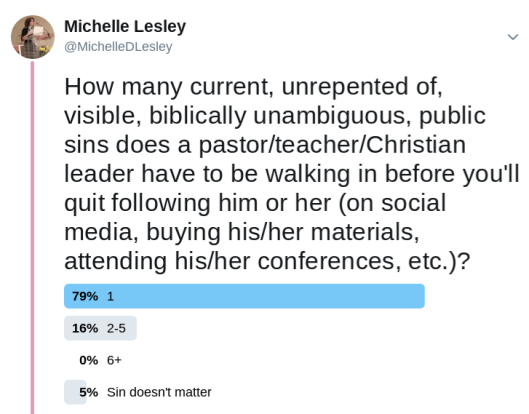
In the wake of Frank Page’s resignation, I asked this poll question on Twitter

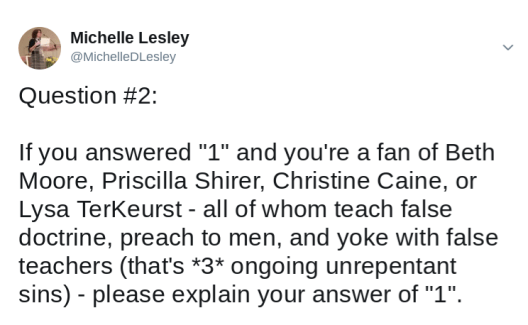
followed by this one

Why are Southern Baptists leaders so quick to – rightly and biblically – oust Frank Page for, as far as we know, one isolated sin which he publicly confessed to and repented of, and yet overlook three major – and much more publicly observable and harmful to Southern Baptists – ongoing sins from pastors and teachers who have been rebuked and refuse to repent? Why, instead of disciplining them for their sin, do those in leadership give them fat book deals, invite them to speak at all the cool conferences, fawn over them on social media, and make them into celebrities?

How many sins will it take to disqualify and discipline these people? Four? Eleven? Ninety-six? Is there any amount of sin these pastors and teachers, and those like them, can commit that will cause those in SBC leadership to pull their materials off the shelves of LifeWay, deny them a seat at the table, and urge them to repent and step down from their positions?

I’ve been a Southern Baptist from the day I was born. I’ve been taught since the cradle roll that if God’s Word says not to do something and you do it anyway, that’s a sin. If God’s Word says to do something and you don’t do it, that’s a sin. And that sin is sin in the eyes of God.

Well is it, or isn’t it, Emperor?

If sin is sin in God’s eyes, why aren’t you treating Beth Moore’s sin like Frank Page’s sin? Why are you rewarding her for her sin and disciplining him for his?

The Bible says in James 3:1:

Not many of you should become teachers, my brothers, for you know that we who teach will be judged with greater strictness.

Those who teach and lead bear more responsibility to teach sound doctrine and walk worthy because they are teaching and leading us by example.

Why are all the aforementioned pastors and teachers better examples to us in their rebellion and unrepentant sin than Frank Page was in his repentance of sin?

Why?

Southern Baptist peasants and little children see right through your foolishness on parade on this issue and we want answers. Biblical answers.

Don’t just stand there shivering, suspecting we are right, but thinking, “This procession has got to go on,” and walking more proudly than ever. Go back to the palace. Repent. Clothe yourselves with humility and obedience to Scripture, and come back and lead us rightly. Biblically.

Because the Emperor of Southern Baptist leadership has been naked for far too long.


ยนH.C. Andersen Centret (The Hans Christian Andersen Centre). The Emperor’s New ClothesAccessed April 5, 2018.

ยฒI am well aware that this is not the only problem in the SBC that needs to be addressed. It would be impossible to address every issue in one article, so this time I’ve chosen to focus on this one particular issue.