Random Ramblings Ruminations Resources

Random Ramblings, Ruminations, and Resources

A couple of months ago, I “beta tested” a new feature here at the blog, which I alliteratively titledย Random Ramblings, Ruminations, and Resources.ย People seemed to like it … or … at least the majority of readers didn’t seem to hate it too much. So I decided to bring it back every once in a while when I’m feelin’ it.

I’m feelin’ it today. Buckle up, Buttercup.ย 

I’m Sorry…

I need to kick things off with an apology. God has graciously seen fit to convict me that my tone has been too harsh in some of my articles recently, particularly in the first part ofย this article. If you’ve ever been offended or hurt by the tone of that or any of my other articles or remarks I’ve made on social media, I wanted to say I’m sorry and to humbly ask your forgiveness.

And even if you weren’t offended or hurt, I know where my heart was as I was writing that article and the tweet it was based on, andย I know it wasn’t right. I failed to exercise self-control and selfishly spewed my emotions in a way that was designed only to vent my own frustration and get it out of my system (which was pretty hypocritical since I was writing that we shouldn’t be slaves to our feelings!). I wasn’t even thinking about how a new Christian, someone going through a difficult time, or someone weak in the faith might have taken the tone in which I was saying those things. Romans 15:1 says:

We who are strong have an obligation to bear with the failings of the weak, and not to please ourselves.

Well, I don’t consider myself all that strong, but I guess each of us is stronger in the faith or in a stronger position of life circumstances than somebody. And for those who are weaker in the faith than I am, or walking through a time of pain or discouragement, I did the exact opposite of what this verse says to do. I pleased myself at your expense, and that’s not what someone who serves you in the name of Christ is supposed to do. So, again, my deepest apologies and I hope you’ll be able to forgive me.

If you’re so inclined, Iย wouldย like to ask you to pray for me about this. Tone is an extremely difficult and confusing sea to navigate, at least for me (that’s one of the many areas in whichย I’mย weak). It is important to speak biblical truth firmly, unequivocally, and unapologetically, but some Christians see that, in and of itself, as being harsh. It’s also important to demonstrate gentleness, kindness, and compassion, but other Christians see that as being wishy-washy or not standing firm on Scripture. I have written articles to which some have responded that I was too harsh and others have responded that I wasn’t harsh enough – to the same article! Add to that the fact that Jesus, Paul, and others in Scripture sometimes used phraseology that we would consider very harsh today…..but yet Paul says, “Imitate me as I imitate Christ.” And, add to that that there are different expectations in the evangelical mind of how women are to address things versus how men are to address things, and you can see what a fine and perplexing line it can be to walk. But I really,ย really want to get it right in God’s eyes, because I want to please Him.

I can’t promise my tone will never offend you again. That would be foolish. I have over 11,000 blog subscribers and over 10,000 social media followers. Everything I write is going to offendย somebody,ย even if I don’t mean it to. Also, I know my heart, so I know I’m going to sin again by being selfish and uncontrolled. Furthermore, I can’t attempt to please everyone. That’s not only an exercise in futility, it’s unbiblical. What I can tell you is that I will do my best to think more about how I’m coming across, edit more to keep my own words, approach, and personality from becoming a stumbling block, and pray more as I write, asking God to grow me in wisdom and self-control, in order to honor, and be pleasing to, Him.

About five years ago, I wrote an article calledย Sacrificing Truth on the Altar of Tone. While it’s incumbent on us as readers and listeners to be able to put tone aside in order to discern whether or not what the speaker or writer is saying isย true, it is also incumbent upon those of us who speak and write not to burden our hearers and readers with the necessity of doing so.

Thanks so much for your prayers as I pursue obedience to Christ in this area of my life. You are such a blessing to me, and I love and appreciate each of you.

Fill itย Filled to the Rim

Didja hear? I’m doing a women’s conference with the ever-awesomeย Amy Spreeman at the end of March. It’sย free, including a couple of meals, and it’s in Princeton, Illinois.

(In case you were wondering, that’sย not where Princeton University, former home of Jonathan Edwards, is located. That’s in Princeton, New Jersey. I know this because I was wondering about it, too, and had to look it up.)

If you’re still trying to make up your mind about whether or not to come, lemme help you:ย come. And you need to hurry up and register too. Last week the event planners said they were already at 83% capacity (one of them must have been a math major!).

Here’s all the info. Be sure to check out the app and other links for resources on accommodations.

Illinois is too far away? Being from Louisiana, I get that. Look, plan your own conference, and I’ll come to you. “Impossible!” you say, “I go to a tiny church with an even tinier budget!”. Get together with a couple of sister churches to share expenses. Do a bake sale or a garage sale or crowdfunding. Take up a love offering and/or sell tickets at a modest fee. If you’re at all able, offer a doctrinally sound conference option to the women of your church and community. Christ’s ewe lambs are hungry for truth.

UPDATE: As I go to press, this conference is at capacity (“sold out”). If the organizers are able to open up any more spots, I’ll let you know. Also, if you’ve already registered and end up not being able to attend, please contact Princeton Bible Church and let them know so they can give your spot to someone else.

Scandal in the SBC

By now you’ve probably read theย Houston Chronicleย article that came out last weekend:ย Abuse of Faith: 20 years, 700 victims: Southern Baptist sexual abuse spreads as leaders resist reforms. If you haven’t, you should, regardless of whether or not you’re Southern Baptist. But, maybe especially if you are. It’s horrifying. And the way some have responded to victims over the years is downright disgusting.

Unless God leads me differently, it’s currently my plan to write an article about this, but I wanted to take the time to give it plenty of thought and prayer. In the meantime, I commend to you this stellar article by Tom Ascol:ย Southern Baptists, Sexual Abuse, and a Far More Serious Problem. It covers a couple of points that I had already rough drafted into my own article before I read his. (So, when you read mine later, just know – it’s not plagiarism, it’s two like-minded Christians drawing the same conclusions.)

This also seems an appropriate time to share this vlog with you explaining how I decide which kinds of evangelical current events to write about, and when, and which I don’t, and why:

And Speaking of Scandals…

This has been in the hopper waiting for me to write about it since the last high profile pastor “fell from grace” (I actually can’t stand that expression. If you’re saved, you’re “in grace” and you can’t fall from it, and if you’re not saved, you’re not “in grace” so you can’t fall from it. It makes no biblical sense. But, I digress…). And, with the recent news of Harvest Bible Chapel firing James MacDonaldย after years and years of spiritual and financial abuses, I was reminded of it again.

There’s a dynamic that happens on social media that you see nearly every time something like this happens. A Christian celebrity falls and other Christians re-post the news story and/or comment about it. In the circles I run in, the comments are usually

biblically appropriate (“This is so sad,” “We need to pray for his family,” etc.). But there will always be someone who will comment to the effect of: “Why is everybody commenting and re-posting about this event? How can it possibly be fruitful or necessary to share this information?” It’s not that people are commenting unkindly, but that people are sharing this informationย at all that bothers this person.

There’s probably an extent to which this person is right, and you can share or not share as your conscience dictates, and I’ll admit that there have been times when an event has beenย so over-shared that I grew weary of the dead horse being beaten. But God has very good purposes in sinful events coming to light. And He demonstrates this Himself in Scripture.

God could have omitted from Scripture every sin, failure, and foible committed by every Bible character, and we would never have heard about them. But He graciously pulls back the veil and lets us seeย someย of them. Why? For His glory and our good. And the same could be said about the public availability of information about the sins of today’s high-profile Christians:

๐Ÿ’กย These stories, both in the Bible and in yesterday’s newspaper, allow us to learn, and develop a holy fear of the consequences of sin without having to go through it ourselves. “Stay home from the war and seduce my neighbor’s wife? Um, no thanks. Look how that turned out for David. I’ll just avoid that altogether.”

๐Ÿ’กย These stories emphasize to those in leadership that theyย mustย walk circumspectly because the world, and the church, are watching them. There is a heavy price to pay for setting a bad example.

๐Ÿ’กย These stories are a reminder that we cannot hide our sin.

๐Ÿ’กย These stories are a call to pray for everyone involved in the situation. You cannot pray about what you do not know about.

๐Ÿ’กย When churches and other Christian organizationsย properly handle a sinful situation, it is a testimony to the world that the church is notย “full of hypocrites” – that thereย are Christians who strive for holiness and obedience to God. It sets us apart from the world, and from “CINOs” (Christians In Name Only).

๐Ÿ’กย When the high-profile Christian repents and submits to church discipline, it paints a picture for the watching world of the way sin is supposed to be dealt with by the individual, and the way God and the church deal with sin in grace, mercy, forgiveness, and restoration. It can be a testimony of the gospel.

On “Dating” your Daughter…

There are a lot of great, godly dads out there. I love hearing them talk about leading their families in worship, talking about their love, hopes and dreams for their kids, and seeing them spend time with their children doing special activities. All of those things are absolutely awesome, andย more dads should be doing them.

So maybe it’s just me (it wouldn’t be the first time), but it’s a bit disquieting when I hear men label spending time with their little girls as “daddy-daughter date night” and doing things like bringing them flowers and candy, ringing the doorbell to “pick them up” for the date, dressing up as if for the prom, etc.

Listen, it’s not a sin, and the guys I know and love who do these things are doing them for all the right reasons. And, if they want to keep on using the “dating” terminology and motif, more power to them – they won’t hear a peep from me and I will still have the utmost respect for them as godly men and godly fathers.

But if I could just throw out some food for thought…

โ™ฅ There is a difference between a father’s role and fatherly love and a (potential) husband’s role and romantic love. Are we blurring the lines and confusing our daughters when Dad mimics boyfriend? Could we, instead, make sure those lines are clearly defined and teach our daughters (and sons) the beauty and goodness of the two different roles and types of love?

โ™ฅ We want our children to be safe from predators. If we introduce and normalize the idea that it’s good and godly for an adult man to engage in behaviors with a child that are usually associated with romantic love, is it possible that we could unwittingly be making it harder for our daughters to recognize when a predator is attempting to groom them?

โ™ฅ If we have both sons and daughters, how is this affecting our sons? Are they getting the impression that their sisters are more special and loved by Dad than they are?

โ™ฅ How is this affecting the relationship between mother and daughter? Is Dad showing as much attention to Mom as he is to daughter? Is there potential for any undercurrent of rivalry or jealousy for Dad’s attention to develop between Mom and daughter? Could the daughter come to see herself as being on equal footing with Mom instead of submissive to her authority?

โ™ฅ Why is the “dating” terminology and motif necessary? Is there a biblical or practical reason why simply spending time with your daughter – whether it’s at home or even on a special outing to a restaurant, movie, etc. –ย without calling it a “date” or acting like it’s a “date” isn’t good enough?

โ™ฅ If the purpose of “dating” your daughter is to demonstrate how her future husband should treat her, what happens when she grows up, gets married, and her good and godly husband is just kind of inept when it comes to “date night”? Have we not created an opportunity for her to unfairly compare him to Dad, find him lacking, and resent him?

โ™ฅ If the purpose of “dating” your daughter is to demonstrate how a husband should treat his wife, couldn’t we be confusing our children by putting Dad in the role of the daughter’s “husband”? “I’mย not his wife, I’m his daughter,” she could think, “so why is he acting like my ‘husband’?” Would it not make more sense to model for our children how a husband is to treat his wife by Dad treating hisย actual wife in a godly way?

Children are very impressionable and – if you remember back to your own childhood – highly susceptible to misunderstanding things and believing things that aren’t accurate. I’m just wondering if maybe we need to think through this whole “daddy-daughter date night” thing a bit more deeply.

Relationships, Sanctification

In Defense of Offense: Why Christians Need to Stop Worrying About Offending People

“You’re a liar,” he said dryly, the passion in his eyes gleaming through.

“What?!?! HOW DARE YOU call me a liar!” his fellow church member fumed.

“You’re a liar, Joe. You show up at church for an hour a week and claim to be a Christian, yet you’ve been living with your girlfriend for over a year, you’ve told me you use pornography, and I’ve talked to five different people with incontrovertible evidence that you’ve cheated in your business dealings with them. When you say you’re a Christian, you’re lying. Just admit it.”

Have you ever had a conversation like this with someone? Have you ever witnessed a conversation like this?

Most of us would never dream of calling someone a liar who claims to be a Christian yet walks in disobedience to Christ. Goodness, no! It might offend the person or cause her to question her salvation! She might leave the church or walk away from the faith!

You know who wouldn’t be afraid of offending such a person or causing her to doubt her salvation? Someone who would dream of calling a professed Christian walking in disobedience a liar?

The Holy Spirit – via the Apostle John – that’s who.

Whoever says โ€œI know [Jesus]โ€ but does not keep his commandments is a liar, and the truth is not in him, but whoever keeps his word, in him truly the love of God is perfected. By this we may know that we are in him: whoever says he abides in him ought to walk in the same way in which [Jesus] walked.

1 John 2:4-6

Take a moment and let that really sink in. People who claim to be Christians yet habitually and unrepentantly make a practice of sinning are not saved.

People who claim to be Christians yet habitually and unrepentantly make a practice of sinning are not saved.

To the Holy Spirit and John that’s as plain and simple and uncontroversial as saying, “The sky is blue, and water’s wet.” But to a false convert, them’s fightin’ words.

And we know it.

So we refrain from lovingly speaking hard, biblical truths to people who need to hear them, usually for one of a handful of reasons:

โ€ข We don’t want this person’s wrath aimed at us because it’s a hassle or because we don’t want to lose the relationship with her.

โ€ข We don’t actually believe the Bible and trust God’s sovereignty. We’d rather lean on our own understanding, desperately clinging to the irrational hope that this person is truly a Christian who’s hanging by a thread, and we don’t want to be the one responsible for saying anything that might clip that thread.

โ€ข We’re worried about how we’ll look to others and that they’ll accuse us of being unloving, unchristlike, and harming the unity of the church.

What do those reasons have in common?

Me. Me me me me me me me.

I want to keep my relationship with this person in tact. I don’t want others to blame me for this person’s reaction to biblical truth or call me unloving or divisive. I don’t want to deal with the aggravation of this person’s emotional blow up.

It’s not exactly the greater love of laying down one’s life for a friend, is it? We’re not even willing to lay down our comfort or our reputation in order to tell someone her walk doesn’t match her talk and call her to repentance. Is that love at all, or is it just plain, old fashioned selfishness? We bow and scrape at the idol of not hurting other people’s feelings while those people careen down the road paved with our good intentions straight toward the gates of Hell. How is that love? 

We bow and scrape at the idol of not hurting other people’s feelings while those people careen down the road paved with our good intentions straight toward the gates of Hell. How is that love?

Love is valuing, and acting on, what is best for another person over and above our own self interests. You know, kind of like Jesus did during His life, death, and resurrection:

By this we know love, that he laid down his life for us, and we ought to lay down our lives for the brothers.

1 John 3:16

You know, it’s interesting that the Holy Spirit speaks a lot of hard, “you’re not saved if…” truths in a book (1 John) whose purpose is to give true Christians assurance of their salvation. The Third Person of the Trinity – the embodiment of perfect love – doesn’t seem to think it’s unloving to tell false converts they aren’t saved, while at the same time reassuring young, shaky-kneed saints.

But us? We can’t seem to get our act together and do both from a heart of love the way the Holy Spirit does.

Weโ€™ve focused so much attention on reassuring anyone who claims the label “Christian” of their eternal security that weโ€™ve lost sight of the fact that there are a great many false converts in our midst who should be questioning their salvation. The gate is wide that leads to destruction, Jesus said. It is the narrow gate that leads to life, and few are those who find it. Test yourself to see if you’re in the faith. How will they know these things if we don’t tell them?

The Bible has hard, sharp edges. It’s a sword, for crying out loud, not a feather duster. The primary purpose of a sword is to cut.

The gospel divides. Jesus – the creator of Christian unity – said, “I have not come to bring peace, but a sword. For I have come to set a man against his father, and a daughter against her mother, and a daughter-in-law against her mother-in-law.” Jesus – perfectly kind, perfectly loving Jesus – called those claiming to be God’s people yet walking in disobedience hypocrites, vipers, and sons of the Devil. Jesus – the Jesus who was more compassionately evangelistic than we could ever hope to be – didn’t beg, plead, or hand-wringingly water down Kingdom requirements so the rich young ruler would keep a toe in the door of God’s house. Jesus held high the standard of the gospel and let him walk away. Jesus wasn’t a nerdy little wimp offering people a cheap plastic heavenly trinket if they would only be His friend. This almighty King demanded perfection, the highest love, loyalty unto death. And, by the way, you’d better count the cost before deciding to follow Him. Jesus wasn’t worried about offending people with biblical truth.

We need to stop worrying that the Bible is going to offend people who need to be offended by its demands, requirements, and judgments so that they might repent and be reconciled to Christ. Whether it’s a sinner in need of a Savior or a saint in need of sanctification, the ministry of reconciliation Christ has called us to begins with confronting sin.

We need to stop worrying that the Bible is going to offend people who *need* to be offended by its demands, requirements, and judgments so that they might repent and be reconciled to Christ.

Every person we would potentially approach with biblical truth is either saved or lost.

If a person is genuinely one of Christ’s sheep, she will hear the voice of her Shepherd calling to her from the truths of His Word, turn from her sin, and follow Him. It may take time. It may take help. It may take teaching and many tears. But sheep love the Shepherd and follow Him. They grow toward Him, not away from Him.

If a person is lost, she isn’t going to get any “loster” when you biblically call her to repentance. Lost is lost, even if that lost person claims to be, or thinks she is, a Christian. There’s no such thing as a genuinely regenerated Christian who’s just barely hanging on to Jesus by her fingernails and you come along and push her out of the faith by confronting her sin with biblical truth. Uh uh. If she abandons Christ in favor of her sin, she was never saved in the first place, I don’t care what she claims to the contrary.

If a person is lost, she isn’t going to get any “loster” when you biblically call her to repentance.

All of this nonsense floating around these days about “de-converting” from Christianity, or “I used to be a real, genuine, bona fide Christian, but I’m not anymore.” Hogwash and poppycock. The Bible says if you leave the body of Christ, you were never a member of it to begin with. That God is greater than all (including you) and no one (not even yourself) is able to snatch you out of His hand if you belong to Him. That those who are saved will endure to the end. That Jesus will not lose a single one of those the Father has entrusted to Him. Dare we believe the words of sinners about themselves over what the Word of God says about them? No matter what you say or do, you don’t have the power to be responsible for someone leaving the faith. Whatever circumstance or person they might use as a scapegoat, people “leave” Christianity because they don’t know or love Christ and they’ve gotten tired of pretending like they do.

The people we love enough to lovingly, yet firmly, speak hard biblical truths to are either Christians who will come to love and embrace those truths (and love us for caring enough to speak them), or theyโ€™re lost or false converts who need to be confronted with the mirror of God’s Word so they can face up to the fact that theyโ€™re lost. Where the Bible speaks plainly and definitively, we must not be ashamed of the gospel and shrink from speaking plainly and definitively in agreement with it.

Stop being afraid of offending people by speaking hard, biblical truths. Sometimes the most loving thing you can do for someone is offend her.

Stop being afraid of offending people by speaking hard, biblical truths. Sometimes the most loving thing you can do for someone is offend her.

Mailbag

The Mailbag: Is lust a sin for women, too?

In the past, I’ve had lots of trouble wondering about my desire and tendency to look at, and get excited by, physically attractive men, especially men who reveal a lot of themselves in underwear modeling and soft-core porn. I think this is a sin, but I’m not sure.

I’ve gotten mixed reactions when I’ve mentioned this to people. There are some who say that, yes, this is the sin of lust. Yet there are others who have told me that women cannot possibly struggle with lust, only men do. I once dealt with one particular man who was very dogmatic that God created men and women to be tempted differently, and that lust is not a temptation women deal with, so he dismissed my struggles with this subject.

When I tried to search Scripture, using Matthew 5:28, it would also seem that this is a male-only sin. So is it OK for me to keep looking at male models, including underwear modeling and soft-core porn?

This is an awesome question for three reasons. First, you’re concerned about whether or not you’re sinning with the aim of mortifying this behavior if it is a sin. Second, you’re not relying on your own feelings, opinions, or experiences to determine whether or not this is a sin, you’re turning to Scripture to find out. Those are both very encouraging things. They demonstrate that the Holy Spirit is working in your heart to sanctify you and make you more like Christ. Third, it gives us an opportunity to take a look at the Scriptures in more depth and give an example of handling God’s Word correctly and in context for everyone reading this article. So, thank you for asking!

The short answer to your question is, yes, lust is sinful for the women who experience it just as much as it is for the men who experience it. But I don’t want you to just take my word for it, so let’s look at why.

The Scripture you’ve cited, Matthew 5:28, is definitely one of the passages that addresses this issue. It says:

But I say to you that everyone who looks at a woman with lustful intent has already committed adultery with her in his heart.

I suspect this verse might be the reason the man you spoke with said that lust is a male-only sin, because this particular verse speaks to men lusting after women. However, to make a blanket statement that because God created men and women differently, lust is never a temptation for women is foolhardy and shows a lack of biblical knowledge and understanding as well as a denial of reality.

Let’s address reality first. It is true that God created men in such a way that they are more likely to be sexually stimulated by what they see than women are. However, that does not mean that no woman anywhere has ever experienced lust. God also created men in such a way that men are usually taller and stronger than women and women are usually more emotionally expressive than men. But we can look around us and see that some women are taller or stronger than some men, and some men are more emotionally expressive than some women.

Furthermore, while you really can’t do anything about how tall you are (and, to some extent, how strong you are), lust is something that can be introduced to women and encouraged in women by culture. A hundred years ago, it would have been unthinkable to see advertisements featuring nearly naked men, or strip clubs with male dancers, or pornography aimed at women, so readily available and with so little shame attached. And at that time there were probably far fewer women who struggled with the sin of lust.

These days, it’s right there on your phone or computer or TV or at the bachelorette party for your friend. Lust, lewd behavior, and lurid talk by women are actually encouraged by the feminist movement. (If men are going to objectify women with lust and porn, we’re going to objectify them right back. Really? This is equality? The right to sink to the same depth of degradation as the scuzziest of men? No thanks.) Watch any sitcom or drama on TV. You’ll see it soon enough. And, of course, there’s money to be made by making women into consumers of porn and other sexual material, so the businesses that peddle these things encourage women to lust as well. All of which means that today, just a hundred years later, far more women are struggling with the sin of lust.

So we can see that the reality is that lust is a temptation experienced by some women, even though men are more prone to it.

But is lust a sin for women if Matthew 5:28 is speaking in terms of men lusting? Yes. There are a couple of different reasons for this, one cultural, and one biblical.

Let’s go cultural first to understand more clearly why this particular verse is addressed to men rather than men and women. We start off with the knowledge that men are much more likely to experience lust than women. Then we take the culture of the time into account.

Jesus spoke these words in a patriarchal society. In His culture, there were no women in positions of authority and power. Men ran the political system, the religious system, and men were the heads of their households. (By the way, despite what our culture today would say, this wasn’t a bad thing in and of itself. In fact, most of this was perfectly biblical.) Normally, women were not educated, and they depended on men – first their fathers, then their husbands, and finally, their grown sons – to take care of them their entire lives.

So when Jesus was teaching to the crowds as with the Sermon on the Mount (which Matthew 5 is part of) the cultural understanding was that He was primarily teaching the men, and any women and children they brought with them were basically along for the ride. Indeed, many would have thought the women incapable of understanding teaching (since they were intellectually inferior to men) or unworthy of receiving teaching (because God had created them as “lesser” than men).

The Jewish understanding that Jesus was primarily teaching the men would have been similar. Rabbis didn’t teach women, they taught men. Any intentional biblical instruction women received would have been from their fathers or husbands at home. We can see further evidence of this cultural and Jewish understanding in several different Scriptures. A few examples:

At the feeding of the five thousand, the feeding of the four thousand, and some other New Testament “crowd scenes”, the crowd is numbered by the number of men present.

Both the woman at the well herself and the disciples “marveled” that Jesus was speaking with a woman.

Due to Martha’s cultural and Jewish understanding of women’s roles, Jesus had to explain to her that it was OK – even good – for Mary to sit at His feet and learn.

At Pentecost, Luke refers to the “multitude” as “devout men“, and Peter addresses this crowd as “men of Judea“, “men of Israel“, and “brothers“.

So, in Jesus’ secular and Jewish cultural context, He was understandably speaking to the men present. (And what was He telling these men who lived in a world that taught them that women were inferior to men, and that men could regard and treat women any way they wanted to? Jesus elevates the status of women by telling the men they’ve got to respect women even in their hearts. They’ve got to respect their wives by not committing adultery with other women in their hearts, and they’ve got to respect those other women by not using them as objects of sexual gratification in their hearts.) It would have been an unnecessary distraction from His message to address the women directly, and it would certainly have been viewed as inappropriate, maybe even perverted, for Jesus to have suggested that women lusted after men.

So Jesus’ culture, and the fact that lust is largely a sin committed by men, required Him to address this remark to men. But those two things do not have any bearing on the intrinsic sinfulness of lust itself, and they do not mean that this instruction applies only to men. In the section of Matthew 5 preceding the section on lust, Jesus deals with the sin of being angry with your “brother”. Does this mean anger is only sinful if you’re angry with a man instead of a woman? The section of Matthew 5 immediately following the section on lust says men may not divorce their wives except for unfaithfulness. Does this mean women are free to divorce their husbands for any reason? Of course not.

But it’s important to remember that Matthew 5:28 is not the only passage of Scripture that deals with lust. Let’s look at some others.

These passages describe lust as female attribute:

a wild donkey used to the wilderness, in her heat sniffing the wind! Who can restrain her lust?
Jeremiah 2:24a

Oholah played the whore while she was mine, and she lusted after her lovers…everyone after whom she lusted…the Assyrians, after whom she lusted…Her sister Oholibah saw this, and she became more corrupt than her sister in her lust and in her whoring, which was worse than that of her sister. She lusted after the Assyrians…all of them desirable young men.
Ezekiel 23:5a,7b,11,12a,c,

Ezekiel even describes Oholibah viewing pictures of men lustfully. Doesn’t it sound like a woman viewing pornography?:

But she carried her whoring further. She saw men portrayed on the wall, the images of the Chaldeans portrayed in vermilion, wearing belts on their waists, with flowing turbans on their heads, all of them having the appearance of officers, a likeness of Babylonians whose native land was Chaldea. When she saw them, she lusted after them and sent messengers to them in Chaldea.
Ezekiel 23:14-16

In the Jeremiah passage, the lusting woman represents Israel. In Ezekiel, Oholah represents Samaria, and Oholibah represents Jerusalem. So these are not individual women lusting, rather, God is using the illustration of a woman lusting after her “lovers” to describe the unspeakable abomination of Israel’s idolatry. He was using the severest language He could to disgust His people over their sin and move them to repent and turn back to Him. God could have chosen any sin – male lust, robbery, murder, etc. – to represent how horrific their idolatry was to Him, but what did He choose? Female lust. Let that sink in.

Romans 1:18-32 clearly refers to the sins of both men and women, with verse 24 stating:

Therefore God gave them up in the lusts of their hearts to impurity, to the dishonoring of their bodies among themselves,

These passages speak of lust in neutral, rather than male or female, terms:

and especially those who indulge in the lust of defiling passion
2 Peter 2:10a

For all that is in the world, the lust of the flesh and the lust of the eyes and the boastful pride of life, is not from the Father, but is from the world.
1 John 2:16

Lust is a form of coveting – the greedy yearning to have something that God has not given to you or has given to someone else, and that is certainly not limited to men. Also notice in these passages that you can covet a person, and that coveting is often linked to sensuality or sexual immorality.

You shall not covet your neighbor’s house; you shall not covet your neighbor’s wife, or his male servant, or his female servant, or his ox, or his donkey, or anything that is your neighbor’s.
Exodus 20:17

coveting, wickedness, deceit, sensuality, envy, slander, pride, foolishness. All these evil things come from within, and they defile a person.
Mark 7:22-23

But sexual immorality and all impurity or covetousness must not even be named among you, as is proper among saints…For you may be sure of this, that everyone who is sexually immoral or impure, or who is covetous (that is, an idolater), has no inheritance in the kingdom of Christ and God.
Ephesians 5:3,5

Put to death therefore what is earthly in you: sexual immorality, impurity, passion, evil desire, and covetousness, which is idolatry.
Colossians 3:5

Finally, lusting after another person – adulterous coveting – is not loving your neighbor:

For the commandments, โ€œYou shall not commit adultery, You shall not murder, You shall not steal, You shall not covet,โ€ and any other commandment, are summed up in this word: โ€œYou shall love your neighbor as yourself.โ€
Romans 13:9

When you look at another person with lust, you are loving yourself. You are thinking selfishly about how that person could gratify your base desires, make you feel good, serve you. That is the antithesis of everything Jesus taught and stood for. Our Master, the One we follow and strive to be like, said:

For even the Son of Man came not to be served but to serve, and to give his life as a ransom for many.
Mark 10:45

Jesus came to die on a cruel rugged cross to pay for the sins of the flesh. He would never have thought of using another person to gratify His own selfish desires. How could we?

Is lust a sin for women too? Absolutely. Stop it. Repent. Receive the merciful grace and forgiveness Christ offers.

Additional Resources:

Just Stop It: Instructions on how to repent at The Cripplegate

Hey, Porn Addict: Stop It by Gabriel Hughes

How do you stop looking at porn? at When We Understand the Text

God Over Porn

Every Womanโ€™s Silent Struggle: Fighting Lust with Sisters in Christ by Marian Jacobs


If you have a question about: a Bible passage, an aspect of theology, a current issue in Christianity, or how to biblically handle a family, life, or church situation, comment below (Iโ€™ll hold all questions in queue {unpublished} for a future edition of The Mailbag) or send me an e-mail or private message. If your question is chosen for publication, your anonymity will be protected.


Sanctification, Sin

Throwback Thursday ~ Performing a Sin-ectomy

Originally published November 3, 2008

Have you ever faced an issue of obedience in your walk that seemed so difficult you felt like you’d never get it right? Maybe it’s something most would consider a “biggie”, like pornography, gambling, or alcoholism. Maybe it’s one of those heart issues that nobody sees except you and God, like racism, a critical spirit, pessimism, or bitterness.

Sometimes the sins we would consider to be “big” are, in a way, easier to deal with than the “small” ones. After all, it’s a lot easier to put an adult content filter on your computer than it is to prevent critical thoughts from jumping into your mind. You can take a different route home from work so you don’t even have to drive past your favorite bar, but we take our minds with us everywhere we go (although looking at the behavior of some people these days, you have to wonder!)

I’m working through not one, but two heart issues right now that are both really tough. (I’m not sure if God is piling on or being efficient!) I’m glad, though, that both issues finally came to a head in my spirit and that God is gradually working them out of me to make me more like Him. As I began the battle against these two sins, God sat me down and showed me some things I needed to know and do as I moved forward:

When God reveals sin in our lives, we can’t just ignore it. We must face it and fight it no matter how difficult it seems. If we don’t, the distance between us and God that was created by that sin won’t just remain, it will grow. This is because we’re now committing two sins, the sin itself, and the sin of refusing to deal with it and get it out of our lives.(James 4:17)

Only God can remove sin. We can try, through our own strength, to fix the problem ourselves, and we might even look successful temporarily, but ultimately, without His power, help, and strength, we wil fail. (Romans 7:14-25)

Prayer is absolutely imperative. Because we need God’s strength and power, we’ve got to ask Him for it at least daily, and preferably continuously throughout the day. I have found that if I don’t stay on top of these two obedience issues in my life by praying for God’s help every single day, I start slipping back into my old ways. (Matthew 26:41 )

Commit consciously and completely. Remember the scene in the movie The Karate Kid in which Mr. Miyagi is talking to Daniel about committing to karate? He says something to the effect of, “You do karate “yes”, safe. You do karate “no”, safe. You do karate “guess so”, get squashed, just like grape.” It’s much the same way with issues of obedience, except that the only safe choice is to “do obedience, ‘yes'”. It’s important to make a firm and definitive decision to give ourselves completely to obeying what God has revealed to us, otherwise we’ll be sure to waver when the going gets tough. Sometimes it is helpful to stand in front of the mirror and watch ourselves making a verbal pledge to God to obey, or write out our commitment on a piece of paper. (Psalm 119:57)

Take all the prayer you can get. While we should be discerning with regard to discretion, it’s helpful to enlist others to pray for us. Not only will we have more prayers going up on our behalf, but we will find that being accountable to those who are praying for us helps us stay on track. (Colossians 1:9-10)

Be ready for the enemy’s attack. If there’s one thing Satan hates, it’s a Christian who desires to be obedient to God. We have to realize that when we determine to set our feet on the road to obedience, he will attack. The obedience issue will suddenly become much more difficult; other things will pop up in our lives that have to be dealt with so we’ll feel like putting the obedience issue on the back burner; depression or discouragement may come. Those things are all designed to deter us and keep us in sin, but we have to stand firm and keep moving forward in obedience. (Ephesians 6:12-13)

Get plenty of rest, eat right, and stay healthy. This is war. We can’t fight off the enemy of the flesh when we’re tired and weak. Being in top physical condition when doing spiritual battle helps immensely. (Mark 12:30)

Stumbling here and there is inevitable, but don’t give up! When babies first start to walk, they don’t just get up in the middle of the floor and walk perfectly from that day forward. They take a few steps and fall, then a few more steps and another fall. But, they keep on getting up and trying again. We’re going to mess up when we try to obey, but we can’t give up. We’ve got to keep at it. Eventually we’ll get the hang of it. (Proverbs 24:16, Galatians 6:9)

Be vigilant and always on the alert for opportunities to practice obedience. The main hurdle I’ve been facing with my obedience issues is that I react automatically, quickly, and without thinking, to the stimuli that trigger my disobedience. It’s almost Pavlovian in nature. I literally need God to change my mind and my thoughts. This has prompted me to pray two things: One, that God will help me to stop for a few seconds after a stimulus presents itself so I can think about my response before I give it; two, that every time I enter the presence of the stimuli, God will help me to be focused and alert to opportunities that arise to practice obeying Him. God has answered those prayers, and it has been immensely helpful. Looking for opportunities to obey has now become almost fun, like an Easter egg hunt. It is exciting to find that opportunity and know I’m doing the right thing for a change. (Romans 12:2, II Corinthians 10:5)

Be patient. If the sin we’re battling is entrenched, it’s likely gotten to that point over a long period of time (decades, in my case). It is probably going to take a while to eradicate it and replace it with Godly behavior. Although God sometimes sets us free from things immediately, usually with behavioral and thought issues He has us roll up our sleeves and do the hard work it requires to change. We just have to keep plugging away and remember that even if we only move an inch forward, we’re still moving forward. (Romans 5:3-5, James 1:2-4)

Keep score. Something I’ve found debilitating in the battle against disobedience is that at the end of the day I seem to remember only my failures and none of my successes. This is extremely discouraging and demotivating, so one of the things I have been praying is that God will help me remember what I’ve done right during the day. It has helped me to see my forward progress and reminded me to thank God for His help and give Him the glory for my successes. Additionally, as God has reviewed my successes with me, He has reminded me that He is cheering me on. He is always pleased when we get it right. (I Corinthians 15:56-57)

Eyes on the prize. “His master said to him, ‘Well done, good and faithful slave You were faithful with a few things, I will put you in charge of many things; enter into the joy of your master.'” Matthew 25:21 “Blessed is a man who perseveres under trial; for once he has been approved, he will receive the crown of life which the Lord has promised to those who love Him.” James 1:12 We do what we do for God’s glory and the applause of Heaven.

Hang in there with God. It is worth it!

Christian women, Complementarianism, Ministry, Sin

Women Preaching: It’s Not a Secondary Doctrinal Issue

When it comes to Christianity, are the specifics of what people believe important?

I think most of us would answer a resounding “yes” to that question. Of course, the various concepts we believe are important. You can’t just believe anything you like and still be a Christian. There are certain things you must believe in order to become a Christian at all, and there are certain things you will come to believe because you are a genuinely regenerated Christian. But what are those things, and how do we know which is which?

You can’t just believe anything you like and still be a Christian.

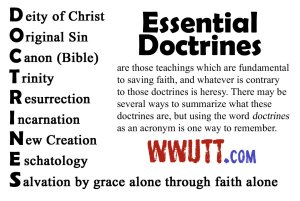
Maybe you’ve heard the terms “essential doctrines” or “primary, secondary, and tertiary theological issues” or “first, second, and third tier levels of doctrine”? For years, theologians have been attempting to organize beliefs of the Christian faith – all drawn from the Bible, naturally – into nice neat categories in order to make things a little simpler. As someone who thrives on organization and categories, I’m grateful for their efforts. But if you begin to study this categorization of beliefs, you’ll find that we haven’t reached an across the board consensus yet.

Generally speaking, “essential”, “primary”, or “first tier” doctrines are those which you, biblically, have to believe in order to become a Christian and/or be considered a Christian. For example:

โœข Sin is a thing, and I am a sinner.

โœข God exists and is the supreme authority of the universe.

โœข Jesus was God in human flesh.

โœข Jesus rose bodily from the grave.

See how this works? If you don’t believe you’re a sinner, you’re not saved. If you don’t believe in the bodily resurrection of Christ, you’re not saved. Here’s how our friend, Pastor Gabriel Hughes, briefly outlines essential doctrines:

(Gabe later tweaked the acrostic a little and added an “S”, which I think is helpful.)

The vast majority of brand new Christians have only the most basic understanding of most of these tenets at the moment of salvation. But it’s not an issue of fully understanding – or else we’d all have to be theologians in order to get saved – it’s an issue of believing. Someone who is genuinely regenerated may not completely understand how the Trinity works (honestly, no one does), but when she’s introduced to the biblical idea of the Trinity, she believes it, learns more about it, and does not reject it.

There is typically agreement among most reputable theologians regarding what constitutes first tier doctrine. Scripture is clear about these things, and several of these issues were settled long ago by the church fathers in assorted church councils (Nicea, Chalcedon, etc.)

Secondary issues are routinely defined as non-salvific but still extremely biblically important, if not quite as biblically clear-cut as primary issues. Doctrines surrounding baptism (credo versus paedo, affusion versus immersion), for example, are usually cited as a secondary issue. A disagreement on a secondary issue doesn’t mean one person is saved and another isn’t, but it normally prevents close partnership in ministry activities involving these issues. For example, my Presbyterian friends and I can join together in pro-life ministry, but we would most likely not plant a church together.

Tertiary issues are non-salvific, less immediately urgent, biblical issues in which the Bible is even less clear-cut and open to wider (yet still biblical) interpretation. These are issues over which Christians can disagree and still maintain close doctrinal fellowship, even in the same church, if they’re in agreement on first and second tier doctrine. Eschatology – the order and timing of events at Jesus’ second coming – is a doctrine that’s often considered third tier. Someone can hold a different eschatological view than mine, yet, for the most part, it shouldn’t affect our ability to worship together, work together, or participate in the ordinances together in the same church.

Some theologians add a fourth category – issues of adiaphora, conscience, or Christian liberty. Usually these are issues of much less importance that the Bible either doesn’t specifically address, or doesn’t give commands about one way or the other. Individual Christians may use biblical principles to inform their consciences and decide for themselves. These would be things like whether or not to take your child trick-or-treating or deciding whether to dress formally or casually for church.

While theologians are largely in agreement about primary doctrines, there is wider spread disagreement on which doctrines are secondary and tertiary (many consider eschatology to be a second tier doctrine, for example) and whether or not there is a need for a category of adiaphora, since such issues are normally not considered to be “doctrinal” issues. In fact, there’s enough space for disagreement that pastors and theologians often wisely refrain from making concrete lists of secondary and tertiary doctrines.

But when we’re talking about the different levels of doctrine, what you won’t find is questions like these: Is murder a first, second, or third tier doctrine? What about gossip? Rape? Adultery? Lying? Gluttony? Pride?

And it’s not because these issues aren’t important or because the Bible doesn’t address them. It’s because they’re in a different category from the other issues: the category of sin. They aren’t doctrines upon which salvation hinges, they aren’t open to interpretation, and the Bible is clear that we are absolutely not to do these things.

The category of doctrine deals with beliefs. The category of sin deals with behavior.

In 2005, Dr. Albert Mohler wrote an excellent article about the different levels of doctrine entitled A Call for Theological Triage and Christian Maturity. He carefully explains the importance of each level of doctrine and what it covers in a plea to keep each level’s urgency in its proper place of significance during discussion, debate, and decision-making.

It was a helpful article to which I always refer people who have questions about tiers of doctrine, and I agree with Dr. Mohler’s thoughts in the article wholeheartedly1 …except on one point:

“In recent years, the issue of women serving as pastors has emerged as another second-order issue.”

Women serving as pastors, women preaching, women teaching men Scripture, and women exercising authority over men in the gathering of the Body is not a secondary issue. Nor is it a primary or tertiary issue. It does not belong in the category of “doctrine” in the same way baptism and eschatology do. It belongs in the category of sin in the same way murder, gossip, and adultery do. Let’s take a look at the reasons for this.

Women serving as pastors, preaching, teaching men Scripture, and exercising authority over men in the gathering of the Body is *not* a secondary issue. Nor is it a primary or tertiary issue. It is a sin.

I do not permit a woman to teach or to exercise authority over a man; rather, she is to remain quiet. 1 Timothy 2:12

(The preponderance of Scripture supports and affirms this concept, so to keep things simple, we’ll use this verse as an exemplar.)

โœข The prohibition in 1 Timothy 2:12 is a clear command against a certain behavior. And when we behave in a way God has prohibited, that is called “sin”. All of the tenets in the three levels of doctrine are affirmative statements regarding beliefs (you must believe in the resurrection of Christ, we believe in baptism by immersion, etc.). None of them are commands, in the negative, against sinful behavior (Thou shalt not murder, I do not permit a woman to teach… etc.)

โœข Secondary and tertiary doctrines can be open – to varying degrees – to biblical interpretation. Every stripe of non-heretical eschatological thought can provide you with chapter and verse passages that can, depending on the angle from which you approach the subject, be biblically plausible and scripturally supported. There is no biblical support for anything God prohibits. No one can cite a properly handled, in context Bible verse in which God says, “It’s OK to commit adultery,” or “Women are allowed to preach.” There can be multiple views on a secondary or tertiary issue that can all be considered biblical, but there can only be one view of sin that is biblical.

โœข Differing beliefs on true secondary and tertiary issues are not sin. My Presbyterian friends have a different view of baptism than I do. That doesn’t mean either of us is sinning. I may think their interpretations of the verses they believe support paedo baptism are incorrect, but they are not breaking any of God’s commands. Differing behavior (again, we see the distinction between doctrinal belief and sinful behavior) on issues of sin is sin. If someone behaves differently from God’s command about lying, she is sinning. If a woman behaves differently from God’s command in 1 Timothy 2:12, she is sinning.

โœข Differing beliefs on secondary and tertiary issues are not born of disobedience and rebellion toward God. Usually, it’s quite the opposite. When someone has studied a theological issue enough to hold a particular position on it, it’s usually because she is striving to please God and to be biblical in her beliefs. Differing behavior on issues of sin is born out of disobedience and rebellion toward God. Someone who steals has already decided in her heart that her desires are better than God’s command. A woman who knowingly holds improper authority over men in her church is doing so because she has already decided to defy God’s clear command against such.

โœข Because different beliefs on secondary and tertiary issues are not born of rebellion and are not sin, they do not require church discipline. Sin does require church discipline. If someone in your church is openly dishonoring her parents, she is sinning and should be subject to church discipline. If a woman is pursuing a career as a pastor, she is sinning and should be subject to church discipline. 

Since the publication of Dr. Mohler’s article (and perhaps as a result of others teaching the same thing) the idea of the violation of 1 Timothy 2:12 being a “secondary doctrine” has spread in a most unhelpful way, leading many Christians to treat the issue in a c’est la vie, “We can just agree to disagree on this,” manner.

No, we cannot.

The idea of the violation of 1 Timothy 2:12 being a “secondary doctrine” has spread in a most unhelpful way, leading many Christians to think “We can just agree to disagree on this.”. No, we cannot.

We would not say, “We can agree to disagree,” on lying or adultery or homosexuality or abortion, and we cannot say it about women preaching, teaching men, or holding unbiblical authority, either. We disciple and teach a sister in Christ who is unaware of what the Bible says on these matters, and if she is committing any of these sins, we begin the process of church discipline. But it would not be loving toward her, or honoring God, to allow her to continue in biblical ignorance or in willful sin.

Furthermore, the violation of 1 Timothy 2:12 brings with it dangers to the church that true secondary and tertiary issues, and even many sins, do not…

The violation of 1 Timothy 2:12 brings with it dangers to the church that true secondary and tertiary issues, and even many sins, do notโ€ฆ

She may not say it with her lips, but when a woman preaches to men in defiance of Scripture, sheโ€™s teaching false doctrine through her behavior. What is the false doctrine sheโ€™s teaching? โ€œI donโ€™t have to obey Godโ€™s Word, and neither do you. If thereโ€™s a part of the Bible you donโ€™t like, youโ€™re free to disregard it.โ€ If your pastor stood up in the pulpit on Sunday morning and said that in words, youโ€™d run him out of town on a rail, and rightly so. Neither should a woman be able to teach that same false doctrine via her actions.

Additionally, I have mentioned several times when dealing with this issue that women preaching to men is highly correlated with women teaching other forms of false doctrine. I have researched scores of women teachers. Every single one of them who unrepentantly teaches men also teaches false doctrine in some other aspect of her theology (usually progressivism, Word of Faith, or New Apostolic Reformation). In other words, if a woman teaches men, you can just about take it to the bank that she also teaches additional false doctrine. False doctrine and heresy are infecting the church – via female preachers – at an alarming rate.

We dare not simply “agree to disagree” on this.

The violation of God’s command that women are not to instruct men in the Scriptures nor hold improper authority over men is a sin like any other. It is not a doctrinal issue in the same sense that other second and third tier doctrines are. If left undisciplined, however, it can lead to first tier doctrinal issues infiltrating a church and eventually destroying it. It is detrimental to the church to label and treat any sin as a secondary doctrinal issue.

Additional Resources

Is Women Preaching a Secondary Issue? on A Word Fitly Spoken

What Are Essentials and Non-Essentials? on A Word Fitly Spoken

Christian Liberty on A Word Fitly Spoken

The importance of Primary and Secondary Doctrines on the Truth Be Known Podcast


1In the years since 2018, when this article was originally written, Dr. Mohler has said, done, and supported various biblically questionable things, leading some to question whether or not he has “gone woke”. While I don’t support his stance on those questionable things, I also don’t believe he has reached the point at which I need to warn against him (although I don’t proactively recommend him, either). To my knowledge, at this time, he is still generally doctrinally sound.