Sanctification, Sin

Throwback Thursday ~ The Garden of Weedin’

Originally published March 31, 2009

It’s that time again. Spring. Time to survey the damage winter did to the yard and get it back in shape. Sandwiched in between last week’s several days of rain and the multiple days of thunderstorms predicted for this week, were a few beautiful days that were just perfect for tackling the jungle that once was my back yard. Yikes. I could have lost a kid in all that grass.

Much to my dismay, when I got up close and personal with the overgrowth, I discovered that, once again, the army of weeds I spend every spring and summer fighting off had made significant advances into the yard. It also seemed to have secured the perimeter of my fencerow with a tall and nearly impregnable line of defense.

Heaving a sigh, I remembered what one gardener friend told me last year. The best way to fight off weeds is to get the grass really healthy and growing so it will choke out the weeds and reclaim the yard. Sounded reasonable to me. And familiar, too. Where had I heard something similar to that before? The idea tickled my brain as I hauled out the mower.

As I began shoving my trusty mower through that mess, it hit me. Weeds….choking something out. There was something about that in the Bible.

Ever notice how many of Jesus’ parables and illustrations include references to farming, plants, and other aspects of agriculture? The “Lord of the Harvest” gave us wheat and tares, fig trees, mustard seeds, vineyards, and of course, the parable of the sower scattering his seed.

Ah, that’s what it was. The parable of the sower. Remember him? He went out to seed his land, and the seed ended up finding its way not only to the good soil he had prepared, but also to some rocky soil, the roadside, and a patch of thorns (which the New Century Version translates as “weeds”):

Some other seed fell among thorny weeds, which grew and choked the good plants. Matthew 13:7 (NCV)

That’s exactly what was going on in my yard! The grass wasn’t yet strong enough to choke out all the weeds, the weeds were choking out my good crop of grass. They were also making my fencerow look awful, so I finished up the mowing, and, mentally assessing our temperamental edger, decided to clean off the fencerow by hand.

As I began yanking at those pesky plants, God reminded me that we all have weeds in our lives that need to be pulled up. So just what constitutes a “weed” in our spiritual lives? Well, Jesus was kind enough to explain that in Matthew 13:22:

And what is the seed that fell among the thorny weeds? That seed is like the person who hears the teaching but lets worries about this life and the temptation of wealth stop that teaching from growing. So the teaching does not produce fruit in that person’s life. (NCV)

Jesus compares the weeds to two things: “the worries about this life” and “the temptation of wealth”.

“The worries about this life” could cover just about anything. It could be a financial struggle, a wayward child, a difficult marriage, a hostile work environment, or even a painful past that we’re striving to put behind us. Any situation we deal with that looms so large, it blocks out our view of Christ and prevents us from trusting Him to handle it. Anything that takes our eyes off Him, tempts us to focus only on our circumstances, and derails the teaching God is trying to manifest in our lives.

“The temptation of wealth” could also cover a lot of areas in our lives. First Timothy 6:10 tells us that “the love of money is a root of all sorts of evil…”. Evil. In other words, sin.

“A root”. Hmmm…interesting.

Well, I was certainly dealing with plenty of roots. When it comes to weeds, it doesn’t do much good to simply pull the leaves off or snap the stem in half. For some reason, weeds– at least the ones in my yard –seem to take this as a challenge to grow back. You have to pull weeds up by the roots in order to get rid of them.

Likewise, if there is something in our lives which “stops [God’s] teachings from growing” or prevents God’s teachings from producing fruit in our lives (see Matthew 13:22 above) we need to have the Master Gardener root out the instigating problem rather than plucking at its leaves ourselves.

For example, if you’re struggling with being a workaholic, you can break off part of the stem of that problem by cutting back on work a few hours a week, but the root of the problem may be that you have made work an idol in place of God, that you don’t trust Him to provide for your needs, or that you are loving yourself and your work more than your family. If those root problems aren’t dealt with you will likely fail in your efforts to cut back on work, or something else, such as a hobby, may spring up to take the place of those hours you would have spent at work.

As I continued to work, I noticed that some weeds were very easy to pull up and some were quite difficult. The easiest to pull seemed to be the weeds that had taken root in the decaying leaf matter on top of the soil rather than in the soil itself. The difficult ones were the ones that had been growing for a long period of time. Some of their roots were over a foot long. These roots had made their way far from the visible plant and into another part of the yard, which meant they were affecting much more than just the immediate area around the plant itself.

And so it is with our spiritual weeds. The best time to deal with sin or turn a troubling situation over to God is early, before it has a chance to take root, because once it does, it’s going to be much harder to deal with and it’s going to begin to affect more and more areas of our lives.

Dealing with sin or difficult situations pre-emptively is even better. Flee temptation before you have a chance to give in to it. Determine to commit your works to the Lordย and acknowledge Him in all your ways, and you will avoid some of the heartbreaking circumstances that might otherwise come your way.

As I struggled with one particularly stubborn weed, I noticed that its roots were intertwined with those of a couple of other totally different weeds. As I pulled at the one I was working on, the others were coming up as well.

When God pulls up those really difficult weeds in our lives, we will often find that He is simultaneously uprooting other sins and situations that have become enmeshed with the primary one. Sometimes when this happens to me, I feels like God is “piling on” and wish He would just work on one thing at a time in my life!

By the time I reached the end of the fencerow, I was sweating, my back was killing me, and I had broken two nails, despite the gardening gloves I was wearing. Pulling weeds is not a day at Disney World. It’s tough work!

But as I stood back and surveyed the results of my efforts, I saw that the fencerow no longer looked trashy. It looked clean and neat. Something any gardener would be pleased with. And, something else had happened that I hadn’t even noticed until that moment. As the roots of those weeds came up, they naturally tilled the soil.

It was moist,

loose,

rich;

the perfect condition for good seed to be sown by the Master Gardener.

Parenting

Do You Trust God with Your Kids?: 8 Ways to Parent Your Children Like God “Parents” You

The world can be a scary place if you have kids. There’s the danger of online predators luring kids into meeting them in person. Kids can take inappropriate pictures of themselves or their peers only to have those pictures spread around on the web. Porn sites abound. Drugs and alcohol seem to be easy for kids to come by. There are kidnappers and sex traffickers and child molesters lurking where you least expect them, even in the church. And, society would have us believe, every teenager is having sex.

It’s a blessing from God that there are so many ways to protect our kids. There are all kinds of software locks and blocks and filters you can put on your electronics in order to keep your kids safer when it comes to technology. There are phone apps that allow you to track your child’s location, and do it yourself drug testing kits, and breathalyzer attachments you can put on your car to keep your child from driving drunk. And then there are the more “analog” precautions of keeping the family computer in a common room, scrolling through your child’s phone log every day and asking about each call or text, banning sleepovers, and never letting her spend time alone with friends.

Certainly, we should use wisdom about the activities we let our kids take part in. Maybe some of those locks, blocks, and filters, or restrictions on places she can go and people she can see would be a wise idea for your family, especially if your child has proved herself untrustworthy with the freedom you’ve already given her.

But, increasingly, as I hear Christian parents in a near frenzy about installing multiple security measures on their electronics or the car and making all kinds of restrictions on activities with friends – not to clamp down on a rebellious child, but to prevent children from getting into trouble who have never showed any signs of rebellion – I have to wonder, what’s the foundational mindset here?

Are we putting these safety measures in place because we’ve prayed about it andย  believe it’s reasonable, godly wisdom, or are we putting these safety measures in place out of the fear of evil, or because we trust devices and restrictions more than we trust God and our kids? For the Christian, it’s not that it’s wrong or bad to take precautions – indeed, God doesn’t want us to be careless or foolish – it’s the motivation for the precautions we take that we need to examine.

Do we really trust God with our kids, or are we taking matters into our own hands out of fear?

Trusting God can be scary. We can’t see Him, hear Him, or touch Him, and He never promised us a life free from difficult or painful circumstances. It’s much easier and more comforting to our flesh to trust something tangible. Something that guarantees us it’ll do what we want it to do. It reminds me of an event that took place toward the end of King Asa’s life in 2 Chronicles 16.

Asa was one of the good kings of Judah. He “did what was good and right in the eyes of the Lord his God. He took away the foreign altars and the high places and broke down the pillars and cut down the Asherim and commanded Judah to seek the Lord, the God of their fathers, and to keep the law and the commandment.” (2 Chronicles 14:2-4) But one day, Baasha, king of Israel, came up against Judah. Did Asa cry out to the Lord, trusting Him to help, as he had years before when the Ethiopian army came out against him? No. Asa’s response was to gather up a truckload of silver and gold from the palace and the temple and bribe the king of Syria to break his covenant with Israel and attack them. Instead of fully trusting in the Lord and seeking His help and guidance, Asa took matters into his own hands and attempted to protect Judah with his own strength.

We love our children. We don’t want to see them hurt or fall into sin. We want to do whatever we can to protect them. Those are all good and godly desires of the heart. But we must make sure we are seeking and trusting God and His ways firstย instead of acting upon our fears and relying on our own strength.

What are God’s ways? How does He “Father” us? How can we imitate our Heavenly Father as we parent?

1. God makes clear that He is the Father and we are the children.
Throughout Scripture, God is crystal clear that He is the one in charge. He made us, He sets the rules, He provides for us, He protects and cares for us, He knows what’s best for us. Because of all this, He instructs us, our responsibility is to be obedient children.

Do you and your children understand that you are the parent? That you are in charge and that they are to obey? That you make the rules and they are to follow them? Are the roles of parent and child clearly defined in your home with a godly authority structure in place?

2. God spells out what He expects from us.
The Bible is chock full of explicit commands. Sometimes God tells us what to do. Sometimes He tells us what not to do. Often, He explains why He is telling us to do or not do a certain thing. We can always rest assured that all of His commands are for our own good, the good of others, and the glory of God, and that they flow out of His great love for us. But God never accepts excuses for disobedience. He expects us to obey.

Have you thoughtfully and prayerfully developed rules for the online and offline activities your child participates in? Have you sat her down and lovingly explained the rules to her, answering any questions she might have? Does she have a clear understanding of what the rules are and how to obey them? Does she grasp your expectation that she will obey the rules without excuses?

3. God warns us of the consequences and dangers of disobedience and the blessings of obedience.
God doesn’t hide the unpleasant truth from us that the wages of sin is death. In fact, He gives us enough of a description of that eternal death to help us understand that we don’t want to go there. He explains that He disciplines those He loves in order to keep them away from sin and harm. But God also reminds us of the blessings of obedience – that it will help us flourish, grow in joy, and bring glory to God.

Have you warned your child of the consequences for disobeying your rules about her activities? Do you carefully and consistently enforce those consequences? Have you explained to her that theย reason there are disciplinary consequences for her disobedience is to protect her from danger and sin? It’s neither necessary nor appropriate to go into all of the specific, terrifying details of child trafficking or the disgusting elements of pornography, but our children must have an age-appropriate understanding of the very real dangers that are out there.

And it’s just as important to explain the blessings of obedience to your child: she won’t have to live in fear or in shame, she’ll be protecting her purity for marriage, her health, or her life, her parents will trust her, and she’ll be acting in a way that’s pleasing to God. Maybe you’ll even be more inclined to give her extra privileges.

4. God doesn’t give the consequencesย before the sin.
Look at what Jesus said in Matthew 5:29-30 with regard to lust:

If your right eye causes you to sin, tear it out and throw it away. For it is better that you lose one of your members than that your whole body be thrown into hell. And if your right hand causes you to sin, cut it off and throw it away. For it is better that you lose one of your members than that your whole body go into hell.

Jesus doesn’t tell us to gouge out an eye or cut off a hand as a precaution toย preventย lust that has not taken place. He tells us to respond toย sinย with an appropriate consequence.

Is there any way you might be “maiming” your child to prevent her from committing sin – especially sin she’s never shown an interest in or temptation to? Maybe it’s time to reconsider that rule or restriction? Conversely, do you have a child who struggles with a particular sin? She may need your love and your help mortifying that sin by “gouging out the eye” of the internet or “cutting off the hand” of that destructive friendship.

5. God wants our obedience to be motivated by our love for Him.
God doesn’t want us to obey Him because we have an unbiblical view of Him as a mean old ogre and we’re terrified of Him. He also doesn’t want us to obey Him in order to get something from Him, to impress others, or just to go through the motions. God wantsย us toย want to obey Him because we love Him.

Have you fostered an environment of sacrificial love for your children in your home? Do you lay down what you want or how you feel to do what’s best for them? Do you invest time in them, pouring the gospel into them, teaching them God’s Word, and demonstrating that we obey Christ because we love Him? Do you take time to talk and play with your children? Do you tell them you’re proud of them? Discipline them and say no when necessary? Are you generous with hugs, “I love you’s”, and encouragement? Do you encourage them to develop their talents and skills? Having parents who love their children in a godly way doesn’t guarantee obedience, but it does encourage it.

6. God doesn’t micromanage every move we make.
At least not the way humans sometimes micromanage. Have you ever noticed that there are no commands in the Bible like, “Thou shalt wear blue socks every Tuesday,” or “Thou shalt not stay up past 11:38 p.m.”? Regulating every little thing we do isn’t God’s way. He loves us and cares for us, He tells us what He expects from us and the consequences of obeying and disobeying Him, and then He gives us space within those parameters to make decisions that are aligned with His will as revealed in His Word. As long as we’re not violating any of His principles or commands and we’re exercising godly wisdom, it’s fine with Him if we want to wear red socks on Tuesday or stay up until midnight.

Our children need space to make decisions within the confines of the rules we’ve set up, especially children who haven’t given us any reason not to exercise reasonable trust in them. Nitpicking, checking, regulating, and hovering over every little move your child makes is smothering and frustrating to her. It says, “I don’t trust you to do what’s right without constant monitoring from me.”

7. God allows us to fail.
I once read the biography of a girl who went blind. She enrolled in a life skills class at a school for the blind to learn how to navigate the world. During orientation, her counselor showed her around the common room of the dorm she was staying in. The counselor took her hand, placed it on the protruding mantel of the fireplace and said, “This is a sharp corner. You’ll need to watch out for it.” The girl gasped, “That’s dangerous! Why don’t you put some padding on it?”. The counselor replied, “You need to learn to be carefulย and aware of your surroundings. Nobody’s going to pad the sharp corners of the world for you.”

God doesn’t pad the sharp corners of the world for us, either. He doesn’t put us in a protective little bubble where we’ll never be hurt or fail or sin. He gives us everything we need for life and godliness in His Word and allows us to obey or disobey Him. Even when we fail, give in to temptation, and sin.

Consider that your child needs to learn the skill of facing and resisting temptation on her own. Give her enough age appropriate, situation appropriate freedom to do that – and to fail at it and repent – in the spiritual safety of your home. One day you won’t be there to put a lock on the computer. God will hold her responsible for her own sin. Will your child have developed the spiritual strength to say no to temptation when there’s nobody to stop her?

8. God is always there.
He’s not a “helicopter parent,” but He’s always there to listen to us, help us, nurture us, and be our Wonderful Counselor and Everlasting Father.

If you are a parent, job one is not your career, it’s parenting. Generally speaking (yes, there are sometimes exceptions and exigent circumstances), that means, Mom, your primary vocation is to raise your own children. Don’t just assume you have to work outside the home. Prayย fervently for God to make a way for you to raise your children. Be creative and look for ways to get out of the workforce and get home. Slash every possible expense. Move. Eat at home. Home school instead of private school. Sell a vehicle. Bargain hunt. Find a way to earn money from home. Make the effort. Your children don’t just need any random person to raise them, they needย you.


Are we imitating our Heavenly Father in the way we parent? Do we cry out to Him for wisdom in the rules and restrictions we set for our children, trusting Him to help us and to protect our children? Or do we live in fear of what might happen, worrying and trying to protect our children in our own strength?

As much as we’d like to sometimes, we canโ€™t build walls around our children to protect them from every sin or from anything bad ever happening to them. That is not how God deals with us. He loves, cares, and provides for us. He disciplines us appropriately when we need it. He clearly spells out what He expects from us. He warns us of the dangers and consequences of disobedience and teaches us the blessings of obedience. It’s then up to us to decide whether we love Him enough to obey Him, or if we’d rather go our own way.

Do we parent our children like God “parents” us?

Discernment, False Doctrine

A Naked Emperor in the Southern Baptist Convention

Think back to your childhood. Remember the story, The Emperor’s New Clothes?

Once upon a time, there lived an emperor. One day two swindlers came to his palace and told him they could weave cloth for his royal robes that was magical: to those who were foolish or unfit for their jobs, it would appear invisible. Only the wise and worthy would be able to see this fine fabric. The emperor hastily agreed to pay the “weavers” an exorbitant amount of money to make him such an amazing garment, thinking he would use it to weed out anyone unfit for royal service.

The weavers set about pretending to weave. From time to time, the emperor sent various folk to check on the progress the weavers were making, and – though in reality, none of them could see the non-existent fabric – all reported back that the garments were coming along nicely and the cloth was beautiful. But strangely enough, when the emperor himself looked in on the weavers, they held up the magnificent fabric, and he could not see it. Not wanting word to leak out that he was unfit to serve as emperor, he pretended to examine the cloth and complimented the weavers lavishly on their fine work.

Finally, the weavers informed the emperor that the garments were finished. They had the emperor strip down to his skivvies and pretended to help him on with his fine new “garments”. Word had spread among the emperor’s subjects about the magical properties of the fabric, and as the royal procession made its way through town, all shouted out praise for the emperor’s fine new clothes.

All. Except for one little boy.

“But he hasn’t got anything on!” the boy shouted.

It took the innocent honesty of a simple child to shock the emperor’s subjects back to their senses. The truth spread like wildfire, and the crowd began to cry out: “The emperor is naked!” “The emperor has no clothes on!” “He’s not wearing anything!”

But did the emperor admit to his foolishness, return to the palace, and get dressed? No. Sadly the story ends this way:

“The Emperor shivered, for he suspected they were right. But he thought, ‘This procession has got to go on.’ So he walked more proudly than ever, as his noblemen held high the train that wasn’t there at all.”ยน

And so the “emperor” of leadership in the Southern Baptist Convention and those who carry its train march proudly on, despite the cries of simple peasants and innocent little children crying at the top of our lungs, “The emperor is naked!” “There are issues that need to be addressed, here!” “Listen to us!”

You’ll note that the story doesn’t say that the emperor was a cruel man, that he overtaxed the people, oppressed them into slavery, was a warmonger, or was in any other way an evil leader. In fact, one could argue that he had good intentions of making sure the people who served at various posts in his empire were of the finest caliber.

And while there are many issues that need to be addressed in my denomination, I think this could generally be said of the leadership of the Southern Baptist Convention as well. Call me a Pollyanna, but I have no reason to believe our denominational leadership – as a whole – is evil or has anything less than the best of intentions for the SBC.

There are many good and praiseworthy things going on in SBC life. We have hundreds of doctrinally sound pastors faithfully preaching the gospel week in and week out. Discernment and biblical literacy among Southern Baptist church members is slowly but steadily growing. The SBC takes a public, biblical stand on abortion and homosexuality while many other denominations do not. Our organizational structure for funding and sending out missionaries, while sometimes flawed in its execution, is without peer. Southern Baptist Disaster Relief is one of the finest relief organizations in the world. And there’s so much more. Find a godly Kingdom effort going on somewhere, and you’ll probably find a Southern Baptist involved in it. By the grace of God, while we’re far from perfect, we’re getting a lot of things right.

But even benevolent emperors get things wrong sometimes, and, Southern Baptist leadership, your drawers are flapping in the breeze on this oneยฒ:

Sin. The public sin our leaders commit that we excuse and the public sin our leaders commit that we discipline, and the fact that there’s a discrepancy between the two.

Recently, Frank Page, president and chief executive officer of the Executive Committee of the Southern Baptist Convention (one of the top positions of SBC leadership at the national level) resigned his position due to “a morally inappropriate relationship in the recent past,” which, we are left with little choice but to assume means “adultery”. (As an aside, Christians, when confessing sin, let’s knock off the the terminological hem-hawing and call a spade a spade. “I had a six month extra-marital romantic and sexual relationship with a married woman in my church,” or whatever. You don’t have to give all the gory details or name names, but, for crying out loud, if you’re going to confess, confess- don’t finesse.)

It was right and biblical for Dr. Page to publicly confess and express sorrow over his sin as well as to resign (it would also have been right and biblical for the SBC to remove him had he refused to resign, which, undoubtedly would have happened). He sinned against God, his family, the woman and her family, his church, his co-workers, and the entire denomination. He publicly embarrassed the Southern Baptist Convention and gave unbelievers fodder for scoffing when the report of his sin made the national news. This was a case of a well known Southern Baptist leader whose public, observable sin was handled biblically by SBC leadership. I am thankful for this witness to Christians and to the world that sin is not to be swept under the rug, but that sinners are to repent, be disciplined, and then be restored to fellowship (although, in cases like this, not leadership).

But we don’t handle all cases of public sin that way. Some public sin we reward by making the sinner into a wealthy, lauded celebrity.

“Impossible!” you say?

Check the shelves at LifeWay. Select twenty average SBC churches with women’s ministries and see whose books, DVDs, and simulcasts are being used again and again. Peruse the speakers at popular SBC conferences.

You’ll find names like Beth Moore, Priscilla Shirer, Lysa TerKeurst, Christine Caine, Ann Voskamp, Sarah Young, Andy Stanley, Steven Furtick, Rick Warren, and T.D. Jakes, just to name a few.

Have they committed adultery? Voiced approval of of homosexuality? Committed theft, abused their spouses, or promoted pornography? No. But those aren’t the only types of sins the Bible prohibits.

Every single one of them teaches false doctrine, from Sarah Young’s blasphemous “channeling” of Jesus, to T.D. Jakes’ denial of the Trinity, to Christine Caine’s Word of Faith heresy, to Lysa TerKeurst’s teaching of contemplative prayer.

All of these women who do speaking engagements unashamedly and unrepentantly preach to co-ed audiences. All of these men allow women to preach to co-ed audiences from their pulpits.

All of them who join in ministry with others have yoked or affiliated themselves with false teachers. Beth Moore and Joyce Meyer. Priscilla Shirer and T.D. Jakes. Steven Furtick and Joyce Meyer and T.D. Jakes. Rick Warren and the Pope.

Scripture plainly prohibits the teaching of false doctrine. It’s a major theme of the New Testament, for goodness sake. The Bible tells us that women are not to preach to men or exercise authority over them in the gathered body of Believers. And God’s Word makes very clear that we are to have nothing to do with false teachers, especially not partnering with them in “ministry”.

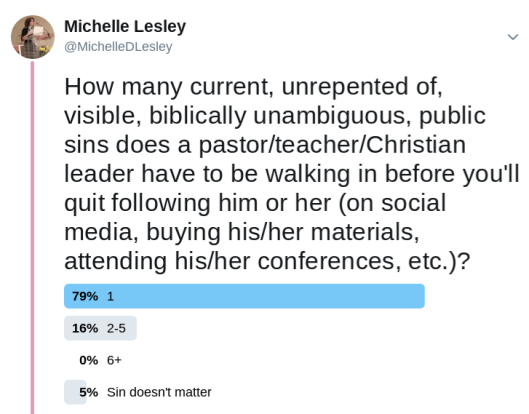
In the wake of Frank Page’s resignation, I asked this poll question on Twitter

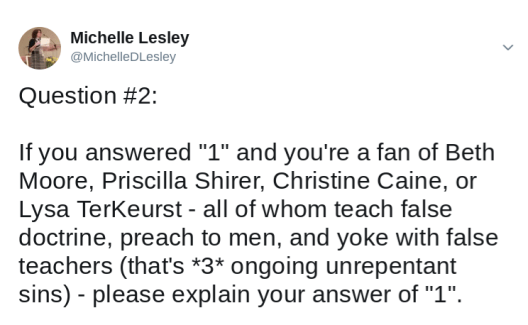
followed by this one

Why are Southern Baptists leaders so quick to – rightly and biblically – oust Frank Page for, as far as we know, one isolated sin which he publicly confessed to and repented of, and yet overlook three major – and much more publicly observable and harmful to Southern Baptists – ongoing sins from pastors and teachers who have been rebuked and refuse to repent? Why, instead of disciplining them for their sin, do those in leadership give them fat book deals, invite them to speak at all the cool conferences, fawn over them on social media, and make them into celebrities?

How many sins will it take to disqualify and discipline these people? Four? Eleven? Ninety-six? Is there any amount of sin these pastors and teachers, and those like them, can commit that will cause those in SBC leadership to pull their materials off the shelves of LifeWay, deny them a seat at the table, and urge them to repent and step down from their positions?

I’ve been a Southern Baptist from the day I was born. I’ve been taught since the cradle roll that if God’s Word says not to do something and you do it anyway, that’s a sin. If God’s Word says to do something and you don’t do it, that’s a sin. And that sin is sin in the eyes of God.

Well is it, or isn’t it, Emperor?

If sin is sin in God’s eyes, why aren’t you treating Beth Moore’s sin like Frank Page’s sin? Why are you rewarding her for her sin and disciplining him for his?

The Bible says in James 3:1:

Not many of you should become teachers, my brothers, for you know that we who teach will be judged with greater strictness.

Those who teach and lead bear more responsibility to teach sound doctrine and walk worthy because they are teaching and leading us by example.

Why are all the aforementioned pastors and teachers better examples to us in their rebellion and unrepentant sin than Frank Page was in his repentance of sin?

Why?

Southern Baptist peasants and little children see right through your foolishness on parade on this issue and we want answers. Biblical answers.

Don’t just stand there shivering, suspecting we are right, but thinking, “This procession has got to go on,” and walking more proudly than ever. Go back to the palace. Repent. Clothe yourselves with humility and obedience to Scripture, and come back and lead us rightly. Biblically.

Because the Emperor of Southern Baptist leadership has been naked for far too long.


ยนH.C. Andersen Centret (The Hans Christian Andersen Centre). The Emperor’s New ClothesAccessed April 5, 2018.

ยฒI am well aware that this is not the only problem in the SBC that needs to be addressed. It would be impossible to address every issue in one article, so this time I’ve chosen to focus on this one particular issue.
Mailbag, Speaking Engagements

The Mailbag: Potpourri (Joni’s testimony, “Messy”, Female seminary profs…)

Welcome to another โ€œpotpourriโ€ edition of The Mailbag, where I give short(er) answers to several questions rather than a long answer to one question. I also like to take the opportunity in these potpourrri editions to let new readers know about my comments/e-mail/messages policy. Iโ€™m not able to respond individually to most e-mails and messages, so here are some helpful hints for getting your questions answered more quickly. Remember, the search bar can be a helpful tool!


Our church has a ministry for the homeless where once a week, lunch is provided and a Bible Study is given usually by a woman, occasionally by a man to a mixture of both men and women. Some might be saved, probably most are not. What are your thoughts in regard to this situation from a Biblical perspective?

Great question! I’ve answered it in #11 of my article Rock Your Role FAQs.


We watched a video of Joni Eareckson Tada speaking at a recent Shepherds Conference. She gave her testimony and shared the meaning of Scripture and what some Greek words were so there was teaching going on as well as testimony. I know she is thought of highly but I was wondering about her speaking and teaching to groups of men.

Joni is not someone I follow closely, though I did read her first book, Joni, when I was a teenager. John MacArthur heads up the Shepherds Conference, which is a conference for men in church leadership, particularly pastors (“shepherds”).

Just to give a little background for anyone not familiar with him, Dr. MacArthur is a staunch complementarian and is a doctrinally sound pastor, teacher, and author I am happy to recommend to my readers. He would never invite a woman to preach at ShepCon nor invite a doctrinally unsound speaker. So I trust Dr. MacArthur’s judgment and reasons for inviting her to speak – that he was not inviting her to preach.

That foundation being laid, there are instances in which it is perfectly biblically appropriate for a woman to speak in front of a co-ed Christian group or a group of Christian men, and giving her testimony – so long as she does not veer off intoย preaching (instructing and/or exhorting men in the Scriptures) – is one of them. I’ve written more about that, giving examples, in these articles:

Rock Your Role FAQs (#7, 14)

The Mailbag: Should women give testimonies and reports, lead prayer and worship in church?

I have not listened to the talk Joni gave at ShepCon. It is possible that I would think her explanations of Scripture crossed the line into teaching, but it is also possible I would not. I just can’t say since I haven’t listened to it. (I would not consider giving the definition of a Greek word or two to be the type of biblical instruction prohibited by 1 Timothy 2:12.)

I would be more inclined to look at Joni’s history and intentions. Did she come to ShepCon with the intent of preaching or instructing men in the Scriptures? Does she have a track record of preaching sermons or giving Bible instruction to men at conferences? If the answer to both is no and she is normally very careful to stay within the parameters of biblical womanhood, I’d be inclined to extend grace on any bobbles she made during her testimony at ShepCon. It’s a very fine line to walk, and I’m sure I would probably make a few mistakes too if I were in that situation.

Update: Thanks to reader DebbieLynne (see comments section) for the heads up that Joni actually gave her testimony at the Strange Fire Conference (2013, also spearheaded by John MacArthur), not at the Shepherds Conference. Strange Fire was co-ed rather than men only. Whether or not women were in attendance at the conference doesnโ€™t really change my answer to the reader, but itโ€™s good to have the facts straight.


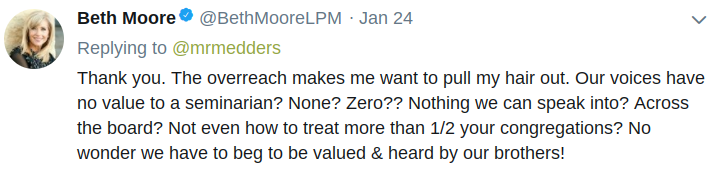
Is it OK for women to teach pastors-in-training at seminaries?

John Piper recently answered this question on an episode of Ask Pastor John. You should read his response for yourself (it’s not long), but, essentially his answer was that experienced pastor-mentors should be training up young pastors, and since it is unbiblical for women to serve as pastors themselves, they lack the experience necessary to mentor pastors-in-training. And, my word, the egalitarian world had a fit – including Beth Moore and her daughter Melissa (who helps run Beth’s ministry):

While I consider him to be a generally doctrinally sound brother in Christ, I’m not particularly a fan of John Piper, but I do want to say that I think his answer was taken wildly out of context by those pushing unbiblical agendas, that he was treated shabbily by many on social media, and that I thought his answer was very good, biblical, and just plain old made sense. Women are not qualified to serve as pastors. Why on earth would we want them training pastors? Moreover, what student wouldn’t want the most qualified and experienced professors he could get for his tuition money?

Let’s say you were the dean of the neurosurgery department at a medical school. A gentleman, totally blind from birth, comes in and applies for a position teaching surgical practicum (cutting, suturing, removing tumors, etc.). He has held positions teaching various subjects at other universities so his ability to impart information is not in question, but he has never performed surgery in his life because he’s blind. Would you hire him to train neurosurgeons to perform brain surgery?

The reason Dr. Piper’s answer caused a bit of a kerfuffle is that he limited his answer to the question he was asked. Imagine that. He was asked if women should train pastors and that’s the question he answered. The agenda-driven screaming neemies took his answer of “no” to mean that no woman should ever teach anything to anyone in any seminary anywhere ever. That is not what Dr. Piper said. He said women should not train men for the pastorate.

I would have answered the same way. However, if I were to expand on Dr. Piper’s answer, what I would further explain is that most seminaries (at least the ones I’m familiar with) do far more than simply train men for the pastorate. Take the seminary my husband attended for example, New Orleans Baptist Theological Seminary. If you’ll click on the “Academics and Admissions” tab at the top of the page and examine the various degree and non-degree programs, you’ll find that most of them are not strictly preaching programs. There are programs for women’s ministry and children’s ministry (Surely we wouldn’t say women are unqualified to teach in these areas?), college ministry, urban ministry, music ministry, missions, counseling, languages, and many more. There’s nothing wrong with women teaching things like music theory, finance, general education classes like math, history, and English, archaeology, legal issues, languages, business, etc., even in a seminary.

There are definitely some classes women shouldn’t be teaching in seminaries, but there are plenty of other classes that would be fine for them to teach.


Since we’ve become parents my husband and I have mostly attended churches that were larger and offered childcare. We were saved out of Mormonism eight years ago which has its own order of services and no childcare provided for the main service, but I don’t know what to expect from a Christian service that doesn’t offer childcare. I don’t know what will be expected of me and my family. I have a four-year-old and I worry that he will end up running around or asleep on the pew. Do we call ahead? Pack a busy bag? Are snacks alright? How do you ever get anything out of the service for yourself?

Before I answer, I want to encourage readers who are experienced church members to really let this precious sister’s question sink in and inform the way you respond to visitors and new members. Increasingly, the people who are new to your church will have very little church background. Church culture may be old hat to you, but it’s like landing on Mars to many of them. They have no idea where to go or what to do, and they don’t speak Christianese. Make sure you warmly welcome and encourage newbies and let them know that it’s OK to ask questions.

I think my article Churchmanship 101: Training Your Child to Behave in Church will help with some practical tips and expectations. You should not allow your child to run around the sanctuary during the worship service any more than you would allow him to run around a restaurant if you went out to eat, or a store if you were shopping, but I would not get overly stressed about him making a few minor noises or dropping the occasional Bible during church. If a church doesn’t offer childcare, they’re surely used to children making a little noise during the service from time to time. Sermon-time naps at four years old are not the end of the world, but you’ll want to curb those as he approaches school-age (if he can stay awake all day in school, he can stay awake for 30 minutes or an hour in church).

Until your child gets into the routine of attending worship and learns how you expect him to behave, you may not get very much out of the service. That’s just one of those parts of being a mom that we all have to accept – like stretch marks :0) But if you will be consistent and diligent as you train your child, he’ll get with the program soon enough.

When you ask if you should “call ahead”, if what you mean is calling the church office prior to Sunday and asking any questions you might have, that is a super idea! Most pastors I know would be delighted to chat on the phone or in person to welcome you to the church and help you feel at ease. That is the point at which I would ask about snacks. Different churches have different policies about food and drink in the sanctuary. I’ve never heard of one that wouldn’t allow a baby bottle, but some may not be keen on the idea of Cheerios ground into their carpet. You could also ask if they have a “cry room”. Some churches have set aside a room near the sanctuary where you can take a fussy baby or jumpy toddler. Many of them have the sermon “piped in” so you can listen until you go back into the worship service. You might also want to ask if the worship service is recorded and posted online so you can listen at home to any parts of the sermon you may have missed. Never be afraid to ask an honest and polite question.


I have been hearing the word messy a lot in reference to our lives..has this word replaced the word sin?

Well…I suppose it may have for those who are trying to sand off the sharp edges of the gospel, but the biblical term is sin, so that’s the correct word to use, despite how popular “messy”, or any other trendy word, might be.


Can you recommend any doctrinally sound female speakers for women’s events?

(I promise this is an actual question I recently received, not one I made up for promotional purposes! :0)

Yes, me. Click the “Speaking Engagements” tab at the top of this page for more information.

If I’m not really your cup of tea, or I’m too far away for your travel budget, I happily recommend any of the women listed under the “Recommended Bible Teachers” tab at the top of this page (although I’m not positive all of them do speaking engagements).


If you have a question about: a Bible passage, an aspect of theology, a current issue in Christianity, or how to biblically handle a family, life, or church situation, comment below (Iโ€™ll hold all questions in queue {unpublished} for a future edition of The Mailbag) or send me an e-mail or private message. If your question is chosen for publication, your anonymity will be protected.

Sin, Throwback Thursday

Throwback Thursday ~ 9 Things that Are Still Sins Whether We Agree or Not

Originally published June 19, 20159 still sins


I do it all the time, Mother, and I’ve decided something-
it’s not a sin.

I heard this line several years ago on a popular sitcom, spoken by an adult daughter to her Christian mother about a behavior the Bible unambiguously calls a sin. I mean, it’s right smack dab in the middle of the Big 10; “thou shalt not” and everything.

It’s one thing to say, “I know it’s a sin, but I don’t care. I’m going to do it anyway,” but how depraved is the world when they think they – in God’s place – are the ones who get to define what sin is? And what’s even worse is that the church has begun to adopt this audacious depravity as well, whether approving of sin by fiat or by simply ignoring God’s word and letting sin slide without rebuke.

When it comes to what’s a sin and what’s not, God made up His mind a long time ago. And He’s not changing it, regardless of what you or I or Joe Politician or Jane Celebrity might think. Maybe we all need a remedial course in hamartiology, so let’s start with the basics. These things are all still sins whether the world and the church agree with God or not:

1. Homosexuality

Let’s just get it out of the way right up front. I don’t care how many celebrity “pastors” and “Christian” authors twist God’s word to say otherwise, or how many people declare themselves to be (unrepentant, practicing) “gay Christians,” or how many homosexuals declare that God made them that way, God’s word is clear: homosexual lust and behavior are sins.

2. Abortion

Abortion is the taking of an innocent human life. We don’t murder people because they’re small or sick or inconvenient or will hinder our sucess. God didn’t say, “You shall not murder, except when…” He said, “You shall not murder.” Period.

3. Extra-Marital (Heterosexual) Sex

Adultery, fornication, whatever form it might take, if you’re not legally married to the person you’re engaging in sexual activity – up to and including actual intercourse – with, you’re sinning.

4. Cohabitation

See #3. And don’t try to whitewash it by saying you’re living together but not sleeping together. A) The Bible says we’re to flee temptation, not move in with it, and B) we’re supposed to avoid every form of evil, even the appearance of it. If you call yourself a Christian and you’re shacking up, you’re living in sin (that’s why they call it “living in sin”). Repent and move out or marry up.

5. Divorce

Yep, still a sin, except in two cases: unfaithfulness or an unsaved spouse leaving a saved spouse. In those two cases the spouse who was wronged is not sinning and is free to marry again.

6. Swearing

The air is saturated with it. Foul language coming from our TVs, music, movies, social media, and the people we’re around all day. But expletives have no place in the vocabulary of a Christian. Is your potty mouth on Saturday the same one you praise God with on Sunday?

7. Taking God’s Name in Vain

It’s gotten to the point where we think so little of casually punctuating our sentences with, “Oh my G-d,” ย or using the name of Jesus as an exclamation that pastors are even doing so from the pulpit these days. God’s name is high and holy and should be spoken only reverently and worshipfully. How can we look people in the eye and call them to repentance and faith in a Person whose name we use as a cuss word?

8. Gluttony

We have almost completely amputated gluttony from the spiritual realm by cordoning it off as merely a physical or medical issue. We’ve renamed it “overeating,” but that doesn’t change the fact that it’s a sin. God created good food for us to enjoy, but just as with all the other good gifts He gives us, He expects us to exercise Spirit-enabled self control when we receive it.

9. Female Usurpation

God makes it abundantly clear in His word that women are not to instruct men in the Scriptures or hold authority over them in the church. Women sin when they pastor churches, preach sermons in church, teach men in Sunday School classes, and hold other positions of authority over men in the church. Men, however, bear the primarily responsibility for this when they sin by failing to rebuke usurping women, or when women feel they have no other choice but to take on male responsibilities in the church because men are shirking their own duties before God.


We don’t get to decide what sin is. That’s God’s job. And all of us – whether we’ve committed one of these nine sins or not – are guilty of sinning against Him. That’s the bad news.

But, in Christianity, we never give the bad news without following it up with the good news. And, oh what wonderfully good news it is: forgiveness. Jesus paid for our sin at Calvary so that if we will only turn from it and trust Him, He will forgive us for all nine of these sins and countless others.

If we confess our sins, he is faithful and just to forgive us our sins and to cleanse us from all unrighteousness.
1 John 1:9