auยทdaยทcious
รดหdฤSHษs
adjective
1. showing a willingness to take surprisingly bold risks.
2. showing an impudent lack of respect.
Audacious. It’s a hot new buzzword that false teachers like Steven Furtick and Beth Moore like to throw around, and “average Jane” Christians are starting to pick up.
“Pray audacious prayers!”
“Live an audacious life!”
Sounds great, right? Rah! Rah! Let’s get out there and be audacious for Jesus!
The only problem with that is… well…the Bible. The Bible doesn’t tell us to live or pray audaciously in either sense of the word. In fact, I checked seven or eight of the most reliable English translations, and the word “audacious” isn’t even in the Bible. (Even The Message doesn’t have it!)
The Bible says nothing about being willing to “take surprisingly bold risks.” Quite the opposite, in fact.
But we urge you, brothers, to [love one another] more and more, and to aspire to live quietly, and to mind your own affairs, and to work with your hands, as we instructed you, so that you may walk properly before outsiders and be dependent on no one. 1 Thessalonians 4:10b-12
Love one another, live quietly, mind your business, go to work, walk in a godly way before a watching world, and be self-supporting. How bold, risky, or audacious does that sound?
Older men are to be sober-minded, dignified, self-controlled, sound in faith, in love, and in steadfastness. Older women likewise are to be reverent in behavior, not slanderers or slaves to much wine. They are to teach what is good, and so train the young women to love their husbands and children, to be self-controlled, pure, working at home, kind, and submissive to their own husbands, that the word of God may not be reviled. Likewise, urge the younger men to be self-controlled. Show yourself in all respects to be a model of good works, and in your teaching show integrity, dignity, and sound speech that cannot be condemned, so that an opponent may be put to shame, having nothing evil to say about us. Bondservants are to be submissive to their own masters in everything; they are to be well-pleasing, not argumentative, not pilfering, but showing all good faith, so that in everything they may adorn the doctrine of God our Savior. Titus 2:2-10
Self-control, dignity, reverence, submission, good works. Nope, nothing about risk-taking there either.
But the fruit of the Spirit is love, joy, peace, patience, kindness, goodness, faithfulness, gentleness, self-control; against such things there is no law. Galatians 5:22-23
Hmmm….still nothing about being audacious….
Pray then like this: โOur Father in heaven, hallowed be your name. Your kingdom come, your will be done, on earth as it is in heaven. Give us this day our daily bread, and forgive us our debts, as we also have forgiven our debtors. And lead us not into temptation, but deliver us from evil. Matthew 6:9-13
Honoring God, asking Him to help us obey, to provide basic food, to forgive us. This is how Jesus Himself taught us to pray, and there’s not a hint of risk or audaciousness to be found.
The Bible doesn’t teach us to be audacious. That’s false doctrine dreamed up in the minds of false teachers. The Bible teaches us to live in humility, patience, kindness, love, and obedience to God’s word.
For more in the Basic Training series, click here.
So whoever knows the right thing to do and fails to do it, for him it is sin. James 4:17
Excuses, excuses.
We’ve all got them. We’ve all used them.
“The dog ate my homework.”
“I was going to, but…”
“I’d like to, but I can’t, because…”
Sometimes there are legitimate reasons we can’t take part in certain earthly activities. Time conflicts: If a birthday party and a wedding are scheduled for the same date and time, you obviously can’t be in two places at once. Financial constraints: Maybe you’d really like to attend that conference, but there’s no money in the budget. Prioritized responsibilities and loyalties- you’d like to travel as much as you did when you were single, but now that you have a family, taking care of them comes first.
Those arenโt really excuses, though, theyโre reasons – totally understandable ones – that you canโt do something. But weโre so much in the habit of explaining why we canโt do something in the day to day logistical realm that it never occurs to us that this isnโt right when it comes to the things of God. When Godโs Word tells us to do something, we are to obey it, not make excuses about why we canโt.
When Godโs Word tells us to do something, we are to obey it, not make excuses about why we canโt.
Most Christians seem to grasp this concept when it comes to one of the โbigโ commands. Take abortion, for example. We know that abortion is a sin regardless of the circumstances, even when those circumstances are huge and scary. We reach out to pregnant women with the gospel and with practical help so that they wonโt commit that sin. We love the homosexual who wants to come to Christ but is being pulled the other direction by her lifestyle, living arrangements, and loved ones, by compassionately providing for her needs while holding firm to the biblical gospel that says she must turn from her sin in repentance if she wants to be saved.
But when it comes to the โlittleโ commands like…
…submitting to your husband
…being a faithful, active member of a local church
…refraining from teaching men or holding authority over them in the church
…refusing to be anxious about anything
…lots of those same Christians (including me) who are so clear that abortion and homosexuality are sins requiring repentance regardless of the circumstances, have at the ready, all kinds of excuses and reasons and circumstances to offer up as to why we canโt obey Godโs word.
โI just donโt think my husbandโs decision is the right way to go.โ
โA church hurt me in the past, so Iโm done with church.โ
โNone of the men in my church will step up and lead, so I have to.โ
โIโm in a really bad situation. I canโt help it if Iโm constantly stressing about it.โ
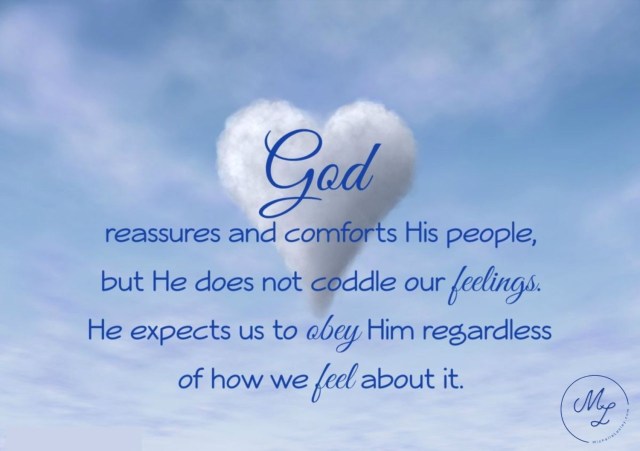
Uh uh. No excuse for disobedience that we can come up with is going to wash with God. There is never any acceptable reason or excuse to say, โI canโt,โ when it comes to a command of Scripture. God expects us to be obedient. So how can we move from excuses to obedience?
There is never any acceptable reason or excuse to say, โI canโt,โ when it comes to a command of Scripture. God expects us to be obedient.
1. Understand that obedience to Scripture is not โlegalismโ or being a โPhariseeโ
As much as pop evangelicalism would like us to believe it, obedience to Scripture is not legalism, nor is someone acting like a Pharisee if sheโs teaching that all Christians should obey Scripture. Legalism is when you think obeying Godโs commands will save you, make up for your sin, or somehow make you right with God through your own fleshly efforts. Pharisee-ism is making up your own bibley-sounding laws – usually ones that are related to Scripture, but more restrictive than Scripture – and insisting that others adhere to them or theyโre not saved, not as good of a Christian as you are, etc. Thatโs not what weโre talking about here. Weโre talking about rightly handling Godโs Word in context, understanding what His commands to Christians actually are, and joyfully submitting to them in obedience.
As much as pop evangelicalism would like us to believe it, obedience to Scripture is not legalism.
So whoever knows the right thing to do and fails to do it, for him it is sin. James 4:17
Teaching them to observe all that I have commanded you. Matthew 28:20a
So you also, when you have done all that you were commanded, say, โWe are unworthy servants; we have only done what was our duty.โ Luke 17:10
And Samuel said, โHas the Lord as great delight in burnt offerings and sacrifices, as in obeying the voice of the Lord? Behold, to obey is better than sacrifice, and to listen than the fat of rams. For rebellion is as the sin of divination, and presumption is as iniquity and idolatry.โ 1 Samuel 15:22-23a
If you love me, you will keep my commandments. John 14:15
And by this we know that we have come to know him, if we keep his commandments. Whoever says, โI know him,โ but does not keep his commandments is a liar, and the truth is not in him, but whoever keeps his word, in him truly the love of God is perfected. By this we may know that we are in him: whoever says he abides in him ought to walk in the same way in which he walked. 1 John 2:3-5
For this is the love of God, that we keep his commandments. And his commandments are not burdensome. 1 John 5:3
Scripture says that Christians seek to obey Godโs Word, and when we donโt, weโre sinning.
3. Know that there are no commands of Scripture followed by asterisks
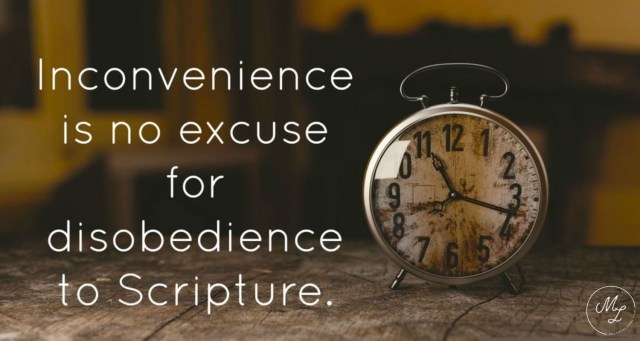
โYou shall not murder…unlessโฆโ โDo not worry…except in circumstances X, Y, or Z, then itโs acceptable.โ โIf no men will step up and teach that co-ed Sunday School class, itโs OK if a woman teaches it.โ Nope. You will not find a command of Scripture that contains exceptions or caveats. When God says โdoโ or โdonโtโ, He means it. He means it for you. He means it for everybody. He means it if itโs difficult or inconvenient. He means it regardless of your circumstances.
When God says โdoโ or โdonโtโ, He means it. He means it for you. He means it for everybody. He means it if itโs difficult or inconvenient. He means it regardless of your circumstances.
4. Realize that God is sovereign over your circumstances
God controls everything in this universe. Nothing happens anywhere that He hasnโt either allowed or caused. Translation: youโre in the circumstances youโre in because God either put you there or allowed you to be there. Everybody has some sort of situation in her life that makes obedience to Scripture difficult or inconvenient. Do you think God intends for everyone to use those circumstances that He sovereignly decided to allow or put into their lives as an excuse to disobey Him? Adam and Eve tried that. Did God accept their excuses? Isnโt blaming your disobedience to Scripture on the circumstances youโre in just another way of saying itโs Godโs fault youโre being disobedient? That if God had just created you differently or put you in a different set of circumstances, youโd obey, but since He didnโt, you have no choice but to disobey?
Isnโt blaming your disobedience to Scripture on the circumstances God sovereignly put you in just another way of saying itโs Godโs fault youโre being disobedient?
When we really want to do something, we find a way or die trying. Be honest- have youchecked out every single church you can get to and explored every available resource and option for finding a church before giving up and saying you canโt attend church? Have you actually tried submitting to your husband even when you think heโs making a boneheaded decision? Is anybody at your church going to die if all of the women refuse to teach men and that co-ed class is disbanded? Are you so willing to obey Christ that youโll do whatever you have to do in order to find a way to obey Him?
Are you so willing to obey Christ that youโll do whatever you have to do in order to find a way to obey Him?
Remember taking pop quizzes when you were in school? Unless you were a child genius, you probably donโt look back on them fondly. They were unpleasant. Hard. Sometimes scary because so much was riding on them. Maybe you were like a lot of students who could easily answer questions on the subject matter while studying, but went blank during the quiz because of the fear and pressure.
The testing of our faith can be a lot like those pop quizzes. We know the test is coming, but weโre never quite sure when. Weโre supposed to be studying the Textbook and asking the Teacher for help every day so weโll be prepared. But when the test comes, we have to take it. Thereโs no opting out and saying, โIf this test werenโt happening Iโd be able to obey easily.โ Of course you would! Itโs easy to obey God when itโs convenient and everythingโs going your way, but obeying when itโs difficult or inconvenient pushes you. Stretches you. It reinforces what youโve learned, reaffirms your commitment to Christ, and refreshes your trust in God. Donโt give up in the middle of the test. Hang on to Christ, hang in there, andโฆ
Count it all joy, my brothers, when you meet trials of various kinds, for you know that the testing of your faith produces steadfastness. And let steadfastness have its full effect, that you may be perfect and complete, lacking in nothing. James 1:2-4
Obeying God when itโs difficult or inconvenient reinforces what youโve learned, reaffirms your commitment to Christ, and refreshes your trust in God.
Christians are supposed to โwalk in the same way He walkedโ (1 John 2:5b). Christ is the perfect example of someone who determined to obey God regardless of His circumstances. Just look at everything He went through. Donโt you think He was awfully hungry after fasting for 40 days in the wilderness? Wouldnโt it have been extraordinarily easy to strike down every Pharisee who got on His nerves? Couldnโt He have decided the cross was just too much and that redeeming mankind wasnโt worth the trouble?
Consider him who endured from sinners such hostility against himself, so that you may not grow weary or fainthearted. In your struggle against sin you have not yet resisted to the point of shedding your blood. Hebrews 12:3-4
Jesus gave up His body – His life – in order to obey God. Are we willing to give up whatever it costs us to walk in the same way He walked?
8. Remember that God has promised to help you
What an amazing God we serve who doesnโt just give us a bunch of rules to follow and leaves us to figure it out on our own! The Holy Spirit is right there, indwelling His people, always ready to help, guide, strengthen, and comfort. First Corinthians 10:13 says:
No temptation has overtaken you that is not common to man. God is faithful, and he will not let you be tempted beyond your ability, but with the temptation he will also provide the way of escape, that you may be able to endure it.
God isnโt going to put you into a situation in which you have no choice but to disobey Him. Jesus proved that with His own life. Have you asked God to provide you with a way to obey Him? The Bible tells us that when we pray for things in accordance with Godโs will, He will give those things to us. It is definitely in Godโs will for you to resist temptation and obey Him, so it is His delight to answer when you ask Him for a way to do that.
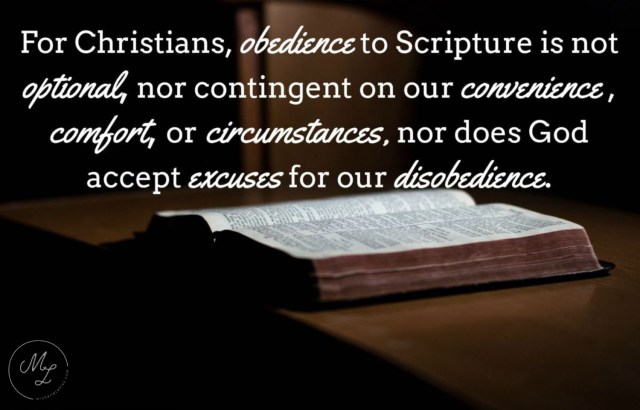
Ladies, obedience to Christ is not optional. We don’t get to pick and choose which of God’s commands to Christians we want to obey and which ones are OK to let slide. He expects us to follow after Christ, who obeyed to His last breath, His last drop of blood. And He promises to help us, even when obeying Him is hard. Let’s stop making excuses and start looking for ways to submit to, and obey, God’s Word.
God expects us to follow after Christ, who obeyed to His last breath, His last drop of blood. And He promises to help us, even when obeying Him is hard. Letโs stop making excuses and start looking for ways to obey Godโs Word.
Your recent article on prayer really helped me. I was always taught that prayer was a two-way conversation. For years, I would talk to God and wait for Him to talk back to me, but He never did. I thought it was because there was unknown sin in my life, or that I didn’t have enough faith, or that God just wasn’t interested in me. It’s so freeing to know the truth.
Comments like this from readers are always bittersweet for me. It makes me practically giddy to hear from Christian women who have been set free from false doctrines they’ve been taught, but it also grieves me deeply to reflect on the years they spent thinking they were somehow deficient as Christians or doubting God’s love for them simply because they were taught, and believed, unbiblical notions and ideas.
Let’s see if we can dispel a few of those today:
1. Prayer is this big, complicated, mystical thing. Nope. Prayer is simply talking to God about whatever is on your heart. What’s made prayer complicated is the unbiblical teachings that have grown up around it such as praying in “tongues,” listening prayer, contemplative prayer, sozo prayer, soaking prayer, etc.
2. “Women’s Ministry” equals fluff and silliness. There’s nothing wrong with having a little fun from time to time. Hey, we all need to blow off steam, right? But if cookie exchanges and teas and painting parties and dress up parties and sleepovers and makeup parties and fashion shows and movie nights areย all your women’s ministry does, it’s unhealthy. And it’s not really a ministry, either. If something is a “ministry” it should exist to point people to Christ and disciple them once they get to Him. Your women’s ministry should include ministry of the Word, discipleship, evangelism, comfort ministry (to the ill, shut-ins, new moms, new members, etc.), serving the church, encouragement, supporting your pastor and elders, and so on.
3. Women’s Bible study- great balls of fire, don’t get me started. โฆ A Bible verse (or half a Bible verse) plus an inspiring story from the author’s or someone else’s life is not Bible study. Bible study is picking up your Bible and studying it.
โฆ If you’re hosting a women’s Bible study, you do not have to use books and DVDs written by someone else. In fact, I would recommend against doing so. Get someone who is able to teach – yes, it could even be a man – and study a book of the Bible from beginning to end.
โฆ One reason I recommend against using “canned” women’s Bible studies is that the vast majority of them (95% in my estimation- not an exaggeration) teach false doctrine. When you walk into most Christian bookstores the first thing you’ll see is the best sellers shelf, and the majority of those books are written by false teachers such as Beth Moore, Priscilla Shirer, Christine Caine, Lysa TerKeurst, Sarah Young, and others.
โฆ If you do decide to occasionally do a book study, you do notย have to use one written by a woman. In fact, if you want a book that’s doctrinally sound, you have a much better chance of finding one written by a man than by a woman, sad to say. Check out some godly men who are pastors, authors, and teachers at…
4. Faithful church attendance isn’t that important. If you think you don’t need church or that you can skip it whenever something more fun comes along, your thinking isn’t biblical. God thinks it’s important enough for His people to gather regularly for worship that He emphasizes it throughout the entirety of Scripture- Old and New Testament. Get your heiney in the pew every week, honey, and find a place to serve.
5. I am woman, hear me roar. โฆ Beth Moore and many other female teachers who rebel against Scripture by preaching to and teaching men in the church say that they are doing so “under their husband’s and/or pastor’s authority”. Neither your husband nor your pastor has the OK from God to allow you, or any other woman, to teach men in the church. God says women aren’t to teach or hold authority over men in the church, and when God says no, no one has the authority to say yes. Furthermore, there isn’t a single passage of Scripture that allows any man to give any woman this type of “under my authority” dispensation to teach men. To say that it’s permissible for a woman to teach men “under her husband’s/pastor’s authority” is just as biblically absurd as saying it’s OK for a woman to lie, commit adultery, gossip, or steal “under her husband’s/pastor’s authority.” Sapphira sinned under her husband’s authority and look what happened to her.
โฆ Egalitarians are often so vehement in their insistence that women should teach men and hold authority over men in the church, that they are essentially saying that the only way a woman’s service or leadership in the church can have any value is if it’s exercised over men. I’ve heard many of them turn up their noses at the idea of teaching women and children and other forms of service (that don’t involve teaching or authority over men), in a haughty “we’re better than that” kind of way.
No way.
Have you seen the garbage women and children are being taught in the church under the guise of “Sunday School” or “Bible study”? Women’s and children’s classes at your church are in desperate need of women who are doctrinally sound and able to teach. What about the need to visit church members who are in the hospital or shut-ins? How about record-keeping, working in the sound booth, welcoming visitors, serving on committees, mowing the church’s lawn, participating in outreach activities, fixing a meal, chaperoning youth activities, hosting a visiting pastor or missionary? There’s a ton of important and valuable work for women to do in the church. We don’t have time to worry about teaching and holding authority over men. Let the men worry about that.
6. My feelings and opinions reign supreme. Uh uh. Not if you’re a Christian, they don’t. That’s how lost people operate. If you’re a Christian, you’re not entitled run your life or make decisions by any opinion other than that of your Master. What He says – in His written word – goes. Period. Regardless of how you feel about it or whether or not you agree with it. That means if a “Bible” teacher you really like is teaching things that conflict with Scripture, you dump her. You love Mr. Wonderful and want to marry him, but he’s not saved? Nope. You’re a woman who’s certain God has called her to preach? No way. Your husband has said no about something, but you want to do it anyway? Forget it.
7. If something or someone claims to be a Christian, it is. I suppose at some point in Christian history, there might have been a time when, if someone handed you a “Christian book,” it was a pretty safe bet it was doctrinally sound. Or if someone said she was a Christian, you could be fairly certain she was truly born again.
Not so much these days.
You cannot take at face value that someone who says she’s a Christian is using the Bible’s definition of Christianity and has been genuinely regenerated. You cannot trust that just because something is sold at LifeWay or another Christian retailer that it’s doctrinally sound. You can’t assume that just because someone is a “Christian” celebrity, writes “Bible” studies, speaks at “Christian” conferences, and has a large following, that she’s handling God’s word correctly (or at all) and teaching you biblical truth. There’s just too much false doctrine running rampant in evangelicalism and too many people who believe and teach it.
Don’t be a weak and naรฏve Christian woman. Jesus Himself said, “Not everyone who says to me, ‘Lord, Lord’ will enter the kingdom of Heaven…” There are many people who draw near to God with their lips, but their hearts are far from Him. It is God’s will for you to be a good Berean and to test everything according to Scripture. We will know the truly Christian from the false by their fruits, not their platitudes.
8. Sugar and spice and everything nice- that’s what Christian girls are made of. That’s not a Bible verse, but rather and unspoken rule among most Christian women. Somewhere we’ve gotten the idea that Christian unity or love means “being nice” to people. Weโre always smilingly sweet and never say anything that might hurt someoneโs feelings or could rock the boat at church.
Are we to be kind? Yes. Are we to do our best not to hurt others? Of course. Should we be making waves over every little thing that rubs us the wrong way? Absolutely not.
But neither is it loving to see a Mack truck bearing down on an oblivious sister in Christ and refrain from yanking her out of harm’s way because it might dislocate her shoulder. It is not unity to see Satan deceiving a friend through sin or false doctrine and not plead with her to turn to Christ and His word because she might think we’re rude. And that’s the situation we often find ourselves in at church or with Christian friends.
Love for the brethren isn’t “being nice.” It’s caring so much about a fellow saint that we want what’s best for her in Christ. Sometimes that requires being firm, confrontational, or demonstrating “tough love.” People’s eternities and spiritual health are at stake. How loving is it to stand aside and let a sister waltz into Hell or struggle for years on end in her walk with the Lord because she’s living in sin or believing false doctrine? “Being nice” isn’t a fruit of the Spirit. It’s time we stop being nice and start being biblical.
Do you believe any of these unbiblical notions? If so, set them aside, repent, and believe and practice what Scripture says. Any time we believe something that’s in conflict with God’s word, it’s a hindrance to the abundant life and growth in Christ that He wants to bless us with.
False doctrine enslaves. It places a yoke of confusion, anxiety, and “try harder” on the shoulders of those who embrace it. Christ did not set us free from sin so that we might turn right around and become captives to a new, pseudo-Christian type of sin: false teaching. It is for freedom and a healthy spiritual life that Christ has set us free.
Christ did not set us free from sin so that we might turn right around and become captives to a new, pseudo-Christian type of sin: false teaching.
For more in the Basic Training series, click here.
When I was a little girl, I remember one of my Sunday School teachers saying, “Prayer is just talking to God.” With all the complex, confusing, convoluted, and even conflicting resources out there today on prayer, that sounds rather simplistic to our adult ears, but it’s still the best definition of prayer I’ve ever heard. Prayer is, indeed, simply talking to God.
And, along with studying God’s word and being a faithful member of a local church, it’s one of the three legs of the stool we call sanctification, or growth in Christ. Yet prayer is the leg that tends to be most neglected in our churches, our families, and our personal walk with the Lord.
Why is that? Why don’t we want to sit down and just talk – no frills, no weird machinations, just talk – to the most interesting, powerful, loving, and kind Being in the universe? If you received an invitation to sit down and chat with the President, your favorite celebrity, or a long lost loved one, you’d jump at the chance, right? I would, too. So what is it about our broken brains and hardened hearts that causes us to say, “Nah, not today,” to a simple monologue with our King? Those broken brains have learned some unbiblical things about prayer, and those hardened hearts have some ungodly attitudes toward prayer.
1. We don’t NEED God enough Western Christians are pretty prosperous and self-sufficient people. We don’t have to cry out to God to provide food so we don’t starve. We have jobs and grocery stores. We don’t have to pray that we won’t be arrested for reading our Bibles or going to church, because that’s not happening where we live (yet). Except in the most dire of circumstances, we don’t have to plead with God to heal. We have doctors, hospitals, and medicine. Don’t get me wrong, those are all tremendous blessings, but one of the pitfalls of being blessed is that we start trusting in the blessing rather than trusting in the Blesser. And when that happens, we tend to pray less often and more superficially. Daily prayer is part of our battle to be dependent on God.
2. We’re idolaters My husband’s uncle used to say, “You do what you want to do.” In other words, you spend your time and resources on the things you value most. I’m a Type A personality: workaholic, git ‘er done, ain’t got time to die. One of the reasons I neglect my own prayer time is that I don’t want to take time out of my busy schedule to stop and do nothing but pray. When I operate that way, I’m demonstrating that I don’t want to pray- that I love something else more than I love obeying God and spending time with Him. That’s idolatry.
3. We don’t trust God and His prescribed methods When we’re in need, when we want to commune with God, when we want to grow in holiness, God’s way is for us to pray. Not climb the highest mountain or offer some amazing sacrifice or fulfill a bunch of items on a checklist- pray. But, to our fleshly hearts, this just doesn’t compute. It’s not enough. We’ve got to conjure up our own efforts and do something worthy of God acting on our behalf. Our hearts don’t trust God enough to simply take Him at His word, bring all of our requests to Him, and believe that He will take care of us. We don’t pray because we don’t trust God to follow through on His Word.
4. “Fervency” in prayer is qualitative, not quantitative Sometimes we get it into our heads that being “fervent” in prayer means we have to constantly voice that prayer over and over in order to get God to give in and do what we want Him to do. But Godโs provision isnโt dependent on our prayers. He truly doesknow what we need before we ask. In other words, you could stop praying right this minute for that thing you desperately want, and never pray about it again, and God is not going to forget that thatโs what you want, or move it to a lower priority level on His prayer-answering list, or punish you by denying your request simply because you stopped praying about it. There are things God blesses us with that weโve never spent a moment praying for. There are things we stop praying for that God finally gives us years later. And there are things we pray constantly for that God says โnoโ about. God is going to do what is best for you and what brings Him the most glory, and that doesnโt hinge on whether you pray about that specific thing every day or not. “Fervency” doesn’t mean repetition. It means an intense trust and dependence on God to do what is right in His eyes in response to your prayer. Sometimes it helps to examine a few good translations side by side:
5. Prayer isn’t a letter to Santa Claus Back in the stone age of my childhood there used to be this thing called the Sears catalog. It was kind of like Amazon, but on paper. Every year, a few months before Christmas, they would publish their “Wish Book” edition that had all the toys in it. My sister and I would go through that catalog and circle all the things we wanted for Christmas and then hand it back to my parents, hoping that, this year, we’d get everything we asked for (and we asked for practically everything).
If this is how you approach prayer, you’re doing it wrong. God is not looking for you to provide Him with a list of stuff your greedy little heart desires so He can wrap it up in a bow and leave it under your tree. He’s not a wish-fulfillment center.
6. Weird stuff and unbiblical beliefs- knock it off โฆ Prayer is not a two-way conversation. We talk to God through prayer. He talks to us through His all-sufficient Word. Yes, while you’re praying, the Holy Spirit may remind you of Scripture that’s relevant to what you’re praying about, or bring to mind someone you should pray for, or you might think of a way you can help or bless someone, but prayer is not a dialogue. You don’t say your piece and then sit there and wait for God to say something back. That’s often called listening prayer or contemplative prayer, and it’s unbiblical. Likewise soaking prayer, sozo prayer, etc. In fact, if you see the word “prayer” preceded by an adjective not found in Scripture, it’s most likely not biblical.
โฆ Prayer doesn’t require any special accessories. You don’t need to draw a circle to stand in, build a “war room,” blow a shofar, stroke a prayer cloth, or lay your hands on a prayer list, picture, object, etc. Scripture doesn’t tell us to do any of these things, and many of them are patently unbiblical.
โฆ Prayer is not about you doing something, it’s about humbly beseeching God to do something. Nowhere in Scripture does God say that the purpose of prayer is for us to assert any power over anything through our words. He does not give us the authority to “bind” Satan, demons, or anything else, or “decree” or “declare” anything as though we could make something happen by doing so. These are false and unbiblical teachings of the heretical Word of Faith and New Apostolic Reformation movements.
7. Watch your language โฆ Having a “private prayer language” (speaking in “tongues”) as it is practiced today has zero basis in Scripture. None. When the disciples point blank asked Jesus to teach them to pray, there wasn’t a single “honda shonda” in His instructions, and nothing in Scripture says your prayers will be more meaningful to you or more likely to be heard by God if they’re in gibberish than if they’re in your native, real language.
โฆ If you grew up fundie or old school, you might feel like you have to use “King James” lingo when you pray. You don’t. If you want to use “thee’s” and “thou’s” when you pray, you can, but you don’t have to. You can use the same vocabulary – respectful and pure speech, of course – you’d use when talking to a friend or loved one.
โฆ If you’re tacking the phrase “in Jesus’ name” on to your decreeing and declaring and binding and rebuking as some sort of way to harness the power of God into making your words a reality, you’re taking God’s name in vain because you’re doing the same thing witches and pagans do when they use incantations and cast spells. “In Jesus’ name” isn’t the Christian version of “abracadabra.” To pray in Jesus’ name means to pray that what God wants – not what we want – will be done.
8. It isn’t about getting what we want. It’s about God getting what He wants. We tend to think of prayer as a means to an end that centers around us. It’s a time to tell God what we want and need and for Him to fulfill those wants and needs, and that’s that. But is that how God thinks about prayer? God tells us to come to Him, to present our requests to Him, ask Him for daily bread, forgiveness, give thanks to Him, and a number of other things. But we also know that He is sovereign. He already knows what we need and what’s best for us, and He does what He pleases. So if God knows better than we do what we need, and if He’s going to do whatever He wants anyway, why bother praying, right?
We say things like that because we think the point of prayer is to get God to do what we want Him to do. But it’s not. The point of prayer is for God to get us to do what He wants us to do. He wants us to pray, not because He needs a “honey do” list, but because coming back to Him time and time again in prayer teaches us to depend on Him and trust Him. It strengthens our understanding of His power and sovereignty. It grows us in humility and submission. It conforms our will and our wants to His. It reminds us of our sin and the cross. It keeps us from taking God’s blessings for granted as we thank and praise Him. It helps us to want what God wants more than what we want.
Ultimately, prayer is not about what we want God to do for us. It’s about what He wants to do in us. So bow your head and close your eyes and make that daily time communing with the Lord your highest priority. God working through prayer to conform you to the image of Christ? That’s not something you want to say, “Nah, not today,” to.
I loved your article, When God Says “No”. I have a question though: At what point do you move on from the hope or desire? Iโm a single mother and feel that I will always have a natural desire for a spouse and I will always desire that for my young children, but the Lord has not provided this for me. At what point do you stop asking for the thing, weep deeply over the life you hoped would be, and move forward?
A dear reader asked this in the comments section of my article When God Says No, and I wanted to share my answer to her here on The Mailbag, because I think it’s something a lot of us struggle with.
When God seems to be saying no to a desire, I think thereโs a sense in which moving forward is something you do over and over again every day until or unless God takes that desire away. Taking life โone day at a timeโ sounds clichรฉ, but if youโll look at the way Jesus teaches, thatโs very much the mindset He wants us to have.
In the Lordโs Prayer, Jesus instructs us to ask for daily bread. This is an echo of the manna God provided in the wilderness on a daily basis. Later in the Sermon on the Mount, Jesus teaches us not to be anxious for the things we donโt have and not to worry about the future. โTherefore do not be anxious about tomorrow, for tomorrow will be anxious for itself. Sufficient for the day is its own trouble.โ He says.
Those passages are hard for me because Iโm a planner, and I donโt like surprises. I like to have everything mapped out and know in advance whatโs going to happen so I can feel secure. But I’ve found that when I’m secure and everything is going well and I don’t really have any problems or unfulfilled desires, I tend to pray less. Depend on God less. Need Him less. And God knows that, more than anything we might desire, what we really need is to need Him. So God does the “daily” thing. God likes for us to get up every day and depend on Him for that day.
So I think what you โ what all of us โ need to do is get up tomorrow morning, spend time with the Lord, and ask Him to help us honor and glorify Him through our words, actions, decisions, etc., that day. Then, we get up the next day and the next and the next, and do the same thing. We put our hope in the Lord Himself, not in what He might or might not do in our lives, and we simply seek to walk with Him and be obedient to Him day by day.
If it would be something that would help you – sort of a โmemorial stoneโ type of thing – you can set aside some time, maybe even in a special place, to hash everything out with the Lord about your situation. Pour out your heart to Him in prayer, cry, repent of anything you might need to repent of, study some applicable Scripture, commit your heart to trust Him, and, as the old gospel song says, โtake your burden to the Lord and leave it there.โ In the future, if you start feeling sad or frustrated with God about not having a husband, you can look back on that time as a reminder that you committed to trust God and leave this issue with Him.
Finally, (and I know this might sound silly, but I have to remind myself of this all the time) remember that Godโs provision isnโt dependent on our prayers. He truly doesknow what we need before we ask. In other words, you could stop praying for a husband right this minute and never pray about it again and God is not going to forget that thatโs what you want, or move it to a lower priority level on His prayer-answering list, or punish you by denying you a husband simply because you stopped praying about it. There are things God blesses us with that weโve never spent a moment praying for. There are things we stop praying for that God finally gives us years later. And there are things we pray constantly for that God says โnoโ about. God is going to do what is best for you and what brings Him the most glory, and that doesnโt hinge on whether you pray about that specific thing every day or not. The purpose of prayer is not to get God to do what we want Him to do. The purpose of prayer is to get us on the same page Heโs on- so that we want what He wants.
It can be really difficult and sad when God doesn’t grant our desires, especially when we know they don’t conflict with Scripture, but the blessing is that God can use these circumstances to increase our dependence on Him and conform our desires to His own.
If you have a question about: a Bible passage, an aspect of theology, a current issue in Christianity, or how to biblically handle a family, life, or church situation, comment below (Iโll hold all questions in queue {unpublished} for a future edition of The Mailbag) or send me an e-mail or private message. If your question is chosen for publication, your anonymity will be protected.