Christian women, Parenting

Throwback Tuesday ~ Avoiding the Creepers: Six Ways to Raise a Biblically Strong Woman

Originally published May 15, 2015

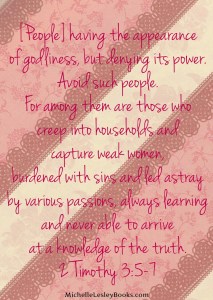
But understand this, that in the last days there will come times of difficulty. For people will be lovers of self, lovers of money, proud, arrogant, abusive, disobedient to their parents, ungrateful, unholy, heartless, unappeasable, slanderous, without self-control, brutal, not loving good, treacherous, reckless, swollen with conceit, lovers of pleasure rather than lovers of God, having the appearance of godliness, but denying its power. Avoid such people. For among them are those who creep into households and capture weak women, burdened with sins and led astray by various passions, always learning and never able to arrive at a knowledge of the truth. 
2 Timothy 3:1-7

If someone were to ask you, “What kind of person do you want to raise your daughter to be?” how would you answer? Caring? Independent? Loyal? Kind?

I’m betting none of us would answer “weak,” “burdened with sins,” “easily led astray by her passions,” or “unable to arrive at a knowledge of the truth.” Yet in these last days in which we find ourselves, that’s exactly what many good-hearted Christian mothers with nothing but the best of intentions are raising their daughters to be. It’s not that they want their daughters to grow up to be spiritually weak or led astray by sin or unbiblical teaching, it’s just that they lack the skills and tools necessary for properly training their daughters in the Scriptures and godliness.

Maybe you’re one of those moms. You want to train your daughter to be a wise, godly, discerning woman, but you’re not quite sure how. Hey, we all have those areas of our lives that we need a little help with. As an older mom myself, maybe I can lend a hand.

My daughter is almost twenty, and while she’s nowhere near perfect, by the grace of God, she is a godly young lady. Looking back, there are many things my husband and I did wrong as parents. But God, in His mercy, covered our failures and saw all of us through as He taught us through His word how to raise a biblically strong woman.

6 Ways to Raise a Biblically Strong Woman

1. Set an example.

Our daughters learn by watching us. Faithfully study your Bible, pray, attend church, obey God’s word, submit to your husband, repent and ask forgiveness when you sin, and serve others and your church together.

2. Learn, and teach your daughter, good hermeneutics.

Hermeneutics is just a fancy word for rightly handling God’s word. Use a reliable Bible translation. Understand Scripture in its immediate and overall context. What was the author’s intended meaning, his audience, genre, and culture? Point your daughter to Christ as you study God’s word together.

3. Find a doctrinally sound church, join it, and attend faithfully as a family.

Study God’s word and compare everything that’s preached and taught to Scripture (in context). Does your church’s teaching line up? Then be committed to attending every single week, not just when you feel like it or when there’s nothing better to do. Instill in your daughter a love for, and a commitment to, the church.

4. Fight the fluff.

Unfortunately, many of the most popular preachers, teachers, and Christian authors (including women’s Bible study authors) teach and write things that may sound good and make us feel good, but are in direct conflict with Scripture. These are the very people Paul was speaking of in 2 Timothy 3. Teach your daughter to follow only trustworthy teachers whose theology is in line with Scripture.

5. Bring prayer and Scripture into every situation.

She can’t find her favorite doll? Kids picking on her at school? She wants to wear clothes that barely cover her? Discuss what the Bible say about these things. Pray together about them. Lead your daughter into prayer and Scripture as part of daily life, and it will teach her that God is to have authority over every aspect of our lives and that we are to obey Him in all things.

6. Teach her how to share the gospel.

If you’re not sure how to properly present the gospel to someone, learn. You can’t lead your daughter to Christ if you can’t share the gospel with her. If your daughter is already saved, make sure she knows how to share the gospel correctly. The Great Commission was the last instruction Christ gave us before leaving earth, and we are all to be about the business of carrying it out until He returns.

The 2 Timothy passage at the beginning of this article is our commission to guard our households against ungodly ways and people – even those who may falsely call themselves Christians – who might creep in and steal our daughters’ hearts and minds away from Christ. He has charged us to train them in godliness, and we must faithfully answer His call to raise wise, discerning, and biblically strong women of God.

What advice would you offer moms who want to raise
biblically strong women?


This article was originally published at Kaylene Yoder’s Blog.

And for all you boy moms, be sure to check out…

Six Ways to Raise a Godly Man

Christian women

Throwback Thursday ~ Evangelical Misogyny and the Spiritual Oppression of Christian Women

Originally published September 16, 2016woman-1246571_20160915144847652

background-1434679_1280

Weak women- always learning and never able to arrive at a knowledge of the truth. Captives to false teachers. Led astray by their feelings. There is hardly a better way to describe a significant portion – dare I say, the majority – of evangelical women today.

There’s plenty of blame to go around. Satan dresses himself up like a Christian and deceives as many as he can. Women (and men, too) give in to the temptation to seek out false teachers who will tell them what they want to hear. Pastors fail to fight off, and in many cases, welcome with open arms, the false doctrine and false teachers creeping into their churches.  And the false teachers themselves are out to make a fast buck on false doctrine.

And the result of it all is a generation of evangelical women held prisoner by Satan in the gilded cage of biblical illiteracy and feel-good “Christianity.” And most of them don’t even know they’re inmates.

It’s bad enough that evangelical women are largely feeding their souls on the anti-biblical poison churned out by the smorgasbord of divangelistas lining the shelves of most “Christian” bookstores- poison that, at worst, will leave them doomed to an eternity in hell, and, at best, will stunt their growth in Christ. But there’s another insidious aspect of this issue: theololgical misogyny against evangelical women.

The Bible knows nothing of women as second class citizens. Throughout recorded history, God, and his obedient children, have been the ones to regard women as precious and valuable people with a crucial role to play in the Kingdom, the family, and society. God elevates women while the world degrades us.

Perhaps one of the best examples of this is in an often overlooked phrase in 1 Timothy 2:11: “Let a woman learn.” The pastors and elders of the first century church – in the midst of a culture that devalued and disregarded women – were to proactively make sure women learned the gospel and sound doctrine. The Holy Spirit goes on in that passage to explain how first century, as well as twenty-first century, women should conduct themselves in a godly way while we’re learning, but there’s no watered down, Barbie doll, “pink is for girls” version of theology that women are to be taught while the real thing – serious Bible study and theology – is reserved for men.

Yet that’s exactly what modern day evangelicalism and Christian retailing are doing. They’re establishing a subtle theological segregation in the name of marketing and meeting felt needs. How? Here’s just one example:

screenshot_2016-09-14-11-39-55_kindlephoto-22263756

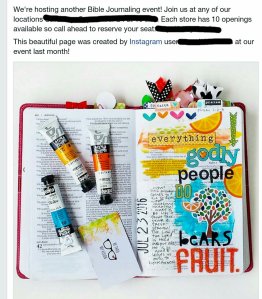
This post, from a major Christian retailer, appeared in my Facebook feed recently. They’re holding “Bible art journaling” workshops to teach women how to color in their Bibles- something we usually teach three year olds not to do.

When was the last time you heard of a Christian retailer or an average evangelical church holding a workshop – aimed at women – on biblical hermeneutics, Christology, pneumatology, church history, discernment, evangelism, or any other serious biblical topic?

Never mind how to properly handle and study God’s word, ladies, here’s a coloring book1! It’s insulting to the intelligence, capabilities, and quest for spiritual maturity of Christian women. And it’s sexist, too. Don’t believe me? Think about it:

How many Christian men do you see taking Bible art journaling classes or sharing about it on social media?

Have you ever seen a men’s ministry share a picture like this in order to reassure men of how special and wonderful they are?

woman-570883_1920_kindlephoto-22633156

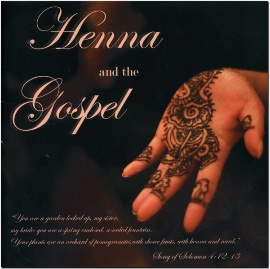
Over the summer, the hot fad aimed at women was using henna to tell Bible stories. How many men do you think participated in that?

sou-hennabklt-m

Contemporary Christian radio intentionally markets to a specific female demographic, resulting in a playlist that’s overwhelmingly comprised of ooey-gooey, salve my feelings, emasculated songs. That’s their perspective of us. That’s what they think we want and can handle.

And it doesn’t stop there. Walk into your local Christian retailer and compare the fluff and false doctrine in the women’s ghetto department to what’s offered in the general (or men’s) area of the store. Christian retailing has been so successful with their marketing plans that they have fairly brainwashed evangelical women into thinking that:

  • only what’s in the women’s section of the store is for them
  • serious theology isn’t for them (because it’s nowhere to be found in the women’s department)
  • women can’t just pick up the Bible and study it for themselves – they have to buy a “canned” study written by someone else
  • that “someone else” has to be a woman (nearly always a woman who teaches false doctrine)

Take all of that, throw it into your gumbo pot, stir it around a little, and what do you get?

Well…you get weak women who are captivated by false teachers and false doctrine, led astray from the truth of God’s word by their passions and emotions, flitting from study to study and event to event, always “learning” but ever biblically ignorant. And you get a church that not only views Christian women this way, but perpetuates this sexist spiritual oppression.

Christian women, you are better, more valuable, and more capable than that. God has more for you and expects more from you than sitting in a corner coloring in your Bible and playing with a theological Barbie Dream House. Like your first century sisters, He wants you to learn.

Strive for more than evangelicalism expects from you and thinks you’re capable of, ladies. Be a strong, healthy student of God’s Word. There are women out there who desperately need you: lost women who need to hear the gospel properly presented so they might know Christ, saved women who need someone to teach them the truth of God’s Word, women who need biblical hope, comfort, and answers about the trials they’re going through.

Buck the system. Challenge the assumptions. Cast off the shackles, and refuse to be that weak woman any more. Be the full grown, spiritually mature woman God has always wanted you to be.


1Some women are artistically talented and enjoy Bible art journaling as a hobby in their spare time. If that’s you, and you’re already a serious student of God’s word, knock yourself out. But if the majority of your Bible “study” time is spent painting or coloring in your Bible, then this might be a tight, uncomfortable shoe, but the shoe fits.

Bible Study

Throwback Thursday on Wednesday! ~ Rightly Dividing: 12 Do’s and Don’ts for Effective Bible Study

Family stuff, church stuff, a hurricane in the Gulf, and a speaking engagement this coming weekend, means I needed a little flexibility in the blog schedule, so I’m flip-flopping Wednesday and Thursday this week. Today, I hope you’ll enjoy this Throwback Thursday article, and, Lord willing, Lesson 10  of Ezekiel will be coming your way tomorrow.

Originally published August 19, 2014

12 dos donts

Bible study. As Christians we want to do it, we know we’re supposed to do it, but have you ever stopped to think that there are right ways and wrong ways to do it? Let’s take a look at a few do’s and don’ts of “rightly dividing God’s word” in Bible study.

Do use a good translation, not a paraphrase. You want to get as close to the original wording as possible. There are a number of easy to read, accurate translations out there. The English Standard Version (ESV) and New American Standard Bible (NASB) are two of the best. Try some translations on for size at BibleGateway.com.

Do read the entire Bible from cover to cover at least every few years. It will give you a better understanding of the “big picture” of the Bible and how all the little pieces inside it fit together. (I highly recommend a chronological reading plan since the books of the Bible aren’t always arranged chronologically.)

Don’t neglect the textual context. Every Bible verse has what I call a “micro-context” (how it fits in with the verses immediately before and after it) a larger context (how it fits in with the chapter and book it’s in) and a “macro-context” (how it fits in with the big picture of the Bible). When we fail to take verses in context, we are mishandling and misappropriating God’s precious and holy word.

Do consider the cultural context. Who wrote the passage, and what do we know about him and his perspective? To whom was the passage written- Jews or Gentiles? Those under the Law or those under grace? Men or women? Pastors or lay people? How did the culture at the time view the topic the passage is about, God, Judaism, the church, etc.? At what period in history, in which country, and in what language was the passage written? A good study Bible or study Bible app can be a tremendous help here.

Don’t confuse descriptive texts (passages that describe something that happened to somebody) with prescriptive texts (a command we’re to obey). Just because you read that Noah built an ark or that Judas went out and hanged himself, doesn’t mean that God is telling you to do the same (thank goodness!). Those are descriptive passages. God is simply telling the story of what happened to someone else because it somehow fits into His bigger story of redemption.

Do consider the type of literature and literary devices you’re reading. Is this book of the Bible history? Poetry? Law? Prophecy? Epistle? Is the particular passage a song, metaphor, hyperbole, comparison, allegory, parable? The Bible uses various vehicles to drive truth home, and they must all be understood in different ways.

Don’t feel like you HAVE to use a Bible study or devotional book or workbook. It really is OK to just pick up the actual Bible and study it. God made His word understandable, made you smart enough to understand it, and gave you the indwelling Holy Spirit to illumine your understanding.

Do, if you decide to use one, choose a Bible study book or workbook that treats Scripture as the “swimming pool” you dive into and swim around in, not the “diving board” the author springs off of into a pool filled only with her own personal stories, anecdotes, and opinions.

Do read the Bible in orderly chunks, not in single verses. Think about the way you would read a magazine. Do you pick it up each day and read a random sentence or paragraph? Do you read the third page of an article before you read the first page of it? You’ll best understand a book of the Bible if you start at the beginning and read the chapters in order to the end.

Don’t give in to the temptation to read yourself into Scripture. The Bible isn’t our story. Approach every passage remembering that the Bible is God’s story of redemption through Christ from His perspective, and we study it to learn about and draw closer to Him.

Don’t underestimate how helpful your Bible’s cross-references to related verses can be. Reading several different passages on a particular topic you’re studying can give you a broader understanding of what the Bible has to say about it.

Do let clear passages interpret unclear passages. This is another reason cross-references are so handy. If you come across a passage you just don’t get, try reading related passages that are clearer, and understand the unclear passage in light of the clearer ones.

Lengthy tomes have been written on the topic of biblical hermeneutics and Bible study methods, so I’m sure I could go on at length, but it’s your turn:

Have you ever found it difficult or daunting to study the Bible?
What are some of the benefits of rightly handling God’s word?
How has a right understanding of Scripture helped you to grow
in your walk with the Lord?


THIS ARTICLE WAS ORIGINALLY PUBLISHED AT SATISFACTION THROUGH CHRIST.
Bible Study

Throwback Thursday ~ 10 Simple Steps to Plain Vanilla Bible Study

Originally published April 22, 2016.

plain vanilla

Baskin Robbins is one of my favorite places to get ice cream. Not only is their ice cream good, but they boast a plethora of flavors to choose from. I love to start at one end of the counter and work my way through all their offerings, getting a little “taste spoon” here and there if a particular flavor piques my interest.

Flavor_Enlarged_Peanutbutter'nChocolate2
Photo courtesy of BaskinRobbins.com.

Having a myriad of options is great when it comes to ice cream, but when it comes to studying the Bible, the tsunami of materials, methods, and other choices out there can be overwhelming. Where do I start? How do I know if a certain Bible study book or teacher is doctrinally sound? Is the study method I’m using in line with good hermeneutics?

It can be enough to make you throw your hands up in the air and head for your local Thirty One Flavors to drown your sorrows in Peanut Butter ‘N Chocolate.

Sometimes it can help to get back to plain old, simple, vanilla Bible study. I’ve been saying for a while now that Christian women should, for the most part, put all the “canned” Bible study books, workbooks, and DVDs aside and simply pick up their Bibles and study them in a systematic way. After all, up until somewhere near the latter half of the 20th century, that’s generally how people studied the Bible. And it worked. People grew in their faith to godly maturity just fine. So, why can’t it work today?

It can. It does. It will.

Unfortunately, the blessing of lots of options, methods, resources, and information, and the marketing of that blessing by celebrity Christians and Christian retailing, has bred a generation of Christian women who are fearful that they aren’t as smart or as capable of reading and understanding God’s word as all the “experts” out there. They look at the simplicity of picking up their Bibles and studying them like calves looking worriedly at a new gate.

“What does that mean?”

“How do I do that?”

“I’m scared I’ll get it wrong!”

It absolutely breaks my heart to hear this angst from women who, I’m certain, genuinely want to study God’s word correctly so that they can know Him better and grow in their faith. And it makes me livid at the churches who haven’t trained them properly, the plantation-style women’s “Bible study” marketing that has kept them ignorant and dependent slaves to Christian retailers, and whatever other forces have conspired to keep these precious ladies away from the pure milk of the word.

So let’s reboot, get back to basics, and get as many women digging into the Word as possible.

First, it’s important to start out with a biblical perspective:

1. God is kind, and He loves you.

Yeah, I know, that’s pretty basic. But it’s worth bringing to the forefront for this discussion. This is a God who loves you and wants you to know Him. He has revealed Himself to you through creation, through Christ, and through His written word. He has indwelt you as a believer with the Holy Spirit to help you understand Scripture. He has told you that you can ask for wisdom and promises to provide it. In His kindness God has bent over backwards to provide you with ways to know Him. He is not some mean ogre sitting up there just waiting for you to get something wrong so He can chastise you. He wants you to understand His word.

2. The Perspicuity of Scripture

There’s this really great, comforting, reassuring doctrine called the perspicuity of Scripture. The gist of it is that Scripture is, for the most part, clear and understandable, especially for believers, because of the aforementioned indwelling of the Holy Spirit. But even lost people tend to understand a lot of what Scripture says (that’s why you hear so many of them arguing against it – they couldn’t do that if they didn’t at least partially understand it).

So, by and large, if you’re reading the Bible in an orderly way you should be able to understand it fairly well. You don’t have to have a seminary degree or be an “expert.” There are dirt farmers and country preachers out there who have a better grasp of Scripture than some celebrity pastors in multi-million dollar churches with thousands of congregants, and a string of seminary degrees behind their names.

OK, now that we have a biblical perspective on studying the Bible, how do we do it in a systematic or orderly way?

3. Pray

Don’t see this as childish or unimportant and skip it. Start your Bible study time by asking God to help you understand His word, to learn what He wants you to learn from it, and to obey its instruction. Even if you’re pretty well versed in the Scriptures, praying like this before opening God’s word will remind you of its holiness and your proper place of humility and submission to it.

bible-1089968_12804. Read the Bible the way you would any other book.

When you pick up a novel, do you read one sentence out of the middle of chapter 4, followed, the next day, by a paragraph from chapter 37, and, the next day, a couple of lines from chapter 1? Of course not. You wouldn’t know what was going on and what the characters meant by what they were saying. If you wouldn’t read something as inconsequential as a novel this way, why would you read the Bible in such a haphazard manner? Yet this is precisely the way people often approach daily Bible study.

My pastor said something awesome about this in his sermon the other day:

The Bible isn’t Google for self-help.

And he’s so right. We don’t just parachute in to a random passage, hoping to glean a nugget of truth. Pick a book of the Bible (maybe Genesis or one of the gospels if you’re new to all this), start at the beginning, and read a little each day until you reach the end. It’s really that simple.

5. Context, context, context

It’s important to read and understand Scripture in its context: how a verse fits with the verses immediately surrounding it, within its chapter, within its book, and within the overarching narrative of the Bible. This is really the biggest key to comprehending Scripture. Fortunately, the main way to do this is by reading the Bible in an orderly way (see #4- You did already read #4, right?)

Another invaluable practice is to make use of the cross-references and footnotes in your Bible. Cross-references will help you get a better idea of how the passage you’re reading fits together with other, related passages. Footnotes are there to add a touch of clarity to particular words and passages.

6. Get a plan, Fran.

If structure helps you, choose a good Bible reading plan. For the beginner, start off with one of the shorter plans so you won’t get overwhelmed. When you’re ready, I highly recommend the chronological plan. It is extremely helpful for learning the big picture of Scripture.

If you decide to choose a reading plan, though, hold its schedule loosely and don’t be beholden to its time frame. Work through the readings at your own pace. Take the time to let the Scriptures sink in and spend as long as you need to on any given section. God doesn’t give gold stars for finishing the Bible in a year.

7. Understand the background and setting.

There are some passages in Scripture that are a little more difficult to understand if you don’t know the customs of the time or what was going on historically and politically. In these cases a good study Bible, commentary, and other resources can be beneficial. I’ve touched on the specifics of some of these resources here. Many of these helpful materials can be found on-line for free.

8. Take notes on the text.

Hmm…an orderly method of reading…footnotes…extra resources…taking notes…this is starting to sound like…well…studying! Yep, that’s the idea. Isn’t it interesting that we often take a more serious and scholarly approach to studying for a class or a test than we do to studying our Bibles?

If you were a better student than I was in high school and college, you probably took notes on your text books as you read them. You wrote down things you wanted to remember, things that seemed important, things you didn’t understand and wanted to work on more later, things that were especially meaningful, even questions that occurred to you. Those are all good things to write down as you study your Bible, as well.

presenter-1206345_12809. Listen to good preaching.

As a Christian, you should already be doing this at least weekly at the church you’re a member of. But try to sneak in some extra listening – to your own pastor or another doctrinally sound pastor – as often as you can during the week. Listening to someone rightly handle and explain God’s word helps you to understand it and trains you to rightly handle it yourself as you study.

I once read that children who read a lot are better spellers. Not because they study spelling more, but because they’re exposed to more words and have the correct spelling of words constantly in front of their eyes. They sort of soak up good spelling by osmosis, and when it’s time for the spelling test, they simply write down what they’ve absorbed. Listening to good, expository preaching can have the same kind of helpful impact on your Bible study skills.

10. Practice makes perfect.

Studying the Bible is just like any other skill. You’ll probably fumble around a good bit when you’re first getting started, but if you stick to it, you’ll find that it gets easier and you get better at it as time goes by. Don’t be afraid to start. Jump right in there and try. Nothing ventured, nothing gained, right?


Ladies, simply picking up the Bible and studying it each day is such a joy. I have been doing it for years, and I love it. The excitement of “digging for buried treasure” in God’s word and uncovering the truths of Scripture for myself has been far more meaningful to me and has grown me so much more than any workbook or curriculum I’ve ever used. I hope you’ll put aside your book studies and devotionals, and give it a try yourself!

Favorite Finds

Favorite Finds ~ January 14, 2020

Here are a few of my favorite online finds…

“How can I know with certainty what the Bible is saying? How can I be certain what books really belong in the Bible? How can I be sure that my interpretation of any text is correct, and, still more, what its proper application is…?” Have you ever tried to explain a biblical principle to someone only to hear the retort, “But That’s Just Your Interpretation!“? D.A. Carson has some helpful words for us in the latest issue of Themelios.

 

“Pastors, I have a plea for you. Please, love your women enough to warn them against false teachers. It isn’t enough to simply teach the good stuff; if they don’t know what is out there that is not good and why it isn’t good? They will continue to fall for it.” Check out Amy Spreeman’s article, When Seemingly Solid Pastors Fail to Protect Women.


“Christianity is sexist!” “The Bible is patriarchal and just wants to keep women down!” We hear these tired arguments trotted out again and again, but are they really true? No, Eric Davis explains in his excellent article over at Cripplegate, 10 Reasons Why the Bible Regards Women Higher than All Other Systems, “The fact is…the Bible regards women higher than any other ideology, religion, philosophy, or system in history. Nothing teaches a higher view of women than biblical Christianity.”


Crossway has an interesting infographic for us on a study they conducted on prayer: “Over 14,000 people recently shared about various aspects of their prayer lives with us…we invite you to dig into the data, looking at established prayer habits, common pain points, and useful practices and tools for prayer.” Take a look at Infographic: How Is Your Prayer Life?.


Hermeneutics is the lens through which we view Scripture. Dr. Dane Ortlund helpfully explains some right and wrong lenses to use when studying Scripture in 6 Ways Not to Read the Bible (a brief excerpt from a longer seminar). Are you handling Scripture correctly?


The resources listed above are not to be understood as a blanket endorsement for the websites on which they appear, or of everything the author or subject of the resource says or does. I do not endorse any person, website, or resource that conflicts with Scripture or the theology outlined in the Statement of Faith and Welcome tabs at the top of this page.