Christian women, False Doctrine

Throwback Thursday ~ 8 Unbiblical Notions Christian Women Need to Be Set Free From

Originally published June 2, 2017

Your recent article on prayer really helped me. I was always taught that prayer was a two-way conversation. For years, I would talk to God and wait for Him to talk back to me, but He never did. I thought it was because there was unknown sin in my life, or that I didn’t have enough faith, or that God just wasn’t interested in me. It’s so freeing to know the truth.

Comments like this from readers are always bittersweet for me. It makes me practically giddy to hear from Christian women who have been set free from false doctrines they’ve been taught, but it also grieves me deeply to reflect on the years they spent thinking they were somehow deficient as Christians or doubting God’s love for them simply because they were taught, and believed, unbiblical notions and ideas.

Let’s see if we can dispel a few of those today:

1. Prayer is this big, complicated, mystical thing.
Nope. Prayer is simply talking to God about whatever is on your heart. What’s made prayer complicated is the unbiblical teachings that have grown up around it such as praying in “tongues,” listening prayer, contemplative prayer, sozo prayer, soaking prayer, etc.

8 Things You Need to Know about Prayer

2. “Women’s Ministry” equals fluff and silliness.
There’s nothing wrong with having a little fun from time to time. Hey, we all need to blow off steam, right? But if cookie exchanges and teas and painting parties and dress up parties and sleepovers and makeup parties and fashion shows and movie nights are all your women’s ministry does, it’s unhealthy. And it’s not really a ministry, either. If something is a “ministry” it should exist to point people to Christ and disciple them once they get to Him. Your women’s ministry should include ministry of the Word, discipleship, evangelism, comfort ministry (to the ill, shut-ins, new moms, new members, etc.), serving the church, encouragement, supporting your pastor and elders, and so on.

Mary and Martha and Jesus and Women’s Ministry
Biblical Womenโ€™s Ministry โ€“ Part 1
Practical Womenโ€™s Ministry โ€“ Part 2

3. Women’s Bible study- great balls of fire, don’t get me started.
โ™ฆ A Bible verse (or half a Bible verse) plus an inspiring story from the author’s or someone else’s life is not Bible study. Bible study is picking up your Bible and studying it.

Bible Study
Bible Studies

Bible study is picking up your Bible and studying it.

โ™ฆ If you’re hosting a women’s Bible study, you do not have to use books and DVDs written by someone else. In fact, I would recommend against doing so. Get someone who is able to teach – yes, it could even be a man – and study a book of the Bible from beginning to end.

You’re Not as Dumb as You Think You Are: Five Reasons to Put Down that Devotional and Pick Up the Actual Bible

McBible Study and the Famine of God’s Word
Can you recommend a good Bible study for women/teens/kids?

โ™ฆ One reason I recommend against using “canned” women’s Bible studies is that the vast majority of them (95% in my estimation- not an exaggeration) teach false doctrine. When you walk into most Christian bookstores the first thing you’ll see is the best sellers shelf, and the majority of those books are written by false teachers such as Beth Moore, Priscilla Shirer, Christine Caine, Lysa TerKeurst, Sarah Young, and others.

Popular False Teachers
The Mailbag: โ€œWe need to stop relying on canned studies,โ€ doesnโ€™t mean, โ€œWe need to rely on doctrinally sound canned studies.โ€.

โ™ฆ If you do decide to occasionally do a book study, you do not have to use one written by a woman. In fact, if you want a book that’s doctrinally sound, you have a much better chance of finding one written by a man than by a woman, sad to say. Check out some godly men who are pastors, authors, and teachers at…

Recommended Bible Teachers

4. Faithful church attendance isn’t that important.
If you think you don’t need church or that you can skip it whenever something more fun comes along, your thinking isn’t biblical. God thinks it’s important enough for His people to gather regularly for worship that He emphasizes it throughout the entirety of Scripture- Old and New Testament. Get your heiney in the pew every week, honey, and find a place to serve.

7 Reasons Church is Not Optional and Non-Negotiable for Christians
Searching for a new church?
5. I am woman, hear me roar.
โ™ฆ Beth Moore and many other female teachers who rebel against Scripture by preaching to and teaching men in the church say that they are doing so “under their husband’s and/or pastor’s authority”. Neither your husband nor your pastor has the OK from God to allow you, or any other woman, to teach men in the church. God says women aren’t to teach or hold authority over men in the church, and when God says no, no one has the authority to say yes. Furthermore, there isn’t a single passage of Scripture that allows any man to give any woman this type of “under my authority” dispensation to teach men. To say that it’s permissible for a woman to teach men “under her husband’s/pastor’s authority” is just as biblically absurd as saying it’s OK for a woman to lie, commit adultery, gossip, or steal “under her husband’s/pastor’s authority.” Sapphira sinned under her husband’s authority and look what happened to her.

Fencing Off the Forbidden Fruit Tree
Jill in the Pulpit

Ten Things You Should Know About 1 Timothy 2:11-15 and the Relationship Between Men and Women in the Local Church at CBMW

Neither your husband nor your pastor has the OK from God to allow you, or any other woman, to teach men in the church.

โ™ฆ Egalitarians are often so vehement in their insistence that women should teach men and hold authority over men in the church, that they are essentially saying that the only way a woman’s service or leadership in the church can have any value is if it’s exercised over men. I’ve heard many of them turn up their noses at the idea of teaching women and children and other forms of service (that don’t involve teaching or authority over men), in a haughty “we’re better than that” kind of way.

No way.

Have you seen the garbage women and children are being taught in the church under the guise of “Sunday School” or “Bible study”? Women’s and children’s classes at your church are in desperate need of women who are doctrinally sound and able to teach. What about the need to visit church members who are in the hospital or shut-ins? How about record-keeping, working in the sound booth, welcoming visitors, serving on committees, mowing the church’s lawn, participating in outreach activities, fixing a meal, chaperoning youth activities, hosting a visiting pastor or missionary? There’s a ton of important and valuable work for women to do in the church. We don’t have time to worry about teaching and holding authority over men. Let the men worry about that.

Servanthood
Let Me Count the Ways: 75 Ways Women Can Biblically Minister to Others

6. My feelings and opinions reign supreme.
Uh uh. Not if you’re a Christian, they don’t. That’s how lost people operate. If you’re a Christian, you’re not entitled run your life or make decisions by any opinion other than that of your Master. What He says – in His written word – goes. Period. Regardless of how you feel about it or whether or not you agree with it. That means if a “Bible” teacher you really like is teaching things that conflict with Scripture, you dump her. You love Mr. Wonderful and want to marry him, but he’s not saved? Nope. You’re a woman who’s certain God has called her to preach? No way. Your husband has said no about something, but you want to do it anyway? Forget it.

The Bible is our Authority
Bad Fruit, Diseased Trees, and the Authority of God’s Word

7. If something or someone claims to be a Christian, it is.
I suppose at some point in Christian history, there might have been a time when, if someone handed you a “Christian book,” it was a pretty safe bet it was doctrinally sound. Or if someone said she was a Christian, you could be fairly certain she was truly born again.

Not so much these days.

You cannot take at face value that someone who says she’s a Christian is using the Bible’s definition of Christianity and has been genuinely regenerated. You cannot trust that just because something is sold at LifeWay or another Christian retailer that it’s doctrinally sound. You can’t assume that just because someone is a “Christian” celebrity, writes “Bible” studies, speaks at “Christian” conferences, and has a large following, that she’s handling God’s word correctly (or at all) and teaching you biblical truth. There’s just too much false doctrine running rampant in evangelicalism and too many people who believe and teach it.

Don’t be a weak and naรฏve Christian woman. Jesus Himself said, “Not everyone who says to me, ‘Lord, Lord’ will enter the kingdom of Heaven…” There are many people who draw near to God with their lips, but their hearts are far from Him. It is God’s will for you to be a good Berean and to test everything according to Scripture. We will know the truly Christian from the false by their fruits, not their platitudes.

8. Sugar and spice and everything nice- that’s what Christian girls are made of.
That’s not a Bible verse, but rather and unspoken rule among most Christian women. Somewhere we’ve gotten the idea that Christian unity or love means “being nice” to people. Weโ€™re always smilingly sweet and never say anything that might hurt someoneโ€™s feelings or could rock the boat at church.

Are we to be kind? Yes. Are we to do our best not to hurt others? Of course. Should we be making waves over every little thing that rubs us the wrong way? Absolutely not.

But neither is it loving to see a Mack truck bearing down on an oblivious sister in Christ and refrain from yanking her out of harm’s way because it might dislocate her shoulder. It is not unity to see Satan deceiving a friend through sin or false doctrine and not plead with her to turn to Christ and His word because she might think we’re rude. And that’s the situation we often find ourselves in at church or with Christian friends.

Was Jesus – our perfect example of love – being unloving, unkind, hateful, or divisive when He rebuked the Pharisees, cleared the temple, or said, “Get behind Me, Satan!” to Peter?

Love for the brethren isn’t “being nice.” It’s caring so much about a fellow saint that we want what’s best for her in Christ. Sometimes that requires being firm, confrontational, or demonstrating “tough love.” People’s eternities and spiritual health are at stake. How loving is it to stand aside and let a sister waltz into Hell or struggle for years on end in her walk with the Lord because she’s living in sin or believing false doctrine? “Being nice” isn’t a fruit of the Spirit. It’s time we stop being nice and start being biblical.

I Can’t Sit Down, Shut Up, and Play Nice
Discernment: What’s Love Got to Do with It?

“Being nice” isn’t a fruit of the Spirit. It’s time we stop being nice and start being biblical.

Do you believe any of these unbiblical notions? If so, set them aside, repent, and believe and practice what Scripture says. Any time we believe something that’s in conflict with God’s word, it’s a hindrance to the abundant life and growth in Christ that He wants to bless us with.

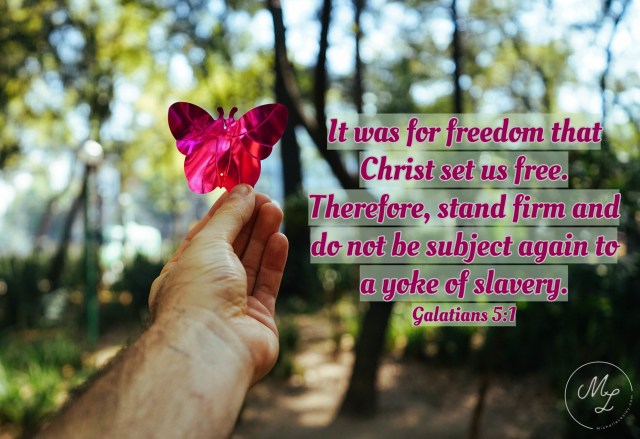
False doctrine enslaves. It places a yoke of confusion, anxiety, and “try harder” on the shoulders of those who embrace it. Christ did not set us free from sin so that we might turn right around and become captives to a new, pseudo-Christian type of sin: false teaching. It is for freedom and a healthy spiritual life that Christ has set us free.

Christ did not set us free from sin so that we might turn right around and become captives to a new, pseudo-Christian type of sin: false teaching.

Mailbag

The Mailbag: Top 10 FAQs

Originally published September 7, 2020

I get lots of great questions, and sometimes, they’re the same questions from lots of different people. So I thought today it would be fun, instead of answering just one person’s question, to answer lots of people’s questions. Here are the top 10 Mailbag questions readers most frequently ask:

1.

โ€œDo you know anything about [Christian pastor/teacher/author] or his/her materials? Is he/she doctrinally sound?โ€

The best way to find out if I’ve written anything on a particular teacher is to put her name (make sure you spell it correctly) into the search bar, which is located at the bottom of every page of the blog. You can also check the Popular False Teachers & Unbiblical Trends tab and the Recommended Bible Teachers tab (in the blue menu bar at the top of this page) to see if the teacher’s name is located there.

If you need answers on a certain teacher right away, and I haven’t written anything about her, you will need to do the research yourself, which is a skill every Christian needs to hone anyway. (You should never just take my, or anybody else’s, word for it that a particular teacher is or isn’t trustworthy.) In case you need a little help getting started, I’ve described how I do my research, complete with some quick litmus tests and shortcuts in my article Is She a False Teacher? 7 Steps to Figuring It Out on Your Own.ย 

If I haven’t written an article about a teacher you see as problematic who’s reaching a wide audience, you’re welcome to send me her name along with any links you may have to her unbiblical teaching or behavior. If I get enough questions about a particular teacher, Iโ€™ll probably write an article on her.

2.

โ€œCan you recommend a good
womenโ€™s/children’s/teens/particular topic Bible study?โ€

No. On principle, I do not recommend what I call “canned” (book, workbook, DVD, etc.) Bible studies- not even doctrinally sound ones. The church has become so utterly dependent on books and materials written by others that the majority of evangelicals have no idea how to simply pick up the Bible and study or teach straight from the text of Scripture. I may be the only one to stand against that tide, but I’m standing against it. We need to, as a general practice, cut out the middleman and get back to learning and teaching straight from the Bible itself.

If studying or teaching directly from Scripture is new to you, I would encourage you to check out the Bible Studies tab in the blue menu bar at the top of this page, which explains more about my philosophy of Bible study and provides numerous resources to help you learn how to study or teach the Bible itself.

One of the resources you’ll find is all of the Bible studies I’ve written. They are all free for individual and group use, and you are welcome to print out as many copies as you need. My studies are learn-by-doing “training wheels” that teach you: how to study/teach the Bible in a systematic way, the kinds of things you should be noticing in the text, the kinds of questions you should be asking of the text, and how the various parts of the Bible fit together to tell God’s grand story of redemption through Christ. Work through a study or two. Once you get the hang of it, you’ll be ready to unbolt those training wheels and study or teach on your own without needing to rely on anyone else’s materials any more – even mine.

Here are a few additional resources:

The Mailbag: Can you recommend a good Bible study for women/teens/kids?

The Mailbag: โ€œWe need to stop relying on canned studies,โ€ doesnโ€™t mean, โ€œWe need to rely on doctrinally sound canned studies.โ€

McBible Study and the Famine of God’s Word

3.

โ€œYou shouldnโ€™t be warning against [popular false teacher]
for [X,Y,Z] reason!โ€

Sorry, but that’s not what the Bible says. The question isn’t, “Why am I warning against them?”. The question is, “Why aren’t you?”

Answering the Opposition- Responses to the Most Frequently Raised Discernment Objections

4.

I’m trying to find a doctrinally sound church. Can you help me?

It is my delight to help my brothers and sisters find a solid church. Please check out the Searching for a new church? tab in the blue menu bar at the top of this page.

If you’re newly saved and/or coming out of the New Apostolic Reformation, prosperity gospel, New Age, Catholicism, Mormonism, etc., I would strongly recommend reading through all of the resources in the “What to look for in a church” section of that tab before beginning your search for an actual church. You need to know what makes a church doctrinally sound (or not), and those resources can help.

Notice that there are multiple church search engines at the top of that tab. If you don’t find something in your area at the first search engine, go to the next one, and keep going until you’ve exhausted all of them.

Keep in mind that doctrinally sound churches are becoming scarcer and scarcer. You may have to drive longer than you’d like to get to one. It may not meet all your preferences. You might have to try a different denomination than you’re used to. The most doctrinally sound church you can find within achievable driving distance may have a few biblical “warts” (for example: a generally solid preaching/teaching church but the women’s ministry uses materials by false teachers). It is possible that God may put you in that less than perfect church to sanctify you, or for you to help bring about biblical change.

Sometimes people e-mail me asking if I can help them find a church. Your best bet is really to use all of the resources at the “Searching for a new church” tab. I want to reassure you that, unlike Walmart, I don’t have any churches in the back store room that haven’t been stocked yet. With the exception of a handful of churches my readers have recommended that I haven’t had a chance to vet yet, everything I have is out on the shelves at that tab. :0) (I would also encourage everyone reading this – if you attend a doctrinally sound church, click the link above and see if your church is listed on at least one of the three most popular church search engines: Founders, G3, and/or Master’s Seminary church search engines. If not, talk to your pastor about submitting your church’s information to one or more of these so people can find you!)

If you’ve made a good faith effort at the “Searching…” tab and have exhausted all of the resources there, and you still can’t find a passable church within achievable driving distance, you have two options (one of which is not giving up on church and staying home): move to an area that has a solid, established church, or look into church planting.

If you’re considering moving for a church, do everything in your power to make sure that church is solid and is going to stay that way. Find out about their history. Watch their worship services online regularly for a few months. Set up a Zoom call with the pastor or elders, explain your situation, and “interview them”. Don’t be shy to ask any, and as many questions as you need to. You’re picking up your entire life and moving based on what they say. Churches are apostatizing at an alarming rate. The last thing you want to do is move somewhere for a church you thought was sound, only to have it take a turn toward sin or false doctrine six months after you get there.

Personally, I think church planting is the preferable option for at least two reasons. First, you don’t have to go through the hassle, logistics (“Will I be able to find a job in this new place?”), and emotional upheaval of leaving family and friends behind that comes with moving. Second, if you’re in an area where you can’t find a good church, neither can any of your neighbors. You could be the person God uses to bring a solid church to an area without a gospel witness. How amazing would that be? Pick up the phone or fire up your email and start contacting the church planting organizations listed. Explain your dilemma. Ask for their help. If none of the church planting organizations can help, contact the nearest doctrinally sound church, explain things to the pastor, and ask about his church planting a church in your area.

5.

The leadership at my church is kicking off a new Bible study using materials by a false teacher. What should I do?

It breaks my heart that this is, indeed, a frequently asked question. Please see my article The Mailbag: How should I approach my church leaders about a false teacher theyโ€™re introducing?.

6.

My church uses …
or
I’m looking for a new church,
and I found one that’s really sound, except they use…
Bethel / Jesus Culture / Hillsong / Elevation music
or other music from heretical sources.
What should I do?

Please see my article The Mailbag: How should I approach my church leaders about a false teacher theyโ€™re introducing?. You can find information about Bethel, et al at the Popular False Teachers & Unbiblical Trends tab in the blue menu bar at the top of this page. Some other resources that may be helpful:

Why Your Church Should Stop Playing Bethel, Hillsong, Elevation and Jesus Culture

The Mailbag: False Doctrine in Contemporary Christian Music

7.

My friend is following a false teacher. How can I help her see this? 

Here are some resources that can help:

Words with Friends: How to contend with loved ones – at A Word Fitly Spoken (many additional resources linked here)

Words With Friends by Amy Spreeman

Clinging to the Golden Calf: 7 Godly Responses When Someone Says Youโ€™re Following a False Teacher 

8.

Whaddaya mean women can’t preach to men? Of course they can!

Again, sorry, but that’s not what the Bible says. I would strongly encourage you to read all of the articles in my Rock Your Role series, which examines the Scriptures dealing with the role of women in the church. (Remember, for Christians, God’s Word is our authority, not our feelings, opinions, and preferences.) I would suggest starting with these:

Jill in the Pulpit

Oh No She Di-int! Priscilla Didnโ€™t Preach, Deborah Didnโ€™t Dominate, and Esther Wasnโ€™t an Egalitarian

Rock Your Role FAQs

The Mailbag: Counter Arguments to Egalitarianism

9.

Why isn’t Teacher X listed at your Popular False Teachers tab?
Does the fact that she’s not listed mean she’s doctrinally sound?
Why isn’t Teacher Y listed at your Recommended Bible Teachers tab? Does the fact that she’s not listed mean she’s a false teacher?

Please understand that these are not comprehensive lists of every false teacher or doctrinally sound teacher in existence. There are thousands of both, so that would be impossible. Also, don’t jump to conclusions about any teacher who’s not on the list. The absence of a particular teacher’s name on either list says nothing definitive about whether or not I would recommend that teacher.

The articles I’ve written about false teachers have mainly been in response to readers inquiring about them. In other words, if you donโ€™t see a particular teacher’s name on the list, itโ€™s probably because I havenโ€™t been asked about her, I’ve been asked about her but havenโ€™t had time to get to it yet, or for one of the reasons below.

The teachers on the recommended teachers list are those I’ve personally listened to or read at enough length that I feel comfortable endorsing them. Most of the teachers on the list trend toward being Calvinistic/Reformed and cessationist because I believe this is the most biblically correct view of Scripture, and because, in my experience, those of these persuasions are generally more discerning about associating with false teachers, and more expository in their teaching. (Of course there are some non-Calvinist/Reformed pastors and teachers who are stellar in these areas. I’ve had the privilege of knowing a few personally.)

There are a few other reasons you might not see someone’s name on either the false teachers or the recommended teachers lists:

โ€ข My articles on false teachers are nearly always about teachers: who are well known (thus the “Popular” in “Popular False Teachers”), who women in my particular audience – average American evangelical women – are most likely to follow, and whose materials are being used in those average American evangelical women’s churches. It takes multiple hours of research to vet teachers, and I have to invest those hours into the teachers who are deceiving the greatest numbers women in my audience.

โ€ข I don’t tend to write articles on teachers who are so blatantly heretical and/or are so well known for being heretical that it should be obvious (unless I feel there’s some compelling reason to do so). This is why you won’t see, for example, Kenneth Copeland, Benny Hinn, or Nadia Bolz-Weber on the false teachers list. Kenneth and Benny are fairly well known for being prosperity gospel heretics, and a 30 second Google search should make it obvious to most Christians who aren’t already familiar with her that Nadia is a liberal heretic. And, again, your average American evangelical woman isn’t following people like this, and her church isn’t using their materials.

โ€ข Normally, I don’t write about contemporary teachers who are dead, especially if they’re not particularly popular with my demographic. This is why you don’t see names like Mother Teresa or David Wilkerson on the list.

10.

I have a dire and complicated family/marriage/church situation,
can you help me?
Can you mentor/disciple me?

I deeply wish I could answer “yes” to all of these inquiries. I’m a helper. I want to help people. But I also know that in most of these situations, I’m not the right person for the job. So my answer to these inquiries has to be “no”. I cannot engage in counseling or discipling/mentoring relationships via e-mail.

The first reason for this is that my primary duty before the Lord is to care for my husband, children, and grandchildren, to manage my household, and to be a faithful church member. That takes a lot of time and energy. And if you’ve ever read my e-mail policy, you know I don’t even have time to answer most of the e-mails I receive, let alone the time that’s required to properly disciple, mentor, or counsel someone through a difficult circumstance.

But the second reason I’m not the right person for the job is that all of these are the job of the local church. It’s not right for me to get between you and your pastor when you need counsel or between you and an older sister at your church when you need to be discipled. You need someone who can walk with you, face to face, for the long haul, through these situations. Relying on me would be cheating yourself out of connecting with the person at your church who could be there for you the best and help you the most.

And, finally, especially in dire counseling situations such as abuse, extreme marital problems, or complex issues at church, I’m not familiar with the laws and resources in your area, I’m only hearing your side of the story, I’m not getting all of the details, etc. Your pastor or an older sister at church is there. They can better help you navigate the intricacies of the situation and provide you with more effective solutions than I can.


If you have a question about: a Bible passage, an aspect of theology, a current issue in Christianity, or how to biblically handle a family, life, or church situation, comment below (Iโ€™ll hold all questions in queue {unpublished} for a future edition of The Mailbag) or send me an e-mail or private message. If your question is chosen for publication, your anonymity will be protected.

Discernment

Getting “Counterfeiting” Right

You’ve probably heard it a million times, just like I have. The old “counterfeit money” illustration about discerning false doctrine and false teachers. If you’re not familiar, it goes a little something like this:

When training tellers to detect counterfeit bills, banks don’t have them study counterfeit money. Tellers are trained to become so familiar with authentic bills that when a counterfeit bill comes their way, they immediately detect it.

This, we’re told, is THE way to learn to discern false doctrine or spot a false teacher – not by being warned about them by name or description (i.e. studying counterfeit money), but only by knowing our Bibles well (i.e. studying authentic bills).

Unless that illustration is being used as a subtle way to say, “Hey, stay away from those mean old discernment bloggers!” it’s a decent illustration, as far as it goes. It’s correct, but not complete.

And if we base our understanding of discernment on this illustration rather than on what Scripture actually teaches about discernment, we’re going to get it wrong. Scripture tells us pastors are to preach sound doctrine AND ALSO rebuke those who contradict it.

The overseer must be…holding fast the faithful word which is in accordance with the teaching, so that he will be able both to exhort in sound doctrine and to reprove those who contradict.

Titus 1:7a, 9

Rebuking, sounding the alarm, and warning against false teachers and false doctrine is one of the biblical qualifications for pastors. In other words, if a pastor doesn’t warn against false teachers and false doctrine, (i.e. doesn’t warn you and train you about counterfeits) he’s only doing half his job and is disqualified.

Likewise, saying that the only way bank tellers learn about counterfeits and counterfeiters is by handling real money is untrue. When there’s a counterfeiter on the loose, the police alert banks and businesses. There are “Wanted:” posters with the suspect’s name, picture, and M.O., if available.

The media run news stories with surveillance video and descriptions of the counterfeit bills. The police want to get the word out so banks, businesses, and citizens won’t be fooled and taken advantage of, and so the criminal can be caught and brought to justice.

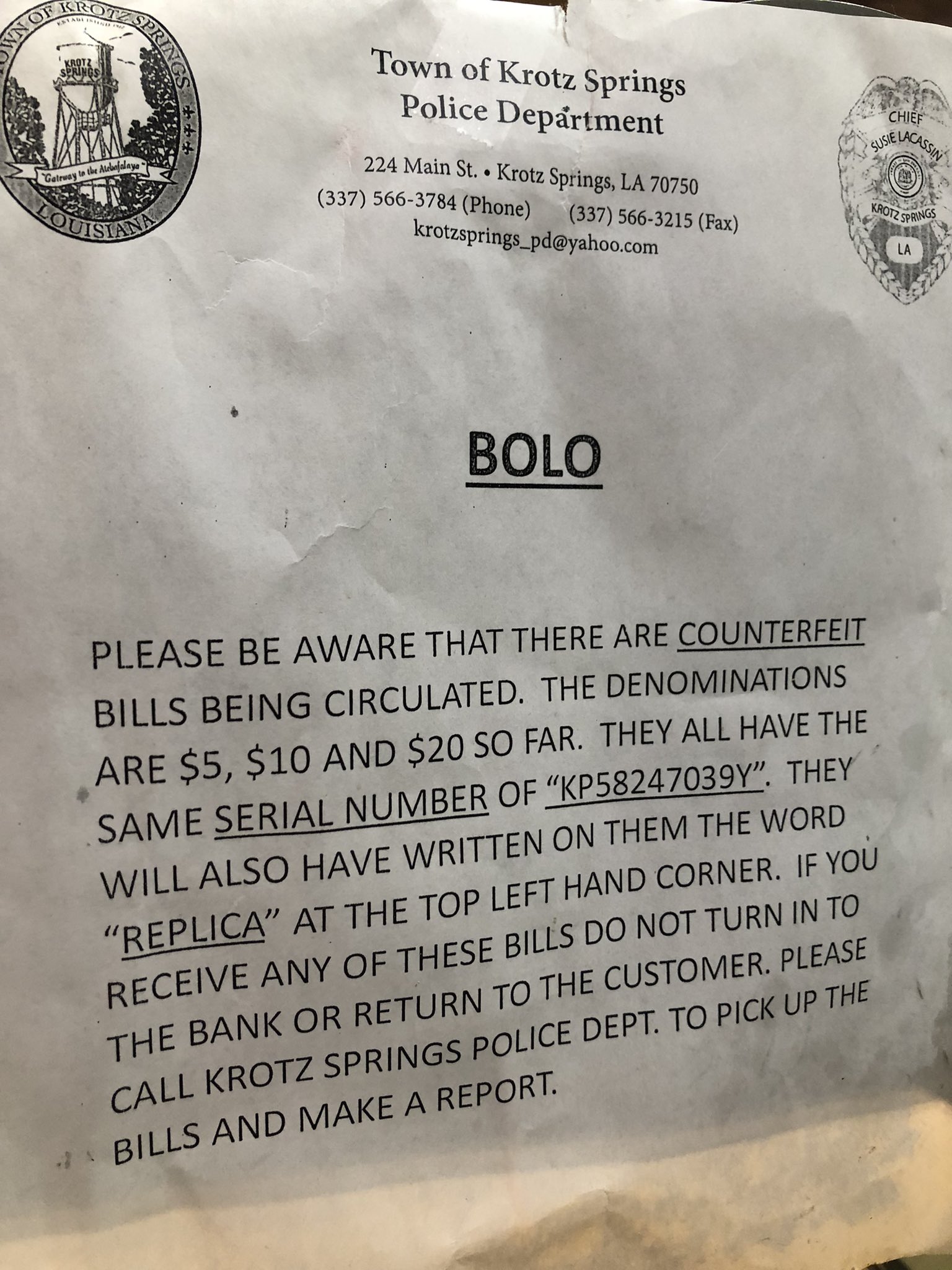
Providentially, not long ago, I spotted this “be on the lookout” (BOLO) warning from the police department of a small town near me. It was posted near a store’s cash register, where all the clerks could see it and be ready when counterfeit bills came their way.

It’s imperative that we study our Bibles and know them well. That knowledge of Scripture is like a filter that can catch all sorts of bad teaching before it has a chance to take root in our brains. But it’s only half the story. We also have to be familiar with the counterfeit teachings and teachers prevalent in evangelicalism today, and warn our churches, friends, and loved ones about them.

This is the complete picture of discernment given to us in Scripture. So, yeah, use the counterfeit money illustration to your heart’s content, but make sure you tell the whole story.

Discernment, False Teachers

The Perilous Parable of Dr. Shepherd and Dr. Tickle

Originally published January 27, 2013

mh900442249

Once upon a time, there was a college student who was majoring in engineering. Letโ€™s call her Brie. (Why? No particular reason except that Iโ€™m hungry and I happen to like cheese. But back to our story.)

One of the pre-requisite classes Brie had to take for her major was calculus. Brie had heard about the various calculus professors at her university. Some were tough. Some were boring. A few had a reputation for being easy.

MH900409045

Brie knew she did not want to take calculus from Dr. Shepherd. Although she had some friends who had taken his class and really seemed to know their stuff, calculaically speaking, they had told her that he demanded excellence of his students, had a no qualms about flunking students who werenโ€™t trying and didnโ€™t know the material, and gave regularโ€”and challengingโ€” homework and tests.

MH900386222

Brie was leaning more towards Dr. Tickle. Everybody said she was really nice and cared warmly for her students. She wasnโ€™t a stickler about deadlines for assignments, taught in a funny and entertaining way, and โ€“most importantly for Brieโ€”didnโ€™t believe in tests. Brie hated tests.

All of the sections of Dr. Tickleโ€™s classes usually filled up quickly, so Brie wasted no time registering, and, happily, secured a spot. She knew sheโ€™d made the right choice when, on the first day of class, Dr. Tickle started the lesson off with a one woman skit. She filled the rest of the class period with jokes and inspiring personal stories about her own days as an engineering major. No formulas. No notes. They didnโ€™t even crack the spines on their new text books. Brie felt completely at home and comfortable in Dr. Tickleโ€™s class.

About half way through the semester, Brie was regaling her friend, Tess, with a joke Dr. Tickle had told in class that day. Tess giggled at the punch line, but then her brow furrowed.

โ€œWow, youโ€™re really taking Dr. Tickle for calculus?โ€ Tess asked.

MH900442248

โ€œSure,โ€ replied Brie, โ€œI love her class. Why?โ€

โ€œWell, I took her calculus class for a few weeks. Dr. Tickle didnโ€™t really teach much actual math. And even when she did teach us a little bit about how to work some of the problems, I checked my notes against the book, and she had completely botched it. She had left out parts of the formulas, and some of the other things she taught us were the exact opposite of what the book said. If I had stayed in her class, I wouldnโ€™t have a clue as to whatโ€™s going on in the upper level classes Iโ€™m taking now. In fact, I probably wouldnโ€™t even be graduating. Iโ€™d really recommend that you drop Dr. Tickleโ€™s class and take calculus from a good professor who knows what heโ€™s doing. I took Dr. Shepherdโ€™s class. Heโ€™s tough, but heโ€™s a great teacher.โ€

โ€œWhat?!?! How can you say that about Dr. Tickle? I leave her class every day feeling great about calculus! Not once has she ever made me feel uncomfortable or stressed about my calculations. Sheโ€™s so understanding and kind, and I love the fun way she teaches. I thought you were my friend, Tess, and I thought you were a nice person, too. How could you say such mean things about Dr. Tickle?

โ€œI am your friend, Brie! I want you to be able to understand calculus properly so youโ€™ll do well in the tougher classes that come later. I want to see you graduate with high marks and become a great engineer. Iโ€™m trying to help you!โ€

โ€œWell, I think Dr. Tickle is a great teacher, and I really enjoy her class,โ€ Brie responded coolly, โ€œWeโ€™ll just have to agree to disagree.โ€

There are Dr. Shepherds and Dr. Tickles on church campuses, too. God has not called pastors to stand in the pulpit and tickle your ears with jokes and stories. Nor has He called them to make the Bible and his sermons all about you and your self esteem, your dreams, your health, or your lust for material things. God has called pastors to:

preachย the word; be ready in seasonย andย out of season;ย reprove, rebuke, exhort, withย greatย patience and instruction. Forย the time will come when they will not endure sound doctrine; butย wantingย to have their ears tickled, they will accumulate for themselves teachers in accordance to their own desires,ย andย will turn away their ears from the truth andย will turn aside to myths.ย But you,ย be sober in all things,ย endure hardship, do the work of an evangelist, fulfill yourย ministry.
2 Timothy 4:2-5

If you have a Tess in your life who is warning you that a pastor, teacher, or author youโ€™re following is a false teacher, donโ€™t react like Brie did. What if your friend is right? Do you really want to follow a wolf in shepherdโ€™s clothing, or do you want to follow a Dr. Shepherd who will give you the truth of Godโ€™s word even if itโ€™s difficult? Check him out. Where? Here are some resources:

Clinging to the Golden Calf: 7 Godly Responses When Someone Says Youโ€™re Following a False Teacher

Popular False Teachers & Unbiblical Trends

Is She a False Teacher? 7 Steps to Figuring it Out on Your Own

Mailbag

The Mailbag: Your Article Was Unloving!

Originally published March 15, 2021

This article crosses a line…it’s bashing…mean-hearted…We shouldn’t be looking to twist a knife or bask in โ€œI warned youโ€ glory…so settled in our sense of rightness that we canโ€™t grieve for those who are struggling.

…reading that [we should pray for Beth Moore’s salvation] after all the condescension comes off as more of a southern โ€œbless her heartโ€.

…this article comes across as sanctimonious with zero grace. It complete [sic] discounts the power of God to transform the most wayward heart….ostracizing and belittling those leaders who fall…I felt a lot of smugness in the article…lack of grace and love…[coming] from a place of superiority…[being] gleeful when sin comes to light…take on the role of judge and executioner…

Michelle: So it’s OK for you to bash me, but it’s not OK for me to “bash” Beth?

I’m not bashing you.

Whenever I post an article about Beth Moore or another false teacher, I invariably get comments like this on social media, the gist of which is that I’m being unloving for saying that she is a false teacher, for rebuking her sin, for recommending that Christian women not receive teaching from her, for my “tone” of using stark language, and so on. (I always find it ironic that the commenter is usually bashing me even as she’s accusing me of “bashing” the false teacher.)

Such was the case last Friday when I posted my article Bye-Bye Beth: What Beth Mooreโ€™s Split with the SBC Means. I’ve posted excerpts above from several comments about the article made by one woman – not to single her out, but because her accusations and phraseology typify so well the pushback I often receive from those of the “You’re being unloving” persuasion. There were a few other women who responded in the same vein on the same Facebook post(s), so this lady – who, I must say, was much more polite and articulate in expressing her thoughts than most usually are – was not alone in her viewpoint.

I have not excerpted this lady’s comments in order to take them out of context or misrepresent her, but because her comments were far too many and too lengthy to post in full. Assuming they have not been deleted, If you would like to read her comments (and those of the other dissenting women) in full to make sure I’m presenting an accurate picture of the thrust of their sentiments, I would encourage you to do so here, here, and here. (Please do not address these women any further. They have spoken their minds in full, and they have been addressed sufficiently. There is no need to pile on.)

So to those who would accuse me of being unloving or hateful, who shame me that “Jesus would never talk to people that way,” who think my wording is too harsh, unkind, not gentle enough, etc., here’s my answer…

Whose definition of “loving” are we using here?

Whose definition of “loving” are we using here?

You’re defining “love” as my saying something in a way that you’re comfortable with and doesn’t offend your sensibilities.

That’s not how the Bible defines it. And that’s why Jesus was able to speak to the Pharisees…

…woe to you, scribes and Pharisees, hypocrites! For you shut the kingdom of heaven in people’s faces…you make him twice as much a child of hell as yourselves. Woe to you, blind guides!…You blind fools!…You blind men!…full of greed and self-indulgence…you are like whitewashed tombs, which outwardly appear beautiful, but within are full of dead people’s bones and all uncleanness…you are full of hypocrisy and lawlessness…you are sons of those who murdered the prophets. Fill up, then, the measure of your fathers. You serpents, you brood of vipers, how are you to escape being sentenced to hell?..on you may come all the righteous blood shed on earth, from the blood of righteous Abel to the blood of Zechariah the son of Barachiah, whom you murdered between the sanctuary and the altar.

Matthew 23

…and God was able to speak about His idolatrous people…

And the Babylonians came to her into the bed of love, and they defiled her with their whoring lust. And after she was defiled by them, she turned from them in disgust. When she carried on her whoring so openly and flaunted her nakedness, I turned in disgust from her, as I had turned in disgust from her sister. Yet she increased her whoring, remembering the days of her youth, when she played the whore in the land of Egypt and lusted after her lovers there, whose members were like those of donkeys, and whose issue was like that of horses. Thus you longed for the lewdness of your youth, when the Egyptians handled your bosom and pressed your young breasts.โ€

Ezekiel 23:17-21

…so much more harshly and starkly than I’ve spoken about Beth in this article, and yet He is still the perfect embodiment of love, and the perfect example of love to us.

Using your definition of love, if you’re going to be fair and consistent, if you accuse me of speaking in an unloving way in this article, you have to accuse God of speaking in an unloving way in Ezekiel 23 and Jesus of speaking in an unloving way in Matthew 23.

But the Bible defines love like this:

God is love. In this the love of God was made manifest among us, that God sent his only Son into the world, so that we might live through him. In this is love, not that we have loved God but that he loved us and sent his Son to be the propitiation for our sins. Beloved, if God so loved us, we also ought to love one another. 1 John 4:8b-11

For God so loved the world, that he gave his only Son, that whoever believes in him should not perish but have eternal life. John 3:16

but God shows his love for us in that while we were still sinners, Christ died for us. Romans 5:8

Because God is love, God alone has the right to define love. And God defines love as the redemption, restoration, and reconciliation of man to Himself. Love isn’t someone making you feel good about yourself or the world or your circumstances. Love isn’t being outwardly “nice”: always being the epitome of sweetness, never confronting anyone, affirming everything, never hurting anyone’s feelings, never saying or doing anything that makes anyone uncomfortable.

Because God is love, God alone has the right to define love. And God defines love as the redemption, restoration, and reconciliation of man to Himself.

While the world looks at a person’s outward, observable behavior and pronounces her loving or unloving depending on how pleasing that behavior is to others, God looks at a person’s heart and pronounces her loving or unloving to the extent that her motives match His.

…the Lord sees not as man sees: man looks on the outward appearance, but the Lord looks on the heart.

1 Samuel 16:7b

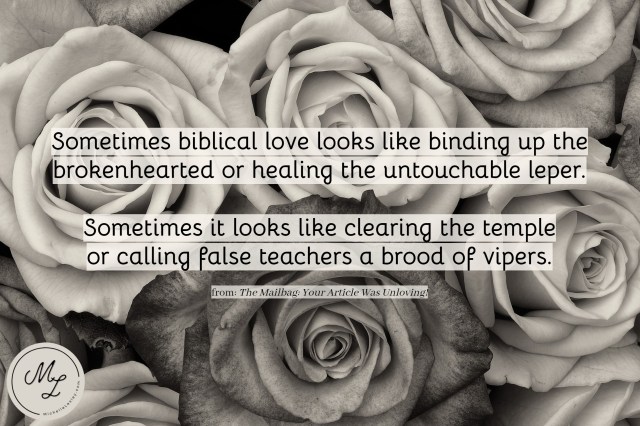
God defines love as cooperating with Him in rescuing the perishing, building up the church, and showcasing His glory. Sometimes that’s going to look like binding up the brokenhearted or healing the untouchable leper, and sometimes that’s going to look clearing the temple or calling false teachers a brood of vipers. While the world would call the former “loving” and the latter “hateful” based on what those behaviors look like, God calls both loving if they spring from a heart motivated to rescue, redeem, restore, and reconcile.

So, when you say I’m being “unloving” to use stringent language about false teachers (like God, Jesus, the prophets, and the apostles did), and I say you’re wrong, it’s because we’re using two different definitions of love. You’re using a worldly definition of love based on how pleasing my outward behavior was to you. I’m using God’s definition of love that’s based on the motivation of my heart. You cannot tell me I’m not demonstrating biblical love in a situation like this because you don’t know the motivation of my heart. I do. The article in question (like so many others about which I’m accused of being unloving) was motivated by love – God’s definition of love – for

  • Beth – that God would graciously remove the scales from her eyes and save her
  • Beth’s fans – that God would open their eyes to deception they’re believing and lead them to repentance and sound doctrine
  • Discerning Christians – that they might be encouraged not to let their guard down but to keep contending for the faith once for all delivered to saints
  • The church – that it would cleanse out the leaven of false teaching so that Christ might present her to Himself in splendor, without spot or wrinkle or any such thing, that she might be holy and without blemish.
  • and the Southern Baptist Convention – that it might forsake the idols of money, power, and celebrity, and return to its first love, Christ.

But it was also motivated by another component of love which the worldly definition of love, being worldly, is completely oblivious to. You see, the world’s definition of love only concerns itself with the “horizontal” love between one human being and another. But God’s definition of love finds its origin in Himself. He is the foundation and the culmination of love. He is both the starting gun and the finish line in the race of love. Where there is no vertical love of God, there is no horizontal love between people. There may be friendship, attraction, affection, attachment, and emotion, but there is no true love.

God’s definition of love finds its origin in Himself. Where there’s no vertical love of God, there is no horizontal love between people. So any biblical -rather than worldly- definition of love must start and finish with love for God.

And so any biblical – rather than worldly – definition of love must start and finish with love for God. Only a heart that loves Him because He first loved me can extend that same redemptive, restorative love to others.

And though I have never, and will never, this side of Glory, love Him as completely and perfectly as I should – as I want to – those articles that offend your sensibilities, that you feel justified in berating me about because they don’t meet your standards, those articles are rooted in and motivated by love for the Christ whom I serve. I would not continue to do what I do and take the abuse I take for it if I did not love Him.

I’ve heard this whole “tone police” perspective a million times. I’ve prayed about it. I’ve considered it. I’ve weighed the motivations of my heart. And in cases in which I know before the Lord that my motives have truly been unloving, I’ve repented. But the astronomically overwhelming majority of accusations I receive are not from people concerned with the biblical definition of love, but from people using a worldly definition of love whose personal sensibilities have been offended. People who wish to correct me from the authority and standard of their feelings, not from the authority and standard of God’s Word.

And as I’ve prayed, and studied, and weighed, and considered all of these things, the conclusion the Lord has graciously led me to is that there’s no way I will ever please every single one of the thousands of people who hear me. Just like Jesus’ words didn’t please all the people who heard Him, or John the Baptist’s words, or Peter’s, or Paul’s, or Noah’s, or Ezekiel’s, or Jeremiah’s, orโ€ฆ (you know, I’m starting to think I’m in good company!)

So rather than trying to please man, I’m going to strive to please God. If my conscience is clear before Him, that’s all that matters.

The fear of man lays a snare, but whoever trusts in the Lord is safe. Proverbs 29:25

For am I now seeking the approval of man, or of God? Or am I trying to please man? If I were still trying to please man, I would not be a servant of Christ. Galatians 1:10


Additional Resources:

Discernment: Whatโ€™s Love Got to Do with It?

Sacrificing Truth on the Altar of Tone

Pull over โ€“ itโ€™s the Tone Police at A Word Fitly Spoken


If you have a question about: a Bible passage, an aspect of theology, a current issue in Christianity, or how to biblically handle a family, life, or church situation, comment below (Iโ€™ll hold all questions in queue {unpublished} for a future edition of The Mailbag) or send me an e-mail or private message. If your question is chosen for publication, your anonymity will be protected.