Discernment, False Teachers

Is She a False Teacher? 7 Steps to Figuring it Out on Your Own

Oops, you’ve reached an old link. Sorry about that.
Please click here for the correct one.

Mailbag

The Mailbag: I’ve been asked to teach a Beth Moore study…

mailbag


I’m part of the women’s ministry leadership at my church. We did a Beth Moore study last year. A lot of things bothered me about it, but I kept my mouth shut because all of the women who participated loved the study. Now that I have read your article, and others, on the theological problems with Beth Moore, I understand why I had so many issues with the study. Today, I was given a copy of another Beth Moore book so that I could prepare to teach it in the fall. I can’t do it, and I feel like I’m the only one in my church who sees a problem with Beth Moore studies. How should I handle this situation?

I always want to be very careful about making definitive statements about how people should or shouldn’t handle specific scenarios with people I don’t know and circumstances I’m not familiar with. Instead, I’d like to share with you what I would do in a similar situation. I encourage you to think and pray about it and ask God to help you decide if this would be the wisest approach for your situation.

First, I would spend some serious time in prayer. I would pray for the the other members of the women’s ministry leadership, as well as my pastor and elders, and ask God to open their eyes to see, their minds to understand, and their hearts to embrace and desire biblical truth. I’d ask God to give me the wisdom to know how best to approach this situation and the right words to say. I would ask Him to make my motives pure, biblical, and loving.

Next, Iโ€™d gather the leaders group, or the main leader, or whichever people I felt were appropriate, and kindly, gently, and biblically explain the problems with Beth Moore. At some point before or after this meeting, the pastor or appropriate associate pastor or elders would need to be given a heads up as to what was going on.

Finally, I canโ€™t tell you how often I hear from women who say things like, โ€œMy church is offering six small group Bible studies right now and theyโ€™re all using book studies (Beth Moore, Priscilla Shirer, etc.). I just want to study the Bible itself, but they wonโ€™t offer a class that just studies the Bible.โ€ I would express that to the women’s ministry leadership during the meeting and, if they continued to insist on using a Beth Moore book, offer to teach a class on a book of the Bible as an alternative for women who might prefer studying the Bible itself. Churches usually like to be able to offer various options to their members.

I would also be prepared for strong opposition. While I would be hopeful that the women of my church would love Christ and His word more than they love Beth Moore, this, sadly, has not been my experience when dealing with diehard Beth Moore disciples. My experience has been that when you topple an idol, her worshipers will defend her at almost any cost.


If you have a question about:ย a well known Christian author/leader, a Bible passage, an aspect of theology, a current issue in Christianity, or how to biblically handle a family, life, or church situation, comment below (Iโ€™ll hold all questions in queue {unpublished} for a future edition of The Mailbag) or send me an e-mail or private message. If your question is chosen for publication, your anonymity will be protected


Discernment

Discernment: What’s Love Got to Do with It?

…so that we may no longer be children, tossed to and fro by the waves and carried about by every wind of doctrine, by human cunning, by craftiness in deceitful schemes. Rather, speaking the truth in love, we are to grow up in every way into him who is the head, into Christ…

Ephesians 4:14-15

Christians who know what discernment is have a variety of perspectives about how it should be practiced. Should we teach about false doctrine at all or just make sure our church is teaching sound doctrine? Should we name the names of false teachers or speak about them anonymously? Should we warn people away from false teachers or just pray for them privately? What’s the biblical precedent for using a stringent tone when speaking of those who teach false doctrine?

Recently, I’ve been thinking a lot about the phrase “speaking the truth in love” from Ephesians 4:15 as it pertains to speaking and writing about false doctrine and false teachers.

Many Christian women have the mistaken idea that “speaking the truth in love” equals being “nice.” We’re always smilingly sweet and never say anything that might hurt someone’s feelings or could rock the boat at church.

Many Christian women have the mistaken idea that “speaking the truth in love” equals being “nice.”

Are we to be kind? Yes. Are we to do our best not to hurt others? Of course. Should we be making waves over every little thing that rubs us the wrong way? Absolutely not. We are to deny ourselves, setting aside our personal preferences and, in many cases, even our own rights, to the point of laying down our lives for others.

We need to understand the distinction between personal preferences and biblical doctrine. We die *to* personal preferences. We die *for* the purity of biblical doctrine.

But we need to understand the distinction between personal preferences and biblical doctrine. And that’s where I think a lot of people get confused. We die to personal preferences. We die for the purity of biblical doctrine. The enemy is stealthily infiltrating and conquering church after church with false doctrine. We are at war. And that’s going to mean ruffling feathers, rocking the boat, and hurting feelings sometimes. Because the full armor of God doesn’t come with a white flag or a pen for signing peace treaties.

The full armor of God doesn’t come with a white flag or a pen for signing peace treaties.

But how do we war for the truth “in love”?

Well, think about the concept and practice of “love.” Love always has an object. We don’t just say, “I love.” We say, “I love my children,” or “I love peanut butter and chocolate ice cream.” Speaking the truth “in love” is not as much about our demeanor or tone of voice as it is about the object of our love. It’s our love for others that compels us to speak biblical truth. And it’s that same love for others that should drive the manner in which we speak the truth.

So when it comes to speaking the truth about false doctrine, how should we be motivated by love? And love for whom?

We love Christ– As Christians, our love for Christ should motivate everything we do. If we’re speaking truth from fleshly motives such as pride, the desire to make a name for ourselves, or the competitive drive to win an argument, everything we say can be 100% factually right and we can still be spiritually in the wrong because the motive of our heart is wrong. God isn’t a debate judge awarding us points for compelling arguments. God weighs the heart.

We love God’s Word– To love Christ is to love the Bible because Scripture is literally God Himself speaking to us. Besides the cleansing of the temple, the passage in which we see Jesus’ righteous anger displayed most clearly is Matthew 23. Here, Jesus delivers a scorching rebuke to the scribes and Pharisees for twisting God’s Word and, in doing so, leading people away from the truth of Scripture. It is only natural for those of us who have the mind of Christ and are indwelt by the Holy Spirit to have that same love for God’s word and feel righteous anger over the maligning of it.

We love the church– To love Christ is also to love His bride, the church. Christ gave his life to cleanse the church “so that he might present the church to himself in splendor, without spot or wrinkle or any such thing, that she might be holy and without blemish.” Seeing Christ’s bride blemished and corrupted by false doctrine should grieve us deeply and motivate us to call the church to be cleansed “by the washing of water with the Word.”

We love the captives– Paul speaks of false teachers “who creep into households and capture weak women.” Often, the women who follow false teachers simply don’t know any better. Though Scripture is clear that they’re complicit in their own captivity, they are casualties and prisoners of war held hostage by the enemy. We are to love them enough to show them the truth of God’s word so that “they may come to their senses and escape from the snare of the devil, after being captured by him to do his will.”

We love the enemyEvery Christian was at one time an enemy of the cross. Every last one of us. Until someone loved us enough to intervene with the truth of the gospel. False teachers – those who, despite biblical correction, unrepentantly teach doctrine which is plainly refuted by Scripture – have made themselves enemies of the cross, even if they call themselves “Christian,” even if they wear the title of “pastor,” even if they’re holding a Bible in their hands and refer to it occasionally as they “teach” us.

In the same way that a loving sister would not turn a blind eye and hope for the best if her sibling began using drugs and became increasingly addicted, it is not loving to stand idly by and allow false teachers to continue to sink deeper and deeper into Satan’s clutches by doing his bidding without making every effort to stop them in order to rescue them.

*It is not loving* to stand idly by and allow false teachers to continue to sink deeper and deeper into Satan’s clutches by doing his bidding without making every effort to stop them in order to rescue them.

Sometimes – just as with the drug abuser – this can be accomplished early on with a private word of correction. And sometimes – as with the addict – more extreme measures of “tough love” and intervention must be employed. But we always love them enough to desire that they come to repentance and embrace the truth.


Our love for these also drives the manner in which we speak truth to them. A good soldier would never deal with a civilian casualty in the same way he would fight off an enemy bent on waging war. Likewise, part of discernment is knowing who the enemy is (and is not) and dealing with people in a biblically appropriate way. This requires humility, wisdom, thorough proficiency with our tools and weapons, unceasing prayer, and complete dependence on and self-crucifying love for our King. We trust in Him and His Word to guide us in the wise and loving way to humbly speak His truth.

Discernment. Speaking truth. What’s love got to do with it?

Everything.

Wednesday's Word

Wednesday’s Word ~ Jeremiah 23

1937485_824377827603153_712723081626384146_n

Jeremiah 23:

โ€œWoe to the shepherds who destroy and scatter the sheep of my pasture!โ€ declares the Lord. 2 Therefore thus says the Lord, the God of Israel, concerning the shepherds who care for my people: โ€œYou have scattered my flock and have driven them away, and you have not attended to them. Behold, I will attend to you for your evil deeds, declares the Lord. 3 Then I will gather the remnant of my flock out of all the countries where I have driven them, and I will bring them back to their fold, and they shall be fruitful and multiply. 4 I will set shepherds over them who will care for them, and they shall fear no more, nor be dismayed, neither shall any be missing, declares the Lord.

5 โ€œBehold, the days are coming, declares the Lord, when I will raise up for David a righteous Branch, and he shall reign as king and deal wisely, and shall execute justice and righteousness in the land. 6 In his days Judah will be saved, and Israel will dwell securely. And this is the name by which he will be called: โ€˜The Lord is our righteousness.โ€™

7 โ€œTherefore, behold, the days are coming, declares the Lord, when they shall no longer say, โ€˜As the Lord lives who brought up the people of Israel out of the land of Egypt,โ€™ 8 but โ€˜As the Lord lives who brought up and led the offspring of the house of Israel out of the north country and out of all the countries where he had driven them.โ€™ Then they shall dwell in their own land.โ€

Lying Prophets
9 Concerning the prophets:

My heart is broken within me;
all my bones shake;
I am like a drunken man,
like a man overcome by wine,
because of the Lord
and because of his holy words.
10 For the land is full of adulterers;
because of the curse the land mourns,
and the pastures of the wilderness are dried up.
Their course is evil,
and their might is not right.
11 โ€œBoth prophet and priest are ungodly;
even in my house I have found their evil,
declares the Lord.
12 Therefore their way shall be to them
like slippery paths in the darkness,
into which they shall be driven and fall,
for I will bring disaster upon them
in the year of their punishment,
declares the Lord.
13 In the prophets of Samaria
I saw an unsavory thing:
they prophesied by Baal
and led my people Israel astray.
14 But in the prophets of Jerusalem
I have seen a horrible thing:
they commit adultery and walk in lies;
they strengthen the hands of evildoers,
so that no one turns from his evil;
all of them have become like Sodom to me,
and its inhabitants like Gomorrah.โ€
15 Therefore thus says the Lord of hosts concerning the prophets:
โ€œBehold, I will feed them with bitter food
and give them poisoned water to drink,
for from the prophets of Jerusalem
ungodliness has gone out into all the land.โ€

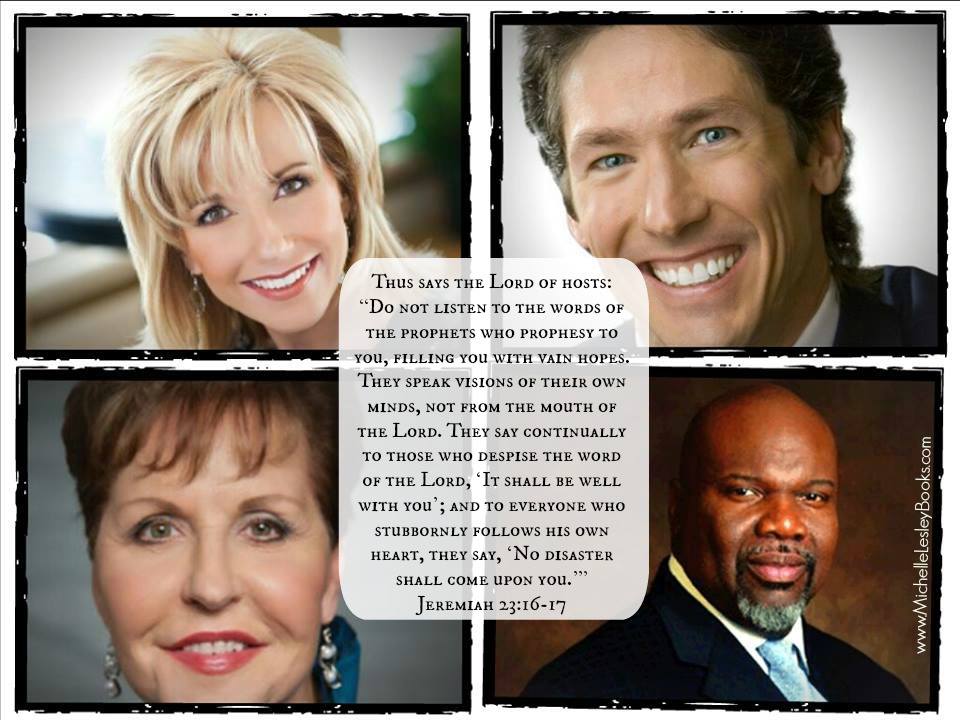
16 Thus says the Lord of hosts: โ€œDo not listen to the words of the prophets who prophesy to you, filling you with vain hopes. They speak visions of their own minds, not from the mouth of the Lord. 17 They say continually to those who despise the word of the Lord, โ€˜It shall be well with youโ€™; and to everyone who stubbornly follows his own heart, they say, โ€˜No disaster shall come upon you.โ€™โ€

18 For who among them has stood in the council of the Lord
to see and to hear his word,
or who has paid attention to his word and listened?
19 Behold, the storm of the Lord!
Wrath has gone forth,
a whirling tempest;
it will burst upon the head of the wicked.
20 The anger of the Lord will not turn back
until he has executed and accomplished
the intents of his heart.
In the latter days you will understand it clearly.

21 โ€œI did not send the prophets,
yet they ran;
I did not speak to them,
yet they prophesied.
22 But if they had stood in my council,
then they would have proclaimed my words to my people,
and they would have turned them from their evil way,
and from the evil of their deeds.

23 โ€œAm I a God at hand, declares the Lord, and not a God far away? 24 Can a man hide himself in secret places so that I cannot see him? declares the Lord. Do I not fill heaven and earth? declares the Lord. 25 I have heard what the prophets have said who prophesy lies in my name, saying, โ€˜I have dreamed, I have dreamed!โ€™ 26 How long shall there be lies in the heart of the prophets who prophesy lies, and who prophesy the deceit of their own heart, 27 who think to make my people forget my name by their dreams that they tell one another, even as their fathers forgot my name for Baal? 28 Let the prophet who has a dream tell the dream, but let him who has my word speak my word faithfully. What has straw in common with wheat? declares the Lord. 29 Is not my word like fire, declares the Lord, and like a hammer that breaks the rock in pieces? 30 Therefore, behold, I am against the prophets, declares the Lord, who steal my words from one another. 31 Behold, I am against the prophets, declares the Lord, who use their tongues and declare, โ€˜declares the Lord.โ€™ 32 Behold, I am against those who prophesy lying dreams, declares the Lord, and who tell them and lead my people astray by their lies and their recklessness, when I did not send them or charge them. So they do not profit this people at all, declares the Lord.

33 โ€œWhen one of this people, or a prophet or a priest asks you, โ€˜What is the burden of the Lord?โ€™ you shall say to them, โ€˜You are the burden, and I will cast you off, declares the Lord.โ€™ 34 And as for the prophet, priest, or one of the people who says, โ€˜The burden of the Lord,โ€™ I will punish that man and his household. 35 Thus shall you say, every one to his neighbor and every one to his brother, โ€˜What has the Lord answered?โ€™ or โ€˜What has the Lord spoken?โ€™ 36 But โ€˜the burden of the Lordโ€™ you shall mention no more, for the burden is every man’s own word, and you pervert the words of the living God, the Lord of hosts, our God. 37 Thus you shall say to the prophet, โ€˜What has the Lord answered you?โ€™ or โ€˜What has the Lord spoken?โ€™ 38 But if you say, โ€˜The burden of the Lord,โ€™ thus says the Lord, โ€˜Because you have said these words, โ€œThe burden of the Lord,โ€ when I sent to you, saying, โ€œYou shall not say, โ€˜The burden of the Lord,โ€™โ€ 39 therefore, behold, I will surely lift you up and cast you away from my presence, you and the city that I gave to you and your fathers. 40 And I will bring upon you everlasting reproach and perpetual shame, which shall not be forgotten.โ€™โ€


The Holy Bible, English Standard Version Copyright ยฉ 2001 by Crossway Bibles, a division of Good News Publishers.


Questions to Consider:

1. What is the purpose of theย bookย ofย Jeremiah? Which genre(s) of biblical literature (prophecy, epistle, narrative, wisdom, etc.) is the book of Jeremiah? What is the historical backdrop for this book?

2. Who are the “shepherds” in 1-4? Compare these shepherds to the “thieves and robbers,” “strangers,” and “hired hands” (false teachers), the gatekeeper (faithful pastors; also here), and the Good Shepherd (Jesus; also here) in John 10. What have they done that they should not have done? What have they failed to do that they should have done?

3. Who is “the righteous Branch” (5) and “the Lord is our righteousness” (6)?

4. How does this chapter of Jeremiah point us ahead to Jesus’ first and second coming? Take note of all of the instances in this chapter in which God says, “I will” do thus and so, such and such will happen, and “the days are coming when…”. Which of these things were accomplished in Jesus’ first coming, and which will be accomplished when He comes back?

5. Make a chart with the following columns and fill it out as you start at the beginning of chapter 23 and work your way through to the end:

False prophets characterized:

Things false prophets say:

How God says things should or will be:

God’s true word characterized:

God characterized:

God’s judgment on false prophets:

How God’s people should respond to false prophets:

Do you see any similarities between the false prophets of Jeremiah’s day and the false teachers of today? What do today’s false teachers promise and “prophesy”? Does God characterize today’s false teachers the same way as the false prophets of Jeremiah’s day, and will He judge them the same way? What should be our (the church, and individual Christians) response be to false teachers today?