Mailbag

The Mailbag: Potpourri (Sexual abuse, Feminism, Serpent seed doctrine…)

Welcome to another โ€œpotpourriโ€ edition ofย The Mailbag, where I give short(er) answers to several questions rather than a long answer to one question. I also like to take the opportunity in these potpourri editions to let new readers know about my comments/e-mail/messages policy. Iโ€™m not able to respond individually to most e-mails and messages, so here are someย helpful hintsย for getting your questions answered more quickly.ย Remember, the search bar can be a helpful tool!


Can you please suggest an iPhone app Radio station that plays biblically sound worship, praise and messages?

A reader asked this question via Facebook recently. I mostly listen to podcasts, and though I’m aware of a few good sermon apps, I wasn’t familiar with any apps that provide both sermons and music. I asked my Facebook readers for some help and got lots of great answers. You can check out their suggestionsย hereย (even if you’re not on Facebook). I’m not personally familiar with all of these sites and apps, so use good discernment and make sure everything they’re teaching lines up with Scripture.


Do you have advice on Christian women and feminism? I have friends who are reading Jesus Feminist. The title makes me cringe.

Secular feminism is not something I handle a whole lot here on the blog, although I have touched on it in these articles:

Toxic (Evangelical) Femininity

Feminist Infiltration and the Emasculation of Christianย Men

6 Reasons Godly Women are Stronger Thanย Feminazis


I would recommend that you head over to Sheologians. Summer and Joy have done several very good podcast episodes and articles on the history of feminism and its current influence on society and the church. I cannot remember whether they coveredย Jesus Feminist or not, so you may want to make use of the “contact us” link at the top of their site and ask. (Tell them I said hi!)


My husband and I are having sexual problems that stem from the fact that I was molested as a child. What should I do?

I have intentionally left out the specific details of this particular reader’s question, first, in order to protect her identity, second, because I have no doubt that many readers have this same general question, and third, because, being a stranger on the internet, I am not the person who can best help anyone in this situation, so I can only give a very general answer anyway.

I grieve with those of you who have had this terrible sin perpetrated against you. I hope the person who abused you was caught and prosecuted to the fullest extent of the law. It is also my prayer that God has taken what was meant for evil against you and used it for good in your life by drawing you to Himself, teaching you to depend on Him, and deepening your walk with Him.

As I mentioned, although I’m humbled and honored that readers sometimes reach out to me for help with staggering griefs and difficulties, I would be doing you a disservice if I tried to help you via e-mail or a blog article with complicated personal problems that require ongoing counseling from someone you have (or can develop) a face-to-face relationship with.

Generally speaking, it’s important that youย understand that, as a child, the abuse was not your fault, regardless of how you responded to it at the time. A physiological response (orgasm) to the abuse does not mean you enjoyed being violated, wanted it to happen, or were “asking for it”. Neither does having kept it a secret, being friendly with the abuser, “allowing” the abuse to continue in order to receive gifts from the abuser, etc. You were a victim.

It’s important that yourย husband understand that the sexual difficulties you are experiencing are no reflection on him. Sex is a very personal thing, and he may be incorrectly assuming that your aversion to sex is an aversion to his performance or to him, personally. He will also need to come to grips with the fact that there’s no quick, cut-and dried, three or five or fifteen step plan to “fixing” this. It will be a growth process for both of you.

Assuming you’re in a doctrinally sound church, I would urge you and your husband in the strongest possible terms to set up an appointment with your pastor for counseling. Shepherding your souls through life’s difficulties is part of his biblical job description, and if he went to a decent seminary, he was trained in marital counseling.

If you absolutely don’t think you could look your pastor in the eye during the sermon every week after discussing such personal matters, ask him for a referral to a certified biblical counselor (not a “Christian counselor” – biblical counseling, formerly called nouthetic counseling, is different) who can help you and your husband heal by learning and walking out in your marriage the Scriptures that apply to your situation. If your pastor isn’t familiar with biblical counseling, find a referral through theย Association of Certified Biblical Counselors, the counselor search linksย here, or contact a nearby (doctrinally sound) seminary or Christian university and ask if you can speak to someone in their school of biblical counseling.

I know it seems like it will be painful and embarrassing to discuss this situation with a third party, but don’t let it continue to fester. It will destroy your marriage. Getting biblical help will set you and your husband free.


What are your thoughts on a woman teaching an introductory class in biblical Greek to adults (men and women) at church?

Not knowing the context and spiritual climate of your church and assuming the class is taught in the same way other academic foreign language classes are taught – alphabet, vocabulary, grammar, etc. – I don’t see any more problem with it than if she were teaching French or Swahili or Chinese.

The biblical prohibition against women teaching men has to do with women instructing men in theย content of the Bible, not the language the Bible was originally written in. Greek is just a language like any other. It is not holy or special just because that’s the language the majority of the New Testament was penned in. (Actually, the opposite is true. Greek was the most widely spoken language of the time, so God used it to get His Word out to the largest number of people.)

Even if the teacher has the class translate portions of Scripture or uses a word or phrase from a Bible verse to illustrate the meaning of a word – assuming she doesn’t veer off into preaching on that verse – she is still teaching aย language, not giving Bible instruction to men in the way prohibited by Scripture.

As I said, I don’t know the context and spiritual climate of your church so there could be other factors along those lines that need to be taken into consideration as to whether or not it’s wise for a woman to teach this class, but strictly speaking as to whether or not it’s a violation of Scripture, no.


Do you have any teachings on the implications of the serpent seed doctrine?

No, I’ve never written about it because, until I was asked this question, I’d never heard of it.

I did a brief search, and I would say that the implications are racism, false doctrine, and poor hermeneutics. Apparently, the gist of this teaching is that when the serpent tempted Eve in the Garden of Eden, a sexual encounter took place between the two, leading to the conception of Cain. Therefore, everyone who is descended from Cain was conceived from the “serpent’s seed” and is of the devil.

This is a concoction of an evil imagination and has no basis in Scripture whatsoever. In fact, Genesis 4:1 clearly tells us who Cain’s father was. Even Cain’s name tells us Godย caused Eve to conceive him:

Now Adam knew Eve his wife, and she conceived and bore Cain, saying, โ€œI have gotten a man with the help of the Lord.โ€

I mean, that’s pretty much a mic drop moment with regard to this ridiculous “doctrine”.

Here are a couple of good resources explaining more:

What is the Serpent Seed doctrine?

The serpent seed and the Kenites


If you have a question about: a Bible passage, an aspect of theology, a current issue in Christianity, or how to biblically handle a family, life, or church situation, comment below (Iโ€™ll hold all questions in queue {unpublished} for a future edition ofย The Mailbag) or send me anย e-mail or private message. If your question is chosen for publication, your anonymity will be protected.


Mailbag

The Mailbag: Potpourri (Heretical church music, Mistranslating 1 Tim. 2:12, Books for women…)

Welcome to another โ€œpotpourriโ€ edition ofย The Mailbag, where I give short(er) answers to several questions rather than a long answer to one question. I also like to take the opportunity in these potpourri editions to let new readers know about my comments/e-mail/messages policy. Iโ€™m not able to respond individually to most e-mails and messages, so here are someย helpful hintsย for getting your questions answered more quickly.ย Remember, the search bar can be a helpful tool!


I need guidance in approaching the worship director of the church I started attending 6 months ago (haven’t joined yet) due to his frequent use of Bethel/Jesus Culture/Hillsong/Elevation Church music. I stand there in silence most of the worship time because I just donโ€™t feel comfortable singing those songs. I donโ€™t want to meet with him and be that person who is critical and legalistic but I feel convicted that someone needs to. Should I go talk to the pastor first (we have somewhat of a relationship since Iโ€™ve met with him a couple times and agree with his theology)?

It’s awesome that you are discerning enough to know that music from these heretical and New Apostolic Reformation organizations shouldn’t be used by any church. I encourage you to keep having those “powers of discernment trained by constant practice” of distinguishing good from evil (Hebrews 5:14).

I also want to encourage you that inquiring about the theology of a church or its music – especially as someone who is deciding whether or not to join that church – is not being “critical and legalistic”. That is what scoffersย say about discernment issues, but it is not theย biblicalย way of viewing “contending for the faith”. Do not allow ungodly people with their unbiblical personal opinions to deter you or even make you feel bad for doing what is right and good and godly.

I agree with you that someone needs to address the issue of the music. It is possible that’s why God put you into this church at this time – to pray for the church, the minister of music, and the pastor about this, and to lovingly explain the issues.

Since I’m not personally involved in the situation, I can’t offer any advice as to whether to approach the minister of music or the pastor first. I would suggest you pray and ask God to give you the wisdom to know which one of them to speak to first, and trust Him to direct your paths. You might want to consider which of these men you feel will be more receptive to what you have to say. If you go to the minister of music first and he brushes you off, I would encourage you to go to the pastor next. I think both of their responses will help you decide whether or not you want to join this church.

Here are some resources that may help:

The Mailbag: How should I approach my church leaders about a false teacher theyโ€™reย introducing?

Hillsongโ€™s Theology of Music andย Worship

The Mailbag: Should Christians listen to โ€œRecklessย Loveโ€?

Popular False Teachers (further information on Hillsong, Bethel, Jesus Culture, Steven Furtick)


A popular Christian apologist I follow says that the prohibition against women preaching, teaching Scripture to men, and holding authority over men in the church in 1 Timothy 2:12 is translated incorrectly.

I do not permit a woman to teach or to exercise authority over a man; rather, she is to remain quiet.

He says it should not be translated as “woman” and “man” “but as “wife” and “husband”, and that he believes Bible translators mainly translate it as man woman due to tradition (i.e. men have historically been the pastors and teachers in the church).

This is why linguists – professional experts in the biblical languages – are hired to translate Scripture, not apologists.

Bible translators (of reliable translations) are true to the text, not church tradition or personal convictions. Furthermore, when translators are working on the text, it is not a lone individual who writes down what he thinks the Greek words say and that’s the Bible you end up reading. There are teams of translators, linguists, editors, and even computer experts who work on the text. They check, and double check, each other’s work. So even if one translatorย was translating according to tradition or opinion, it would be caught by others and not allowed to slip through the cracks.

All of the most reliable English translations translate the words as “man” and “woman”, not “husband” and “wife”.

And just for kicks, I checked this verse in about a dozen of the less reliable translations, and every single one of them translates it “man” and “woman”. Even versions that got other parts of verse 12 incorrect still use “man” and “woman.” For goodness sake, evenย The Messageย andย The Passion “Translation” possibly the two worst English versions of the Bible (They’re not even translations.ย The Message is a paraphrase, written by someone who endorsed the heresy-laden bookย The Shack and has made statements affirming homosexuality. Andย Passion is the new New Apostolic Reformation version of the Bible, based, supposedly, on new revelation directly from God.) both say “man” and “woman”. And the NAR is totally OK with female preachers, so you know they’re not using “man” and “woman” due to tradition.

So we’ve got one apologist who’s of the opinion that it should be “husband” and “wife” against scads of translators who are experts in their fieldsย andย whack job NAR “translators” who approve of female pastors, who all use “man” and “woman”. You would thinkย someone out of all of those people would have translated it “husband” and “wife” if that was the correct translation. It’s telling that even “translators” who push the egalitarian agenda won’t go so far as to change it to “husband” and “wife”.ย I think the apologist is somewhat out of his depth here.

A few more quotes from said apologist:

Verse 11 and following is directed at women in the context of their relationship with a man to whom they are supposed to be entirely submissive. That is a marriage relationship…1 Timothy 2 talks about the relationship between husband and wife; itโ€™s chapter 3 that talks about church leadership.”

No, verse 11 is not directed at women. Neither are any of the other verses in chapter two or the rest of the book. First Timothy is a pastoral epistle. It was directed at Timothy by the Holy Spirit via Paul as sort of a “policy and procedure manual” for the church. This passage is not talking to women about their marriages, it is talking to pastors and elders about how to run the church. Verses 11-12 are talking about the role and behavior of women (all women, not just wives) in the church setting. They are not to instruct men in the Scriptures or exercise authority over men. Thatย  definitely “talks about church leadership” by excluding women from leadership roles that place them in authority over, or instructing, men.

And keep in mind that when 1 Timothy was written, there were no chapter and verse markings. The text was one continuous flow. If you begin reading in 2:11 and go through 3:13 (try reading it here, adjusting the settings to remover chapter and verse markings), I believe there’s a strong case to be made that 2:11-15 is actually theย introduction to the qualifications for pastors, elders, and deacons. The passage (2:11-3:13) starts by stating who is disqualified from those positions and whyย (2:11-15) and then moves on to who is qualified and how (3:1-13).

Furthermore, if you’ll take a look at verses 8-10ย of chapter two, which immediately precede the verses in question (11-12) and provide context, you’ll see more instructions to both men and women. Are only husbands to pray? Are only wives to dress modestly and respectably and adorn themselves with good works? What about single men and women, divorced men and women, widows and widowers?

No other place in Scripture teaches that all women should be under the authority of all men in the church. If this passage is to be interpreted the traditional way, this makes a new and unusual pattern of submission.

And this passage (1 Timothy 2:12) doesn’t teach that either. The statement that women are not to have authority over men doesn’t flip around to mean that all men are in authority over all women. That’s fallacious logic, silly reasoning, and patently unbiblical. The text says what it says and that’s it. You can’t turn it inside out and make an inference from an incorrect converse. That’s being a poor workman and mishandling Scripture.

It’s abundantly clear that “man” and “woman” are the correct translation in 1 Timothy 2:12. If anyone is being more loyal to an agenda than to the text here, it’s the apologist, not the translators.

Rock Your Role: Jill in the Pulpit (1 Timothyย 2:11-12)

I Know Greek, So That Verse Is Wrong!


What do you recommend as daily devotionals for children, ages 2 and 10? I am looking to start daily Bible time with the kids before we start school.

I don’t recommend “canned” Bible studies and devotionals, but rather teaching straight from Scripture itself. I’ve explained this more, including a few suggestions for teaching your children, in my articleย The Mailbag: Can you recommend a good Bible study for women/teens/kids?

If you’re looking at a 5-10 minute time frame, you might want to work your way through Proverbs one verse at a time, or possibly some of the shorter Psalms. I usually set aside a 30 minute block of time and read through a book with my boys one chapter a day, asking questions and explaining things along the way. If you’d like, feel free to use any of my studies at the “Bible Studies” tab at the top of this page, selecting and simplifying the questions you feel are most appropriate for your children.


How can I subscribe to your blog via e-mail?

If you’re on a computer, there’s a little box in the left sidebar where you can enter your e-mail address:

Inline image

I don’t know if your phone is the same as mine or not, but here’s what the e-mail sign-up on my phone looks like:

Inline image


I was wondering if you had a list of recommended books for women. I’m trying to offer an alternative to anย NAR book that has nice ideas and some good thoughts but also strays into Spiritual Formation and, of course, really off-base hermeneutics.ย 

I don’t really know of any off-hand along those lines that I would recommend. The problem with “Christian” books for women by women is that most of them contain false doctrine. A couple of suggestions:

1. The Bible. If you’re looking for a book with nice ideas and good thoughts, Psalms might be a good place to start. Getting grounded in God’s Word and digging deep into Scripture itself is the best way to guard your ladies against the false doctrine you’re describing.

2. There’s no reason women can’t read books authored by men. If you already have a particular doctrinally sound book in mind that was authored by a man, go right ahead and use that one. I would recommend any of the male authors under my “Recommended Bible Teachers” tab (as well as any of the female authors listed there). You might also find the kind of book you’re looking for at GTY or Ligonier.


If you have a question about: a Bible passage, an aspect of theology, a current issue in Christianity, or how to biblically handle a family, life, or church situation, comment below (Iโ€™ll hold all questions in queue {unpublished} for a future edition ofย The Mailbag) or send me anย e-mail or private message. If your question is chosen for publication, your anonymity will be protected.
Christian women, Complementarianism, Ministry, Sin

Women Preaching: It’s Not a Secondary Doctrinal Issue

When it comes to Christianity, are the specifics of what people believe important?

I think most of us would answer a resounding “yes” to that question. Of course, the various concepts we believe are important. You can’t just believe anything you like and still be a Christian. There are certain things you must believe in order to become a Christian at all, and there are certain things you will come to believe because you are a genuinely regenerated Christian. But what are those things, and how do we know which is which?

You can’t just believe anything you like and still be a Christian.

Maybe you’ve heard the terms “essential doctrines” or “primary, secondary, and tertiary theological issues” or “first, second, and third tier levels of doctrine”? For years, theologians have been attempting to organize beliefs of the Christian faith – all drawn from the Bible, naturally – into nice neat categories in order to make things a little simpler. As someone who thrives on organization and categories, I’m grateful for their efforts. But if you begin to study this categorization of beliefs, you’ll find that we haven’t reached an across the board consensus yet.

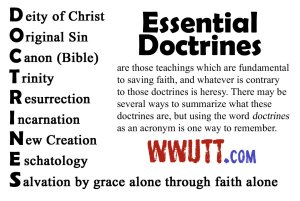
Generally speaking, “essential”, “primary”, or “first tier” doctrines are those which you, biblically, have to believe in order to become a Christian and/or be considered a Christian. For example:

โœข Sin is a thing, and I am a sinner.

โœข God exists and is the supreme authority of the universe.

โœข Jesus was God in human flesh.

โœข Jesus rose bodily from the grave.

See how this works? If you don’t believe you’re a sinner, you’re not saved. If you don’t believe in the bodily resurrection of Christ, you’re not saved. Here’s how our friend, Pastor Gabriel Hughes, briefly outlines essential doctrines:

(Gabe later tweaked the acrostic a little and added an “S”, which I think is helpful.)

The vast majority of brand new Christians have only the most basic understanding of most of these tenets at the moment of salvation. But it’s not an issue of fully understanding – or else we’d all have to be theologians in order to get saved – it’s an issue of believing. Someone who is genuinely regenerated may not completely understand how the Trinity works (honestly, no one does), but when she’s introduced to the biblical idea of the Trinity, she believes it, learns more about it, and does not reject it.

There is typically agreement among most reputable theologians regarding what constitutes first tier doctrine. Scripture is clear about these things, and several of these issues were settled long ago by the church fathers in assorted church councils (Nicea, Chalcedon, etc.)

Secondary issues are routinely defined as non-salvific but still extremely biblically important, if not quite as biblically clear-cut as primary issues. Doctrines surrounding baptism (credo versus paedo, affusion versus immersion), for example, are usually cited as a secondary issue. A disagreement on a secondary issue doesn’t mean one person is saved and another isn’t, but it normally prevents close partnership in ministry activities involving these issues. For example, my Presbyterian friends and I can join together in pro-life ministry, but we would most likely not plant a church together.

Tertiary issues are non-salvific, less immediately urgent, biblical issues in which the Bible is even less clear-cut and open to wider (yet still biblical) interpretation. These are issues over which Christians can disagree and still maintain close doctrinal fellowship, even in the same church, if they’re in agreement on first and second tier doctrine. Eschatology – the order and timing of events at Jesus’ second coming – is a doctrine that’s often considered third tier. Someone can hold a different eschatological view than mine, yet, for the most part, it shouldn’t affect our ability to worship together, work together, or participate in the ordinances together in the same church.

Some theologians add a fourth category – issues of adiaphora, conscience, or Christian liberty. Usually these are issues of much less importance that the Bible either doesn’t specifically address, or doesn’t give commands about one way or the other. Individual Christians may use biblical principles to inform their consciences and decide for themselves. These would be things like whether or not to take your child trick-or-treating or deciding whether to dress formally or casually for church.

While theologians are largely in agreement about primary doctrines, there is wider spread disagreement on which doctrines are secondary and tertiary (many consider eschatology to be a second tier doctrine, for example) and whether or not there is a need for a category of adiaphora, since such issues are normally not considered to be “doctrinal” issues. In fact, there’s enough space for disagreement that pastors and theologians often wisely refrain from making concrete lists of secondary and tertiary doctrines.

But when we’re talking about the different levels of doctrine, what you won’t find is questions like these: Is murder a first, second, or third tier doctrine? What about gossip? Rape? Adultery? Lying? Gluttony? Pride?

And it’s not because these issues aren’t important or because the Bible doesn’t address them. It’s because they’re in a different category from the other issues: the category of sin. They aren’t doctrines upon which salvation hinges, they aren’t open to interpretation, and the Bible is clear that we are absolutely not to do these things.

The category of doctrine deals with beliefs. The category of sin deals with behavior.

In 2005, Dr. Albert Mohler wrote an excellent article about the different levels of doctrine entitled A Call for Theological Triage and Christian Maturity. He carefully explains the importance of each level of doctrine and what it covers in a plea to keep each level’s urgency in its proper place of significance during discussion, debate, and decision-making.

It was a helpful article to which I always refer people who have questions about tiers of doctrine, and I agree with Dr. Mohler’s thoughts in the article wholeheartedly1 …except on one point:

“In recent years, the issue of women serving as pastors has emerged as another second-order issue.”

Women serving as pastors, women preaching, women teaching men Scripture, and women exercising authority over men in the gathering of the Body is not a secondary issue. Nor is it a primary or tertiary issue. It does not belong in the category of “doctrine” in the same way baptism and eschatology do. It belongs in the category of sin in the same way murder, gossip, and adultery do. Let’s take a look at the reasons for this.

Women serving as pastors, preaching, teaching men Scripture, and exercising authority over men in the gathering of the Body is *not* a secondary issue. Nor is it a primary or tertiary issue. It is a sin.

I do not permit a woman to teach or to exercise authority over a man; rather, she is to remain quiet. 1 Timothy 2:12

(The preponderance of Scripture supports and affirms this concept, so to keep things simple, we’ll use this verse as an exemplar.)

โœข The prohibition in 1 Timothy 2:12 is a clear command against a certain behavior. And when we behave in a way God has prohibited, that is called “sin”. All of the tenets in the three levels of doctrine are affirmative statements regarding beliefs (you must believe in the resurrection of Christ, we believe in baptism by immersion, etc.). None of them are commands, in the negative, against sinful behavior (Thou shalt not murder, I do not permit a woman to teach… etc.)

โœข Secondary and tertiary doctrines can be open – to varying degrees – to biblical interpretation. Every stripe of non-heretical eschatological thought can provide you with chapter and verse passages that can, depending on the angle from which you approach the subject, be biblically plausible and scripturally supported. There is no biblical support for anything God prohibits. No one can cite a properly handled, in context Bible verse in which God says, “It’s OK to commit adultery,” or “Women are allowed to preach.” There can be multiple views on a secondary or tertiary issue that can all be considered biblical, but there can only be one view of sin that is biblical.

โœข Differing beliefs on true secondary and tertiary issues are not sin. My Presbyterian friends have a different view of baptism than I do. That doesn’t mean either of us is sinning. I may think their interpretations of the verses they believe support paedo baptism are incorrect, but they are not breaking any of God’s commands. Differing behavior (again, we see the distinction between doctrinal belief and sinful behavior) on issues of sin is sin. If someone behaves differently from God’s command about lying, she is sinning. If a woman behaves differently from God’s command in 1 Timothy 2:12, she is sinning.

โœข Differing beliefs on secondary and tertiary issues are not born of disobedience and rebellion toward God. Usually, it’s quite the opposite. When someone has studied a theological issue enough to hold a particular position on it, it’s usually because she is striving to please God and to be biblical in her beliefs. Differing behavior on issues of sin is born out of disobedience and rebellion toward God. Someone who steals has already decided in her heart that her desires are better than God’s command. A woman who knowingly holds improper authority over men in her church is doing so because she has already decided to defy God’s clear command against such.

โœข Because different beliefs on secondary and tertiary issues are not born of rebellion and are not sin, they do not require church discipline. Sin does require church discipline. If someone in your church is openly dishonoring her parents, she is sinning and should be subject to church discipline. If a woman is pursuing a career as a pastor, she is sinning and should be subject to church discipline. 

Since the publication of Dr. Mohler’s article (and perhaps as a result of others teaching the same thing) the idea of the violation of 1 Timothy 2:12 being a “secondary doctrine” has spread in a most unhelpful way, leading many Christians to treat the issue in a c’est la vie, “We can just agree to disagree on this,” manner.

No, we cannot.

The idea of the violation of 1 Timothy 2:12 being a “secondary doctrine” has spread in a most unhelpful way, leading many Christians to think “We can just agree to disagree on this.”. No, we cannot.

We would not say, “We can agree to disagree,” on lying or adultery or homosexuality or abortion, and we cannot say it about women preaching, teaching men, or holding unbiblical authority, either. We disciple and teach a sister in Christ who is unaware of what the Bible says on these matters, and if she is committing any of these sins, we begin the process of church discipline. But it would not be loving toward her, or honoring God, to allow her to continue in biblical ignorance or in willful sin.

Furthermore, the violation of 1 Timothy 2:12 brings with it dangers to the church that true secondary and tertiary issues, and even many sins, do not…

The violation of 1 Timothy 2:12 brings with it dangers to the church that true secondary and tertiary issues, and even many sins, do notโ€ฆ

She may not say it with her lips, but when a woman preaches to men in defiance of Scripture, sheโ€™s teaching false doctrine through her behavior. What is the false doctrine sheโ€™s teaching? โ€œI donโ€™t have to obey Godโ€™s Word, and neither do you. If thereโ€™s a part of the Bible you donโ€™t like, youโ€™re free to disregard it.โ€ If your pastor stood up in the pulpit on Sunday morning and said that in words, youโ€™d run him out of town on a rail, and rightly so. Neither should a woman be able to teach that same false doctrine via her actions.

Additionally, I have mentioned several times when dealing with this issue that women preaching to men is highly correlated with women teaching other forms of false doctrine. I have researched scores of women teachers. Every single one of them who unrepentantly teaches men also teaches false doctrine in some other aspect of her theology (usually progressivism, Word of Faith, or New Apostolic Reformation). In other words, if a woman teaches men, you can just about take it to the bank that she also teaches additional false doctrine. False doctrine and heresy are infecting the church – via female preachers – at an alarming rate.

We dare not simply “agree to disagree” on this.

The violation of God’s command that women are not to instruct men in the Scriptures nor hold improper authority over men is a sin like any other. It is not a doctrinal issue in the same sense that other second and third tier doctrines are. If left undisciplined, however, it can lead to first tier doctrinal issues infiltrating a church and eventually destroying it. It is detrimental to the church to label and treat any sin as a secondary doctrinal issue.

Additional Resources

Is Women Preaching a Secondary Issue? on A Word Fitly Spoken

What Are Essentials and Non-Essentials? on A Word Fitly Spoken

Christian Liberty on A Word Fitly Spoken

The importance of Primary and Secondary Doctrines on the Truth Be Known Podcast


1In the years since 2018, when this article was originally written, Dr. Mohler has said, done, and supported various biblically questionable things, leading some to question whether or not he has “gone woke”. While I don’t support his stance on those questionable things, I also don’t believe he has reached the point at which I need to warn against him (although I don’t proactively recommend him, either). To my knowledge, at this time, he is still generally doctrinally sound.

Podcast Appearances

Theology. Driven. Podcast Guest Appearance: Beth Moore, the SBC, and Christian Women


I had an awesome time, recently, chatting with Kevin, Scott, and James from theย Theology. Driven. podcast. What an honor to be their first ever female guest! We covered a variety of topics: what to do if your church is hosting a Beth Moore study, my background in writing and teaching ministry, the Southern Baptist Convention’s slouching toward egalitarianism, studying the Bible without using Bible study books…and more!

Click here to listen.

Theology. Driven. is also offering a special giveaway in connection with my episode. If you tweet a link to the episode (or re-tweet a post about the episode such asย this one) and include the hashtagย #MichelleTheologyDriven, you’ll be entered into the drawing. Listen all the way to the end of the episode to find out all the details.

Give this episode a listen, and share it around! You can subscribe to Theology. Driven. on iTunes, Google Play, Overcast, and Podbean, or just listen online at theย Theology. Driven. websiteย (episode 27). And don’t forget to follow Theology. Driven. on Facebook and Twitter!

Resources mentioned on the podcast:

How should I approach my church leaders about a false teacher theyโ€™re introducing?

Five Reasons Itโ€™s Time to Start Exercising โ€œMooreโ€ Discernment

(Information on the theological problems with Beth Moore. For information on others, please see the “Popular False Teachers” tab at the top of this page.)

Is the SBCโ€™s Tent Big Enough for ALL Marginalized Christianย Women?

Speaking Engagement Information


Got a podcast of your own or have a podcasting friend who needs a guest? Need a speaker for a womenโ€™s conference or church event? Click the โ€œSpeaking Engagementsโ€ tab at the top of this page, drop me an e-mail, and letโ€™s chat!

Mailbag

The Mailbag: Potpourri (Michelle’s a money-grubber, Still small voice, Husband of one wife…)

Welcome to another โ€œpotpourriโ€ edition ofย The Mailbag, where I give short(er) answers to several questions rather than a long answer to one question. I also like to take the opportunity in these potpourri editions to let new readers know about my comments/e-mail/messages policy. Iโ€™m not able to respond individually to most e-mails and messages, so here are someย helpful hintsย for getting your questions answered more quickly.ย Remember, the search bar can be a helpful tool!


Michelle, you’ve mentioned that your husband is previously divorced and also that he is a minister of music. How can this be? Isn’t he disobeying Scripture’s instruction that a pastor is to be “the husband of one wife“? Don’t you believe the Bible? Do you follow it? If so how do you justify your husbandโ€™s role in the church when compared to 1 Timothy 3?

Yes, of course, I believe and follow the Bible. I believe and follow theย rightly handled, in context, written Word of God, not popular misunderstandings of certain passages.

(And by the way, asking a fellow Believer a question like “Don’t you believe/follow the Bible?” in an accusatory way is rude and inflammatory.ย Furthermore, while I am happy to answer polite questions, it is not incumbent upon me to “justify” myself or my husband to whatever stranger might have the temerity to demand that I do so.

Rudeness and ugliness from people who call themselves Christians seems to have hit epidemic proportions. I’m going to be addressing it more frequently. Let’s play nice, folks.)

I have previously written about the “husband of one wife” clause in the 1 Timothy 3/Titus 1 qualifications for elders in my Mailbag articleย “Can a divorced man be a pastor?”

For a number of reasons, it would be inappropriate for me to go into the details of my husband’s divorce in a public forum like this, but you may rest assured that we have not been living in sin for the past 25 years, and that we have been up front about his divorce with the search committee of every church he has ever interviewed with. There are some churches who have a policy of refusing to consider for ministry positions anyone who has ever been divorced. Though we personally disagree with those types of policies (based on the biblical reasons in the article cited above), we certainly respect each church’s right to set its own hiring policies and have been grateful to the churches that have disclosed their policies from the outset.


I recently discovered your blog and am enjoying looking around and reading your posts. I do wonder at your use of your blog for promoting your own gain, your option to donate, and the near complete aligning of oneโ€™s salvation with the allegiance to a physical church organization. I wonder if you can share Bible verses that support both of those things?

“Promoting my own gain”? I think you might need to look around and read some more. All of my blog content is available for free, including the Bible studies I write and allow individuals and churches to print out and use free of charge.ย I don’t keep any content behind a paywall (such as Patreon) or charge any sort of subscription fee. I don’t sell any books, materials, or other merchandise. I don’t receive any remuneration from the ads that appear on my blog.ย My blog isn’t sponsored by any organizations. And, I don’t receive any sort of salary for writing this blog. How is that “promoting my own gain”?

There are only two instances in which I receive money for anything in connection with this ministry:

1. When kind and generous readers take it upon themselves to send me a gift through myย Financial Support page (I rarely mention this giving option, and I have neverย asked readers to send me money.). Few do, though I deeply appreciate the blessing those folks have been to my family. Most of the gifts I receive go toward paying household bills. (And when I say “bills” I mean electricity, water, rent, etc. I don’t have an extravagant wardrobe, a fancy car, or take luxury vacations.)

2. When I do a speaking engagement. If I could afford toย do these events for free, I would. I can’t. As you no doubt read at the Financial Support tab “my family lives frugally on one modest income.” We can rarely afford to go out to eat, never mind afford for me to drive or fly hundreds of miles from home, spend several days away from taking care of my family, and pay for food and lodging once I get there. Additionally, it takes dozens ofย hours to properly prepare speaking engagement material, and it isย work.ย I usually don’t do more than a few of these a year, and, so far, I haven’t spoken at any huge churches that can afford to pay me thousands of dollars. This money also usually goes towards bills.

It is absolutely Scripturally appropriate for me or any other Christian to receive financial gifts or compensation in these two instances. (Click on the words in red for related Scriptures.)

The first situation is the giving of a gift. The money I receive from time to time is not expected, asked for, owed, or required.ย Jesusย received monetary gifts. The early church gave financial gifts to Christians in need. The Philippians sent Paul gifts more than once. The Corinthian and Galatian Believers sent financial gifts to the church in Jerusalem. You give people gifts. I give people gifts. Christians give each other gifts.

The second situation is a) payment for work, and b) support of ministry. Jesus didn’t have a secular job. He received financial support of His earthly ministry. First Corinthians 9ย and 1 Timothy 5:17-18 are abundantly clear that “those who proclaim the gospel should get their living by the gospel.” Proverbs 31ย speaks of the wife and mother who crafts various things and sells them to bring in extra money for her household. My craft is writing and speaking. This is how I help bring in extra money for my household. These Scriptures are also why it would be completely fine for me to sell books, utilize Patreon, charge subscription fees, receive money from ads and sponsorships and any of the other things I mentioned in the first paragraph,ย just as it is fine for most other Christian bloggers and ministries who do.

Another excellent resource on this topic is Daniel Darling’s article No, All Christian Content Shouldn’t Be Free.

As to “the near complete aligning of oneโ€™s salvation with the allegiance to a physical church organization”, first of all, I’m not entirely clear on what you mean by that, but the New Testament couldn’t be plainer that Christians are to be joined to a local church and that one of the first signs that someone isn’t a Christian is when she leaves or refuses to be part of the church. I’ve covered this thoroughly, including the relevant Scriptures, in my articleย Basic Training: 7 Reasons Church is Not Optional and Non-Negotiable for Christians.


Our churchโ€™s womenโ€™s Bible study is using Priscilla Shirerโ€™s content (The Armor of God). I looked at your blog, but didnโ€™t find too many quotes from Shirer that I could use to draw an appropriate conclusion.ย 

Occasionally I will get this question from readers: “I know youโ€™ve written an article saying that _____ is a false teacher, but what about [this particular book she wrote]? Is it OK for me/our church to study?”

It seems like your question might be along those lines. I’ve answered it in this Mailbag article.ย 

Priscilla Shirer is a false teacher (see my articleย Going Beyond Scripture: Why Itโ€™s Time to Say Good-Bye to Priscilla Shirer and Going Beyond Ministries). The way Scripture instructs us to deal with false teachers is to avoid the person entirely, which would includeย all of her materials, merchandise, etc. This is not only the biblical way to do things, it is much less time-consuming than sifting through quotes from her books to find out if any of them might be passable for use in your church.

If your church is using Priscilla Shirer materials, you may also find my articleย How should I approach my church leaders about a false teacher theyโ€™re introducing?ย to be helpful.


I recently posted on Facebook about how Christians are easily fooled by the false teaching that God speaks to certain people. Someone commented, โ€œDonโ€™t discount the still small voice of the Holy Spirit who calls, guides, instructs, comforts.โ€. I have searched the Bible and I havenโ€™t found any verses confirming or refuting this statement. Can you shed some light on that thought? Is it in line with Scripture or is it more false verbiage that has encroached on the church?

I think the person who commented proved the point of your Facebook post. Is it “in line with Scripture”? “More false verbiage”? Yes and no.

Usually, when I see the phrase “the still, small voice” of the Holy Spirit,ย if the person using the phrase even knows she’s alluding to Scripture (many are just parroting what they think is a catch-phrase from pop-evangelicalism), it is based on a misunderstanding, or deliberate twisting, of 1 Kings 19:12:

And he said, โ€œGo out and stand on the mount before the Lord.โ€ And behold, the Lord passed by, and a great and strong wind tore the mountains and broke in pieces the rocks before the Lord, but the Lord was not in the wind. And after the wind an earthquake, but the Lord was not in the earthquake. 12 And after the earthquake a fire, but the Lord was not in the fire. And after the fire the sound of a low whisper. 13 And when Elijah heard it, he wrapped his face in his cloak and went out and stood at the entrance of the cave.
1 Kings 19:11-13

This is God talking to Elijah. (The King James Version translates the blue phrase in verse 12 as “a still, small voice”). It was normal for God to talk to Elijah. He was an Old Testament prophet.

You’ll notice that this is aย descriptive passage, not aย prescriptive passage (more on that here). That means it’s simply a passage telling us what happened withย Elijah at that moment. This passage doesn’t promise, imply, or even hint that God will speak to you, me, or anybody else in the same way. It’s just a report of what happened.

(Just an aside, but isn’t it interesting that people take descriptive passages like this and assume that God will speak to them the same way He spoke to Elijah, but no one ever reads about God turning Lot’s wife into a pillar of salt, God sending a whale to swallow a disobedient Jonah, or God causing the ground to open up and swallow the rebellious Korah, Dathan, and Abiram, and assumes God will do the same to them? No, we only want the good stuff!)

God does not speak this way to people any more. He speaks to us through His written Word. And who is the author of Scripture, God’s written Word? Second Timothy 3:16 tells us it is the Holy Spirit. So if you want the Holy Spirit to “speak to you in a still small voice,”ย read your Bible.ย I’ve covered this topic in greater detail in my articleย Basic Training: The Bible Is Sufficient. You may also find this resource from John MacArthur to be helpful:ย Does God give us personal direction through a still small voice?


I just wanted to drop you a quick note and tell you how much I am enjoying your study of Mark. I have been praying a lot about exactly HOW to study the Bible on my own. I love MacArthur’s method of reading the OT in a year and a book of the NT each month, but when I’d sit down to read great portions of Scripture, I didn’t have a solid grasp of what I’d just read. This month I knew it was time to start in another gospel and I decided to use your Bible study to help. Your method and questions are just right! Turns out, it’s better for me to slow down and really dig into a smaller number of verses at one time rather than digesting a great number of chapters in one sitting. And the result? I’ve been so excited about what I’m learning and often mull over throughout the day what the Holy Spirit is teaching me through His Word. Thank you for sharing these studies so selflessly! Truly, I am blessed! Indeed, your whole site is an encouragement to fight the good fight; I am grateful for you!

I get encouraging little e-mails, messages, and blog/social media comments like this all the time. And I wouldn’t trade them for all the money in the world. It thrills me beyond words to hear about Christian women who are growing in the grace and knowledge of Christ, digging into His Word, growing in discernment, and serving their families and churches.

And when I get to be a tool in God’s hands to help a sister with that in some small way, it absolutely astounds me and humbles me beyond words. Christ is soย good and soย kind to allow us the honor and joy of serving Him by helping others, whether that’s a sister in Christ, our husbands, our children, a co-worker, or a neighbor.

Thanks so much, truly, to all of you who have ever written me a little note of encouragement. It will one day be my joy to lay all of those e-mails and comments at the feet of my precious Jesus as a fragrant offering. All of this has always been…and will always be…all for Him.

(If you’d like to try one of my Bible studies or learn more about how to study the Bible for yourself, click the “Bible Studies” tab at the top of this page.


If you have a question about: a Bible passage, an aspect of theology, a current issue in Christianity, or how to biblically handle a family, life, or church situation, comment below (Iโ€™ll hold all questions in queue {unpublished} for a future edition ofย The Mailbag) or send me anย e-mail or private message. If your question is chosen for publication, your anonymity will be protected.