Holidays (Other), New Year's

Sanctification Over Resolutions: 6 Ways God Could Sanctify You in the New Year

Originally published January 1, 2018

Happy New Year!

There’s just something about the beginning of a new year that brings with it a yen for getting a fresh start. We think back over the past year, evaluate what we’ve spent our time and efforts on – or what we should have spent our time and efforts on – and, invariably, there’s a desire to make this year better.

Lots of people make lots of resolutions on January 1: to lose weight, to stop smoking, to exercise more. And by mid-February, some 80% of those people will have failed and given up on their resolutions.ยน Why? Partly because (statistically speaking) most of those people are lost and the flesh is exceedingly hard to tame by sheer “pull yourself up by your own bootstraps” willpower. Even Holy Spirit-indwelt Believers can testify to the pull of the flesh.

Should we, as Christians make New Year’s resolutions? Is it OK to set a goal to get a certain area of our lives under better control? Sure, there’s nothing wrong with that. But, is it possible there’s a bigger picture we need to take a look at?

Should we, as Christians make New Year’s resolutions? Sure, there’s nothing wrong with that. But, is it possible there’s a bigger picture we need to take a look at?

The Christian life is not one of putting out fires via resolutions. We don’t tackle one problem, get it under control and then move on to each of the other five problems that popped up while we were working on the first one. It’s more like fire prevention. We get up every day and hose down the house and yard by resting in Christ, communing with Him through prayer and the Word, and seeking to obey Him throughout the day. Sanctification is not mainly reactive, it’s proactive. And it doesn’t come by our own outward effort and striving, but by Christ growing us, changing our hearts, and enabling us to obey Him from the inside out.

Sanctification is not mainly reactive, it’s proactive.

And guess what? Along the way as Christ is conforming you to His image, you’re going to fail. You’re going to give in to temptation, and you’re going to sin against your Master. But here’s what biblical sanctification offers you that New Year’s resolutions cruelly withhold:

If we confess our sins, he is faithful and just to forgive us our sins and to cleanse us from all unrighteousness. 1 John 1:9

The steadfast love of the Lord never ceases;
his mercies never come to an end;
they are new every morning;
great is your faithfulness.
Lamentations 3:22-23

You don’t just get a fresh start once a year. You get a fresh start every time you confess your sin, repent, and receive Christ’s cleansing and forgiveness. You get the mercy of Christ, the grace of God, and the empowerment of the Holy Spirit to move forward in submission to God’s Word. You get the steadfast, never ceasing love of the Father who is out for your good rather than the unfeeling “do more, try harder, be better” taskmaster of New Year’s resolutions.

So, bearing all that in mind, how might God be trying to grow you in Christlikeness this year? What are some ways you can get up each day and proactively rest in, and obey Christ? Let’s prayerfully consider the following aspects of our walk and ask God to sanctify us and help us submit our will to His as we follow Him in this new year.

Growing in the Word

1. Daily personal Bible study. Do you set aside daily time for the personal study of God’s Word? Have you ever read the Bible from cover to cover? Have you considered, maybe just for this year, putting away all of the Bible study books and materials authored by others and using only the Bible during the next 365 days of your personal study time? Evaluate your daily time in God’s Word. Here are some resources you might find helpful:

๐Ÿ“–ย Bible Study Resourcesย (how to study the Bible)
๐Ÿ“–ย Bible Studies
๐Ÿ“–ย Bible Reading Plans for the New Year- 2026
๐Ÿ“–ย Youโ€™re Not as Dumb as You Think You Are: Five Reasons to Put Down that Devotional and Pick Up the Actual Bible

2. Scripture memorization. This is something God got a hold of me about several years ago. It’s important to store up God’s Word in our hearts as a weapon against temptation, for comfort, for prayer, and to encourage others. Try starting with verses you’re already somewhat familiar with. Many find it easier to memorize Scripture in song form, or by typing it out. If your pastor is preaching through a certain book, memorize a verse or passage out of each chapter as he comes to it. I’ve found it helpful to recite my verses in my head in bed at night. It helps me fall asleep faster, and there’s actually research that shows retention is improved if you study right before bed.

๐Ÿง  Scripture Memory with Susan Heck at A Word Fitly Spoken

Growth In Prayer

3. Daily prayer time. Of course we should be talking to the Lord throughout the day as we go about the routine of life and work, but that’s not a substitute for having a daily block of time set aside for focusing all of our attention on communicating with God. Jesus set this example for us, and we should follow it. Do you have a daily time of prayer? Do you know how to pray in a way that’s pleasing to God and helps you grow in Christ?

๐Ÿ™ Prayer
๐Ÿ™ After this Manner Therefore Pray
๐Ÿ™ Basic Training: 8 Things You Need to Know about Prayer
๐Ÿ™ Sweet Hour of Prayer (Bible study on prayer)

Growth in the Body of Christ

4. If you don’t have a solid church, find one. Physically gathering with the Body of Christ for worship, teaching, fellowship, prayer, baptism, the Lord’s Supper, giving, serving – and so much more – is not optional. It’s vital to your growth in Christ.

โ›ช Basic Training: 7 Reasons Church is Not Optional and Non-Negotiable for Christians
โ›ช Six Ways Not to Forsake the Assembly
โ›ช Searching for a new church?

5. Faithful church attendance. At a minimum, Christians should be at Sunday morning worship and Sunday School/Bible study class/small group every week unless Providentially hindered (circumstances beyond your control: illness, emergency, the rare out of town trip, occasionally having to work). That’s not legalism, that’s loving the Bride of Christ and having your priorities in line with Scripture. Contrary to popular metrics, habitually missing Sunday worship twice or more a month (when you could be there if you made it a priority) is not faithful attendance. If you’re lackadaisical in church attendance, examine your heart. What’s going on in your spiritual life that’s keeping you from wanting to gather with your brothers and sisters in Christ? (And if it’s a problem with the church itself, see #4.)

6. Don’t just “go to church,” invest yourself in it. Are you serving your church in some capacity? Do you regularly and fervently pray for your church, your fellow church members, and your pastors, elders, and teachers? Have you poured yourself into personal relationships with others at church for fellowship, care, and discipling? Do you regularly, sacrificially, and joyfully give offerings? Are you sharing the gospel with the lost? As with anything else, you get out of it what you put into it. God loves you and wants you to invest yourself in His Bride for His glory and for your joy.

โ›ช The Servanthood Survey
โ›ช Let Me Count the Ways: 75 Ways Women Can Biblically Minister to Others
โ›ช Servanthood
โ›ช Top 10 Ways to Pray for Your Pastor
โ›ช To Tithe or Not to Titheโ€ฆ
โ›ช Evangelism

How might God want to conform you more to the image of Christ this year? Could it be in one of these areas? Maybe another area? New Year’s resolutions are often about how you want to shape your life. Sanctification is about how God wants to shape your life. Not just for the new year, but for eternity.

New Year’s resolutions are often about how you want to shape your life. Sanctification is about how God wants to shape your life. Not just for the new year, but for eternity.


ยนLuciani, Joseph. “Why 80 Percent of New Year’s Resolutions Fail.” U.S. News & World Report. December 29, 2015. Web. December 29, 2017.
Mailbag, Worship

The Mailbag: Potpourri (Judas in Hell?… Dementia & submission… Supporting Israel… Replace the sermon with ___?)

Welcome to another โ€œpotpourriโ€ edition of The Mailbag, where I give short(er) answers to several questions rather than a long answer to one question.

I like to take the opportunity in these potpourri editions to let new readers know about my comments/e-mail/messages policy. Iโ€™m not able to respond individually to most e-mails and messages, so here are some helpful hints for getting your questions answered more quickly. Remember, the search bar (at the very bottom of each page) can be a helpful tool!

Or maybe I answered your question already? Check out my article The Mailbag: Top 10 FAQs to see if your question has been answered and to get some helpful resources.


Did Judas go to Hell when he died?

Although there is no Bible verse that says verbatim, โ€œJudas died and went to Hell,โ€ and we always have to be very careful with speculating, I believe we can safely infer from two passages (and their surrounding contexts) that Judas is, indeed in Hell.

The first passage is Matthew 26:20-25. This is the scene at the Last Supper when Jesus has just told the disciples that one of them (Judas) will betray Him. He says about His betrayer in verse 24, โ€œwoe to that man by whom the Son of Man is betrayed! It would have been better for that man if he had not been born.โ€ โ€œWoe,โ€ and โ€œbetter if he had not been born,โ€ are not phraseology anyone, let alone omniscient Jesus, would use to describe someone who would be entering Heaven mere hours later.

The second passage is John 17, Jesusโ€™ high priestly prayer for His disciples just prior to His crucifixion. In verse 12, Jesus says, โ€œnot one of them perished but the son of perdition,โ€ referring to Judas. Again, Jesus knows Judasโ€™ death is only hours away. He also knows whether Judas will be in Heaven or Hell afterward. If Jesus knew Judas would be in Heaven, why would He call him โ€œthe son of perditionโ€? Furthermore, the Greek word translated “perdition” or in other Bible translations, “destruction,” is apoleia. This word can carry the connotation, โ€œdamnable,โ€ and โ€œthe destruction which consists of eternal misery in Hellโ€ (Strongs, G684).

So, yes, Scripture indicates that Judas is spending eternity in hell.

Additional Resources:

Was Judas Iscariot forgiven / saved? at Got Questions?

Did Judas repent? by John MacArthur


This question was submitted in response to my article The Mailbag: What Is Submission?

My cousin’s (a professing Christian) husband has Alzheimerโ€™s, and his mental state has gone downhill very quickly (she is 59 and he is 77.) At one point in the conversation, she mentioned all the responsibilities sheโ€™s taken on that he used to handle, and said that she was now the head of the household. Iโ€™m wondering if any Biblical texts address a wifeโ€™s role in that situation.

My heart goes out to your cousin. Alzheimer’s Disease and other forms of dementia are such cruel conditions, both for the patient and his or her loved ones.

There is nothing in the Bible that specifically addresses caring for a spouse with dementia or any other mental incapacitation, or what a wife’s submission to her husband might look like in that situation.

I think what your cousin probably meant by her remark about being “head of the household” is that she now has to take over all of the family “business” responsibilities her husband used to handle: paying the bills, getting things around the house fixed, handling legal paperwork and taxes, making decisions, and so on. And, sadly, her husband is also not able to lead her in Bible study, prayer, and spiritual matters, so she’s having to handle that as well.

These are all things she would immediately have to take over and handle if her husband suddenly dropped dead of a heart attack, and we wouldn’t think a thing of it.

What’s happening to your cousin’s husband is a slow death. His body isn’t dying all at once, but day by day, bit by bit. So, she’s gradually taking over the things his body has died to and is unable to handle any more. And, biblically, that’s not just OK, that is being a faithful, godly helper.

If she came to me for counsel, I’d advise her to keep doing what she’s doing. If her husband has moments of lucidity in which she can tell he’s making a reasonable decision or request, she should certainly submit to that. If her husband made non-sinful decisions before he became ill, she should continue to submit to and carry out those decisions*. But otherwise, she should continue to love and serve him the best she can, and that includes gradually taking over what he can no longer do.

*(Thank you to “hiltonjp5c174e0fe6” for her comment below on 10/8/25, which reminded me of this.)


Are Christian Americans ALWAYS supposed to back Israel? The people of Israel now may not even be Jesus believing Christians or even God believing Jews. Should we support everything they say and do, just because they live in the country? Iโ€™m not implying anything, one way or another, but it seems a lot of Christians say, โ€œwe back Israel so we will be blessedโ€ and it sometimes seems like a blind backing.

Much has been written and said in the last hundred years or so about Israel, eschatology, end times prophecy, and so on, but sometimes it gets a little complicated and convoluted. I think there might be a simpler way to look at things.

First, I would have to ask: What does it mean for a Christian individual in 2025, who’s not a politician or a pastor, to “back Israel”? What does that look like in your daily life? Posting supportive things about Israel on social media? Voting for politicians who promise to create legislation and policies that are favorable to Israel? Those are really the only things I can think of. You and I have no power to do anything substantive to “back Israel” in our day to day lives, so this question is mostly moot for the majority of us as individuals.

Second, Christians handle and evaluate situations according to Scripture as they come up. If an issue comes up with Israel, we look at it biblically:

Did Israel’s government make a decision that the Bible clearly says is sin? Christians can’t support that. God certainly has never supported Israel’s sin just because they’re Israel. Just take a gander at how He responded to Israel’s sin in the Old Testament. He sent diseases, natural disasters, the armies of pagan nations to attack them, and finally exiled them for 70 years. In Jeremiah 7, God essentially tells them they can’t go out and commit a bunch of abominations and then expect Him to deliver them.

Did Israel’s government make a decision that doesn’t conflict with God’s commands or biblical principles? Then we evaluate the wisdom of it according to Scripture, and we have the freedom in Christ to support or not support that decision (whatever that might mean) accordingly.


Iโ€™m curious if replacing the preaching of Godโ€™s Word on the Lordโ€™s Day during the morning worship service with a gospel music concert or a VBS commencement is biblically appropriate and/or considered to be our worship of Him? I am seeing a doctrinal shift toward the progressive left in some areas of my local church, and Iโ€™m burdened and heartbroken as I pray for God to make clear what I perceive as concerns and how I can glorify Him in this matter.

I’m so sorry. I know firsthand what it’s like to be in a good church that goes bad. It is heartbreaking and stressful.

Scripture doesn’t give us a line by line order of service to follow for the worship service, but that doesn’t mean anything goes, either. Typically, churches follow either the regulative principle of worship (RPW) or the normative principle of worship (NPW). The NPW is the idea that we can do anything in the worship service that isn’t prohibited in Scripture. The RPW basically says that we are only to do things in the worship service that are prescribed in Scripture: preaching the Word, worshiping God through song, praying, giving offerings, and so on.

Now, you’ll notice that God commands both the preaching of the Word and singing in His church, but He doesn’t specify how much time we’re to devote to each. However, when we look at the overall picture of the church that the New Testament presents, it’s easy to see that the preaching and teaching of the Word should be central as a general rule.

That being said, it is my opinion that it’s perfectly OK for a doctrinally sound church to occasionally (maybe a couple of times a year) have a service in which the music portion of the worship service is longer than the preaching portion, as long as the Word is being proclaimed through the music.

For example, my church usually holds a worship service a couple of weeks before Christmas called “Lessons and Carols”. Scriptures pertaining to Christ’s incarnation are alternated with Christmas carols and hymns that echo those Scriptures. That takes up most of the service. At the end, my pastor gives a briefer than normal gospel presentation / sermon.

I think something like that or a Christmas or Easter cantata is fine.

I would not agree that it would be appropriate to replace the sermon with a “gospel music concert” (if, by that, you mean a singer/group comes in and gives a performance) or a VBS commencement, to the exclusion of the sermon. Neither a concert-style performance nor a commencement program are elements of worship prescribed in Scripture. And if you’re seeing other doctrinal problems alongside these things, it’s probably indicative of the overall declining spiritual health of your church. Time to make an appointment with the pastor, and kindly and lovingly express your concerns.

I pray your pastor will listen, and I hope you won’t need this, but just in case you do, you can always find the Searching for a new church? tab in the blue menu bar at the top of this page.


If you have a question about: a Bible passage, an aspect of theology, a current issue in Christianity, or how to biblically handle a family, life, or church situation, comment below (Iโ€™ll hold all questions in queue {unpublished} for a future edition of The Mailbag) or send me an e-mail or private message. If your question is chosen for publication, your anonymity will be protected.

Christian women, Complementarianism, Ministry, Sin

Women Preaching: It’s Not a Secondary Doctrinal Issue

Originally published August 3, 2018

When it comes to Christianity, are the specifics of what people believe important?

I think most of us would answer a resounding “yes” to that question. Of course, the various concepts we believe are important. You can’t just believe anything you like and still be a Christian. There are certain things you must believe in order to become a Christian at all, and there are certain things you will come to believe because you are a genuinely regenerated Christian. But what are those things, and how do we know which is which?

You can’t just believe anything you like and still be a Christian.

Maybe you’ve heard the terms “essential doctrines” or “primary, secondary, and tertiary theological issues” or “first, second, and third tier levels of doctrine”? For years, theologians have been attempting to organize beliefs of the Christian faith – all drawn from the Bible, naturally – into nice neat categories in order to make things a little simpler. As someone who thrives on organization and categories, I’m grateful for their efforts. But if you begin to study this categorization of beliefs, you’ll find that we haven’t reached an across the board consensus yet.

Generally speaking, “essential”, “primary”, or “first tier” doctrines are those which you, biblically, have to believe in order to become a Christian and/or be considered a Christian. For example:

โœข Sin is a thing, and I am a sinner.

โœข God exists and is the supreme authority of the universe.

โœข Jesus was God in human flesh.

โœข Jesus rose bodily from the grave.

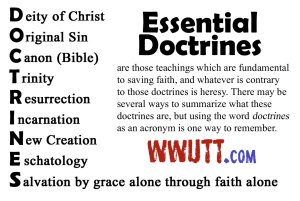
See how this works? If you don’t believe you’re a sinner, you’re not saved. If you don’t believe in the bodily resurrection of Christ, you’re not saved. Here’s how our friend, Pastor Gabriel Hughes, briefly outlines essential doctrines:

(Gabe later tweaked the acrostic a little and added an “S”, which I think is helpful.)

The vast majority of brand new Christians have only the most basic understanding of most of these tenets at the moment of salvation. But it’s not an issue of fully understanding – or else we’d all have to be theologians in order to get saved – it’s an issue of believing. Someone who is genuinely regenerated may not completely understand how the Trinity works (honestly, no one does), but when she’s introduced to the biblical idea of the Trinity, she believes it, learns more about it, and does not reject it.

There is typically agreement among most reputable theologians regarding what constitutes first tier doctrine. Scripture is clear about these things, and several of these issues were settled long ago by the church fathers in assorted church councils (Nicea, Chalcedon, etc.)

Secondary issues are routinely defined as non-salvific but still extremely biblically important, if not quite as biblically clear-cut as primary issues. Doctrines surrounding baptism (credo versus paedo, affusion versus immersion), for example, are usually cited as a secondary issue. A disagreement on a secondary issue doesn’t mean one person is saved and another isn’t, but it normally prevents close partnership in ministry activities involving these issues. For example, my Presbyterian friends and I can join together in pro-life ministry, but we would most likely not plant a church together.

Tertiary issues are non-salvific, less immediately urgent, biblical issues in which the Bible is even less clear-cut and open to wider (yet still biblical) interpretation. These are issues over which Christians can disagree and still maintain close doctrinal fellowship, even in the same church, if they’re in agreement on first and second tier doctrine. Eschatology – the order and timing of events at Jesus’ second coming – is a doctrine that’s often considered third tier. Someone can hold a different eschatological view than mine, yet, for the most part, it shouldn’t affect our ability to worship together, work together, or participate in the ordinances together in the same church.

Some theologians add a fourth category – issues of adiaphora, conscience, or Christian liberty. Usually these are issues of much less importance that the Bible either doesn’t specifically address, or doesn’t give commands about one way or the other. Individual Christians may use biblical principles to inform their consciences and decide for themselves. These would be things like whether or not to take your child trick-or-treating or deciding whether to dress formally or casually for church.

While theologians are largely in agreement about primary doctrines, there is wider spread disagreement on which doctrines are secondary and tertiary (many consider eschatology to be a second tier doctrine, for example) and whether or not there is a need for a category of adiaphora, since such issues are normally not considered to be “doctrinal” issues. In fact, there’s enough space for disagreement that pastors and theologians often wisely refrain from making concrete lists of secondary and tertiary doctrines.

But when we’re talking about the different levels of doctrine, what you won’t find is questions like these: Is murder a first, second, or third tier doctrine? What about gossip? Rape? Adultery? Lying? Gluttony? Pride?

And it’s not because these issues aren’t important or because the Bible doesn’t address them. It’s because they’re in a different category from the other issues: the category of sin. They aren’t doctrines upon which salvation hinges, they aren’t open to interpretation, and the Bible is clear that we are absolutely not to do these things.

The category of doctrine deals with beliefs. The category of sin deals with behavior.

In 2005, Dr. Albert Mohler wrote an excellent article about the different levels of doctrine entitled A Call for Theological Triage and Christian Maturity. He carefully explains the importance of each level of doctrine and what it covers in a plea to keep each level’s urgency in its proper place of significance during discussion, debate, and decision-making.

It was a helpful article to which I always refer people who have questions about tiers of doctrine, and I agree with Dr. Mohler’s thoughts in the article wholeheartedly1 …except on one point:

“In recent years, the issue of women serving as pastors has emerged as another second-order issue.”

Women serving as pastors, women preaching, women teaching men Scripture, and women exercising authority over men in the gathering of the Body is not a secondary issue. Nor is it a primary or tertiary issue. It does not belong in the category of “doctrine” in the same way baptism and eschatology do. It belongs in the category of sin in the same way murder, gossip, and adultery do. Let’s take a look at the reasons for this.

Women serving as pastors, preaching, teaching men Scripture, and exercising authority over men in the gathering of the Body is *not* a secondary issue. Nor is it a primary or tertiary issue. It is a sin.

I do not permit a woman to teach or to exercise authority over a man; rather, she is to remain quiet. 1 Timothy 2:12

(The preponderance of Scripture supports and affirms this concept, so to keep things simple, we’ll use this verse as an exemplar.)

โœข The prohibition in 1 Timothy 2:12 is a clear command against a certain behavior. And when we behave in a way God has prohibited, that is called “sin”. All of the tenets in the three levels of doctrine are affirmative statements regarding beliefs (you must believe in the resurrection of Christ, we believe in baptism by immersion, etc.). None of them are commands, in the negative, against sinful behavior (Thou shalt not murder, I do not permit a woman to teach… etc.)

โœข Secondary and tertiary doctrines can be open – to varying degrees – to biblical interpretation. Every stripe of non-heretical eschatological thought can provide you with chapter and verse passages that can, depending on the angle from which you approach the subject, be biblically plausible and scripturally supported. There is no biblical support for anything God prohibits. No one can cite a properly handled, in context Bible verse in which God says, “It’s OK to commit adultery,” or “Women are allowed to preach.” There can be multiple views on a secondary or tertiary issue that can all be considered biblical, but there can only be one view of sin that is biblical.

โœข Differing beliefs on true secondary and tertiary issues are not sin. My Presbyterian friends have a different view of baptism than I do. That doesn’t mean either of us is sinning. I may think their interpretations of the verses they believe support paedo baptism are incorrect, but they are not breaking any of God’s commands. Differing behavior (again, we see the distinction between doctrinal belief and sinful behavior) on issues of sin is sin. If someone behaves differently from God’s command about lying, she is sinning. If a woman behaves differently from God’s command in 1 Timothy 2:12, she is sinning.

โœข Differing beliefs on secondary and tertiary issues are not born of disobedience and rebellion toward God. Usually, it’s quite the opposite. When someone has studied a theological issue enough to hold a particular position on it, it’s usually because she is striving to please God and to be biblical in her beliefs. Differing behavior on issues of sin is born out of disobedience and rebellion toward God. Someone who steals has already decided in her heart that her desires are better than God’s command. A woman who knowingly holds improper authority over men in her church is doing so because she has already decided to defy God’s clear command against such.

โœข Because different beliefs on secondary and tertiary issues are not born of rebellion and are not sin, they do not require church discipline. Sin does require church discipline. If someone in your church is openly dishonoring her parents, she is sinning and should be subject to church discipline. If a woman is pursuing a career as a pastor, she is sinning and should be subject to church discipline. 

Since the publication of Dr. Mohler’s article (and perhaps as a result of others teaching the same thing) the idea of the violation of 1 Timothy 2:12 being a “secondary doctrine” has spread in a most unhelpful way, leading many Christians to treat the issue in a c’est la vie, “We can just agree to disagree on this,” manner.

No, we cannot.

The idea of the violation of 1 Timothy 2:12 being a “secondary doctrine” has spread in a most unhelpful way, leading many Christians to think “We can just agree to disagree on this.”. No, we cannot.

We would not say, “We can agree to disagree,” on lying or adultery or homosexuality or abortion, and we cannot say it about women preaching, teaching men, or holding unbiblical authority, either. We disciple and teach a sister in Christ who is unaware of what the Bible says on these matters, and if she is committing any of these sins, we begin the process of church discipline. But it would not be loving toward her, or honoring God, to allow her to continue in biblical ignorance or in willful sin.

Furthermore, the violation of 1 Timothy 2:12 brings with it dangers to the church that true secondary and tertiary issues, and even many sins, do not…

The violation of 1 Timothy 2:12 brings with it dangers to the church that true secondary and tertiary issues, and even many sins, do notโ€ฆ

She may not say it with her lips, but when a woman preaches to men in defiance of Scripture, sheโ€™s teaching false doctrine through her behavior. What is the false doctrine sheโ€™s teaching? โ€œI donโ€™t have to obey Godโ€™s Word, and neither do you. If thereโ€™s a part of the Bible you donโ€™t like, youโ€™re free to disregard it.โ€ If your pastor stood up in the pulpit on Sunday morning and said that in words, youโ€™d run him out of town on a rail, and rightly so. Neither should a woman be able to teach that same false doctrine via her actions.

Additionally, I have mentioned several times when dealing with this issue that women preaching to men is highly correlated with women teaching other forms of false doctrine. I have researched scores of women teachers. Every single one of them who unrepentantly teaches men also teaches false doctrine in some other aspect of her theology (usually progressivism, Word of Faith, or New Apostolic Reformation). In other words, if a woman teaches men, you can just about take it to the bank that she also teaches additional false doctrine. False doctrine and heresy are infecting the church – via female preachers – at an alarming rate.

We dare not simply “agree to disagree” on this.

The violation of God’s command that women are not to instruct men in the Scriptures nor hold improper authority over men is a sin like any other. It is not a doctrinal issue in the same sense that other second and third tier doctrines are. If left undisciplined, however, it can lead to first tier doctrinal issues infiltrating a church and eventually destroying it. It is detrimental to the church to label and treat any sin as a secondary doctrinal issue.

Additional Resources

Is Women Preaching a Secondary Issue? on A Word Fitly Spoken

What Are Essentials and Non-Essentials? on A Word Fitly Spoken

Christian Liberty on A Word Fitly Spoken

The importance of Primary and Secondary Doctrines on the Truth Be Known Podcast


1In the years since 2018, when this article was originally written, Dr. Mohler has said, done, and supported various biblically questionable things, leading some to question whether or not he has “gone woke”. While I don’t support his stance on those questionable things, I also don’t believe he has reached the point at which I need to warn against him (although I don’t proactively recommend him, either). To my knowledge, at this time, he is still generally doctrinally sound.

Christian women, Ministry

Mary and Martha and Jesus and Women’s Ministry

Originally published March 11, 2016

You remember the story. Jesus comes to Mary and Martha’s house. Martha’s Pinteresting up the place while Mary sits at Jesus’ feet to listen to Him teach. Martha gripes to Jesus that Mary should help her and Jesus says no because it’s better for her to listen to Him than fold napkins into the shape of swans or whatever. Moral of the story- Martha needs to relax and not let other things distract her from Jesus.

Thatโ€™s a good, true, and important takeaway from this passage, and one that we would all do well to heed.

But did you ever stop to think that Mary and Martha arenโ€™t the main characters in this story? Jesus is. Jesus is the main character in every Bible story, so our primary focus should always be on Him: what He said and did and was like.

Did you ever stop to think that Mary and Martha arenโ€™t the main characters in this story? Jesus is.

What was Jesus teaching that day at Mary and Marthaโ€™s house? The passage doesnโ€™t tell us the topic He was speaking about, but we are privy to a very important lesson He imparted through the scenario with Mary and Martha. A lesson about the way God loves and values women.

Remember how women were generally regarded at that time? They didnโ€™t have much more value than livestock, furniture, or a manโ€™s other possessions. They were considered intellectually inferior, they werenโ€™t formally educated, and their legal and social standing were often tenuous at best. They could not go beyond the Court of the Women at the temple for worship. There was even a traditional prayer Jewish men recited in which they thanked God for not making them a woman, a Gentile, or a slave. Women were low man on the totem pole, so to speak.

And thatโ€™s where we find Martha. She wasnโ€™t doing anything wrong that day. In fact, in her culture, she was doing everything right. If anything, Mary would have been the one viewed as being in the wrong because the teaching was for the men, and it was the womenโ€™s job to bustle around taking care of all the hospitality duties. Martha knew this. Mary knew this. Jesus knew this. Everyone else present knew this. Martha must have wondered why someone hadnโ€™t yet shooed Mary out of the living room and into the kitchen. So her statement to Jesus in verse 40, โ€œLord, do you not care that my sister has left me to serve alone? Tell her then to help me,โ€ was probably not just, โ€œI need another pair of hands,โ€ but also a bit of, โ€œMary is forgetting her place. This isnโ€™t what proper women do.โ€

Oh yes, it is.

Whatever else He might have been lecturing about that day, that was one of the lessons Jesus taught Mary, Martha, the rest of their guests, and Christendom at large.

Women arenโ€™t second class citizens in the Kingdom of God. We are precious and valuable to Him. He has important, worthwhile work for us to do โ€“ His way – in the body of Christ. And He wants us trained in His Word in order to carry out that work.

How did Jesus teach that lesson?

First, He allowed Mary to stay and receive His teaching (39). (We see this echoed in Godโ€™s instruction to the church in 1 Timothy 2:11: โ€œLET a woman learnโ€ฆโ€) It hadnโ€™t slipped Jesusโ€™ mind that she was sitting there. He could have told her to leave, but He had no intention of doing so. Jesus wanted Mary there. He wanted to teach her and to have her learn Godโ€™s word from Him.

Next, when someone tried to take Mary away from hearing and being trained in Godโ€™s word, Jesus โ€“ God Himself โ€“ answered with a resounding NO. This โ€œwill not be taken away from her,โ€ Jesus said. Mary, and Martha too (41), could arrange centerpieces or turn a cookie into a work of art any time or never. But this, the teaching of Godโ€™s Word, was urgent. Vital. Jesus didnโ€™t want either of them to miss it by focusing on the trivial things they thought they should be pursuing.

And He doesnโ€™t want us to miss it either, ladies.

Jesus pulled women out of the craft room and into the study. Is the womenโ€™s ministry at your church trying to pull them back?

Jesus pulled women out of the craft room and into the study. Is the womenโ€™s ministry at your church trying to pull them back?

Is the womenโ€™s events page on your churchโ€™s web site filled exclusively with painting parties, fashion shows, ladiesโ€™ teas, and scrapbook sessions?

Does your womenโ€™s ministry do canned โ€œBibleโ€ studies authored by women who offer nothing but personal stories, experiences, and false doctrine?

Are the Marys in your church who want to sit at the feet of Jesus and hear His word rightly handled and taught being scolded by the Marthas for not staying in their place and embracing the banality the womenโ€™s ministry is doling out?

Are the Marys in your church who want to sit at the feet of Jesus and hear His word rightly handled and taught being scolded by the Marthas for not staying in their place and embracing the banality the womenโ€™s ministry is doling out?

Is this it? Is this all women are good for in the church- fluff and false doctrine?

Jesus didnโ€™t think so.

Letโ€™s have our women’s ministries train women in the full scope of biblical womanhood. Let’s be serious students of Godโ€™s Word by picking it up and studying it like mature women. Letโ€™s get equipped to teach and disciple other women who are babes in Christ. Letโ€™s share the gospel with the lost. Letโ€™s learn how to train our own children in the Scriptures and be the ones to raise the bar for what the kids at our church are being taught. Letโ€™s roll up our sleeves and get our hands dirty ministering to those who are ill, in prison, lonely, poor, elderly, considering abortion, experiencing crisis; who have wayward children, problems in their marriages, a parent with Alzheimerโ€™s, or have lost a loved one.

Is this it? Is this all women are good for in the church- fluff and false doctrine?

Women are worth more and capable of more than the bill of goods theyโ€™re being sold by โ€œChristianโ€ retailers suggests. More than cutesy crafts and fairy tales masquerading as biblical teaching. Letโ€™s put the โ€œministryโ€ โ€“ ministry of the Word and ministry to others โ€“ back in โ€œwomenโ€™s ministry.โ€

Women are worth more and capable of more than the bill of goods theyโ€™re being sold by โ€œChristianโ€ retailers suggests.

Discernment

Discernment: What’s Love Got to Do with It?

Originally published January 22, 2016

…so that we may no longer be children, tossed to and fro by the waves and carried about by every wind of doctrine, by human cunning, by craftiness in deceitful schemes. Rather, speaking the truth in love, we are to grow up in every way into him who is the head, into Christ…

Ephesians 4:14-15

Christians who know what discernment is have a variety of perspectives about how it should be practiced. Should we teach about false doctrine at all or just make sure our church is teaching sound doctrine? Should we name the names of false teachers or speak about them anonymously? Should we warn people away from false teachers or just pray for them privately? What’s the biblical precedent for using a stringent tone when speaking of those who teach false doctrine?

Recently, I’ve been thinking a lot about the phrase “speaking the truth in love” from Ephesians 4:15 as it pertains to speaking and writing about false doctrine and false teachers.

Many Christian women have the mistaken idea that “speaking the truth in love” equals being “nice.” We’re always smilingly sweet and never say anything that might hurt someone’s feelings or could rock the boat at church.

Many Christian women have the mistaken idea that “speaking the truth in love” equals being “nice.”

Are we to be kind? Yes. Are we to do our best not to hurt others? Of course. Should we be making waves over every little thing that rubs us the wrong way? Absolutely not. We are to deny ourselves, setting aside our personal preferences and, in many cases, even our own rights, to the point of laying down our lives for others.

We need to understand the distinction between personal preferences and biblical doctrine. We die *to* personal preferences. We die *for* the purity of biblical doctrine.

But we need to understand the distinction between personal preferences and biblical doctrine. And that’s where I think a lot of people get confused. We die to personal preferences. We die for the purity of biblical doctrine. The enemy is stealthily infiltrating and conquering church after church with false doctrine. We are at war. And that’s going to mean ruffling feathers, rocking the boat, and hurting feelings sometimes. Because the full armor of God doesn’t come with a white flag or a pen for signing peace treaties.

The full armor of God doesn’t come with a white flag or a pen for signing peace treaties.

But how do we war for the truth “in love”?

Well, think about the concept and practice of “love.” Love always has an object. We don’t just say, “I love.” We say, “I love my children,” or “I love peanut butter and chocolate ice cream.” Speaking the truth “in love” is not as much about our demeanor or tone of voice as it is about the object of our love. It’s our love for others that compels us to speak biblical truth. And it’s that same love for others that should drive the manner in which we speak the truth.

So when it comes to speaking the truth about false doctrine, how should we be motivated by love? And love for whom?

We love Christ– As Christians, our love for Christ should motivate everything we do. If we’re speaking truth from fleshly motives such as pride, the desire to make a name for ourselves, or the competitive drive to win an argument, everything we say can be 100% factually right and we can still be spiritually in the wrong because the motive of our heart is wrong. God isn’t a debate judge awarding us points for compelling arguments. God weighs the heart.

We love God’s Word– To love Christ is to love the Bible because Scripture is literally God Himself speaking to us. Besides the cleansing of the temple, the passage in which we see Jesus’ righteous anger displayed most clearly is Matthew 23. Here, Jesus delivers a scorching rebuke to the scribes and Pharisees for twisting God’s Word and, in doing so, leading people away from the truth of Scripture. It is only natural for those of us who have the mind of Christ and are indwelt by the Holy Spirit to have that same love for God’s word and feel righteous anger over the maligning of it.

We love the church– To love Christ is also to love His bride, the church. Christ gave his life to cleanse the church “so that he might present the church to himself in splendor, without spot or wrinkle or any such thing, that she might be holy and without blemish.” Seeing Christ’s bride blemished and corrupted by false doctrine should grieve us deeply and motivate us to call the church to be cleansed “by the washing of water with the Word.”

We love the captives– Paul speaks of false teachers “who creep into households and capture weak women.” Often, the women who follow false teachers simply don’t know any better. Though Scripture is clear that they’re complicit in their own captivity, they are casualties and prisoners of war held hostage by the enemy. We are to love them enough to show them the truth of God’s word so that “they may come to their senses and escape from the snare of the devil, after being captured by him to do his will.”

We love the enemy– Every Christian was at one time an enemy of the cross. Every last one of us. Until someone loved us enough to intervene with the truth of the gospel. False teachers – those who, despite biblical correction, unrepentantly teach doctrine which is plainly refuted by Scripture – have made themselves enemies of the cross, even if they call themselves “Christian,” even if they wear the title of “pastor,” even if they’re holding a Bible in their hands and refer to it occasionally as they “teach” us.

In the same way that a loving sister would not turn a blind eye and hope for the best if her sibling began using drugs and became increasingly addicted, it is not lovingย to stand idly by and allow false teachers to continue to sink deeper and deeper into Satan’s clutches by doing his bidding without making every effort to stop them in order to rescue them.

*It is not loving* to stand idly by and allow false teachers to continue to sink deeper and deeper into Satan’s clutches by doing his bidding without making every effort to stop them in order to rescue them.

Sometimes – just as with the drug abuser – this can be accomplished early on with a private word of correction. And sometimes – as with the addict – more extreme measures of “tough love” and intervention must be employed. But we always love them enough to desire that they come to repentance and embrace the truth.


Our love for these also drives the manner in which we speak truth to them. A good soldier would never deal with a civilian casualty in the same way he would fight off an enemy bent on waging war. Likewise, part of discernment is knowing who the enemy is (and is not) and dealing with people in a biblically appropriate way. This requires humility, wisdom, thorough proficiency with our tools and weapons, unceasing prayer, and complete dependence on and self-crucifying love for our King. We trust in Him and His Word to guide us in the wise and loving way to humbly speak His truth.

Discernment. Speaking truth. What’s love got to do with it?

Everything.

Discernment. Speaking truth. What’s love got to do with it? Everything.