Family, Mailbag

The Mailbag: Stay at Home Dads?


What is the Biblical view of men fulfilling womenโ€™s roles? I.e. staying home and managing the household, caring for small children, etc. while the woman works outside the home to provide for the family?

Super question! It’s not a cut-and-dried easy answer, though. There are a lot of things to take into consideration.

The first thing we need to consider is, of course, what the Bible says about this issue. And when we look at what the Bible says about human behavior, we need to look at two things: the heart and the actions. The Bible does forbid and command a lot of actions, but God is also clear that He judges the heart. It is possible to do the right thing with the wrong motives and the wrong thing with the right motives. We want to make sure we have right motives that lead us to do the right thing.

And Samuel said, โ€œHas the Lord as great delight in burnt offerings and sacrifices, as in obeying the voice of the Lord? Behold, to obey is better than sacrifice, and to listen than the fat of rams. For rebellion is as the sin of divination, and presumption is as iniquity and idolatry. 1 Samuel 15:22-23a

For the Lord sees not as man sees: man looks on the outward appearance, but the Lord looks on the heart.โ€ 1 Samuel 16:7b

The first question we need to ask ourselves is, “Is there an explicit command that the husband must leave the house and go to work every day to financially support the family, a command that he absolutely cannot stay at home and manage the household and raise the children, or a command that a wife may not work outside the home or support her family financially?”

I have not found any specific, in context, “thou shalt/thou shalt not” commands along those lines. And there’s a reason for that. God beautifully designed the Bible to be applicable and relevant to all people, across all cultures, in all time periods. So there are some universal commands in the Bible that apply to everybody, everywhere, in every time. For example: It is a sin to murder whether you’re young or old, male or female, smart or dumb, ugly or pretty, rich or poor, living in the Middle East or Polynesia or Antarctica, in 3271 B.C., A.D. 0, or A.D. 2019. Murder is always a sin, no matter what.

But God has not chosen to make that same pronouncement about the financial support of the family and who should work inside or outside the home. If we examine all of the Scriptures that mention men and women working, we can see a general overall pattern that points to the wisdom, in most cases, of wives doing most of the household management and child-rearing, leaving husbands free to concentrate primarily on bringing home the bacon, but God has not chosen to make this a universal command.

(I’m sure many readers are thinking, “But what about Titus 2:5, saying women are to be ‘workers at home’?” First, this is not a command that women are never to work outside the home (keep reading for more Scripture about women working and contributing to the support of their families). Second, if you’ll examine that verse in context (2:2-10), you’ll notice that this passage deals with people’s character, not careers. This can be easier to see if you compare Titus 2:3-5 with 1 Timothy 5:3-16, especially v.6, 13-14. Women are not to be lazy, idlers, and busybodies, they are to be hard workers, glorifying God in their work. In first century culture, this nearly always meant marrying, raising children, and managing their households, because this was virtually the only culturally appropriate venue available to them in which to work. Titus 2:5 is primarily about working hard to the glory of God, not primarily about where that work is performed. Does this mean all Christian women are free to abandon their children and homes in favor of working outside the home just because they feel like it? Of course not. As we’re about to see, that goes back to having a godly motive, going with the grain of the way God generally created women if at all possible, and discerning what is pleasing to the Lord in the circumstances in which He has placed your family. Which is exactly the type of character Titus 2 and 1 Timothy 5 teach that Christian women are to have.)

Why did God not make this a command? Because in His sovereignty, over time, God has allowed or created different types of cultures to develop at the macro level, and different sorts of circumstances to occur in the lives of various individuals at the micro level.

In our culture, with regard to supporting a family, it is typical for a husband to get up Monday through Friday, leave the house, work for someone else for eight hours, receive a paycheck, and return home.

Although that was true for some families, particularly city-dwellers, during Bible times, it was far less the norm than it is today. Think about the types of work most often mentioned in the Bible. It was a much more agrarian society. Dads usually worked their land and livestock as an extension of their home, and moms and any children who were old enough had their chores around the “farm” as well. The whole family worked together to provide necessary sustenance, and dads had much more direct oversight over their children on a day to day basis than a 21st century dad who leaves home and goes to the office every day.

But even in situations in which there was a family business (such as Joseph being a carpenter) the sons usually grew up learning the business under the direct tutelage of their fathers. And though the daughters were being trained at home to learn how to be good wives, it is reasonable to assume that they and their mothers helped out with the business as needed in a culturally appropriate way.ยน There was much more integration of work and family in that culture, giving fathers more contact with their children during the day.

There are also passages in the Bible that help us to see that bringing in income was not strictly relegated to men and child-rearing was not strictly relegated to women. In Proverbs 31, we see a wife and mother conducting business and contributing to the support of her family. We see Deborah “working outside the home”. We find that Lydia was, in some way, a merchant. And we do not see the Bible condemning these women as ungodly for contributing to the support of their families or performing some kind of work outside the home. Quite the opposite, in fact – the “Proverbs 31 woman” is, to this day, held up as the ideal wife and mother for godly women to emulate.

Furthermore, we often see passages in Scripture that lay the ultimate responsibility for instructing, disciplining, and properly bringing up children at Dad’s feet, not Mom’s. Read the first nine chapters of Proverbs. This is a father, not a mother, training up his son. And take a look at Ephesians 6:4 (Fathers…bring [your children] up) and Colossians 3:21 (Fathers, do not provoke your children…).

So there is no explicit biblical command about only husbands supporting the family financially and only wives managing the household and raising the children. We need to make sure we separate out what is biblical and what is cultural when it comes to the roles of husbands and wives.

As I mentioned, in addition to God sovereignly creating/allowing different cultures on the macro level, He has also created/allowed, on the micro level, varying life situations for various families. Dads who are disabled or have medical conditions that are more conducive to staying home with the children than having a job outside the home. Men who have had very limited educational and job opportunities who fall in love with and marry women already established in lucrative careers. And, especially in these modern times, Dads who are able to work from home while caring for the children. These and other scenarios can be contributing factors when it comes to which spouse works outside the home (If, indeed, working outside the home as someone else’s employee is necessary for either spouse; working from home or starting your own home-based business is an option many families overlook).

So there are a lot of external, and sometimes unavoidable, cultural and personal circumstances at play in each family’s decision-making process. But what about the internal factors at play? This brings us back to the motive of the heart.

What is the husband’s motive for wanting to stay home with the children? Is it because he’s lazy (lemme just take a moment to say this: if you’re lazy, raising children and managing a household isn’t the job for you) and just wants to shirk responsibility? Because he’s so arrogant or headstrong that he refuses to submit to a boss’s authority? Because he wants to live in luxury on his wife’s salary rather than cutting expenses and living more modestly on what he is able to earn so she can stay at home?

What is the wife’s motive for wanting to work outside the home while her husband manages the household and raises the children? Is she a feminist out to make a statement or further an agenda? Does she pridefully feel that the day to day job of wife and mom is beneath her? Is she finding her identity in her position, her income, or the praise of men instead of finding her identity in Christ?

These are wrong reasons for doing what might, financially, actually be the right thing. But as I said, as Christians, we need to make sure we have right motives leading us to do the right thing. And what is the right motive in this, or any other, decision-making process?

Walk as children of light (for the fruit of light is found in all that is good and right and true), and try to discern what is pleasing to the Lord. Ephesians 5:8b-9

Husbands and wives each need to repent of any wrong motives they may have harbored in their hearts, walk in Christ as children of light, sit down together, pray for God to give them wisdom, examine all the factors at play in their situation, and try to discern what is pleasing to the Lord in the situation He has sovereignly placed them in.

For most families in our culture, what this typically ends up looking like is that the husband is the main breadwinner and the wife is the main manager of the household and children. And part of the reason for this is that God has generally wired men to desire to go out and conquer the world, and He has generally wired women to desire to keep the home fires burning. So if there aren’t any circumstances that force a couple to go against that grain, it’s usually wisest for Dad to be the primary financial supporter of the family and Mom to be the primary manager of the family. But there are going to be godly exceptions to the rule, and we need to be sure we’re not assuming people are in sin just because they don’t fit what’s usually the norm.


ยนCertainly there were other types of work/employment in Bible times, I’m just using these primary two to demonstrate my point.

If you have a question about: a Bible passage, an aspect of theology, a current issue in Christianity, or how to biblically handle a family, life, or church situation, comment below (Iโ€™ll hold all questions in queue {unpublished} for a future edition ofย The Mailbag) or send me anย e-mail or private message. If your question is chosen for publication, your anonymity will be protected.

Christian women, Church, Complementarianism

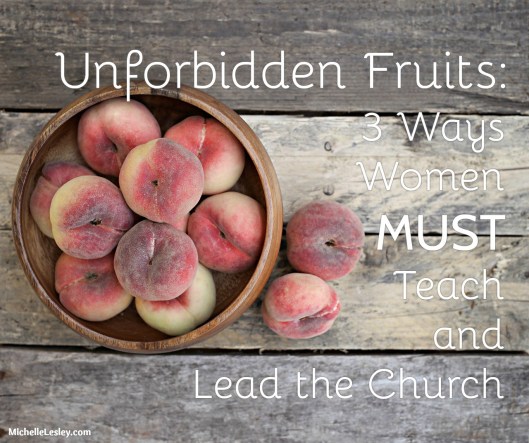
Unforbidden Fruits: 3 Ways Women MUST Lead and Teach the Church

Ladies, we whine too much.

Like petulant little girls, we look at what’s off limits to us, stomp our Mary Janes on the floor and cry “Why can’t I? I want to!” instead of giddily jumping into all the opportunities God has blessed us with. Instead of being happy and thankful for what we have, our greedy little fingers stretch out to grasp what God has said we can’t have because it’s not good for us or anybody else.

God has instructed pastors – who are, in turn, to instruct us – that, in the gathered body of Believers, women are not to preach to men, instruct men in the Scriptures, or exercise authority over men. And that’s what we focus on, and whine and kick our feet about. That part – the childish rebellion and discontent with the role God has graciously placed us in – that’s on us.

But pastors, we badly need your help on this one. Many pastors do a wonderful job of rightly and biblically explaining what women are not to do (And may I take a moment to say, from the bottom of my heart, thank you. I know how difficult that can be and that you take a lot of undeserved flak for simply teaching God’s Word on this subject.), but that “no” teaching has often not been coupled with the “yes” teaching of what women must do and how they must lead in order for women, and the church, to be healthy and function properly.

The “no” teaching of what the Bible forbids has often not been coupled with the “yes” teaching of what women *must* do and how they must lead in order for women, and the church, to be healthy and function properly.

You’ve loved us well to tell us not to bite at the apple from the forbidden tree, but we also desperately need you to take us on a tour of the Garden and introduce us to the all-you-can-eat buffet of pear and peach and cherry and pecan trees that we have the privilege and the responsibility to feast on.

๐ŸŠ The Other Institution ๐ŸŠ

Did you ever notice that the “do” for women in the church comes before the “don’t”? We tend to totally skip over that enormous little word that kicks off 1 Timothy 2:11: “Let a woman learn…”. We have no idea of, nor appreciation for, how huge and groundbreaking it was for the Holy Spirit, through Paul, to proactively instruct pastors: “Hey, get these women in here, make sure they listen up, and train them properly in the Scriptures so they’ll be equipped to fortify their homes with biblical truth.”

We completely miss the fact that, though God installs men as the teachers and leaders in one of His foundational institutions – the church – He has very much made women the functional, boots on the ground, day to day, teachers and leaders by example – of His other foundational institution – the family. The church didn’t even exist for the first few millennia of human history, but the family has existed since Creation. And people who are members of families populate and lead the church. Raising and molding those people is a tremendous position and responsibility. A position and responsibility God has largely given to women.

Wives pray for our husbands’ growth in Christ. We build them up with Scripture. With a gentle and quiet spirit, we set a godly example for them as they observe our respectful and pure conduct. We encourage and help them in their leadership roles at church.

Moms pray for our children’s salvation. We pour the gospel into them at every turn. We train up our children in the way that they should go – in the nurture and admonition of the Lord – so that when they are old they do not depart from it. We teach them to love and serve and invest in the church both directly and by modeling these things for them.

And our single, widowed, and childless sisters work right alongside us in this labor, praying for church leaders and members, nurturing children at church whose parents are unsaved or unequipped to raise them biblically, encouraging and assisting brothers and sisters in Christ.

We grow and develop, nourish and support, exhort and sharpen the population of the body of Christ.

Men may lead the church, but women raise the church.

Men may lead the church, but women *raise* the church.

๐Ÿ Woman to Woman ๐Ÿ

Essential to the health of any church is the component of women training women, whether in the formal setting of a Bible study class and structured women’s ministry programs or an impromptu “let’s get together for coffee this week” discipleship discussion.

Though we receive instruction in Scripture from our pastors, elders, and teachers, there are some counseling and teaching situations it’s not appropriate for a man to address with a woman, or that a woman understands better than a man. There are issues women face that men just don’t “get” in the same way a sister in Christ does. There are insights and perspectives a woman can use to explain Scripture to another woman that a man just doesn’t have. There are times when a woman needs someone to walk through a long term emotional journey with her that requires a personal intimacy which would be inappropriate for a man to engage in with her. And in the same way men are better equipped than women to train men to be godly husbands, fathers, and church members, women are better equipped than men to train women to be godly wives, mothers, and church members.

God knew all of this back when He breathed out the words of Titus 2:3-5…

Older women likewise are to be reverent in behavior, not slanderers or slaves to much wine. They are to teach what is good, and so train the young women to love their husbands and children, to be self-controlled, pure, working at home, kind, and submissive to their own husbands, that the word of God may not be reviled.

…and, again, 1 Timothy 2:11:

Let a woman learn quietly with all submissiveness.

Women must be trained properly in the Scriptures so we can take that training and pour it into other women, teaching and sharpening them into godly women, wives, mothers, and church members.

๐Ÿ‘ Super Models ๐Ÿ‘

Women instruct our brothers and sisters in the church in biblical truth when we lead by example. When we sin against someone, we go to that person and ask forgiveness. We demonstrate the importance of meeting together with the Body by being faithful in our church and Sunday School attendance. We model servanthood by serving the church and our brothers and sisters. We paint a picture of biblical compassion by ministering to the sick and others in need. We show Christians how to carry out the Great Commission by sharing the gospel. We set an example of trusting God when others see us depending on Him through difficult situations.

And one of the most important biblical concepts women have the privilege and responsibility of teaching the church through our example is submission to authority – a lesson the church is sorely in need of these days.

Because God blessed us by creating us as women, we have an opportunity to model submission to authority in a unique way that God has chosen to deny to men.

Because God blessed us by creating us as women, we have an opportunity to model submission to authority in a unique way that God has chosen to deny to men.

As we submit to our husbands, we teach the church what it means to submit to Christ. How to walk in humility and obey Him out of love. How to put selfishness aside. To trust Him to take care of us. To deny ourselves, take up our cross daily, and follow Him.

When we submit to God’s design for leadership in the church and joyfully carry out the work He has planned for us as godly women, we teach the church to submit to God’s authority and love Him by obeying His commands. We instruct our fellow church members in respecting and submitting to the pastors and elders God has placed in spiritual authority over us.

Submission to Christ, to God’s commands, and to pastors and elders is the bedrock of a healthy church. God has graciously given women the role – and the duty – of teaching these and other biblical principles to our churches in a way that men cannot -through our example as godly women.

Remember the series of fun little nutritional books that came out several years ago called Eat This, Not That? The idea the books centered around was, “Don’t eat that unhealthy thing. Eat this similar but healthy thing instead.”

Sadly, many Christian women have only been getting half the story. “Not that” (preaching to/teaching men and exercising authority over men) is biblically correct, but it’s not biblically complete. If all you tell someone is “Don’t eat that,” without showing her the “Eat this,” part, what she needs to eat to be healthy, she’s going to starve, and the church will be malnourished as well.

Christian women need our pastors to teach us to eat the fat of the land of being properly trained in the Scriptures and drink the sweet wine of leading and instructing the church the way God gifts us and requires us to. Only then will the Body be healthy and well nourished.


Mailbag

The Mailbag: Should Christian women serve as surrogate mothers?

I’m a single mom in my 20s with a small child. I know a couple who is having difficulty conceiving and was thinking about offering to be a surrogate for them. A donor egg will be used, so the child will not be biologically mine. This couple would only be “renting my womb” so to speak. It would mainly be to help them out, but the fee I would be paid would really ease the financial stress I’m under. Would I be sinning if I did this?

Infertility can be a heartbreaking experience. It is very kind and compassionate of you to want to help this couple out.

Whenever we’re trying to make decisions like this, the first thing we need to do is look at what the Bible says about it. The New Testament does not prohibit Christian women from serving as surrogate mothers. However, just because Scripture doesn’t mention something or specifically prohibit it doesn’t mean it’s permissible. We need to consider why surrogacy isn’t addressed in the New Testament.

If surrogacy had been addressed by Paul, Peter, or any of the other New Testament writers, it would have been denounced as sin, because in that time, the only way for a woman to become pregnant was through sexual intercourse, and sex with anyone other than her husband would have been sinful.

We do see instances of “surrogacy” in the Old Testament (Sarah, Rachel, Leah) in the ancient Middle Eastern cultural practice of a barren wife giving her maid to her husband. The child that the maid bore would then be legally considered the child of the husband and his wife. But, in this case, we have to remember that just because Scripture does mention something doesn’t mean it’s OK with God.

God did not instruct Sarah, Rachel, or Leah (or any other infertile Old Testament woman such as Hannah or Samson’s mother) to give their maids to their husbands to serve as surrogates. This was a cultural practice of the time that these women took it upon themselves to participate in without regard to whether or not it was godly. We also need to remember that these areย descriptive (simply telling what happened) passages of Scripture, notย prescriptive (a command or instruction we’re to follow – more on that here). Furthermore, we need to consider the context of these surrogacies: the maids had no choice in the matter, the pregnancy came about through a sexual act, the child the maid bore was biologically hers, and the maid continued to live in the same household with the husband, wife, and child after the birth, factors, most of which, normally do not apply to modern day surrogacies.

But there is one aspect of most surrogacies that the Bible does speak directly to in a prescriptive way: “You shall not murder.” (Exodus 20:13) Surrogacy is a legally binding contractual agreement between the biological parents and the surrogate, and most surrogacy contracts require the surrogate to agree to abort (sometimes called “selective reduction” or “termination”) any or all of the babies she is carrying at any time and for any reason the biological parents demand it. If that is the case in your situation, the Bible prohibits you from serving as a surrogate under that stipulation.

But even if that is not a requirement of your contract, there are still a couple of principles we can glean from these Old Testament surrogacies that you would do well to consider as you make your decision.

First, as with the Old Testament surrogacies, surrogacy today is a practice of our modern culture. It is not something God affirmatively instructs either couples or potential surrogates to do in response to infertility. The difference is that modern surrogacy does not involve a sexual encounter, so it may be considered as an option by Christians.

Next, even though the Old Testament surrogacies are different from modern day surrogacies in many ways, one thing they both have in common is that unforeseen problems and complications can arise and cause heartache for the surrogate, the couple, and others.

A great guiding principle in making this decision is found in 1 Corinthians 10:23:

“All things are lawful,โ€ but not all things are helpful. โ€œAll things are lawful,โ€ but not all things build up.

In other words, the Bible does not say you’ll be sinning by carrying this couple’s child, but is it the wisest and most godly thing to do in your particular situation? Think about some of those unforeseen problems and complications that could arise:

โ˜™Women do still die in pregnancy and childbirth. What would happen to your own child if you died serving as a surrogate?

โ˜™Many health issues (morning sickness, bed rest, etc.) come along with pregnancy and childbirth. How will these impact your body and your ability to mother your own child, who is your responsibility before the Lord?

โ˜™Will the couple raise this child to know Christ? Could you, in good conscience, bring a child into the world you know will not be raised in a godly home?

โ˜™Hormones run rampant during pregnancy and carrying a child brings with it strong emotions. What if you end up being emotionally devastated to give this child up?

โ˜™What would happen if, during your pregnancy, the couple suddenly becomes unable or unwilling to fulfill their financial responsibility to you? Would you be able to absorb the loss or pursue legal action against them?

โ˜™What happens if one or both of the couple dies in a tragic accident, or becomes direly ill or disabled, or the couple divorces, or some other circumstance occurs during your pregnancy which causes them to be unwilling or unable to take the baby? 

โ˜™What if, prior to birth, the baby is found to have a disability and the couple backs out of the agreement?

โ˜™How will it impact your own child to see you give this baby away? Will he be fearful that you will give him away, too?

I would encourage you to enter into this decision-making process with much prayer, asking God for wisdom and searching His word for guidance. I would also encourage you to set up an appointment with your pastor for counseling on this matter, speak to some godly older women in your church who are mothers, and carefully examine the materials in the “Additional Resources” section below.

Additional Resources:

‘Big Fertility’ & The Truth Behind The Surrogacy Industry with Jennifer Lahl on Relatable with Allie Beth Stuckey

IVF, Embryo Adoption & Surrogacy: Answering the Hard Questions with Jennifer Lahl on Relatable with Allie Beth Stuckey


If you have a question about: a Bible passage, an aspect of theology, a current issue in Christianity, or how to biblically handle a family, life, or church situation, comment below (Iโ€™ll hold all questions in queue {unpublished} for a future edition of The Mailbag) or send me an e-mail or private message. If your question is chosen for publication, your anonymity will be protected.