Mailbag

The Mailbag: Potpourri (Catholic book, Baptist church… Sharing Michelle’s blog with husband/church… Is posting “preaching”?… Husband wants to stay at unbiblical church)

Welcome to another โ€œpotpourriโ€ edition of The Mailbag, where I give short(er) answers to several questions rather than a long answer to one question.

I like to take the opportunity in these potpourri editions to let new readers know about my comments/e-mail/messages policy. Iโ€™m not able to respond individually to most e-mails and messages, so here are some helpful hints for getting your questions answered more quickly. Remember, the search bar (at the very bottom of each page) can be a helpful tool!

Or maybe I answered your question already? Check out my article The Mailbag: Top 10 FAQs to see if your question has been answered and to get some helpful resources.


I have a question on a Carol Mader. Our church is a Baptist church and we are using a book called โ€˜kids travel guide to the fruit of the spiritโ€. When I check Carol out I find sheโ€™s Catholic? What are your thoughts?

I’m not familiar with Carol, but no Christian should be attending a church of any denomination where the pastor is OK with using Bible study, discipleship, etc. materials written by Catholics. Catholicism is not Christianity any more than Mormonism is.

The first thing I would encourage you to do is to make absolutely certain that Carol is, indeed, Catholic. I Googled her name, and several different Carol Maders popped up, including at least one who’s Catholic (also one who’s a retired Episcopal priest). The results also included the Amazon page selling books similar to the one you mentioned, by someone named Carol Mader. However, I was unable to verify that the Carol Mader who wrote those books is the same person as one of the Catholic Carol Maders.

But perhaps you have a more reliable source that unequivocally states that the Carol Mader who wrote the book is Catholic. In that case, I would encourage you to go to your pastor and kindly and gently ask him if he knows that this woman is Catholic. If he knows and doesn’t care, or tries to make you feel like you’re the bad guy for bringing this up, it’s time to find a new church. If he seems surprised and apologetic, immediately stops the use of the book, this was a one time goof on his part, and everything else about your church is doctrinally sound, forgive him and move on. Here are some resources that may help:

The Mailbag: How should I approach my church leaders about a false teacher theyโ€™re introducing?

Roman Catholicism: Mass Confusion at A Word Fitly Spoken


I am greatly appreciative of everything you have written [on your blog] and I wish I could read it all at once. There is so much good information. I desperately want to share this with my husband and church, but how can I do that as you are a woman, and then you would be teaching men? Thank you so much.

You’re very welcome. Thank you for your kind words. I’m glad my materials have been helpful, and it is my pleasure to serve you -and all of my readers- in Christ.

Let’s clear up a few things it sounds like you might be confused about or conflating, and I’ll share with you some resources that will give you fully-orbed answers to the several different questions implicit in your comment:

โ—‡ Scripture’s prohibition against women instructing men in the Scriptures has a very specific context: in the gathering of the church body. There are many differences between the home and the church. They are two separate entities God has established in different ways for different purposes, and we need to keep them separate in our minds, especially when we study Scripture.

It might help to think about some of the obvious differences. Do you take up an offering or observe the ordinances of baptism and the Lord’s Supper in your home? Do you submit to your pastor in the same way you submit to your husband? Do you make sure everyone in your church is fed three meals a day and do all their laundry for them? These things may sound silly, but they help to illustrate that the church and the home run differently and have different purposes. Having a private conversation with your husband at home about something biblical you’ve learned (which is fine, biblically) is not the same thing as preaching it to your church from the pulpit (which is not).

Rock Your Role: Jill in the Pulpit

Rock Your Role FAQs

โ—‡ Whether you verbally explain what you’ve learned to your husband, hand him one of my articles to read, or a random man stumbles across my blog and reads it, I am not violating Scripture’s prohibition against teaching men (and neither are you).

Are Female Bloggers Violating Scripture by โ€œTeachingโ€ Men?

โ—‡ As far as sharing with your church or others, there’s certainly no problem with sharing my articles on social media, emailing them to a friend, etc. There’s also no reason you can’t share them with other women at church. However, if you’re going to be sharing them with more than a few other women, or reading one of my articles in a women’s class you teach, etc., run it by your pastor first, as a courtesy. He not only deserves to know what’s going on in his flock, he’s also responsible to God for what’s being taught in His church.

Rock Your Role Series

I answered this same basic question (with a few slight differences) to another reader a few years ago here (second question) in case it’s of interest.

I have been posting Scripture on my Facebook page every morning for the last six months. My friends are both male and female. Sometimes to make a verse more understandable I will explain who is speaking or who is being addressed. Iโ€™m starting to feel uncomfortable when I do this because Iโ€™m afraid Iโ€™m preaching. I check my study Bible before including clarifications to make sure Iโ€™m not misleading anyone. My gut is telling me I need to just state the verse. I pray about it and am wondering if itโ€™s the Spirit convicting me. Thank you for your help.

It’s very important that Christians listen to our consciences so we don’t sin against them. If your conscience bothers you about posting the explanations, by all means, don’t do it. For you to do so would mean that you believe posting the explanations is sin, but you’re going to do it anyway. Don’t do that.

But while it’s important that we not sin against our consciences, it’s equally important that our consciences are informed by rightly handled, in context Scripture. And, in a nutshell, your conscience is a bit misinformed.

Though I wouldn’t suggest going to the extreme of habitually posting lengthy diatribes aimed specifically at men, railing at them about how they can be more godly men, pastors, husbands, or fathers, there’s nothing unbiblical about posting a verse with a few clarifying remarks to a general audience. Biblically, that is not preaching.

I would encourage you to prayerfully consider the materials I’ve provided the previous reader as well as this one Sisters Are Part of the Family of God, Too!. If, after reading, praying, and studying the pertinent Scriptures you still think it’s better not to post the explanations, that’s OK. Don’t. If your conscience is clear, and you decide it’s OK to post them, then you can do that. A few other options you might consider that your conscience may find acceptable:

  • Post enough of the surrounding verses to make the context clear so you don’t have to explain.
  • Use brackets. This is a perfectly acceptable grammatical device, especially in an informal setting like social media. For example: if the verse begins, “And he said to them…” and it’s clear from the surrounding context that it’s Jesus speaking to the disciples, then bracket that part of the verse with the antecedents replacing the pronouns for clarity: “And [Jesus] said to [the disciples]…”.
  • Use a direct quote from your study Bible or a reliable commentary instead of using your own words. Remember to use quotation marks, and cite your source.
  • When you post the verse, include a link to a (doctrinally sound) sermon, article, Bible study video / podcast, etc. that explains the verse and its context.


I have found myself in the situation of looking for another church because of women being allowing to preach occasionally in our current church, but my husband wants to remain. Should I come under his authority and remain also or do you think itโ€™s ok to follow my own convictions? I feel somewhat conflicted.

I’m so sorry. I know that must be really difficult. Sadly, this is an issue wives face more often than you’d think. I hope these articles, though they may not match your situation exactly, will be of help to you.

The Mailbag: My husband wants to stay at an unbiblical church.

The Mailbag: A Lost Husband, a Saved Wife, and an Apostate Church


If you have a question about: a Bible passage, an aspect of theology, a current issue in Christianity, or how to biblically handle a family, life, or church situation, comment below (Iโ€™ll hold all questions in queue {unpublished} for a future edition of The Mailbag) or send me an e-mail or private message. If your question is chosen for publication, your anonymity will be protected.

Complementarianism, Rock Your Role

The Mailbag: Questions about the role of women in the church

A reader recently left a comment containing numerous questions on my article Rock Your Role: Jill in the Pulpit (1 Timothy 2:11-12). Her individual questions are in bold type below with my answers in regular type.

If you have questions about the role of women in the church, I recommend not only that article, but all of the articles in my Rock Your Role series. Jill, Rock Your Role FAQs, and The Mailbag: Counter Arguments to Egalitarianism seem to answer the questions I’m asked the most, so you may want to start with those.


some honest questions here

Thanks for asking. I hope my answers will help. I’d like to preface my answers with some biblical information I hope will be helpful to all of my readers when addressing questions and issues like this:

You did not say whether or not you are a genuinely regenerated Christian, nor was I able to infer from your questions whether or not you are. This is going to be crucial to your understanding and accepting the biblical answers I’m about to give you, because Scripture makes clear to us that people who aren’t saved do not embrace the things of God. They aren’t even able to understand them in any meaningful way.

The natural person does not accept the things of the Spirit of God, for they are folly to him, and he is not able to understand them because they are spiritually discerned.

1 Corinthians 2:14

Scripture is also clear that those who belong to Christ will obey His written Word, while those who do not belong to Christ -even if they claim to be Christians- don’t obey His written Word.

And by this we know that we have come to know him, if we keep his commandments. Whoever says โ€œI know himโ€ but does not keep his commandments is a liar, and the truth is not in him, but whoever keeps his word, in him truly the love of God is perfected. By this we may know that we are in him: whoever says he abides in him ought to walk in the same way in which he walked.

1 John 2:3-6

Sometimes when we read hard truths in the Bible, we initially struggle to accept them, but genuinely born again Christians are on a general trajectory of increasing in their love for, understanding of, and submission to God’s written Word. False converts (unsaved people who think they’re saved) and unsaved people are on the opposite trajectory and increasingly disdain, harden their hearts against, and rebel against God’s written Word.

If, in examining your own heart, you (or someone else reading this) find yourself on that second trajectory regarding this or any other biblical issue, let me offer you some resources that will help and that are much more urgent for you than the issue of the role of women in the church:

What must I do to be saved? (in the blue menu bar at the top of this page) You must repent and believe the biblical gospel.

Am I Really Saved? A First John Check-Up If you’re not really sure whether or not you’re saved, you may find it helpful to work through my Bible study on 1 John.

Searching for a new church? (in the blue menu bar at the top of this page) If you’re saved, you need to be a faithful, invested member of a doctrinally sound local church. Among many other things, that’s where you’ll learn the biblical answers to questions like the ones you’ve asked below.

As I said in the Jill article:

Godly women donโ€™t look for ways to get around Scripture.
Godly women look for ways to obey Scripture.

If you already know Christ as Savior, awesome! It’s wonderful that you’re asking questions and learning more about Scripture so you can grow in Him.

Now, let’s tackle your specific questions…


โ€”if the letter to Timothy was a letter to him and we are reading his mail, then what about the other NT letters written to the various churches? Are we also not reading their mail and what God was meaning for them to do?

I would encourage you to read that paragraph again carefully. I’ve bold-typed some of the more salient points:

First Timothy (along with 2 Timothy and Titus) is one of the pastoral epistles. It was written by Paul to young pastor Timothy as sort of a job description and operations manual for pastors, elders, and the church. So right off the bat, an important point we often miss about 1 Timothy is that it was written to a man, Timothy, a pastor, who would use this letter to train his elders (also men) and, subsequently, his congregation. That doesnโ€™t mean that 1 Timothy doesnโ€™t apply to women, or shouldnโ€™t be studied by women, or that women arenโ€™t required to obey 1 Timothy. It just means that when we open the letter of 1 Timothy, we need to understand that we, as women, are reading somebody elseโ€™s mail. Mail that pertains to us, yes, but mail thatโ€™s addressed to Timothy, and by extension, to pastors and elders today. That will help us better understand the tone and perspective of the passage.

So, you could think of it like this: the pastoral epistles (1&2 Timothy and Titus) have three “levels,” if you will, of who they’re addressed to: a) immediate: Timothy and Titus, b) by extension: all other / subsequent pastors and elders, c) with application to every church, Christian group, and individual Christian.

The other epistles, generally speaking, have two “levels” of who they’re addressed to: a) immediate: a specific church or people group of Christians (the church at Colossae, the church at Ephesus, etc.) b) by extension: all other / subsequent churches, groups of Christians, and Christian individuals.

There’s a sense in which, from Genesis through Revelation, we’re “reading somebody else’s mail,” because we were not alive when any of the books of the Bible were written, so we were not the original audience of any of Scripture. That being said, the Bible is still God’s word to us, through those original audiences. All of it, when correctly handled, applies to us in one or more ways, and we are required to obey God’s commands, instructions, laws, and teachings to New Testament Christians, no matter where in the Bible they are located.


โ€”What about women who are called to preach? Like slave Sojourner Truth and 2 quaker women called to preach against slavery in the south USA civil war times. Were they wrong? sinning? going against scripture?

I don’t know who the Quaker women are that you’ve referred to, and I’m not overly familiar Sojourner Truth or any of her “sermons,” but I think you may be conflating and confusing a few things here. Let’s see if we can untangle them.

  1. As I mentioned in my preface remarks, just because someone claims to be a Christian (or history has led us to believe they were Christians) does not mean they have actually been born again. I don’t know whether or not any of these women were truly Believers, and neither do you. Sojourner said and did some things that might cause one to wonder, and, while there could be individuals who get saved while still in Quakerism, the Quaker belief system, generally speaking, is not biblical, and therefore, not Christian.
  2. Making civil speeches against slavery (or on any other topic) is not “preaching” even if the speech maker or others called it preaching. “Preaching” is defined by Scripture alone, not by culture or common parlance. Preaching is the proclamation of God’s rightly handled, written Word for the edification of the church.
  3. If any of these women were actually preaching – proclaiming God’s Word or exhorting people from God’s Word – in a co-ed gathering, then yes, they were “wrong, sinning, and going against Scripture” because God’s written Word prohibits women from doing that as I explained at length in the Jill article. And when God’s written Word says not to do something and we do it anyway, that’s called sin.
  4. God doesn’t call women to preach or pastor. God has never called a single, solitary woman to preach. Ever. First, because God doesn’t give extra-biblical revelation like that. He tells us exactly who He has called to preach (and who He hasn’t) in 1 Timothy 2:11-3:7 and Titus 1:5-9. Second, because, even if He did give extra-biblical revelation, God is not a man that He should lie or change His mind, and He already told us in His Word that women aren’t to pastor, preach to, or teach men, or exercise authority over men in the gathering of the church body.

โ€”Paul gives โ€œcommandsโ€ about operating under patriarchy and slavery, both part of Roman society. He does not talk against either yet today we Christians abhor slavery but still support patriarchy. Why?

Because patriarchy was God’s design and command and antebellum American slavery wasn’t. I’m not totally sure exactly what you mean by Roman “patriarchy” and the “commands” Paul gave about it, which passages you’re referring to, or what all you many have in mind about patriarchy and slavery as you asked this question, so I can only give you a very general answer.

  • Instructing Christians on how to behave in a godly way when they’re in the middle of ungodly circumstances is not the same thing as God condoning or approving of those ungodly circumstances. There were many Christians who obeyed Scripture’s instructions while in concentration camps during World War II. That doesn’t mean God was in favor of concentration camps.
  • Antebellum American slavery was “man stealing” (which was a different type of slavery than that practiced during New Testament times), and is prohibited by Scripture.
  • Male headship was established by God at Creation and is continually buttressed and re-established throughout the Bible:

Look at the overall general pattern of male headship and leadership in Scripture. First human created? A man. The Patriarchs? As the word implies โ€“ all men. Priests, Levites, Scribes? Men. Heads of the twelve tribes of Israel? Men. Major and minor prophets? Men. All kings of Israel and Judah? Men. Noahic, Abrahamic, Mosaic, and Davidic Covenants? All established between God and men. Authors of Scripture? Men. The forerunner of Christ? John the Baptist โ€“ a man. Messiah? A man. All of the apostles? Men. All of the pastors, elders, and deacons of churches in the New Testament? Men. Founder and head of the church? Christ โ€“ a man. Leader and head of the family? Men. – from: The Mailbag: Counter Arguments to Egalitarianism

Anyone – including the Romans of Paul’s time – who stepped outside of God’s commands regarding patriarchy and slavery was in sin.


โ€”-in Ephesians 5:21 and following verses Paul tells 4 different groups to submit. He uses 2 different forms. For people and spouses he uses the form that means to submit as to one another. For children/slaves he uses the form that means to submit to an authority. Why werenโ€™t women included under the same one as children/slaves?

I’m sorry, but this question is impossible to answer because neither slaves nor children are mentioned in Ephesians 5:21-33 (or even in 5:1-20). If by “following verses” you meant elsewhere in Ephesians or in other places in the New Testament, you should have specified those passages so I could look at them, understand what you’re talking about, and explain them to you in context.

I also don’t know where you’re getting your information about “two different forms” (of the word “submit,” I’m assuming), so I have no way of knowing whether or not that’s accurate, and since I don’t read Greek, and I suspect you don’t either, I prefer to stick to reliable English translations rendered by experts in the biblical languages.

All I can say is, since I don’t know which passages you’re referring to, I don’t know why, allegedly, two different forms of the word submit were used. All I can tell you is – you know whether or not you’re a wife, and you know what the English word “submit” means, and if you’re married, Scripture’s instruction to you in Ephesians 5:22-33 (and elsewhere in Scripture) is to submit to your husband.

There is nowhere in Scripture where husbands are commanded to submit to their wives or that husbands and wives are to “mutually submit” to one another. Many egalitarians try to make Ephesians 5:21 say that, but that is a twisting of Scripture. Notice that verse 21 isn’t even a complete sentence. If you read verse 21 in context (i.e. – read verses 1-21) it should be obvious that Paul is addressing the church, not married couples, and that verse 21 is referring to being unselfish and putting others in the church first. (Check your cross-references on that verse. One of them is probably Philippians 2:3.) See why I keep harping on “rightly handled Scripture”?


โ€”-why do churches send women who say they are called to preach to the mission field?

Because they’re in sin. Those churches are either ignorant of Scripture’s commands about women preaching, or they’re in rebellion against those commands. Both are shameful, and both are sin.

If it is wrong here in the US for a woman to preach/pastor why is it ok in a foreign land?

It isn’t. If it’s a sin in the United States, it’s a sin in Kenya, Croatia, Uruguay, Sri Lanka, Australia, Antarctica, and everywhere else on the planet (and off the planet if God ever allows humans to live on the moon or something like that).

โ€”-why did Jesus break the rules about women? He talked with them, obeyed his mom at the party, let them learn of spiritual things, defended them, the woman at the well was the first evangelist and women were the first to see the empty tomb (all these things broke rules/laws about women and their testimonies were outlawed in that time and place) What was the point of doing this if women were going to be told they could not preach/teach and their only purpose to be wife/mom/homebodies? It does not make sense to me.

Where does the Bible say any of those things, though? Most of the things you’ve listed aren’t God’s law, they were secular law, Pharisaical law, or cultural custom, not commands of God. Jesus never broke any of God’s laws that are spelled out in the Bible. That would be sin, and we know Jesus never sinned. He wasn’t bound by man’s laws, and certainly not if they contradicted God’s Word. That’s why He and the Pharisees butted heads so often. They were trying to bind Him to their man-made laws (which often contradicted Scripture), which they sinfully equated to Scripture. By ignoring man-made laws and customs about women (while obeying God’s law about them) Jesus re-elevated the women He came into contact with to their rightful biblical place.

Let’s look:

  • “He talked with them…defended them” – There’s nothing in Scripture telling men they can’t talk to or defend women. Men talk to women all over the Bible and there are many places in Scripture where men are called upon to take up arms to defend women and children.
  • “Obeyed His mom at the party” – I assume you’re talking about the wedding at Cana. I just want to make sure we’re all understanding this correctly. From an earthly perspective, Jesus was obeying or acquiescing to His mother. However, Jesus, while fully man, was also fully God. He knew exactly what He was going to do next. Mary’s request was in line with His pre-ordained plan to turn the water into wine, and thus, in addition to the miracle, also gave Him an opportunity to set us an example of honoring His mother. Had she requested something that was not in line with His plan to turn the water into wine, He would have honored her in another way, but he would not have “obeyed” her request.
  • “Let them learn of spiritual things” – Not only does Scripture not prohibit women from learning spiritual things, women are commanded to “learn of spiritual things” from Genesis to Revelation. When Adam told Eve, “Hey, God said we can’t eat from this one tree right here,” that was a spiritual thing a woman learned. Deuteronomy 6:7 commanded the Israelites to teach God’s Word to their children, not just their sons. Ezra taught God’s law to “both men and women and all who could understand what they heard”. I also addressed this concept in the Jill article: First Timothy 2:11 (immediately before 2:12, which prohibits women from pastoring, preaching ,etc.) says “Let a woman learn quietly with all submissiveness.” God (remember, Jesus is God) commanded pastors to make sure women had the opportunity to “learn of spiritual things”.
  • “the woman at the well was the first evangelist” – Welllll, technically, no. We don’t even know for sure if she was a Believer when she went back to town and told everyone to come see Jesus. But OK, let’s go with that for a minute. Again, Scripture doesn’t prohibit women from relaying the gospel to lost people they encounter, it commands it of all Christians. (If you’re not clear on the difference between evangelism and preaching/pastoring, listen here.)
  • “women were the first to see the empty tomb…their testimonies were outlawed in that time and place” – I know a woman’s testimony in court was considered unreliable, but I’m not positive it was actually “outlawed”. But even if it was, that would have been a secular law. God’s Word doesn’t outlaw it. Yes, perhaps Jesus allowed women to be the first eyewitnesses to His resurrection in part to honor these women who had followed Him so faithfully, and to demonstrate that the testimony of women isn’t unreliable just because they’re women.

What was the point of doing this if women were going to be told they could not preach/teach and their only purpose to be wife/mom/homebodies? It does not make sense to me.

Because, as I said, Jesus elevated women to their rightful biblical place. He didn’t lower them to the wrongful, unbiblical place of modern day feminism and its rebellion against Scripture.

But really listen to what you’re saying here. I hope you didn’t mean to do this, but you just dismissively swept aside God’s high, holy, good, and biblical calling on the lives of most Christian women to be godly wives and mothers and manage their households well for the glory of God.

“Their only purpose…” Seriously? I don’t mind telling you I’m personally offended that you just insulted what I’ve dedicated my heart, soul, and life to for the past 30 years. You’re saying it doesn’t matter because I wasn’t pastoring or preaching to men. Never mind that I continually poured God’s Word into the six beautiful children He blessed us with. Never mind that I’ve gotten up every day for three decades – with no pay or vacation time, mind you, 24/7/365 – and striven to be a godly example, encouragement, and helpmeet to my husband. Never mind that I’ve taught and discipled more women and children at my church than I can count. No, all of that is worthless because I wasn’t preaching to or teaching men. That women’s teaching is only valuable if they’re teaching men. You may not have meant that, but that’s the effect of what you said. I’m not trying to be unnecessarily harsh with you, I’m trying to give you just enough of a healthy, biblical sting that you’ll realize that you’ve been influenced more by what the world values for women than what God values for women.

Godly women honor and respect the high calling and unique gifting women have to disciple other women and to raise up the next generation of godly men and women by discipling our own, and other, children. Because this is such a weighty and arduous responsibility, we consider it a blessing that God has not also burdened us with the responsibility to preach, teach the Scriptures to men, or exercise authority over men in the context of the gathering of the church. Rather, we encourage the men who have been given this responsibility, leaving godly women free and unfettered to carry out the ministry God has given us. – from: The Mailbag: Counter Arguments to Egalitarianism


I have so many more questions and seeking lots of help to find the answers. The scripture says to study to show yourself approved. I hope this applies to women too!

It absolutely does! I’m glad you’re asking questions and seeking to learn! And you’re right, as I’ve referred to throughout this article, 2 Timothy 2:15 says:

Do your best to present yourself to God as one approved, a worker who has no need to be ashamed, rightly handling the word of truth.

2 Timothy 2:15

As I said at the beginning, the best place to get your questions answered and to learn how to rightly handle Scripture is in a doctrinally sound local church. Ask a godly older woman in your church to disciple you. (Not sure what that’s all about? Listen here and here.) “Pester” your pastor (he’ll love it!). And study, study, study, directly from the text of Scripture (listen here, and check out the Bible studies tab in the blue menu bar at the top of this page).

Thanks for any insight you can give me.

You are most welcome. It is my pleasure to serve you in Christ.


If you have a question about: a Bible passage, an aspect of theology, a current issue in Christianity, or how to biblically handle a family, life, or church situation, comment below (Iโ€™ll hold all questions in queue {unpublished} for a future edition of The Mailbag) or send me an e-mail or private message. If your question is chosen for publication, your anonymity will be protected.

Complementarianism

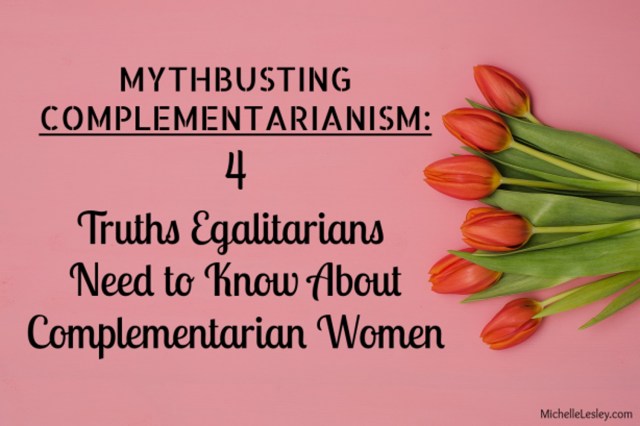
Mythbusting Complementarianism: 4 Truths Egalitarians Need to Know About Complementarian Women

Originally published May 31, 2019

I am often frustrated in my role as a complementarianยน woman. I am not frustrated by what God teaches in the Bible about my roles in the home and the church. I am not frustrated in carrying out those roles. I am not frustrated by complementarian men.

I am frustrated by egalitarians – most of the ones who have crossed my path, anyway – because of the incorrect assumptions they make about me and other complementarian womenยฒ.

And it’s not just that the assumptions are wrong, it’s that the assumptions are often hypocritically, “log in the eye,” wrong. Then, they turn around and use these false assumptions as reasons to fight against complementarianism. But the reasons don’t exist. They’re shadow boxing. Fighting against a ghost. If you’re going to fight for something, your fight should at least be based on legitimate reasons.

I’m under no delusions that this article will change the hearts and minds of egalitarians, but if I could, here’s what I’d try to help them understand…

1.
It’s a spiritual issue.

I know this isn’t going to be popular. I know I’m going to be called judgmental and harsh and any number of other printable and unprintable names, but I’m going to say this anyway because this is the crucial element on which this entire complementarian vs. egalitarian argument rests.

This is a spiritual issue. It’s not an oppressors versus victims issue, it’s not about power or position or circumstances or legalism or casting off shackles. It’s not about any of those visible, tangible, surface level things we think it’s about. This goes beyond the earthly realm and has its foundation in the invisible, spiritual realm. The reason you hold the positions and opinions you hold as an individual is based on one thing – your relationship with God. This is a me versus God issue. Do you love and obey God as a genuinely regenerated Christian, or do you reject Him and rebel against His commands as someone who is still lost?

The Bible makes crystal clear from Genesis to Revelation that people who genuinely know and love God obey Him, and that if you don’t obey Him, you don’t know Him or love Him. Over and over and over again we see this through Israel’s countless cycles of idolatry and the prophets calling them to repentance in the Old Testament, to John’s near broken-record repetition of the theme in the New Testament. Scripture is clear. Love of God and obedience to God are inextricably and irreducibly intertwined.

And by this we know that we have come to know him, if we keep his commandments. Whoever says โ€œI know himโ€ but does not keep his commandments is a liar, and the truth is not in him, but whoever keeps his word, in him truly the love of God is perfected. By this we may know that we are in him: whoever says he abides in him ought to walk in the same way in which he walked. 1 John 2:3-6

Additionally, if you’re not saved – a “natural man” – the things of God are folly to you. It’s not that you’re smarter or enlightened or have a different opinion than those who obey Scripture. It’s that you’re spiritually incapable of accepting, embracing, and obeying what God has told you to do. That’s why you see those of us who do as fools.

The natural person does not accept the things of the Spirit of God, for they are folly to him, and he is not able to understand them because they are spiritually discerned. 1 Corinthians 2:14

Let me say it plainly. If your general trajectory in life is to consistently find yourself angered by, indifferent to, or unable to accept the plain meaning of Scripture, and your heart persists in fighting back against God’s Word even if you’ve been biblically corrected, you are almost certainly not saved.ยณ That’s not me saying that. That’s a whole lot of Scripture saying that. Regardless of how saved you feel. Despite what you may claim to be. No matter what people have told you about your salvation. God says loving Him equals walking with Him toward embracing, loving, and obeying His commands. And that includes His commands about the roles of men and women.

This is the fundamental reason most egalitarians disagree with most complementarians. It’s usually not that either side doesn’t understand what the other side stands for. It’s that both sides generally do understand what the other side stands for and they reject the other side’s view because of where they are, spiritually.

(Addendum: After I published this article, a few people responded who seemed to misunderstand what I’ve said in this paragraph. Let me see if I can clarify:

1) You’ll notice I’ve used words/phrases (“most egalitarians,” “general trajectory,” “almost certainly,” etc.) indicating that this is a broad, general principle, not something that is universally deterministic about every single individual who has ever had an egalitarian-esque thought cross her mind.

2) I am not saying that holding to an egalitarian viewpoint is what makes someone unsaved. Rejecting the gospel is what makes someone unsaved. What I am saying is that most people who are already false converts gravitate toward the egalitarian viewpoint as a fruit of the pre-existing condition of being unsaved. It is a logical fallacy to turn that statement around and assume I mean the converse to be true.

3) I certainly believe it is possible for genuinely regenerated Christians to have good faith, incorrect interpretations or understandings of Scripture – starting with me. When my husband and I picked out wedding vows 26 years ago, I flatly refused to use any set of vows that said I would “obey” him and only grudgingly agreed to a set that used the word “submit” instead. Embarrassingly, in our wedding video, you can clearly hear me hesitate before repeating that part of the vows. About 10-15 years ago I held a position of local denominational leadership that I’m only now beginning to see I probably, in some respects, shouldn’t have held. One reason for that is that on two or three occasions the position required me to speak to local congregations during their midweek services on a biblical topic which could not be properly addressed without explaining Scripture. Do I think I was unsaved because I thought those things were OK at the time? Of course not. But I’ll tell you this – over time, the Holy Spirit convicted me of those things and I repented. And as I’ve grown in Christ my rebellious attitudes and misunderstandings of those Scriptures and others have increasingly come under submission to God’s Word.

That’s the kind of thing we’re talking about here – the general biblical principle that saved people are on a trajectory of increasing holiness and Christlikeness. Lost people are on a trajectory of increasing disobedience and rebellion (and not strictly with regard to egalitarian ideas). It is possible to be a saved, simul justus et peccator, growing in holiness, desiring to please the Lord, Christian and get some non-soteriological things wrong along the way, in good faith, in the process of growing. What is not possible is for someone to be genuinely regenerated and live in a general attitude of heart-rebellion against God, His Word, and His ways (His ways in general, not strictly egalitarianism) in favor of doing life on her own terms. I don’t know how to make that more clear. That is what the Bible teaches.

4) I clearly made the statement that this article pertains to “most of the [egalitarians] who have crossed my path”. I guess what I did not make clear is that most of the egalitarians who have crossed my path have not been the small minority of genuinely regenerated Christians who have made a good faith error about Scripture’s teaching on the role of women as they’re growing in Christ. That might be your experience, but it has not been mine. Most of the egalitarians who have crossed my path have clearly been of the vast majority of egalitarians who have come to that position, as I explained above, as a result of being false converts. And it shows in their demeanor as they mock the authority of God’s Word in general, lash out in rage, blaspheme, swear, and slander, and generally display the opposite of the Fruit of the Spirit.

5) As I’ve stated many, many times in my articles, the Bible is our authority as Christians, not a pastor or Christian leader who holds a particular position, not your loved ones who are in error but you’re certain they love Jesus, not any church or denominational structure or position that conflicts with Scripture – the Bible. If you are going to argue against a biblical principle, you need to support your argument with rightly handled, in context Scripture, not examples of fallible human beings – however godly or well-intentioned they might be. Scripture is our standard, not people.)


2.
Complementarian women don’t feel
oppressed and downtrodden.

Obviously I can’t speak for every complementarian woman out there, but I can say that of the dozens of women I know personally and the thousands who have followed me online for the last eleven years, and speaking for myself, I have never met a single, genuinely regenerated, complementarian woman who felt diminished, held back, chained up, or walked all over by the role God lays out for us in Scripture.

Do we sometimes sin by thinking and acting selfishly? Yep. Have there been husbands, pastors, and other men who have sinned against us? Of course. Do we have a bad day from time to time? Naturally. But none of that changes our delight in our role itself. Even people who have their dream jobs have nightmare moments, but there’s still nothing on the planet they’d rather do. Nothing that makes them feel more alive and fulfilled. And that’s generally how complementarian women feel about our job – maybe even more so, because it’s not just a job, it’s a calling from God Himself. And nobody has a better Boss than we do.

We don’t need your pity, egalitarians, any more than a kid in a candy store needs to be pitied. And we don’t need to be rescued, just like you wouldn’t think of trying to rescue a child from Disneyland. We’re not sitting around saying, “Woe is me,” and feeling like we’re losing out on life. For us, keeping God’s commands about our role is a delight and a joy, because we love Him:

For this is the love of God, that we keep his commandments. And his commandments are not burdensome. 1 John 5:3

for I find my delight in your commandments, which I love. Psalm 119:47

No one is happier, more fulfilled, or more content in life than the Christian who is living in the will of God by obeying Him. No one is more miserable than a false convert who is trying to obey God through sheer force of will, or a genuine Christian living in disobedience to God’s commands.

And if all of that seems foreign or ridiculous, folly or foolishness to you, unfortunately, you’re bearing out the biblical truth I explained in section 1 of this article.


3.
Complementarian women aren’t brainwashed.

Probably the most hypocritical sexist viewpoint of egalitarians is that they assume that Christian women couldn’t possibly have come to the complementarian worldview via our own study, intellect, will, and choice. We must have been brainwashed into it by sexist, misogynistic, abusive complementarian men. But if we could somehow manage to understand the viewpoint delivered by our egalitarian saviors, we’d see the light, cast off the shackles, and be set free from all that’s holding us back.

I’m not making that up. That’s essentially the diatribe I received from one of Beth Moore’s followers recently (and I’ve heard it plenty of times before). Beth had said on Twitter that the reason she was receiving so much pushback from Christians following her announcement that she would be preaching the Sunday morning service at a local church was because sexist men were just trying to protect their positions and power. To which I responded, “What about the pushback you’re receiving from complementarian women? Are we sexist and trying to protect positions and power, too?” No, her follower angrily replied, you’ve just be brainwashed by those men.

If egalitarians can’t see how arrogant, hypocritical, and sexist it is to stand on a pedestal and declare that they’re the ones who will empower women, ensure that women are heard and valued for their independent ideas and unique contributions, and then turn around and condescendingly assume that women who have used those very independent minds they themselves tout to reach a non-egalitarian conclusion are brainwashed, I’m at a loss as to how to explain it. It’s like trying to prove water exists to someone who’s sitting in a lake while drinking a glass of ice water.

Complementarian women are not brainwashed into our worldview. We are convinced by the study of Scripture and our love for God that His plan for men and women is best, beneficial, and a blessing.


4.
Complementarian women aren’t
limited or lesser, we’re specialists.

Oh, that poor cardiologist! He’s so limited in his profession. If only he could be a General Practitioner!

I just feel terrible for that guy – he only practices civil law! He doesn’t know what he’s missing by not also practicing criminal, personal injury, estate, real estate, corporate, family, and malpractice law!

If you ever had the misfortune of hearing someone say something so ridiculous, you’d probably think she was a little off her nut. In the professional world, we normally regard specialty positions as more prestigious than more generalized positions (not that that’s right – general medicine, law, etc. are equally important). Specialists usually go to school longer and have a unique skill set for a unique segment of the population. General practitioners don’t have the luxury of focusing on a more narrow field of study. They have to be a jack of all trades – all things to all people.

But somehow, for egalitarians, that concept doesn’t translate to complementarianism. In the complementarian church, male pastors, elders, and teachers are the general practitioners. Women are the specialists. We specialize in discipling women and children, because we have a unique, God-given skill set for ministering to that unique segment of the population. God has given us the luxury and freedom to concentrate on this population He has called us to serve without the added burden of also having to teach, disciple, and oversee men.

It’s much the same in the complementarian home. The husband is like the CEO of the family. The buck stops with him. Every. single. buck. The house. The wife. The kids. The car. The yard. The bills. Everybody’s health. The extended family. The spiritual leadership. Church involvement. Provision. Decisions. Everything is ultimately on his shoulders. This leaves the wife free to specialize in being the COO of the family – day to day, boots on the ground operation of the household – an equally important position, which, again, she has a unique, God-given skill set for carrying out. While she and her husband certainly work together, God has given her the freedom and the luxury of passing everything that’s not under her purview up the chain of command for someone else to deal with. If she needs something in order to do her job, she has someone to turn to to provide it.

The egalitarian worldview looks down on women who specialize in discipling women and children in the church and being the chief operating officer in the home. Our teaching only has value if there are men in the audience, which reeks of sexism. As if men are the standard, the high bar to be set, the only ones whose mere bodily presence can validate a woman’s teaching and suddenly make it worthwhile. Who cares about teaching women and children? Men are the important ones. Our role at home is only a worthy and important one if we’re the ones calling all the shots at the macro level. Never mind that things actually have to get done and be overseen at the micro level in order for every member of the household, including the CEO, to live, grow, and flourish.

Specialties aren’t limiting or lesser. There’s an equally prestigious and necessary place for GPs and specialized medicine. For general law and specialty law. For CEOs and COOs. For complementarian men and complementarian women.

The egalitarian view does not value women as women. It only values women who are cheap knock-offs of men. Complementarians are the ones who value women as a separate, and equally significant, unique creation of God – not measured by how well we can imitate a man, but measured by how well we live up to all God created us to be as women. And we’re supposed to feel oppressed, limited, and lesser by that? We’d have to be brainwashed to love a worldview that values us for what we are, not for clawing and scraping toward some impossible standard and state of being God never created us to reach?

When you set men up as the standard and tell women they have to measure up to men to have any value, what you are is not egalitarian. What you are is sexist.

No thanks. I’ll take the complement.


ยนThanks to the advent of everything-but-the-pastoral-office “soft complementarianism” I should probably add an adjective, like “biblical complementarian,” but I’m not ready to concede the term yet. Complementarian means you embrace the full biblical teaching of the roles of women and men. If you compromise on that, you’re a functional egalitarian. We only need two terms.
ยฒEgalitarians make incorrect assumptions about complementarian men, too, the main one being that they’re sexist, misogynistic, even abusive. Please. I’ll let complementarian men speak to that themselves, or this article will be way too long.
ยณSometimes people who are genuinely saved worry that they’re not. If you’re concerned about your salvation, I encourage you to work through my study AM I REALLY SAVED?: A 1 JOHN CHECK-UPand make an appointment with your pastor if you need counsel.
Mailbag

The Mailbag: Husbands, pastors, and mentors- Which roles do they play in a Christian woman’s life?

Originally published January 20, 2020

I have three questions that are kind of related to each other:

1 Corinthians 14:35 says women should ask their husbands questions at home; how does this fit with women mentoring other women in Titus 2?

Where does a husbandโ€™s role end and where does the role of a godly older woman begin in terms of teaching younger women?

Are there areas where a pastorโ€™s authority trumps a husbandโ€™s authority?

Thank you for your help.

These are really awesome questions. I love it when women ask questions that demonstrate that they’re digging into Scripture and thinking deeply about the things of God. It’s so exciting to me!

(Before I begin answering, let me just stipulate, as I usually do in articles about marriage, that the following statements assume a normal, relatively healthy, average marriage, not abusive marriages, extremely aberrant marriages, etc. Also, it’s not my intent to leave out my single sisters, but the reader asked specifically about married women, so that’s how I’m answering the questions.)

So let’s take each question separately…

1 Corinthians 14:35 says women should ask their husbands questions at home; how does this fit with women mentoring other women in Titus 2:3-5?

The first thing we need to do when we’re addressing questions like this is to look at each of these passages in context. This is a very simple study skill that will clear up nearly all instances of supposed contradictions in Scripture.

Read 1 Corinthians 14:26-40. What is the venue for Paul’s instructions in this passage? In other words, is he telling people how to behave at home? At work? At the movies? Look at the key phrases in verses 26 (“when you come together”) and 28,33b-35 (“in church”). Paul is giving instructions for how an orderly worship service is to be conducted. He is not making a blanket statement that any time any woman wants to know anything about Scripture or God or life in general that the only person she can ever ask questions of is her husband. What he’s saying is that in order to avoid chaos in the worship service, women are to sit down and be quiet during the preaching and teaching, rather than interrupting to comment or ask questions (one of the reasons Paul says this is that the women in the Corinthian church were doing just that – interrupting the preaching and teaching with questions and comments). If you read further in chapter 14, you’ll notice he places similar restrictions on prophesying and speaking in other languages to prevent chaos and confusion during the worship service. I’ve discussed this passage in further detail in my article Rock Your Role ~ Order in His Courts: Silencing Women?

Now read Titus 2. What’s the main idea of this chapter? Is it the same as the main idea of 1 Corinthians 14 – instructions for an orderly worship service? No. Verse 12 gives a nice summary of chapter 2: “renounce ungodliness and worldly passions, and to live self-controlled, upright, and godly lives in the present age.” That’s what this chapter is about. “Titus, here’s what your church members (and you) are to do and how they’re to conduct themselves as they go about the business of living as Christians in this world and in community with one another.” The older women teaching and training the younger women in verses 3-5 is not taking place during the worship service, but as these women go about daily life with one another. Today, this kind of teaching and training takes place in women’s Bible study classes, women’s fellowship groups, and in one on one discipleship, not in, nor instead of, the gathering of the whole church for worship.

So as we can see when we examine the context of both passages, 1 Corinthians 14:35 and Titus 2:3-5 are not in conflict, they’re actually in harmony, addressing two distinct ways women are to conduct themselves in two completely different venues.

Where does a husbandโ€™s role end and where does the role of a godly older woman begin in terms of teaching younger women?

I don’t think it’s really that discrete and linear, i.e. the husband teaches this list of topics the wife needs to be taught about and the godly older woman teaches that list of topics she needs to be taught about, and never the twain shall meet. It’s a much more informal and “whatever is needful at the moment” type of thing. Additionally, it’s going to vary from marriage to marriage. Some women have unsaved husbands. Some women are newly saved with husbands who have been saved for decades. Some husbands and wives are very private about everything, some are very open to others. So the balance between who (husband or older woman mentor) teaches what, and how much, and when, is going to look different in every marriage.

I would just offer a few guidelines:

โ€ข After your relationship with Christ, if you’re married, your highest allegiance is to your husband. He should be your best friend and first confidant, not a woman who’s mentoring you (or even your mother, sister, or female best friend). He should never feel like he’s in competition for your time, interest, or affinity with the woman who’s mentoring you, or that you esteem her on the same (or, perish the thought, higher) level of loyalty or emotional intimacy with him. If you’ve gotten that close to your mentor, you’re too close. Turn your attention toward your husband.

โ€ข Along those same lines, always keep in mind that God instructs you to submit to your husband, not your mentor. The only time you should ever follow your mentor’s advice over your husband’s desires is if your husband is asking you to do something the Bible clearly calls sin and your mentor is advising you to obey Scripture instead. (But even in that case, you’re not really choosing your mentor over your husband, you’re choosing to obey God rather than to sin.)

โ€ข There are some things that are private between a husband and wife that shouldn’t be shared with anyone, including a mentor. Which things? Again, that’s going to vary from marriage to marriage, but a few no no’s might include the private details of your sex life, your finances, and anything your husband would be embarrassed for someone else to know. Talk with your husband and ask if there’s anything he would rather you didn’t share with your mentor.

Are there areas where a pastorโ€™s authority trumps a husbandโ€™s authority?

It really depends on what you have in mind when you ask that question.

If you’re talking about personal decisions made between a husband and wife, let’s say, for instance, whether or not to move to a certain part of town or whether or not the wife should take a part time job, it is not the pastor’s place to step in and overrule the husband’s decision, nor should the pastor have any expectation that the couple would obey any edicts he issues. If the couple goes to him for counseling or asks for his advice, he can certainly give it, but we never see any place in Scripture where a pastor has authority over another family’s decisions. The husband is responsible before God for leading his family, not the pastor.

But if you’re talking about a situation in the church, then yes, a pastor’s (or the elders’) authority – assuming he’s abiding by Scripture – trumps a husband’s authority, and pretty much every other church member’s authority as well. For example, a husband does not have the authority to walk up to the pastor and say, “I’m going to let my wife preach the sermon next Sunday,” or “My wife is going to take over this Sunday School classroom and use it as her personal office.”. If a husband were to say something like that, the pastor is well within his authority as shepherd of the church to say, “Oh no she’s not.”. The buck stops with the pastor when it comes to how the church runs, and he is responsible before God for making godly decisions for the church.

I’m aware that there are aberrant, fringe “churches” (many of them are some stripe of New Apostolic Reformation or extreme legalism/fundamentalism) out there in which the “pastor” has ultimate authority over every decision a family makes: where they live, how many children they have, what to name their children, whether and where each spouse should work, etc. If you’re in a so-called church like that, leave immediately and find a doctrinally sound church to join. A church doesn’t plunge to that depth of spiritual abuse without succumbing to other dangerous false doctrines along the way.


If you have a question about: a Bible passage, an aspect of theology, a current issue in Christianity, or how to biblically handle a family, life, or church situation, comment below (Iโ€™ll hold all questions in queue {unpublished} for a future edition of The Mailbag) or send me an e-mail or private message. If your question is chosen for publication, your anonymity will be protected.

Discernment

Anne Graham Lotz

If you are considering commenting or sending me an e-mail objecting to the fact that I warn against certain teachers, please click here and read this article first. Your objection is most likely answered here. I won’t be publishing comments or answering emails that are answered by this article.


This article is kept continuously updated as needed.

I get lots of questions about particular authors, pastors, and Bible teachers, and whether or not I recommend them. Some of the best known can be found above at my Popular False Teachers tab. The teacher below is someone I’ve been asked about recently, so I’ve done a quick check (this is brief research, not exhaustive) on her.

Generally speaking, in order for me to recommend a teacher, speaker, or author, he or she has to meet three criteria:

a) A female teacher cannot currently and unrepentantly preach to or teach men in violation of 1 Timothy 2:12. A male teacher or pastor cannot allow women to carry out this violation of Scripture in his ministry. The pastor or teacher cannot currently and unrepentantly be living in any other sin (for example, cohabiting with her boyfriend or living as a homosexual).

b) The pastor or teacher cannot currently and unrepentantly be partnering with or frequently appearing with false teachers. This is a violation of Scripture.

c) The pastor or teacher cannot currently and unrepentantly be teaching false doctrine.

I am not very familiar with most of the teachers I’m asked about (there are so many out there!) and have not had the opportunity to examine their writings or hear them speak, so most of the “quick checking” I do involves items a and b (although in order to partner with false teachers (b) it is reasonable to assume their doctrine is acceptable to the false teacher and that they are not teaching anything that would conflict with the false teacher’s doctrine). Partnering with false teachers and women preaching to men are each sufficient biblical reasons not to follow a pastor, teacher, or author, or use his/her materials.

Just to be clear, “not recommended” is a spectrum. On one end of this spectrum are people like Nancy Leigh DeMoss Wolgemuth and Kay Arthur. These are people I would not label as false teachers because their doctrine is generally sound, but because of some red flags I’m seeing with them, you won’t find me proactively endorsing them or suggesting them as a good resource, either. There are better people you could be listening to. On the other end of the spectrum are people like Joyce Meyer and Rachel Held Evans- complete heretics whose teachings, if believed, might lead you to an eternity in Hell. Most of the teachers I review fall somewhere in the middle of this spectrum (leaning toward the latter).

If you’d like to check out some pastors and teachers I heartily recommend, click the Recommended Bible Teachers tab at the top of this page.


Anne Graham Lotz
Not Recommended

Perhaps best known for being Billy Graham’s daughter, Anne Graham Lotz “speaks around the globe…Her Just Give Me Jesus revivals have been held in more than 30 cities in 12 different countries, to hundreds of thousands of attendees.” She is the founder and president of AnGeL Ministries, her speaking, publishing, events, etc., organization.

While the core of Anne Graham Lotzโ€™s teaching historically hasn’t been radically off base, biblically, (i.e. sheโ€™s not blatantly teaching Word of Faith, NAR, or other heretical doctrine), she handles Scripture poorly, and there are too many red flags about her teaching and behavior to regard her as a trustworthy teacher of Godโ€™s word.

“Called ‘the best preacher in the family’ by her father, Billy Graham…” This opening sentence of her website is how Anne Graham Lotz has chosen to introduce herself to the world: as a female “preacher.” We could take this as a cute, antiquated father-daughter endearment if Anne did not, in fact, preach to men. However, she has no qualms about doing so herself and encouraging other women to do so, habitually violating this prohibition of Scripture. Just a few brief examples of the myriad available:

I Saw the Lord (Men clearly present in the audience at 7:29)

Vision of His Glory (Men clearly present in the audience at 3:36)

Preaching the Sunday sermon at Maranatha Chapel, 2/9/20. At 1:04, Anne says, “I’m very grateful for Pastor Ray giving me this opportunity…and for a pastor to give up his pulpit…I want to say thank you to him for that, and also for the statement that he makes concerning women in ministry…the fact that he would allow me to stand in his pulpit on a Sunday morning and speak to his congregation…so if you’re a woman in ministry, be encouraged.”

Preaching the Sunday sermon at Bridgeway Community Church, 2/16/20. At 0:40, Anne says: “I want to thank Pastor Anderson for his affirmation, his support, his encouragement, of women in ministry…To be in a church, on a Sunday morning, and for a pastor to give up his pulpit to me is a rare privilege.”. Two Sundays in a row. A nearly verbatim spiel. Not that “rare,” apparently.

Anne also yokes with numerous false teachers.

Priscilla Shirer and New Apostolic Reformation “pastor” Samuel Rodriguez have both written endorsements for one of Anne’s books. Rick Warren and Beth Moore have each written forewords for Anneโ€™s books.

Anne has written several devotions for Lysa TerKeurst’s Proverbs 31 website.

Anne calls false prophet and rabbi Jonathan Cahn her “friend” and publicly allies with him, spiritually.

Anne also participated in The Return, a September 2020 prayer and revival event organized by Cahn. Additionally, Anne sits on the board of advisors of The Return with Cahn and false teachers Pat Robertson, “Bishop” Harry Jackson, Robert Morris, Marcus Lamb, and John Kilpatrick, as well as Steve Strang– publisher/founder of Charisma Magazine, and Gordon Robertson- CEO of CBN.

Also participating in The Return1 were Che Ahn and Cindy Jacobs – “apostles” and major players in the New Apostolic Reformation, and Michael Brown, who often functions as an apologist for NAR (and other) false teachers on his radio program.

Again, Anne sits on the board of advisors for this event / organization. She cannot be ignorant as to who these people are and what they teach.

On the same day as The Return, Anne also delivered one of the featured prayers at her brother, Franklin Graham’s, Prayer March 2020. (It is unclear to me if, or how, these two events were connected.) Also featured at this event were numerous heretics and false teachers, including TBN (Trinity Broadcasting Network), Matt and Laurie Crouch (heads of TBN), Jonathan CahnJentzen FranklinRobert Morris, and Paula White.

Anne has appeared on disgraced televangelist and false prophet Jim Bakker’s show:

Anne participated in, promoted, and was a featured speaker at the 2020 Jerusalem Prayer Breakfast, an ecumenical event touted as a time for Jews and Christians to pray together in unity. (Christians are not to yoke with any unbeliever who denies Christ as the Messiah, including Jews.)

Anne has poor hermeneutics and often mishandles Scripture. In her excellent analysis, Anne Graham Lotz and Her Narcissistic Interpretation of the Transfiguration, Erin Benziger carefully and biblically walks us through Anne’s eisegesis and allegorization of the story of the Transfiguration.

In a video tease for her book, The Daniel Prayer, Anne completely ignores the context of 2 Chronicles 7:14 and claims it as God’s promise to America. 

The following year, as chair of the 2017 National Day of Prayer Task Force, Anne mishandled the same passage the same way, combined it with a mishandling of Daniel’s prayer in Daniel 9, and claimed that these passages are God’s promise to “heal” America’s moral ills if we will just pray hard enough. Neither of these passages are about, nor apply to the secular nation of America. They both pertain to God’s covenant people, Old Testament Israel, at a very specific point in history.

This is indicative of Anne’s general hermeneutic when it comes to anything having to do with politics, America, social issues, foreign relations, etc. Her standard practice is to eisegete all of those things into Old Testament Scripture, taking God’s warnings to Israel as though they were literal warnings to America, and claiming God’s promises to Israel as literal promises to America. This is not rightly handling God’s Word.

Anne’s teaching on extra-biblical revelation (i.e. “hearing God’s voice”) is muddled at best. At times, such as in this excerpt from her teaching video Journey to Jesus Part 1: How to Study the Bible

…she correctly emphasizes that God speaks through His Word, yet in this same video (and other venues such as this article at Decision Magazine, How to Know God’s Voice) she also seems to teach extra-biblical revelation by saying we can mistake other peopleโ€™s voices for the voice of God, that some people aren’t hearing God speak, and continually using phrases like โ€œlistening for Godโ€™s voice.โ€

In her article, Preprayer 2016 Anne explains and endorses unbiblical โ€œcircle-makingโ€ prayer. Similar to Mark Batterson’s book, The Circle Maker, Anne re-tells the story of Honi the circle-maker, then says:

As I look ahead into 2016, I feel compelled to draw a circle around this city, this state, this nationโ€ฆ and pray!  Until God answers. Do the same. Please.  On this first day of the New Year, draw your own circle.  Then pray for everything thatโ€™s inside of it.

As we might expect, with her numerous ties to false prophets and New Apostolic Reformation heretics, Ann has begun to dabble in NAR-esque prophesying.

In his July 7, 2014 episode of Fighting for the Faith, Chris Rosebrough deftly analyzes a message Anne says God gave her for the United States.

In the Charisma News article Anne Graham Lotz Gives Prophetic Warning About 2016, Anne predicts “As I look ahead into 2016, I believe our national and global situation will get worse,” and “I have been repeatedly warned in my spirit that the enemy is advancing. It’s something that I know.”

Anne seems to be a lovely and caring person, not to mention very patriotic. I know she’s a sentimental favorite to many because of her father. Those are all endearing qualities. But we must put feelings and nostalgia aside when we evaluate whether or not someone is qualified to teach. James 3:1 is clear that teachers will be judged more strictly, not given a pass because they’re nice people or related to a beloved spiritual figure. Anne consistently mishandles Scripture, yokes in ministry with heretics and false teachers, and preaches to men, encouraging other women to do the same. She is not a trustworthy teacher, and I recommend that you not follow or receive teaching from her.


Additional Resources:

Anne Graham Lotz at Berean Research


1If you closely follow conservative politics, you may wish to examine the list of names of the participants in The Return.