Random Ramblings Ruminations Resources

Random Ramblings, Ruminations, and Resources

We’ve got to stop meeting like this…only once or twice a year, that is. When I first started 4R, I kind of envisioned it as a four or five times a year feature, and now we’re at about once a year. Well, life happens, I guess.

It’s time for some Random Ramblings, Ruminations, and Resources! Ready, set, go!

#FreeJamesCoates

Have you been following the story of James Coates, Pastor of GraceLife Church in Edmonton, Alberta, Canada? He was recently arrested and imprisoned for obeying God rather than men by refusing to stop holding church services and refusing to bar those who desperately wanted to attend from coming in to worship, among other official Covid-related reasons that were given. The restrictions on gathering in that particular are are so strict they have effectively shuttered churches. (No, they cannot hold services outside {Have you ever been to Canada in February? I haven’t, and even I know that’s a ridiculous suggestion.} No, “online church” is not the same as gathering in person and it is not a biblical long-term substitute for gathering in person.)

I’m not alerting you to this situation in order to debate whether or not James and GLC should have given in to the draconian demands of their local government. (Frankly, I was shocked and downright embarrassed at some of the cruel and critical comments that were made about James and GLC- by people who profess to be Christians – on my social media platforms Wednesday when I posted about this. And after everything I’ve seen in ministry, it takes a lot to shock and embarrass me. Those folks ought to be ashamed of themselves. No such comments will be allowed on this article or my social media platforms. They will be deleted and you will be blocked.)

I’m asking you to pray.

Pray for James, his wife, Erin, and their children, and GLC. (If the name Erin Coates sounds familiar it might be because she was one of my sister speakers at the Open Hearts in a Closed World online conference last summer, and coming up again this summer.)

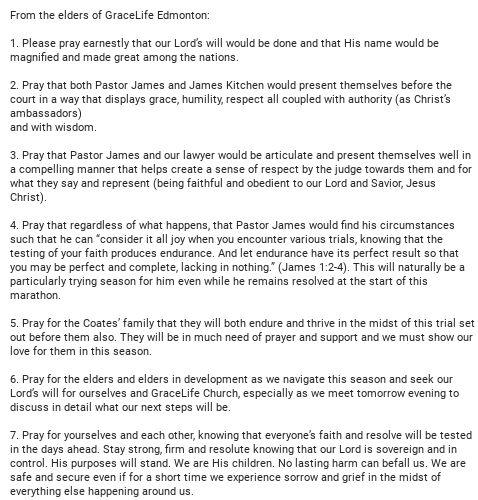
The elders of GLC have suggested these prayer points:

Erin’s Instagram handle is @erincoates80 if you’d like to follow her. Here is her most recent update as of the time I’m writing this:

What is something tangible you can do? Open your churches. Worship Christ. Practice the one anothers, sing your hearts out, let your pastor see your eyes as he preaches the word of God to you. Don’t underestimate this task in your life. Obey Christ with all you have.”

Erin says it better than I ever could.

Fakes and Frauds

If you haven’t already subscribed to Justin Peters’ YouTube channel, what are you waiting for? I know it’s super-duper long, but you’ve got to watch one of his most recent videos: 2020 The Terrible Horrible No Good Very Bad Year For The Prophets, especially if you’re unfamiliar with New Apostolic Reformation heresy as it relates to false prophets / prophecy. This will get you up to speed. Also included is an excellent interview with Nathan Busenitz on what Scripture says about false prophets.

Hymn and Hymn, but Not Hymn

You’ve heard that old joke, right? One Sunday morning, the minister of music announced from the pulpit, “In honor of Miss Doretha’s 80th birthday, we’re going to let her choose three hymns today.” Miss Doretha jumped breathlessly to her feet, scanned the room, and began pointing: “I’ll take him, him, and him!”

Well some young whippersnapper took it upon herself (a few years ago, but I only saw it recently) to pick 10 Christian Hymns That Need to Be Put to Rest. At least I’m inferring from the tone of the article that the author, Jennifer, is a young whippersnapper, because – I’m sorry, I’m honestly not trying to be mean here, but to me she comes off as a bit immature and shallow.

Or maybe I’m just old and curmudgeonly, having reached the “GET OFF MY LAWN!” stage of life.

Jennifer’s argument for putting several of these hymns out to pasture seems to be, “This hymn is too hard for people to understand,” or “People don’t understand what these words mean”.

By her logic, we should ditch the King James Version of the Bible, the Puritans (certainly Jonathan Edwards – my stars, have you ever tried to read his stuff?), the Reformers, and the early church fathers.

Schools should stop teaching Shakespeare, Beowulf, and Chaucer. And we should probably get rid of some of our patriotic songs too (I mean who knows what a “rampart” is, anyway?)

It’s just further reflective of the worldly attitude of dumbing things down to the level of people’s sloth (excuse me – “laziness” – since some may not know what “sloth” means).

How about, instead of getting rid of hymns and words people don’t understand, pastors and ministers of music take a second and teach the congregation what those words and hymns mean? Or the congregation could pull their phones out and Google it. We do that with everything else – why not do it with hard words and build our vocabularies and our knowledge base?

But there are some hymns that need to go due to theological issues with their lyrics. I’ve got two picks and then I’ll let you get in on the game. Click on the titles for lyrics. (Please note, I don’t really know anything about the people performing these songs, but I’m guessing I wouldn’t recommend them since it’s pretty hard to find doctrinally sound Christians singing songs that aren’t.)

The Savior is Waiting

It pains me to list this hymn as one that needs to be put to rest because I’ve been singing it all my life and have a deep sentimental attachment to it. Also the music is lovely, and I really do think the hymnist’s heart was in the right place when he wrote it. But…

The entire tenor of the first verse reminds me of a mom nagging her reluctant child to befriend the snaggle-toothed, bespectacled, nerdy little kid on the playground who’s running around offering his entire Hot Wheels collection if somebody – anybody – will just please, pleeeeeeeeeze, be his friend. Jesus is not some pitiful little weirdo whose day would be made if you would do Him the honor of sitting at His lunch table. He is loving and kind, yes, but He is also King of Kings and Lord of Lords, and we humbly bow the knee to Him.

And don’t even get me started on verse two. People who are dead in their sins can’t “take one step toward the Savior,” my friend. Christ has to raise us from the dead to new life in Christ.

Pass It On

This was the (depending on your age) Shout to the Lord, or Oceans, or Way Maker of my day, kiddies, and I have lots of fond memories attached to it, too. It was the song you sang at youth camp, and sometimes – if your minister of youth and music was cool, like ours was – during Sunday night church. (Some of my contemporaries will remember that we used to yell out, “Praise God!” after the phrase, “I’ll shout it from the mountaintop.”).

Whether or not the composer intended to base the opening words of this song – “It only takes a spark to get a fire going” – in Scripture, it evokes James 3:5b, which, in the most popular modern translation around the time this song was written said:

Consider what a great forest is set on fire by a small spark.

Which would be all well and good except for context, context, context. Because James 3:3-6 says:

When we put bits into the mouths of horses to make them obey us, we can turn the whole animal. 4 Or take ships as an example. Although they are so large and are driven by strong winds, they are steered by a very small rudder wherever the pilot wants to go. 5 Likewise, the tongue is a small part of the body, but it makes great boasts. Consider what a great forest is set on fire by a small spark. 6 The tongue also is a fire, a world of evil among the parts of the body. It corrupts the whole body, sets the whole course of oneโ€™s life on fire, and is itself set on fire by hell.

Scripture out of context…fires of hell…yeah, as peace, love, and “I’d like to teach the world to sing in perfect harmony” as this song is, I think it could be put to rest.

What do you think? Are there any hymns you think could be mothballed because of their unbiblical lyrics? Comment below and share. But play by the rules:

  • It has to be a non-contemporary hymn. Let’s say anything written between the first century and 1980.
  • None of this, “Everything from Bethel, Hillsong, and Elevation!” stuff. Everybody knows that already. This is about hymns.
  • “Because of their unbiblical lyrics.” Not because the hymnist him/herself apostatized, fell into sin, etc.
  • I get that all of this could be avoided if every church only sang the psalms. That’s beside the point.

OK, get out those hymnals and let’s hear it!

Faith Works

A few thoughts on Hebrews 11:8-19:

The original audience of Hebrews was first century Christians from Jewish backgrounds. Slavery to Law-keeping was so ingrained that the Holy Spirit gave them a chapter of “Old Testament Survey” (let the seminarian understand).

In this portion of the chapter, He demonstrates to them that the central figure of their faith, the one in whom they had their biological, tribal, and spiritual inheritance – Abraham – left them a legacy, not of Law-keeping, but of faith. Abraham believed God, and that is what was credited to him as righteousness, not any good deeds that he might have done. And, indeed that is the preeminent truth of the entire Old Testament: faith in God and in the Christ to come, not good works.

We are part of that same spiritual legacy of faith today. No amount of good works will save you: being a nice person will not save you, going to church, giving offerings, and serving at church will not save you, being baptized will not save you, praying to saints and other religious rituals will not save you, parroting a “sinner’s prayer” will not save you.

Only repenting of your sin and trusting that Christ’s death, burial, and resurrection paid the penalty for your sin of an eternity in hell will save you.

If you’ve never placed your faith in Jesus and been completely changed into a new creature in Christ with Christlike desires and a hatred for sin, how about doing that today? Check out the What Must I Do to Be Saved? tab in the blue menu bar at the top of this page for more information.

Faith

7 Ways to Endure to the End

For an A Word Fitly Spoken podcast version of this article,
please click here:

Facing an Uncertain Future


I don’t know about you, but over the past year, I’ve experienced moments of just about every emotion imaginable as I’ve walked through the various evil events filling up our 2020 calendars. Anger. Outrage. Offense. Depression. Anxiety. Fear. Frustration. Incredulity. Grief. Maybe you’ve had those moments too.

I’d like to give all of you a hug and say “Cheer up! Everything’s going to be fine!” – temporally speaking.

And maybe it will be.

But I don’t think so.

Sure, there are going to be times of blessing and happiness in our future, just like there were last year and every year before. But as far as the general trajectory American society and government are on, things are going downhill at breakneck speed. And unless we stop and think now, get prepared now, we’re going to be caught unawares and fail at what could be a crucial moment of decision.

Trials and persecution – real persecution – are coming. And coming sooner than we think. How can we be prepared to endure whatever comes our way until Christ returns?

1.
Go to church

Hebrews 10:24-25

I get it. “Go to church” isn’t as easy as it used to be. I get that some of your churches are closed. I get that there are health concerns.

But I also get that when the Holy Spirit inspired the author of Hebrews to pen these words, He knew full well, and, in His sovereignty had pre-ordained, all the details surrounding Covid and the restrictions and hassles that go along with it. And still He said that as the day of Christ’s return gets closer, we need to meet together (face to face, in person) more, not less.

Do we believe Him? Do we trust Him? Will we obey Him?

I don’t know you. I don’t know your situation. So, I can’t tell you what to do. All I’m saying is that as Covid restrictions drag on and on and on, maybe it’s time to reevaluate your church attendance in light of this command from Scripture:

  • If the primary reason you’re not attending church now is that your own church is closed, consider a friendly, loving chat with your pastor about his thoughts on the possibility of opening back up in some way, even if only partially. You can also check around and see if any other doctrinally sound local churches are meeting. If you find one, hang out with them until yours opens back up. Family is family, and you need the fellowship, teaching, and encouragement. Get to know the “cousins” down the street.
  • Are all the doctrinally sound churches in your area shut down due to government regulations and that’s the main reason you’re not going? Find another way to meet together with your brothers and sisters in Christ. Get on the phone with the members of your Sunday School class or a few others you know from church and plan to meet together for worship, prayer, and Bible study at your house, the park, wherever you can gather. I realize your local government may frown upon that. Governments all over the world have been prohibiting Christians from meeting together for 2000 years, and they meet anyway, underground. Looks like it might be our turn. Prayerfully consider whether it might be time to start walking out “we must obey God rather than men” in your context.
  • Perhaps it’s legitimate health concerns for yourself or your family that is keeping you away from the Lord’s house. Listen, I’m not a doctor, so I’m not qualified to dispense medical advice. All I can say is, check back in with your doctor (not the internet – your personal doctor) and ask if there are any new or different precautions you could take that would make going to church or gathering with a few others possible. Prayerfully and wisely weigh the potential health risks against the very real spiritual damage that occurs when you don’t gather with the Body.
  • Finally, take some time alone in prayer with the Lord and carefully and honestly examine your heart and your motives. Is the real reason you’re staying away from church laziness or an ungodly fear that stems from refusing to trust God? Only you can answer that. If you find that those are the actual reasons you haven’t been going to church, repent, and get your posterior back in the pew this Sunday.

God gave the command for the Body to gather knowing it would cost many Christians their lives and their freedom down through the years. But He gave that command anyway. That should tell us how utterly crucial it is for us not to neglect meeting together – out of obedience to Him, and for our own good.

There used to be a general sense of consistency, fair play, and “what’s good for the goose is good for the gander” logic in America.

That’s gone, and we need to get used to it.

As I write this, I could throw a rock out the window and hit a dozen tweets, articles, and podcasts decrying the hypocrisy and inconsistency of liberals. I’ve remarked on it myself. How there is one set of rules for them, but another set of rules for others, whether we’re talking about governors having Thanksgiving dinner with their extended families after telling you not to, or liberal evangelicals supporting BLM riots while decrying peaceful conservative protests and church gatherings. And they have absolutely no shame about their double standards.

Don’t expect that to change. Stand for what’s right, keep pointing out hypocrisy, but don’t expect people who support torturing babies in the womb to death and sexually abusing children via genital mutilation surgery to suddenly have an attack of conscience about holding themselves to one (or no) standard, and holding everybody else to another. They don’t care one whit about being fair and consistent – especially toward Christians. And if we keep expecting them to, it’s going to drive us mad.

These people are depraved, and this is spiritual warfare. Believers are unwelcome trespassers on the Devil’s playground, and he doesn’t play fair.

This is spiritual warfare. Believers are unwelcome trespassers on the Devil’s playground, and he doesn’t play fair.

3.
Expect betrayal

Give the gospels a good study again, keeping a special eye on Jesus’ enemies. Who were they? What positions did they hold? What tactics did they use? What was the real reason they wanted to destroy Him? When you have the answers to those questions, you’ll better understand who your real enemies are, and why they’ll turn on you when you least expect it.

Who was it who wanted to destroy – kill – Jesus for speaking the truth? Not the Roman government. It was the powerful and influential “church leaders” of Jesus’ day, the scribes and Pharisees. It was they who pursued Jesus, made false allegations against Him, and cajoled the government into executing Him because they wanted to preserve the position, power, and wealth they maintained by sleeping with, and fearing, the Roman enemy

If we let [Jesus] go on like this, everyone will believe in him, and the Romans will come and take away both our place and our nation.โ€ But one of them, Caiaphas, who was high priest that year, said to them, โ€œYou know nothing at all. Nor do you understand that it is better for you that one man should die for the people, not that the whole nation should perish.โ€

John 11:48-50

And who was it who betrayed Jesus into the hands of those bent on His destruction? His closest of friends and protรฉgรฉs – Judas. Judas, who, for the price of his greed, would give Jesus the kiss of a brother while thrusting a traitor’s knife into His back.

Then one of the twelve, whose name was Judas Iscariot, went to the chief priests and said, โ€œWhat will you give me if I deliver him over to you?โ€ And they paid him thirty pieces of silver. And from that moment he sought an opportunity to betray him.

Matthew 26:14-16

Judas, who, for the price of his greed, would give Jesus the kiss of a brother while thrusting a traitor’s knife into His back.

A servant is not greater than his master. If this is how “God’s people” treated Jesus, we can expect no less. Expect to be betrayed by those closest to you- a brother, a friend, a cherished member of your church family. Expect false teachers and influential evangelical leaders to cozy up to governmental leaders so they can hang on to their multi-million dollar “ministries,” minions, and mansions. Expect them to make sacrificial lambs of true sheep and shepherds. After all, better that one, or a hundred, or thousands of genuine Believers should die than that their nation or way of life should perish.

Those we hold dear will turn on us. Those we thought we could trust with our lives will deliver us up.

4.
Count the cost

Whoever loves father or mother more than me is not worthy of me, and whoever loves son or daughter more than me is not worthy of me. And whoever does not take his cross and follow me is not worthy of me. Whoever finds his life will lose it, and whoever loses his life for my sake will find it.

Matthew 10: 37-39

Count the cost, Jesus said. When He spoke these words, Jesus meant them – and His audience understood them – literally, not metaphorically. A cross wasn’t bearing up under insults on social media. It was a cross. Rough-hewn wood that real human beings were nailed to (after a thorough flogging, of course) to hang on for hours or days until they succumbed to one of the most agonizing deaths imaginable. “That’s your future if you follow Me,” He said to them – and to us.

Is staying true to Jesus worth losing your job…your closest loved ones…your freedom…your health…your dignity…your home and possessions…even your life? When you sing “I Surrender All” do you actually mean it? All? Do you love Jesus more? If you’ve never taken the time to sit down and seriously think about whether or not you’d follow Jesus all the way to a cross, do it now.

Count the cost, because the cost is a cross.

If you’ve never taken the time to sit down and seriously think about whether or not you’d follow Jesus all the way to a cross, do it now. Count the cost, because the cost is a cross.

5.
Embrace suffering

If you believe in your heart that robustly and unashamedly following Jesus is worth any cost, be prepared to suffer for it. Yet know that what man means for hurt and humiliation, Christ means for honor and high regard.

โ€œBlessed are those who are persecuted for righteousness’ sake, for theirs is the kingdom of heaven. โ€œBlessed are you when others revile you and persecute you and utter all kinds of evil against you falsely on my account. Rejoice and be glad, for your reward is great in heaven, for so they persecuted the prophets who were before you.”

Matthew 5:10-12

and when they had called in the apostles, they beat them and charged them not to speak in the name of Jesus, and let them go. Then they left the presence of the council, rejoicing that they were counted worthy to suffer dishonor for the name. 

Acts 5:40-41

Suffering for the name and sake of Christ is an honor.

Be prepared to suffer for following Jesus. Yet know that what man means for hurt and humiliation, Christ means for honor and high regard.

6.
Know your Bible

When oppressors want to stamp out an ideology – like Christianity – that threatens their agenda, the first thing they do is quash speech about that ideology. And then they come for the books.

Over the last few years, how many times have you heard of Christians getting in some sort of trouble for sharing the gospel? For refusing to call a “he” a “she” or a “she” a “he”? For saying homosexuality is a sin? For declining to “repent” of racism they haven’t committed?

We’re already seeing the suppression of speech. The written word is next on the chopping block. Bibles will be confiscated and disposed of. Publishing houses that produce Bibles and other Christian materials will be shut down. Big tech will de-platform Bible apps, Christian podcasts, Christian bloggers, and all other forms of doctrinally sound Christian media.

And we’ll probably even see something worse: the powers that be changing the written word of God to fit their own agenda. How easy would it be for someone in power to stroll through the back door of your Bible app and begin changing, adding, or deleting whole verses and passages until the “Bible” says what they want it to say? Think that kind of thing could never happen here? It’s already happening in China.

Make sure you have a good, reliable, hard copy (the kind with paper pages) translation of the Bible on hand. (You might even want to start stockpiling them to quietly give away when owning God’s Word becomes illegal.) Study it forward, backward, and inside out until you know what it says so well you could spot a modification a mile away. Memorize it. Because they can take away the copies in our hands, but they can’t touch the Word hidden in our hearts.

7.
Believe God

Pressing on in the face of all these daunting circumstances would be impossible if God were not who He is. But because of all that He is, we can hope in Him and endure anything that comes our way.

When you don’t know what to do, He says: Trust Me. I’ll give you wisdom and guide you.

When you have to do hard things, He says: I’ll strengthen you and help you.

When you’re weary from fighting the good fight, He says: I’ll give you rest.

When you’re afraid, He says: Fear not. I am with you.

With our pampered lifestyle of freedom and ease, many of us have never experienced a moment in which our only option – for provision, for protection, for help – was to cry out to God and trust Him to take care of us. I daresay, in the days ahead, those moments will come with increasing frequency. And that’s not a bad thing.

Because God loves you. He cares for you. He can be trusted. You can depend on Him.

What’s coming our way next? It’s hard to know exactly, but we can see the handwriting of persecution and trials on the wall. So gather with the Body and encourage each other. Be wise to the ways of the enemy. Ready yourself for betrayal and suffering. Know God’s Word. Trust God to carry you through.

Because Christ’s return is drawing near. It’ll be here before we know it. And we can endure ’til then.

Mailbag

The Mailbag: Asked and Answered

Have I told you lately that I love you? (Some of us are old enough to remember that song! :0) I really do love all of you readers and followers. It is an honor and a joy to serve you in Christ.

Sometimes in an article I’ll say something like, “If you’ve been around the blog for a while, you probably know that…yada, yada, yada.” Well, some of y’all haven’t been around the blog for a while, and to that, I say welcome! It’s always great to have more of the fam gathered ’round.

But because some of y’all are new, you aren’t yet aware of all of the resources here to help you. Let’s remedy that!

First, if you’re new (or if you’ve never read it), check out Blog Orientation for New Readers and Old Friends. It’s like a Cliffs Notes intro to the blog.

Second, be sure to familiarize yourself with all of the tabs in the blue menu bar at the top of the page. That’s where I keep the info I’m most frequently asked about.

Third, there’s a search bar at the bottom of every page (and one in the blue menu bar at the top of every page) which might help you find what you need.

And finally, let me get you newbies some answers to the questions several of you have asked recently. Some of you long time friends may have missed these along the way, so I hope they’ll be helpful to you, too!

Are there any sound Christian musicians anymore?

Yes, they’re just few and far between, and not as well known as the unsound ones. Check out this article which contains both artists to avoid and doctrinally sound artists, plus other helpful resources:

The Mailbag: False Doctrine in Contemporary Christian Music


My sister just got ordained by her church as a minister, also she is involved in deliverance ministries. She believes that God speaks outside of Scripture and promotes many false teachers. I’ve been praying for wisdom and compassion and the right opportunity to share. Any suggestions you may have would be greatly appreciated.

It is heartbreaking when a loved one forsakes sound doctrine and does a swan dive into the cesspool of rebellion and false teaching. If you need to approach a loved one in a situation like this, here’s some help:

The Mailbag: How should I approach my church leaders about a false teacher theyโ€™re introducing? (While this article is about approaching church leaders about false teachers, the same basic principles apply when approaching a loved one.)

Clinging to the Golden Calf: 7 Godly Responses When Someone Says Youโ€™re Following a False Teacher 

Discernment: A Spiritual Battle, Not a Logical One 

Discernment: Whatโ€™s Love Got to Do with It? 

Words with Friends: How to contend with loved ones at A Word Fitly Spoken


Which translation of the Bible do you recommend?

I think the two best English translations out there right now are the English Standard Version (ESV) and the New American Standard (NASB). I also highly recommend the MacArthur Study Bible. Check out more info on Bible translations, some to avoid, and more great resources here:

The Mailbag: Which Bible Do You Recommend?


Are you on any other social media that is in favor of free speech? I have deleted Twitter and am attempting to get off Facebook but I would still like to follow you.

This is an important one with all the censorship that’s taking place on the major platforms right now. I am currently on Facebook, Twitter, Instagram, Pinterest, MeWe, Parler, and Gab. (I also have a YouTube channel, but I’m not really using it at the moment.) My plan is to remain on Facebook and Twitter (and probably Instagram since it’s owned by Facebook) until I’m banned, then utilize my remaining platforms. You can always find the direct links to all of my social media accounts in the Contact and Social Media tab in the blue menu bar at the top of this page.


I have tried without success to find the answer to: As a woman is it violating 1 Timothy 2:11-12 for me to present the gospel to a man?

There’s a lot of confusion about what it means to “present the gospel” or “share the gospel” or “evangelize”. Some people use those as catchall terms for everything from a woman pastoring a church, to a mom reading a Bible story to her 2 year old, to posting a Bible verse on Facebook. If what you mean is a one on one conversation with a man in which you explain to him that he is a sinner, and how he can be saved (which is the actual defintion of the aforementioned terms), then the answer to your question is no. It is not a violation of Scripture for a woman to do that. See #11 here.

Got questions about the role of women in the church? Check out these resources:

Rock Your Role: A series of articles examining the Scriptures which pertain to the role of women in the church

Rock Your Role FAQs: Frequently asked questions about real life roles and activities in the church and whether or not women may biblically participate in them


Is X teacher, pastor, or author doctrinally sound?

Check the Popular False Teachers & Unbiblical Trends tab in the blue menu bar at the top of this page. These are the teachers I’ve actually written articles on.

If you don’t find the person you’re looking for there, find the search bar and type in the person’s name. (Make sure you spell it exactly right.) I may have mentioned the person you’re looking for in an article about someone or something else.

If you do both of these and you don’t get any hits, you can be confident that I haven’t written anything on the person you’re looking for. You’re welcome to email me asking about that teacher, but as you know (having read the “Blog Orientation” article linked above) I most likely won’t be able to answer. That brings us to our final resource here at the blog for researching and vetting teachers:

Is She a False Teacher? 7 Steps to Figuring it Out on Your Own


Who are some pastors, teachers, and authors you recommend?

You’ll find a list of several dozen at the Recommended Bible Teachers tab in the blue menu bar at the top of this page.


I live in X area. Can you help me find a doctrinally sound church?

The Searching for a new church? tab in the blue menu bar at the top of this page has multiple church search engines, churches recommended by my readers, information on church planting, what to look for in a doctrinally sound church, and how to biblically leave your current church. Just click and start searching!

Just a couple of notes:

  • You’ll have to do the legwork of searching and vetting the churches for yourself. I can’t do that for you.
  • If you’ve thoroughly searched every single search engine and can’t find an established church within achievable driving distance of your home, you may need to check around with local friends or denominational agencies, move, or start utilizing the church planting resources. You can email me, but I’m afraid I won’t be able to help. As I once joked with a friend, “I’m not Walmart. I don’t have any churches in the back stock room. Everything I have is out on the shelves.” :0)

Can you recommend a good women’s Bible study?

Yes, mine. You can find all of them – all free and all suitable for individual or group study, along with my philosophy of Bible study – at the Bible Studies tab in the blue menu bar at the top of this page.

No, I mean, can you recommend a pre-packaged book, DVD, etc., study by a well known Christian author?

No, because I recommend that women study straight from the text of Scripture itself (which is what my studies are designed to teach women how to do).

The Mailbag: Can you recommend a good Bible study for women/teens/kids?


If you have a question about: a Bible passage, an aspect of theology, a current issue in Christianity, or how to biblically handle a family, life, or church situation, comment below (Iโ€™ll hold all questions in queue {unpublished} for a future edition of The Mailbag) or send me an e-mail or private message. If your question is chosen for publication, your anonymity will be protected.

Bible Study

Throwback Thursday ~ 10 Simple Steps to Plain Vanilla Bible Study

Originally published April 22, 2016.

plain vanilla

Baskin Robbins is one of my favorite places to get ice cream. Not only is their ice cream good, but they boast a plethora of flavors to choose from. I love to start at one end of the counter and work my way through all their offerings, getting a little “taste spoon” here and there if a particular flavor piques my interest.

Flavor_Enlarged_Peanutbutter'nChocolate2
Photo courtesy of BaskinRobbins.com.

Having a myriad of options is great when it comes to ice cream, but when it comes to studying the Bible, the tsunami of materials, methods, and other choices out there can be overwhelming. Where do I start? How do I know if a certain Bible study book or teacher is doctrinally sound? Is the study method I’m using in line with good hermeneutics?

It can be enough to make you throw your hands up in the air and head for your local Thirty One Flavors to drown your sorrows in Peanut Butter ‘N Chocolate.

Sometimes it can help to get back to plain old, simple, vanilla Bible study. I’ve been saying for a while now that Christian women should, for the most part, put all the “canned” Bible study books, workbooks, and DVDs aside and simply pick up their Bibles and study them in a systematic way. After all, up until somewhere near the latter half of the 20th century, that’s generally how people studied the Bible. And it worked. People grew in their faith to godly maturity just fine. So, why can’t it work today?

It can. It does. It will.

Unfortunately, the blessing of lots of options, methods, resources, and information, and the marketing of that blessing by celebrity Christians and Christian retailing, has bred a generation of Christian women who are fearful that they aren’t as smart or as capable of reading and understanding God’s word as all the “experts” out there. They look at the simplicity of picking up their Bibles and studying them like calves looking worriedly at a new gate.

“What does that mean?”

“How do I do that?”

“I’m scared I’ll get it wrong!”

It absolutely breaks my heart to hear this angst from women who, I’m certain, genuinely want to study God’s word correctly so that they can know Him better and grow in their faith. And it makes me livid at the churches who haven’t trained them properly, the plantation-style women’s “Bible study” marketing that has kept them ignorant and dependent slaves to Christian retailers, and whatever other forces have conspired to keep these precious ladies away from the pure milk of the word.

So let’s reboot, get back to basics, and get as many women digging into the Word as possible.

First, it’s important to start out with a biblical perspective:

1. God is kind, and He loves you.

Yeah, I know, that’s pretty basic. But it’s worth bringing to the forefront for this discussion. This is a God who loves you and wants you to know Him. He has revealed Himself to you through creation, through Christ, and through His written word. He has indwelt you as a believer with the Holy Spirit to help you understand Scripture. He has told you that you can ask for wisdom and promises to provide it. In His kindness God has bent over backwards to provide you with ways to know Him. He is not some mean ogre sitting up there just waiting for you to get something wrong so He can chastise you. He wants you to understand His word.

2. The Perspicuity of Scripture

There’s this really great, comforting, reassuring doctrine called the perspicuity of Scripture. The gist of it is that Scripture is, for the most part, clear and understandable, especially for believers, because of the aforementioned indwelling of the Holy Spirit. But even lost people tend to understand a lot of what Scripture says (that’s why you hear so many of them arguing against it – they couldn’t do that if they didn’t at least partially understand it).

So, by and large, if you’re reading the Bible in an orderly way you should be able to understand it fairly well. You don’t have to have a seminary degree or be an “expert.” There are dirt farmers and country preachers out there who have a better grasp of Scripture than some celebrity pastors in multi-million dollar churches with thousands of congregants, and a string of seminary degrees behind their names.

OK, now that we have a biblical perspective on studying the Bible, how do we do it in a systematic or orderly way?

3. Pray

Don’t see this as childish or unimportant and skip it. Start your Bible study time by asking God to help you understand His word, to learn what He wants you to learn from it, and to obey its instruction. Even if you’re pretty well versed in the Scriptures, praying like this before opening God’s word will remind you of its holiness and your proper place of humility and submission to it.

bible-1089968_12804. Read the Bible the way you would any other book.

When you pick up a novel, do you read one sentence out of the middle of chapter 4, followed, the next day, by a paragraph from chapter 37, and, the next day, a couple of lines from chapter 1? Of course not. You wouldn’t know what was going on and what the characters meant by what they were saying. If you wouldn’t read something as inconsequential as a novel this way, why would you read the Bible in such a haphazard manner? Yet this is precisely the way people often approach daily Bible study.

My pastor said something awesome about this in his sermon the other day:

The Bible isn’t Google for self-help.

And he’s so right. We don’t just parachute in to a random passage, hoping to glean a nugget of truth. Pick a book of the Bible (maybe Genesis or one of the gospels if you’re new to all this), start at the beginning, and read a little each day until you reach the end. It’s really that simple.

5. Context, context, context

It’s important to read and understand Scripture in its context: how a verse fits with the verses immediately surrounding it, within its chapter, within its book, and within the overarching narrative of the Bible. This is really the biggest key to comprehending Scripture. Fortunately, the main way to do this is by reading the Bible in an orderly way (see #4- You did already read #4, right?)

Another invaluable practice is to make use of the cross-references and footnotes in your Bible. Cross-references will help you get a better idea of how the passage you’re reading fits together with other, related passages. Footnotes are there to add a touch of clarity to particular words and passages.

6. Get a plan, Fran.

If structure helps you, choose a good Bible reading plan. For the beginner, start off with one of the shorter plans so you won’t get overwhelmed. When you’re ready, I highly recommend the chronological plan. It is extremely helpful for learning the big picture of Scripture.

If you decide to choose a reading plan, though, hold its schedule loosely and don’t be beholden to its time frame. Work through the readings at your own pace. Take the time to let the Scriptures sink in and spend as long as you need to on any given section. God doesn’t give gold stars for finishing the Bible in a year.

7. Understand the background and setting.

There are some passages in Scripture that are a little more difficult to understand if you don’t know the customs of the time or what was going on historically and politically. In these cases a good study Bible, commentary, and other resources can be beneficial. I’ve touched on the specifics of some of these resources here. Many of these helpful materials can be found on-line for free.

8. Take notes on the text.

Hmm…an orderly method of reading…footnotes…extra resources…taking notes…this is starting to sound like…well…studying! Yep, that’s the idea. Isn’t it interesting that we often take a more serious and scholarly approach to studying for a class or a test than we do to studying our Bibles?

If you were a better student than I was in high school and college, you probably took notes on your text books as you read them. You wrote down things you wanted to remember, things that seemed important, things you didn’t understand and wanted to work on more later, things that were especially meaningful, even questions that occurred to you. Those are all good things to write down as you study your Bible, as well.

presenter-1206345_12809. Listen to good preaching.

As a Christian, you should already be doing this at least weekly at the church you’re a member of. But try to sneak in some extra listening – to your own pastor or another doctrinally sound pastor – as often as you can during the week. Listening to someone rightly handle and explain God’s word helps you to understand it and trains you to rightly handle it yourself as you study.

I once read that children who read a lot are better spellers. Not because they study spelling more, but because they’re exposed to more words and have the correct spelling of words constantly in front of their eyes. They sort of soak up good spelling by osmosis, and when it’s time for the spelling test, they simply write down what they’ve absorbed. Listening to good, expository preaching can have the same kind of helpful impact on your Bible study skills.

10. Practice makes perfect.

Studying the Bible is just like any other skill. You’ll probably fumble around a good bit when you’re first getting started, but if you stick to it, you’ll find that it gets easier and you get better at it as time goes by. Don’t be afraid to start. Jump right in there and try. Nothing ventured, nothing gained, right?


Ladies, simply picking up the Bible and studying it each day is such a joy. I have been doing it for years, and I love it. The excitement of “digging for buried treasure” in God’s word and uncovering the truths of Scripture for myself has been far more meaningful to me and has grown me so much more than any workbook or curriculum I’ve ever used. I hope you’ll put aside your book studies and devotionals, and give it a try yourself!

Bible Study

A Hard Bible for Hard Times

These days, popular women’s “Bible” studies tend to be seven lessons of fluff, feelings, and false doctrine.

This is the “anti-study”.

Roughly 20 lessons of digging into the text of what can be a challenging passage of Scripture.

I believe you’re up for the challenge, ladies. Let’s study.

A couple of days ago, I launched Ezekiel – our new Bible study here on the blog – with these introductory remarks on social media. I made it pretty clear, both in my social media remarks and the introduction to the study itself that this wasn’t going to be your typical walk-in-the-park women’s “Bible” study designed to make you feel better about yourself.

Ezekiel is a long book. There are parts of it that are going to be hard to understand. There are parts of it that, to our flesh, are going to be boring. There are cubits. Lots and lots of cubits. This is a Bible study that’s going to require extra work – probably with commentaries and study Bibles. And I’m not making any “feel good” guarantees.

And yet, I was overwhelmed by the response from so many readers: “I’m in!” “Sign me up!” “Looks like a good time!” “Excited is an understatement!”

All this about….a hard text? More work? Even as we endure Corona and quarantine, separation from loved ones, the shuttering of our churches, economic hardship, increasing persecution, racial strife, rampant crime, rioting, anarchy, and God only knows what’s next?

Yeah. Want to know why?

It’s the same reason that being bone-weary after a long day of hot, sweaty yard work feels better than the mind-numbed sleepiness you feel when you’ve been binge-watching Netflix in your pajamas all day. The same reason you feel better after a satisfying, well-balanced meal than after snarfing a dozen Oreos.

It’s what we need.

It’s what’s good for us.

It’s accomplishing something lasting.

We need a hard Bible in these hard times.

Think about the hard times the first century Christians of the New Testament went through. For refusing to offer a pinch of incense in worship to Caesar, for declaring that Jesusย aloneย – not Jesus plus the pantheon – is Lord, they were fed to the lions for sport, burned and boiled alive, crucified, beheaded, speared, beaten, stoned, whipped, exiled, and considered “the scum of the world, the refuse of all things.”

And for most of that first century, the bulk of the Scriptures Believers had access to was the Old Testament. The part that soft, milquetoasty, “I want a God made in my own image” evangelicals today want to “unhitch” from preciselyย becauseย it’s hard.

While fearing for their very lives for following Christ, our forefathers in the faith studied the God who flooded the earth for its rebellion against Him, who wiped out pagan nations for their idolatry, who sent horrific plagues upon those who defied Him, and who poured out His wrath on His own people for their sin and spiritual whoredom.

They had a hard Bible during their hard times.

To be sure, they saw, and we also see, the God of mercy, love, and grace who spared Noah, who provided His children with a land flowing with milk and honey, who rescued the Hebrews out of slavery, and who blessed all who were faithful to Him. And we know that all of Scripture – the hard to swallow parts and the easy to embrace parts, the “dig in and study hard” parts and the simple and sweet to the soul parts –ย all of Scripture is profitable.

But we need a hard Bible for hard times.

Because hard passages that make us stop and spend extra time and effort build discipline, endurance, and patience into our spirits. They make us do the hard work of digging for the nature and character of God and reward us with the treasure of knowing Him more intimately. They show us who God is in a unique way that the easy passages do not.

Feelings, fluff, and false doctrine can never accomplish those ends. They do not prepare us to endure suffering and persecution with strength and dignity, but to whine and complain and focus on the hurt. They do not teach us who God truly is in our trials and temptations, but that we can create a custom-made idol we’re comfortable with and call it “God”. They do not lead us to trust and obey God when the going gets tough, but to abandon His Word and His statutes in favor of worldly means and methods of dealing with difficulties.

Most evangelical women today are spiritually flaccid because no one – not their denomination, nor their church, nor their pastor, nor their Sunday School teachers, nor their women’s ministry leaders, nor their favorite “Bible” study authors – has ever made them do the hard work of wrestling with challenging Scriptures, overcoming them, and adding that victory to their inventory of joy in Christ.

We need to raise the bar.

We need to expect more, not less.

We need to encourage the pink side of the pew to do hard spiritual things, and cheer them on and help them as they try.

The Kingdom doesn’t need weak women who don’t know their Bibles because all they’ve been taught – and all they’ve been taught to hunger for – is feelings, fluff, and false doctrine. Because those women crumple in the face of controversy. They fall away rather than stand and fight.

The Kingdom needs strong, godly women who apply their hearts and minds to knowing and understanding God’s Word and reach down to help their weaker sisters do the same.

Hiding God’s Word in our hearts doesn’t just mean we learn the surface-level do’s and don’t’s, giving us a spiritual Post-It note reminder not to lie and steal. In order to hide something, we first have to possess it. Own it. And to own God’s Word we have to plunge in and swim in it. Breathe it in and out. Drink deeply of it. Eat the honey-sweet scroll. Let it so penetrate our souls’ DNA that when the rooster begins to crow, and the accusers point and say, “I know you. You were with Jesus,” we can plant our feet firmly and mean it when we boldly declare, “Yes. And though others may fall away because of Him, I will never fall away. Even if I must die for Jesus, I will not sin by denying Him.โ€

Because those hard times are coming.

Indeed, they are already here.

And we need a hard Bible for hard times.