Baskin Robbins is one of my favorite places to get ice cream. Not only is their ice cream good, but they boast a plethora of flavors to choose from. I love to start at one end of the counter and work my way through all their offerings, getting a little “taste spoon” here and there if a particular flavor piques my interest.
Photo courtesy of BaskinRobbins.com.
Having a myriad of options is great when it comes to ice cream, but when it comes to studying the Bible, the tsunami of materials, methods, and other choices out there can be overwhelming. Where do I start? How do I know if a certain Bible study book or teacher is doctrinally sound? Is the study method I’m using in line with good hermeneutics?
It can be enough to make you throw your hands up in the air and head for your local Thirty One Flavors to drown your sorrows in Peanut Butter ‘N Chocolate.
Sometimes it can help to get back to plain old, simple, vanilla Bible study. I’ve been saying for a while now that Christian women should, for the most part, put all the “canned” Bible study books, workbooks, and DVDs aside and simply pick up their Bibles and study them in a systematic way. After all, up until somewhere near the latter half of the 20th century, that’s generally how people studied the Bible. And it worked. People grew in their faith to godly maturity just fine. So, why can’t it work today?
It can. It does. It will.
Unfortunately, the blessing of lots of options, methods, resources, and information, and the marketing of that blessing by celebrity Christians and Christian retailing, has bred a generation of Christian women who are fearful that they aren’t as smart or as capable of reading and understanding God’s Word as all the “experts” out there. They look at the simplicity of picking up their Bibles and studying them like calves looking worriedly at a new gate.
“What does that mean?”
“How do I do that?”
“I’m scared I’ll get it wrong!”
It absolutely breaks my heart to hear this angst from women who, I’m certain, genuinely want to study God’s Word correctly so that they can know Him better and grow in their faith. And it makes me livid at the churches who haven’t trained them properly, the plantation-style women’s “Bible study” marketing that has kept them ignorant and dependent slaves to Christian retailers, and whatever other forces have conspired to keep these precious ladies away from the pure milk of the Word.
So let’s reboot, get back to basics, and get as many women digging into the Word as possible.
First, it’s important to start out with a biblical perspective:
1. God is kind, and He loves you.
Yeah, I know, that’s pretty basic. But it’s worth bringing to the forefront for this discussion. This is a God who loves you and wants you to know Him. He has revealed Himself to you through creation, through Christ, and through His written Word. He has indwelt you as a Believer with the Holy Spirit to help you understand Scripture. He has told you that you can ask for wisdom and promises to provide it. In His kindness God has bent over backwards to provide you with ways to know Him. He is not some mean ogre sitting up there just waiting for you to get something wrong so He can chastise you. He wants you to understand His Word.
2. The Perspicuity of Scripture
There’s this really great, comforting, reassuring doctrine called the perspicuity of Scripture. The gist of it is that Scripture is, for the most part, clear and understandable, especially for Believers, because of the aforementioned indwelling of the Holy Spirit. But even lost people tend to understand a lot of what Scripture says (that’s why you hear so many of them arguing against it – they couldn’t do that if they didn’t at least partially understand it).
So, by and large, if you’re reading the Bible in an orderly way you should be able to understand it fairly well. You don’t have to have a seminary degree or be an “expert.” There are dirt farmers and country preachers out there who have a better grasp of Scripture than some celebrity pastors in multi-million dollar churches with thousands of congregants, and a string of seminary degrees behind their names.
OK, now that we have a biblical perspective on studying the Bible, how do we do it in a systematic or orderly way?
3. Pray
Don’t see this as childish or unimportant and skip it. Start your Bible study time by asking God to help you understand His Word, to learn what He wants you to learn from it, and to obey its instruction. Even if you’re pretty well versed in the Scriptures, praying like this before opening God’s Word will remind you of its holiness and your proper place of humility and submission to it.
4. Read the Bible the way you would any other book.
When you pick up a novel, do you read one sentence out of the middle of chapter 4, followed, the next day, by a paragraph from chapter 37, and, the next day, a couple of lines from chapter 1? Of course not. You wouldn’t know what was going on and what the characters meant by what they were saying. If you wouldn’t read something as inconsequential as a novel this way, why would you read the Bible in such a haphazard manner? Yet this is precisely the way people often approach daily Bible study.
My pastor said something awesome about this in his sermon the other day:
The Bible isn’t Google for self-help.
And he’s so right. We don’t just parachute in to a random passage, hoping to glean a nugget of truth. Pick a book of the Bible (maybe Genesis or one of the gospels if you’re new to all this), start at the beginning, and read a little each day until you reach the end. It’s really that simple.
5. Context, context, context
It’s important to read and understand Scripture in its context: how a verse fits with the verses immediately surrounding it, within its chapter, within its book, and within the overarching narrative of the Bible. This is really the biggest key to comprehending Scripture. Fortunately, the main way to do this is by reading the Bible in an orderly way (see #4- You did already read #4, right?)
Another invaluable practice is to make use of the cross-references and footnotes in your Bible. Cross-references will help you get a better idea of how the passage you’re reading fits together with other, related passages. Footnotes are there to add a touch of clarity to particular words and passages.
6. Get a plan, Fran.
If structure helps you, choose a good Bible reading plan. For the beginner, start off with one of the shorter plans so you won’t get overwhelmed. When you’re ready, I highly recommend the chronological plan. It is extremely helpful for learning the big picture of Scripture.
If you decide to choose a reading plan, though, hold its schedule loosely and don’t be beholden to its time frame. Work through the readings at your own pace. Take the time to let the Scriptures sink in and spend as long as you need to on any given section. God doesn’t give gold stars for finishing the Bible in a year.
7. Understand the background and setting.
There are some passages in Scripture that are a little more difficult to understand if you don’t know the customs of the time or what was going on historically and politically. In these cases a good study Bible, commentary, and other resources can be beneficial. I’ve touched on the specifics of some of these resources here and here. Many of these helpful materials can be found on-line for free.
8. Take notes on the text.
Hmm…an orderly method of reading…footnotes…extra resources…taking notes…this is starting to sound like…well…studying! Yep, that’s the idea. Isn’t it interesting that we often take a more serious and scholarly approach to studying for a class or a test than we do to studying our Bibles?
If you were a better student than I was in high school and college, you probably took notes on your text books as you read them. You wrote down things you wanted to remember, things that seemed important, things you didn’t understand and wanted to work on more later, things that were especially meaningful, even questions that occurred to you. Those are all good things to write down as you study your Bible, as well.
9. Listen to good preaching.
As a Christian, you should already be doing this at least weekly at the church you’re a member of. But try to sneak in some extra listening – to your own pastor or another doctrinally sound pastor – as often as you can during the week. Listening to someone rightly handle and explain God’s Word helps you to understand it and trains you to rightly handle it yourself as you study.
I once read that children who read a lot are better spellers. Not because they study spelling more, but because they’re exposed to more words and have the correct spelling of words constantly in front of their eyes. They sort of soak up good spelling by osmosis, and when it’s time for the spelling test, they simply write down what they’ve absorbed. Listening to good, expository preaching can have the same kind of helpful impact on your Bible study skills.
10. Practice makes perfect.
Studying the Bible is just like any other skill. You’ll probably fumble around a good bit when you’re first getting started, but if you stick to it, you’ll find that it gets easier and you get better at it as time goes by. Don’t be afraid to start. Jump right in there and try. Nothing ventured, nothing gained, right?
Ladies, simply picking up the Bible and studying it each day is such a joy. I have been doing it for years, and I love it. The excitement of “digging for buried treasure” in God’s Word and uncovering the truths of Scripture for myself has been far more meaningful to me and has grown me so much more than any workbook or curriculum I’ve ever used. I hope you’ll put aside your book studies and devotionals, and give it a try yourself!
It seems to be a common dilemma among new Christians, Christians who have never developed the habit of daily Bible study, and even those whose current Bible study methods or materials just don’t seem to be “working.” You know you need to be studying God’s word efficiently and effectively every day, but you aren’t quite sure how to get the ball rolling.
Let me just say right off the bat that getting over that ginormous hurdle between knowing you ought to study your Bible today and actually doing it is normal. Every Christian goes through that at least occasionally. So don’t worry that your flesh balking initially when it’s time to open your Bible means you aren’t saved or you don’t have enough faith, or whatever. But don’t let it stop you either. There are some things you can do to get off to a good start with setting up and sticking to a daily Bible study time. What can you do to set yourself up for success?
Prioritize It
Take a little time to get alone with the Lord, and be honest with Him and yourself. Is daily Bible study actually important to you – something you want to do? Why or why not? Do you feel like you should be studying, but you don’t really have a desire to? Ask God to help you understand your motivations and submit them to Him. Ask him to give you a passion for His word. Ask Him to help you to be obedient to Him in making His word a priority in your life.
Pair It
Pair your study time with something you already do faithfully, and at roughly the same time, every day. Study while you’re eating lunch, during the baby’s nap time, right after you exercise, as soon as you get up in the morning, etc. Piggybacking onto something that’s already built in to your schedule helps you stay faithful and keeps you from forgetting.
Plan for It
Do your best to block off your schedule for your Bible study time and guard that time from interruptions. Turn your phone off and get away from social media. Don’t schedule other appointments or activities that might run long and impinge on your study time. Take care of any possible contingencies that could come up before you get started.
Be Purposeful About It
The Bible should be studied in an orderly way so you can understand and apply it properly. I usually recommend simply picking up the Bible and studying it rather than using Bible study books and workbooks, and having a systematic plan of study is essential, not only to proper understanding and application of God’s word, but also to keep you from wasting time trying to figure out what to study each day. Choose a book of the Bible, start at the beginning, and work your way through it, or choose a plan for working your way through the New Testament, Old Testament, or whole Bible.
Pare It
Bible reading plans are great, but some of them can simply require so much daily reading that you don’t have time to slow down, take it all in, and linger over what you need to linger over. You don’t have to read the whole Bible in a year, but if a plan interests you, you could tweak the timing of it or pare it down in some way so you’re not biting off more than you can chew. Go for quality rather than an overwhelming quantity. Many beginners find that a chapter a day (unless it’s Psalm 119!) is just about right.
Partner with Someone
Check in regularly with a friend or your husband and discuss what each of you is learning from God’s word and how He’s using what you’re studying to make you more like Christ. It’s great fellowship and will help keep you both accountable to staying in the Word.
Positively Reinforce It
It’s true that studying God’s word is its own reward, but sometimes disciplining yourself to stick to a schedule needs a little extra boost of incentive, especially when you’re just starting out. How about making a deal with yourself that you can get on social media, watch TV, have dessert, etc., only after you’ve had your Bible study time? Or that if you don’t miss any days of studying your Bible for a whole week, you’ll reward yourself with an ice cream cone, a bubble bath or some other small treat?
Pursue It
Realize from the get go that there are going to be some days when you’re going to forget to study your Bible, or oversleep, or have an emergency, or just plain old give into temptation to skip it. Take a breath. It’s OK. If there was sin involved, repent and ask God’s forgiveness. If there’s still time left in the day, and you’re able, go ahead and pull your Bible out, even if it’s not your regularly scheduled time. If not, just get back up on that horse tomorrow. God’s mercies are new every morning (Lamentations 3:22-23).
Prize It
Above all, whether it’s a day when you’ve had a fantastic time in God’s word or a day when you’ve messed up royally, keep your eyes on the prize and see the long term value in spending time in the Scriptures each day. God is using His word to grow you in holiness and make you more Christlike.
All Scripture is breathed out by God and profitable for teaching, for reproof, for correction, and for training in righteousness, that the man of God may be complete, equipped for every good work. 2 Timothy 3:16-17
And these words that I command you today shall be on your heart. You shall teach them diligently to your children, and shall talk of them when you sit in your house, and when you walk by the way, and when you lie down, and when you rise.
Deuteronomy 6:6-7
Phew. That’s a pretty tall order, isn’t it? God may have said this through Moses to Old Testament Israel, but His words are just as relevant for 21st century Christian parents. God wants our children immersed in His Word as they go about their daily lives. Ephesians 6:4 reminds fathers that they are to bring their children up “in the discipline and instruction of the Lord,” and as moms, we have the joy of supporting our husbands in that venture by bringing Scripture and prayer to bear on all those little daily “walk by the way” moments. But how? Here are some practical ways I’ve discovered for capturing those teachable moments and pouring God’s Word into them.
1. Set an example.
Be faithful to your own Bible study and prayer time. Let your children “catch you in the act” from time to time. Share with them what you’re learning from God’s Word, things you’re praying about, things you’ve asked God to forgive you for, etc.
2. Train your children to have their own daily Bible study time.
You might be surprised at how early you can start developing this godly habit in your child. With an infant, you might simply take a few minutes of her morning feeding to read aloud from your Bible and pray. With a toddler, you can regularly set aside five or ten minutes (when she’s not tired or hungry) for her to sit down and look at pictures in a children’s Bible, maybe while you’re sitting nearby with your own Bible, modeling for her. As children get a little older and can read, you can set aside a block of time before their bedtime for individual Bible study and prayer. When they’re very small, children aren’t going to understand much from the Bible (although they will surprise you sometimes!), but they will still be absorbing some valuable things: the Bible is an important book, God is the top priority in my family, and God and His Word should be preeminent in my life.
3. Establish a regular time of family worship at home.
If your husband is a believer, be careful not to usurp his leadership in this area. It is ultimately His responsibility to lead his family in worship. Help each other think of ways to make your family worship time age appropriate for the children, and support your husband as he teaches God’s Word. Also, understand that with children comes chaos. (My four children who are still at home range in age from 11 to 19, and I still have to remind them to quiet down and stay on track during family worship.) It’s going to happen. Just tuck and roll and don’t give up.
4. Sing.
Who cares if you can’t carry a tune in a bucket? God doesn’t, that’s for sure. Sing some hymns while you’re washing the dishes. Sing along with some worship music (doctrinally sound, of course) in the car. Music is a great way to get God’s truths into your child’s heart and mind.
5. Conversation Prayer
During our family worship time, we used to go around and share prayer requests, then one or two people would pray. We found that the children were either forgetting the prayer requests or we would have to spend time writing them down. So now we often do what we have dubbed “conversation prayer”. One parent will say a brief opening prayer, and then the “floor is open” for anyone to say a (or several) one or two sentence prayer about whatever is on his heart (“Please help me do well on my math test tomorrow,” or “Lord, please save Grandmamma.”). When it seems like everyone is finished, the other parent says a closing prayer.
6. What is God up to?
Sometimes it’s hard for children (and even adults) to recognize and remember the ways God is answering prayers and working in their lives. When our children were smaller, I put up a piece of posterboard on the wall of the breakfast room with the title “What is God up to?” at the top. Whenever God answered something we had been praying about, provided for us, moved in our lives in some way, or blessed us, we made a little note about it, along with the date. It had big things – like my daughter getting saved – as well as little things – like my son finally learning to tie his shoes. It helped my children to recognize God’s sovereignty over all areas of our lives, that He does answer prayer, and that He gets the glory for everything.
7. Let’s pray about this.
Your children are going to struggle with things. They’re going to have times of rejoicing and times of sorrow. There will be times when they have disobeyed and need to repent of their sin. What better opportunities to teach them to take everything to God in prayer? Teach them how to ask God for help when something is too hard. Teach them to thank God for blessing them and ask Him to comfort them when they’re sad. Show them how to ask God for forgiveness when they’ve done wrong.
8. Sprinkle life with Scripture.
(In order to do this, you’re going to have to know Scripture, so be sure to be faithful to your own study of God’s Word.) When you see a beautiful sunset, talk about how God created the sun and moon. When your child is kind to someone, praise him and tell him God wants us to be kind to others. When you discipline him, show him his sin from Scripture, and talk about repentance and God’s forgiveness.
9. Memorize Scripture together.
There is a wonderfully wide variety of Scripture memory resources out there. My children were all involved in a Scripture memory program at church when they were small, and we worked on their memory verses together at home. Our home schooling curriculum, at the kindergarten level, had a 26 verse Scripture memory program in which we memorized a verse beginning with each letter of the alphabet. Seeds Kids Worship is a fantastic program with word for word Scripture songs and other great resources. There are even apps that can help. And you can always make up your own fun programs, songs, and contests to help the whole family memorize God’s Word.
10. Ask questions.
“Would God be pleased with the way you’re acting? How do you know?” “What does the Bible say about the way we should treat each other?” “What does the Bible say about _____?” Questions like these get your children thinking. They take your children from simply reading and hearing God’s Word to applying Scripture to their lives and recognizing that they must submit to it.
11. The Gratitude Game
Forget the tablets and the radio. This is a great way to harness that down time in the car (or anywhere else) and use it to teach your kids about prayer and thankfulness. It’s kind of like playing “I Spy.” Just look out the window and take turns thanking God for what you see: “Thank You, God, for making birds.” “Thank You for ice cream.” “Thank You for police officers who help us.” Or pray for people as you pass by various buildings. “God, please help the sick people in that hospital…help the pastor of that church do a good job of preaching Your Word…provide homes for the people in that shelter…” We also made it a habit to pray for victims of accidents or tragedies whenever we saw an ambulance or fire truck.
12. Kiddievangelism
Our kids need to see us sharing the gospel with people as a normal part of everyday life, and we need to explain to them why it’s so important. There’s an easy way to get your kids personally involved, too, especially when they’re small: tracts. Get some doctrinally sound tracts (my favorites are from Bezeugen) and let your child leave one in the waiting room at the doctor’s office, on the table when you leave McDonald’s, or hand one to the cashier at the store. I’ve had people turn me down when I offer them a tract, but who’s going to refuse an adorable three year old? Get them started on a lifelong habit of sharing the gospel wherever they go.
As Christian parents it’s our responsibility before God to train our children in the Scriptures, prayer, and godliness. If we slow down and ask God to direct us, He will show us all kinds of ways we can teach them diligently to our children, when we sit in our houses, and when we walk by the way, and when we lie down, and when we rise.
What are some fun or unique ways you’ve found to pour God’s word into your children’s everyday lives?
The elder to the elect lady and her children, whom I love in truth, and not only I, but also all who know the truth,2 because of the truth that abides in us and will be with us forever:
3 Grace, mercy, and peace will be with us, from God the Father and from Jesus Christ the Father’s Son, in truth and love.
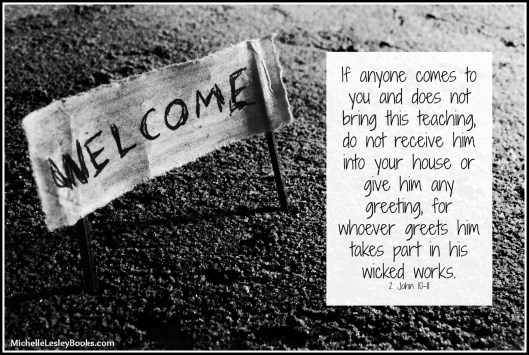
4 I rejoiced greatly to find some of your children walking in the truth, just as we were commanded by the Father.5 And now I ask you, dear lady—not as though I were writing you a new commandment, but the one we have had from the beginning—that we love one another.6 And this is love, that we walk according to his commandments; this is the commandment, just as you have heard from the beginning, so that you should walk in it.7 For many deceivers have gone out into the world, those who do not confess the coming of Jesus Christ in the flesh. Such a one is the deceiver and the antichrist.8 Watch yourselves, so that you may not lose what we have worked for, but may win a full reward.9 Everyone who goes on ahead and does not abide in the teaching of Christ, does not have God. Whoever abides in the teaching has both the Father and the Son.10 If anyone comes to you and does not bring this teaching, do not receive him into your house or give him any greeting,11 for whoever greets him takes part in his wicked works.
12 Though I have much to write to you, I would rather not use paper and ink. Instead I hope to come to you and talk face to face, so that our joy may be complete.
1. Which genre of biblical literature (epistle, prophecy, history, etc.) is the book of 2 John? Who wrote this book, and to whom was it written? What are two major topics this book deals with in verses 5-6 and in verses 7-11?
2. How many times does the word “truth” appear in this passage? In light of the topic of verses 7-11, why does John place so much emphasis on truth in verses 1-4? Which word, used twice in verse 7, stands in direct contrast to the word “truth” and serves as a pivot point into the topic of verses 7-11?
3. What is the “commandment” in verses 5-6? How does verse 6 say that we demonstrate our love for God? What can we learn about obedience to God from these verses? Can you think of any ways you have shown your love for God today by obeying Him?
4. Which false teaching was John speaking against in verse 7? What does verse 9 say about people who “go on ahead” of what the Bible says Christianity is and believe (or teach) false doctrine? Are they saved? Compare verse 9 to Galatians 1:6-9.
5. What does verse 10 say we should not do when we come across a false teacher? Why? (11) Think about how verses 10-11 might apply today with regard to attending conferences headlined by, or using materials written by, false teachers, following false teachers on social media, re-posting or retweeting false teachers, etc. How is this giving a “greeting” to false teachers and taking part in their wicked works?
Often, when someone is told she’s following a false teacher, she will say, “But she says some good things, too! I just chew up the meat and spit out the bones.” Is this line of thinking supported by verses 10-11 and passages such as Romans 16:17?
Prayer. It seems so simple- just talk to God. But when it’s time to actually do it, there can be a million questions. What should I pray about? How long should I pray? Do I have to say “Thee” and “Thou”? Eyes opened or closed? Do I have to be on my knees? Should I speak aloud or pray silently?
It’s nothing to be ashamed of. The disciples lived with Jesus. Heard Him pray. Watched Him pray. And they still had to ask Him, “Lord, teach us to pray.” Jesus graciously answered their request with what we now call “The Lord’s Prayer” or “The Model Prayer.” There’s one version of it in Luke where Jesus teaches the disciples personally, and another, expanded version in Matthew 6:9-13 in the Sermon on the Mount, the version we’ll be looking at today.
Even after all these years, and after hundreds of books and sermons on prayer, Jesus’ simple teaching is still the best way to make sure we’re “doing prayer right.” When we submit the way we pray to His instruction, we can be sure we’re praying the way He wants us to pray. So how can we follow the Lord’s Prayer in our own prayer lives? Let’s take a look.
Pray then like this:
This may not seem like a very important phrase – after all, it’s not even in the body of the Lord’s Prayer – but it’s actually vital to our understanding of modeling our prayers after the Lord’s Prayer. Notice Jesus didn’t say, “repeat after Me” or “recite these exact words.” He said “pray like this.” The NASB renders this phrase as, “Pray, then, in this way.” KJV says, “After this manner therefore pray.” And the NIV has, “This, then, is how you should pray.”
The point? Jesus gave the Lord’s Prayer as an outline for prayer or as a sample prayer, not a specific set of words to recite every time you pray. While it’s fine to sincerely pray – and mean – the exact words of the Lord’s Prayer, we must guard against the “vain repetition” of “empty phrases” Jesus had warned the disciples about just two verses earlier. Mindlessly rattling off the words of the Lord’s Prayer out of habit or so you can check prayer off your daily “to do” list is not prayer. Instead, try using each phrase of the Lord’s Prayer as a guide to how you should approach Him in prayer.
“Our Father in heaven, hallowed be your name.
Take some time to worship God and praise Him just for being Him. Contemplate how high and holy He is and how lowly you are in comparison. Think about, and thank Him for some of His attributes that we find in Scripture- His goodness, justice, compassion, omnipotence, wrath, mercy, and grace. You might even want to sing a hymn or song – like “Holy, Holy, Holy” or “God Is So Good” – that focuses on God’s holiness or other attributes.
Your kingdom come,
Do you long for Christ to return? It’s OK to tell Him that and to take some time to focus on the joy that will be ours in eternity. Christ is coming back (hopefully today!) to gather His people, weary of this sin sick world, to Himself. But remember, He will ONLY be taking people who know Him as Savior and Lord. Is there someone you need to share the gospel with? Someone you desperately desire to see saved? This is a great time to pray for that person and ask God to give you the opportunity, and the right words, to share with her.
Your will be done, on earth as it is in heaven.
In Heaven, God is always glorified, always praised, and always obeyed. Wouldn’t it be great if that were the case on earth? Well, it’s not, because of sin. Is there an area of obedience you’re struggling with? Ask God to help you with it. Pray that God will help your children to be obedient to you and your husband. Pray that God will strengthen your husband’s obedience to Him in his areas of weakness. Pray that your loved ones, boss, and elected officials will make the decisions God wants them to make. Ask God to guide your pastor, elders, and church members, and pray that they will be obedient to His word and His leading.
Give us this day our daily bread,
Here, we recognize and thank God that He is our provider. Even the smallest things in life, like a simple loaf of bread, only come to us because God provides them. He wants us to put our trust in Him, not a paycheck, for our needs. A great passage to go along with this verse is Philippians 4:6-7:
do not be anxious about anything, but in everything by prayer and supplication with thanksgiving let your requests be made known to God. And the peace of God, which surpasses all understanding, will guard your hearts and your minds in Christ Jesus.
God doesn’t want us to worry about the things we need. He wants us to trust Him. When we take our needs to Him in prayer, we are declaring our trust in Him to take care of us – in His way and in His time – and that is where our peace comes from.
Notice, too, the words “this day” and “daily” in this verse. They show us that prayer is an all day, every day affair. God wants us to keep coming back to Him in prayer again and again. It helps us recognize our dependence on Him.
These words also help us to focus our prayers on what we need today. It’s OK to pray about future events, but sometimes focusing on future “what ifs” can tempt us to worry, and, as Jesus says later in Matthew 6, “do not be anxious about tomorrow, for tomorrow will be anxious for itself. Sufficient for the day is its own trouble.” (34)
And forgive us our debts, as we also have forgiven our debtors.
Repentance time. Did you notice that this verse (12) is the culmination of a sentence that began in the previous verse (11)? “Give us this day our daily bread, and forgive us…” Repentance for our sin and asking God to forgive us is also also an all day, every day affair. But, praise God, so is His mercy to forgive! Lamentations 3:22-23 reminds us:
The steadfast love of the Lord never ceases; his mercies never come to an end; they are new every morning; great is your faithfulness.
Take this time to confess your sin and ask God to cleanse you and forgive you. And be sure to ask Him to show you any bitterness you may be harboring in your heart against someone. Forgive that person and ask God to help you make things right with her. Consider the magnitude of your sin against God. If God has forgiven you of your sin against Him, who are you to hold a grudge against someone who has sinned against you?
And lead us not into temptation, but deliver us from evil.
Sin. It’s always lurking around just waiting to ensnare us again, isn’t it? Think about the sins you struggle with. Ask God to show if there are any changes you can make in your life to stay away from temptation to those sins. Pray that He will strengthen you to be obedient to Him when you can’t avoid tempting circumstances, and ask Him to show you the godly way out of every situation, which He has promised to provide. Pray for God’s protection from evil people or circumstances and ask Him to protect your family and church.
For thine is the kingdom, and the power, and the glory, for ever. Amen.
The KJV includes this phrase at the end of the Lord’s prayer, but it isn’t in the earliest and most reliable biblical manuscripts (from which modern versions such as the ESV are translated). But since its meaning and intent is thoroughly supported by other Scriptures, there’s certainly no harm in including it as part of the model for your prayer time.
Acknowledge and thank God for His sovereignty over all things, His power, His glory, and His eternality. Ask Him to help you live in such a way that others will see these attributes of His. Submit yourself to Christ and pray that God will help you to follow Him humbly and honorably.
Eyes open or closed? On our knees or not? Jesus didn’t address those kinds of things, so we have a certain amount of liberty in those secondary issues. Jesus’ desire is that we stay in constant communion with Him in prayer, humbly honoring Him, praising Him, thanking Him, repenting of sin, and depending on Him for our every need. So, let’s pray then, like this.