Doctrinally Sound Teachers, Special Events

Report Back: Reflections on G3 Conference 2018


A week ago today, I was drinking from the fire hose of good teaching and good fellowship at the 2018 G3 Conference: Knowing God – A Biblical Understanding of Discipleship. I not only had the blessing of being able to hear many of my heroes in the faith speak for the first time in person, but I also had the joy of meeting numerous social media friends – finally! – face to face.

Some of the wonderful brothers and sisters I got to hear from:
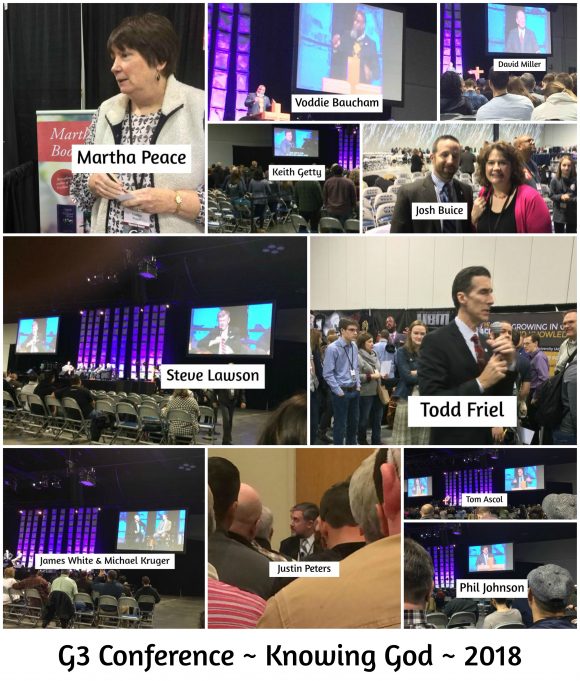
I remarked to a friend that it felt strange to me when readers approached me during the conference to thank me for being a good resource for them. “I’m not really a resource,” I said, “I point people to others who are good resources.” So, in keeping with pointing you to good resources, I’d like to share a little about some of the pastors and teachers I sat under last weekend – not so much about what they taught, but more about how God uniquely crafted and fit each of them into the Body to minister to their local churches, and the church at large, in their own special way. I highly recommend each of them to you.

Josh Buice

A superb example to other pastors, Josh has the heart of a shepherd and a servant. He is genuine and humble, and his greatest concern is that His people know and serve God through their local church. I’ve previously recommended Josh here and have had the pleasure of linking to many of his materials.


Tim Challies

Tim is someone who has figured out his ministry context and is flourishing in it. He not only serves his church well, but is intent on learning from his church in order to serve it better. Tim’s is one of the handful of blogs I follow regularly.


David Miller

Kindness and grace personified, David has a way about him of speaking hard truths in gentleness. Due to degenerative muscular atrophy, David uses a wheelchair and had to memorize his entire sermon including the lengthy Scripture passages he cited, which was very encouraging to me for my own Scripture memory. David reminded me of older, small church pastors I have known who are so good at loving and caring for their sheep.


Justin Peters

If you’ve ever wondered what biblical meekness looks like, you need to get to know Justin Peters. Calm, kind, graceful, knowledgeable, and with a quick wit, Justin cares deeply about sound doctrine and calling out false teachers because he has a heart for people to be saved and know the truth of the gospel. Justin taught two breakout sessions on the New Apostolic Reformation, and I am overjoyed to report to you that there was standing room only (and there were many standing) for both sessions. What a joy to see Christians getting informed so they can protect themselves and their churches! I have recommended Justin here and have linked to several of his resources.

Justin’s a Louisiana expat in the Northwest, so I brought him
some essentials from home: king cake and crawfish :0)


Voddie Baucham

Voddie is intense. He is passionate about preaching and the Scriptures to such an extent you begin to sense that, if he could, he’d grab you by the shoulders and physically stuff you with Scripture and a proper understanding of it. He wants the church to get it. I’ve recommended Voddie here.


Martha Peace

Gracious. Godly. Gutsy. That’s the “G3” of Martha Peace. Unlike so many of today’s “divangelistas” Martha is not a young, silly, hyper Barbie doll. She’s older, mature, and sedate, yet still fun to be around. She doesn’t have the perfect figure or the trendiest clothes. She looks and acts like your average, older, wiser sister at church. And that’s a good thing. We need far more mature sisters like that to look up to. It was a blessing to see her breakout sessions full of younger women who want that kind of biblical teaching and example from a Titus 2 woman. I’ve recommended Martha before, based largely on others recommending her to me. Now it’s my pleasure to commend her to you, having personally heard her speak.


My dear friend, Darlene (left), with her hero of Biblical Counseling and women’s Bible study, Martha Peace.


James White and Michael Kruger

Drs. White and Kruger presented a joint session on the canon of Scripture. Lovable eggheads both, they showcased the fact that Believers don’t have to gullibly check their intellects at the door of Christianity and that academicians don’t have to be godless liberals. They made “doctrinally sound smart” look beautiful.

Paul Tripp

I thought I was a fairly decent parent until I sat under Paul Tripp’s teaching, but I get the feeling he can make pretty much any parent feel like a failure. There’s a purpose to that: without God’s grace and the empowerment of the Holy Spirit, relying on your own efforts, you are a failure as a parent. Paul wants you to see that so you’ll stop trying to parent in the flesh and parent with the gospel instead so that your children might be saved.


Derek Thomas

Derek Thomas is the iconic image of an elder statesman pastor, a breath of fresh air standing in stark contrast to today’s cool, hipster, twentysomething pastors. There is a Bible-fueled furnace deep in Derek’s soul that empowers his preaching. He is living proof that formal doesn’t have to equal cold and boring.


Tom Ascol

This is a man who knows God and wants you to know Him, too. Tom is a regular Joe who’s good at explaining biblical concepts simply and lovingly, like the uncle who taught you how to tie your shoe or ride a bike. I was pleased to learn that he is Southern Baptist as well as the executive director of Founders Ministries, and am looking forward to hearing more from him.


Steve Lawson

Long one of my favorite pastors, Steve Lawson is the definition of unction in preaching. The man is a preaching machine, and I don’t see how he replenishes all the calories he must burn off in the pulpit. There is an urgency about his preaching that says, “You need to know this, and you need to know it now because it will help you love Jesus more, and you don’t want to wait another second to love Him more, do you?” It’s been my pleasure to recommend Dr. Lawson here. If you listen to preaching and podcasts, you’ll want to add him to your queue.


Phil Johnson

The man knows his stuff, and he tells it like it is. He’s a straight shooter. That’s the main thing I appreciate about Phil Johnson. There’s no way I could briefly capture the awesomeness that is Phil, so I’ll just leave you with a little tidbit I learned on this trip, that made him even dearer to my heart. He said he was a terrible extemporaneous speaker, but a decent writer, so when he preaches, he writes out his manuscript word for word and reads from it at the pulpit. I’m exactly the same way when it comes to speaking. If you’re not already listening to, and reading Phil, get caught up. I’ve enthusiastically recommended him here.


Equally as important as the wonderful teaching at G3 was the opportunity to meet so many good friends I’d only been able to get to know on social media. I even got to meet a few readers, too!

Nate Pickowicz, Gabriel Hughes, Me, Beki Hughes, Sonya Walker


Josh Buice said something during his sermon that really stuck with me: Attending a conference is an unbelievably wonderful experience, but it isn’t church. Church is where we go back to when a conference is over – to do the hard and joyful work of ministry and the long-term labor of love of discipling and being discipled in the local body.

And Josh was absolutely right. God doesn’t call us to be conference junkies, bouncing from event to event because we’re addicted to the high we get from “mountaintop experiences.” That’s not real life. And it’s not biblical life, either. God calls every Christian to be plugged into a local body of Believers. To walk with the same group of people week in and week out through sorrows and joys, sins and victories.

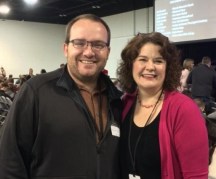
Aaron Armstrong                                                            Allen Nelson

But in another sense, the very reason conferences like G3 are so addictive, is that they are the church. The universal church. The church catholic. The family of Believers we’ll spend eternity with.

I can’t tell you how many times I totally tuned out the preaching or the music and just looked out over that sea of people I’d never seen before – enraptured by the words of  God, praising the name of our dear Savior – and thought, “This is the tiniest little taste of what Heaven is going to be like.”

Kevin and Lynnette

And every time I shrieked with delight at the first glimpse of a precious friend I’d previously known only online, I thought again, “This is what Heaven will be like!” A glorious family reunion with loved ones – those we’ve known personally, those we’ve known from afar, and those we’ve never met before – all bound together by our mutual love, adoration, and worship of Jesus.

Thanks so much to those of you who generously gave financial gifts which enabled me to attend G3. Your investment and kindness meant so much to me, and I hope you’ll be blessed by the way God has grown and encouraged me through this conference as I continue to serve you through this online ministry.

If you ever get the chance to attend G3, I can’t recommend it enough. But if you don’t, you can download the G3 app, listen to all the teaching from past conferences, and soon, from this year’s conference.

The G3 Conference was a wonderful experience, and I hope I’ll have the opportunity to go back. I think the most important thing I learned at G3 is that a Christian conference can do lots of things, but if it doesn’t send you back home loving your own church more and equipped to serve it better, it hasn’t done its job. I came home with both. Thanks, Josh Buice, Pray’s Mill Baptist Church, and everyone associated with the G3 Conference.


Women of Genesis Bible Study

The Women of Genesis: Lesson 8

Previous Lessons: 1, 2, 3, 4, 5, 6, 7

📖📖📖📖📖

Read Genesis 10-11:26

📖📖📖📖📖


Questions to Consider

1. Read through the names and places listed in chapters 10 and 11. Do you recognize any of them from other parts of the Bible? What roles did they play in biblical history?

2. Often, when we approach “list passages” of Scripture (such as genealogies, censuses, inventories, etc.) we do so in a very ego-centric way: “How does this help me?” “How does this apply to my life?” “This is boring to me.” Could it be that God had a purpose for including these things in Scripture that have nothing to do with your personal life or mine? Why did God put the genealogies of Genesis 10-11 in the Bible? Examine these genealogies in light of 2 Timothy 3:16-17. How are they profitable, how do they equip, etc.?

3. Matthew 1 traces the genealogy of Christ back to Abraham. Can you pick up where Matthew leaves off and follow Christ’s family tree from Abraham (Abram) back to Noah? (Hint: start at 11:26 and work backward)

4. Why don’t the genealogies of Genesis 10-11 list any women? (Hint: think about Israel’s societal structure, the twelve tribes of Israel, inheritance, land allotment, etc.)

5. Compare 10:5,20,31 with 11:1,6. What do these verses say about the language(s) of the peoples? Is this an example of Scripture contradicting itself or of non-linear chronology in Scripture? Briefly review Lesson 2, question 1 (link above). Are we seeing something similar in chapters 10-11 to what we saw in chapters 1-2 (the “two” Creation accounts)?

6. Read 11:2,4 with 10:8-10. Who led the people to settle in Shinar? According to God’s command in Genesis 9:1, were they supposed to settle down or spread out? (11:4) What happened as a result of God confusing their languages? (11:8-9)

7. Besides rebelling against God’s command to spread out and fill the earth, what sin were the people committing by building the tower? (11:4) What does the Bible say about those who act in pride or attempt to take God’s glory for themselves? Why is it so important to glorify God in everything we do?

8. In your job, at your church, on social media, among your friends and family, etc., do you try to “make a name for yourself” (11:4) by the way you act and speak? Do you hunger to be the center of attention, crave adulation, constantly try to impress people? How might pride and love of self be the foundation for these actions and attitudes? Is there anything you need to repent of and ask God’s forgiveness for? Nimrod’s people would have brought glory to God by obeying His command to spread out and fill the earth instead of building the tower. What are some practical ways you can glorify God by obeying Him instead of glorifying yourself?


Homework

If you’d like to read up more on biblical genealogies and their importance, here are a couple of good resources:

Why were genealogies so important to Israel? at Got Questions

Why the Genealogies? at Grace to You


Suggested Memory Verse

Therefore its name was called Babel, because there the Lord confused the language of all the earth. And from there the Lord dispersed them over the face of all the earth.
Genesis 11:9

Discernment, False Doctrine

Touch Not My Anointed?

“Never challenge or speak out against God’s anointed,” I recently read in a book for Christian women.

“Never challenge or speak out against God’s anointed,” I recently read in a book for Christian women. Have you ever heard someone say this? Is it biblical?

Have you ever heard someone say this? Is it biblical? Who are “God’s anointed”? Why should we never challenge or speak out against them? What does it mean to be “anointed” anyway?

This is just one more of the many dangerous false teachings coming out of the Word of Faith and New Apostolic Reformation heresies. It is an adulteration of Psalm 105:15/1 Chronicles 16:22 (same text).

saying, “Touch not my anointed ones,
do my prophets no harm!”

Psalm 105:15 / 1 Chronicles 16:22

The phrase “touch not My anointed” is lifted out of context and imbued with the meaning “never criticize, correct, or rebuke the pastor.” Unfortunately, churches that wield this false teaching like a weapon usually do so because they are pastored by a false teacher who needs to be (or is being) biblically criticized, corrected, or rebuked.

The context of Psalm 105/1 Chronicles 16 makes it obvious that this is not what this verse means, even in the Old Testament, as anyone who takes the trouble to read the whole chapter can clearly see. This verse is about God protecting the Israelites from oppression by foreign kings when they were wandering in the wilderness. “Touch not My anointed oneS” and “do my prophets no harm” is a warning to pagan nations to leave God’s people – all of them, the common people as well as the prophets – alone during the Exodus.

This has nothing whatsoever to do with New Testament churches and the idea that one should never challenge or speak out against a pastor. Pastors are only “anointed” today in the same sense that every believer is “anointed.”

In the Bible, “anoint” simply means to apply oil or another substance (Luke 7:38, John 9:6) to a body part (your own or someone else’s). In the Old Testament, one of the occasions for applying oil was in ceremonies to consecrate – set apart – someone (or something: Genesis 31:13, Exodus 29:36) for a particular purpose. For example, David was anointed with oil when God set him apart as king. All Old Testament priests were anointed with oil. Elisha the prophet was anointed with oil.

But we do not see this in the New Testament. No one is anointed with oil as part of a consecration ceremony. In the New Testament, the verses containing the word “anoint” fall into one of three categories: medicinal/hygienic application of oil and other substances, references to Jesus as the “Anointed One” (Messiah), and two passages (2 Corinthians 1:21-22, 1 John 2:20,27) speaking of all Christians as being allegorically “anointed”: set apart as God’s special people (the same way Psalm 105/1 Chronicles 16 talk about the Israelites as God’s special, set apart people).

The only individual in the New Testament who was anointed – literally or allegorically – in the Old Testament, ceremonial, consecrated sense is Jesus. Why? Because He fulfills all three of those Old Testament “anointed” positions: prophet, priest, and king. He is the final prophet, the Great High Priest, and the eternal King.

Jesus fulfills all three of those Old Testament “anointed” positions: prophet, priest, and king. He is the final prophet, the Great High Priest, and the eternal King.

Therefore, no New Testament believers are “anointed” to any position but we are all spiritually anointed – set apart to and for Christ as His special possession. We are to submit to our pastors and elders (Hebrews 13:17) insofar as they teach and obey God’s written Word (1 Timothy 5:19-20, Acts 5:29), but “never challenge or speak out against God’s anointed”? Only if the Anointed One you’re talking about is Jesus.

“Never challenge or speak out against God’s anointed”? Only if the Anointed One you’re talking about is Jesus.

Mailbag

The Mailbag: Men attending women’s Bible study class at nursing home

Note from Michelle:
This is a question some friends and I were recently discussing on Twitter, 
not one sent in by a reader. A few minor details have been slightly altered.

A female relative of mine teaches a women’s Bible study at a Catholic nursing home (my relative is a Protestant Christian). Sometimes, a male resident or two – none of whom are saved – will wander in and attend her class. Occasionally, one of them attempts to correct her according to Catholic doctrine. Even though she’s not technically teaching “in the church” (1 Timothy 2:12) she’s uncomfortable with men attending the class, as well as with having to biblically correct their unscriptural Catholic doctrine. On the other hand, she shares the gospel every time she teaches, and she doesn’t want to turn away anyone who might receive the good news and be saved. What should she do?

I love it when Christians think deeply about issues like this. It is encouraging to interact with godly people who want to be obedient to Christ, and it pushes me to desire to obey Him better myself.

Foreword:

Just to lay a quick foundation for my answer to this question, it needs to be understood that people who currently believe and practice Catholic doctrine as it is written in Catholic documents are not saved. There are numerous unbiblical beliefs Catholics hold to (which I will not go into right now because that’s beyond the scope of this article) but for the purposes of understanding my answer, in a nutshell, the Catholic religion does not teach salvation by grace alone through faith alone in Christ alone (in fact, Catholicism anathematizes {condemns to Hell} anyone who teaches this), works must be included in the salvation process. If you believe your own good works play any part in earning your salvation, you are not saved. Salvation is all of Christ, and Christ alone.

✢✢✢✢

I am assuming that whoever invited this teacher to teach a Bible study in the nursing home knows that she is Protestant and will be teaching Protestant (biblical) doctrine. I am also assuming that the person who invited her to teach is OK with this. I would not advise someone to give the appearance of teaching in compliance with Catholic doctrine and then surreptitiously “sneaking in” Protestant doctrine. That’s deceitful and dishonest, and it would be understandable for the Catholic residents to be correcting her.

✢✢✢✢

If you’re unclear as to why having men in her Bible study class is a dilemma for the female teacher, I’d encourage you to read these two articles before moving on to my answer:

Jill in the Pulpit

Rock Your Role FAQs (this article expands on my brief comments below)


Here are my thoughts on the issue:

1. If the people attending the study are Catholic, then the female teacher is evangelizing the lost outside of the church, not discipling (teaching) Believers who are the church, unless some of those attending the study have gotten saved (the question indicates none of the male “drop ins” are saved). Evangelism falls under the “do” of the Great Commission, not the “don’t” of 1 Timothy 2:12. (see #11)

2. We always have to keep the definition of “church” in mind when we’re talking about women teaching or holding authority over men “in the church.” The gathered body of Believers is the church, not the building in which they meet. The mere fact that a group meets in a nursing home, house, park, community center, or other edifice that isn’t a church building doesn’t automatically mean a woman is free to teach men (see #7). It doesn’t automatically mean she can’t teach them either.

3. If the male attendees are being disruptive and introducing false doctrine, the teacher is well within her biblical rights and wisdom to say that this a women’s only group and exclude the men. (The same would apply to excluding any women who behave the same way.)

4. If, at some point, genuinely regenerated men begin attending the class because they want to be taught the Bible, praise God! The best case scenario would be for the teacher to go to her pastor, explain the dilemma, and have him ask one of the associate pastors, elders, or another appropriate male church member to volunteer to teach the men.


If you have a question about: a Bible passage, an aspect of theology, a current issue in Christianity, or how to biblically handle a family, life, or church situation, comment below (I’ll hold all questions in queue {unpublished} for a future edition of The Mailbag) or send me an e-mail or private message. If your question is chosen for publication, your anonymity will be protected.

Discernment

Throwback Thursday ~ Still Be Discerning about Discerners Discerning Discernment Ministries

discerners discerning discernment

Recently, one of my favorite blogs, ParkingSpace23 (a fantastic, doctrinally sound blog I’d encourage everyone to subscribe to), published an excellent article by John Chester called Still Be Discerning about Discernment Ministries. It’s all about John’s thoughts on discernment blogs and podcasts and why he has chosen to swear off of them.

John seems like a thoughtful guy and he handled what can be a touchy subject evenly, calmly, scripturally, and with grace. As someone who frequently writes on discernment topics, it gave me some good food for thought and an opportunity to biblically examine both my writing and reading/listening habits. It’s a great article, I was thankful for it, and I agree with a lot of his points.

But while John has decided not to partake of discernment blogs and podcasts, I still find discernment ministry to be an important aspect of this blog as well as my personal spiritual “diet”. Does that mean I think John, or any other Christian, is wrong for not wanting to regularly read or listen to discernment material? Absolutely not! But I’d like to present a bit of a different perspective regarding the value of discernment ministry.

In the first few paragraphs of his article, John draws a distinction between two different types of discernment ministries- a disctinction which I think is both astute and important. John differentiates between what I would call “propositional” discernment sites like CARM, and, if I’m understanding him correctly, mine – which generally post single, position paper-type articles on a given false teacher or false doctrine – and what I would call “daily news” discernment ministries such as Berean Research and Fighting for the Faith – which report on the shenanigans du jour of false teachers and apostate churches.

John’s position is that the propositional discernment ministries [PDM] can be helpful when needed, but he is not fond of the daily news discernment ministries [DNDM]. I think both can be beneficial, assuming they’re done biblically. Take a look at John’s points and my counterpoints, and then you can prayerfully decide whether or not it would be profitable for your sanctification to include discernment media as part of your spiritual fare.

John’s point: “[DNDMs] often spend much time dissecting sermons or blog posts that someone with even a rudimentary sense of discernment would have stopped listening to or reading within the first few phrases.”

Michelle’s counterpoint: “Someone with even a rudimentary sense of discernment” is the crucial phrase here. Perhaps John is blessed to pastor a body of believers who are good bereans and most of the Christians he knows are discerning. I hope that’s the case. It should be the case that every believer has “a rudimentary sense of discernment” and immediately rejects false doctrine when she hears it. Nothing would bring me more joy.

But, sadly, that’s not the case. In fact, in my experience, the exact opposite is true, especially among Christian women. The vast majority of Christians are very undiscerning when it comes to false teachers and false doctrine. Often, people lack discernment because they’re false converts. But because most churches don’t proactively teach discernment, there are also plenty of genuninely born again believers who take at face value that anything which wears the label of “Christian,” is sold at a Christian retailer, or is proclaimed by a Christian celebrity is biblical and trustworthy.

I know, because I used to be one of those undiscerning Christians who hadn’t been taught any better by my church. Sure, I could pick out charlatans like Benny Hinn or Todd Bentley, and I probably would have described people like Kenneth Copeland and Jesse Duplantis as “wrong” or “that’s not what Baptists believe” without really knowing why. But the Beth Moore Bible studies that every church I’ve ever been a member of has pushed on its female membership? I had no idea she was teaching false doctrine, especially since my own church was endorsing her books.

It wasn’t until I Providentially “stumbled across” Todd Friel’s TV program, Wretched, one night several years ago that I began to understand what false doctrine was, why it was wrong, biblically, and how it could hurt me and the church. And it wasn’t until I discovered Chris Rosebrough’s Fighting for the Faith that I learned how to compare everything to Scripture – to listen to sermons with a discerning ear and read Christian books with a discerning mind. Todd and Chris taught me the discernment no church ever bothered to mention to me. And from the myriad of discerning Christians I’ve known, heard from, and read about, people like me are the rule, not the exception.

It’s not right that the church isn’t teaching Christians how to be discerning. I think every biblically responsible discernment ministry would agree that it is the church’s job, not a discernment ministry’s, to teach Christians to be bereans. But that’s not happening. And I thank God for those ministries who are standing in the gap- who have helped thousands of Christians like me.

John’s point: “[DNDMs] are unbiblical. What I mean is that there seems to me to be no biblical model or mandate for this kind of ‘ministry’.”

Michelle’s counterpoint: John may hold more closely to the regulative principle than I do, which would, understandably, account for my difference in perspective from this point. We do a lot of things, both in church and in parachurch ministry, that there’s no specific biblical model or mandate for. There’s no biblical model or mandate for vacation Bible school or crisis pregnancy ministry or handing out gospel tracts or even writing for a Christian blog. Yet these, and many other ministries, can carry the gospel to the lost (I’ve heard of many people who have read/listened to DNDMs, realized they were false converts, and have become believers.) and edify the saved – just like discernment ministries can. And there’s certainly a biblical mandate for that.

John’s point: “Did Jesus ever engage in a point by point take down of a particular Pharisee’s teaching that is recorded in Scripture? How much do we know about the Nicolaitans…in Revelation 2:15?… Or… the Colossian heresy…in Colossians 2:8?”

Michelle’s counterpoint: Jesus didn’t do sermon reviews (that we know of) the same way Chris Rosebrough does. But He did publicly enumerate and correct many of the Pharisees’ false teachings in Matthew 23. He publicly clarified Scripture and corrected unbiblical beliefs and false teachings – “You have heard it said…but I say to you…” – in the Sermon on the Mount. He publicly warned people against the false teaching of the scribes, Pharisees, and Sadducees. And every time those scribes, Pharisees, and Sadducees confronted Him with questions or after a miracle, He set them straight for the whole crowd to hear.

As to the Nicolaitan and Colossian heresies, Colossians and Revelation 2 were addressed to particular churches. Just because we may not know much about these heresies doesn’t mean the Ephesian and Colossian churches weren’t thoroughly familiar with them. Perhaps that’s why John and Paul didn’t elaborate- because their intended audiences were already knowledgeable about those heresies. And perhaps the reason they might have been familiar with those heresies is that they were constantly being warned about them. Every book in the New Testament (except Philemon) warns against false teaching or false teachers.

Not so with the church today. Christians are not only not being warned about the heresies and false teachers running rampant in evangelicalism, undiscerning pastors are actually embracing false teachers, inviting them to speak at their churches, simulcasting their conferences, sharing their social media posts, and ordering their materials for the church’s small groups. And the church at large is so biblically illiterate that Christians have no idea they’re being fed false doctrine.

John’s point: “Curiously many discernment mavens will quote 1 Peter 3:15 as a text that supports what they do. But to be blunt, it doesn’t, not by a long shot…. This is about being ready to proclaim Christ to those who would persecute you.”

Michelle’s agreement: I could not agree with this point more. This verse isn’t about discernment. (I usually hear this verse more frequently in support of apologetics ministries, and it isn’t about apologetics, either.) It’s about evangelism.

One of the main features of today’s false doctrine is the twisting of Scripture and ripping it out of context. How can we who do discernment work rebuke false teachers for taking Scripture out of context and then turn right around and do the same to justify our own ministries? We know better. Specks and logs, anyone?

There are plenty of other passages of Scripture (such as the ones I’ve cited above and others) that speak of the importance of warning against false teachers and removing false doctrine from the church. We should not be using a verse that has nothing to do with discernment to justify discernment ministry.

John’s point: “Don’t get me started on the lack of gentleness and respect [from 1 Peter 3:15] that permeates many of these blogs and podcasts.”

Michelle’s agreement/counterpoint: John is right, here. Some of the discernment ministries that (incorrectly) claim the first part of 1 Peter 3:15 as justification for their ministry are not following the second part of the verse which says to “do so with gentleness and respect”. There are discernment ministries whose articles I absolutely will not share or link to because their snideness and name calling are so over the top it overshadows the valid point they’re trying to make, sometimes even damaging their own credibility.

At the same time, we do see instances of Jesus using harsh language and calling false teachers names, and Paul, Elijah, and others couldn’t always be characterized as gentle or respectful.

The thing is, their cultural context was a little different from ours, and these are descriptive passages, not prescriptive. Sometimes different cultures call for different approaches. Additionally, one woman’s “gentle and respectful” is another woman’s “harsh and unkind.” I’ve written discernment articles that were characterized as hateful by some Christians and too nice toward the false teacher by others- both about the same article!

Although I fail miserably at it – often – I try to use 2 Timothy 2:24-26 as my guideline when I write:

And the Lord’s servant must not be quarrelsome but kind to everyone, able to teach, patiently enduring evil, correcting his opponents with gentleness. God may perhaps grant them repentance leading to a knowledge of the truth, and they may come to their senses and escape from the snare of the devil, after being captured by him to do his will.

It not only reminds me of how to contend for the faith (not quarrelsome, kind, patient, gentle), it reminds me who I’m contending for (those being held captive by Satan’s snare of false doctrine), and why I’m contending (that they might repent, know the truth, come to their senses, and escape captivity).

John’s point: “[DNDMs] are unhealthy…’you are what you eat’…A diet of constant critical speech and reading is naturally going to produce a critical spirit.”

Michelle’s agreement: This is absolutely true. I don’t know whether it makes me over-critical or not, but when I OD on discernment media it certainly makes me feel angry, frustrated, depressed, and that there’s no hope for the church. It takes my eyes off Christ and the very real salvific and sanctifying work He is still doing in churches across across the globe, and causes me to focus on the monster of false doctrine instead.

It’s exceedingly important that we not go overboard on discernment or any other single aspect of theology or or spiritual life. In order to be spiritually healthy, we must have a balance of all the good things: discernment, Bible study, prayer, evangelism, fellowship, worship, service, etc. When I find myself spending too much time in Discernment Land, I know it’s time to step back and readjust my focus.

John’s point: “They are not very helpful…I don’t think very many Christians, especially the kind who read theological blogs, are going to be taken in by [blatantly obvious false teachers].”

Michelle’s agreement/counterpoint: I’ve already shared my thoughts on the helpfulness of discernment ministries for Christians who are not discerning, but, if I’m understanding him correctly, I think what John is saying here is that Christians who are already discerning aren’t going to be taken in by false teachers, and, therefore, have little need for regular consumption of discernment media. I generally agree with that. I still subscribe to a few DNDMs and peruse their daily headlines, not because I need to learn discernment, but because I like to know what’s going on in the church, just like people skim section A of the newspaper because they like to know what’s going on in the world.

I might add, though, that just because someone is the type of person who reads theological blogs doesn’t mean he’s on top of things, discernment-wise. Thom Rainer writes a theological blog (and books, and has a seminary Ph.D), yet persists in allowing false doctrine onto the shelves of LifeWay despite the many rebukes he has received from pastors, seminarians, lay people, and, yes, discernment media. Not long ago, I took a class via video from a conservative Southern Baptist seminary president who positively (albeit in passing) cited Beth Moore and Rick Warren in one of the sessions. And these are just two isolated examples. There are many more.

John’s point: “[DNDMs] often have significant blindspots…In their rush to expose the errors of others, often discernment bloggers/podcasters can overlook real problems with themselves or with their theological allies, especially in the areas of tone and conduct.”

Michelle’s agreement: This is so true. There’s no way I could disagree with this, because I have been guilty of it myself far too often. I would only add that this is not a problem specific to discernment ministry. Every ministry has blind spots because every Christian has blind spots. We’re all guilty of hypocrisy, myopia, failure, and sin. And, because we’re believers, when a brother or sister points out our sin, we repent, we receive God’s wonderful, cleansing, restorative grace, mercy, and forgiveness, and we move forward in obedience to Him and His word.

John closes out his insightful article with this thought:

I am not saying that you must swear off “discernment” blogs and podcasts, but I am saying I did, for the reasons above along with others, and I think I am better off for it. I would challenge you to consider what I have written and to think deeply about your spiritual diet. I am exhorting you to be discerning about discernment ministries.

I am not saying you must partake of discernment blogs and podcasts. But I am saying I do, for the reasons above along with others, and I think I am better off for it. I would challenge you to consider what John and I have written and to think deeply about your spiritual diet. I am exhorting you to think about it, study about it, pray about it, and discern what God would have you do about consuming discernment media.