Easter, Holidays (Other)

Jesus Wept

Originally published April 18, 2011

It was hardly a day for tears.

It was a day that should have been the high point of His ministry.

As he was drawing nearโ€”already on the way down the Mount of Olivesโ€”the whole multitude of his disciples began to rejoice and praise God with a loud voiceย for all the mighty works that they had seen,ย saying,ย โ€œBlessed isย the King who comes in the name of the Lord! Peace in heaven andย glory in the highest!โ€
Luke 19:37-38

After three years of hard work and harder prayer, miracles, and countless hours of teaching, the people were finally getting it.  They recognized that Jesus was the Messiah.  His people were giving Him the praise He was due.

Or were they?

And when he drew near and saw the city,ย he wept over it,
Luke 19:41

What’s this? This isn’t part of the Palm Sunday pageant. In every Bible, commentary, and Sunday School lesson, this scene is called “The Triumphal Entry”. Why is Jesus over there crying?  What’s that He’s saying?

saying,ย โ€œWould that you, even you, had known on this day the things that make for peace! But nowย they are hidden from your eyes.ย Forย the days will come upon you, when your enemiesย will set up a barricade around you andย surround you and hem you in on every sideย and tear you down to the ground, you and your children within you. Andย they will not leave one stone upon another in you, because you did not knowย the time of yourย visitation.โ€
Luke 19:42-44

Why is Jesus over there crying?  What’s that He’s saying?

Once again, Jesus sees through the outer display of behavior and lays the heart of the people bare.

They’re praising Him because He multiplied bread and fish.

Because He healed diseases.

Because they think their Messiah has come to set them free from Roman oppression.

They don’t get it after all. And that’s why He’s weeping.

They don’t get that Jesus didn’t come to give us stuff. They don’t get that the bondage of sin is far worse than enslavement to Rome. They don’t get that taking up a cross and following Jesus will get them something far sweeter and deeper and more satisfying than all the miracles and riches and healings in the world. It will get them Jesus. And that’s what He wants to give them.

And as I watch my Savior’s heart break over His people so many years ago, I wonder– is He still weeping today?

As I watch my Savior’s heart break over His people so many years ago, I wonder– is He still weeping today?

Every Sunday, we, Jesus’ people, offer Him loud Hosannas. We lift our palms in celebration of His goodness and blessings. We sing out His praise. We kneel before Him.

But is He weeping?

Does He see through our outward behavior to a heart that just wants worldly trinkets from Him? Does He see a church that draws near to Him with its lips but whose heart is far from Him? A stiff-necked people who deign to physically bow the knee but not crucify the will?

Are we the new Jerusalem?

Social Media

9 Ways Social Media Is a Blessing to Believers

Originally published May 5, 2017

If you’re more of a listener than a reader, check out Sanctified Social Media at A Word Fitly Spoken, which was based on this article.

Porn. Foul language. Arguments. Hacking. Cyber bullying. Affairs. Frittering away your time. Coveting others’ seemingly idyllic lives. Living and dying by how many “likes” your post got.

I get it. There are a lot of ways social media can go wrong.

But there’s nothing intrinsically wrong with Facebook, X, Instagram, or social media platforms in general. They’re tools. Like a steak knife. You can cut up your supper with it so you can eat- good – or you can puncture somebody’s tire with it – bad. It’s all in how you use it.

There have been lots of articles which have rightly discussed the problems with social media and the need to take a break from it every now and then. (Ironically, I’ve seen these articles posted on Facebook and X.) And if social media tempts you to sin or the problems it brings into your life outweigh the benefits, then, by all means, you should disconnect. For thousands of years, people have been living very fulfilling and godly lives without sharing pictures of every meal they eat and watching videos of their third cousin’s cat.

But if you use the tools available to you to customize your news feed, your list of followers, and other aspects of your account, there are many ways social media can be beneficial to Believers.

1. Close contact with your church family during the week
How is Susannah, in your Sunday School class, doing with that problem at work? Is Mrs. Bunyan still in the hospital? The water main is busted and we won’t be able to have midweek services? Social media makes it easy to keep up with your brothers and sisters from church- to serve their needs, pray for them, rejoice with them, and encourage them outside of worship service. We’re meant to share our lives with one another, and social media is just one way we can do that. It’s also a great way for churches to send out announcements, reminders, and prayer requests as they come up to keep members informed.

2. You don’t have to miss church when you miss church
Once, before livestreaming the worship service was a thing, and I’d had to miss church for a couple of weeks in a row due to having sick babies at home, I had my husband call me from the worship service right before the pastor started preaching and hold up the phone so I could hear the sermon. It was difficult to hear, we got disconnected a couple of times, and I had to keep things really quiet on my end. Now, lots of churches stream “Facebook Live” videos of their services. If you’re sick, out of town, or otherwise providentially hindered (video coverage is not an excuse to skip church for frivolous reasons) from being at church, you don’t have to miss worship. And, as a bonus, you can watch other churches’ services, too!

3. Supplementary preaching and teaching
Your pastor, elders, Sunday School, and Bible study teachers at your home church should always be your primary source of instruction in the Scriptures. Some churches make good use of social media by setting up a private group for church members to discuss Sunday’s sermon or what they’re learning in Bible study, and there are many excellent independent theology and Christian issues discussion groups on social media as well.

If you want to listen to additional good teaching during the week, social media is a great place to find it. Ask your doctrinally sound Facebook friends whose sermons they’d recommend. Follow good pastors, teachers, and podcasters on X. You’ll soon have more good teaching queued up than you have time to listen to. And there are scads of excellent godly authors and bloggers to follow and learn from, too.

4. Evangelism
Social media is a great place for sharing the gospel! Write out a post of your own, share an evangelistic page, video (like this one or this one), or share an online tract. There may come a time when Christians or the Bible are banned from social media, but until that day comes, let’s get busy sharing the gospel online.

5. Fellowship

Online friendships are no substitute for face to face fellowship with your church family. But sometimes you’re in a church situation in which there are few sisters who understand a unique life circumstance you’re going through, who share an interest in the branch of theology you’re currently studying, and so on. On social media, you can “meet” like-minded brothers and sisters from all over the world and form sweet friendships with them- sometimes you can even experience the joy of meeting them in person!

6. Prayer and Encouragement
Need prayer or encouragement? In addition to asking your church family to pray for you or getting together with a Christian friend for lunch, your godly social media friends are always around to lift you up and intercede for you. And you can be a blessing to others by praying for them or offering a word of encouragement.

7. Thinktanking
“Does anybody know whether ______ is a doctrinally sound teacher?” “I’m researching Bible Topic X- what are some good resources?” “What’s that verse that says ____? I can’t remember the reference.” I can’t tell you how many times I’ve asked questions like this on social media and my friends have come through for me. There are a lot of godly people out there who have read a lot of books, listened to a lot of teachers, know a lot of Scripture, and been through a lot of experiences. Harness their knowledge and share your own.

8. Looking for a new church?
One of the things about social media that has brought me the most joy is helping people who are moving or who have to leave an apostate church to find a new, doctrinally sound church to join. Not only are there some great church search engines out there, but because of social media friendships and connections across the world, I’m able to get personal recommendations for good, solid churches. Not only can social media help you find a good church if you’re looking for one, you can help others by suggesting good churches you’re familiar with when they’re looking.

9. Current events in Christendom
What is the president of your denomination up to? Who’s the latest celebrity Christian to publicly support the homosexual lifestyle? Are there any good conferences coming up that would be helpful to your church members? Which sister churches in your state need some assistance?

Even more vital than being an informed citizen by following the local and international news, Christians need to be aware of what’s going on in the church- locally, nationally, and globally. Follow the pages of your denominational leadership, local churches, Christian news services, and so on, to keep abreast of current events. Outside of social media, you’ll probably never find out about the latest happenings until they happen in your own church and take you by surprise.


There’s no doubt that social media has the potential to cause a lot of problems, even the temptation to sin. But if you’re able to put it in its correct place so that it doesn’t steal time from God, your family, your church, or other vital relationships and ministries- using it, instead, as just one more tool to encourage yourself, and others, towards greater Christlikeness – social media can be a fantastic blessing.

Click here, and let’s be friends!


Additional Resources:

The Mailbag: Contending for the Faith on Social Media

A Biblical Theology of Social Mediaโ€“ Just Thinking Podcast

Mailbag

The Mailbag: Should Christians drink alcohol?

Originally published March 13, 2017

I wanted to know what is your stance on drinking alcohol? Meaning drinking not to get drunk but having wine with dinner etc.

Great question, but just to tweak it a little, let’s look at the Bible’s stance on drinking alcohol. I don’t want readers to base their beliefs about alcohol usage (or anything else) on my opinions, but on what the Bible says about it.

The Bible does not prohibit Christians from drinking alcohol, only from drunkenness. Christians are not required to partake of alcohol, but may do so in moderation if they like, so long as their use of alcohol does not violate any other Scriptural principles, such as:

Evangelism
Would your drinking alcohol in some way hurt your witness to lost people? If a lost person came to your house and saw alcohol in the fridge, or saw you buying alcohol at the store, or drinking alcohol in a restaurant, would it inhibit your ability to share the gospel with that person due to her perceptions about people who drink alcohol? Could you hand a person a tract with one hand while holding a bottle of beer in the other?

Love for the brotherhood
Do you love your brothers and sisters in Christ enough to deny yourself alcohol if that would set a better example for them, if it would confuse them or cause them to violate their own consciences, or if it would be more conducive to your discipleship of them? There are many people who have had such bad experiences associated with alcohol that your drinking would destroy their trust in, and respect for, you. There are new Christians who aren’t yet mature enough to understand that seeing you – a godly person they look up to – take a drink doesn’t mean that any and all drinking is OK for Christians. Read what Paul had to say about eating meat offered to idols and apply these principles to your consumption of alcohol.

Flaunting Liberty
I occasionally see Christians post pictures of bottles of alcohol, intentionally posed pictures of themselves drinking, and so forth, on social media, and I have to wonder – especially for those who are well aware that this is a difficult issue for many Christians – why? Is it to throw their liberty in the face of other Christians whose consciences prevent them from drinking? Is it to prove a point? Is it a result of being puffed up with the knowledge that they have the liberty to drink? Is it to dare onlookers to take them to task in order to excoriate the person with the Scriptures regarding liberty and alcohol? None of these are godly attitudes.

Authority
Has your husband, employer, school, government, or anyone else in rightful authority over you asked you not to drink? We are to submit to those God has placed in authority over us.

Ambassadorship
Would your drinking in any way tarnish the reputation of Christ, your church, or Christianity as a whole? God is jealous for His holy name, and we are commissioned to represent Him well.

Self Control
One of the fruits of the Spirit is self control. Obviously, if you’re drunk, you’re not really in control of yourself, but there’s another aspect of drinking which requires self control. Are you able to deny yourself your right to have a drink when spiritual concerns, such as the ones mentioned above, outweigh your liberty to imbibe?

Drinking alcohol is a far deeper question than just “Can I or can’t I?” The question we should be asking about drinking (and all other activities) is: “Will doing this further the cause of Christ in my life and the lives of others?”.

Additional Resources:

What does the Bible say about drinking? at Got Questions

Do Not be Drunk with Wine, Part 3 by John MacArthur

Christians and Alcohol by Tim Challies


If you have a question about: a Bible passage, an aspect of theology, a current issue in Christianity, or how to biblically handle a family, life, or church situation, comment below (Iโ€™ll hold all questions in queue {unpublished} for a future edition of The Mailbag) or send me an e-mail or private message. If your question is chosen for publication, your anonymity will be protected.


Basic Training, Obedience

Basic Training: Obedience: 8 Ways To Stop Making Excuses and Start Obeying Scripture

Originally published August 18, 2017

For more in the Basic Training series, click here.

So whoever knows the right thing to do and fails to do it, for him it is sin. James 4:17

Excuses, excuses.

We’ve all got them. We’ve all used them.

“The dog ate my homework.”

“I was going to, but…”

“I’d like to, but I can’t, because…”

Sometimes there are legitimate reasons we can’t take part in certain earthly activities. Time conflicts: If a birthday party and a wedding are scheduled for the same date and time, you obviously can’t be in two places at once. Financial constraints: Maybe you’d really like to attend that conference, but there’s no money in the budget. Prioritized responsibilities and loyalties- you’d like to travel as much as you did when you were single, but now that you have a family, taking care of them comes first.

Those arenโ€™t really excuses, though, theyโ€™re reasons – totally understandable ones – that you canโ€™t do something. But weโ€™re so much in the habit of explaining why we canโ€™t do something in the day to day logistical realm that it never occurs to us that this isnโ€™t right when it comes to the things of God. When Godโ€™s Word tells us to do something, we are to obey it, not make excuses about why we canโ€™t.

When Godโ€™s Word tells us to do something, we are to obey it, not make excuses about why we canโ€™t.

Most Christians seem to grasp this concept when it comes to one of the โ€œbigโ€ commands. Take abortion, for example. We know that abortion is a sin regardless of the circumstances, even when those circumstances are huge and scary. We reach out to pregnant women with the gospel and with practical help so that they wonโ€™t commit that sin. We love the homosexual who wants to come to Christ but is being pulled the other direction by her lifestyle, living arrangements, and loved ones, by compassionately providing for her needs while holding firm to the biblical gospel that says she must turn from her sin in repentance if she wants to be saved.

But when it comes to the โ€œlittleโ€ commands like…

…submitting to your husband

…being a faithful, active member of a local church

…refraining from teaching men or holding authority over them in the church

…refusing to be anxious about anything

…lots of those same Christians (including me) who are so clear that abortion and homosexuality are sins requiring repentance regardless of the circumstances, have at the ready, all kinds of excuses and reasons and circumstances to offer up as to why we canโ€™t obey Godโ€™s word.

โ€œI just donโ€™t think my husbandโ€™s decision is the right way to go.โ€

โ€œA church hurt me in the past, so Iโ€™m done with church.โ€

โ€œNone of the men in my church will step up and lead, so I have to.โ€

โ€œIโ€™m in a really bad situation. I canโ€™t help it if Iโ€™m constantly stressing about it.โ€

Uh uh. No excuse for disobedience that we can come up with is going to wash with God. There is never any acceptable reason or excuse to say, โ€œI canโ€™t,โ€ when it comes to a command of Scripture. God expects us to be obedient. So how can we move from excuses to obedience?

There is never any acceptable reason or excuse to say, โ€œI canโ€™t,โ€ when it comes to a command of Scripture. God expects us to be obedient.

1. Understand that obedience to Scripture is not โ€œlegalismโ€ or being a โ€œPhariseeโ€

As much as pop evangelicalism would like us to believe it, obedience to Scripture is not legalism, nor is someone acting like a Pharisee if sheโ€™s teaching that all Christians should obey Scripture. Legalism is when you think obeying Godโ€™s commands will save you, make up for your sin, or somehow make you right with God through your own fleshly efforts. Pharisee-ism is making up your own bibley-sounding laws – usually ones that are related to Scripture, but more restrictive than Scripture – and insisting that others adhere to them or theyโ€™re not saved, not as good of a Christian as you are, etc. Thatโ€™s not what weโ€™re talking about here. Weโ€™re talking about rightly handling Godโ€™s Word in context, understanding what His commands to Christians actually are, and joyfully submitting to them in obedience.

As much as pop evangelicalism would like us to believe it, obedience to Scripture is not legalism.

2. Embrace what Scripture says about obedience:

So whoever knows the right thing to do and fails to do it, for him it is sin. James 4:17

Teaching them to observe all that I have commanded you. Matthew 28:20a

So you also, when you have done all that you were commanded, say, โ€œWe are unworthy servants; we have only done what was our duty.โ€ Luke 17:10

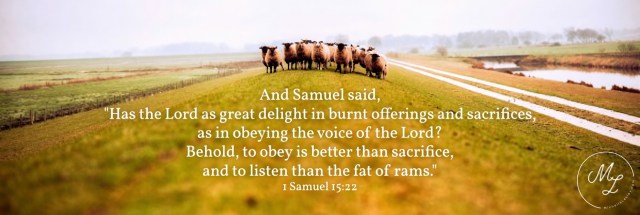
And Samuel said, โ€œHas the Lord as great delight in burnt offerings and sacrifices, as in obeying the voice of the Lord? Behold, to obey is better than sacrifice, and to listen than the fat of rams. For rebellion is as the sin of divination, and presumption is as iniquity and idolatry.โ€ 1 Samuel 15:22-23a

If you love me, you will keep my commandments. John 14:15

And by this we know that we have come to know him, if we keep his commandments. Whoever says, โ€œI know him,โ€ but does not keep his commandments is a liar, and the truth is not in him, but whoever keeps his word, in him truly the love of God is perfected. By this we may know that we are in him: whoever says he abides in him ought to walk in the same way in which he walked. 1 John 2:3-5
For this is the love of God, that we keep his commandments. And his commandments are not burdensome. 1 John 5:3

Scripture says that Christians seek to obey Godโ€™s Word, and when we donโ€™t, weโ€™re sinning.

3. Know that there are no commands of Scripture followed by asterisks

โ€œYou shall not murder…unlessโ€ฆโ€ โ€œDo not worry…except in circumstances X, Y, or Z, then itโ€™s acceptable.โ€ โ€œIf no men will step up and teach that co-ed Sunday School class, itโ€™s OK if a woman teaches it.โ€ Nope. You will not find a command of Scripture that contains exceptions or caveats. When God says โ€œdoโ€ or โ€œdonโ€™tโ€, He means it. He means it for you. He means it for everybody. He means it if itโ€™s difficult or inconvenient. He means it regardless of your circumstances.

When God says โ€œdoโ€ or โ€œdonโ€™tโ€, He means it. He means it for you. He means it for everybody. He means it if itโ€™s difficult or inconvenient. He means it regardless of your circumstances.

4. Realize that God is sovereign over your circumstances

God controls everything in this universe. Nothing happens anywhere that He hasnโ€™t either allowed or caused. Translation: youโ€™re in the circumstances youโ€™re in because God either put you there or allowed you to be there. Everybody has some sort of situation in her life that makes obedience to Scripture difficult or inconvenient. Do you think God intends for everyone to use those circumstances that He sovereignly decided to allow or put into their lives as an excuse to disobey Him? Adam and Eve tried that. Did God accept their excuses? Isnโ€™t blaming your disobedience to Scripture on the circumstances youโ€™re in just another way of saying itโ€™s Godโ€™s fault youโ€™re being disobedient? That if God had just created you differently or put you in a different set of circumstances, youโ€™d obey, but since He didnโ€™t, you have no choice but to disobey?

Isnโ€™t blaming your disobedience to Scripture on the circumstances God sovereignly put you in just another way of saying itโ€™s Godโ€™s fault youโ€™re being disobedient?

When we really want to do something, we find a way or die trying. Be honest- have you checked out every single church you can get to and explored every available resource and option for finding a church before giving up and saying you canโ€™t attend church? Have you actually tried submitting to your husband even when you think heโ€™s making a boneheaded decision? Is anybody at your church going to die if all of the women refuse to teach men and that co-ed class is disbanded? Are you so willing to obey Christ that youโ€™ll do whatever you have to do in order to find a way to obey Him?

Are you so willing to obey Christ that youโ€™ll do whatever you have to do in order to find a way to obey Him?

6. Consider that this might be a test

Remember taking pop quizzes when you were in school? Unless you were a child genius, you probably donโ€™t look back on them fondly. They were unpleasant. Hard. Sometimes scary because so much was riding on them. Maybe you were like a lot of students who could easily answer questions on the subject matter while studying, but went blank during the quiz because of the fear and pressure.

The testing of our faith can be a lot like those pop quizzes. We know the test is coming, but weโ€™re never quite sure when. Weโ€™re supposed to be studying the Textbook and asking the Teacher for help every day so weโ€™ll be prepared. But when the test comes, we have to take it. Thereโ€™s no opting out and saying, โ€œIf this test werenโ€™t happening Iโ€™d be able to obey easily.โ€ Of course you would! Itโ€™s easy to obey God when itโ€™s convenient and everythingโ€™s going your way, but obeying when itโ€™s difficult or inconvenient pushes you. Stretches you. It reinforces what youโ€™ve learned, reaffirms your commitment to Christ, and refreshes your trust in God. Donโ€™t give up in the middle of the test. Hang on to Christ, hang in there, andโ€ฆ

Count it all joy, my brothers, when you meet trials of various kinds, for you know that the testing of your faith produces steadfastness. And let steadfastness have its full effect, that you may be perfect and complete, lacking in nothing. James 1:2-4

Obeying God when itโ€™s difficult or inconvenient reinforces what youโ€™ve learned, reaffirms your commitment to Christ, and refreshes your trust in God.

7. Look to Christ as your example

Christians are supposed to โ€œwalk in the same way He walkedโ€ (1 John 2:5b). Christ is the perfect example of someone who determined to obey God regardless of His circumstances. Just look at everything He went through. Donโ€™t you think He was awfully hungry after fasting for 40 days in the wilderness? Wouldnโ€™t it have been extraordinarily easy to strike down every Pharisee who got on His nerves? Couldnโ€™t He have decided the cross was just too much and that redeeming mankind wasnโ€™t worth the trouble?

Consider him who endured from sinners such hostility against himself, so that you may not grow weary or fainthearted. In your struggle against sin you have not yet resisted to the point of shedding your blood. Hebrews 12:3-4

Jesus gave up His body – His life – in order to obey God. Are we willing to give up whatever it costs us to walk in the same way He walked?

8. Remember that God has promised to help you

What an amazing God we serve who doesnโ€™t just give us a bunch of rules to follow and leaves us to figure it out on our own! The Holy Spirit is right there, indwelling His people, always ready to help, guide, strengthen, and comfort. First Corinthians 10:13 says:

No temptation has overtaken you that is not common to man. God is faithful, and he will not let you be tempted beyond your ability, but with the temptation he will also provide the way of escape, that you may be able to endure it.

God isnโ€™t going to put you into a situation in which you have no choice but to disobey Him. Jesus proved that with His own life. Have you asked God to provide you with a way to obey Him? The Bible tells us that when we pray for things in accordance with Godโ€™s will, He will give those things to us. It is definitely in Godโ€™s will for you to resist temptation and obey Him, so it is His delight to answer when you ask Him for a way to do that.

Ladies, obedience to Christ is not optional. We don’t get to pick and choose which of God’s commands to Christians we want to obey and which ones are OK to let slide. He expects us to follow after Christ, who obeyed to His last breath, His last drop of blood. And He promises to help us, even when obeying Him is hard. Let’s stop making excuses and start looking for ways to submit to, and obey, God’s Word.

God expects us to follow after Christ, who obeyed to His last breath, His last drop of blood. And He promises to help us, even when obeying Him is hard. Letโ€™s stop making excuses and start looking for ways to obey Godโ€™s Word.

Mailbag

The Mailbag: Applying Twisted Scripture to Pseudo-“Christian” Events, Ideas, and Fads

Originally published March 7, 2023

The Asbury “revival”. Jesus Revolution. Bethel. The Enneagram. IF:Gathering...

Week after week, we see the ads, the social media posts, and the news stories of the latest, greatest “Christian” thing on the horizon.

Discerning Christians speak up in our churches, with our friends, and on our Facebook pages and rightly warn about the dangerous teachings and agendas these things push.

Other concerned Christians, genuinely fearing the “baby will be thrown out with the bathwater,” push back on those warnings. And sometimes, though they often have the best of intentions, they misapply Scripture or biblical principles to do so.

During the recent furor over the so-called Asbury “revival,” I saw, and was asked about, several of those misapplied Scriptures and principles employed in defense of the idea that we shouldn’t be so quick or so willing to publicly and confidently say something is not of God.

These Scriptures and principles could be applied to a myriad of things past and present, and will surely be employed again the next time a pseudo-“Christian” event, idea, or fad pops up, so let’s take a look at them and untangle them…

These Scriptures and principles will surely be employed again the next time a pseudo-“Christian” event, idea, or fad pops up, so let’s take a look at them and untangle themโ€ฆ


In response to doctrinally sound Christians decrying the Asbury event, one genuinely concerned lady asked:

What about Scripture that says “whoever is not against us is for us” in Mark 9:38-40? How do we apply this? Only God knows their heart, and Iโ€™m sure that people did come to know the Lord because of this.

There are several points in her question I’d like to address:

What about Scripture that says “whoever is not against us is for us” in Mark 9:38-40? How do we apply this?

John said to him, โ€œTeacher, we saw someone casting out demons in your name, and we tried to stop him, because he was not following us.โ€ But Jesus said, โ€œDo not stop him, for no one who does a mighty work in my name will be able soon afterward to speak evil of me. For the one who is not against us is for us.
Mark 9:38-40

Because we know that God’s Word never contradicts itself, and Jesus never contradicted Himself or Scripture during His earthly ministry, we have to understand passages like Mark 9:38-40 within the context of the entirety of the New Testament. In this case, we understand it in light of…

Not everyone who says to me, โ€˜Lord, Lord,โ€™ will enter the kingdom of heaven, but the one who does the will of my Father who is in heaven. On that day many will say to me, โ€˜Lord, Lord, did we not prophesy in your name, and cast out demons in your name, and do many mighty works in your name?โ€™ And then will I declare to them, โ€˜I never knew you; depart from me, you workers of lawlessness.โ€™
Matthew 7:21-23 (emphasis added)

โ€ฆand…

“Why do you call me โ€˜Lord, Lord,โ€™ and not do what I tell you?”
Luke 6:46 (emphasis added)

Notice Jesus is the speaker in all three of these passages. Again, Jesus did not contradict Himself during His earthly ministry.

We have to understand that there are a great many people out there who claim to be Christians and who, at first glance, look very much like Christians, but are not living in obedience to Christ, and/or are not teaching what accords with sound doctrine. Scripture calls those people liars and false teachers.

So when Jesus says in Mark 9:38-40 and other passages, that whoever is not against Him is for Him and vice versa, He’s defining “for Him” as someone who’s genuinely regenerated, obedient to Scripture, and teaching sound doctrine. Everybody else, regardless of what they might claim, is against Him according to Scripture.

You might think of it like this. When the disciples came to Jesus and said, “We tried to stop those guys because they aren’t part of our group,” and Jesus said, “Don’t. They’re still ‘with’ us,” it would have been similar to Him saying, “Don’t stop them. They’re doctrinally sound Presbyterians. We’re doctrinally sound Baptists. We preach the same gospel. We’re on the same team.”.

What He would not have been saying would have been something like, “It’s OK that they’re [Catholic, Mormon, prosperity gospel, New Apostolic Reformation, or any other heretical religion that claims to worship Jesus]. They say they love Me, so don’t stop them. Maybe some good will come out of this and a few people will get saved.”

Every week during his pastoral prayer, my pastor leads us to pray for a sister church in the area, and in his prayer, he always says, “Lord, we thank you that we are not the only expression of a Bible believing, God honoring, Christ exalting, Spirit filled church in this area.”

It’s kind of like that.

Only God knows their heart…

That’s not an excuse for failing to exercise discernment as Scripture commands us. God doesn’t require us to know other people’s hearts. He does require us to evaluate their observable behavior and teaching, compare it to Scripture, and stay away from it, warn others about it, and eradicate it from the church if it’s false.

“Only God knows their heart” is not an excuse for failing to exercise discernment as Scripture commands us.

Furthermore, Scripture tells us we do know their hearts:

The good man out of the good treasure of his heart brings forth what is good; and the evil man out of the evil treasure brings forth what is evil. For his mouth speaks from the abundance of his heart.
Luke 6:45

โ€œBeware of the false prophets, who come to you in sheepโ€™s clothing, but inwardly are ravenous wolves. You will know them by their fruits. Are grapes gathered from thorn bushes or figs from thistles? Even so, every good tree bears good fruit, but the bad tree bears bad fruit. A good tree cannot bear bad fruit, nor can a bad tree bear good fruit. Every tree that does not bear good fruit is cut down and thrown into the fire. So then, you will know them by their fruits.
Matthew 7:15-20

And by this we know that we have come to know Him, if we keep His commandments. The one who says, โ€œI have come to know Him,โ€ and does not keep His commandments, is a liar, and the truth is not in him; but whoever keeps His word, truly in him the love of God has been perfected. By this we know that we are in Him: the one who says he abides in Him ought himself to walk in the same manner as He walked.
1 John 2:3-6

We can’t read people’s minds, but we certainly can know their hearts when their words and actions demonstrate what’s in their hearts.

…and Iโ€™m sure that people did come to know the Lord because of this.

1. That’s speculation on your part. Is it possible some people did get genuinely saved at this event? Yes, but we don’t have any proof of that. It’s an assumption.

2. The only way someone could have gotten saved at this event is if she heard the biblical gospel of law and grace, sin and repentance, and Jesus’ vicarious life, death, burial, and resurrection explicitly preached or explained. Here’s the biblical gospel. Was it proclaimed and explained at this event? If not, no salvations took place.

3. That idea is pragmatism. People come to Christ in all sorts of horrible situations and under all sorts of horrible teaching. People came to Christ in concentration camps, while they were still Muslims, in Catholic “churches,” while working as prostitutes, while practicing homosexuality, etc. The fact that people get saved while in those horrible situations or under that horrible teaching doesn’t magically make those situations and that teaching good. It means that God is so good and powerful and merciful that, through the power of His Word, He can save someone out of those situations and teaching.


But if even one person got saved, wasn’t it worth it?

Let me begin my answer to that question with another question.

Did you know that several medical procedures that have saved the lives of many people were discovered in World War II concentration camps by performing torturous experiments on inmates? Does the fact that those medical procedures have helped so many people justify the torture the Nazis inflicted on their victims?

Of course it doesn’t. Neither does one person (or even a bunch of people) getting saved excuse, nullify, justify, or make sin and false teaching “worth it”.

Stop and take a few moments to meditate on how high, and holy, and worthy of all honor, glory, majesty, praise, and reverence is God, the almighty King of the universe. Think about the excruciating pain Jesus went through on the cross, and the agony of having every drop of God’s wrath against sin poured out on Him. So that He might bear your sin and mine. So that we could be forgiven and free and saved from an eternity in Hell.

How could we ever say that the sewer slime of committing any sin against that God is “worth it,” no matter what the outcome might be?

No. A blasphemy-fest isn’t “worth it”. God doesn’t consider false teaching “worth it” if someone gets saved. He’s perfectly capable of saving everyone He means to save without such events.


You discerning Christians speaking out against this event should just back off like Gamaliel suggested in Acts 5 and let it play out. If it’s not of God, it will come to nothing.

So in the present case I tell you, keep away from these men and let them alone, for if this plan or this undertaking is of man, it will fail; but if it is of God, you will not be able to overthrow them. You might even be found opposing God!โ€
Acts 5:38-39

{Be sure to read that passage in its entirety (Acts 5:17-42), so you can get the context and all the details.}

Sisters, we’ve got to get it through our heads that the book of Acts is largely historical narrative like Genesis or Judges or Nehemiah. Not only that, it is also a historical narrative of transition from Old Testament Judaism to New Testament Christianity. Many of the things we read about in Acts are not to be understood as normative of, or instruction to the church today. (Those sorts of things are mainly in the pastoral epistles – 1&2 Timothy and Titus.)

Such is the case with the Gamaliel passage in Acts 5. This is a descriptive passage (it simply tells us what happened), not a prescriptive passage (instructions for us to follow). And be thankful for that, because the disciples get beaten a lot in Acts 5.

Nowhere in God’s didactic instruction to the New Testament church does He tell us to back off an event or teacher that claims to be “Christian” and just let things play out. Nowhere. Instead, we repeatedly see instruction throughout the New Testament (and even the Old Testament) to be wise and discerning, test the spirits, and have nothing to do with false teachers, either as individuals or the church.

We also have to take into account that Gamaliel was a Pharisee who was still hanging out with the rest of the Council. Know what that means? He wasn’t a Believer. You take Gamaliel’s advice, and you’re taking the advice of a lost person – over God’s instructions – about how to handle a situation in the church.

Gamaliel is not the hero of this story. If he were, he would have believed the gospel the disciples proclaimed, and prevented the Council from beating them and forbidding them to preach. And he probably would have suffered the same consequences the disciples suffered.

Gamaliel isn’t the hero of this story. If he were, he’d have believed the gospel the disciples proclaimed, and prevented them from being beaten & forbidden to preach. And he probably would have suffered the same fate as the disciples.

Finally, though Gamaliel, in his limited experience, could cite a couple of instances in which this rubric seemed to work, we have the advantage of looking back across much more history, over many more years, and in many more places, and we can see that his advice doesn’t always work. How long has Islam been hanging around? Hinduism? Mormonism? Buddhism? Catholicism? Certainly none of those religious movements are of God, and still, here they all are.

Don’t take Gamaliel’s advice in these situations, submit to God’s instructions to the church.


Be careful that you are not calling what is of God as not. Very serious thing to do.

It may not always be meant this way, but this kind of warning can come across as a veiled threat.

Be careful you are not calling something “of God” when it is not. That is also a very serious thing to do, especially if what you’re basing your conclusion on is your feelings, opinions, experiences, and out of context, misapplied Scripture, rather than on rightly handled, in context Scripture.


God can bring good out of anything!

Of course He can. God is out for His glory and the good of His people. But that doesn’t make the situation or false teaching itself good or excusable or that we shouldn’t warn against it if it’s bad. Scripture says the opposite.

When God sovereignly brings something good and holy out of a bad or sinful situation, it doesn’t mean that bad or sinful situation is good and holy. It means God is good and holy.

For example: A Mormon who studies her Bible and/or is evangelized can get genuinely saved while still in Mormonism. (And God will save her out of Mormonism.) That doesn’t make Mormonism Christian or good or biblical. That means God is good and merciful and kind.

When God sovereignly brings something good and holy out of a bad or sinful situation, it doesn’t mean that bad or sinful *situation* is good and holy. It means *God* is good and holy.

Be ready. The next “Christian” thing is just around the corner. Study your Bible and be prepared to correctly apply rightly handled Scripture as you carefully evaluate it according to God’s Word.


If you have a question about: a Bible passage, an aspect of theology, a current issue in Christianity, or how to biblically handle a family, life, or church situation, comment below (Iโ€™ll hold all questions in queue {unpublished} for a future edition of The Mailbag) or send me an e-mail or private message. If your question is chosen for publication, your anonymity will be protected.