

Bible, Entertainment

Birthday Verses

I’m probably the last person EVER to have heard of this, but I recently saw a post of a beautiful Bible verse meme on social media, and someone had commented underneath, “That’s my birthday verse!”.

“Birthday verse?” I thought, “What’s that?”. Well, it didn’t take too long to figure out that the numbers in the reference of the Bible verse corresponded to the numbers in the date of the commenter’s birthday.

Now if you’re a long timer around here, you know that I’m not too keen on “life verses” and having a “word for the year” because people tend to go too far with them. They build doctrine and theology around those concepts (which are found nowhere in Scripture), and things can go wonky fast.

And if you take this “birthday verse” thing seriously, the same thing can happen. It doesn’t define you. It doesn’t have any significance in your life or identity. It doesn’t mean anything.

But it’s kinda fun just to see what pops up, and if that’s all you’re in it for, it’s no more a harmful diversion than watching a funny YouTube video or playing some Wordle.

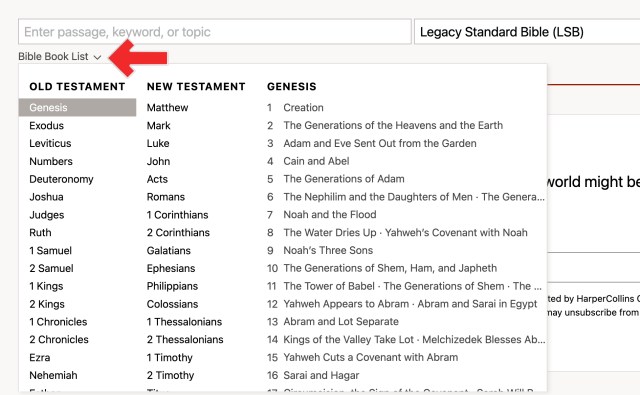
You can go old school and flip through your Bible, but I found it easier to go to Bible Gateway and click on the “Bible Book List” drop down. That way it’s easy to see – if, say, your birthday is in December – whether or not the book you’re looking at actually has twelve chapters. If it does, you can just click on chapter 12, and it’ll take you right to that chapter of the book you’re looking at:
My husband and I gave it a try with both of our birthdays. His birthdate yielded some pretty impactful verses. Mine, some pretty random verses. All Scripture isย God-breathed and profitable (Any March 16 babies out there?)… but some of them need a lot more context than others!๐Ÿ˜€

My birthday is April 27 (4/27). Some books don’t have four chapters, and of those that do, not all of those fourth chapters have 27 verses. But here are my “birthday verses” for the ones that do. Why not give it a try with your birthday!

4:27

Exodus: Then Yahweh said to Aaron, โ€œGo to meet Moses in the wilderness.โ€ So he went and encountered him at the mountain of God and kissed him.

I have a son whose middle name is Aaron, and a son-in-law whose first name is Aaron. Neither of them were born on April 27, and I’m pretty sure neither of them know anybody named Moses. I guess this one’s a bust.

Leviticus: โ€˜Now if anyone of the common people sins unintentionally in doing any of the things which Yahweh has commanded not to be done, and becomes guilty,

…Eeek! A cliffhanger!

Numbers: All the service of the sons of the Gershonites, in all their loads and in all their service, shall be performed at the command of Aaron and his sons; and you shall assign to them as a responsibility all their loads.

There’s ol’ Aaron again. These Gershonites sound like pretty responsible, hard working dudes.

Deuteronomy: And Yahweh will scatter you among the peoples, and you will remain few in number among the nations where Yahweh drives you.

See, this is where “These verses don’t have any significance in your life,” is a GOOD thing.

1 Kings: And these deputies sustained King Solomon and all who came to King Solomonโ€™s table, each in his month; they left nothing lacking.

More responsible, hard working dudes.

2 Kings: Then she came to the man of God to the hill and took hold of his feet. And Gehazi came near to push her away; but the man of God said, โ€œLet her alone, for her soul is bitter within her; and Yahweh has hidden it from me and has not told me.โ€

This is from the story of the Shunamite woman. If you’ve never read it, you should! It is an amazing story that points us ahead to Christ.

1 Chronicles: Now Shimei had sixteen sons and six daughters; but his brothers did not have many sons, nor did all their family multiply like the sons of Judah.

Good to know… I guess?

Proverbs: Do not turn to the right nor to the left; Turn your foot from evil.

Aha! Meaningfulness! What a great admonition to remember!

Jeremiah: For thus says Yahweh, โ€œThe whole land shall be a desolation, Yet I will not execute a complete destruction.

Again, thank you, Lord, for good hermeneutics that tells me this judgment has no application to my immediate life circumstances.

Daniel: Therefore, O king, may my advice seem good to you: break away now from your sins by doing righteousness and from your iniquities by showing mercy to the poor, in case there may be a prolonging of your prosperity.โ€™

I wouldn’t mind saying this to a “king” or two…

Mark: and he sleeps and rises, night and day, and the seed sprouts and growsโ€”how, he himself does not know.

God has a sense of humor. He knows I have a black thumb.

Luke: And there were many lepers in Israel in the time of Elisha the prophet, and none of them was cleansed, but only Naaman the Syrian.โ€

The story of Naaman is another fantastic Old Testament story you should read. You can find it in 2 Kings 5.

John: And at this point His disciples came, and they were marveling that He was speaking with a woman, yet no one said, โ€œWhat do You seek?โ€ or, โ€œWhy are You speaking with her?โ€

OK, this one touched my heart. Who am I that my Lord should come to me, make sure I heard the gospel, and, in His love and mercy, save me? Why would you speak with me, Lord? I am just a sinful woman. But even sinful women are precious to Jesus.

Acts: For truly in this city there were gathered together against Your holy Servant Jesus, whom You anointed, both Herod and Pontius Pilate, along with the Gentiles and the peoples of Israel,

This is in the middle of an incredible prayer raised by some of the first Christians. I included it in my Bible study, Sweet Hour of Prayer: Learning to Pray from the People of Scripture (lesson 10).

Galatians: For it is written, โ€œRejoice, barren woman who does not give birth; Break forth and shout, you who are not in labor; For more numerous are the children of the desolate one Than of the one who has a husband.โ€

This is actually a quote of Isaiah 54:1. It is an allegory of the old and new covenants.

Ephesians: and do not give the devil an opportunity.

OK, maybe this IS my life verse! Or at least my ministry verse.๐Ÿ˜€

What about YOUR birthday verses?
Anything interesting, meaningful, or funny?
Share in the comments!

Holidays (Other), New Year's

The Mailbag: My word for the year is…

Originally published January 7, 2019

I canโ€™t seem to find information on one topic that keeps coming up with women I am friends with. โ€œOne wordโ€ for the year. They are all waiting to โ€œhearโ€ from God what one word they need to focus on for the year. I have been asked what my word for the year is. I just think… the Word Of God is my word for every year. Do you happen to have any links, resources, or input?

I wish there weren’t any links or resources on this, but, unfortunately, it looks like a small cottage industry – both secular and evangelical – is growing up around this unbiblical concept. (I’m not going to give anyone free advertising and website hits by providing their links.)

The idea is pretty simple. You pick (or God “speaks” to you) a word that represents some sort of change you want to see in your life and you focus on that word, especially during situations when you want to see that change manifest itself, for the remainder of the year. For example, if you want to be a more peaceful person, you might choose “peace” as your word for the year. You find some way to think about or meditate on the word “peace” every day, but especially in worrisome or chaotic situations, and that’s supposed to make you a more peaceful person by the end of the year.

The only problem with this is – as with so many things in pop evangelicalism – the Bible.

You will not find this practice taught, endorsed, or even mentioned in the Bible. In fact, I suspect this idea traces its roots back to some form of Eastern mysticism. It’s a modern day twist on repeating a mantra. And somebody thought it would be a good idea to “Christianize” it – so she slapped a thin coat of “this is how God can speak to you and work in your life” paint over the surface of it.

That’s not how this works. That’s not how any of this works. You don’t just get to make up Christianity as you go along. That’s God’s job, not ours, and He already set it up exactly the way He wants it – in the Bible.

We know that God is not going to speak a certain “word for the year” to people for two reasons. First of all, extra-biblical revelation is unbiblical. God speaks to us through His all-sufficient written Word, not audibly. Which brings us to reason number two. Because God speaks to us through His written Word, and there’s nothing in His written Word about getting a word for the year, we can be certain that He’s not going to be whispering a word for the year in anybody’s ear.

OK, so let’s take the extra-biblical revelation component out of it. What if we go at it from a sanctification angle? Maybe I’ve noticed that I tend to worry too much, so I decide, for the sake of my own spiritual growth, that my word for the year is going to be “peace”, and I’m going to focus on that word this year?

Still not biblical. Not just because it’s not taught in the Bible (although that’s certainly reason enough), but for a host of other reasons as well.

For starters, we are not in charge of our sanctification, God is. He is the one who gets to decide what work He’s going to do in our hearts, and how He’s going to do that. And that’s a really good thing because He is infinitely wiser and more powerful than we are and He knows our hearts much better than we do. You probably won’t hear many of your girlfriends choosing words like “suffering”, “humility”, or “repentance” as their word for the year, but God knows that areas like these – the ones we often push back against with the greatest resistance – are the ones we usually need the most work on.

Next, sanctification isn’t linear. You don’t tackle peace, master it, then move on to patience, master it, and then move on to whatever’s next. And that’s how this “word for the year” thing is set up. This year, you choose the word “peace”. Next year, maybe you’ll choose “patience”, and so on. But what do you do when you get to the end of the year and you know you haven’t mastered peace yet? What then? Do you choose the word “peace” again? Give up on peace and choose another word?

Biblical sanctification is more like a big bowl of spaghetti noodles. Everything is all tangled up and inter-connected. At any given time, God could be working on one or five or a dozen different aspects of your character. And while you’ll rejoice when you occasionally look back over how much you’ve grown, you’ll never “master” any aspect of Christlikeness this side of Glory.

Finally, God has already prescribed our role in sanctification, and meditating on a particular word for the year is not even a little part of it. Our role in sanctification is to abide in Christ. How? We learn the “how” of abiding in Christ from studying our Bibles. John 15 offers us a little glimpse:

V.1: I [Jesus] am the true vine, and my Father is the vinedresser. Recognize that, as I mentioned, God is the vinedresser – the one who prunes, waters, fertilizes, harvests – not you.

V.2: …every branch that does bear fruit he prunes, that it may bear more fruit. Bear up under pruning as God conforms you to the image of Christ. Cooperate with whatever He’s working on in your life by obeying Him, thanking Him, and realizing that He’s doing it to make you more fruitful.

V.4: As the branch cannot bear fruit by itself, unless it abides in the vine, neither can you, unless you abide in me. Recognize and practice your dependence on Christ and His work for you and in you, not on a word you meditate on. You can’t be a fruitful Christian by coming up with your own way to grow in Christ. You can only do it His way.

V.7a: If you abide in me, and my words abide in you… To abide in Christ is simply to live for Him and commune with Him day by day. One of the ways we do that is to study “His words” – the Bible – so that those words will live in us. We ingest the words of Christ by studying our Bibles at home, with our Sunday School or Bible study class at church, sitting under good preaching at our church, and consuming other biblical materials during the week.

V.7b: …ask whatever you wish, and it will be done for you. If you’re abiding in Christ and His Word is abiding in you – what kinds of “whatever you wish” things do you think you’ll be asking Him for? Your foundational prayer to anything else you might ask for will be for God to be glorified and for Him to make you more like Christ. “Father, please heal me, but only if that will glorify You and make me more like Christ.” “Lord, I’d like You to take away this difficult situation at work, unless letting it continue would grow me to be more like Christ. Help me to glorify You no matter what.” Prayer is one of God’s prescribed methods of sanctification.

V.8: By this my Father is glorified, that you bear much fruit and so prove to be my disciples. Glorify God by bearing the fruit of the Spirit, displaying the fruit of obedience, harvesting the fruit of evangelism, and by doing so, displaying for the world what a real disciple of Christ looks like in order to point them to Him.

V.10,12,14: If you keep my commandments, you will abide in my love…This is my commandment, that you love one another as I have loved you…You are my friends if you do what I command you. Obey Christ’s commands and love others the way He loves you. That’s the heart of your role in sanctification. It’s an outward focus on how you can bring Him glory in any situation by obeying Him and loving others with a die-to-self love rather than a navel-gazing, self-centered, inward focus on “How can I be a better me?”.

V.11: These things I have spoken to you, that my joy may be in you, and that your joy may be full. Don’t forget the joy! What joy is there in a word that you focus on? How can you quantify whether or not you’re a better person at the end of the year and derive joy from that? Sanctification God’s way offers instant, daily gratification in the joy department. Joy dwells in us because the Holy Spirit dwells in us. Joy wells up when we see the hand of God at work in our hearts and lives, when He answers prayer, even just from spending time with Him in His Word, worship, and prayer. Joy is communion with a Person, not satisfaction over a job well done of pulling yourself up by your own boot straps.

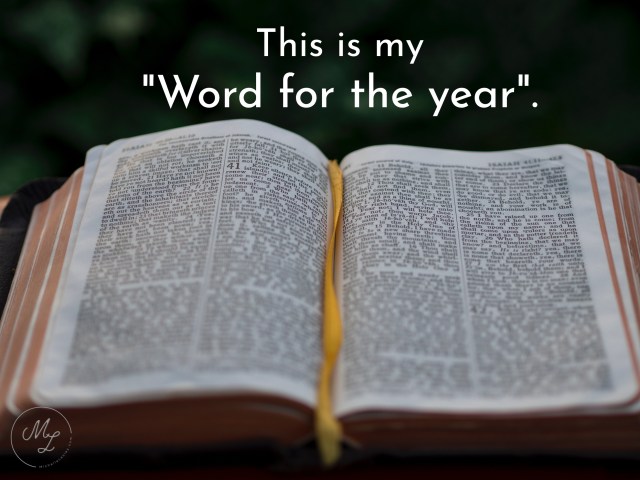
This “word for the year” thing is not necessary or biblical. When someone asks you what your word for the year is, just hold up your Bible and tell her, “All of these.”

This “word for the year” thing is not necessary, it’s not biblical, and it kicks God out of His rightful place of authority in sanctification and attempts to put self in the driver’s seat. You’re on the right track with your thinking. When someone asks you what your word for the year is, just hold up your Bible and tell her, “All of these.” After all, Christ gives us abundant life. Why would we limit ourselves to one measly little word when we can study all of God’s words?


If you have a question about: a Bible passage, an aspect of theology, a current issue in Christianity, or how to biblically handle a family, life, or church situation, comment below (Iโ€™ll hold all questions in queue {unpublished} for a future edition of The Mailbag) or send me an e-mail or private message. If your question is chosen for publication, your anonymity will be protected.