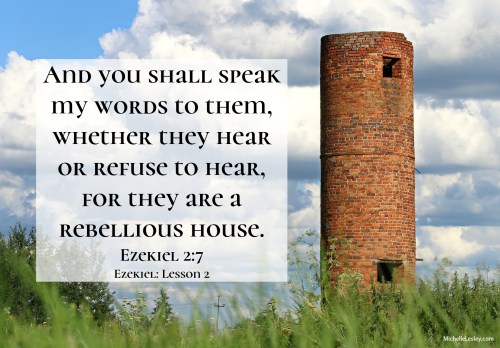
Ezekiel Bible Study

Ezekiel ~ Lesson 2

Welcome, ladies! I’m so glad you’re here! I have received a lot of questions about the study that were answered in last week’s introductory lesson. Please do not skip Lesson 1 (link below). Not only will it answer any questions you may have about the study itself, but if you want to study Ezekiel properly, you must do the background work contained in Lesson 1.


Previous Lessons: 1

Read Ezekiel 1:1-3:15

Questions to Consider

1. Review your notes from last week’s introductory lesson. What are some things to keep in mind as you begin to study the text of Ezekiel today? Drawing from your notes and 1:1-3, imagine you’re a playwright and write the setting for the “script” of Ezekiel. Which phrases in verses 1 and 3 connect us to 2 Timothy 3:16?

2. Read 1:4-28. Does this passage remind you of any other biblical passages? Which ones, and why? Read through all of the cross-references and footnotes in this passage as well as any study Bible notes or commentaries you like on this passage in order to gain as good an understanding of it as you can. Why do prophetic visions of Heaven and the spiritual realm (apocalyptic passages) always seem so hard to understand? Is it OK if we read these passages and, despite our best efforts, don’t completely grasp all of the symbolism? Do you think Ezekiel understood everything he was shown?

What does 1:28b say that the main idea of 1:4-28a is? What was Ezekiel’s response to seeing the glory of God? (1:28b) How did being overwhelmed by God’s glory put Ezekiel in the right frame of mind and heart to receive and proclaim the message God subsequently gave him? (1:28b-2:2)

3. Read chapters 2-3.

Using your concordance, search the term “son of man“. Ignoring false results (ex: “son of Manasseh”), what are the main ways this term is used? How many times is Ezekiel called “son of man”? What other major Bible character is called the Son of Man? What is the difference between the reference to Ezekiel as “son of man” and Christ’s title “the Son of Man“?

To whom is God sending Ezekiel (2:3, 3:11), and why (2:4,7, 3:4,11)? How will Israel respond?(3:7) How would the pagans have responded if God had sent Ezekiel to them instead? (3:4-7) Explain the shame it should bring to God’s people – in Ezekiel’s day and today – when lost people respond to the preaching of God’s Word in repentance and faith, and those who claim to be His people do not.

Compare God’s charge to Ezekiel to speak His word to His people “whether they hear or refuse to hear” to God’s charge to pastors to preach the Word to His people “in season and out of season” in 2 Timothy 4:1-2.

Explain the metaphor of Ezekiel eating the scroll in 2:8-3:3. How does this apply to us as Christians today?

Why was it bad for Israel to be “hard headed” but good for Ezekiel to be “hard headed”? (3:7-9) Explain why a pastor, or any Christian, needs to be “hard headed” (yet soft-hearted) when dealing with Believers (or false converts) who are disobedient to God’s Word.


Homework

•If you’re artistic, illustrate part or all of the scene in 1:4-28.

•Are you familiar with the “heavenly tourism” books like Heaven Is for Real or 90 Minutes in Heaven that were popular a few years back? Read some of the descriptions of “Heaven” found in these books and compare them with Ezekiel’s, Daniel’s, and Revelation’s descriptions of heavenly scenes. How do they compare?

•From what I can tell, this church has horribly unbiblical theology, so don’t follow them or their beliefs, but I loved their choir’s rendition of Ezekiel Saw the Wheel. Listen carefully to the lyrics (or Google them). How closely do they match up to Ezekiel 1:4-28 and/or other passages of Scripture?


Suggested Memory Verse

Share Your Testimony

Testimony Tuesday: Michelle’s Story

Michelle’s* Story

Literally the other day, I was set completely free. I’m still dancing!! And, I am not the dancing type!

About a year ago, my husband and I began attending a new church. I could not put my finger on what happened during that initial service, but I remember saying to my husband, “Whatever that was, I want more of that.”

At that time, I was a Christian, but a struggling one. I had not yet come to understand what being free in Christ meant. I was struggling physically with un-diagnosable chronic physical pain. I was on a downward spiral of acute insomnia coupled with not only the physical pain, but also fear and anxiety. I read my Bible. I went to Bible studies. My friends were almost all self-professing Christians. I grew up in a churched family. No one shared with me the truth I was about to hear and understand.

No one shared the truth with me…

About 18 months ago, after exhausting all of my options for treatment, I felt even more anxious that I (keyword, I) couldn’t do anything further to fix this. It was then that God brought an amazing woman into my life to teach me what a true and vibrant personal relationship with the Living Christ was … I bombarded her with questions. What she was teaching me and what I was learning at church on Sunday lined up with each other seamlessly. I have never met this woman face-to-face, she was introduced and referred to me through long-distance friends. Come to find out, she knew the pastor of my new church years back through a family member. Through her, God confirmed the difference was this church was under the leadership of a true Christ-follower. Praise God for people who know their identity in Christ and continue referring you back to Him.

God brought an amazing woman into my life…

As I continue to study, I’m really beginning to wonder if I ever was a Christian. I mentioned that I was a Christian, but a struggling one. And I did read my Bible, and go to countless Bible Studies.

Whether or not I was I guess is not important, because now I am – I get it, oh thank you, Jesus, that I get it. I didn’t get it before. I was under the assumption that since God’s will is for everyone to be saved, then anyone who wanted to be saved and prayed the prayer was saved forever and that could not change. In fact, my uncle recently passed away and we were not close but I talked to someone about this and I was assured of “once saved always saved.”

Oh, thank You, Jesus, that I get it.

A fire has now been lit under me that screams most people I know are likely false converts and they have no idea. I’d never heard of the idea that God saves you in His timing. I thought that as soon as you prayed that prayer, boom, that was it. Your address for eternity had permanently changed. I was never convicted of sin to the point of complete repentance and I don’t recall ever being corrected on this – in fact, I only remember being assured over and over again that I was saved. I was sorry for my sin, I didn’t like my sin, I knew Jesus died for my sin. All good, but I wasn’t changed. But now, the Truth has set me free.


*This is from a reader who shares my first name. This is not my (Michelle Lesley’s) testimony.

Ladies, God is still at work in the hearts and lives of His people, including yours! Would you like to share a testimony of how God saved you, how He has blessed you, convicted you, taught you something from His Word, brought you out from under false doctrine, placed you in a good church or done something otherwise awesome in your life? Private/direct message me on social media, e-mail me (MichelleLesley1@yahoo.com), or comment below. Your testimony can be as brief as a few sentences or as long as 1500 words. Let’s encourage one another with God’s work in our lives!

Mailbag

The Mailbag: Potpourri (Paul’s gospel, National repentance, Pastor search committee, Pastor’s wife teaching men)

Welcome to another “potpourri” edition of The Mailbag, where I give short(er) answers to several questions rather than a long answer to one question. I also like to take the opportunity in these potpourri editions to let new readers know about my comments/e-mail/messages policy. I’m not able to respond individually to most e-mails and messages, so here are some helpful hints for getting your questions answered more quickly. Remember, the search bar (at the very bottom of each page) can be a helpful tool!

In these potpourri editions of The Mailbag, I’d also like to address the three questions I’m most commonly asked:

“Do you know anything about [Christian pastor/teacher/author] or his/her materials? Is he/she doctrinally sound?”

Try these links: 
Popular False Teachers /
 Recommended Bible Teachers / search bar
Is She a False Teacher? 7 Steps to Figuring It Out on Your Own
(Do keep bringing me names, though. If I get enough questions about a particular teacher, I’ll probably write an article on her.)

“Can you recommend a good women’s Bible study?”

No. Here’s why:
The Mailbag: Can you recommend a good Bible study for women/teens/kids?
The Mailbag: “We need to stop relying on canned studies,” doesn’t mean, “We need to rely on doctrinally sound canned studies.”.

“You shouldn’t be warning against [popular false teacher] for [X,Y,Z] reason!”

Answering the Opposition- Responses to the Most Frequently Raised Discernment Objections


Didn’t the risen Christ give Paul the Gospel of salvation by grace through faith? Paul called it “my gospel”? Is the Great Commission the same as Paul’s gospel? Thanks!

Not exactly, but it’s great that you’re noticing those little details as you study God’s Word!

“Paul’s” gospel…

Remember Jesus Christ, risen from the dead, the offspring of David, as preached in my gospel, 2 Timothy 2:8

…is the biblical gospel of salvation that Paul preached – the good news of what Christ did to save sinners through His death, burial, and resurrection – and the call to repentance and belief.

The Great Commission…

And Jesus came and said to them, “All authority in heaven and on earth has been given to me. Go therefore and make disciples of all nations, baptizing them in the name of the Father and of the Son and of the Holy Spirit, teaching them to observe all that I have commanded you. And behold, I am with you always, to the end of the age.” Matthew 28:18-20

…is the church’s (and individual Christians’) “marching orders” to share that gospel with sinners and disciple them to maturity in Christ. It is God’s main purpose for the church.

So, in a nutshell, the gospel is what Christ did. The Great Commission is what we’re supposed to do with the gospel.


I got into quite the discussion with people today who feel that prayers of repentance for our national sins are not only unnecessary, but an affront to them because THEY did nothing wrong. I cited Daniel who prayed prayers of repentance for his nation, though he led a righteous life. They got all confused with Old Testament sacrificial law and that Christ was the ultimate sacrifice so we only need repent of our OWN sins. Could you address this, please?

Well…depending on exactly what they were saying, they may have been at least partly right. We can certainly pray that God will lead individuals in our nation to repent of whatever sins they may have committed, but we cannot repent on behalf of another person or of a nation. God does not hold us responsible for the sins of others, and we cannot repent for the sins of others. (see Ezekiel 18).

If you’re referring to Daniel’s prayer in Daniel 9, if you’ll read very carefully, you’ll notice he is confessing the sin of his people, lamenting over the sin of his people, and asking God to pour out His mercy on his people despite their sin, but he is not repenting on their behalf.

It is impossible to repent for someone else’s (let alone a whole nation’s) sin because repenting is more than:

  • confessing that sin has occurred,
  • admitting that someone is guilty for having committed that sin,
  • feeling sorrowful over sin,
  • asking forgiveness for sin, or
  • asking God to be merciful toward the sinner.

Repentance means to turn away from your sin, to forsake it, to stop doing it because you want to obey God instead. Although I’m sure he wished he could have, Daniel could not turn away from someone else’s (the nation of Israel’s) sin. And, he specifically says in verse 13: “we have not entreated the favor of the Lord our God, turning from our iniquities”.

Another thing to remember is that Daniel is interceding for God’s covenant people. They belonged to Him. They had agreed to follow Him. America is not in a covenant relationship with God. For a Christian today, interceding for the church and praying that God would lead Christians to repentance would be more analogous to what Daniel was doing.


We lost our pastor almost a year ago and are struggling to find a new one. Do you have any suggestions of where we could send the information about our church and the position in hopes of finding a suitable candidate?

I would suggest sending your information to:

The Master’s Seminary’s Pastor Search page

Founders Ministries Minister Search page

Expositors Seminary

I hope you’ll find a wonderful, godly pastor very soon!

Now, although this might not be possible for your particular church, I would like to throw something out there for the consideration of any pastor or church member who might be reading this. The most biblical model of leadership for the local church is that it be led by a plurality of elders.¹ For that primary reason, I would encourage every church that doesn’t already have this leadership structure in place to look into it and give strong, prayerful consideration to transitioning into leadership by a plurality of elders.

However, secondarily, there are practical benefits to your church being led by a plurality of elders, and avoiding being “pastorless” is a huge one. My own church recently welcomed a new pastor after being without one for two full years. That two years was a struggle. The interim pastor was a stranger to us and we were strangers to him. He did not know the ins and outs of life at our church or the strengths and weaknesses of our church. As affable as our interim pastor was, it was always in the back of everyone’s mind that he was temporary. This was not our pastor and everyone knew it. And then there were some other issues that arose during his tenure that awaited the new pastor’s arrival.

When a church is led by a plurality of elders, many of these issues can be avoided or lessened. When a lead teaching elder dies, moves, or steps down for whatever reason, there is, ideally, already another elder available to step in and take over. This elder already knows the church and the people and they know him. There’s no need to assemble and train a pastor search committee, launch a nationwide search, wait on resumes to arrive, interview candidates, present them to the church for a vote, and then hire a stranger about whom you know virtually nothing except what’s on his resume and whatever he says in his interview. The transition from elder to elder is smoother and immediate with little upheaval and relational trauma to the church body.

Just something to think about.

¹I’m not saying that churches which aren’t elder-led are apostate or intrinsically sinful, I’m just saying that if you want to get as close to the biblical model as possible, go with a plurality of elders.

I am a relatively new (about one year old –  but growing in discernment!) Christian, and I attend a small Baptist church of about 15 people in the remote area in which I live. The pastor’s wife leads both men and women in a “Bible” study group using popular (biblically questionable at best, such as Max Lucado) books instead of reading Scripture. I choose not to attend these studies, but because the church is so small, my absence is obvious and noticed. People comment that they have not seen me at “Bible” study. 

Everything else that happens in the church, the sermons, worship, prayer, are all on point biblically, thus far. My pastor is a godly man as far as I can tell, so my only issue to date is these co-ed, led by a woman, “not-Bible” studies. Should I take my concerns to my pastor? I’m already on a bit of shaky ground with the pastor’s wife. I’m reluctant to upset the apple cart any more. However, if the right thing to do is to address it and deal with potential consequences (shunning, whatever) then I want to do the right thing by my Lord and Savior. How would you guide me in this situation?

I know this is a really difficult situation to be in and I’m sorry it’s making you uncomfortable at church. Yes, when we see sin in the camp, we must speak up, so you should begin preparing to address this situation. Normally, I encourage women to go to the person most directly in charge of the issue first, which in this case would be the pastor’s wife, but I’m guessing that if you’re on “shaky ground” with her it’s because you’ve already tried to address this with her. The next step is to go to the pastor.

I would encourage you to spend a little time studying through the book of Esther, realizing that she was in a somewhat similar situation to yours: God revealed to her an ungodly situation that would harm His people, and she – at great personal risk – had to go to the man in charge and implore him to right the situation, not knowing how he would respond. It could be that God has specifically placed you in this church “for such a time as this”.

Notice that Esther asked that her people be gathered to pray for her. If you have any like-minded friends or loved ones who will pray with you as you prepare your heart to talk to your pastor, that would be beneficial. I have already prayed for you, and I am asking everyone reading this to stop and take a moment to pray for you as well.

If the pastor tells you you’re wrong or doesn’t rectify the situation, and there’s another, better church you could join, even if it’s not as convenient as this one, prayerfully consider moving your membership there. If, as you said, everything else at your current church really is doctrinally sound, and you have no other options for a doctrinally sound church to attend that’s within achievable driving distance of your house, my counsel to you would be to stay at this church, continue not to attend the “not-Bible” study, and fervently pray for God to change the hearts of your pastor and his wife.

If you stay and people continue to say, “We missed you at ‘Bible’ study!” all you have to say is, “Thank you!” or “It’s nice to be missed,” or something like that. I can’t speak for everyone, but when I say, “I missed you at _____,” to someone, it’s not a demand to know why she wasn’t there, it’s to let her know that I love her and missed fellowshipping with her. Hopefully, that’s all your fellow church members mean by saying that. If a nosy Nelly asks why you weren’t there, keep in mind that you’re not required to give her that information just because she asked. You can say something like, “I have a conflict and can’t attend,” which is truthful (you have a biblical conflict and can’t, in good conscience, attend), yet gives no one the opportunity to say that you were gossiping or trying to stir up division in the church. If she continues to pry, look her dead in the eye and keep repeating, “I have a conflict and can’t attend” until she comes to her senses and realizes it’s none of her business why you weren’t there.

Here are some resources I hope will help you:

Rock Your Role: Jill in the Pulpit

The Mailbag: How should I approach my church leaders about a false teacher they’re introducing?

Searching for a new church?


If you have a question about: a Bible passage, an aspect of theology, a current issue in Christianity, or how to biblically handle a family, life, or church situation, comment below (I’ll hold all questions in queue {unpublished} for a future edition of The Mailbag) or send me an e-mail or private message. If your question is chosen for publication, your anonymity will be protected.


Bible Study

A Hard Bible for Hard Times

These days, popular women’s “Bible” studies tend to be seven lessons of fluff, feelings, and false doctrine.

This is the “anti-study”.

Roughly 20 lessons of digging into the text of what can be a challenging passage of Scripture.

I believe you’re up for the challenge, ladies. Let’s study.

A couple of days ago, I launched Ezekiel – our new Bible study here on the blog – with these introductory remarks on social media. I made it pretty clear, both in my social media remarks and the introduction to the study itself that this wasn’t going to be your typical walk-in-the-park women’s “Bible” study designed to make you feel better about yourself.

Ezekiel is a long book. There are parts of it that are going to be hard to understand. There are parts of it that, to our flesh, are going to be boring. There are cubits. Lots and lots of cubits. This is a Bible study that’s going to require extra work – probably with commentaries and study Bibles. And I’m not making any “feel good” guarantees.

And yet, I was overwhelmed by the response from so many readers: “I’m in!” “Sign me up!” “Looks like a good time!” “Excited is an understatement!”

All this about….a hard text? More work? Even as we endure Corona and quarantine, separation from loved ones, the shuttering of our churches, economic hardship, increasing persecution, racial strife, rampant crime, rioting, anarchy, and God only knows what’s next?

Yeah. Want to know why?

It’s the same reason that being bone-weary after a long day of hot, sweaty yard work feels better than the mind-numbed sleepiness you feel when you’ve been binge-watching Netflix in your pajamas all day. The same reason you feel better after a satisfying, well-balanced meal than after snarfing a dozen Oreos.

It’s what we need.

It’s what’s good for us.

It’s accomplishing something lasting.

We need a hard Bible in these hard times.

Think about the hard times the first century Christians of the New Testament went through. For refusing to offer a pinch of incense in worship to Caesar, for declaring that Jesus alone – not Jesus plus the pantheon – is Lord, they were fed to the lions for sport, burned and boiled alive, crucified, beheaded, speared, beaten, stoned, whipped, exiled, and considered “the scum of the world, the refuse of all things.”

And for most of that first century, the bulk of the Scriptures Believers had access to was the Old Testament. The part that soft, milquetoasty, “I want a God made in my own image” evangelicals today want to “unhitch” from precisely because it’s hard.

While fearing for their very lives for following Christ, our forefathers in the faith studied the God who flooded the earth for its rebellion against Him, who wiped out pagan nations for their idolatry, who sent horrific plagues upon those who defied Him, and who poured out His wrath on His own people for their sin and spiritual whoredom.

They had a hard Bible during their hard times.

To be sure, they saw, and we also see, the God of mercy, love, and grace who spared Noah, who provided His children with a land flowing with milk and honey, who rescued the Hebrews out of slavery, and who blessed all who were faithful to Him. And we know that all of Scripture – the hard to swallow parts and the easy to embrace parts, the “dig in and study hard” parts and the simple and sweet to the soul parts – all of Scripture is profitable.

But we need a hard Bible for hard times.

Because hard passages that make us stop and spend extra time and effort build discipline, endurance, and patience into our spirits. They make us do the hard work of digging for the nature and character of God and reward us with the treasure of knowing Him more intimately. They show us who God is in a unique way that the easy passages do not.

Feelings, fluff, and false doctrine can never accomplish those ends. They do not prepare us to endure suffering and persecution with strength and dignity, but to whine and complain and focus on the hurt. They do not teach us who God truly is in our trials and temptations, but that we can create a custom-made idol we’re comfortable with and call it “God”. They do not lead us to trust and obey God when the going gets tough, but to abandon His Word and His statutes in favor of worldly means and methods of dealing with difficulties.

Most evangelical women today are spiritually flaccid because no one – not their denomination, nor their church, nor their pastor, nor their Sunday School teachers, nor their women’s ministry leaders, nor their favorite “Bible” study authors – has ever made them do the hard work of wrestling with challenging Scriptures, overcoming them, and adding that victory to their inventory of joy in Christ.

We need to raise the bar.

We need to expect more, not less.

We need to encourage the pink side of the pew to do hard spiritual things, and cheer them on and help them as they try.

The Kingdom doesn’t need weak women who don’t know their Bibles because all they’ve been taught – and all they’ve been taught to hunger for – is feelings, fluff, and false doctrine. Because those women crumple in the face of controversy. They fall away rather than stand and fight.

The Kingdom needs strong, godly women who apply their hearts and minds to knowing and understanding God’s Word and reach down to help their weaker sisters do the same.

Hiding God’s Word in our hearts doesn’t just mean we learn the surface-level do’s and don’t’s, giving us a spiritual Post-It note reminder not to lie and steal. In order to hide something, we first have to possess it. Own it. And to own God’s Word we have to plunge in and swim in it. Breathe it in and out. Drink deeply of it. Eat the honey-sweet scroll. Let it so penetrate our souls’ DNA that when the rooster begins to crow, and the accusers point and say, “I know you. You were with Jesus,” we can plant our feet firmly and mean it when we boldly declare, “Yes. And though others may fall away because of Him, I will never fall away. Even if I must die for Jesus, I will not sin by denying Him.”

Because those hard times are coming.

Indeed, they are already here.

And we need a hard Bible for hard times.

Ezekiel Bible Study

Ezekiel ~ Lesson 1- Introduction

Welcome to our new study: Ezekiel!

What is God’s perspective on sin?  What is His posture toward His people when they persist in sin…and when they repent? What was it like to be a prophet of (mostly) doom and gloom? For the next few months we’ll work our way through the book of Ezekiel, learning about the holiness of God and what it’s like to stand on God’s Word even when “God’s people” don’t want to hear it. You might be surprised to find out just how relevant this Old Testament book is to Christians today!

The image in the title pic for this study alludes to Ezekiel 33:7:

So you, son of man, I have made a watchman for the house of Israel. Whenever you hear a word from my mouth, you shall give them warning from me.

In Ezekiel’s day a watchman would be stationed in a watchtower in an area with good visibility so he could see if an enemy was approaching the city. The watchman needed good eyes and the ability to distinguish an enemy from an ally. If he spotted an enemy, he was to alert everyone to the impending threat and the need to mount a defense. God appointed Ezekiel a spiritual “watchman” to His people, Israel. The book of Ezekiel is God’s warning to His people – through the prophet Ezekiel – that the enemy of sin is overtaking them.

Parts of the book of Ezekiel can be a little challenging. Your comprehension will be challenged. Your patience might even be challenged. But it’s good to stretch ourselves and choose books that help us to develop discipline in our study of the Word, rather than always choosing the shorter or “easier” books of Scripture. I have complete confidence that you’re up for the challenge and that God will grow you in the grace and knowledge of Christ as you apply yourself to His Word.

Ezekiel is one of the longer books of Scripture, weighing in at 48 chapters. This means that instead of studying approximately one chapter per week in depth (as we usually do in my studies of shorter books), we will be covering at least two chapters (often more) per week with a broader perspective.

As I mentioned in this recent article on study resources, you might – particularly for this book of the Bible – want to invest in a good study Bible or at least check out some of the online resources that can help if you have questions while you’re studying.


If you’re new to using my Bible studies, just a few housekeeping items and helpful hints:

The studies I’ve written (you can find all of them at the Bible Studies tab in the blue menu bar at the top of this page) are like “training wheels”. They’re designed to teach you how to study the Bible for yourself and what kinds of questions to ask of the text so that, when you get the hang of it, you won’t have to depend on other people’s books and materials – even mine – any more. To that end, I do not provide answers for the study questions in the studies I’ve written.

My studies are meant to be extremely flexible and self-paced so that you can use them in the way that works best for you. You can do an entire lesson in one day or work on the questions over the course of the week (or longer). You do not need to feel obligated to answer all (or any) of the questions. If the Holy Spirit parks you on one question for several days, enjoy digging deep into that one aspect of the lesson. If He shows you something I haven’t written a question about that captures your attention, dive in and study it! Those are ways the Holy Spirit speaks to us through His Word. This is your time to commune with the Lord, not a school assignment or work project you are beholden to complete in a certain way by a certain deadline.

I will post a new lesson on the blog every Wednesday, so there is nothing to sign up for or commit to. Simply stop by the blog each week, or subscribe to the blog via e-mail to have the lessons delivered to your inbox.

I use hyperlinks liberallyThe Scriptures for each lesson will be linked at the beginning of the lesson and in the lesson questions. As you’re reading the lesson, whenever you see a word in a different color text, click on it, and it will take you to a Scripture, article, or other resource that will help as you study.

All of the studies I’ve written are suitable for groups or individuals. You are welcome to use them as a Sunday school or Bible study class curriculum (for free) with proper attribution.

You are also welcome to print out any of my Bible studies (or any article I’ve written) for free and make as many copies as you’d like, again, with proper attribution. I’ve explained more about that in this article (3rd section).


Introduction to Ezekiel

Before we begin studying a book of the Bible, it’s very important that we understand some things about that book. We need to know…

Who the author was and anything we might be able to find out about him or his background.

Who the audience of the book is: Jews or Gentiles? Old Testament Israelites or New Testament Christians? This will help us understand the author’s purpose and approach to what he’s writing.

What kind of biblical literature we’re looking at. We approach books of history differently than books of wisdom, books of wisdom differently than books of prophecy, etc.

What the purpose of the book is. Was it written to encourage? Rebuke? Warn?

What the historical backdrop is for the book. Is Israel at war? At peace? In exile? Under a bad king? Good king? Understanding the historical events surrounding a piece of writing help us understand what was written and why it was written.

When the book was written. Where does the book fall on the timeline of biblical history? This is especially important for Old Testament books which are not always arranged in chronological order.

So this week, before we start studying the actual text of the book of Ezekiel, we need to lay the foundation to understanding the book by finding the answers to these questions.

Read the following overviews of the book of Ezekiel, taking notes on anything that might aid your understanding of the book, and answer the questions below:

Bible Introductions: Ezekiel at Grace to You

Overview of the Book of Ezekiel at Reformed Answers

Summary of the Book of Ezekiel at Got Questions

1. Who wrote the book of Ezekiel? How do we know this?

2. Approximately when was Ezekiel written? What is the geographical setting of the book of Ezekiel? Here are some maps (scroll down to “Ezekiel”) that may be helpful as you study through the book of Ezekiel.

3. Who is the original, intended audience of the book of Ezekiel? Describe the historical setting (historic events, politics, sociology of the time, etc.) of Ezekiel.

4. Which genre of biblical literature is the book of Ezekiel: law, history, wisdom, poetry, narrative, epistles, or prophecy/apocalyptic? What does this tell us about the approach we should take when studying this book versus our approach to books of other genres?

5. What is the theme or purpose of the book of Ezekiel?

6. What are some of the major topics of instruction or exhortation in the book of Ezekiel? How do these topics relate to the theme of Ezekiel?

7. What are some ways Ezekiel points to and connects to Jesus?

8. What else did you learn about Ezekiel or the setting of this book that might help you understand the text of the book better?

Take some time in prayer this week to begin preparing your heart for this study. Ask God to give you wisdom and understanding for the text and a greater appreciation for his attributes of wrath and mercy as we study Ezekiel together.