Social Media

Memeology 101

I post a lot of memes on my social media pages, mostly Facebook and Instagram. I usually post four Bible verse memes every weekday morning on Facebook and other miscellaneous memes at various times on all my social media platforms. Over the course of the last couple of years, I’ve gotten some critical comments about a few of these memes, which, I think, stem mostly from misconceptions people have about what a meme is and the general understanding of the function of memes on social media. I’d like to try to clear up some of those misconceptions today.

Memes- Definition and Function

A meme is simply a picture with words superimposed on it (usually a couple of sentences, max), like the ones in the collage above, that you see on social media. The function of a meme is to convey a brief thought, quote, or joke. Memes are not books, articles, theses, or even long Facebook posts. They are not meant to exhaustively cover every aspect of the thought they present. Reading a meme is kind of like eating one grape (or even reading one verse of Proverbs!). The grape is good and nutritious in and of itself, but it is not: a bunch of grapes, a full meal, a well-balanced diet, or the buffet at Golden Corral. It is simply a grape. Appreciate it for what it is and don’t criticize it for not being something it isn’t.

Bible Verse Memes (BVMs)

The criticism I most often receive about Bible verse memes (a picture with a Bible verse on it) is that the verse is not in context. Of course it’s not in context. That’s the nature of a meme- it contains only a brief thought or quote (which is why you don’t usually see an extraordinarily long verse {like Esther 8:9} on a meme, either).

BVMs are not meant to be a Bible study, sermon, or exegesis of a passage of Scripture. The daily BVMs I post are to jog your memory about passages you’ve already studied or to pique your interest in studying the passage surrounding the verse on the meme. When I post a BVM, I do my best to make sure of three things: a) the meme contains a whole, not partial, verse, b) the meme contains the reference so you can look up the context for yourself, c) the picture that goes with the verse does not suggest a misleading meaning to the verse.
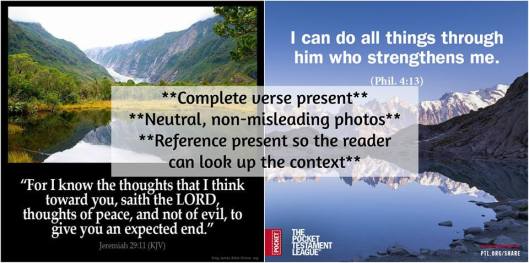
Interestingly, the only verses I seem to receive the “out of context” criticism about are Jeremiah 29:11 and Philippians 4:13. (Shouldn’t we want all Bible verses to be in context?) I’m fully aware that many Christians out there, and even false teachers, use these verses out of context. The fact that many people misunderstand or twist these verses to fit their own agendas does not negate the fact that these are still Holy Spirit-breathed portions of the Bible. I refuse to surrender these verses to those who abuse them by declining to post them. God’s Word is God’s Word, and even one verse can stand on its own, qualitatively, as the Word of God. The reader is the one who has the responsibility to look up those verses and understand and use them in context.

Christian Quote Memes

Going back to the grape illustration, the thing to remember is that a meme is not meant to exhaustively cover every aspect of the thought it presents. If I post a meme that says, “The grass is green,” that does not mean:

  • Only grass is green
  • Everything in the world is green
  • There aren’t other things in the world that are other colors
  • I hate things that aren’t green
  • Grass should never be mowed, fertilized, watered, etc.
  • Grass can’t be other colors because you could dye it or set it on fire

Also, simply stating that the grass is green does not obligate me to explain photosynthesis, suggest landscaping techniques, or debate zoysia versus Kentucky bluegrass. There’s certainly a time and a place to go into detail about issues (which I do every day on the blog), but it is also okay to make simple, true, stand alone statements without having to comment on every intricate aspect of the topic.

People Pictured in Memes

This is something you kind of have to get a feel for through exposure to memes, but I’ll do my best to explain.

Sometimes a meme uses a picture of a person because the words on the meme are a direct quote from that person. Other times, the words on the meme poke fun at or allude to the person pictured. Still other times, the words on a meme have nothing to do with the beliefs, personality, or actions of person pictured in the meme, rather, that picture was selected because of the look on the person’s face, the way he is posed, etc.
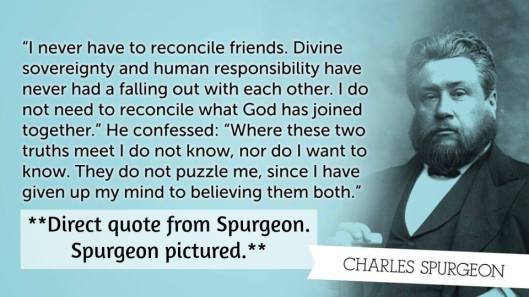
If you’re confused as to whether or not the person in the picture is being quoted, you can always Google the quote to find out. If you’re familiar with the person in the picture and know he would never say the words on the meme, it’s fair to assume the words are either poking fun at/alluding to the person in the picture, or that the picture was chosen for the visible appearance of the person, not for his beliefs, personality, actions, etc.

I can’t speak for everyone who shares memes, but the rule of thumb for my social media pages is that you will never see me positively quoting or promoting the beliefs of someone who’s well known to be a false teacher or otherwise theologically aberrant by biblical standards. So if you see a meme on my page that contains a picture of a famous false teacher, a non-Christian actor, politician, etc., it should be a given that I am not promoting his or her false beliefs. The meme is making another point, which you will need to glean from context or ask politely about.

Attribution

Except for BVMs, I create most of the memes I share. But with regard to BVMs and other memes I haven’t created, I see them – shared by a friend or a page I follow – in my social media timeline and I share them, just like you do. Most of the time I don’t share them immediately. They sit in my file for days, weeks, or even months before I get around to sharing them.

At that point, I usually can’t remember where I found them, so I can‘t type out a caption crediting the person who made it (if I even know). (If you design memes and you want credit for them, my advice is to watermark the meme with your name or website.) So, if you see me share a meme with no attribution, I’m not in any way trying to plagiarize it or claim that I made it any more than you would be if you shared a meme like that. All of the memes I create are watermarked with my website address (see collage above). If you see me share one that doesn’t have my website on it, you can safely assume I did not create it.

Sharing

I’m frequently asked by social media followers if they may have permission to share a meme (or an article, post, etc.) I’ve posted. Yes! I’m honored that you would want to. Sharing is the nature of social media. Generally speaking, you do not need to ask permission to share something that a public figure has posted publicly on social media. We like it when you share our stuff. It gets our material out to more people. And since my material is sound doctrine, the Bible, and the gospel, I want to get it out to as many people as possible. Consider this blanket permission to everyone who might ever want to share something of mine: Share away! No need to ask permission! :0)

The only thing you can’t do when sharing is to remove attributions (for example: cropping out the watermark of my web address on the memes I create) in order to intentionally present my work as your own or someone else’s. That’s called plagiarism, which is a fancy word for lying and stealing. And those are sins. But simply sharing a public post, attributions in tact, with your social media friends is not plagiarism, and you don’t need to ask permission.

If you’d like to peruse all the memes I’ve created, check out my Memes board on Pinterest.1

I hope this helps clear up any misunderstandings you may have about any of the memes I post on social media. Memes are just little nuggets that are meant to be humorous or thought provoking. Let’s let them be what they are, not expect them to be what they’re not.


1The oldest memes on that board (the ones toward the bottom) are still watermarked with my old web address (MichelleLesleyBooks.com). I’m in the process of editing them to reflect my current web address (MichelleLesley.com), and re-releasing them. I’m totally fine with you sharing a meme watermarked with the old address, but if there’s one you want to share that you need edited to the new address before you share it for whatever reason, just let me know, and I’ll fix it as fast as I can.

Discernment

Jennifer Rothschild

If you are considering commenting or sending me an e-mail objecting to the fact that I warn against certain teachers, please click here and read this article first. Your objection is most likely answered here. I won’t be publishing comments or answering emails that are answered by this article.


This article is kept continuously updated as needed.

I get lots of questions about particular authors, pastors, and Bible teachers, and whether or not I recommend them. Some of the best known can be found above at my Popular False Teachers tab. The teacher below is someone I’ve been asked about recently, so I’ve done a quick check (this is brief research, not exhaustive) on her.

Generally speaking, in order for me to recommend a teacher, speaker, or author, he or she has to meet three criteria:

a) A female teacher cannot currently and unrepentantly preach to or teach men in violation of 1 Timothy 2:12. A male teacher or pastor cannot allow women to carry out this violation of Scripture in his ministry. The pastor or teacher cannot currently and unrepentantly be living in any other sin (for example, cohabiting with her boyfriend or living as a homosexual).

b) The pastor or teacher cannot currently and unrepentantly be partnering with or frequently appearing with false teachers. This is a violation of Scripture.

c) The pastor or teacher cannot currently and unrepentantly be teaching false doctrine.

I am not very familiar with most of the teachers I’m asked about (there are so many out there!) and have not had the opportunity to examine their writings or hear them speak, so most of the “quick checking” I do involves items a and b (although in order to partner with false teachers (b) it is reasonable to assume their doctrine is acceptable to the false teacher and that they are not teaching anything that would conflict with the false teacher’s doctrine). Partnering with false teachers and women preaching to men are each sufficient biblical reasons not to follow a pastor, teacher, or author, or use his/her materials.

Just to be clear, “not recommended” is a spectrum. On one end of this spectrum are people like Nancy Leigh DeMoss Wolgemuth and Kay Arthur. These are people I would not label as false teachers because their doctrine is generally sound, but because of some red flags I’m seeing with them, you won’t find me proactively endorsing them or suggesting them as a good resource, either. There are better people you could be listening to. On the other end of the spectrum are people like Joyce Meyer and Rachel Held Evans- complete heretics whose teachings, if believed, might lead you to an eternity in Hell. Most of the teachers I review fall somewhere in the middle of this spectrum (leaning toward the latter).

If you’d like to check out some pastors and teachers I heartily recommend, click the Recommended Bible Teachers tab at the top of this page.


Jennifer Rothschild
Not Recommended

Jennifer is “an author, speaker, Bible study teacher, wife and Mom. And, I happen to be blind.”

Jennifer habitually yokes with false teachers. She calls Beth Moore a “dear friend,” and has “teamed up with [Beth]…to lead national women’s conferences.” Beth wrote the foreword to Jennifer’s book, Lessons Learned in the Dark and endorsed Jennifer’s bookMe, Myself, and Lies on her own blog.

Jennifer’s conference ministry, Fresh Grounded Faith, features false and problematic teachers such as Lysa TerKeurst, Ann Voskamp, Liz Curtis Higgs, Karen Kingsbury, Angie Smith, and Sheila Walsh as regular speakers.

Among the other connections and yokings Jennifer has with these teachers (and others), which are too numerous to list…

Lysa TerKeurst has endorsed at least two of Jennifer’s books, Missing Pieces and God is Just Not Fair. Jennifer has been featured on Lysa’s Proverbs 31 website multiple times, including featuring her book Psalm 23: The Shepherd with Me as an online study.

Ann Voskamp (whom Jennifer calls a “dear, dear friend in the introduction to a guest post Ann wrote for Jennifer’s blog) also endorsed Jennifer’s book, God is Just Not Fair, has appeared on Jennifer’s podcast, and is featured on Jennifer’s website multiple times (likewise Sheila Walsh).

Jennifer was a contributing author to the study, The Faithful, alongside Beth Moore, Priscilla Shirer, Kelly Minter, and Lisa Harper.

Jennifer is scheduled to appear with Beth Moore, Priscilla Shirer, Kelly Minter, and others at a 2020 LifeWay Women Live event.

Though the general posture of Jennifer’s teaching, conferences, and materials is geared toward women, Jennifer has no problem violating Scripture by preaching to men at her speaking engagements. Her website says she “speaks 25-30 times per year to groups – mostly women.”

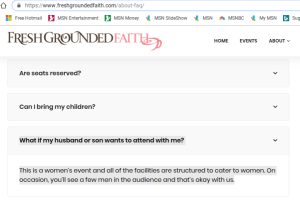
And Jennifer’s Fresh Grounded Faith website clearly says on the FAQ page:

What if my husband or son wants to attend with me?
This is a women’s event and all of the facilities are structured to cater to women. On occasion, you’ll see a few men in the audience and that’s okay with us.

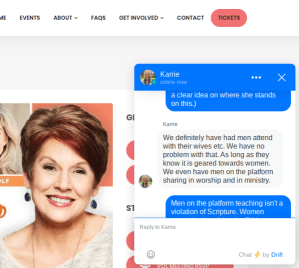
Karrie, who runs the instant chat feature on Jennifer’s website confirmed this when I asked about it: “We definitely have had men attend with their wives etc. We have no problem with that. As long as they know it is geared towards women. We even have men on the platform sharing in worship and in ministry.”

The way both of these responses are worded and presented seems to indicate that women preaching to men as a violation of Scripture is not even a factor to consider for Jennifer and her staff when it comes to whether or not men should attend Jennifer’s conferences. They aren’t twisting Scripture to defend allowing men to attend, it feels more like they don’t know Scripture prohibits women from preaching to men. The answer they have presented gives the sense of, “There may not be a men’s restroom easily available, and men might not like this conference because the swag and the content of the teaching will be pink and girly, but as long as they’re aware of those things and they still want to come, they’re welcome!”. This is troubling because, if Jennifer and her staff firmly stood behind Scripture on this issue, it would be very easy for the FAQ page and Karrie to simply say something like, “In compliance with Scripture, Jennifer does not teach men. Therefore, her conferences are restricted to women only.” But they don’t even make that small effort.

In addition to writing and speaking, Jennifer also runs a ministry to women in leadership, WomensMinistry.net, which, commendably, is geared toward women who lead women’s ministries in their churches (rather than toward women who unbiblically assume the position of pastor, elder, etc.). Most of the (free) information on the site seems to be practical help and tips for leading a women’s ministry, which, of course, is not out of line with Scripture. However, I did notice two things which gave me pause.

First, while the vast majority of the wording on the site led me to believe this ministry is about equipping women who lead women’s ministries, there were a few sentences sprinkled across the site that didn’t seem to make sense if this is all strictly about women’s ministry:

“If you are a woman in ministry leadership, including women’s ministry…” (What forms of “ministry leadership” are included besides women’s ministry?)

“[If] Your heart’s desire is to: See women, men and children come to know the Lord…Connect with fellow women’s ministry leaders and women in ministry.” (What does men coming to know the Lord have to do with women’s ministry? What does “women in ministry” mean, since she has differentiated it from “fellow women’s ministry leaders”?)

I don’t want to draw any definitive conclusions from these few statements. Perhaps it was just a poor choice of wording. Maybe “including women’s ministry” and “women in ministry” is referring to women who teach children or a work in a parachurch pro-life ministry or something like that. Maybe “see…men…come to know the Lord” means that leading women well will enable wives to share the gospel with their unsaved husbands at home. I don’t know. I just find it confusing and unclear, especially since Jennifer has no problem with men attending her conferences to be taught by her and other women.

Of greater concern than these examples of (hopefully) poor wording, is the Prayer Journal offered as a downloadable free resource. The text of the journal is based on the usual out of context misunderstanding of Psalm 46:10 (“Be still and know that I am God.” Indeed, many of the Scriptures in the journal are taken out of context and misunderstood.) and goes on to teach “listening prayer,” a form of the unbiblical practice of contemplative prayer:

“He wanted me to ‘Be Still’. He didn’t want me to just have a prayer time with Him where I was doing all of the talking. He wanted to have a conversation with me. He wanted me to “listen” to what He had to say.” p.3

Though the author does say, “I am not talking about an audible voice from the Lord, but a gentle whisper, or a still, small voice that you hear within your heart.” (p.3- this allusion to God’s “still small voice” is an out of context misunderstanding of 1 Kings 19:12), she includes in the journal a long section entitled A Guide to Listening to God (p. 17-18) with verbiage that completely contradicts her own statement:

…God continues to speak to me. Since that first time I heard God’s voice…It has been important when I talk to God that I listen as He speaks to me. It is a two way conversation…Prayer is a dialogue with God, not a monologue.

This section also includes quotes from Priscilla Shirer and Henry Blackaby.

In the section “Four ways to measure if God is speaking” only the first could be considered biblical (and only if you consider extra-biblical revelation to be a doctrinally sound Christian practice, which it is not). The others are completely subjective and feelings-based:
1. Does what you hear align with God’s word?
2. Confirmation is received through a worship service or Bible study.
3. A Christian friend listens, prays for you, and agrees with what God might be saying.
4. Personal experience, a “God Moment”.

Later in the journal, in one suggested prayer for the lost, the author presumptuously speaks for God, providing His “answer” to the prayer:

“‘Lord, I am overwhelmed with memorizing Bible verses to share with a lost person.’ (God’s reply) ‘Just tell them my words of John 3:16. Love, God .’” p.25

Jennifer may not have written the prayer journal herself, but offering it as a resource from her ministry indicates that she has read it, approves of it, and believes it will be helpful to the people who receive and use it.

One of my readers, Holly, commented on Jennifer’s study Hosea: Unfailing Love Changes Everything:

I picked up her Hosea study to do with two dear sisters in Christ. After one day of us starting, we were texting each other about unbiblical teachings in it.

The book came across as all God can do is love, He doesn’t have a choice, and weaving US into the story of Hosea and Gomer. We quit the study, and sent our books back to Amazon. Blessed are we, they gave us a refund.

The contemplative prayer is just like Lysa [TerKeurst] and Priscilla [Shirer].

Jennifer seems like a lovely person who has admirably overcome the challenges in her life and has a genuine desire for women to know and grow in the Lord, but with the unbiblical ministry relationships and theologies she holds, I cannot recommend her teaching, conferences, or materials to you.

Salvation

Throwback Thursday ~ He Knows My Name

Originally published September 6, 2016

440px-Hello_my_name_is_sticker.svg

One of the things I love about checking my notifications on my social media pages is learning my readers’ names. They are all so interesting!

Some of you have the same names as some of my family members, which makes me think fondly of them and wonder if you’re like them in any way.

Some of your names remind me of characters in funny movies and make me smile.

Some of your names sound like they are French or Chinese or Middle Eastern or African or originated somewhere fascinating, and lead me to think about the beautiful places God has created all over the world.

Some of your names are a mystery of phonetics, and I have a fun time trying to figure out how to pronounce them.

Some of you have biblical names, and those call well-loved Bible stories to mind.

But whatever your name is, it doesn’t really matter what it makes me think of. What matters is what God thinks. He who calls the stars by name (Psalm 147:4) certainly knows your name. What does He think of you when He sees your name?

Does He see your name written in the Lamb’s book of life (Revelation 21:27) because you have repented of your sin and placed your faith in Christ alone for salvation?

Or, when your name comes before Him in eternity, will He say, “Depart from Me. I never knew you”? (Matthew 7:23)

If you’re not sure of the answer to those questions, or how God sees you, here are some resources that can help. God wants you to know for sure (1 John 5:13).

Basic Training: The Gospel

Am I Really Saved? A 1 John Check-up

Prayer Bible Study

Sweet Hour of Prayer: Lesson 4

Previous Lessons: 1, 2, 3,

Read 2 Samuel 7

David’s Prayer Regarding Building the Temple

Questions to Consider

1. Are you familiar with what is going on in the history of Israel and in the life and reign of David at this time? If not, use this synopsis (or another Bible Book Background) to bring you up to speed.

2. Break chapter 7 down into three major parts or events and write a one-sentence synopsis of the main action taking place in each part:

Verses 1-3:

Verses 4-17:

Verses 18-29:

3. What did David want to do? (2,5) How would you characterize David’s desire to build the temple, especially in light of his prayer in 18-29? Was his desire prideful, worshipful, godly, selfish, grateful, immoral, etc.? Why did David tell Nathan his desire? (2-3) What was Nathan, as a prophet, supposed to do (4,17) before giving David God’s reply? (3-4) How was David telling Nathan this desire similar to the way we might pray for God’s guidance today? How does Nathan, as an imperfect intermediary between God and man, point to Jesus, our perfect mediator and intercessor?

4. Examine God’s answer to David’s “prayer” (to build the temple) in verses 4-17. What was God’s overall answer – yes, or no? Go through each verse, making a list of the reasons or explanations God gives David for His answer. Which of the reasons/explanations have to do with it not being part of God’s overall plan for (OT) Israel’s history as a nation? Which of the reasons/explanations have to do with God’s plan for redemptive history and the future Messiah? Which of the reasons/explanations have to do with David personally, as an individual? When God says no to your perfectly biblical prayer, have you ever considered that there might be more to it than just saying no to you personally? That maybe it has something to do with God’s larger plan for your church, community, redemptive history, etc.?

5. Examine David’s prayer (in response to God’s answer) in 18-29.

What is the position of David’s body while he is praying? (18a) Think of some of the other body positions we see in Scripture when people are praying. Is there any special significance or meaning to these various body positions? Is there one particular position that’s “holier” than the rest, or does God hear and answer our prayers without regard to body position?

How does David react to God answering his prayer “no”? What character trait does David exhibit most in this section? Which attribute of God does David focus on the most in his prayer? How does David’s recognition of God’s sovereignty impact his humility and inform the way he reacts to God saying “no”? How does this same sovereignty/humility dynamic enable David to look past his own personal desires to the good of his nation, the good of his son Solomon, the good of redemptive history, and the good of God glorifying Himself by carrying out His own plans despite David’s desires?

When we talk about praying “in Jesus’ name” we often explain that this means praying in agreement with and in submission to God’s will. Explain how David’s prayer exemplifies praying “in Jesus’ name” even as he looks ahead to the Messiah yet to come.

6. Do you notice the gospel motif in this chapter? David wants to do what for God? (2,4) And God basically says, “I don’t need your good works (5-7, i.e. for you to build me a house of filthy rags). You, and all My people, need My good work of salvation, and I’m going to give them to you by building you a ‘house’ whose foundation and cornerstone are the Messiah, whom you all so desperately need.” We may desire to do great things for God, but we desperately need Him to do far greater things in us, for us, and to us, in saving and sanctifying us. Spend some time in prayer this week asking God to do those greater things in your heart and life.


Homework

Have you ever prayed for something or wanted to do something that was completely biblical, yet God did not give it to you or allow you to do it? What was your reaction? How did your reaction compare to David’s reaction? How would more humility and a greater view of God’s sovereignty have shaped your reaction? Write out a prayer of response to God saying “no” in which you humble yourself and honor and celebrate God’s sovereignty.


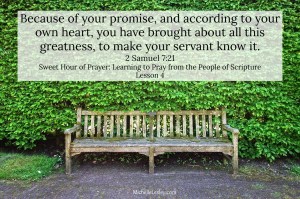
Suggested Memory Verse

Share Your Testimony

Testimony Tuesday: Stories from Several Sisters 5

On today’s Testimony Tuesday,
several sisters in Christ share their stories.

Tiffany’s Story

My husband and I and family were first at a word of faith/prosperity church, and thankfully God granted us and we continually prayed for wisdom and discernment. We then moved on to an AG [Assemblies of God] church and again, just like the last church, we got heavily involved. The more we read and the more we talked, we realized they weren’t on the same page as us, and it’s only been 3 weeks but we have found a Reformed Bible church. I continually pray that the people in our old church will have their eyes open and begin seeing the truth in the Word. I’m so grateful and thankful to the Father for the journey He has us on. We continually learn and teach our children.


Latoya’s Story

As some other women on your site have said: “Yay, women like me! Who believe in The Word! I’m not weird!”

I was born and raised in a Pentecostal church…but have REALLY been having a relationship with God for over one year now.

Thank you for teaching me what a Godly, Bible-based church looks like. . .

One particular article spoke of expository versus topical sermons. I am reading though the Bible (for the first time ever) since last summer. Wow! I can’t say enough of how awesome The Word is! It’s my favorite thing to do: study His Word! Anyway, that article spoke to me. I thought: I’ve never been under an expository preacher, but it sounds amazing! So, out of curiosity (..and because I do feel led to be at another church…although I do not know where yet) I looked under the “searching for a new church?” tab. I found a church one hour away. The sermons are listed. Each Sunday they take a handful of verses in order from each chapter. ((Jumping up and down that this even exists!)). I never knew.


Christine’s Story

I grew up as a Catholic. I prayed to God but didn’t understand anything of the Bible or the significance of why Jesus had to die. I attended “church” weekly growing up, but knew nothing of the Bible. I lived a life with no clarity in why I needed a Savior and like so many, thought I was a pretty good person, so I would be fine. In the meantime, I met my husband in college. He also grew up Catholic and led a similar life of sin and confusion. Just before we got engaged, my husband was saved at a Christian service that I did not attend. We got married and continued to go to Catholic service while he was growing in his faith.

My husband then led us to a non-denomination church, which I reluctantly attended. They shared the Gospel regularly and taught from the Bible. It wasn’t until years later, after we had two boys and after my dad passed, that I was saved. It took several years of me hearing the Gospel before I truly accepted Christ and repented of my sins. I am beyond grateful for what Jesus did for me, opening my eyes to His Truth and saving me from my sin. I am also so thankful he saved my husband years earlier before I even realized what that meant. My husband and I have become passionate creationists and are looking forward to an upcoming trip with our boys to the Creation Museum and Ark in Kentucky! Although we continue to be sinners, I hope I can continue to live my life glorifying God and sharing the Gospel of what Jesus did for us, dying on the cross to save us from our sins and reconciling us back to our perfect God.


Michele’s Story

When my husband and I moved to a new city 13 years ago, we spent almost a year searching for a new church. We settled in a church that seemed to affirm the authority of Scripture while honoring the freedom we have in Christ. We attended faithfully and served in many different capacities. This past year, as we have grown in our knowledge and love of the Bible as well as in biblical discernment, we have realized we were in a purpose-driven, seeker-sensitive church.

We met with the pastor and associate pastor many times, but they were defensive and unhearing. After many months of continuing to serve, to cope, to adapt, we knew we had to leave.

I almost dreaded to process of finding a new church. In our small town, there didn’t seem to be many (if ANY!) realistic options, and I just didn’t want to church shop. I longed to be planted quickly into a fellowship of like-minded believers. I prayed, “You know my desires, Lord, but Your will be done.”

I clicked on your “searching for a new church” tab and scrolled through the items. There were few suggested churches for [my state], and none for our city. Then I clicked on “churches recommended by my readers” and saw the one listing for our area.

I would like to say that it was love at first visit! However, I had been so pampered and pandered to that I didn’t have much patience for the longer service and deep, expositional preaching. However, I was encouraged by the Lord to persist. Our first visit was in April and earlier this month we became members.

I am so very grateful to the Lord for directing us to this precious little church and to your resources. I mean, really.


Ladies, God is still at work in the hearts and lives of His people, including yours! Would you like to share a testimony of how God saved you, how He has blessed you, convicted you, taught you something from His Word, brought you out from under false doctrine, placed you in a good church or done something otherwise awesome in your life? Private/direct message me on social media, e-mail me (MichelleLesley1@yahoo.com), or comment below. Your testimony can be as brief as a few sentences or as long as 1500 words. Let’s encourage one another with God’s work in our lives!