Mailbag

The Mailbag: Potpourri (Tithing, Beth Moore on abortion, wife earning more than husband…)

Welcome to another “potpourri” edition of The Mailbag, where I give short(er) answers to several questions rather than a long answer to one question. I also like to take the opportunity in these potpourri editions to let new readers know about my comments/e-mail/messages policy. I’m not able to respond individually to most e-mails and messages, so here are some helpful hints for getting your questions answered more quickly. Remember, the search bar can be a helpful tool!

In these potpourri editions of The Mailbag, I’d also like to address the three questions I’m most commonly asked:

“Do you know anything about [Christian pastor/teacher/author] or his/her materials? Is he/she doctrinally sound?”

Try these links: 
Popular False Teachers /
 Recommended Bible Teachers / search bar
Is She a False Teacher? 7 Steps to Figuring It Out on Your Own
(Do keep bringing me names, though. If I get enough questions about a particular teacher, I’ll probably write an article on her.)

“Can you recommend a good women’s Bible study?”

No. Here’s why:
The Mailbag: Can you recommend a good Bible study for women/teens/kids?
The Mailbag: “We need to stop relying on canned studies,” doesn’t mean, “We need to rely on doctrinally sound canned studies.”.

“You shouldn’t be warning against [popular false teacher] for [X,Y,Z] reason!”

Answering the Opposition- Responses to the Most Frequently Raised Discernment Objections


Any good info you can send in about tithing? Is it for NT believer? Are we in sin if we don’t?

Great question – and it’s one that a lot of Believers probably wonder about. For the long answer, check out my article To Tithe or Not to Tithe… (and don’t forget to click on the links in that article to the helpful resources I’ve included).

The short answer is no. Christians are not required by Scripture to tithe. The main Scripture that covers the principles for New Testament giving is 2 Corinthians 9:7:

Each one must give as he has decided in his heart, not reluctantly or under compulsion, for God loves a cheerful giver.

We are to give thoughtfully, decisively, generously, willingly, and gladly. Now, if you consider your finances and the needs of your church, you and ask God to help you make a wise decision about how much to give, and ten per cent is the prayerful conclusion you come to, then by all means, give ten per cent. If it’s fifty per cent or two per cent or 97 per cent or some other amount, give that. New Testament giving is about glad generosity of heart and godly decision-making, not rote fulfillment of a non-applicable Mosaic Covenant law.

Are you in sin if you don’t tithe? It depends on the reason you’re not tithing. If you’re not tithing (or giving) because you’re selfish and greedy and you don’t want to give anything to the church, then, yes, you’re sinning. If you’re not tithing because you’re barely scraping by and can only afford to give five per cent to the church, which you give with a joyful and generous heart, no, you’re not sinning. But for sure, if your pastor or someone else is attempting to coerce or compel you to tithe, he is putting you under the yoke of the law, he is violating 2 Corinthians 9:7, and he is in sin.


What is Beth Moore’s position on abortion?

I received this question from several readers in connection with the publication of An Open Letter to Beth Moore (which you can still sign if you haven’t yet, ladies).

I don’t know what Beth’s position on abortion is. I Googled “Beth Moore abortion” and the closest thing I came up with was a tweet thread from 2016 that had something to do with the presidential election and whether or not Beth supported Hillary Clinton (it wasn’t 100% clear since some of the tweets have since been deleted or made private). Some questioned Beth in that thread about her stance on abortion since they believed she supported Clinton, but while Beth clearly said she did not support either candidate, unless I missed a tweet or it was deleted, she did not state what her position on abortion was.

If you want to know Beth’s position on abortion, you will have to ask her. Since she is Southern Baptist, you may wish to ask her if she agrees with the portion of Article XV of the Baptist Faith and Message (BFM2000– the SBC’s statement of faith) which states,

“We should speak on behalf of the unborn and contend for the sanctity of all human life from conception to natural death.”

It is possible Beth would be willing to give a pro-life answer since it is likely much more acceptable among her followers for her to stand against abortion than to stand against homosexuality. But since she has already demonstrated that she is unwilling to take a firm biblical stand on an issue when doing so might diminish her popularity, I imagine she will respond to questions about abortion the same way she responded to our questions about homosexuality: ignore the questions as much as possible, or answer them in an obfuscatory or cryptic manner when pressed.


As a woman, am I sinning by witnessing to a man?

Nope. Not under the auspices of 1 Timothy 2:12, anyway. What you’re doing is carrying out the Great Commission, Jesus’ mandate to all Christians. A couple of articles that explain more and that you might find helpful:

Rock Your Role FAQs (#11)

The Mailbag: Is it biblical for women to carry out The Great Commission?


One of my loved ones says she hears God’s voice, still small voice, a new revelation from Him and so on. How can I search your website to get information on this?

May God bless you for wanting to help your loved one! I think these articles will help:

Basic Training: The Bible Is Sufficient

Basic Training: The Bible Is Our Authority

The Mailbag: Potpourri (Michelle’s a money-grubber, Still small voice, Husband of one wife…)


Wondering what kind of instruction you received to teach what [you] have on your website. I have studied the Scriptures for many years, but am disappointed that I did not spot some of the false and lacking “teachers” you have written about. I found you, thankfully, by following a rabbit trail regarding false teachers. Thanks.

Thanks for asking! The biblical instruction I’ve received:

•Sitting under good preaching and teaching at my own church

•Studying straight from the Bible itself (not workbook/DVD studies, etc.) during my daily Bible study time

•Listening to good sermons and Bible teaching online

•Reading good, solid theological books by doctrinally sound authors.

I have audited one or two online seminary classes, but I’ve never been enrolled in a seminary, nor do I have a seminary degree.

I’ve explained a bit more about how I got started learning discernment here. Many of the authors, pastors, and teachers I’ve listened to can be found in the sidebar to your left (Blogs and Podcasts I Follow and Links I Love) and at the Recommended Bible Teachers tab at the top of this page.

This is part of the reason I’m forever hounding women to put aside the “canned” studies and systematically study straight from the Bible for themselves and to get faithfully invested in a doctrinally sound church – it’s not only biblical, it works.


Biblical views on a wife making more than her husband financially?

To my knowledge, there is no passage in the Bible that explicitly prohibits a woman from having a larger salary than her husband’s, assuming that they are both employed in a manner that doesn’t violate biblical standards. (Readers- For the purposes of this question, let’s assume that neither spouse is neglecting his/her biblical duties to the marriage, children, or home by being employed in this season of his/her life.)

In other words, if they’re both employed full time and her position or field just happens to pay more than his position or field, that doesn’t violate any Scripture I’m aware of. Or there could be situations such as: a husband is ill or disabled and unable to work full time (or at all), or the husband has had to reduce his workload temporarily to care for an ill family member, go back to school, etc. However, if it’s a situation like the wife is making more money because the husband is a lazy bum who refuses to work enough hours (or at all) to support his family, that would be sinful on his part.

If there’s nothing unbiblical about the wife’s or the husband’s employment situation but it bothers one or both of them that her salary is larger, they should sit down, talk it out, and pray through the issue to discover and resolve the problem. I would also recommend setting up an appointment with their pastor or a biblical counselor for counseling (see Biblical Counseling Resources tab at the top of this page).


If you have a question about: a Bible passage, an aspect of theology, a current issue in Christianity, or how to biblically handle a family, life, or church situation, comment below (I’ll hold all questions in queue {unpublished} for a future edition of The Mailbag) or send me an e-mail or private message. If your question is chosen for publication, your anonymity will be protected.
Speaking Engagements

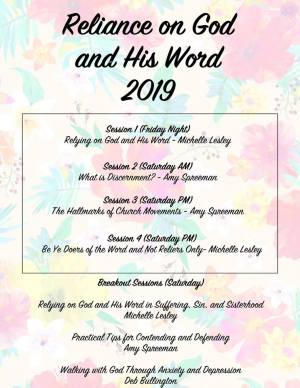
Reliance on God and His Word Conference Audio


It was my joy, recently, to speak at the Reliance on God and His Word conference at Princeton Bible Church.

PBC was so kind to record audio of the main sessions of the conference:

I hope you’ll enjoy my two sessions…

Relying on God and His Word


Be Ye Doers of the Word and Not Reliers Only


You can also listen at PBC’s website and hear Amy Spreeman’s wonderful sessions as well!

If your church is ever in need of a speaker for a women’s event, I’d love to come share with your ladies as well. Click here for more information.

Mailbag

The Mailbag: Potpourri (Michelle’s a money-grubber, Still small voice, Husband of one wife…)

Welcome to another “potpourri” edition of The Mailbag, where I give short(er) answers to several questions rather than a long answer to one question. I also like to take the opportunity in these potpourri editions to let new readers know about my comments/e-mail/messages policy. I’m not able to respond individually to most e-mails and messages, so here are some helpful hints for getting your questions answered more quickly. Remember, the search bar can be a helpful tool!


Michelle, you’ve mentioned that your husband is previously divorced and also that he is a minister of music. How can this be? Isn’t he disobeying Scripture’s instruction that a pastor is to be “the husband of one wife“? Don’t you believe the Bible? Do you follow it? If so how do you justify your husband’s role in the church when compared to 1 Timothy 3?

Yes, of course, I believe and follow the Bible. I believe and follow the rightly handled, in context, written Word of God, not popular misunderstandings of certain passages.

(And by the way, asking a fellow Believer a question like “Don’t you believe/follow the Bible?” in an accusatory way is rude and inflammatory. Furthermore, while I am happy to answer polite questions, it is not incumbent upon me to “justify” myself or my husband to whatever stranger might have the temerity to demand that I do so.

Rudeness and ugliness from people who call themselves Christians seems to have hit epidemic proportions. I’m going to be addressing it more frequently. Let’s play nice, folks.)

I have previously written about the “husband of one wife” clause in the 1 Timothy 3/Titus 1 qualifications for elders in my Mailbag article “Can a divorced man be a pastor?”

For a number of reasons, it would be inappropriate for me to go into the details of my husband’s divorce in a public forum like this, but you may rest assured that we have not been living in sin for the past 25 years, and that we have been up front about his divorce with the search committee of every church he has ever interviewed with. There are some churches who have a policy of refusing to consider for ministry positions anyone who has ever been divorced. Though we personally disagree with those types of policies (based on the biblical reasons in the article cited above), we certainly respect each church’s right to set its own hiring policies and have been grateful to the churches that have disclosed their policies from the outset.


I recently discovered your blog and am enjoying looking around and reading your posts. I do wonder at your use of your blog for promoting your own gain, your option to donate, and the near complete aligning of one’s salvation with the allegiance to a physical church organization. I wonder if you can share Bible verses that support both of those things?

“Promoting my own gain”? I think you might need to look around and read some more. All of my blog content is available for free, including the Bible studies I write and allow individuals and churches to print out and use free of charge. I don’t keep any content behind a paywall (such as Patreon) or charge any sort of subscription fee. I don’t sell any books, materials, or other merchandise. I don’t receive any remuneration from the ads that appear on my blog. My blog isn’t sponsored by any organizations. And, I don’t receive any sort of salary for writing this blog. How is that “promoting my own gain”?

There are only two instances in which I receive money for anything in connection with this ministry:

1. When kind and generous readers take it upon themselves to send me a gift through my Financial Support page (I rarely mention this giving option, and I have never asked readers to send me money.). Few do, though I deeply appreciate the blessing those folks have been to my family. Most of the gifts I receive go toward paying household bills. (And when I say “bills” I mean electricity, water, rent, etc. I don’t have an extravagant wardrobe, a fancy car, or take luxury vacations.)

2. When I do a speaking engagement. If I could afford to do these events for free, I would. I can’t. As you no doubt read at the Financial Support tab “my family lives frugally on one modest income.” We can rarely afford to go out to eat, never mind afford for me to drive or fly hundreds of miles from home, spend several days away from taking care of my family, and pay for food and lodging once I get there. Additionally, it takes dozens of hours to properly prepare speaking engagement material, and it is work. I usually don’t do more than a few of these a year, and, so far, I haven’t spoken at any huge churches that can afford to pay me thousands of dollars. This money also usually goes towards bills.

It is absolutely Scripturally appropriate for me or any other Christian to receive financial gifts or compensation in these two instances. (Click on the words in red for related Scriptures.)

The first situation is the giving of a gift. The money I receive from time to time is not expected, asked for, owed, or required. Jesus received monetary gifts. The early church gave financial gifts to Christians in need. The Philippians sent Paul gifts more than once. The Corinthian and Galatian Believers sent financial gifts to the church in Jerusalem. You give people gifts. I give people gifts. Christians give each other gifts.

The second situation is a) payment for work, and b) support of ministry. Jesus didn’t have a secular job. He received financial support of His earthly ministry. First Corinthians 9 and 1 Timothy 5:17-18 are abundantly clear that “those who proclaim the gospel should get their living by the gospel.” Proverbs 31 speaks of the wife and mother who crafts various things and sells them to bring in extra money for her household. My craft is writing and speaking. This is how I help bring in extra money for my household. These Scriptures are also why it would be completely fine for me to sell books, utilize Patreon, charge subscription fees, receive money from ads and sponsorships and any of the other things I mentioned in the first paragraph, just as it is fine for most other Christian bloggers and ministries who do.

Another excellent resource on this topic is Daniel Darling’s article No, All Christian Content Shouldn’t Be Free.

As to “the near complete aligning of one’s salvation with the allegiance to a physical church organization”, first of all, I’m not entirely clear on what you mean by that, but the New Testament couldn’t be plainer that Christians are to be joined to a local church and that one of the first signs that someone isn’t a Christian is when she leaves or refuses to be part of the church. I’ve covered this thoroughly, including the relevant Scriptures, in my article Basic Training: 7 Reasons Church is Not Optional and Non-Negotiable for Christians.


Our church’s women’s Bible study is using Priscilla Shirer’s content (The Armor of God). I looked at your blog, but didn’t find too many quotes from Shirer that I could use to draw an appropriate conclusion. 

Occasionally I will get this question from readers: “I know you’ve written an article saying that _____ is a false teacher, but what about [this particular book she wrote]? Is it OK for me/our church to study?”

It seems like your question might be along those lines. I’ve answered it in this Mailbag article. 

Priscilla Shirer is a false teacher (see my article Going Beyond Scripture: Why It’s Time to Say Good-Bye to Priscilla Shirer and Going Beyond Ministries). The way Scripture instructs us to deal with false teachers is to avoid the person entirely, which would include all of her materials, merchandise, etc. This is not only the biblical way to do things, it is much less time-consuming than sifting through quotes from her books to find out if any of them might be passable for use in your church.

If your church is using Priscilla Shirer materials, you may also find my article How should I approach my church leaders about a false teacher they’re introducing? to be helpful.


I recently posted on Facebook about how Christians are easily fooled by the false teaching that God speaks to certain people. Someone commented, “Don’t discount the still small voice of the Holy Spirit who calls, guides, instructs, comforts.”. I have searched the Bible and I haven’t found any verses confirming or refuting this statement. Can you shed some light on that thought? Is it in line with Scripture or is it more false verbiage that has encroached on the church?

I think the person who commented proved the point of your Facebook post. Is it “in line with Scripture”? “More false verbiage”? Yes and no.

Usually, when I see the phrase “the still, small voice” of the Holy Spirit, if the person using the phrase even knows she’s alluding to Scripture (many are just parroting what they think is a catch-phrase from pop-evangelicalism), it is based on a misunderstanding, or deliberate twisting, of 1 Kings 19:12:

And he said, “Go out and stand on the mount before the Lord.” And behold, the Lord passed by, and a great and strong wind tore the mountains and broke in pieces the rocks before the Lord, but the Lord was not in the wind. And after the wind an earthquake, but the Lord was not in the earthquake. 12 And after the earthquake a fire, but the Lord was not in the fire. And after the fire the sound of a low whisper. 13 And when Elijah heard it, he wrapped his face in his cloak and went out and stood at the entrance of the cave.
1 Kings 19:11-13

This is God talking to Elijah. (The King James Version translates the blue phrase in verse 12 as “a still, small voice”). It was normal for God to talk to Elijah. He was an Old Testament prophet.

You’ll notice that this is a descriptive passage, not a prescriptive passage (more on that here). That means it’s simply a passage telling us what happened with Elijah at that moment. This passage doesn’t promise, imply, or even hint that God will speak to you, me, or anybody else in the same way. It’s just a report of what happened.

(Just an aside, but isn’t it interesting that people take descriptive passages like this and assume that God will speak to them the same way He spoke to Elijah, but no one ever reads about God turning Lot’s wife into a pillar of salt, God sending a whale to swallow a disobedient Jonah, or God causing the ground to open up and swallow the rebellious Korah, Dathan, and Abiram, and assumes God will do the same to them? No, we only want the good stuff!)

God does not speak this way to people any more. He speaks to us through His written Word. And who is the author of Scripture, God’s written Word? Second Timothy 3:16 tells us it is the Holy Spirit. So if you want the Holy Spirit to “speak to you in a still small voice,” read your Bible. I’ve covered this topic in greater detail in my article Basic Training: The Bible Is Sufficient. You may also find this resource from John MacArthur to be helpful: Does God give us personal direction through a still small voice?


I just wanted to drop you a quick note and tell you how much I am enjoying your study of Mark. I have been praying a lot about exactly HOW to study the Bible on my own. I love MacArthur’s method of reading the OT in a year and a book of the NT each month, but when I’d sit down to read great portions of Scripture, I didn’t have a solid grasp of what I’d just read. This month I knew it was time to start in another gospel and I decided to use your Bible study to help. Your method and questions are just right! Turns out, it’s better for me to slow down and really dig into a smaller number of verses at one time rather than digesting a great number of chapters in one sitting. And the result? I’ve been so excited about what I’m learning and often mull over throughout the day what the Holy Spirit is teaching me through His Word. Thank you for sharing these studies so selflessly! Truly, I am blessed! Indeed, your whole site is an encouragement to fight the good fight; I am grateful for you!

I get encouraging little e-mails, messages, and blog/social media comments like this all the time. And I wouldn’t trade them for all the money in the world. It thrills me beyond words to hear about Christian women who are growing in the grace and knowledge of Christ, digging into His Word, growing in discernment, and serving their families and churches.

And when I get to be a tool in God’s hands to help a sister with that in some small way, it absolutely astounds me and humbles me beyond words. Christ is so good and so kind to allow us the honor and joy of serving Him by helping others, whether that’s a sister in Christ, our husbands, our children, a co-worker, or a neighbor.

Thanks so much, truly, to all of you who have ever written me a little note of encouragement. It will one day be my joy to lay all of those e-mails and comments at the feet of my precious Jesus as a fragrant offering. All of this has always been…and will always be…all for Him.

(If you’d like to try one of my Bible studies or learn more about how to study the Bible for yourself, click the “Bible Studies” tab at the top of this page.


If you have a question about: a Bible passage, an aspect of theology, a current issue in Christianity, or how to biblically handle a family, life, or church situation, comment below (I’ll hold all questions in queue {unpublished} for a future edition of The Mailbag) or send me an e-mail or private message. If your question is chosen for publication, your anonymity will be protected.
Church

It’s Time for a Reformation in the SBC – 3 Issues We Need to Set Right

I don’t know the brother who said it, but I saw a remark the other day from a Presbyterian gentleman who said something to the effect of, “It’s time for all doctrinally sound Southern Baptists to leave the SBC.”

I get that.

When you have an organization as large, open, and widespread as the Southern Baptist Convention, problems – even major ones – are inevitable. At this point, there are many things the SBC is still getting right, biblically speaking…

There are many good and praiseworthy things going on in SBC life. We have hundreds of doctrinally sound pastors faithfully preaching the gospel week in and week out. Discernment and biblical literacy among Southern Baptist church members is slowly but steadily growing. The SBC takes a public, biblical stand on abortion and homosexuality while many other denominations do not. Our organizational structure for funding and sending out missionaries, while sometimes flawed in its execution, is without peer. Southern Baptist Disaster Relief is one of the finest relief organizations in the world. And there’s so much more. Find a godly Kingdom effort going on somewhere, and you’ll probably find a Southern Baptist involved in it. By the grace of God, while we’re far from perfect, we’re getting a lot of things right

…But for some individual Southern Baptists and Southern Baptist churches, the biblical error and other problems pervading the SBC have become too much to bear, and they have deemed it time to walk away from what they see as a system damaged beyond repair, seeking refuge in ARBCA, Bible, Independent, or non-denominational churches and networks instead.

Like I said, I get that, and I don’t blame them one little bit. Believe me, I’ve had leaving on my mind more than once. And if the SBC continues its downward spiral, it’s an inevitability for nearly all of us who hold to sound doctrine.

But there are still plenty of us crazy, “glass half full” doctrinally sound optimists out there who, like Luther, don’t want to abandon the SBC to the rubbish heap if it can be avoided, but would rather see it reformed (little “r”), renewed, and restored to the glory of God.

If you’ve ever labored through the entirety of the Old Testament (and if you haven’t, stop denying yourself that blessing, and study it), you know that God exercised patience with Israel through centuries of idolatry, rebellion, and paganism of the vilest sorts, sending them prophet after prophet, warning after warning, discipline after discipline, lovingly calling, urging, and commanding them to repent and be reconciled to Him before finally executing judgment on them.

I’m just not sure we’re quite at the point of exiling the SBC… yet. I think maybe these are the days of Elijah. And Jeremiah. And Isaiah. And even Luther. A time for godly Southern Baptist men and women to stand firmly on the written Word of God and speak prophetically, chapter and verse, into their beloved churches and denomination, “Thus saith the Lord.”

And in that same spirit of the prophets of old, we don’t speak from a position of “I’m right and I’m here to prove it,” or because we’re haters, or because we’re power-hungry. It’s because we’re cut to the heart over the sin and idolatry we see among our brothers and sisters. We’re grieved that those things dishonor our precious Savior and bring His judgment and discipline upon those who participate in and propagate them. We deeply desire that our denomination and our churches experience the joy that comes with being spiritually healthy and biblically submitted to Christ.

So, while there are probably at least ninety-five theses that could be nailed to the doors of the Executive Committee in Nashville, here are three that would be a good start.

1.
The Authority and Sufficiency of Scripture

Nearly forty years ago, Southern Baptist movers and shakers in the conservative resurgence went to war for the inerrancy of Scripture. It was a long, hard battle, but they won. Now it’s time to fight for the authority and sufficiency of Scripture in the SBC.

The Bible is our authority as Christians, not the ideas, opinions, and traditions of denominational leaders, SBC celebrities, pastors, or any other person. The Bible. If the Bible commands us to do something, we do it. If the Bible commands us not to do something, we don’t do it. We don’t formulate our own programs and methods and try to squish the Bible in to make it fit. We start with the Bible. We stay with the Bible. We end with the Bible.

Because the SBC does not always submit to the authority of the Bible, we have leaders, celebrities, and pastors looking to, and promoting, sources outside the Bible for direction instead of simply trusting and obeying God’s written Word. We have influential “Bible” teachers who stand on stages in front of thousands and dare to proclaim, “God told me…”, functionally denying the sufficiency of Scripture by relying on supposed extra-biblical revelation (and teaching their followers to do the same). We have pastors and denominational leaders who look to polls and surveys to decide how to conduct their worship services or which social issues need to be addressed and how to address them. We have church growth gurus teaching our pastors to adopt all manner of worldliness that “works” to get sinners in the doors of their churches.

If the Southern Baptist Convention is to survive as an entity of biblical Christianity, the authority and sufficiency of Scripture is the number one issue that must be dealt with.  If this issue is properly addressed and corrected, it will alleviate or minimize nearly all other problems facing the SBC. We must submit to God’s written Word and give Scripture its proper place – first place – in our denomination, our individual churches, and our personal lives.

Basic Training: The Bible Is Our Authority

Basic Training: The Bible Is Sufficient

2.
False Doctrine and False Teachers

If the SBC truly regarded the Bible as authoritative and sufficient, the cancer of false doctrine and false teachers that is slowly killing us would be cured or in remission. Indeed, the aforementioned false teaching of extra-biblical (God told me, showed me in a dream, spoke to me, etc.) revelation is probably the most pervasive false doctrine accepted among Southern Baptists.

When Hilkiah found the Book of the Law in the temple (Imagine a house of God in such a shambles of idolatry that people had to dig and search for the actual Scriptures. Selah.), and Shaphan read it to Josiah, Josiah tore his clothes in grief and began to set God’s house and God’s people in order. After covenanting together with the people to obey God’s Word, the very first thing Josiah did was to have the altars and vessels of false gods carried out of God’s house and destroyed. If the SBC would follow in Josiah’s footsteps we would see things like:

LifeWay would immediately remove and destroy any and all materials by Beth Moore, Andy Stanley, Priscilla Shirer, TD Jakes, Lysa TerKeurst, Sarah Young, Christine Caine, Bethel Music, Jesus Culture, Hillsong, and all other false teachers and promulgators of false doctrine.

There would be no more conferences, simulcasts, or leadership training seminars featuring false teachers, and false teachers would certainly not be invited to speak in any capacity at the annual Southern Baptist Convention.

Pastors, authors, and speakers who attempted to build a career inside the SBC by teaching false doctrine would be subject to church discipline for their sin, not turned into celebrities or appointed or elected to denominational leadership positions.

Messenger voting privileges at the Convention would be revoked for churches which habitually and unrepentantly welcome false teachers.

If the Bible were to become our sufficient authority for both orthodoxy and orthopraxy, our eyes would quickly be opened to the enormity of the hold false doctrine has on our denomination, churches, and individuals, and we would act accordingly and biblically.

A Naked Emperor in the Southern Baptist Convention

10 Things I Wish Southern Baptists Knew About Southern Baptists

The Peterson Predicament and LifeWay’s Peculiar Policies

3.
Disfellowshipping Errant Churches

Earlier this week, the Southern Baptist Convention severed ties with the District of Columbia Baptist Convention (DCBC- an association of Southern Baptist churches in the Washington, D.C. area) for refusing to disfellowship one of its member churches, Calvary Baptist, which had called a legally “married” lesbian couple to serve as its co-“pastors” over a year ago.

It was absolutely the right thing to do (the SBC has disfellowshipped several churches that embrace homosexuality), and I’m glad that this standard remains in tact, but…lesbian co-pastors…? That’s how bad it has to get before the SBC can, or will, act to remove a church? What about churches that are embracing sins other than homosexuality?

There are plenty of apostate Southern Baptist churches, and we have no mechanism in place for kicking them out of the SBC.

This is a verbatim quote from the FAQ section (5th question from the top) of the SBC’s web site:

“According to our constitution, if a church no longer makes a bona fide contribution to the Convention’s work, or if it acts to ‘affirm, approve, or endorse homosexual behavior,’ it no longer complies with the Constitution of the Southern Baptist Convention and is not permitted to send messengers to the annual meeting. These, however, are the only explicitly stated instances in which the SBC has the prerogative to take action.”

What does that mean? As long as your church doesn’t affirm homosexuality and gives to the Cooperative Program, you’re in. Never mind if your pastor twists God’s word until it’s unrecognizable. Or lets women and false teachers get behind the pulpit like Steven Furtick does. Or plays AC/DC’s “Highway to Hell” on Easter Sunday and says he probably wouldn’t have strippers on stage like Perry Noble does. Or any of the other ridiculous and blasphemous shenanigans so many of the seeker sensitive types in our denomination pull. Nope, as long as you give your money and stand on the right side of homosexuality, you’re good to go.² ³

I’ll be the first to admit, it would be a difficult standard to set and implement, but look at the standards the New Testament required of churches. We’ve got to set the bar higher than a homosexuality litmus test and an offering for a church to be in good standing with the SBC. Doctrine and practices simply have to be a factor.


Can there be another conservative resurgence that brings reform to the SBC? I believe there can.

The Bible says “nothing will be impossible with God.” I believe that. I believe that the God who spoke the universe into existence from nothing, who opened sealed tombs and barren wombs, who parted seas and walked on water and turned water into wine can change the hearts of Southern Baptists and the trajectory of the Southern Baptist Convention.

By His grace. For His glory. For our good.


¹A Naked Emperor in the Southern Baptist Convention
²10 Things I Wish Southern Baptists Knew About Southern Baptists
³As of 2019, this verbiage has been removed from the FAQ section of the SBC website. Conceptually similar language can be found here (see Article III: Composition).

Discernment, False Doctrine

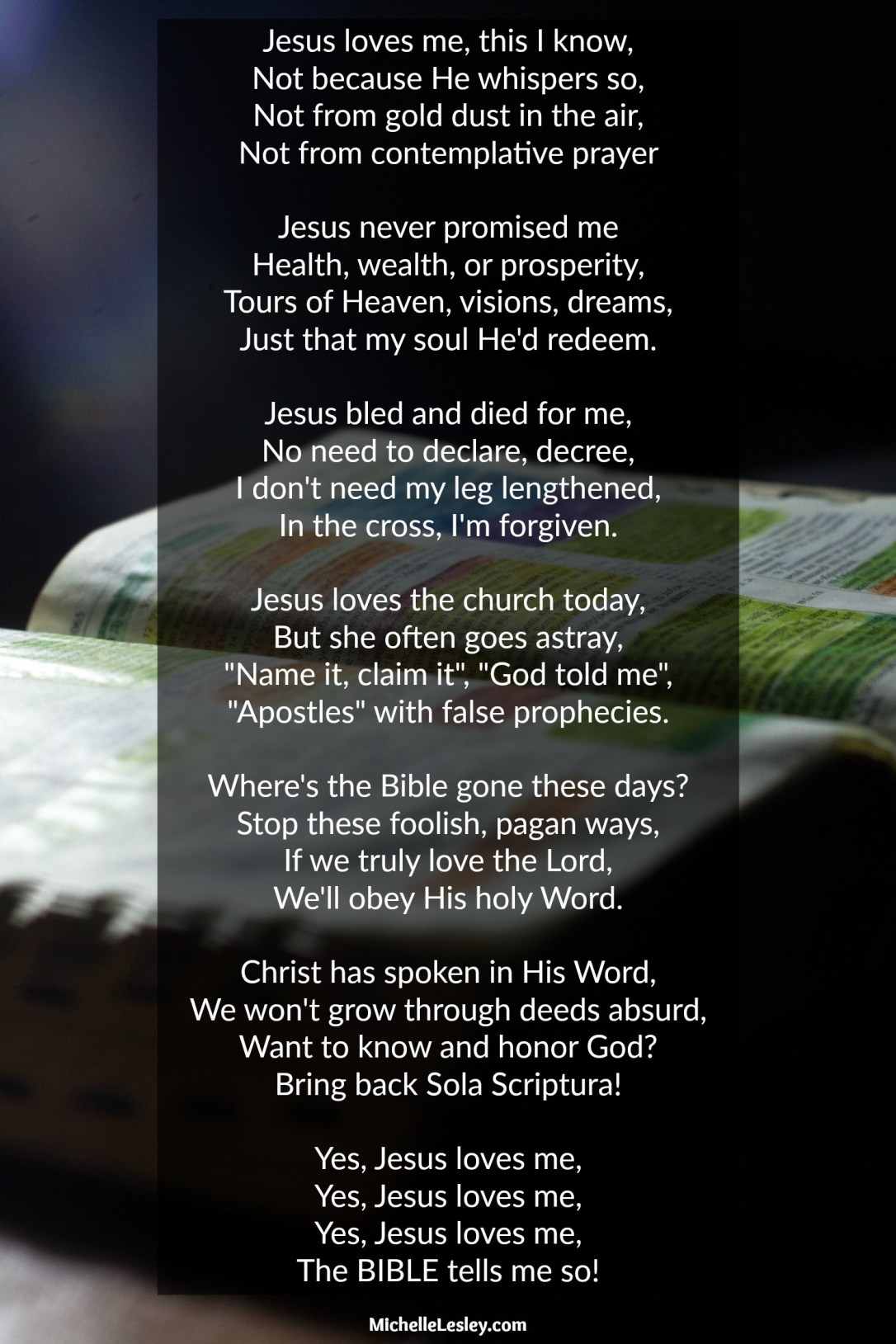
Jesus Loves Me: The “Contending for the Faith” Version

Every now and then I do a little creative writing. I posted this to Facebook on Sunday, and people seemed to like it, so I thought I’d share it here for those who aren’t on social media.