Mailbag

The Mailbag: Potpourri (“Potty Prayers,” Women as Children’s/Worship Pastors, Solid churches with heretical music, Eternal Security)

Welcome to another “potpourri” edition of The Mailbag, where I give short(er) answers to several questions rather than a long answer to one question. I also like to take the opportunity in these potpourri editions to let new readers know about my comments/e-mail/messages policy. I’m not able to respond individually to most e-mails and messages, so here are some helpful hints for getting your questions answered more quickly. Remember, the search bar (at the very bottom of each page) can be a helpful tool!

In these potpourri editions of The Mailbag, I’d also like to address the three questions I’m most commonly asked:

“Do you know anything about [Christian pastor/teacher/author] or his/her materials? Is he/she doctrinally sound?”

Try these links: 
Popular False Teachers /
 Recommended Bible Teachers / search bar
Is She a False Teacher? 7 Steps to Figuring It Out on Your Own
(Do keep bringing me names, though. If I get enough questions about a particular teacher, I’ll probably write an article on her.)

“Can you recommend a good women’s Bible study?”

No. Here’s why:
The Mailbag: Can you recommend a good Bible study for women/teens/kids?
The Mailbag: “We need to stop relying on canned studies,” doesn’t mean, “We need to rely on doctrinally sound canned studies.”.

“You shouldn’t be warning against [popular false teacher] for [X,Y,Z] reason!”

Answering the Opposition- Responses to the Most Frequently Raised Discernment Objections


I know this is going to sound silly or troll-like, but I’m serious! I have a habit of praying a quick prayer when thoughts cross my mind, like “God, please help Aunt Pam to feel better from her cold today,” or “Lord, thank You for providing that salary bonus I needed.” Sometimes those same kinds of thoughts and prayers cross my mind when I’m using the bathroom. Is that wrong? Should I wait until I get out of the bathroom to think that little prayer? What about what Deuteronomy 23:14 says about using the bathroom, “that God may not see anything indecent among you and turn away from you”?

I don’t think that’s a silly or troll-like question at all, and I’ll bet there are bunches of Christians out there who do the exact same thing and now, after reading this question, are wondering the exact same thing.

First Thessalonians 5:17 instructs us to “pray without ceasing,” which means our hearts are to be constantly oriented toward prayer even though we’re not consciously praying every moment of the day. (Kind of like your compass’ needle always points north even if it’s just sitting in a drawer not being used.) For most Christians, that means we’re intermittently speaking to God, just like you described, throughout the day as things happen, as random thoughts cross our minds, as we see various things. And this becomes such a habit (a good one!) that it doesn’t occur to us to think about where we are or what we’re doing as we utter those prayers in our hearts. Honestly, I think that mindset of reflexive prayer is pleasing to God, because it embodies what it means to pray without ceasing.

Deuteronomy 23:12-14 is part of the Old Testament ceremonial law regarding, in this particular case, the way Israel was to set up camp. When you give the law a good, thorough reading, you’ll notice that the underlying principle of most of the laws is that Israel is to be set apart and holy – different – from the pagan nations surrounding them. And He gives them laws to this effect that touch every aspect of their lives so that, at every turn, throughout the course of their day, there are little reminders, through the law, to “Be holy for I am holy.” This law is just one more of those little reminders: Don’t act like animals like the pagan nations around you, Israel, and just potty willy nilly in the street or the front yard or wherever you take a notion to. Step it up and keep your camp to a higher standard, because God is with you and you are His people.

The Deuteronomy passage is not about offending God by relieving yourself. God has seen every single time every person on the planet has ever relieved himself/herself, because God is omnipresent. If that were offensive to Him, He would not have designed your body to work that way.

Although I don’t think “bathroom time” should be the only time you pray, I don’t see anything in Scripture indicating that God considers it offensive for you to reflexively pray even though you happen to be in the bathroom at that moment. However, if it offends your sensibilities, wait until you get out of the bathroom and then pray.


Would you read 1 Tim 3 1-7 to read women can’t be “overseers/leaders/official” as in they can’t be “Children pastors” or “Women Pastors” in the church with those actual titles or even as directors? The verses only say men and state guidelines on how to choose. I’ve noticed some red flags in my church with a woman Worship Leader, which I don’t agree with since she sometimes teaches in between songs, but they are also giving women the pastor title, but only for children and women.

If I’m understanding correctly, you’re asking:

  • Is it biblical for women to hold a position of leadership over the women’s ministry or children’s ministry of a church?
  • Is it biblical for a woman to be the worship leader of a church?
  • If so, is it biblical to give those women leaders the title of, for example: “Pastor of Women’s Ministry” or “Children’s Pastor”?

Here are the fast and dirty answers. Below are a couple of links where I’ve discussed these issues in more detail.

Assuming the woman is doctrinally sound, has a godly character, her husband (if she’s married) is on board, and she’s otherwise qualified for the job, it’s fine for a woman to lead women or children in the church as long as the position she holds (which will vary from church to church) doesn’t require her to preach to or teach Scripture to men, or hold unbiblical authority over men.

No, it is not biblical for a woman to be the worship leader of a church. This is supposed to be a pastoral position.

No, churches should not give any woman on staff the title of “Pastor,” even if she isn’t violating Scripture in her position. Because Scripture doesn’t permit women to be pastors it is misleading and confusing, and will probably give people the impression that she is violating Scripture and that that’s OK. Neither should the converse be true – churches should not have women on staff in any capacity that violates Scripture (preaching to/teaching men, holding authority over men) and try to conceal that fact by giving her a title (instead of “pastor”) like “minister,” “facilitator,” “coach,” “associate,” “director,” etc.

Rock Your Role: Jill in the Pulpit

Rock Your Role FAQs (see #16, 21)


We have been searching for a doctrinally sound church in the area we moved to, and unfortunately it has not been easy! The few that we have found still use a Hillsong, Bethel or Elevation music. I usually cross a church off the list quickly if they sing from those artists. But like I said, now I am finding even doctrinally sound churches are throwing some of those songs in. Do you have any insight to this dilemma?

It can be really difficult to find a doctrinally sound church these days. Unfortunately even some churches that are fairly solid use music from these groups. The first thing I would recommend is that you check out the Searching for a new church? tab in the blue menu bar at the top of this page, just to make sure you haven’t overlooked any doctrinally sound churches in your area. There are lots of church search engines there and other resources that might help.

My counsel would be to find the most doctrinally sound church you possibly can (following your husband’s leadership, of course, if you’re married, {and assuming, in this particular case, that he’s saved}), attend for a while to get a feel for whether or not it’s a fit for your family, and set up an appointment with the pastor to ask any questions you might have (check out the articles under “What to look for in a church” at the “Searching…” tab for suggestions of questions you may want to ask). (I would recommend the appointment with the pastor regardless of how perfect the church seems.)

If the church uses Bethel, etc. music, this would be the time to gently and lovingly address it with the pastor, but let him know that this is a reason you’re a bit reticent about joining the church so he’ll understand the seriousness of the problem. I would approach the subject giving him the benefit of the doubt that he simply doesn’t know the problems with these groups (the vast majority of pastors are ignorant of things like this – they shouldn’t be, but it is what it is).

If he seems open, you might want to ask if you can send him some information. (You can find links on all three groups at the “Popular False Teachers & Unbiblical Trends” tab. Pick the 2 or 3 most convincing links for each group and send those rather than sending him the link to that tab. For someone who’s ignorant in the area of discernment, opening up that tab would be information overload, and he’ll tune it out.) If he says yes, send the links and then touch base with him again in a couple of weeks to get his reaction.

The only other counsel I would offer you is to remember that no church is perfect, and God may put you into a particular church to help it with those imperfections.

I would now like to take a moment to highlight this reader’s question for pastors and ministers of music. This is yet one more reason it is detrimental to your church to use music from Bethel, Jesus Culture, Hillsong, Elevation, any musician connected these groups (such as Phil Wickham who’s very prolific and has strong ties to Bethel), or any other musician who isn’t doctrinally sound (after you have thoroughly vetted him/her/them.) regardless of how biblical the lyrics of any particular song of theirs that you’re using might be. You could potentially be turning away solid, mature, discerning Believers who might otherwise be interested in joining your church. The woman who sent in this question is not the first to ask me something like this – not by a long shot. This issue is increasingly of concern to Christians looking for a solid church. (For that reason, I do not list churches – even Reformed or seemingly otherwise doctrinally sound churches – on my Reader Recommended Churches list, who use music from heretical sources like these.)

When a visitor walks into your sanctuary for the first time, your worship service is the “face” of your church to her. What kind of a first impression are you making? When you use music by doctrinally unsound musicians, it does not say, “We’re really a doctrinally sound church – honest! We only use songs from these groups whose lyrics are biblical.”. It says, “This church has leaders who aren’t discerning,” or “If this church uses music by these heretical groups, what other doctrinal problems does it have?”. Why put that stumbling block out there when there is plenty of music available with biblical lyrics written/performed by doctrinally sound musicians?

And there’s another stumbling block that using this type of music puts in front of weaker brothers and sisters that you may not have realized. I have heard from a number of Christians whom God graciously saved and rescued out of the pit of “churches” similar to Bethel, Hillsong, and Elevation. They tell me that when they walk into what they think is a doctrinally sound church and hear music from these and other heretical sources, it triggers a form of spiritual PTSD. It’s traumatizing to them. They immediately become fearful that your church is mere steps from turning into one of these types of “churches.” Will they grow out of that reflexive reaction? Yes, someday, as God continues to sanctify them. In the meantime, do you want the music at your church to cause them unnecessary anxiety? I hope not.

Even for Christians who have not come out of “churches” like these but are knowledgeable about their heretical theology, using these songs in your worship service is putting a stumbling block in front of them, too. Take me, for example. I’ve studied these groups. I’ve seen their heresy and the damage they do to both the Kingdom and to the individuals who follow them. And because of that, I’ve zealously spoken out against them. If I visit your church and an Elevation song suddenly flashes up on the screen, my ability to worship is completely derailed in grief that your church would use a song from that source – especially if you know about their theology and are well acquainted with music from doctrinally sound sources that you could have used instead. I cannot sin against my conscience by singing those songs. Consider me a “weaker brother” if you like, but do you care more about me as your sister in Christ, or your “right” to use music from these sources? What about Paul’s posture in 1 Corinthians 8:9-13?

But take care that this right of yours does not somehow become a stumbling block to the weak. For if anyone sees you who have knowledge eating in an idol’s temple, will he not be encouraged, if his conscience is weak, to eat food offered to idols? And so by your knowledge this weak person is destroyed, the brother for whom Christ died. Thus, sinning against your brothers and wounding their conscience when it is weak, you sin against Christ. Therefore, if food makes my brother stumble, I will never eat meat, lest I make my brother stumble.

If this was true in Paul’s personal life, shouldn’t it surely be true of our worship services? If you wouldn’t put a Christmas tree or portrayals of Jesus in your sanctuary because it might offend a brother in Christ, why would you use worship music that causes offense to your brothers and sisters?

Finally, what is the proactively good reason for intentionally choosing music from a heretical source? In other words, when you’re selecting music for the worship service, why would you choose, say, a Hillsong song about God’s glory, or Psalm 23, or the crucifixion, when you could just as easily choose a song from a doctrinally sound source about any of those things – a source that isn’t a stumbling block to anyone, won’t give anyone the wrong impression about your church, won’t lead anyone to follow a heretical “church,” and won’t use your church’s offerings to support a heretical “church”? What makes the Hillsong song you’re choosing better than the song from the doctrinally sound source? It doesn’t seem to me that there’s a good enough reason to use songs from these sources that outweighs all the good, biblical reasons not to use them.
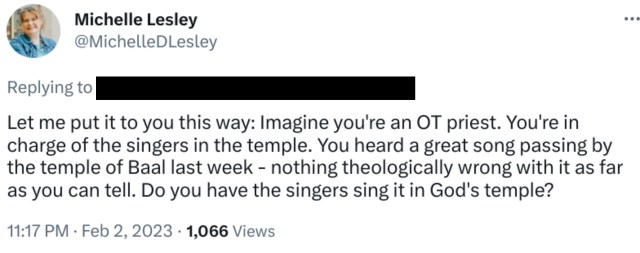
There is simply no good reason for a doctrinally sound church to use music from heretical sources like these.

The Mailbag: False Doctrine in Contemporary Christian Music

Why Our Church No Longer Plays Bethel or Hillsong Music (or Elevation or Jesus Culture), and Neither Should Yours

Hillsong’s Theology of Music and Worship

The Mailbag: Should Christians listen to “Reckless Love”?


Hello there. I read your blog about Priscilla Shirer being a false teacher. Read some parts of your blog. Found your recommended preachers with sound doctrine. I don’t know what denomination you’re in. But I just wanted to ask if you believe if we can lose our salvation?

Hi there! I’m a Reformed Southern Baptist. You can read more about my denomination and my beliefs at the Statement of Faith tab and the Welcome tab (both in the blue menu bar at the top of this page.

No, I do not believe genuinely regenerated Christians can lose their salvation because that’s not what the Bible teaches. I discussed this at length, including the relevant Scriptures, in my article The Mailbag: Can unforgiveness cause you to you lose your salvation?.


If you have a question about: a Bible passage, an aspect of theology, a current issue in Christianity, or how to biblically handle a family, life, or church situation, comment below (I’ll hold all questions in queue {unpublished} for a future edition of The Mailbag) or send me an e-mail or private message. If your question is chosen for publication, your anonymity will be protected.


Guest Posts

Guest Post: Be Part of the Solution – Preach the Whole Counsel of God

If your theology pretty much matches up with mine (as outlined in my “Welcome” and “Statement of Faith” tabs in the blue menu bar at the top of this page) and you’d like to contribute a guest post, drop me an e-mail at MichelleLesley1@yahoo.com, and let’s chat about it.


Be Part of the Solution:
Preach the Whole Counsel of God

by Andy de Ganahl

“If you’re not part of the solution, you’re part of the problem.”

An honest assessment of what passes for Evangelicalism today is depressing. Individual Christians are vastly ignorant of the Scriptures, churches that teach verse-by-verse are few and far between, and whole denominations are apostatizing left and right. The reason for this massive downgrade is simple: once a departure from Scripture’s authority has commenced, total destruction is imminent.

For the time will come when they will not endure sound doctrine; but wanting to have their ears tickled, they will accumulate for themselves teachers in accordance to their own desires, and will turn away their ears from the truth and will turn aside to myths. – 2 Timothy 4:3-4

We are even now living in a time when “Christians” desperately desire to have their ears tickled. They want people to tell them what they want to hear and have no stomach for anything outside of that small circle.

We conservatives are quick to point the finger at men like Joel Osteen or Steven Furtick who deny redemption from sin in favor of redemption of personal circumstances. The damning errors of Beth Moore and Rachel Hollis who preach empowerment instead of submission are easy pickings. These are ear-ticklers who have a vast following. But what are we doing about it?

The cancer of heresy is easy to spot once it manifests, but we must address the source of this sickness rather than only treating the symptoms. Generally speaking, we know the problem. We have departed from the Word of God. When you confuse the gospel of grace with personal wealth and individual independence, you’re clearly off the reservation. But where did this start? How far back do we have to go before we find the root of this problem? At what point did we become those who desire to have our ears tickled? It is my opinion that this sickness has infected many more of us than you may suspect.

What Is The Problem?

If you’re like me, you may associate that phrase “wanting to have their ears tickledwith heresy. Clearly what Paul is talking about is a gross misrepresentation of the gospel that might include things like:

  • Denying Christ’s divinity
  • Denying Christ’s humanity
  • Denying the need of repentance
  • Denying human inability in salvation

We could go on and point out the heresies of various cults and false teachers, but Paul’s point is broader than that. All that the phrase means is that people want to be told what they want to hear at the expense of everything else. This does not mean that the thing that people want to hear is necessarily contrary to Scripture.

Paul contrasts ear-tickling with sound doctrine. The Greek literally means healthy/wholesome teaching. It brings the idea of a complete and filling spiritual and theological diet. There is no room in a whole diet for sweets and fluff. But we also need more than only steak, only bread, only broccoli (Praise Him!).

Christians must hold certain convictions with an iron grip. There are many things that a true Christian will never budge on. But that iron grip must hold the totality of God’s Word and not only those convictions that we personally adore more than others.

Some beloved believers, while holding fast their biblical convictions, are ignorant to other important doctrines. Not only are they ignorant, they’re indifferent. They’ve no time for these matters nor do they desire to submit to them. They only wish to hear about the things that are most concerning to them.

We hot-blooded Protestants are eager to rally to the cry of Sola Scriptura! Yet that slogan means that we stand on the totality of Scripture alone, not that we only stand on our favorite passages and doctrines.

I’ve noticed a trend in the various posts that I write. The majority of my writing reflects a careful exposition of Scripture. I write like I preach, verse by verse. But occasionally it is necessary to address issues and topics in light of current events (case in point). Those topics are still presented and studied under the light of Scripture, but they remain topical in nature. It is these kinds of posts that receive the most attention, views, and shares on social media. This trend follows the trajectory of the larger problem. In general, the people of God are more interested in topical discussions that tickle their ears than enduring wholesome teaching. If I am honest, I find this discouraging.

If I were to write something rather controversial like the clear demonic influence of the Democratic National Convention or the apostasy of the Southern Baptist Convention, these sensational topics would likely be well circulated. But these are crumbs. The truths of these propositions are so utterly basic to the Christian faith. To feast on these things is to ensure spiritual starvation. To prefer sensational topics to steady exposition is the very definition of wanting to have our ears tickled.

Please understand me. I am not suggesting that pastors should not address topics that intersect with our surroundings. The sheep need to hear the clear voice of the Shepherd in all things. But it grieves me that there is a genuine lack of appetite for meat while the crumbs are quickly gobbled up. The true child of God loves all of the Word of God and not only the parts he finds to be sensational.

This is a problem of our own making. It has become the standard operating procedure of most churches to completely avoid vast portions of Scripture. We are grieved when we see churches adopt atheistic presuppositions about the origins of the universe and deny God’s literal creation. We marvel and shake our heads when we hear that churches no longer teach homosexuality is sin in both practice and desire. We are shocked when we see mainstream denominations promote blatant violations of 1 Timothy 2:12. But all of these are only the fruit. The root is much deeper.

We have been giving lip service to the inerrancy and sufficiency of Scripture while practically denying that “all Scripture is God-breathed and is profitable for teaching, reproof, correction, and exhortation” (2 Timothy 3:16-17).

In plain language, the problem is a departure from the totality of Scripture.

What Is The Solution?

The solution is as simple as the problem. We must cling to and submit under the totality of Scripture. But what does that simple solution look like?

As a people, we must soundly reject the false understanding of doctrinal triage. We cannot survive another decade if we continue to treat the church like a 1950’s dinner party where are certain topics are off limits. There is simply no such thing as secondary or tertiary doctrines that pale in significance or even lapse into insignificance when placed alongside “primarydoctrines. The biblical authors never divide the Word of God into degrees of significance and neither should we. The solution to biblical fidelity will never be found in arbitrary divisions of biblical teaching. If we’re not part of the solution, we’re part of the problem.

As a church, our pulpits must proclaim the full counsel of God and not only the portions that are palatable. The teaching must be only the Word and must consist of the totality of the Word. Careful verse-by-verse exposition takes a very, very, very long time. It took John MacArthur almost 50 years to preach through the New Testament. But there are still 39 books in the Old Testament that need to be taught. Precise verse-by-verse exposition is the only way to preach. But that means the church must provide more than only the pulpit ministry. The people need the whole story. Their diet must contain the totality of God’s bounty. The solution to biblical fidelity requires the totality of the Bible to be taught. If we’re not part of the solution, we’re part of the problem.

As an individual, you must feast upon the totality of Scripture on a daily basis. There are many Bible reading programs out there. I have my opinion as to how to make your daily Bible reading and communion with God most profitable, but at the end of the day you must be familiar with your ENTIRE Bible. When is the last time you read through Leviticus, or Habakkuk, or Philemon, or (heaven forbid) Revelation? If you own a Bible and possess the ability to read, there is no excuse to be biblically malnourished. This is akin to starving do death with a full pantry. The solution to biblical fidelity requires that we are familiar with our Bibles. If we’re not part of the solution, we’re part of the problem.

Helpful Suggestions

Find a church: The individual Christian is never truly an individual but a member of a larger body. If you find yourself floating from church to church, or just not going to church, then repent of your sin and attach yourself to a faithful body. But be wise to what you attach yourself. There is only one thing that should look for: does this church teach the Bible? Sequential exposition is not just an effective way to preach, it is the only way to preach. The style of music, the quality of the sound system, and the presence (or lack of) children’s church does not amount to a hill of beans. Does the pastor open up his Bible, read it, explain it, and then exhort obedience to it? Find a church that does this, attach yourself to her, bless her and be blessed by her.

Redeem the time: There are portions of our day when our minds a free to wander. Whether we are driving to work, getting in a work out at the gym, or doing some mindless chore around the house. These are fantastic opportunities to engage the mind as well as the hands. We live in a day when we have countless resources full of sound teaching at our fingertips. Many faithful ministries have apps free to download on your phone (Search for Grace to You and S.L.J Institutes in the app store). Stop wasting your time with pointless and Godless music or simply allowing your mind to wander and feast upon the Word of God.

Be selective: Make a conscious decision between what’s good and what’s best. There are many teaching resources out there that seek to teach biblical truth, but are not necessarily teaching the Bible. Is it good to learn about God’s good creation and the scientific discoveries that assume Genesis 1 is true? Is it good to listen to men discussing current events from a biblical worldview? Absolutely. But what is best is to feast on the Word itself. Why waste your time listing about the Bible when you can hear the Bible being taught?

Conclusion

Apostasy and heresy are running rampant in our land and we are partly to blame. We have the audacity to be shocked at the fruit of unbelief when the root of biblical infidelity has been growing for decades. What did Paul command Timothy before he warned him? Preach the Word! (2 Timothy 4:1-2)

He doesn’t say, preach the primary” doctrines, or when it’s convenient. Preach the whole counsel of God and preach it all the time. There’s no room here for private convictions held within small circles. He says reprove (give correction), rebuke (call out sin), exhort (call for obedience) with great patience (people need to hear it over and over again) and instruction (TEACH IT!).

The problem with the church today is that we have neglected the totality of Scripture. As a result we must be chained to, immersed in, and fully submitted under all of Scripture.

This is our battle cry. This is what Sola Scriptura means. This is the path of fidelity. This is the solution to the problem. But if we’re not part of this solution, then we’re part of the problem.


Andy de Ganahl is a graduate of The Master’s Seminary and pastor of Calvary Baptist Church in Burley Idaho. Andy’s burning desire is for the people of God to know the Word of God so that they can more accurately worship the God of the Word. You can check out If You’re Not Part of the Solution, Then You’re Part of the Problem (from which this guest post was excerpted), and other articles by Andy, at The Pastor’s Brief

Favorite Finds

Favorite Finds ~ January 14, 2020

Here are a few of my favorite online finds…

“How can I know with certainty what the Bible is saying? How can I be certain what books really belong in the Bible? How can I be sure that my interpretation of any text is correct, and, still more, what its proper application is…?” Have you ever tried to explain a biblical principle to someone only to hear the retort, “But That’s Just Your Interpretation!“? D.A. Carson has some helpful words for us in the latest issue of Themelios.

 

“Pastors, I have a plea for you. Please, love your women enough to warn them against false teachers. It isn’t enough to simply teach the good stuff; if they don’t know what is out there that is not good and why it isn’t good? They will continue to fall for it.” Check out Amy Spreeman’s article, When Seemingly Solid Pastors Fail to Protect Women.


“Christianity is sexist!” “The Bible is patriarchal and just wants to keep women down!” We hear these tired arguments trotted out again and again, but are they really true? No, Eric Davis explains in his excellent article over at Cripplegate, 10 Reasons Why the Bible Regards Women Higher than All Other Systems, “The fact is…the Bible regards women higher than any other ideology, religion, philosophy, or system in history. Nothing teaches a higher view of women than biblical Christianity.”


Crossway has an interesting infographic for us on a study they conducted on prayer: “Over 14,000 people recently shared about various aspects of their prayer lives with us…we invite you to dig into the data, looking at established prayer habits, common pain points, and useful practices and tools for prayer.” Take a look at Infographic: How Is Your Prayer Life?.


Hermeneutics is the lens through which we view Scripture. Dr. Dane Ortlund helpfully explains some right and wrong lenses to use when studying Scripture in 6 Ways Not to Read the Bible (a brief excerpt from a longer seminar). Are you handling Scripture correctly?


The resources listed above are not to be understood as a blanket endorsement for the websites on which they appear, or of everything the author or subject of the resource says or does. I do not endorse any person, website, or resource that conflicts with Scripture or the theology outlined in the Statement of Faith and Welcome tabs at the top of this page.
Guest Posts

Guest Post: 8 Ways to Pray for Your Pastor’s Wife

If your theology pretty much matches up with mine (as outlined in the “Welcome” and “Statement of Faith” tabs) and you’d like to contribute a guest post, drop me an e-mail at MichelleLesley1@yahoo.com, and let’s chat about it.


8 Ways to Pray for Your Pastor’s Wife
by Jennifer Buck

As a pastor’s wife, I have seen many lists of ways to “pray for your pastor.” I admit, I usually scroll through and delete them as I find most to be…well…generic.

Michelle, however, actually hit the pulse of what a pastor really needs in our prayers. I found myself reading and inwardly shouting, “YES! This is exactly what pastors need.”.

Then my mind began forming a list of what their wives need in our prayers—more than just physical strength and a good group of friends. Although those things are important, I believe these other areas, as they are cultivated in her life would result in physical endurance and draw women wanting friendships with her.

I don’t think a pastor’s wife should live or look differently than any other believer in Christ. However, I do think she’s in this sometimes awkward but wonderful position of having a pulse on the heart of the church her husband serves and is so heavily invested in.

She’s an insider, but not really; it’s complicated. She may know a lot of what’s happening, but may have no leadership position. Even if she does, she’s limited to the scope of the area of which she heads.

She is not a female version of her husband. She is usually looked to as an over all leader by the people, but has no authority to act independently as a decision maker. Therefore, it does take an extra measure of grace to be acutely aware of the inner workings of the church but often only able to watch, offer ideas or opinions when asked, or mostly, wait as the leaders/committees make the decisions that will shape the church.

With those things in mind, if I were asked what to pray for me or any pastor’s wife, this would be my list:

1

Pray she has a deep love for the people in her church. There is a special love that can be developed for the Lord’s church. She doesn’t have to intimately know each person to hold a deep and genuine concern for their well-being and spiritual development.

2

That she loves the Lord God with all her heart and soul and mind. Being in the ministry does not guarantee that a once teachable heart cannot grow cold. Her personal walk must not be neglected in the doing of ministry. She needs to operate with a steady and sound mind.

3

That she delights in caring for her family/home. Her husband’s role will by necessity make his presence in the home sometimes erratic as he cares for the church. She needs to be the steady presence in the home. Her attitude will help form the opinion of her children about the church and the demands on their father. She will also need to be able to alert her husband when the needs of the home are greater for a period of time. Sometimes in ministry, the church will need his attention more than home and at other times the family will need his attention more. A wise wife will help him see the greater needs and willingly allow him to be where he is needed the most.

4

Pray she is able to submit to the reality that her daily living will serve as a model for others. She will naturally be looked to as an example, and she needs to be willing to live a life that reflects well the work of Christ in her.

5

That she does not have a grudge-holding heart. Ministry can be hard. Sometimes hurtful things are said and done and a pastor’s wife will not endure well if she carries the offenses of her husband. She must be able to take her hurt to the Lord and be willing to remind her husband, when he forgets, to lay his grievances before the cross also.

6

She needs to be able to allow her husband time to grieve in situations she cannot help him through. Sometimes he carries a grief no one but the Lord can lighten. He must simply walk through it.

7

That she be less concerned about what others think of her and more concerned about pleasing the Lord. That will provide much protection for her heart.

8

That she learns contentment and finds comfort in the knowledge that her personal and family needs will be provided by the Lord – in his time. Pray she functions knowing, “When I need it, it will be provided, if I don’t have it, I don’t need it yet.”


This is by no means an exhaustive list, these are just some of the things I have had to walk through and learned how to process in my years as a pastor’s wife. I’ve seen many other wives do these things well and watched them flourish in home and church. Others have not fared so well and I have watched with sadness as their marriage and ministry either crumbled or lost all effectiveness.

There is no doubt that ministry has its hard moments, however, it is also an amazing journey to be a part of laboring alongside your husband and witnessing the transforming work of the Gospel. Praying for your pastor and his wife can be a way for the church family to participate in the continuation and transforming work of the Gospel in the hearts of those who lead them.


Jennifer and her husband, Tom have been married for 32 years and have 3 children. For the last 13 years they have been serving in Lindale TX, where Tom is Senior Pastor of First Baptist Church. Jennifer is one of the teachers in the church’s Women’s Bible Study Fellowship and leads a small group discipleship called Gracestoration. Jennifer loves to teach and encourage women in the truths of Scripture.

Podcast Appearances

The Everyday Ministry Podcast Guest Appearance: Women in Ministry

It was so fun to appear as a guest on The Everyday Ministry Podcast last week! Listen in as James, Krist, and I discuss complementarianism, how pastors can help women minister effectively in their churches, and more!

You can also subscribe to The Everyday Ministry Podcast on iTunes and Google Play, and be sure to follow them on Facebook and Twitter!

Here are a few articles I’ve written about some of the topics we covered in the podcast:

How a Little Acorn Helped Reassure a Nut Like Me
Testify
Rock Your Role: Jill in the Pulpit
Let Me Count the Ways: 75 Ways Women Can Biblically Minister to Others
Deaconesses and Female Deacons
Servanthood
Bible Studies
Rock Your Role FAQs


Got a podcast of your own or have a podcasting friend who needs a guest? Need a speaker for a women’s conference or church event? Click the “Speaking Engagements” tab at the top of this page, drop me an e-mail, and let’s chat!