Church

Throwback Thursday ~ You Don’t Need the Internet, You Need a Pastor

Originally published July 28, 2017

Mark Zuckerberg: Facebook Can Fill the Role Played by Churches,” declared recent headlines.

It should come as no surprise to us that Mark could reach such a conclusion. He sees people’s innate desire for community. He’s a decent guy (by the world’s standards) and wants to give something back. He sees his profession as a way to do that. It makes sense if you look at things from his perspective.

To Mark, church is merely a gathering of people for social interaction and encouragement. Like a coffee klatch. Or a support group. But the thing is, Mark isn’t a believer. His mind hasn’t been transformed by Christ to a biblical way of thinking, so it’s understandable that he doesn’t get it.

What should shock us is that, long before Mark’s thoughts on church popped up in our news feeds, people who identify as Christians were saying the same thing. Or at least acting like it.

I don’t need to join a church. I can just watch sermons online.

I’ve been hurt by a church, so I’m done with it altogether. I’ll just hang out in my Christian Facebook group instead.

I like my online friends way better than the people at the churches around here.

It seems like a lot of Christians -who should be thinking biblically – don’t get it either.

Sure, there are times of illness, tragedy, work, being out of town, and other circumstances that can temporarily prevent us from being with our church family. In those cases, social media and the internet are a godsend that can keep us connected, in a minimal way, to the body of Christ. But, in much the same way that it would be unhealthy to replace every meal with a Snickers bar simply because you don’t want to make the effort to cook, choosing a steady diet of internet “church” when there’s a spiritually healthy meal available is a sure fire way to deteriorate into a diseased, malnourished Christian.

There are lots of reasons why being a faithful, active member of a local church isn’t optional for Christians, but now it seems necessary to also explain that the internet isn’t your local church. It can’t be. There’s just too much missing: church ordinances, practicing the “one anothers”, serving in church ministries, making sacrifices for others, church discipline, ecclesiastical structure and authority, and…you know…actual face to face interaction with other humanoids. There’s far more to church than hearing a good sermon and the occasional carefully-edited chat with other Christians.

And perhaps one of the most important things that’s missing at First Church of the Interwebs is a pastor.

Not a preacher. A pastor. Your pastor.

You need a pastor – a man who labors in prayer over the sheep God has entrusted to him, who nurtures and serves those under his care, whose heart so beats with the Body that he knows whether they need encouragement, rebuke, comfort, training, or guidance, and lovingly provides it.

A blogger isn’t going to come to your house and comfort you at 3:00 a.m. when your spouse has just passed away.

A Facebook group can’t possibly grasp all the nuances of the situation with your prodigal child and provide correct biblical counsel on how to deal with it.

A sermon web site isn’t led by the Holy Spirit to choose the sermon you need to hear. You choose what you want to hear.

Even the most doctrinally sound preacher on the web can’t marry you, bury you, baptize you, or administer the Lord’s Supper to you.

Your Twitter friends won’t visit the hospital and pray with you before surgery.

Your favorite Christian podcaster can’t look you in the eye and know when something’s wrong or that you need help.

And even if they could, it’s not their place.

You see, when you have real, serious spiritual needs, reaching out to a blogger, internet pastor, or other online personality to fill those needs doesn’t work right and could even be harmful to your situation, because you’re asking us to step in where we don’t belong. To usurp the place God has reserved for the man He has called to shepherd you.

God didn’t ordain the office of blogger. He didn’t breathe out Scripture to train and encourage podcasters. And there aren’t any biblical qualifications for social media groups.

God created pastors.

God created pastors because He thought that was the best way for Christians to be cared for until Christ returns to take us home. And if God thought that was the best way, isn’t any other way we come up with going to be less than what’s best for us? Who are we to second guess the God of the universe and try to replace His plan with one of our own making?

Yes, there are wolves out there masquerading as shepherds, and it can be hard to find a doctrinally sound church and pastor. That doesn’t mean you give up and settle for something that’s not biblical. As far as it’s within your ability, you search, you pray, you make sacrifices, maybe you even pack up and move, but you find a reasonably healthy church with a pastor you can submit to, and you plug in. That’s what people did before there was an internet, you know.

Nobody on the internet can take the place of a living, breathing, boots on the ground pastor and church family, so stop trying to replace them with people you’ll likely never meet, who don’t love you as much, can’t care for you, and aren’t as invested in you as those God has ordained to fill that need in your heart and life.

You don’t need the internet. You need a pastor.

Christian women, Discernment

Throwback Thursday ~ Women In Combat

Originally published March 18, 2016

Over the last few months, thereโ€™s been a lot of talk about the possibility of future U.S. military drafts including young women in addition to young men. Iโ€™ve admired godly male friends who have spoken out vehemently against this and expressed concern about the government trying to press their daughters or wives into service. Some even vowed to lay their lives down protecting their women from having to face the horrors and dangers of war.

But I wonder if these men โ€“ husbands, fathers, pastors, elders – know that many of their wives, daughters, and sisters in Christ are already in the trenches fighting off the enemy with every ounce of our strength and every weapon at our disposal.

Itโ€™s not a war for territory or political control or freedom from dictatorial tyranny.

Itโ€™s a battle for the purity of the Bride. And the souls of our sisters.

Daily. Weekly. At church. On line. In our families. We strap on our Swords, march out to the front and engage in hand to hand combat with the Enemy.

His troops: false teachers.

His weapon of mass destruction: false doctrine.

Sometimes we stand as a shield between grenade-lobbing grunts and weak sisters who donโ€™t know how to fight, or even that theyโ€™re in a war. Who want nothing more than to knock us down into the mud as they desert our King and join our foes.

Sometimes we infiltrate the enemy camp to bring back intelligence on his troops to our commanders and generals, only to be ignored, reprimanded, or dishonorably discharged from the unit.

Sometimes we stand as guards at the walls of our churches, watching the adversary advance, sounding the alarm, and standing in stunned disbelief as our commanding officers smilingly welcome the enemy troops through the gate.

Why? Why, in a field of pink, are there so few Green Berets? Why is it that so many women are out on the front lines battling this insidious rival while most of our brothers in arms seem to be AWOL?

men1

As Steve Lawson famously said a few years ago, “Give us some men who know the truth!”

And to that I respond with a hearty amen. But with much love and respect to Brother Steve, I would add:

Give us some men who will DEFEND the truth.

And the weak women the enemy seeks to capture.

And the strong women who should be protected, working safely away from the line of fire to support the troops and nurse the casualties back to health.

Give us men who willโ€ฆ

โ€ฆthoroughly vet any curricula, books, or materials used by their churchโ€™s Bible study classes.

โ€ฆtrain all of their churchโ€™s teachers to properly handle and exegete the word of God.

โ€ฆtake a close look at the authors of the books and blogs their wives or church members are reading and the speakers at the conferences and retreats theyโ€™re attending.

โ€ฆexamine the doctrine of the singers their daughters or youth listen to and the leaders of the youth camps they attend.

โ€ฆspeak out with godly boldness (not jerkiness- godly boldness) against false doctrine and false teachers on social media, in Sunday School, in the sanctuary, in their homes, and in every arena in which they have influence.

โ€ฆjoin the few brave brothers who are already standing in the gap to present a united front to ward off the enemy.

Godly men on active duty in their churches, homes, and in the public square are out there. Iโ€™m privileged to know several. But they need a bigger band of brothers to join them in fighting the good fight.

We need men who will gird up, gear up, and stand up. Because some women in combat are wounded, battle fatigued, and in need of some R&R. And we canโ€™t keep fighting this battle without a few more good men.

1 cor 16 13
Mailbag

The Mailbag: Expository or Topical Preaching: Which is better?

Originally published March 5, 2018

I would like to read your thoughts on expositional vs. topical preaching. I know we can benefit from both but is one superior to the other and why?

Great question! You’re right, both forms of preaching can be beneficial as long as the pastor properly exegetes (rather than eisegetes) Scripture.

For readers who might not be familiar with the terms, expository preaching is basically when a pastor preaches through books of the Bible from beginning to end carefully explaining what each passage means. He might go through only a few verses each week, or maybe a chapter each week, so the time it takes to work through a book will vary from pastor to pastor.

The termย topicalย preaching can have a couple of different meanings depending on who you’re talking to and what she understands the term to mean. Some people understand “topical preaching” to mean a sermon series, usually in a seeker drivenย church, that centers around something in pop culture. (For example, popular moviesย or the Olympics.) Normally, these sermons are very shallow, biblically – sometimes nothing more than a pep talk or self-help tips. This type of preaching is unbiblical, and if it makes up the bulk of the preaching at your church, I’d recommend finding a new church.

There is, however, a biblical form of topical preaching that can be very helpful. If a doctrinally sound pastor sees an issue in the church that needs to be addressed, there is nothing wrong with his taking a break from preaching through a certain book (or when he’s between books) to teach on this issue from the pulpit.

For example, pastors in Parkland, Florida, might wish to take a few weeks right now to preach sermons on “Why does God allow tragedies to happen?”, “How can I biblically comfort the families of the victims?”, “Are the victims of the shooting in Heaven?”, and so on. One great topical sermon concept I’ve seen is for the pastor to give the congregation the opportunity to submit biblical questions and then preach sermons answering those questions. Other times a pastor might address a biblical topic for several weeks, such as peace, the gospel, the Fruit of the Spirit, or parenting. As long as these topics are driven by “let’s look at what the Bible says about X” and the pastor handles Scripture correctly and in context, topical preaching is both biblical and beneficial.

My personal opinion (this is not law and there may be plenty of perfectly doctrinally sound pastors who disagree) is that the majority of a pastor’s preaching should be expository with occasional breaks for (biblical) topical preaching as needed. Why?

โœข Expository preaching usually covers a wider spread of Scripture and a wider variety of topics. Topical preaching is, by definition, very narrowly focused on fewer passages and fewer topics.

โœข Expository preaching models for the congregation the proper way they should study the Bible at home. Most of the time, in your daily Bible study, you should be working your way through books of the Bible systematically. (That said, topical preaching done properly is also helpful for demonstrating to the congregation how to correctly find and apply Scripture to various topics and situations which arise in their lives. We need to know how to do both, but the former is primary.)

โœข Expository preaching helps a pastor better preach the whole counsel of God. He doesn’t have to worry that he’s neglecting to teach on a certain issue and wrack his brain trying to think of what that issue might be. With expository teaching, Scripture takes care of that for him.

โœข I have to think that expository preaching is easier than being forced to come up with a new topic or series every week or few weeks. I’m not a pastor, but the Bible studies I post each Wednesday are nearly always expository. The articles I post each Friday are nearly always topical. Hardly a week goes by that I don’t fret over coming up with a topic for the Friday article and struggle against writer’s block. But I know exactly what each week’s Bible study is going to cover: whatever the next passage of Scripture is in the book we’re studying. Exposition eliminates “forced creativity stress” for me, and I’m thinking maybe it’s similar for pastors.

โœข Expository preaching pushes pastors to tackle hard and unfamiliar passages as they come up in the text, making them more biblically knowledgeable and well-rounded, and allowing them the blessing of depending on God in prayer to open their eyes to understand His Word.

โœข Expository preaching should keep the Old Testament and certain books of the Bible from being neglected as much as they usually are. There are only 66 books in the Bible to preach through. Eventually you’re going to have to get to the minor prophets, Leviticus, Jude, Philemon, Song of Solomon, and the really long books of the Old Testament. Ostensibly. I’m sure there are expository pastors out there who have preached through the more neglected books, but I’ve never sat under a pastor who preached through Nahum or Zephaniah or Ezekiel. Just sayin’.

โœข Expository preaching gives the congregation a better grip on the overall story arc of the Bible and the culture of the period being studied. If your pastor preaches a topical sermon on leadership from Nehemiah one Sunday, you’re not going to understand the post-exilic period of Israel’s history or the culture of that time nearly as well as if he preached through the entire book over several weeks or months. That knowledge and insight is something you can stick in your pocket and hang on to for studying other post-exilic Scripture at home or in Sunday School, or listening to other sermons dealing with that period of Israel’s history.

โœข Expository preaching better lends itself to encouraging the congregation to prepare for Sunday worship during the week. If you know what passage your pastor is going to be preaching on this Sunday, you can study, and even memorize verses, ahead of time to prepare your heart to hear your pastor preach it.

I just have a couple of caveats (still just my personal opinions) about expository preaching:

I don’t think it’s wise for a pastor to be so rigidly stuck on expository preaching that he ignores the leading of the Holy Spirit to preach the occasional biblical topical sermon when it would be a benefit and a blessing to his congregation simply because he sees himself as an expository preacher. Preaching a topical sermon or series from time to time doesn’t mean you have to turn in your expository preaching card.

Also, while verse by verse preaching is an excellent way to teach the text thoroughly, I once heard someone talking about her (very good, doctrinally sound) pastor who had been preaching through a particular book of the Bible for seven years and still had several chapters to go. I don’t think it’s a good idea to take that long on a single book. At that point, several of the aforementioned benefits of expository preaching are gone: the pastor has ceased to preach the whole counsel of God, he’s neglecting bibilical topics not found in that book, he’s neglecting other books of the Bible, he’s not helping his congregation learn the whole storyline of Scripture and the customs of various historic periods and cultures, and he’s not covering as wide a spread of Scripture as he could if he’d limit himself to a year or two, max, to finish one book and move on to the next.

Expository and topical preaching are both helpful in their own ways, but the most important thing is that the pastor is “rightly handling the word of truth.”


Additional Resources

Why topical preaching can never build a healthy church by Mark Dever

The Sheer Weightlessness of So Many Sermonsโ€”Why Expository Preaching Matters by Albert Mohler

What is topical preaching? Does it have a place in the church? by John MacArthur

Can Topical Preaching Be Expository? by Timothy Warren


If you have a question about: a Bible passage, an aspect of theology, a current issue in Christianity, or how to biblically handle a family, life, or church situation, comment below (Iโ€™ll hold all questions in queue {unpublished} for a future edition of The Mailbag) or send me an e-mail or private message. If your question is chosen for publication, your anonymity will be protected.


Christian women, Church, Discernment

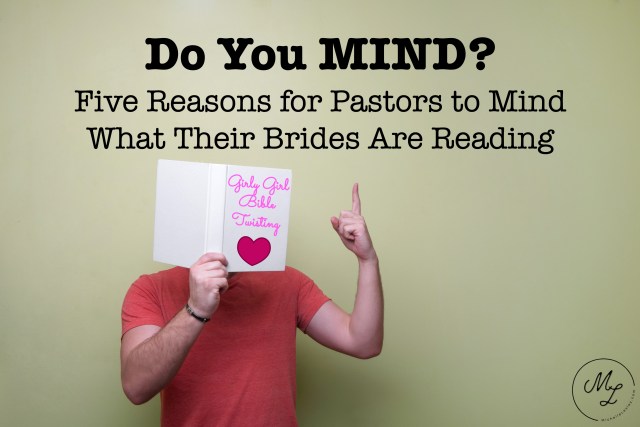
Throwback Thursday ~ Do You MIND? : Five Reasons for Pastors to Mind What Their Brides Are Reading

Originally published May 27, 2016

A while back, my husband and I were driving down the road on the way to the store discussing various aspects of ministry. At some point the conversation turned to a pastor with whom we were both vaguely familiar. Neither of us knew much about him, so we decided to look him up on Facebook to see if we could get a better handle on where he was coming from, theologically. Aside from a couple of mildly iffy posts that it wasn’t a stretch to extend the benefit of the doubt about, it didn’t seem as though there were any major doctrinal red flags. He just seemed like your average, Bible believing pastor who needed to brush up a little on his discernment. (Hey, who doesn’t, right?)

I was actually more interested in the pastor’s wife and what kind of ministries she was involved in that I might also like, so I clicked over to her page. I was pretty disappointed by what I saw. She had posted materials from several major false teachers- the female equivalents of people from Joel Osteen all the way down to Benny Hinn.

I remarked to my husband that I thought there might be some concerns about this pastor’s theology if he was OK with his wife following and sharing materials from high profile false teachers. And my husband gently reminded me that wasn’t necessarily the case:

“He probably doesn’t even know those women are false teachers.”

My husband went on to say that he wouldn’t have known that people like Beth Moore and Joyce Meyer are false teachers if I hadn’t done the research and filled him in. Not because he doesn’t care whether or not I read sound doctrine, but because pastors and Christian men in general don’t often pick up and read books written for Christian women to examine the theology we’re feeding on.

Until the last few decades, they haven’t always needed to. If your wife went shopping and came home with a book from LifeWay, it never crossed your mind to question whether or not it was biblical. It was LifeWay for heaven’s sake. LifeWay is run by pastors and theologians with years of experience and doctoral degrees from seminary. Of course it was biblical.

Well not any more, it isn’t. The majority (and that’s not an exaggeration) of the “Bible” studies and other materials marketed to Christian women by Christian retailers are authored by false teachers.

what rose reads_kindlephoto-19662398

Pastors, on behalf of Christian women everywhere, I plead with you: check out the theology of the authors and bloggers (including me) your wife is reading and the Christian personalities she follows and shares on social media. Please thoroughly vet the materials your Sunday School/small group/Bible study classes and women’s ministry are using. Find out about the speakers headlining the women’s conference or simulcast your ladies are attending. Make sure guest speakers appearing at your church’s women’s event teach sound doctrine.

Why?

It’s not my place to instruct you (and I’m sure you already know, anyway) in what the Scriptures say about being the spiritual leader of your family, responsible for its theological health or your obligations as a pastor to guard your church against false doctrine. I’ll leave that to godly men, fellow pastors, theologians, etc. What I’d like to do is to offer you some practical insights (in no particular order) from the pink side of the pew that you might find to be helpful tools as you think about and pray through how to handle vetting the teachers your wife or church ladies follow:

1. Your wife’s decision to follow false teachers could cost you a job. There are women out there like me who are familiar with the “twisted sisters” your wife is sharing on social media. If I could wrongly make assumptions about the theology of the aforementioned pastor based solely on his wife’s Facebook activity (because wives can be a reflection of their husbands’ spiritual leadership), others could do the same – maybe even those on a pulpit search committee – and that could impact your search for a pastoral position.

2. You don’t want to shoot yourself in the foot. A pastor’s wife can have a huge influence on her church. She is often the one teaching the women’s Bible study or heading up the women’s ministry, and even if she doesn’t, her input on curricula, guest speakers for women’s events, etc., is usually seen by the women of your church as carrying the weight of your approval or preferences. If you’re up in the pulpit preaching sound doctrine every week while your wife or women’s leader is importing false doctrine into the women’s ministry, it’s like bailing water out of a boat with a hole in the hull.

3. Your wife or (women’s ministry leader) may be chasing off spiritually healthy church members. (If you’ve stuck with me thus far, what follows is unlikely to describe your wife, but I’m going to go ahead and throw it out there for awareness’ sake.) I have heard the following prototypical scenario from dozens of Christian women (and experienced it myself):

“My pastor’s wife is in charge of our church’s women’s ministry, and is a big Beth Moore fan. We only do Beth Moore studies in our small groups, and last year our church hosted a Beth Moore simulcast. I participated in a couple of the studies, but they just seemed “off” biblically, so I started doing some research.

I discovered Beth Moore was teaching false doctrine, preaching to men, partnering with false teachers, and doing other unbiblical things. I went to the pastor’s wife and very kindly, humbly, and patiently showed her the scriptural evidence of Beth Moore’s false teaching. I couldn’t believe it when she flew into a rage, screamed at me, and accused me of trying to create disunity in the church! My husband and I tried to talk to the pastor about it, but he seemed completely unaware of what goes on in the women’s ministry or any problems with Beth Moore, and backed up his wife. We are now looking for a new church.”

This is not an exaggeration or isolated case. I don’t know what it is about Beth Moore’s disciples, but they (especially the ones who are pastors’ wives) seem to be some of the most vicious defenders of false teachers out there. And if your wife or women’s ministry leader acts like this it could cost you godly, spiritually mature church members.

4. Your children’s spiritual lives are at stake, both at home and at church. As with any dad who works long hours, your wife probably has more of an influence in the moment to moment aspects of your children’s lives than you do, even when it comes to training them in godliness. If her spiritual diet consists of false teaching, that’s what is being imparted to your children on a daily basis.

The same goes for the children at your church. The majority of children’s Sunday School teachers and children’s ministry workers are women. The false doctrine these women consume today will be taught to the children of your church on Sunday.

5. When women are spiritually healthy, the whole family benefits. Statistically, women make up about 60% of church attenders, and, of course, 50% of a marriage. That is an enormous influence on your own family and your church family. You want those women spiritually healthy. It’s not only biblical and good for them personally, but everyone they influence and interact with benefits.

When women are taught sound doctrine, they grow to Christlike maturity. They exhibit the fruit of the Spirit. They want to share the gospel. They walk in humility, patience, love, repentance, forgiveness, and biblical submission. They encourage their husbands toward godliness. And you know what else they do?

They teach other women to do the same. They train up children who are godly. They’re self-replicating.

Spiritually healthy, mature, godly women make your life easier, more peaceful, and more of a joy, both at home and at church, because they’re working with you, not against you.

But your wife and the women of your church are not going to get the pure milk of the Word they need to grow in Christlikeness from the pantheon of divangelistas lining the shelves of your local Christian bookstore. And most of those precious ladies you shepherd are completely unaware of that fact. So they need your help, Pastor. Your bride, and the Bride, desperately need you to mind what they’re reading.

Mailbag

The Mailbag: Potpourri (Paul’s gospel, National repentance, Pastor search committee, Pastor’s wife teaching men)

Welcome to another โ€œpotpourriโ€ edition ofย The Mailbag, where I give short(er) answers to several questions rather than a long answer to one question. I also like to take the opportunity in these potpourri editions to let new readers know about my comments/e-mail/messages policy. Iโ€™m not able to respond individually to most e-mails and messages, so here are someย helpful hintsย for getting your questions answered more quickly.ย Remember, the search bar (at the very bottom of each page) can be a helpful tool!

In these potpourri editions of The Mailbag, I’d also like to address the three questions I’m most commonly asked:

“Do you know anything about [Christian pastor/teacher/author] or his/her materials? Is he/she doctrinally sound?”

Try these links:ย 
Popular False Teachersย /
ย Recommended Bible Teachersย /ย search bar
Is She a False Teacher? 7 Steps to Figuring It Out on Your Own
(Do keep bringing me names, though. If I get enough questions about a particular teacher, I’ll probably write an article on her.)

“Can you recommend a good women’s Bible study?”

No. Here’s why:
The Mailbag: Can you recommend a good Bible study for women/teens/kids?
The Mailbag: โ€œWe need to stop relying on canned studies,โ€ doesnโ€™t mean, โ€œWe need to rely on doctrinally sound canned studies.โ€.

“You shouldn’t be warning against [popular false teacher] for [X,Y,Z] reason!”

Answering the Opposition- Responses to the Most Frequently Raised Discernment Objections


Didn’t the risen Christ give Paul the Gospel of salvation by grace through faith? Paul called it “my gospel”? Is the Great Commission the same as Paul’s gospel? Thanks!

Not exactly, but it’s great that you’re noticing those little details as you study God’s Word!

“Paul’s” gospel…

Remember Jesus Christ, risen from the dead, the offspring of David, as preached in my gospel, 2 Timothy 2:8

…is the biblical gospel of salvation that Paul preached – the good news of what Christ did to save sinners through His death, burial, and resurrection – and the call to repentance and belief.

The Great Commission…

And Jesus came and said to them, โ€œAll authority in heaven and on earth has been given to me. Go therefore and make disciples of all nations, baptizing them in the name of the Father and of the Son and of the Holy Spirit, teaching them to observe all that I have commanded you. And behold, I am with you always, to the end of the age.โ€ Matthew 28:18-20

…is the church’s (and individual Christians’) “marching orders” to share that gospel with sinners and disciple them to maturity in Christ. It is God’s main purpose for the church.

So, in a nutshell, the gospel is what Christ did. The Great Commission is what we’re supposed to do with the gospel.


I got into quite the discussion with people today who feel that prayers of repentance for our national sins are not only unnecessary, but an affront to them because THEY did nothing wrong. I cited Daniel who prayed prayers of repentance for his nation, though he led a righteous life. They got all confused with Old Testament sacrificial law and that Christ was the ultimate sacrifice so we only need repent of our OWN sins. Could you address this, please?

Well…depending on exactly what they were saying, they may have been at least partly right. We can certainly pray that God will lead individuals in our nation to repent of whatever sins they may have committed, but we cannot repent on behalf of another person or of a nation. God does not hold us responsible for the sins of others, and we cannot repent for the sins of others. (see Ezekiel 18).

If you’re referring to Daniel’s prayer in Daniel 9, if you’ll read very carefully, you’ll notice he is confessing the sin of his people, lamenting over the sin of his people, and asking God to pour out His mercy on his people despite their sin, but he is not repenting on their behalf.

It is impossible to repent for someone else’s (let alone a whole nation’s) sin because repenting is more than:

  • confessing that sin has occurred,
  • admitting that someone is guilty for having committed that sin,
  • feeling sorrowful over sin,
  • asking forgiveness for sin, or
  • asking God to be merciful toward the sinner.

Repentance means to turn away from your sin, to forsake it, to stop doing it because you want to obey God instead. Although I’m sure he wished he could have, Daniel could not turn away from someone else’s (the nation of Israel’s) sin. And, he specifically says in verse 13: “we have not entreated the favor of the Lord our God, turning from our iniquities”.

Another thing to remember is that Daniel is interceding for God’s covenant people. They belonged to Him. They had agreed to follow Him. America is not in a covenant relationship with God. For a Christian today, interceding for the church and praying that God would lead Christians to repentance would be more analogous to what Daniel was doing.


We lost our pastor almost a year ago and are struggling to find a new one. Do you have any suggestions of where we could send the information about our church and the position in hopes of finding a suitable candidate?

I would suggest sending your information to:

The Master’s Seminary’s Pastor Search page

Founders Ministries Minister Search page

Expositors Seminary

I hope you’ll find a wonderful, godly pastor very soon!

Now, although this might not be possible for your particular church, I would like to throw something out there for the consideration of any pastor or church member who might be reading this. The most biblical model of leadership for the local church is that it be led by a plurality of elders.ยน For that primary reason, I would encourage every church that doesn’t already have this leadership structure in place to look into it and give strong, prayerful consideration to transitioning into leadership by a plurality of elders.

However, secondarily, there are practical benefits to your church being led by a plurality of elders, and avoiding being “pastorless” is a huge one. My own church recently welcomed a new pastor after being without one for two full years. That two years was a struggle. The interim pastor was a stranger to us and we were strangers to him. He did not know the ins and outs of life at our church or the strengths and weaknesses of our church. As affable as our interim pastor was, it was always in the back of everyone’s mind that he was temporary. This was not our pastor and everyone knew it. And then there were some other issues that arose during his tenure that awaited the new pastor’s arrival.

When a church is led by a plurality of elders, many of these issues can be avoided or lessened. When a lead teaching elder dies, moves, or steps down for whatever reason, there is, ideally, already another elder available to step in and take over. This elder already knows the church and the people and they know him. There’s no need to assemble and train a pastor search committee, launch a nationwide search, wait on resumes to arrive, interview candidates, present them to the church for a vote, and then hire a stranger about whom you know virtually nothing except what’s on his resume and whatever he says in his interview. The transition from elder to elder is smoother and immediate with little upheaval and relational trauma to the church body.

Just something to think about.

ยนI’m not saying that churches which aren’t elder-led are apostate or intrinsically sinful, I’m just saying that if you want to get as close to the biblical model as possible, go with a plurality of elders.

I am a relatively new (about one year old –ย  but growing in discernment!) Christian, and I attend a small Baptist church of about 15 people in the remote area in which I live. The pastorโ€™s wife leads both men and women in a โ€œBibleโ€ study group using popular (biblically questionable at best, such as Max Lucado) books instead of reading Scripture. I choose not to attend these studies, but because the church is so small, my absence is obvious and noticed. People comment that they have not seen me at โ€œBibleโ€ study.ย 

Everything else that happens in the church, the sermons, worship, prayer, are all on point biblically, thus far. My pastor is a godly man as far as I can tell, so my only issue to date is these co-ed, led by a woman, “not-Bible” studies. Should I take my concerns to my pastor?ย Iโ€™m already on a bit of shaky ground with the pastor’s wife. Iโ€™m reluctant to upset the apple cart any more. However, if the right thing to do is to address it and deal with potential consequences (shunning, whatever) then I want to do the right thing by my Lord and Savior. How would you guide me in this situation?

I know this is a really difficult situation to be in and I’m sorry it’s making you uncomfortable at church. Yes, when we see sin in the camp, we must speak up, so you should begin preparing to address this situation. Normally, I encourage women to go to the person most directly in charge of the issue first, which in this case would be the pastor’s wife, but I’m guessing that if you’re on “shaky ground” with her it’s because you’ve already tried to address this with her. The next step is to go to the pastor.

I would encourage you to spend a little time studying through the book of Esther, realizing that she was in a somewhat similar situation to yours: God revealed to her an ungodly situation that would harm His people, and she – at great personal risk – had to go to the man in charge and implore him to right the situation, not knowing how he would respond. It could be that God has specifically placed you in this church “for such a time as this”.

Notice that Esther asked that her people be gathered to pray for her. If you have any like-minded friends or loved ones who will pray with you as you prepare your heart to talk to your pastor, that would be beneficial. I have already prayed for you, and I am asking everyone reading this to stop and take a moment to pray for you as well.

If the pastor tells you you’re wrong or doesn’t rectify the situation, and there’s another, better church you could join, even if it’s not as convenient as this one, prayerfully consider moving your membership there. If, as you said, everything else at your current church really is doctrinally sound, and you have no other options for a doctrinally sound church to attend that’s within achievable driving distance of your house, my counsel to you would be to stay at this church, continue not to attend the “not-Bible” study, and fervently pray for God to change the hearts of your pastor and his wife.

If you stay and people continue to say, “We missed you at ‘Bible’ study!” all you have to say is, “Thank you!” or “It’s nice to be missed,” or something like that. I can’t speak for everyone, but when I say, “I missed you at _____,” to someone, it’s not a demand to know why she wasn’t there, it’s to let her know that I love her and missed fellowshipping with her. Hopefully, that’s all your fellow church members mean by saying that. If a nosy Nelly asks why you weren’t there, keep in mind that you’re not required to give her that information just because she asked. You can say something like, “I have a conflict and can’t attend,” which is truthful (you have a biblical conflict and can’t, in good conscience, attend), yet gives no one the opportunity to say that you were gossiping or trying to stir up division in the church. If she continues to pry, look her dead in the eye and keep repeating, “I have a conflict and can’t attend” until she comes to her senses and realizes it’s none of her business why you weren’t there.

Here are some resources I hope will help you:

Rock Your Role: Jill in the Pulpit

The Mailbag: How should I approach my church leaders about a false teacher theyโ€™re introducing?

Searching for a new church?


If you have a question about: a Bible passage, an aspect of theology, a current issue in Christianity, or how to biblically handle a family, life, or church situation, comment below (Iโ€™ll hold all questions in queue {unpublished} for a future edition of The Mailbag) or send me anย e-mail or private message. If your question is chosen for publication, your anonymity will be protected.