Discernment, False Teachers

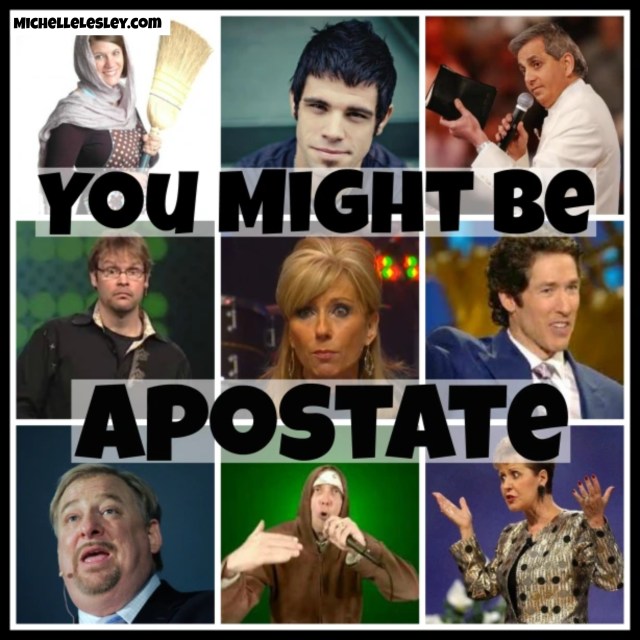
You Might Be Apostate

Originally published June 3, 2016

Comedian Jeff Foxworthy hit the big time several years ago with his “You Might Be a Redneck” one-liners. He frequently introduced the bit by saying, “I’ve found that there are rednecks all over, but sometimes people don’t know they’re rednecks. So, I came up with this little test…” and continued with such gems as:

“If you’ve ever had to carry a bucket of paint to the top of a water tower to defend your sister’s honor, you might be a redneck.”

“If your wife has ever said, ‘Honey, come get this transmission out of the tub so I can take a bath!’ you might be a redneck.”

“If you’ve ever been accused of lying through your tooth, you might be a redneck.”

It was a routine that a lot of us in the South found hilarious because we knew someone (or were someone) who fit nearly every one of Jeff’s jabs.

Like rednecks, there are apostate false teachers all over the place out there, only a lot of them (and their disciples) don’t know they’re false teachers. And the fruit of their lives and ministries is far wackier than anything a redneck has ever dreamed up. That fruit is a sign that we’d better examine the root of doctrine from which the fruit sprang.

So if any of the preachers and teachers you’re following have ever said or done the following things (or something even crazier), watch out, because they Might Be Apostate.

HoNuthaLevel

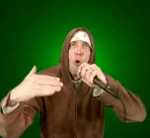
If you’re a middle aged pastor who makes embarrassing rap videos, who publicly extols the virtues of Spanx for men (even though it gives you gas) and who calls himself a Ferrari you might be apostate.

If you feature a Naked Cowboy impersonater (aka- your youth “pastor”) at your “Christian” women’s conference, you might be apostate.

If you’ve ever purposefully applied the pronoun “herself” to God, you might be apostate.

If you celebrated your 35th birthday by preaching at the “church” of your mentor, T.D. Jakes, and placing a $35,000 check in his offering wheelbarrow, you might be apostate.

If God has ever told you to go up to a stranger in the airport and ask if you can brush his hair, you might be apostate.

If you’ve ever given your congregation a sob story about needing a new $70 million Gulfstream jet, because the old one is worn out, you might be apostate.

If you think of the Holy Spirit as the “sneaky,” “silly,” “funny,” “blue genie from Aladdin,” you might be apostate.

If you’re a woman who thinks God is OK with you preaching to men despite what His Word clearly says to the contrary, you might be apostate.

If you’ve ever said, regarding your church’s worship service, “I probably wouldn’t have a stripper on stage…” but leave the door open to the idea because “God told Isaiah to walk around naked for three years,” you might be apostate.

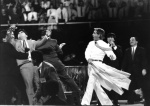
Benny Hinn at Maple Leaf Gardens on Sept. 28, 1992 photos by Tony Bock/Toronto Star and handout photo.

If you think smacking people in the face with your Nehru jacket is a ministry of the Holy Spirit, you might be apostate.

If you’ve ever typed a Facebook status in tongues, you might be apostate.

If you say you’re a trinitarian, but think the Father, Son, and Holy Ghost are three “manifestations” of God rather than three Persons, you ARE apostate.

If you think Proverbs 21:9 means you should camp out on your roof in a quest for biblical womanhood, you might be apostate.

If your senior pastor father sexually abused boys at your church and paid them off to keep them quiet and you, as the subsequent pastor, knew about it but didn’t speak up, you might be apostate.

If you officiated at your homosexual son’s “wedding,” you might be apostate.

If you’re a pastor who thinks expository preaching is “cheating” because it’s “too easy” and that “it’s not the way you grow people” AND that we shouldn’t say “the Bible says…” AND that parents who take their children to a small church instead of a mega church are “stinkin’ selfish,” AND that we shouldn’t use the Bible to convince the lost of their need for Christ, AND that we need to “unhitch” from the Old Testament, you might be apostate.

If you’re Oprah’s idea of an awesome pastor, you might be apostate.

download

If your preaching, ministry, and theology have ever been publicly rebuked by John MacArthur, Paul Washer, or Justin Peters, you might be apostate.

If you partnered with a Roman Catholic mystic with a degree in spiritual psychology to make a completely unbiblical movie about the Bible featuring ninja angels and Mary Magdalene bossing the disciples around, you might be apostate.

If you and your 80s rock star third husband stand in the pulpit and tell people to watch porn to improve their sex life, you might be apostate.

If a feature of your “worship service” is people laughing uncontrollably or barking like dogs, you might be apostate.

If you’ve ever decided to “p*ss off the religious people” on Easter Sunday by playing AC/DC’s Highway to Hell to open the service, you might be apostate.

If you’ve written a book entitled “I Am” and it’s about positive confession rather than Jehovah, you might be apostate.

If you think you have the power to control the weather by the words you speak, you might be apostate.

Joyce-Meyer-600x450

If you think that between the cross and the resurrection Jesus went to Hell and that Satan and the demons jumped up and down on His back, you might be apostate.

If the top three “pastors” you encourage people to follow on Twitter are T.D. Jakes, Rick Warren, and Joel Osteen, you might be apostate.

If a currently practicing homosexual couple wants to serve in leadership at your church and your only problem with it is that one of them isn’t yet divorced from his wife, you might be apostate.

If you’ve ever been accused of having an affair with Benny Hinn, you might be apostate.

If, a hundred years ago, your worship leaders might have been carted off to the funny farm or treated to an exorcism for conducting themselves like this, you might be apostate.

And, if you’re about to write a comment rebuking me for marking false teachers to avoid and exposing unfruitful works of darkness because Jesus would never do such a thing then you don’t know your Bible.

And you just might be apostate.

Mailbag

The Mailbag: Top 10 FAQs

Originally published September 7, 2020

I get lots of great questions, and sometimes, they’re the same questions from lots of different people. So I thought today it would be fun, instead of answering just one person’s question, to answer lots of people’s questions. Here are the top 10 Mailbag questions readers most frequently ask:

1.

โ€œDo you know anything about [Christian pastor/teacher/author] or his/her materials? Is he/she doctrinally sound?โ€

The best way to find out if I’ve written anything on a particular teacher is to put her name (make sure you spell it correctly) into the search bar, which is located at the bottom of every page of the blog. You can also check the Popular False Teachers & Unbiblical Trends tab and the Recommended Bible Teachers tab (in the blue menu bar at the top of this page) to see if the teacher’s name is located there.

If you need answers on a certain teacher right away, and I haven’t written anything about her, you will need to do the research yourself, which is a skill every Christian needs to hone anyway. (You should never just take my, or anybody else’s, word for it that a particular teacher is or isn’t trustworthy.) In case you need a little help getting started, I’ve described how I do my research, complete with some quick litmus tests and shortcuts in my article Is She a False Teacher? 7 Steps to Figuring It Out on Your Own.ย 

If I haven’t written an article about a teacher you see as problematic who’s reaching a wide audience, you’re welcome to send me her name along with any links you may have to her unbiblical teaching or behavior. If I get enough questions about a particular teacher, Iโ€™ll probably write an article on her.

2.

โ€œCan you recommend a good
womenโ€™s/children’s/teens/particular topic Bible study?โ€

No. On principle, I do not recommend what I call “canned” (book, workbook, DVD, etc.) Bible studies- not even doctrinally sound ones. The church has become so utterly dependent on books and materials written by others that the majority of evangelicals have no idea how to simply pick up the Bible and study or teach straight from the text of Scripture. I may be the only one to stand against that tide, but I’m standing against it. We need to, as a general practice, cut out the middleman and get back to learning and teaching straight from the Bible itself.

If studying or teaching directly from Scripture is new to you, I would encourage you to check out the Bible Studies tab in the blue menu bar at the top of this page, which explains more about my philosophy of Bible study and provides numerous resources to help you learn how to study or teach the Bible itself.

One of the resources you’ll find is all of the Bible studies I’ve written. They are all free for individual and group use, and you are welcome to print out as many copies as you need. My studies are learn-by-doing “training wheels” that teach you: how to study/teach the Bible in a systematic way, the kinds of things you should be noticing in the text, the kinds of questions you should be asking of the text, and how the various parts of the Bible fit together to tell God’s grand story of redemption through Christ. Work through a study or two. Once you get the hang of it, you’ll be ready to unbolt those training wheels and study or teach on your own without needing to rely on anyone else’s materials any more – even mine.

Here are a few additional resources:

The Mailbag: Can you recommend a good Bible study for women/teens/kids?

The Mailbag: โ€œWe need to stop relying on canned studies,โ€ doesnโ€™t mean, โ€œWe need to rely on doctrinally sound canned studies.โ€

McBible Study and the Famine of God’s Word

3.

โ€œYou shouldnโ€™t be warning against [popular false teacher]
for [X,Y,Z] reason!โ€

Sorry, but that’s not what the Bible says. The question isn’t, “Why am I warning against them?”. The question is, “Why aren’t you?”

Answering the Opposition- Responses to the Most Frequently Raised Discernment Objections

4.

I’m trying to find a doctrinally sound church. Can you help me?

It is my delight to help my brothers and sisters find a solid church. Please check out the Searching for a new church? tab in the blue menu bar at the top of this page.

If you’re newly saved and/or coming out of the New Apostolic Reformation, prosperity gospel, New Age, Catholicism, Mormonism, etc., I would strongly recommend reading through all of the resources in the “What to look for in a church” section of that tab before beginning your search for an actual church. You need to know what makes a church doctrinally sound (or not), and those resources can help.

Notice that there are multiple church search engines at the top of that tab. If you don’t find something in your area at the first search engine, go to the next one, and keep going until you’ve exhausted all of them.

Keep in mind that doctrinally sound churches are becoming scarcer and scarcer. You may have to drive longer than you’d like to get to one. It may not meet all your preferences. You might have to try a different denomination than you’re used to. The most doctrinally sound church you can find within achievable driving distance may have a few biblical “warts” (for example: a generally solid preaching/teaching church but the women’s ministry uses materials by false teachers). It is possible that God may put you in that less than perfect church to sanctify you, or for you to help bring about biblical change.

Sometimes people e-mail me asking if I can help them find a church. Your best bet is really to use all of the resources at the “Searching for a new church” tab. I want to reassure you that, unlike Walmart, I don’t have any churches in the back store room that haven’t been stocked yet. With the exception of a handful of churches my readers have recommended that I haven’t had a chance to vet yet, everything I have is out on the shelves at that tab. :0) (I would also encourage everyone reading this – if you attend a doctrinally sound church, click the link above and see if your church is listed on at least one of the three most popular church search engines: Founders, G3, and/or Master’s Seminary church search engines. If not, talk to your pastor about submitting your church’s information to one or more of these so people can find you!)

If you’ve made a good faith effort at the “Searching…” tab and have exhausted all of the resources there, and you still can’t find a passable church within achievable driving distance, you have two options (one of which is not giving up on church and staying home): move to an area that has a solid, established church, or look into church planting.

If you’re considering moving for a church, do everything in your power to make sure that church is solid and is going to stay that way. Find out about their history. Watch their worship services online regularly for a few months. Set up a Zoom call with the pastor or elders, explain your situation, and “interview them”. Don’t be shy to ask any, and as many questions as you need to. You’re picking up your entire life and moving based on what they say. Churches are apostatizing at an alarming rate. The last thing you want to do is move somewhere for a church you thought was sound, only to have it take a turn toward sin or false doctrine six months after you get there.

Personally, I think church planting is the preferable option for at least two reasons. First, you don’t have to go through the hassle, logistics (“Will I be able to find a job in this new place?”), and emotional upheaval of leaving family and friends behind that comes with moving. Second, if you’re in an area where you can’t find a good church, neither can any of your neighbors. You could be the person God uses to bring a solid church to an area without a gospel witness. How amazing would that be? Pick up the phone or fire up your email and start contacting the church planting organizations listed. Explain your dilemma. Ask for their help. If none of the church planting organizations can help, contact the nearest doctrinally sound church, explain things to the pastor, and ask about his church planting a church in your area.

5.

The leadership at my church is kicking off a new Bible study using materials by a false teacher. What should I do?

It breaks my heart that this is, indeed, a frequently asked question. Please see my article The Mailbag: How should I approach my church leaders about a false teacher theyโ€™re introducing?.

6.

My church uses …
or
I’m looking for a new church,
and I found one that’s really sound, except they use…
Bethel / Jesus Culture / Hillsong / Elevation music
or other music from heretical sources.
What should I do?

Please see my article The Mailbag: How should I approach my church leaders about a false teacher theyโ€™re introducing?. You can find information about Bethel, et al at the Popular False Teachers & Unbiblical Trends tab in the blue menu bar at the top of this page. Some other resources that may be helpful:

Why Your Church Should Stop Playing Bethel, Hillsong, Elevation and Jesus Culture

The Mailbag: False Doctrine in Contemporary Christian Music

7.

My friend is following a false teacher. How can I help her see this? 

Here are some resources that can help:

Words with Friends: How to contend with loved ones – at A Word Fitly Spoken (many additional resources linked here)

Words With Friends by Amy Spreeman

Clinging to the Golden Calf: 7 Godly Responses When Someone Says Youโ€™re Following a False Teacher 

8.

Whaddaya mean women can’t preach to men? Of course they can!

Again, sorry, but that’s not what the Bible says. I would strongly encourage you to read all of the articles in my Rock Your Role series, which examines the Scriptures dealing with the role of women in the church. (Remember, for Christians, God’s Word is our authority, not our feelings, opinions, and preferences.) I would suggest starting with these:

Jill in the Pulpit

Oh No She Di-int! Priscilla Didnโ€™t Preach, Deborah Didnโ€™t Dominate, and Esther Wasnโ€™t an Egalitarian

Rock Your Role FAQs

The Mailbag: Counter Arguments to Egalitarianism

9.

Why isn’t Teacher X listed at your Popular False Teachers tab?
Does the fact that she’s not listed mean she’s doctrinally sound?
Why isn’t Teacher Y listed at your Recommended Bible Teachers tab? Does the fact that she’s not listed mean she’s a false teacher?

Please understand that these are not comprehensive lists of every false teacher or doctrinally sound teacher in existence. There are thousands of both, so that would be impossible. Also, don’t jump to conclusions about any teacher who’s not on the list. The absence of a particular teacher’s name on either list says nothing definitive about whether or not I would recommend that teacher.

The articles I’ve written about false teachers have mainly been in response to readers inquiring about them. In other words, if you donโ€™t see a particular teacher’s name on the list, itโ€™s probably because I havenโ€™t been asked about her, I’ve been asked about her but havenโ€™t had time to get to it yet, or for one of the reasons below.

The teachers on the recommended teachers list are those I’ve personally listened to or read at enough length that I feel comfortable endorsing them. Most of the teachers on the list trend toward being Calvinistic/Reformed and cessationist because I believe this is the most biblically correct view of Scripture, and because, in my experience, those of these persuasions are generally more discerning about associating with false teachers, and more expository in their teaching. (Of course there are some non-Calvinist/Reformed pastors and teachers who are stellar in these areas. I’ve had the privilege of knowing a few personally.)

There are a few other reasons you might not see someone’s name on either the false teachers or the recommended teachers lists:

โ€ข My articles on false teachers are nearly always about teachers: who are well known (thus the “Popular” in “Popular False Teachers”), who women in my particular audience – average American evangelical women – are most likely to follow, and whose materials are being used in those average American evangelical women’s churches. It takes multiple hours of research to vet teachers, and I have to invest those hours into the teachers who are deceiving the greatest numbers women in my audience.

โ€ข I don’t tend to write articles on teachers who are so blatantly heretical and/or are so well known for being heretical that it should be obvious (unless I feel there’s some compelling reason to do so). This is why you won’t see, for example, Kenneth Copeland, Benny Hinn, or Nadia Bolz-Weber on the false teachers list. Kenneth and Benny are fairly well known for being prosperity gospel heretics, and a 30 second Google search should make it obvious to most Christians who aren’t already familiar with her that Nadia is a liberal heretic. And, again, your average American evangelical woman isn’t following people like this, and her church isn’t using their materials.

โ€ข Normally, I don’t write about contemporary teachers who are dead, especially if they’re not particularly popular with my demographic. This is why you don’t see names like Mother Teresa or David Wilkerson on the list.

10.

I have a dire and complicated family/marriage/church situation,
can you help me?
Can you mentor/disciple me?

I deeply wish I could answer “yes” to all of these inquiries. I’m a helper. I want to help people. But I also know that in most of these situations, I’m not the right person for the job. So my answer to these inquiries has to be “no”. I cannot engage in counseling or discipling/mentoring relationships via e-mail.

The first reason for this is that my primary duty before the Lord is to care for my husband, children, and grandchildren, to manage my household, and to be a faithful church member. That takes a lot of time and energy. And if you’ve ever read my e-mail policy, you know I don’t even have time to answer most of the e-mails I receive, let alone the time that’s required to properly disciple, mentor, or counsel someone through a difficult circumstance.

But the second reason I’m not the right person for the job is that all of these are the job of the local church. It’s not right for me to get between you and your pastor when you need counsel or between you and an older sister at your church when you need to be discipled. You need someone who can walk with you, face to face, for the long haul, through these situations. Relying on me would be cheating yourself out of connecting with the person at your church who could be there for you the best and help you the most.

And, finally, especially in dire counseling situations such as abuse, extreme marital problems, or complex issues at church, I’m not familiar with the laws and resources in your area, I’m only hearing your side of the story, I’m not getting all of the details, etc. Your pastor or an older sister at church is there. They can better help you navigate the intricacies of the situation and provide you with more effective solutions than I can.


If you have a question about: a Bible passage, an aspect of theology, a current issue in Christianity, or how to biblically handle a family, life, or church situation, comment below (Iโ€™ll hold all questions in queue {unpublished} for a future edition of The Mailbag) or send me an e-mail or private message. If your question is chosen for publication, your anonymity will be protected.
Mailbag

The Mailbag: Potpourri (Imprecatory prayers, Woman leading co-ed small group, LifeWay litmus test…)

Welcome to another โ€œpotpourriโ€ edition of The Mailbag, where I give short(er) answers to several questions rather than a long answer to one question.

I like to take the opportunity in these potpourri editions to let new readers know about my comments/e-mail/messages policy. Iโ€™m not able to respond individually to most e-mails and messages, so here are some helpful hints for getting your questions answered more quickly. Remember, the search bar (at the very bottom of each page) can be a helpful tool!

Or maybe I answered your question already? Check out my article The Mailbag: Top 10 FAQs to see if your question has been answered and to get some helpful resources.


I tried subscribing to your blog using the email subscription box, but I wasn’t able to. Here’s my email address. Can you do it for me?

First of all, thank you so much to all of you who subscribe (or are trying to) to the blog via email. I really appreciate it.

I’ve received this question from two or three of y’all over the past couple of weeks, so I reached out to WordPress (my blog host) just to make sure there wasn’t anything technologically wrong. They checked things on their end and said everything seemed to be working fine, and indicated that a number of people had been successful in subscribing to the blog via email in recent days. So, after chatting with the customer service guy for a few minutes here are some suggestions we came up with if you’re having trouble subscribing via email:

  • Unfortunately, I cannot subscribe to the blog for you. You have to do it yourself, so sending me your email address and asking me to subscribe for you won’t work.
  • Try using a different device. For example, if you’re trying to subscribe on your phone, switch to your computer, or try using a friend’s phone.
  • Try clearing your browser cache
  • Make sure you’re typing in your email address correctly- no typos – and into the correct box (the one that says “enter your email address”).
  • If all else fails, ask a friend who’s there with you to help.
  • If nothing works, you can always follow me on social media. I post my blog articles on my social media accounts every day.

Is it OK for Christians to pray imprecatory prayers against evil people?

I’m going to say “yes,” but with some New Testament provisos:

Examine your heart first. What is motivating you to want to pray an imprecatory prayer against this person? Do you hate her? Want revenge? Are you jealous of her? If the motive of your heart is ungodly, you need to deal with that first. You should not enter into any sort of prayer about anything if your motives are sinful (unless, of course, you’re praying that God will change your motives!)

Just as God’s greatest desire for you was for you to repent and be forgiven in Christ, that should be your greatest desire for others. Do you desire, from the heart, that God would save this person, or do you find yourself hoping God will hurt her or send her to Hell? Again, examine the motives of your heart.

It’s never wrong to ask God to stop someone from sinning or to protect you or others from that person’s sin. (Which is not the same as an imprecatory prayer).

Is the person you want to pray the imprecatory prayer against someone you know personally? If so, a better prayer would be to ask God to help you love her, forgive her, and give you opportunities to be a godly influence on her.

Is the person you want to pray the imprecatory prayer against someone you don’t know and have virtually no access to such as a well known false teacher or an evil governmental leader? This is probably the best fit for praying what we would think of as an imprecatory prayer. When I pray for false teachers, here’s what that prayer generally sounds like:

Dear Lord- I pray for Teacher X. Would you please pour out your grace and mercy on her, give her the gift of repentance, and graciously save her? However, You know all things, and you know whether or not she will be saved. If You know she will not bow the knee to Christ, I am asking You to please remove her from all positions and relationships of influence she has. Even though I know that You may be using her as an instrument of judgment against those who want their itching ears scratched, I am asking you to show mercy – to her, to them, and to the visible church – by sitting her down and shutting her up. But whatever You decide, I trust You.

Some people would probably say that’s not really an imprecatory prayer, and I might agree with them, but, to me, that’s what an imprecatory prayer sounds like when run through a New Testament filter.


We have a co-ed small group in our home which my husband leads, however due to work, sometimes he is gone. There isnโ€™t another person who feels comfortable enough to lead so I usually just keep us on track by getting us through our questions which are based on Sundayโ€™s sermon. So, does this mean that when my husband is gone, we should cancel our Small Group?

Though it is very servant-hearted and loving toward your husband and church for you to be willing, you should not be leading the group when your husband is gone. There would be nothing wrong with reading aloud some questions you’ve been provided if that’s all it was, but I would assume the leader has to at least provide some biblical guidance. What if someone answers a question with false doctrine that needs to be biblically corrected? What if no one can answer the question and answering it yourself requires you to teach Scripture to the group? That’s going to put you in the position of possibly violating Scripture and/or your conscience by teaching the Bible to a mixed group. That’s not fair to you or to the group.

Here are some things I would suggest:

  • If your husband can change his work schedule around or change the date or time of the small group meeting so he doesn’t have to be absent (at all or as much), that would be helpful.
  • Your husband should talk things over with your pastor and ask him for suggestions of other men (outside the group) who can lead when he has to be gone.
  • I’m sorry, but there’s no other way to say this (and please understand, this is not directed at you, personally, but a general statement about so many churches these days). The men in your group need to man up. I’m sorry they feel uncomfortable, but that has never been a biblical excuse for men failing to do what God has called them to do – lead. Barak felt uncomfortable doing what God had called him to do, and look how that turned out. Godly men manage to find a way to do things that make them uncomfortable all the time out of obedience to Christ. Your husband can mentor them, the pastor can train them, whatever. They all need to get together, figure it out, and step up. This shouldn’t be something you even need to worry about. It’s not your burden to carry, it’s theirs.

    And besides that, you’re uncomfortable too, aren’t you? At least uncomfortable enough to write and ask me whether or not you should be doing this or if the meeting should be canceled. So you – a woman – feel uncomfortable about doing something you shouldn’t be doing but you have to do it anyway, but these men feel uncomfortable about doing something they should be doing – leading – and they don’t have to do it because they feel uncomfortable? Does that sound biblical? Or even fair?

Perhaps it’s time for evangelical pastors and elders to start giving some thought to what is going on in the culture of their churches that makes men comfortable slacking off and shoving their God-given responsibilities off onto the shoulders of women.

So no, it shouldn’t come down to you leading or canceling the meeting all together. The best and healthiest thing that could happen here is for the men to step up and lead.

Additional Resources:

Adam 3.0: Meanwhile, Back in the Garden, Itโ€™s Deja Vu All Over Again

The Mailbag: I Have to Preach Because No Man Will Step Up


Iโ€™ve discovered your podcast and started listening to the one on how to study the Bible. You speak of LifeWay in it. Am I to avoid ANY and all books and authors they sell/endorse on their website? Like Mr. X Preacher and Mr. Y Author? I have a library full of books listed on LifeWay!

Thank you so much for listening in to A Word Fitly Spoken!

I’m sorry, but I think you may have misunderstood what I said on our How to Study the Bible – And How Not To! episode.

We started off the episode by discussing how not to study the Bible, and one of our first points was that you should not use “Bible” studies authored by false teachers. I gave a list of some of the best selling women’s “Bible” study authors to avoid (Beth Moore, Lysa TerKeurst, Priscilla Shirer, Christine Caine, etc.), and then I followed that up by saying this:

And Iโ€™m going to add one more. This is actually the first time Iโ€™m publicly saying this, and as a Southern Baptist, it pains me to say it, but if you need a quick way to rule someone out without doing hours of research on an author youโ€™re not familiar with, I would avoid any author or conference speaker promoted by LifeWay Women – thatโ€™s the womenโ€™s division of LifeWay.

Now hear me, Iโ€™m not saying that every woman in LifeWay Womenโ€™s stable of womenโ€™s Bible study authors is necessarily unbiblical or a false teacher, but the majority of them are – certainly enough that I feel comfortable saying you could use their endorsement as a litmus test of who to avoid.

I was specifically talking about authors and conference speakers endorsed and promoted by LifeWay Women (the women’s division of LifeWay). I wasn’t talking about LifeWay in general, and I wasn’t saying that every single author you can find in LifeWay’s online store is a false teacher.

What I was trying to get across is this: Say you’ve heard of a new women’s Bible study by Jane Doe. You’ve never heard of her and don’t know anything about her, but you’ve heard other women raving about her. You’re wondering, “Is Jane Doe doctrinally sound?”.

I’m saying if you go to the LifeWay Women website and you see Jane’s picture plastered all over the place as their latest and greatest author and conference speaker, she’s probably not doctrinally sound, and if you don’t have time to read the book and compare all of her teachings to Scripture, you can take their endorsement of her as a signal that you should probably avoid her.

A brief note on the two particular men you mentioned. I would not recommend either of them – not because their materials are sold by LifeWay, but because there are theological issues with both of them. If you want to listen to or read some godly pastors and authors who rightly handle Scripture and will help you grow properly in Christ, please check out the Recommended Bible Teachers tab in the blue menu bar at the top of this page. (If you need the list narrowed down a little, I would recommend starting with John MacArthur, Steve Lawson, Gabriel Hughes, or Josh Buice).


Iโ€™m trying to remember the name of a recent release book that warns of singing the Hillsong/Bethel songs in church but Iโ€™m drawing a blank! Can you help me? I thought Costi Hinn wrote it but he just helped promote it maybe?

I personally haven’t read any recent books that I recall mentioning this (lots of blog articles, videos, podcasts, etc., but not books).

It is possible that Costi mentioned this in one or both of his books, Defining Deception or God, Greed, and the Prosperity Gospel (both of which I would highly recommend). I’ve read both, but it’s been a couple of years, so I don’t remember whether or not he specifically mentioned churches using Hillsong, Bethel, etc., music in either of them. I know he has mentioned it several times on his blog and podcast.

The only other book that keeps coming to mind is Blessed: A History of the American Prosperity Gospel by Kate Bowler. It’s not really recent, and I only read part of it when it first came out (2013), so I don’t know if she deals with that subject or not. But it keeps coming to mind, so I thought I’d mention it. (And if nothing else, it’s a very good reference book.)

Readers, any ideas which book (not online articles, podcasts, videos, etc. – BOOK) this sister might be thinking about?
Comment below.


If you have a question about: a Bible passage, an aspect of theology, a current issue in Christianity, or how to biblically handle a family, life, or church situation, comment below (Iโ€™ll hold all questions in queue {unpublished} for a future edition of The Mailbag) or send me an e-mail or private message. If your question is chosen for publication, your anonymity will be protected.
Discernment, False Teachers

Hillsong/Brian & Bobbie Houston

If you are considering commenting or sending me an e-mail objecting to the fact that I warn against certain teachers, please click here and read this article first. Your objection is most likely answered here. I won’t be publishing comments or answering emails that are answered by this article.


This article is kept continuously updated as needed.


This article is what I call a “clearinghouse article”. It is a collection of articles written by others on the teacher, ministry, or unbiblical trend named below. Either I have not had the time to write a full blown article on it myself, or I felt that the articles listed did a fine job of explaining the biblical issues and there was no need to reinvent the wheel.

Disclaimer: I did not write most of the articles below, and I am not thoroughly familiar with all of the websites used in my clearinghouse articles. I do not endorse anything on these sites that deviates from Scripture or conflicts with my beliefs as outlined in the โ€œWelcomeโ€ or โ€œStatement of Faithโ€ tabs in the blue menu bar at the top of this page.

Here are the  biblical criteria I use when deciding whether or not to recommend a teacher, ministry, etc.:

Generally speaking, in order for me to recommend a teacher, speaker, author, or ministry, he/she/it has to meet three criteria:

a) A female teacher cannot currently and unrepentantly preach to or teach men in violation of 1 Timothy 2:12. A male teacher or pastor cannot allow women to carry out this violation of Scripture in his ministry. The pastor or teacher cannot currently and unrepentantly be living in any other sin (for example, cohabiting with her boyfriend or living as a homosexual).

b) The pastor or teacher cannot currently and unrepentantly be partnering with or frequently appearing with false teachers. This is a violation of Scripture.

c) The pastor, teacher, or ministry cannot currently and unrepentantly be teaching false doctrine.

I recommend against any teacher or ministry who violates one or more of these biblical tenets.

If you’d like to check out some pastors and teachers I heartily recommend, click the Recommended Bible Teachers tab at the top of this page.


Hillsong/Brian & Bobbie Houston
Not Recommended

Brian Houston stepped down as head of Hillsong in 2022 (see below) and has been replaced by Phil and Lucinda Dooley. For the present, Brian’s and Bobbie’s names and the information below about them will remain in this article. They led Hillsong for nearly 40 years. It will take a while before Hillsong leaves them and their legacy behind.

Primary issues with Hillsong/Brian & Bobbie Houston: Heresy (Word of Faith/prosperity gospel/New Apostolic Reformation – NAR), false teachers/heretics, women “pastors”/preachers (Bobbie and others)

New Apostolic Reformation

New Apostolic Reformation articles

The Mailbag: What is the New Apostolic Reformation?

Articles by Unbelievers*

(May contain profanity)

Can Jesus Close the Wage Gap? Inside Hillsong’s Instagram-Fueled Women’s Movement at Elle

11 Things To Know About Hillsong Church at Cosmopolitan

Sunday service: one writer investigates the truth behind Hillsong church at Vogue

Hillsong: A church with rock concerts and 2m followers at BBC (this article also covers the homosexual worship leaders incident- see “Specific Incidents at Hillsong” below)

*More articles by unbelievers below

Theological Issues

The Deficient Pulpit of Bethel and Hillsong: The Growing Influence of the Modern Charismatic Movement by Josh Buice

Is Hillsong a biblically solid church? at Got Questions

You Need More Money by Brian Houston

Hillsong Church at Apologetics Index

The Heresy of Hillsong at The Protestant Standard

Music

Why Your Church Should Stop Playing Bethel, Hillsong, Elevation, and Jesus Culture (multiple videos/articles)

Hillsongโ€™s Theology of Music and Worship

Should we Listen to Hillsong Music? by Justin Peters

Specific Incidents at Hillsong

Brian Houston’s resignation, scandal, and replacement

Australian megachurch founder steps down amid allegations of misconduct at CNN*

Hillsong Church founder Brian Houston resigns after revelation of misconduct at The Christian Post

Phil and Lucinda Dooley appointed new global senior pastors of Hillsong Church at The Christian Post

Brian Houston covers up his father’s child sexual abuse at Hillsong

Hillsong’s Brian Houston failed to report abuse and had conflict of interest โ€“ royal commission at The Guardian*

Hillsong pastor Brian Houston stands by decision not to report dad’s child abuse to police at Christian Today

Pedophiles being protected-at itโ€™s finest. Hillsong and Houston, September 2019, Parliament Address*

Naked Cowboy at Colour (women’s) Conference

Cowboy-cott Hillsong

Homosexual worship leaders / Hillsong’s homosexuality policy

Why TVโ€™s โ€˜Broadway Boyfriendsโ€™ will keep singing with Hillsong Church by Jonathan Merritt*

Hillsong’s Brian Houston says church won’t take public position on LGBT issues by Jonathan Merritt*

Sleazy Christmas performance

Hillsong’s “Sleazy Silent Night!” at Fighting for the Faith (here is the video to which the article refers)

Carl Lentz on abortion

Hillsong Pastor Carl Lentz Provides Moral Cover For Abortion On โ€˜The Viewโ€™ at The Federalist

Apostate worship leader

Hillsong Worship Leader Leaves the Faith by Gabriel Hughes

Fraud and Finances

Hillsong leaders accused of money laundering, tax evasion, shopping that would โ€˜embarrass a Kardashianโ€™ at The Christian Post

Collections of Articles

The Brian Houston & Hillsong Cornucopia of False Doctrine, Abuse, Obfuscation & Money Generation at Messed Up Church

Hillsong articles at Grace to You (enter “Hillsong” in the search bar)

Hillsong posts/episodes at Fighting for the Faith

Brian Houston posts/episodes at Fighting for the Faith

Hillsong articles at Berean Research

If you came here looking for a critique of individual Hillsong songs, that’s not really what this is about. Everything connected to Brian Houston – Hillsong “Church,” Hillsong Music (as an entity and all individual songs), all Hillsong personnel (including Bobbie Houston), materials, programs, and events – are all fruit of the poisonous tree of false teacher, Brian Houston. No, you cannot biblically pick and choose songs from Hillsong that don’t seem to overtly violate Scripture. The Bible never tells us to “chew up the meat and spit out the bones.” It says:

I appeal to you, brothers, to watch out for those who cause divisions and create obstacles contrary to the doctrine that you have been taught; avoid them. For such persons do not serve our Lord Christ, but their own appetites, and by smooth talk and flattery they deceive the hearts of the naive. Romans 16:17-18

“Watch out” for false teachers. “Avoid them.” That includes everything about them: all their materials, books, events, music, social media, etc. Would the God who breathed out these words of Scripture be pleased if we ourselves, or our churches, use materials by people who “do not serve our Lord Christ”?

Mailbag

The Mailbag: Potpourri (“Potty Prayers,” Women as Children’s/Worship Pastors, Solid churches with heretical music, Eternal Security)

Welcome to another โ€œpotpourriโ€ edition of The Mailbag, where I give short(er) answers to several questions rather than a long answer to one question. I also like to take the opportunity in these potpourri editions to let new readers know about my comments/e-mail/messages policy. Iโ€™m not able to respond individually to most e-mails and messages, so here are some helpful hints for getting your questions answered more quickly. Remember, the search bar (at the very bottom of each page) can be a helpful tool!

In these potpourri editions of The Mailbag, I’d also like to address the three questions I’m most commonly asked:

“Do you know anything about [Christian pastor/teacher/author] or his/her materials? Is he/she doctrinally sound?”

Try these links: 
Popular False Teachers /
 Recommended Bible Teachers / search bar
Is She a False Teacher? 7 Steps to Figuring It Out on Your Own
(Do keep bringing me names, though. If I get enough questions about a particular teacher, I’ll probably write an article on her.)

“Can you recommend a good women’s Bible study?”

No. Here’s why:
The Mailbag: Can you recommend a good Bible study for women/teens/kids?
The Mailbag: โ€œWe need to stop relying on canned studies,โ€ doesnโ€™t mean, โ€œWe need to rely on doctrinally sound canned studies.โ€.

“You shouldn’t be warning against [popular false teacher] for [X,Y,Z] reason!”

Answering the Opposition- Responses to the Most Frequently Raised Discernment Objections


I know this is going to sound silly or troll-like, but I’m serious! I have a habit of praying a quick prayer when thoughts cross my mind, like “God, please help Aunt Pam to feel better from her cold today,” or “Lord, thank You for providing that salary bonus I needed.” Sometimes those same kinds of thoughts and prayers cross my mind when I’m using the bathroom. Is that wrong? Should I wait until I get out of the bathroom to think that little prayer? What about what Deuteronomy 23:14 says about using the bathroom, “that God may not see anything indecent among you and turn away from you”?

I don’t think that’s a silly or troll-like question at all, and I’ll bet there are bunches of Christians out there who do the exact same thing and now, after reading this question, are wondering the exact same thing.

First Thessalonians 5:17 instructs us to “pray without ceasing,” which means our hearts are to be constantly oriented toward prayer even though we’re not consciously praying every moment of the day. (Kind of like your compass’ needle always points north even if it’s just sitting in a drawer not being used.) For most Christians, that means we’re intermittently speaking to God, just like you described, throughout the day as things happen, as random thoughts cross our minds, as we see various things. And this becomes such a habit (a good one!) that it doesn’t occur to us to think about where we are or what we’re doing as we utter those prayers in our hearts. Honestly, I think that mindset of reflexive prayer is pleasing to God, because it embodies what it means to pray without ceasing.

Deuteronomy 23:12-14 is part of the Old Testament ceremonial law regarding, in this particular case, the way Israel was to set up camp. When you give the law a good, thorough reading, you’ll notice that the underlying principle of most of the laws is that Israel is to be set apart and holy – different – from the pagan nations surrounding them. And He gives them laws to this effect that touch every aspect of their lives so that, at every turn, throughout the course of their day, there are little reminders, through the law, to “Be holy for I am holy.” This law is just one more of those little reminders: Don’t act like animals like the pagan nations around you, Israel, and just potty willy nilly in the street or the front yard or wherever you take a notion to. Step it up and keep your camp to a higher standard, because God is with you and you are His people.

The Deuteronomy passage is not about offending God by relieving yourself. God has seen every single time every person on the planet has ever relieved himself/herself, because God is omnipresent. If that were offensive to Him, He would not have designed your body to work that way.

Although I don’t think “bathroom time” should be the only time you pray, I don’t see anything in Scripture indicating that God considers it offensive for you to reflexively pray even though you happen to be in the bathroom at that moment. However, if it offends your sensibilities, wait until you get out of the bathroom and then pray.


Would you read 1 Tim 3 1-7 to read women can’t be “overseers/leaders/official” as in they can’t be “Children pastors” or “Women Pastors” in the church with those actual titles or even as directors? The verses only say men and state guidelines on how to choose. I’ve noticed some red flags in my church with a woman Worship Leader, which I don’t agree with since she sometimes teaches in between songs, but they are also giving women the pastor title, but only for children and women.

If I’m understanding correctly, you’re asking:

  • Is it biblical for women to hold a position of leadership over the women’s ministry or children’s ministry of a church?
  • Is it biblical for a woman to be the worship leader of a church?
  • If so, is it biblical to give those women leaders the title of, for example: “Pastor of Women’s Ministry” or “Children’s Pastor”?

Here are the fast and dirty answers. Below are a couple of links where I’ve discussed these issues in more detail.

Assuming the woman is doctrinally sound, has a godly character, her husband (if she’s married) is on board, and she’s otherwise qualified for the job, it’s fine for a woman to lead women or children in the church as long as the position she holds (which will vary from church to church) doesn’t require her to preach to or teach Scripture to men, or hold unbiblical authority over men.

No, it is not biblical for a woman to be the worship leader of a church. This is supposed to be a pastoral position.

No, churches should not give any woman on staff the title of “Pastor,” even if she isn’t violating Scripture in her position. Because Scripture doesn’t permit women to be pastors it is misleading and confusing, and will probably give people the impression that she is violating Scripture and that that’s OK. Neither should the converse be true – churches should not have women on staff in any capacity that violates Scripture (preaching to/teaching men, holding authority over men) and try to conceal that fact by giving her a title (instead of “pastor”) like “minister,” “facilitator,” “coach,” “associate,” “director,” etc.

Rock Your Role: Jill in the Pulpit

Rock Your Role FAQs (see #16, 21)


We have been searching for a doctrinally sound church in the area we moved to, and unfortunately it has not been easy! The few that we have found still use a Hillsong, Bethel or Elevation music. I usually cross a church off the list quickly if they sing from those artists. But like I said, now I am finding even doctrinally sound churches are throwing some of those songs in. Do you have any insight to this dilemma?

It can be really difficult to find a doctrinally sound church these days. Unfortunately even some churches that are fairly solid use music from these groups. The first thing I would recommend is that you check out the Searching for a new church? tab in the blue menu bar at the top of this page, just to make sure you haven’t overlooked any doctrinally sound churches in your area. There are lots of church search engines there and other resources that might help.

My counsel would be to find the most doctrinally sound church you possibly can (following your husband’s leadership, of course, if you’re married, {and assuming, in this particular case, that he’s saved}), attend for a while to get a feel for whether or not it’s a fit for your family, and set up an appointment with the pastor to ask any questions you might have (check out the articles under “What to look for in a church” at the “Searching…” tab for suggestions of questions you may want to ask). (I would recommend the appointment with the pastor regardless of how perfect the church seems.)

If the church uses Bethel, etc. music, this would be the time to gently and lovingly address it with the pastor, but let him know that this is a reason you’re a bit reticent about joining the church so he’ll understand the seriousness of the problem. I would approach the subject giving him the benefit of the doubt that he simply doesn’t know the problems with these groups (the vast majority of pastors are ignorant of things like this – they shouldn’t be, but it is what it is).

If he seems open, you might want to ask if you can send him some information. (You can find links on all three groups at the “Popular False Teachers & Unbiblical Trends” tab. Pick the 2 or 3 most convincing links for each group and send those rather than sending him the link to that tab. For someone who’s ignorant in the area of discernment, opening up that tab would be information overload, and he’ll tune it out.) If he says yes, send the links and then touch base with him again in a couple of weeks to get his reaction.

The only other counsel I would offer you is to remember that no church is perfect, and God may put you into a particular church to help it with those imperfections.

I would now like to take a moment to highlight this reader’s question for pastors and ministers of music. This is yet one more reason it is detrimental to your church to use music from Bethel, Jesus Culture, Hillsong, Elevation, any musician connected these groups (such as Phil Wickham who’s very prolific and has strong ties to Bethel), or any other musician who isn’t doctrinally sound (after you have thoroughly vetted him/her/them.) regardlessย of how biblical the lyrics of any particular song of theirs that you’re using might be. You could potentially be turning away solid, mature, discerning Believers who might otherwise be interested in joining your church. The woman who sent in this question is not the first to ask me something like this – not by a long shot. This issue is increasingly of concern to Christians looking for a solid church. (For that reason, I do not list churches – even Reformed or seemingly otherwise doctrinally sound churches – on my Reader Recommended Churches list, who use music from heretical sources like these.)

When a visitor walks into your sanctuary for the first time, your worship service is the “face” of your church to her. What kind of a first impression are you making? When you use music by doctrinally unsound musicians, it does not say, “We’re really a doctrinally sound church – honest! We only use songs from these groups whose lyrics are biblical.”. It says, “This church has leaders who aren’t discerning,” or “If this church uses music by these heretical groups, what other doctrinal problems does it have?”. Why put that stumbling block out there when there is plenty of music available with biblical lyrics written/performed by doctrinally sound musicians?

And there’s another stumbling block that using this type of music puts in front of weaker brothers and sisters that you may not have realized. I have heard from a number of Christians whom God graciously saved and rescued out of the pit of “churches” similar to Bethel, Hillsong, and Elevation. They tell me that when they walk into what they think is a doctrinally sound church and hear music from these and other heretical sources, it triggers a form of spiritual PTSD. It’s traumatizing to them. They immediately become fearful that your church is mere steps from turning into one of these types of “churches.” Will they grow out of that reflexive reaction? Yes, someday, as God continues to sanctify them. In the meantime, do you want the music at your church to cause them unnecessary anxiety? I hope not.

Even for Christians who have not come out of “churches” like these but are knowledgeable about their heretical theology, using these songs in your worship service is putting a stumbling block in front of them, too. Take me, for example. I’ve studied these groups. I’ve seen their heresy and the damage they do to both the Kingdom and to the individuals who follow them. And because of that, I’ve zealously spoken out against them. If I visit your church and an Elevation song suddenly flashes up on the screen, my ability to worship is completely derailed in grief that your church would use a song from that source – especially if you know about their theology and are well acquainted with music from doctrinally sound sources that you could have used instead. I cannot sin against my conscience by singing those songs. Consider me a “weaker brother” if you like, but do you care more about me as your sister in Christ, or your “right” to use music from these sources? What about Paul’s posture in 1 Corinthians 8:9-13?

But take care that this right of yours does not somehow become a stumbling block to the weak. For if anyone sees you who have knowledge eating in an idol’s temple, will he not be encouraged, if his conscience is weak, to eat food offered to idols? And so by your knowledge this weak person is destroyed, the brother for whom Christ died. Thus, sinning against your brothers and wounding their conscience when it is weak, you sin against Christ. Therefore, if food makes my brother stumble, I will never eat meat, lest I make my brother stumble.

If this was true in Paul’s personal life, shouldn’t it surely be true of our worship services? If you wouldn’t put a Christmas tree or portrayals of Jesus in your sanctuary because it might offend a brother in Christ, why would you use worship music that causes offense to your brothers and sisters?

Finally, what is the proactively good reason for intentionally choosing music from a heretical source? In other words, when you’re selecting music for the worship service, why would you choose, say, a Hillsong song about God’s glory, or Psalm 23, or the crucifixion, when you could just as easily choose a song from a doctrinally sound source about any of those things – a source that isn’t a stumbling block to anyone, won’t give anyone the wrong impression about your church, won’t lead anyone to follow a heretical “church,” and won’t use your church’s offerings to support a heretical “church”? What makes the Hillsong song you’re choosing better than the song from the doctrinally sound source? It doesn’t seem to me that there’s a good enough reason to use songs from these sources that outweighs all the good, biblical reasons not to use them.

There is simply no good reason for a doctrinally sound church to use music from heretical sources like these.

The Mailbag: False Doctrine in Contemporary Christian Music

Why Our Church No Longer Plays Bethel or Hillsong Music (or Elevation or Jesus Culture), and Neither Should Yours

Hillsongโ€™s Theology of Music and Worship

The Mailbag: Should Christians listen to โ€œReckless Loveโ€?


Hello there. I read your blog about Priscilla Shirer being a false teacher. Read some parts of your blog. Found your recommended preachers with sound doctrine. I don’t know what denomination you’re in. But I just wanted to ask if you believe if we can lose our salvation?

Hi there! I’m a Reformed Southern Baptist. You can read more about my denomination and my beliefs at the Statement of Faith tab and the Welcome tab (both in the blue menu bar at the top of this page.

No, I do not believe genuinely regenerated Christians can lose their salvation because that’s not what the Bible teaches. I discussed this at length, including the relevant Scriptures, in my article The Mailbag: Can unforgiveness cause you to you lose your salvation?.


If you have a question about: a Bible passage, an aspect of theology, a current issue in Christianity, or how to biblically handle a family, life, or church situation, comment below (Iโ€™ll hold all questions in queue {unpublished} for a future edition of The Mailbag) or send me an e-mail or private message. If your question is chosen for publication, your anonymity will be protected.