Mailbag

The Mailbag: Potpourri (Orange Curriculum, Jesus went to hell?, 1 Tim. 2:12 only for Ephesus?…)

Welcome to another “potpourri” edition of The Mailbag, where I give short(er) answers to several questions rather than a long answer to one question. I also like to take the opportunity in these potpourrri editions to let new readers know about my comments/e-mail/messages policy. I’m not able to respond individually to most e-mails and messages, so here are some helpful hints for getting your questions answered more quickly. Remember, the search bar can be a helpful tool!


In the Apostles Creed, there is a section that states Christ descended into hell and was resurrected. Isn’t that what Joyce Meyer teaches? What about the part about the “holy catholic church: the communion of the saints”? Is that talking about Catholicism and the mass?

These are very common questions (I threw in the second part about Catholicism and the mass, since that’s also commonly asked.), and it’s good to ask, because if you’re confused, other people probably are, too.

The Apostles’ Creed says:

I believe in God, the Father Almighty,
the Creator of heaven and earth,
and in Jesus Christ, His only Son, our Lord:
Who was conceived of the Holy Spirit,
born of the Virgin Mary,
suffered under Pontius Pilate,
was crucified, died, and was buried.
He descended into hell.
The third day He arose again from the dead.
He ascended into heaven
and sits at the right hand of God the Father Almighty,
whence He shall come to judge the living and the dead.
I believe in the Holy Spirit, the holy catholic church,
the communion of saints,
the forgiveness of sins,
the resurrection of the body,
and life everlasting.
Amen.

It’s a beautiful, basic reiteration of the gospel which many churches and ministries use as part of their official statement of faith. Some churches even recite the Apostles’ Creed during their worship services.

The earliest written record of the creed is from AD 390, in Greek, so you can imagine that some of the terminology used had different connotations back then than those terms have in 21st century America.

Providentially, my friend, Pastor Gabe Hughes, was also recently asked this same question and addressed it both on his podcast and in a WWUTT video, so I’m going to let him do the “heavy lifting” of Scripture and history in the resources below and just give you the short and sweet version:

📜 You’re quite right in saying that Joyce Meyer teaches that Jesus went to hell between His death on the cross and His resurrection. The Bible doesn’t say this anywhere, and this is a heretical teaching. Just one of the multiple reasons no Christian should follow Joyce Meyer.

📜 The word “hell” in the Apostles’ creed is based on a mistranslation or confusing translation. The literal meaning of the phrase is that he descended into the grave or was buried.

📜 You might have noticed that the word “catholic” in the creed starts with a lowercase “c” rather than a capital “C”. The noun “catholic” with a lowercase “c” simply means the universal church – all genuinely regenerated Believers across the globe, past, present, and future. Roman Catholicism is (or at least by rules of grammar is supposed to be) denoted by a capital “C”.

📜 “Communion” in the creed does not refer to the Roman Catholic mass or even to the Protestant Lord’s Supper. A clearer word to us today would be “fellowship” or “unity”. The sense is that Believers commune with on another. 

Some churches have modernized and clarified the creed by replacing these phrases with “He descended into the grave” or “He descended to the dead” and “the holy Christian church.”

Additional Resources:

WWUTT Podcast #645– Gabe expands on the above video at the 30:15 mark

The Apostles’ Creed: Its History and Origins at Faithlife Blog


I was wondering if you could post your articles in a larger font. I have an old computer that messes up when I try to make the font bigger. My old eyes are a real struggle.

At first, I thought I was the only one having this problem, but I’ve gotten this question a couple of times, so I know it’s not just my own aging eyes :0)

I’m going to play around with the font a little bit and see if I can find one that’s bigger. Just a few things to understand as I’m working on it: WordPress gives me a limited number of fonts to choose from, and the sizes of those fonts are pre-set. In other words, I can’t set it to 12 point or 18 point, I can only choose from tiny, small, normal, large, and huge. (Right now it’s set on “normal” if you can believe that. “Tiny” is virtually invisible.)

Additionally, when I change the font size, it doesn’t just change the size of the font in the body of my articles, it also changes the size of things like the tags (to the immediate upper left of every article), the sidebar (far left of the page), and the tab titles (top of the page), which, as you can see, are already much larger than the font in the article body. When the font of those texts gets larger, it throws the layout of the whole page out of whack. You might not notice it on a desktop computer with a large monitor, but it can be problematic for people who are viewing the blog on a phone or tablet.

Like I said, I’ll play around with it and see what I can do, but if I’m not able to enlarge the font, there are two workarounds that may help:

1. The reader said she’s unable to change her screen magnification, but it works for me and might work for others. Here’s what it looks like on my computer. Maybe yours is similar:
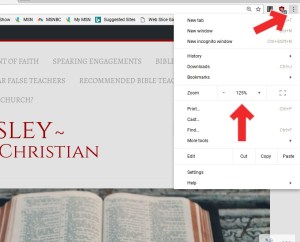
2. If worse comes to worst, you can highlight and copy the body of the article, paste it into your word processing program, and enlarge the font accordingly.


I have been leading a women’s small group at our church for a couple of years now. My husband and I have decided to leave the church because, even after confronting leadership about the direction the church is being led doctrinally, they continue to espouse unsound doctrine. What do you think is a wise way to tell the ladies I will no longer be teaching? Do I tell them we are leaving? If so, do I tell them why? What do you think you would do?

It’s hard to say exactly what I would do because every situation and every church is different. But I can tell you that the first thing I would do is talk it through with my husband and ask his advice. There have been many times when he has had very good ideas about how to address (or not address) certain issues, and he will sometimes bring out an aspect of the situation that I hadn’t thought of before. I would encourage you to do that first, and also to make sure you’re submitting to your husband in whatever ways might be applicable in this situation.

My inclination is to advise you to take the “the less said, the better” route with regard to the whole class. (There may be other venues, such as you and your husband meeting with the elder board, in which you’ll need to clearly spell out all the problems, but let’s just focus on the class right now.)

I would probably wait until the end of the very last class and say something generic, like, “I’ve really enjoyed leading this class, but I wanted to let you know I won’t be teaching any more. I encourage you to continue studying God’s Word and growing in Christ. Class dismissed.” Then, go home fairly quickly.

The next level is going to be women coming up to you individually and asking why you won’t be teaching any more. Unless she’s a very close friend, I’d still keep it pretty generic: “We love our brothers and sisters at this church, but we’re finding we disagree with some of the doctrine that’s being taught here, and we’ll be going to a new church.”

For very close friends, you might wish to disclose more about the doctrinal problems, but do so wisely, making sure your focus is on doctrine, not on personal conflicts with the pastor or others. You don’t want people jumping to the wrong conclusion about why you’re leaving.

I really would not talk to people about leaving other than discreetly informing those who need to know. If you give details or talk about it a lot there could be an ugly blow up, and most people will make wrong assumptions about why you’re leaving.


Do you have any information on the Orange Curriculum for children’s Sunday School?

The main thing I know about the Orange Curriculum (or Orange Strategy) is that it is put out by Andy Stanley’s “church”. That’s enough for me to warn people to stay far, far away from it. Andy Stanley is a Scripture-twisting false teacher. You don’t want your children being taught by him or his disciples.

My friend Amy Spreeman over at Berean Research was asked the same question by a reader. I refer you to her article, Parents: If your church is “Turning Orange…” for more details.


How would you respond to someone’s who says that [1 Timothy 2:12] was meant only for that time and culture?

It’s one of the most common arguments made by people who are looking for an acceptable way to rebel against God’s clear command, “I do not permit a woman to teach or to exercise authority over a man; rather, she is to remain quiet.” I have never had a woman who was humbly seeking to deny herself and obey Scripture make this argument, only those who stubbornly want to have their own way despite what the Bible says, yet simultaneously want to cloak themselves in the appearance of obeying Scripture.

God gave us His exact reasons for this command in verses 13 and 14 (almost as if He somehow knew this argument was coming!), and those reasons weren’t restricted to the women in the first century Ephesian church. The first reason was the Creative order – Adam was formed first, then Eve. The second reason is that Eve was deceived. Both of those reasons are universal (applying to all women and churches everywhere regardless of era or culture). It makes no sense that these two reasons related to Eve would apply only to first century Ephesus any more than it would make sense for them to apply only to tenth century Damascus or seventeenth century Paris.

Next, examine the context of 1 Timothy 2. There are all sorts of instructions to the church in that chapter. Was the instruction to pray for governmental leaders (1-2) limited to the first century Ephesian church? Were only the men of the first century Ephesian church to pray without quarreling (8)? Was modesty (9-10) only required of women in the first century Ephesian church? Then why pick out this one instruction in verse 12 and claim it was limited to that time and culture?

Finally, look at the overall general pattern of male headship and leadership in Scripture. First human created? A man. The Patriarchs? As the word implies – all men. Priests, Levites, Scribes? Men. Heads of the twelve tribes of Israel? Men. Major and minor prophets? Men. All kings of Israel and Judah? Men. Noahic, Abrahamic, Mosaic, and Davidic Covenants? All established between God and men. Authors of Scripture? Men. The forerunner of Christ? John the Baptist – a man. Messiah? A man. All of the apostles? Men. All of the pastors, elders, and deacons of churches in the New Testament? Men. Founder and head of the church? Christ – a man. Leader and head of the family? Men. Now which fits better with this pattern, women preaching to, teaching, and exercising authority over men in the church, or women not preaching to, teaching, and exercising authority over men in the church?

But the truth is, you can have all the biblical evidence in the world, and it’s not going to convince someone who’s in rebellion against Scripture because self is reigning on the throne of her heart. She’s not concerned with actually obeying God’s Word, she just wants to be able to claim that Scripture supports what she wants to do, either to look good to others or to attempt to drown out the Holy Spirit’s conviction of her sin.

Additional Resources:

Jill in the Pulpit 

Ten Things You Should Know About 1 Timothy 2:11-15 and the Relationship Between Men and Women in the Local Church at The Council on Biblical Manhood and Womanhood (CBMW) This is a refutation of the most common egalitarian arguments against the plain meaning of 1 Timothy 2:11-15.


If you have a question about: a Bible passage, an aspect of theology, a current issue in Christianity, or how to biblically handle a family, life, or church situation, comment below (I’ll hold all questions in queue {unpublished} for a future edition of The Mailbag) or send me an e-mail or private message. If your question is chosen for publication, your anonymity will be protected.

Discernment, False Doctrine

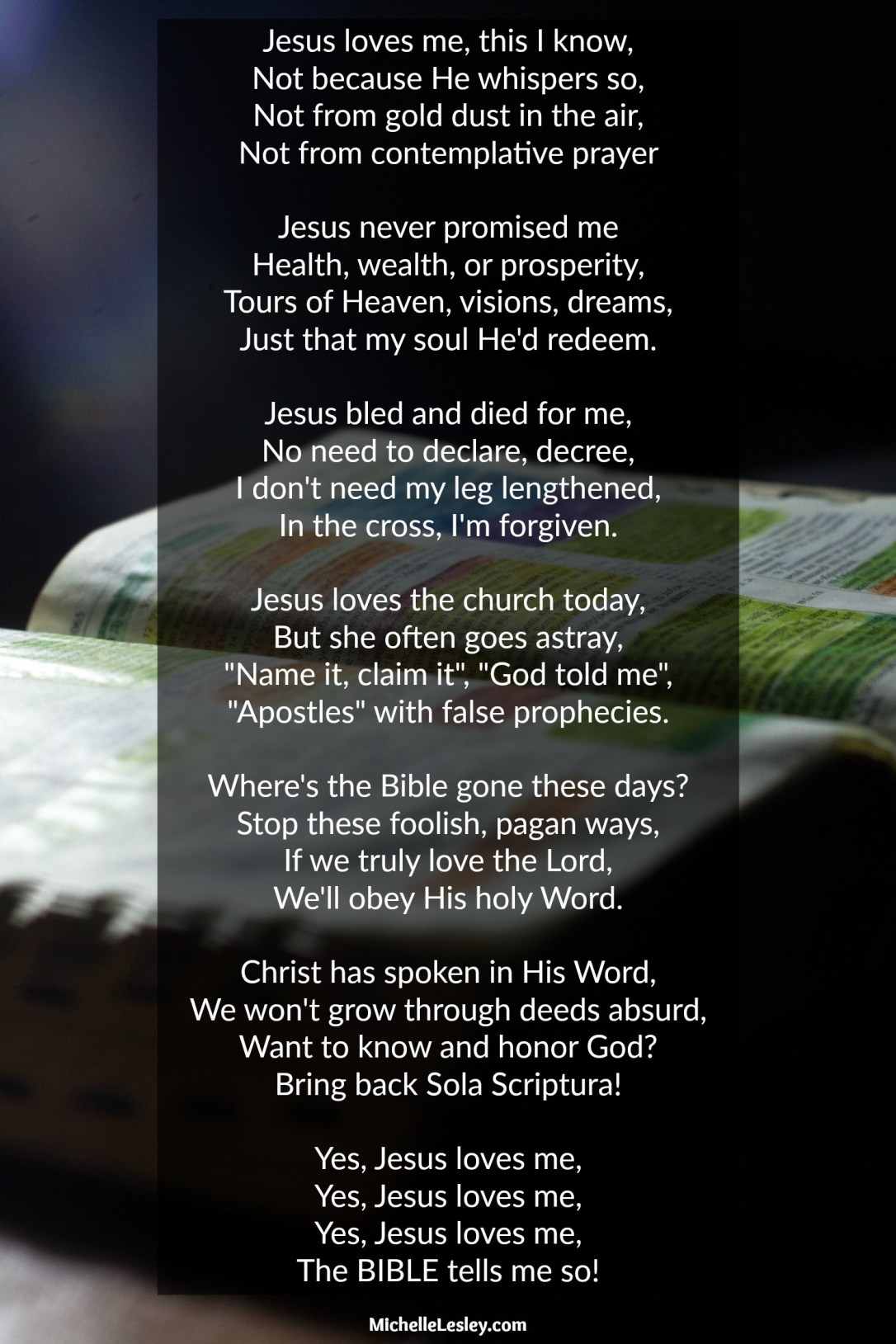
Jesus Loves Me: The “Contending for the Faith” Version

Every now and then I do a little creative writing. I posted this to Facebook on Sunday, and people seemed to like it, so I thought I’d share it here for those who aren’t on social media.

Mailbag

The Mailbag’s Top 5


While I’m out of town this week, let’s recap The Mailbag’s greatest hits. Here are the five most popular Mailbag articles:


Should Churches Use Praise Teams?

It’s a decision each individual pastor has to prayerfully make as he seeks to do what is
best, wisest, and most godly for his particular church.


What is Calvinism? Semi-Reformed?

It’s OK to hold those things in tension while we’re here on earth. We believe what Scripture says God does, but, where the Bible is silent as to how He does it, His reasons for doing it, etc.,
well, we trust God and believe Scripture there, too.


Should Christians Do Yoga?

The reason the question “Should Christians do yoga?” is even being asked is because there’s doubt in the minds of the Christians asking the question that yoga is kosher with God.
That’s a healthy doubt because yoga is a Hindu worship practice.


False Doctrine in Contemporary Christian Music

Are there any CCM groups, artists, or songs I should avoid?
Can you recommend any specific doctrinally sound artists or groups?


What is the New Apostolic Reformation?

Since there’s no official NAR creed or statement of faith, beliefs and practices can vary from church to church, but, loosely speaking, the NAR takes the Word of Faith (prosperity gospel) heresy and kicks it up a notch with outlandish “supernatural” manifestations, blasphemously attributed to the Holy Spirit.


If you have a question about: a Bible passage, an aspect of theology, a current issue in Christianity, or how to biblically handle a family, life, or church situation, comment below (I’ll hold all questions in queue {unpublished} for a future edition of The Mailbag) or send me an e-mail or private message. If your question is chosen for publication, your anonymity will be protected.

Discernment, Share Your Testimony

Testimony Tuesday: “God Used a Discernment Ministry in My Life”

Recently, there’s been a lot of pushback against online discernment ministries. There’s no question that some of them are vile and ungodly, and the perpetrators of these sites, in many cases, should face discipline from their home churches. But that doesn’t mean that all online ministries that do discernment work are bad or should be banished. I’d like to share with you the testimonies of some sisters
who have been helped by discernment ministries.


If it wasn’t for online discernment ministries I would still be a Beth Moore groupie, a tossed salad Christian who accepted everything and everyone that called themselves “Christian”.

I just want to say if it wasn’t for women who teach about discernment, I know I would be so lost believing false teachers because I did follow [a false teacher]. I’m so grateful I found out about this person and will not follow that person anymore. I thank you for your how you have helped me see the truth and set me free.

If it wasn’t for discernment ministries I would still be in the Assemblies of God church that has gone Emergent, and I wouldn’t have known about the New Apostolic Reformation movement that my Foursquare Church embraced in the 90’s and almost messed up my theology and eschatology. My spirit was bearing witness and I was alone…. [Discernment] ministries explained and named the names with real research and quotes and videos and the abundance of SCRIPTURE to help me “armor up”!!

For two years I adored Priscilla Shirer and felt like I got to know God better. My fire for His Word did come alive…but after seeing that she belongs to the false teachers “club”, and with your encouragement to just TAKE THE BIBLE AND STUDY IT – I AM doing it! My heart was sad and upset and frustrated that I might have been led astray from true Bible study principles for too long and too far, but this morning God led me to Philippians 1:18: “What then? Only that in every way, whether in pretense or in truth, Christ is proclaimed; and in this I rejoice. Yes, and I will rejoice,”. It removed my guilt and anger… I am thankful for the circumstances that He used to get my attention and get me back to His Word, and I am excited to do it the RIGHT way this time!

I just want to let you know that your site has been a tremendous blessing to me. I’ve been praying for a long time and my prayer has been, “Lord lead me and guide me into Your truth. Direct my path. I want Your truth. I want teachers and pastors who teach Your truth.”

For the last 10+ years, I was a regular attendee of [churches I now know were] Word of Faith/prosperity/positive speaking and thinking churches and I just couldn’t understand why I was continuing to die spiritually. I had faith. I tithed faithfully and I still couldn’t understand why I had no “real” visible victory in my life. Although I had seen, heard and experienced strange things, I remained because I did not want to church hop. But then things took a real dive and I could not remain any longer under those teachings.

I did several Google searches seeking biblically sound churches in my area; what and who false teachers are (I never expected to find lists naming people); biblically sound teachers/pastors, etc. Your website came up in the search along with a few others and a site for finding a biblically sound church. I am now at a church where expository teaching is done (first I knew anything about such; the pastor is a Master’s Seminary grad). I’ve watched many of Justin Peters’ and John MacArthur’s YouTube videos and from your site, I’ve discovered good women teachers to follow.

Step by step, I’m letting go of the false and wrong teachings and beliefs that were a part of my learning. I love how Justin Peters says (and I’m paraphrasing) “If you want to know God’s will, read the Bible. If you want to hear Him speak, read the Bible out loud.” WHAT??? That right there blew my mind in overdrive. You mean there’s no deep mystery, going deeper, secret prayer, speaking it into existence, secret handshake or sowing of seeds that I need to perform or do to know what God’s will is?

It’s really unlearning a lot of the wrong/false/bad teachings and learning God’s word for myself.


Ladies, God is still at work in the hearts and lives of His people, including yours! Would you like to share a testimony of how God saved you, how He has blessed you, convicted you, taught you something from His word, brought you out from under false doctrine, placed you in a good church or done something otherwise awesome in your life? Private/direct message me on social media, e-mail me (MichelleLesley1@yahoo.com), or comment below. Try to be brief (3-4 paragraphs or less) if possible. I’ll select a few to share on the blog another time. Let’s encourage one another with God’s work in our lives!

Christian women, Church, Discernment, Guest Posts

Guest Post: Building a Biblically Healthy Women’s Ministry (by a pastor, for pastors)

If your theology pretty much matches up with mine (as outlined in the “Welcome” and “Statement of Faith” tabs) and you’d like to contribute a guest post, drop me an e-mail at MichelleLesley1@yahoo.com,
and let’s chat about it.


Building a Biblically Healthy Women’s Ministry
(by a pastor, for pastors)

by Pastor John Chester

It is no secret that I am not a fan of discernment ministries, and that I think the concept of Biblical discernment is grossly misunderstood by many. But that in no way means that I don’t think telling truth from error and sound theology from errant (or even heretical) theology is unimportant.

And nowhere is it more important than in women’s ministry. The reason I say that is simple, more than 50% of the people in our churches are either women or they are growing into women. According to The Pew Research Center 55% of those attending Evangelical churches are women. 

Yet women’s ministry is often not thought of much by us pastors, I think because we view “women’s ministry” as a thing or program, rather than ministry to women who make up more than half of the congregation we are charged to shepherd. And so we spin it off to someone else or put it on our benign neglect list so that we can concentrate on “more important” things. But nothing is more important than the souls of the women of the church. And practically speaking, any error introduced in a women’s Bible study will work its way through whole families and infect the whole church.

With that in mind, let me offer some tips to guard against error in your church’s women’s ministry.

Preach The Bible

The pulpit sets the tone for the church and everything that the church does, or at least it should. The good news is that even the smallest church with the least talented preacher can have a strong pulpit, because the strength of the pulpit depends on what is preached, not the preacher. What the church needs is a healthy dose of Bible. And by a healthy dose, I mean all that should be preached is the Bible.

It is the Scripture that is inspired and the Word of God that is living and active, and it is the word of God that makes your pulpit strong, not your ability. No one needs your ten tips on having a more productive quiet time or your five steps toward a healthy marriage even if you sprinkle them with a few verses. The people the Lord has entrusted to you need to hear from Him, not you. Your job as a preacher is to decrease while the whole counsel of God is declared. By all means, illustrate, explain, introduce, conclude and apply the text, just stick to the text!

Why this is so important for women’s ministry and guarding the women of your church from error is that it will trickle down in to the church’s Bible studies. If on Sunday (and whenever else you preach) the women of the church get a strong dose of God’s truth, they are going to be better able to spot error and less susceptible to it. And when they see that you have a high view of Scripture, they will develop a high view of Scripture too. When they see you are a Berean who evaluates everything in light of what Scripture says, they will be more likely too as well.

And as a corollary, when you’re preaching the Bible, use it as an opportunity to teach the church, women included, how to think about and interpret the Bible. I’m not saying that the pulpit is a place for a discourse on the grammatico-historic hermeneutic, but it is a place to (often) say things like “this would have meant to the original readers” or “context determines meaning” or “Whenever you see a ‘therefore,’ ask yourself, ‘What is the ‘therefore’ there for?’.” These may be throwaway phrases to you, but they teach the congregation, including the women, how to approach Scripture.

Pay Attention

This seems very basic but it needs to be said, you need to know what is going on, what is being taught and what materials are being used. And you need to read any material being used in any class or study. Read, not skim, not look up on the internet, not ask your seminary alumni group on Facebook, but actually read. Need I remind you that you will give an account for how you cared for the souls the Lord entrusts to you? When you stand before God to give an account, “Well, I Googled it,” is not going to be good enough.

You need to pay attention to what is popular in the world of women’s ministry too. The women in your church buy and read more books than the men. Pay attention to what is out there, and don’t be afraid to address any errors that are gaining traction in churchianity”.

Be The Bad Guy

What I mean by that is be willing to be the one to take the heat. Be willing to veto a book, a curriculum, or even a topic that the women’s Bible study wants to use, and be willing to have the leader lay the blame for the veto on you. I would much rather have someone say to me, “We wanted to use ________ book. Why did you say to use ________ instead?” than have a bad book used, or quash the joy of the women’s Bible study leader if she became an object of scorn. And quite frankly (and this actually happened to me) I would rather have the women’s Bible study leader mad at me, than to have the women be taught something that is wrong.

Invest In Your Leaders

I am genuinely baffled by the lack of investment in women’s leaders. We pastors will often go out of our way to invest both time and treasure in a young man we think might one day have a significant ministry in our church (or dare we hope and pray) or even go into pastoral ministry themselves.. But we often fail to invest our time and treasure in women who have a significant ministry in our churches right now. Might I suggest that the bare minimum you should do for every Bible study leader (man or woman) is to provide basic instruction in hermeneutics. A great resource is Grasping God’s Word by Scott Duvall and Daniel Hays, and there is an excellent companion workbook that makes teaching basic hermeneutics a snap. I promise you that if you teach the teachers of the women in your church how to approach Scripture, it will rub off.

Invest time and invest treasure too. Provide at your (or the church’s) expense good reliable resources for deeper study to leaders of your church’s women’s Bible study. If the women are going through a book of the Bible (with an approved curriculum as the guide) provide reliable (and accessible) commentaries on that book. If the women’s Bible study is topical or using a topical book as a guide, provide some other good books for deeper study and reading. 

Be Approachable

The women of your church need to feel comfortable sending you an email, shooting you a text or even Facebook messaging you with a question. They should even feel OK picking up the phone and calling you if need be. I get the wisdom in erecting hedges and being careful how you interact with women. But you can’t shepherd effectively if you treat over half of your congregation as walking third rails. Rest assured the women of the church will pick up on your reluctance to interact with them and they will be reluctant to approach you with any questions, doctrinal or otherwise.

If you are married, this is one area where your wife can really help you. Her saying “you should ask my husband” will go a long way. And as a corollary one of the worst things that can come out of your mouth when a woman from your church asks you a theological question is “you should ask my wife.”

If you are like me you will have to work at this. The one thing I can say that always gets a laugh from my wife is, “I’m a people person.” It’s not that I don’t love people, it’s that I tend toward shyness, and I’m not super outgoing. So I work at being an accessible resource for the women of the church, and you can too. And who knows, you may one day be rewarded with a call where a newer believer asks “Is it true that the Israelites ate the scapegoat?”. (That is a real question I got from a real woman in the church and why it is so important that women feel like they can pick up the phone and call you.)

Write

Your pulpit ministry and other teaching at the church is not enough. You need need to be regularly writing. As Al Mohler observed, “Leadership is about communication, and much of that communication is necessarily written…leaders must learn to write and to set time aside for writing.

But you say you don’t have time. Mohler, one of the busiest men on the planet offers this helpful bit of advice, “You do what you have to do.” I contribute to a group blog with other pastors and a couple of former seminary professors. We all write with an audience in mind – our own church. Why? For two reasons, it builds a resource library that they can access, and it allows us to address issues that we may not get to address in a systematic fashion from the pulpit. I’ve covered topics like the various approaches to apologetics, what goes into a worldview, basic pneumatology, basic anthropology, how to bring Scripture to bear on anxiety, the sanctifying power of suffering, and much more. And yes I have written some things that would fall into the broad category of discernment, like why our church isn’t charismatic, the danger of letting a prolife social gospel supplant the biblical gospel and the respect for life that flows from it, why assisted suicide is unbiblical and even why events like Together 2016 (which for the record took place in our proverbial back yard) should be avoided. I write because I want to educate the church, especially the women of the church, who as a rule read more, about these issues.

Be willing to Sacrifice

Whatever cherished activity or ministry is keeping you from being all in on your church’s ministry to the women of the church, give it up! Let me give you an example. I love our men’s Bible study, so much so that I had the next three topics for the study preplanned. But currently there is no overlap in our church between the women qualified to lead a women’s Bible study and the women with the desire and time to do so. So the Wednesday night Men’s Bible study I have taught since the church opened has been tabled and replaced with a coed midweek Bible study. Sure, I had planned on going through the topics covered in Men Counseling Men edited by John Street, but instead I am teaching an Old Testament survey course geared to Christians of both genders. Truth be told I’d rather be with the guys, but that is not the best thing for the church, and as pastors we should lead in counting others (including the women of the church) as more significant than ourselves.

I could go on and on, but I’ll close with this; it breaks my heart that Michelle asked me to write this guest post. When she asked me to write this post she said that multiple women had contacted her and asked if there was anything about how important it is to help church ladies tell truth from error that they could print out and give to their pastors. For shame! No one should be more concerned with the spiritual well being and growth of the women in the church than their pastors. That in some places and in some cases that is not true is a blight on our brotherhood. This is a profound failure to fulfill the charge of 1 Peter 5:1-4, and there is no excuse for it. As the Apostle said:

So I exhort the elders among you, as a fellow elder and a witness of the sufferings of Christ, as well as a partaker in the glory that is going to be revealed: shepherd the flock of God that is among you, exercising oversight, not under compulsion, but willingly, as God would have you; not for shameful gain, but eagerly; not domineering over those in your charge, but being examples to the flock. And when the chief Shepherd appears, you will receive the unfading crown of glory.


John Chester is the pastor of Piedmont Bible Church, a Grace Advance church plant in Haymarket, Virginia. Prior to ministry John worked as a lacrosse coach, a pizza maker, a writer, a marketing executive, and just about everything in between. He hails from The City of Champions: Pittsburgh, Pennsylvania, and is blessed to be married to his wife Cassandra. Read John’s blog articles at ParkingSpace23.


Note from Michelle: I first had the pleasure of “meeting” John when I read and responded to this excellent article of his on ParkingSpace23. While he and I have a couple of differences on discernment ministry, I think the world of him as a brother in Christ, pastor, and fellow blogger. I literally teared up when I first read this guest post, because I wish every church could have a pastor like John.


ALTHOUGH I DO MY BEST TO THOROUGHLY VET THE THEOLOGY OF THE BLOGGERS WHO SUBMIT GUEST POSTS, IT IS ALWAYS POSSIBLE FOR THINGS TO SLIP THROUGH THE CRACKS. PLEASE MAKE SURE ANY BLOGGER YOU FOLLOW, INCLUDING ME, RIGHTLY AND FAITHFULLY HANDLES GOD’S WORD AND HOLDS TO SOUND BIBLICAL DOCTRINE.