Discernment, Sermons

Why Your Church Should Stop Playing Bethel, Hillsong, Elevation, and Jesus Culture

If you prefer listening to reading, check out our A Word Fitly Spoken podcast episode, Discord: Why Your Church Should Reject Bethel Hillsong and Elevation Music, based on this article.


While this article deals primarily with Bethel, Hillsong, Elevation, and Jesus Culture, they are by no means the only heretical music sources to be avoided. Phil Wickham, for example, is just as prolific as these groups and his music is used by just as many churches. With his strong ties to Bethel, he should be included under the umbrella of Bethel as you consider the remainder of this article. There are numerous other unbiblical musicians who should be avoided for these same (and other) reasons. You can find a sampling of them in my article The Mailbag: False Doctrine in Contemporary Christian Music.


Justin Peters and Todd Friel discuss the theological problems with Bethel, Jesus Culture, Hillsong, and Elevation music and why your church shouldn’t use their music in this video interview: Why Your Church Shouldn’t Play Bethel and Hillsong Music.

Is it wrong to sing songs from Bethel if they are theologically correct? In this episode of Redeeming Truth, Pastors Costi Hinn, Dale Thackrah, and Kyle Swanson provide insight into the dangers of supporting ministries like Bethel [and Hillsong, Jesus Culture and Elevation Music], that have a false understanding of who Christ is.

If you are looking for theologically accurate worship music to listen to or sing in your church, they have put together a Spotify worship playlist that you can listen to. Costi has also written an excellent companion article on his blog: Should Your Church Sing Jesus Culture & Bethel Music?

Excerpted from my article The Mailbag: False Doctrine in Contemporary Christian Music

“Itโ€™s imperative for churches to be discerning about the CCM they use in worship. If Jane Churchmember hears a CCM song in church and likes it, sheโ€™s likely to Google the song (probably right there in church- Iโ€™ve done it!), find out who sings it, and begin following that artist. Worship pastors who use CCM have a responsibility to vet the artists who perform the songs they select for the worship service to make sure theyโ€™re not sending Jane into the arms of a heretic. Additionally, music costs money, and you donโ€™t want your churchโ€™s offerings supporting false doctrine.

Now, every time I address the subject of being discerning about worship music and that churches should not use worship music from heretical sources (such as Bethel, Hillsong, and Elevation) someone whoโ€™s defending using music from these heretical sources [will say]:

Well, [insert name of hymn writer here] wrote lots of perfectly biblical hymns, but he had some theological problems too, and youโ€™re not recommending we get rid of all of his hymns.

Well, first of all, maybe we should more closely examine the theology of some of our most prolific hymnists and stop using their music because of what they believed. Quick โ€“ off the top of your head, name the three we should start withโ€ฆ

โ€ฆAnd thatโ€™s what separates the errant hymnist from Bethel, et al. Most Christians, even those who prefer hymns over CCM, could probably not name three people who wrote hymns, let alone tell you anything about their theology. But if you ask the average Christian to name three top Christian artists, she could rattle them off in a second.

Most hymn writers have been dead for up to hundreds of years. They donโ€™t have Facebook pages you can follow, nobodyโ€™s playing their stuff on KLOVE, theyโ€™re not on tour to promote their latest album, they donโ€™t have thousands of followers worldwide, and their music is in the public domain, so your church isnโ€™t financially supporting them or their work. If you wanted to follow their errant theology, youโ€™d have to hit the books to research and study it. Contemporary musiciansโ€™ theology is only a click away on YouTube, social media, live streamed concerts and conferences, and on their web sites. Nobody is following dead hymnistsโ€™ false doctrine, but hordes are following contemporary musiciansโ€™ heresy.”


Excerpted from my articles on Bethel, Hillsong, and Elevation:

If you came here looking for a critique of individual [Bethel, Hillsong, or Elevation] songs, thatโ€™s not really what this is about. Everything connected to [these “pastors”] โ€“ [the “churches,” the music companies] (as entities and all individual songs), all [“church” and music] personnel, materials, programs, and events โ€“ are all fruit of the poisonous tree [of the false teacher who heads everything up]. No, you cannot biblically pick and choose songs from [any of these organizations] that donโ€™t seem to overtly violate Scripture. The Bible never tells us to โ€œchew up the meat and spit out the bones.โ€ It says:

I appeal to you, brothers, to watch out for those who cause divisions and create obstacles contrary to the doctrine that you have been taught; avoid them. For such persons do not serve our Lord Christ, but their own appetites, and by smooth talk and flattery they deceive the hearts of the naive. Romans 16:17-18

โ€œWatch outโ€ for false teachers. โ€œAvoid them.โ€ That includes everything about them: all their materials, books, events, music, social media, etc. Would the God who breathed out these words of Scripture be pleased if we ourselves, or our churches, use materials by people who โ€œdo not serve our Lord Christโ€?

Excerpted from my article The Mailbag: Potpourri (…Solid churches with heretical music…)

“We have been searching for a doctrinally sound church in the area we moved to, and unfortunately it has not been easy! The few that we have found still use Hillsong, Bethel or Elevation music. I usually cross a church off the list quickly if they sing from those artists. But like I said, now I am finding even doctrinally sound churches are throwing some of those songs in. Do you have any insight to this dilemma?”

for pastors and ministers of music: This is yet one more reason it is detrimental to your church to use music from Bethel, Jesus Culture, Hillsong, Elevation, any musician connected these groups (such as Phil Wickham, who’s very prolific and has strong ties to Bethel), or any other musician who isnโ€™t doctrinally sound (after you have thoroughly vetted him/her/them.) regardless of how biblical the lyrics of any particular song of theirs that youโ€™re using might be. You could potentially be turning away solid, mature, discerning Believers who might otherwise be interested in joining your church. The woman who sent in this question is not the first to ask me something like this โ€“ not by a long shot. This issue is increasingly of concern to Christians looking for a solid church. (For that reason, I do not list churches – even Reformed or seemingly otherwise doctrinally sound churches – on my Reader Recommended Churches list who use music from heretical sources like these.)

When a visitor walks into your sanctuary for the first time, your worship service is the โ€œfaceโ€ of your church to her. What kind of a first impression are you making? When you use music by doctrinally unsound musicians, it does not say, โ€œWeโ€™re really a doctrinally sound church โ€“ honest! We only use songs from these groups whose lyrics are biblical.โ€. It says, โ€œThis church has leaders who arenโ€™t discerning,โ€ or โ€œIf this church uses music by these heretical groups, what other doctrinal problems does it have?โ€. Why put that stumbling block out there when there is plenty of music available with biblical lyrics written/performed by doctrinally sound musicians?

And there’s another stumbling block that using this type of music puts in front of weaker brothers and sisters that you may not have realized. I have heard from a number of Christians whom God graciously saved and rescued out of the pit of “churches” similar to Bethel, Hillsong, and Elevation. They tell me that when they walk into what they think is a doctrinally sound church and hear music from these and other heretical sources, it triggers a form of spiritual PTSD. It’s traumatizing to them. They immediately become fearful that your church is mere steps from turning into one of these types of “churches.” Will they grow out of that reflexive reaction? Yes, some day, as God continues to sanctify them. In the meantime, do you want the music at your church to cause them unnecessary anxiety? I hope not.

Even for Christians who have not come out of “churches” like these but are knowledgeable about their heretical theology, using these songs in your worship service is putting a stumbling block in front of them, too. Take me, for example. I’ve studied these groups. I’ve seen their heresy and the damage they do to both the Kingdom and to the individuals who follow them. And because of that, I’ve zealously spoken out against them. If I visit your church and an Elevation song suddenly flashes up on the screen, my ability to worship is completely derailed in grief that your church would use a song from that source – especially if you know about their theology and are well acquainted with music from doctrinally sound sources that you could have used instead. I cannot sin against my conscience by singing those songs. Consider me a “weaker brother” if you like, but do you care more about me as your sister in Christ, or your “right” to use music from these sources? What about Paul’s posture in 1 Corinthians 8:9-13?

But take care that this right of yours does not somehow become a stumbling block to the weak. For if anyone sees you who have knowledge eating in an idol’s temple, will he not be encouraged, if his conscience is weak, to eat food offered to idols? And so by your knowledge this weak person is destroyed, the brother for whom Christ died. Thus, sinning against your brothers and wounding their conscience when it is weak, you sin against Christ. Therefore, if food makes my brother stumble, I will never eat meat, lest I make my brother stumble.

If this was true in Paul’s personal life, shouldn’t it surely be true of our worship services? If you wouldn’t put a Christmas tree or portrayals of Jesus in your sanctuary because it might offend a brother in Christ, why would you use worship music that causes offense to your brothers and sisters?

Finally, what is the proactively good reason for intentionally choosing music from a heretical source? In other words, when you’re selecting music for the worship service, why would you choose, say, a Hillsong song about God’s glory, or Psalm 23, or the crucifixion, when you could just as easily choose a song from a doctrinally sound source about any of those things – a source that isn’t a stumbling block to anyone, won’t give anyone the wrong impression about your church, won’t lead anyone to follow a heretical “church,” and won’t use your church’s offerings to support a heretical “church”? What makes the Hillsong song you’re choosing better than the song from the doctrinally sound source? It doesn’t seem to me that there’s a good enough reason to use songs from these sources that outweighs all the good, biblical reasons not to use them.
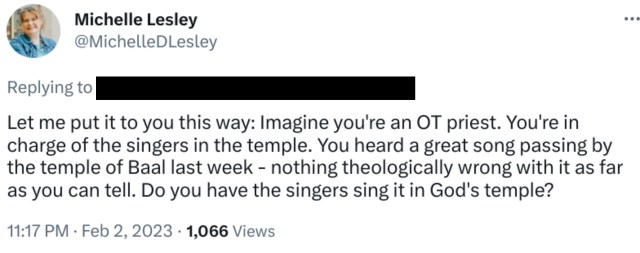
There is simply no good reason for a doctrinally sound church to use music from heretical sources like these.

There is simply no good reason for a doctrinally sound church to use music from heretical sources like Bethel, Jesus Culture, Hillsong, and Elevation.


Additional Resources

Stop Singing Hillsong, Bethel, Jesus Culture, and Elevation by Scott Aniol

The Mailbag: โ€œI Speak Jesus,โ€ Charity Gayle, and How to Vet Christian Music

Why I Donโ€™t Sing the Songs of Hillsong and Jesus Culture by Dan Cogan

Why Fundamental Baptist Churches Must Avoid Bethel Music by Spencer Smith

Bethel Church (Redding, CA)/Bethel Music/Jesus Culture

Hillsong/Brian & Bobbie Houston

Elevation/Elevation Music

The Mailbag: What Is the New Apostolic Reformation?

The Mailbag: Should Christians Listen to Reckless Love?

God’s Not Like, “Whatever, Dude,” About How He’s Approached in Worship

The Mailbag: False Doctrine in Contemporary Christian Music

Hillsong’s Theology of Music and Worship

Let’s Talk About the Worship Music at the [Charlie Kirk] Memorial Service… with Dawn Hill

Mailbag, Social Media

The Mailbag: Contending for the Faith on Social Media

Originally published December 5, 2016

mailbag


I was wondering what your opinion is about using Facebook to correct false doctrine. Mostly what I do is post Scriptures, but every once in a while I may comment on something that is blatantly contrary to the Bible and I try to point to the appropriate Scriptures to show the truth. This mostly happens when a popular preacher or teacher that does not hold to sound doctrine posts something, or when a friend posts something that is clearly unbiblical.

This is such a great question that so many of us (including me!) struggle with. We love our friends and don’t want to see them believing something unbiblical (and spreading it around on social media) and it’s hard to just scroll past the blasphemy false teachers so often post without taking a stand for God’s word.

I readily admit I don’t have a perfect answer for this question. On the one hand, you want to protect your friends from error. On the other hand, there aren’t enough hours in the day to correct every single false teaching out there. And, if you try, people stop listening and you become ignorable background noise. Here are some of the principles I personally try to operate from on my personal (personal friends and family) social media pages. (I try to be consistent, but it doesn’t always work out that way):

  • Do keep in mind that – if it’s a matter of someone simply following a false teacher/ministry, not re-posting – people don’t always follow these accounts because they agree with them. Sometimes it’s to keep an eye on what the false teacher is teaching, to find out more about her doctrine because her materials are being introduced at church, etc. I follow two or three accounts on Twitter for reasons like that.
  • By and large, I don’t follow false teachers/ministries on social media. It just raises my blood pressure too much. So, for the most part, I don’t comment directly on false teachers’ posts because I don’t see them in my feed. If you do decide to comment, be sure you provide ample, in context Scripture passages to support what you’re saying, and comment in a patient, kind tone, not with histrionics, keeping in mind that most of the people who follow that false teacher are baby Christians, Christians who simply aren’t aware they’re being fed false doctrine, or false converts. Be aware that you’re almost certainly not going to change anyone’s mind, that people will verbally eviscerate you, and that the admin of the page will probably block and/or report you.
  • My main way of sharing biblical truth and discernment is to post about it on my own timeline. That way, the information is out there, yet direct confrontation is avoided.
  • When it comes to posting things on your own news feed, make sure you’re posting about good resources and teachers as well as warning about the bad. It’s not enough to get people away from bad teaching. They need somewhere to go for good teaching.
  • I have something of a “Golden Rule” policy about commenting on other people’s posts. I’ve had people comment on my discernment-type posts rebuking me and arguing with me for posting such things, as though they have some sort of right to dictate what I can and can’t post on my own page. That’s not right. People have the right to post what they want to post on their own page, and, while I’m not always perfect at it, I try to remember to respect that fact with others as I would want them to respect it with me. If what the person has posted concerns me for her soul, I will send her a private message. I operate on the assumption that people who claim to be Christians would want to know they’re posting something that’s in conflict with God’s word.
  • If someone’s post or comment makes me biblically angry, I try to remember to wait 24 hours before responding. I’ve found that helps me to calm down and respond more patiently and kindly. I’ve also found that sometimes my anger clouds my understanding of what the person actually meant. I have greater clarity the next day and can respond (or even refrain from responding) more appropriately.
  • There are two passages of Scripture I try to keep in mind when responding to people on social media about false teaching. The first is 2 Timothy 2:24-26. It reminds me of where that person might be coming from and how I am to comport myself:

And the Lord’s servant must not be quarrelsome but kind to everyone, able to teach, patiently enduring evil, correcting his opponents with gentleness. God may perhaps grant them repentance leading to a knowledge of the truth, and they may come to their senses and escape from the snare of the devil, after being captured by him to do his will.

The second is Matthew 7:6:

Do not give dogs what is holy, and do not throw your pearls before pigs, lest they trample them underfoot and turn to attack you.

The Bible is the final word of the holy God of the universe. What He says, goes, whether people believe it or not. It is stake in the ground, unalterable truth that needs no defense from us to pigs and dogs (not that everyone who posts false doctrine is a pig or dog- sometimes they’re just unaware). Sometimes the best response you can give on social media is to patiently lay down simple biblical truth in one comment and walk away, refusing to engage in debate, and trusting God to work on people’s hearts through His word.

  • Above all, pray. Pray for the false teacher/ministry you’re concerned about. Pray for the friend or loved one who’s re-posting false doctrine, that God will open her eyes to the truth. Pray about whether you should approach someone on social media, in which venue (comment, private message, etc.), and for wisdom to use the right words, tone, and Scriptures.

If you have a question about:ย a well known Christian author/leader, a Bible passage, an aspect of theology, a current issue in Christianity, or how to biblically handle a family, life, or church situation, comment below (Iโ€™ll hold all questions in queue {unpublished} for a future edition of The Mailbag) or send me an e-mail or private message. If your question is chosen for publication, your anonymity will be protected.

Discernment

Discernment IS Love

I’m often accused of being “unloving” for writing in a direct or firm tone against false doctrine and other unbiblical issues in the church.

I received another such accusation recently on one of my older articles, “Nine Reasons Discerning Women Are Leaving Your Church“. I thought I’d share my response to the reader with you, because it seems there’s a misunderstanding among Christian women as to the biblical definition of love. It ain’t always “sugar and spice and everything nice” y’all…

“I donโ€™t think you have a complete understanding of the biblical definition of love. You seem to think that โ€œloveโ€ is restricted to always being sweet and nice to people. Thatโ€™s not biblical.

–Was Jesus being unloving when He cleared the temple? (Matthew 21)
–Was Jesus being unloving when He rebuked the Pharisees? (Matthew 23)
–Was Jesus being unloving when He instructed us to disfellowship unrepentant sinners from the church? (Matthew 18:15-20)
–Was Paul being unloving when he turned Hymenaeus and Alexander over to Satan so they would learn not to blaspheme? (1 Timothy 1:19-20)
–Was Paul being unloving when he anathematized anyone who preaches a false gospel? (Galatians 1:6-9)
–Was Peter being unloving when he described false teachers in 2 Peter 2?
–Was Jude being unloving when he wrote to the brothers warning them about the evils of false teachers instead of writing about the gospel?

Am I being unloving in writing this article? No. Reproof, rebuke, and biblical instruction are all part of godly love. I am demonstrating love for Christ, His Bride, and His Word by pointing out biblical error that needs to be corrected. I am demonstrating love for ignorant pastors and churches by explaining to them why their most spiritually healthy members are leaving. I am demonstrating love for the thousands of doctrinally sound Christians out there who long to attend a healthy church and canโ€™t find one because so many churches are in error in the areas I mentioned. And, I am demonstrating love for you by helping you understand what Godโ€™s definition of love is.

Is this article loving? You bet it is.”

Additional Resources:

I Canโ€™t Sit Down, Shut Up, and Play Nice

Discernment: Whatโ€™s Love Got to Do with It?

Movies

Movie Tuesday: By What Standard?

…it seems like evangelicals, including Southern Baptists, are in danger of loosening their commitments to…basic, Christian commitments. Dangerous ideologies like Critical Theory and Intersectionality are gaining inroads into the thinking of some leaders, churches and organizations.

These ideologies are even being promoted among some evangelicals as reliable analytical tools that can assist our understandings and efforts in gospel ministry.

The result is that, in the name of social justice, many unbiblical agendas are being advanced under the guise of honoring and protecting women, promoting racial reconciliation, and showing love and compassion to people experiencing sexual dysphoria.

By What Standard? Godโ€™s World, Godโ€™s Rules is a documentary that presses those questions by showing how godless ideologies are influencing evangelical thought and life.

If you’re a Southern Baptist – especially if you don’t know what’s going on in your denomination outside the four walls of your own church – you desperately need to watch this documentary.

Because our local churches are autonomous, many Southern Baptists think, “It doesn’t really matter what’s going on at the national level of the SBC as long as my church is doing well.” When you watch, you’ll see why that’s such a dangerous attitude to take. The insidious and sinful concepts of critical race theory, intersectionality, egalitarianism, and other false doctrines have made their way into our SBC seminaries,ย  where your next pastor is currently being trained, into LifeWay, where your next Sunday school, women’s Bible study, or VBS curriculum is coming from, and into the national leadership of the SBC, which represents us and our denomination to the world.

But even if you’re not Southern Baptist, these concepts are almost certainly slithering in to your denomination or church as well.

Be ready by informing yourself.

Click here to watch By What Standard?.

Abuse, Suffering

From Victimhood to Victory: Biblically Helping Abused Women Heal

Ever since the Me Too movement exploded on social media a couple of years ago, weโ€™ve been hearing more and more heartbreaking stories of women who have experienced physical and sexual abuse. If anyone can help and should be helping victims of abuse, it ought to be the church. But, unfortunately, it seems that the people in the evangelical spotlight who are stepping up to advocate for victims are often popular false teachers.

In 2019, we saw Beth Moore take the lead at the Caring Well conference, which centered around helping abuse victims. Christine Caine is the founder and leader of A 21, an anti-human trafficking ministry. In 2018, Lisa Harper was the keynote speaker at the Pastorsโ€™ Wives Conference at the annual Southern Baptist Convention where she addressed the issue of abuse. And in addition to stepping out into the spotlight as champions for abuse victims, Beth Moore, Christine Caine, and Lisa Harper, as well as Joyce Meyer, Paula White, Lysa TerKeurst, Jackie Hill Perry – and many more, Iโ€™m sure – share their own personal stories of abuse at their conferences, in their books, and so on.

These are the people being showcased to the average Jane in the pew as those who care about abuse victims. These are the people who are actually (supposedly) doing something about abuse. By and large, we’re not seeing doctrinally sound men and women being put forth on the stage of the visible church as caring about abuse victims or doing anything about abuse.

And so, when an Evangelical woman is coming to terms with her abuse, these are the women she’s seeing, so these are the women and their resources that she reaches out for. And by the same token, because these false teachers are in the spotlight and have name recognition and resources available, and there aren’t very many well known doctrinally sound resources available, churches who want to help abuse victims are also reaching out and grabbing hold of false teaching to try to help the women in their churches.

So what we’re finding is that women who are victims of abuse are especially vulnerable to false teaching because they see these teachers as someone who has gone through the same thing they’ve gone through: โ€œThis teacher knows how I feel. She has experienced the same thing.โ€ And that’s the primary reason victims seek out these false teachers, rather than seeking out someone who – regardless of whether or not he or she has experienced abuse – can help them to heal with rightly handled Scripture.

This is one reason I am purposelyย not disclosing in this article whether or not I have ever been abused. Because biblical healing from abuse isn’t about me or my personal experiences. It’s about what the Bible says. My experiences don’t change what God’s Word says. The Bible remains the same whether I’ve been abused or not. Scripture is our standard, not our personal experiences.

But, unfortunately in the church, and particularly in the realm of women’s Bible study, we have indoctrinated women with the idea that personal experience reigns, not Scripture. So what abused women get when they seek out these false teachers for help dealing with their abuse is exactly what I’ve said before is the problem with womenโ€™s Bible study in general: narcissism.

These victims of abuse don’t get taught how to biblically come to terms with what happened to them and how to biblically heal from it. They get a cheap, shallow compassion that teaches them to focus on their own pain and feelings, and to harbor bitterness against their abuser and everyone and everything else they can assign blame to for the abuse (some of those things supposedly being biblical complementarianism, sexism in the church, misogyny in the church, not enough women in positions of leadership in the church, as Beth Moore said at the Caring Well conference, etc.)

These women are being victimized twice.

And so these women are being victimized twice – once by the abuser, and once by false teachers who are not only not helping them to heal biblically, but are actually eroding biblical teaching and sound doctrine – for that woman personally and in the church in general – by saying that biblical precepts, such as leadership of the church being restricted to men, are at fault for their abuse. Itโ€™s really insidious, because whatโ€™s implied by this whole paradigm is that this mixture of focusing on your feelings and believing unbiblical teaching is the quick fix that will make them feel better right away. This is what will finally bring them healing and wholeness. They’re being sold a lie.

Praise be to God, there are lots of doctrinally sound Christians out there who are quietly, out of the spotlight, helping victims of abuse in a biblical way, one on one, in their own local churches. So, how are they doing it, and how should we be doing it? What are some biblical ways we can help abuse victims?

Genuine Compassion

Abuse is a horrible, despicable thing that no one should ever have to suffer. The pain that it causes doesn’t just magically disappear because it happened years ago. It is not something about which any woman should ever be told, โ€œYou just need to get over it and forget about it.โ€

And certainly no woman should ever be made to feel that it was her fault, or that if she had just done something differently it wouldn’t have happened. The sin of abuse lies with the abuser, not the victim.

The sin of abuse lies with the abuser, not the victim.

So when we disciple a woman who is just beginning the journey of healing from her abuse, it should be handled with biblical compassion every step of the way. It’s important, especially in the beginning, to do what Romans 12:15 says, and โ€œweep with those who weepโ€.

Let her pour out her feelings of pain and anger, and sit there in that with her.

Yes, that was awful.

No, you didnโ€™t do anything to cause it. It wasnโ€™t your fault.

That man was evil and took advantage of you. It was his sin, not yours.

We need to have that same heart for her that God has in Psalm 147:3: โ€œHe heals the brokenhearted and binds up their wounds.โ€

A Biblical Perspective of Suffering

It’s imperative that we have a biblical perspective of suffering so we can teach it to abuse victims. Because one of the things you’ll notice about the way false teachers approach the issue of abuse is that this component is completely missing. Why? Because walking through suffering in a biblical way can be hard and scary and painful and messy. It’s much easier to just smile and exude sympathy and say, โ€œJust listen to me and I’ll tell you how to feel better right now.โ€

And if we’re honest with ourselves, that’s what we all want, isn’t it? Our flesh doesnโ€™t want to suffer, we just want to feel better now. And that’s what makes this a hard sell that false teachers don’t want to deal with. It doesnโ€™t fit in with their ear-tickling paradigm. But if we want to offer victims true help and true healing in Christ, we have to address the issue of suffering, and address it biblically and correctly.

A biblical theology of suffering applied to the issue of abuse understands that…

Everyone suffers. You’re not the first person to suffer, and you won’t be the last. 1 Peter 4:12 says, โ€œBeloved, do not be surprised at the fiery trial when it comes upon you to test you, as though something strange were happening to you.โ€ When it comes to suffering, youโ€™re not special, and neither am I. We donโ€™t all suffer in the same way, but everybody suffers. It’s just the human condition resulting from the Fall.

Even Jesus suffered. Isaiah 53 tells us: โ€œHe was despised and rejected by men, a man of sorrows and acquainted with grief; He was oppressed, and he was afflicted,โ€

Abuse is not a special class of suffering that exempts you from dealing with it in obedience to Scripture. Weโ€™re kind of seeing this line of thinking with homosexuality- that it’s a special class of sin that people don’t have to repent of. That homosexuals can hold onto their sin, cherish it in their hearts, and maybe even live it out, and still supposedly be biblical Christians.

And thatโ€™s the same sort of mindset a lot of the false teachers espouse: Abuse is a special class of suffering that you don’t have to walk through in a biblical way. You get to wallow in your victimhood for the rest of your life and think and act and feel and express yourself however you want to because you’ve been hurt so deeply. That’s not right. Perpetual victimhood is not biblical, it doesn’t help you heal, and it doesn’t bring your abuser to justice. It makes God look impotent and uncaring. If He can’t or won’t transform someone from victimhood to victory, how could He have the power to raise Christ from the dead? If He doesn’t care about a victim of abuse, why would He care about anybody else’s problems?

I would never minimize the pain and suffering of abuse victims, but all Believers are required by Scripture to act in a godly way regardless of their particular kind of suffering. Believers who have terminal diseases have to deal with that in a godly way. Believers who have lost a child have to deal with that in a godly way. Believers whose spouses have cheated on them have to deal with that in a godly way. Believers who are being tortured and persecuted just for being Christians have to deal with that in a godly way. We all have to bear up and respond to suffering in a godly way, regardless of what kind of suffering weโ€™re dealing with.

1 Peter 4:19: โ€œTherefore let those who suffer according to God’s will entrust their souls to a faithful Creator while doing good.โ€

Jesus understands your pain and serves as your perfect example for responding to suffering. Go back and read Isaiah 53. Go back and read the gospel accounts of Jesusโ€™ trials, flogging, and crucifixion. He knows what it feels like to be abused. And look at the way he handled it. He didn’t give up. He didn’t feel sorry for himself or lash out at his abusers or become bitter. He didn’t blame God or the church or anyone else or His circumstances.

Jesus knows what it feels like to be abused.

Jesus kept his eyes on the Father. He continued to walk out God’s plan for Him and didn’t let the abusers distract him from that plan. He continued to behave in a godly way. He forgave his abusers, even though it must have been extraordinarily difficult. Remember what He said on the cross: โ€œFather, forgive them, for they know not what they do.โ€

You donโ€™t have to suffer alone. If you are a Believer, the Holy Spirit dwells within you. He will enable you and empower you to suffer well. You are never alone.

โ€œPray without ceasing,โ€ 1 Thessalonians 5:17 tells us. โ€œMy grace is sufficient for you, for my power is made perfect in weakness,โ€ God says in 2 Corinthians 12:9. Ask God to carry you through the difficult times. Ask God to heal you, to help you forgive, to give you strength. Whatever you need, ask Him for it.

God has a purpose for your pain. The abuse you suffered was horrific, but in Godโ€™s economy, it wasnโ€™t random and senseless. God can take what that abuser meant for evil and turn it around and use it for your good– to grow you and strengthen you. There are so many passages of Scripture that talk about this. One of my favorites is Romans 5:3-5:

Not only that, but we rejoice in our sufferings, knowing that suffering produces endurance, and endurance produces character, and character produces hope, and hope does not put us to shame, because God’s love has been poured into our hearts through the Holy Spirit who has been given to us.

Jesus didnโ€™t save you for you to live in self-pity, bitterness, unforgiveness, and victimhood. That is not the abundant life He promised you in John 10:10. It’s no life at all. Christians are not weak, helpless victims. Jesus makes us victors. Yes, what happened to you was unspeakably evil and hurtful. But in Christ, thatโ€™s not where your story ends!

Jesus makes us victors.

As you walk with Christ – trusting Him, obeying Him, loving Him – day by day, He will bring you that peace that passes understanding. He will reveal Himself to you as hope of the hopeless. He will heal your broken heart and bind up your wounds. If you refuse to handle your pain biblically, youโ€™re missing out on all of the good things God wants to use that pain for – the godly character He wants to build in you, the healing He wants to give you. If you refuse to handle your pain biblically, youโ€™re choosing to give that abuser the power to continue to stand in the way of all those good gifts God wants to give you.

Your pain and suffering wonโ€™t last forever. Once Christ begins healing you, your pain will fade over time, and eventually He will wipe it out all together in Heaven. Consider these two wonderfully comforting and hope-giving passages:

2 Corinthians 4:17-18: For this light momentary affliction is preparing for us an eternal weight of glory beyond all comparison, as we look not to the things that are seen but to the things that are unseen. For the things that are seen are transient, but the things that are unseen are eternal.

Revelation 21:1,3-4: Then I saw a new heaven and a new earth, for the first heaven and the first earth had passed away, and the sea was no more…And I heard a loud voice from the throne saying, โ€œBehold, the dwelling place of God is with man. He will dwell with them, and they will be his people, and God himself will be with them as their God. 4 He will wipe away every tear from their eyes, and death shall be no more, neither shall there be mourning, nor crying, nor pain anymore, for the former things have passed away.โ€

Your suffering has a time limit.

Your suffering has a time limit, and one day God is going to take it away forever. Rest in that hope.


How can we biblically help abuse victims move from victimhood to victory? We continually take them back to the truth of God’s Word and remind them of His goodness and grace, and the hope and healing He wants to bring them through Christ.


Additional Resources:

This article is excerpted from the A Word Fitly Spoken Podcast episode Itโ€™s Time for Sound Leaders to Talk About Abuse

Band-Aids vs. Chemotherapy: Why Suffering Women are Drawn to False Doctrine and 7 Things We Can do to Helpย 

Weeping with Those Who Weepย 

Christ- the Suffering Servantย 

Six Reasons to Rejoice that Christ is Enough in Our Sufferingย 

True or False: Is Your Theology of Suffering Biblical?ย 

Godโ€™s Good Purposes in Suffering